Wednesday, March 21, 2007

On my way home I saw a bird...


It's sometimes good to have a camera in your pocket. Take today: was walking home, I saw a group of people standing around, looking at the ground, near a tree on campus. "Oops," I thought. "A squirrel has probably fallen out of the tree, and everyone's looking at it." I got closer, and noticed that there was something larger than a squirrel on the ground. It was a hawk.

It turns out that, yes, there was also a squirrel (or what remained of one) on the ground, and that the hawk had effectively torn it out of the tree before slamming it to the ground and killing it. It had been at it for about an hour, according to a bystander who had been watching the whole thing.

Since I don't normally see hawks around, I decided to take some photos.

In additional photographic news, the continued destruction of the Frieze Building continues (the old A2 High School).

Wednesday, March 14, 2007

Yesterday was sunny and warm...

Almost record high temperatures in Ann Arbor yesterday. Definitely above average temperatures, at any account. I was half considering holding my discussion section outside (especially since they can hardly fit into the assigned room), but looking outside at all the frisbee-playing, hands-holding students, I decided that it would be a bad idea (plus, the ground was likely to be soddingly wet).

Since today is Wednesday, I am holding office hours for my students. However, as in previous weeks, no one is likely to show up. Of course, I will make use of the time by updating my blog and grading more homework. They have just turned in a larger, rather open-ended assignment, meaning that I will take a longer time in going through it.

Such is my life at the present time.

Tuesday, March 06, 2007

Risk Society

Amongst the many interesting points brought up by Gary Was, the scale of the energy demand was something that I hadn’t thought of for some time. The number of nuclear energy plants (i.e., clean energy) needing to come online every year to power growth in the United States alone was mind-blowing. Having considerations for the rest of the world seemed impossibly high.

This is a little ironic, considering that Ulrich Beck discussed many of the issues of scale by pointing out the potential hazards of nuclear technology (amongst other things) in his book Risk Society: Towards a New Modernity. In a more-recent article he stated:

“With the past decisions on nuclear energy and our contemporary decisions on the use of genetic technology, human genetics, nanotechnology, computer sciences and so forth, we set off unpredictable, uncontrollable and incommunicable consequences that endanger life on earth.”[1]

That Beck would flash into my mind while I was watching the presentation was not surprising. However, it is interesting that looking back on what I recall reading of Beck and his arguments, he didn’t discuss the issues of risk surrounding reliance on fossil fuels. This form of energy appears to have become the albatross around the neck of industrialized society; the medallion of progress that we have accepted in place of the possible risks associated with diversification into alternative (possibly risky) energy sources.

The issue of scale – when referring back to Was’ lecture – appeared throughout his talk, and brought to mind two immediate questions:

1) Since he didn’t discuss the issue of changing scale too much, does Was think it central to the issue (and left it out for brevity’s sake) or peripheral (leaving it out for that reason)?

2) How many people recognize the issue as one encompassing different temporal and spatial scales?

As for the first question, I would like to thin the answer lies closer to the former, and that a discussion on issues of scale would be not only off-topic, but rather dull to the majority of people there (quite probably including myself). Further analysis of this question would require being able to get into Was’ head, so I will leave off here.

The second question is (while possibly just as philosophical) more interesting than the first, because it draws upon implications stemming from social constructs as well as biological limitations. Some of the more obvious social constructs that limit our recognition of scale are the “invisible hand” of the market; the overarching social identity (e.g, American individualism or Japanese conformism); and the robustness of nature.

The “invisible hand” of the market is a great “black-box” explanation of all the interactions taking place to get any good (and all its constituent energy and material flows) from its sources to you. If you were to ponder where the fried egg you had this morning actually came from, you might get back to the obvious point of a chicken (unless you get eggs from a different fowl). However, this doesn’t give you any idea about the number of chickens it takes to supply even a single grocery store’s-worth of eggs over a month; the transport network needed to get eggs from farm to packaging to warehousing to your market; and any other myriad connections I cannot even begin to fathom (and all I wanted to do was enjoy my egg!). The almost-flippant tacit semi-acknowledgement of this process in the over-used, dogmatic, and therefore near-useless term “invisible hand” is a convenient way to ignore the network underlying a majority of market transactions.

Overarching social identity is also a great way of cudgeling a nation’s people into thinking between a particular set of blinders. As a person who grew up with expectations of living according to two apparently opposing social identities (US individualism and Japan’s conformism), I realized the presence of these identity pillories early on, and did my best to have an identity of individualism of my own creation. However, I didn’t realize the immense impact an American social identity had on her citizens until returning to the US after living for 14 years abroad. It was amazing to me how people didn’t seem to comprehend things I took for granted. Two examples which stand out in my mind were the implications of countries’ interactions through history and the implications of working within coalitions of different sizes.

I would argue that the idea of the robustness of nature is both a social construct as well as a biological limitation. The robustness of nature operates as a social construct, because although we know that massive engineering projects have changed the face of the planet, we still act as if the planet cannot be broken. They physical enormity of the planet gives us comfort in this way. The time scales over which impacts are fully imprinted on the earth is much longer than our biological ability to fully comprehend, making it a biological limitation. Because of these two sets of blinders, we are unable to comprehend the absolute vastness of environmental (or socio-environmental) impacts: tsunamis, drought, famine, desertification, etc.

Our biological limitation is a limiting factor that we cannot really get past (perhaps genetic engineering at some point in the future can get us over this current high-bar and on to a different level of biological limiations). Our minds can only process so much information; can only comprehend numbers of a certain magnitude; can only grasp the interconnectedness of a frustratingly few variables; etc. Due to these limitations, we came up with simplified explanations and models of the way the world should ideally work; models that ultimately fail when taken to increasing levels of complexity. Because of this exploration of increasing complexity, having computers is a godsend. Of course, computer technology created a new set of new social and technological complexity.

At the end of the day, if we were sit down and try to think about growing levels of complexity (as I have done while thinking about and writing this paper) within any field of our choosing, I vouchsafe that it would be one of the most frustrating mental exercises you could try and attempt to do. It’s frustrating (at least to me) because of the attempt in trying to maintain all the potential outcomes as they grow exponentially, along with the number and quality of connections between each new level of elements.

This discussion of complexity all comes back (of course) to being reminded about how to scale the needs of a growing planet to that which people can grasp. From there we can only wonder what people will do when faced with the enormity of the implications behind the numbers. I suppose a form of Beck’s “risk society” has arrived, and we must face it, complete with our cultural constructs and biological limitations of understanding, as Dylan Thomas wrote, “Wild men who caught and sang the sun in flight,/And learn, too late, they grieved it on its way,/Do not go gentle into that good night.”[2]


[1] U. Beck, “The Silence of Words and Political Dynamics in the World Risk Society,” Logos, 1(4) 2002.

[2] Thomas, Dylan (2003) Collected Poems 1934-1953 (London: Phoenix).

Thursday, March 01, 2007

Rain and thunderstorms

Today was a day full of rain, thunderstorms, and melting snow. I also got to learn about how all the wiring in the IFR will be changed in the coming month, and make the physical reality fit within the mandated reality of network sharing (instead of the other way around). Oh, well.

I took the photo below as a contrast to the one I took last week from the same location. (This might be something I continue doing as the seasons change... I did something similar for a couple of building sites around town, and they turned out pretty cool.)


Friday is tomorrow.

Wednesday, February 28, 2007

Bini's birthday.

Today was Bini's birthday! We went to Eve's Restaurant for a fantastically sublime dinner. Happily, their kitchen was open after 9:30PM, since we wouldn't have been able to get to eating until then. Their birthday special is apparently a free dessert or drink. Luckily for us, when I called ahead they were willing to allow Bini to have a free appetizer instead of a choice of others. (Of course, she/we did end up having a fantastic triple chocolate dessert.)

Happy Birthday, Bini!

Shaman Drum commercial & Brown Jug

The Shaman Drum (and Amer's across the street) was having a commercial filmed. I don't know for what, but it did mean that I was not able to get a sandwich at the deli.

I guess I should have asked where the commercial was eventually going to be shown, but I was not thinking about that at the time: merely where to get myself fed for lunch.

Tuesday was the second weekday with a majority of undergraduate students off to wherever they decide to go during the U of M's incredibly early Spring Break.

Walking through campus is almost like walking through an eerie potential future world where there are large institutional buildings with very few people to fill them. Of course, all the restaurants are all well under-capacity, meaning it's easy to get a seat. On the flip side, it means that the waitstaff are really getting a short shrift, since waitstaff is one of those positions that doesn't get their base pay at the level of minimum wage. (For some reason, the federal government, way back in history, decided that waiters don't need to get the full benefits of minimum wage, and so, until this day, they are slaves of tips - and the ups and downs of the local populace who don't really want to take the time to calculate an extra 15% on top of the 6% sales tax which isn't always included in the bill that is brought to your table.)


Anyway, Menan, Morgan, and I went to the rather empty Brown Jug for some food, and got into a discussion of intra-familial relationships. In Tanzania, the words "aunt," "uncle," "nephew," and "niece" mean different things than they do in an English context. Similarly, so do "mother" and "father." Very interesting. It took me an hour to figure this out (and I'm not sure that I really did get all of it) - but I wonder how confusing it might be for visitors when someone starts calling several different people their "mother." (Btw, the pizza was standard, but pretty good.)

Friday, February 23, 2007

Start of Spring Break


Last night was a happy hour, followed by going out to Bridge to Terabithia. Turns out that we were the only ones in the theater! The film was pretty good, but I think it would have been better if the final scene wasn't so over-done. Oh, well.

So, I'm taking the bus back this evening, and I get off at my stop. Across the street, A2 Waterworks is tearing up the street. So, what else am I do do except take a photo?


I also took some time earlier today and took a photo from atop one of the rocks outside the Dana Building.

Monday, February 19, 2007

Happy (Chinese) New Year!

It's the Year of the Pig! Happy New Year!

¡Es el Año del Cerdo!

United States highway map

I saw this online the other day, and was trying to find it again. It's the link to the highway's map of the United States done in the style of a subway map. I personally really like it. However, it needs to have more color! (I'm not a big fan of the use of orange-on-white.)

Anyway, check it out here.

Thursday, February 15, 2007

They're back.

Robins. They have been sighted. (By me.) Apparently I was the only one who saw them without having to have it pointed out. Robins are back, and its the 15th of February. They were pretty much the only bird flying (perching on branches, eating dessicated berries, pooping, etc) about whilst I was walking back to the Dana building earlier today.

Saturday, February 10, 2007

Role of Universities

One very interesting lecture presented was Jim Duderstadt’s presentation on the history of the institution of “the university,” the university in Britain, the early United States, and The University of Michigan. The concluding remarks about the future of higher education, as well as the Spellings Commission were also very elucidating.

A couple of points of interest that came up for me were:

· the continued desire of higher education to continue to require a liberal arts education;

· research universities teaching basic classes; and

· an (apparent) lack of connection between secondary and higher education.

With regard to the first point – the continued desire to teach a liberal arts education – is, I believe, one of the major points of weakness in the US higher education system. While this is usually seen as a major strength of the US system, I am cognizant of the continually quickening pace of the world’s economies. Students in US higher education are waiting two years – half of their potential time of training at university – to decide their major field of study. This is compared to students in the UK who are admitted directly into their majors, and take courses almost exclusively within it. In Taiwan – as far as I understand their curriculum – all students are required to take a series of “core” courses (“colloquia”), but then stay pretty confined to their disciplines.

The idea that the US-educated university graduate knows a little about everything, and more about their topic is a good thing to have, but I believe that there are enough students who are in the system that have little desire to learn outside their field. This leaves me at an intellectual fork-in-the-road situation: should students be forced to take courses they do not want to (and professors and lecturers teach courses to these students who do all wish to learn) in order to have a liberal education, or should the requirements of education be changed to be more in line with a different goal?

I feel that a student body should not be forced to take courses for the sake of broadening their education – that is what personal development (for which everyone has a whole lifetime) is for. Instead, the US university system should use the first two years of each students’ academic tenure to try and instill the traits they desire in their graduates. Hopefully, these would include a strong basis in ethics, as well as training in thoughtful reasoning, leadership, and cooperation, as well as the basic tools each student would need in continuing within their chosen field.

This last point brings me to my second point of interest: research universities teaching basic classes. Should UofM be offering classes in basic algebra, biology, chemistry, etc? What difference does it make for a student to take such courses at an expensive research university, as opposed to a community college? A lecturer at a community college should have as much knowledge with such foundational material as any professor, lecturer, or graduate student at a research university. Indeed, I would make the argument that a professor at a research university who is interested in the cutting-edge of science might be less inclined to be interested in re-hashing the basics of his or her field every four months. If this is the case, it makes little sense that such a professor would teach such a class, leaving it (or as much of the running of it as possible) to his or her graduate students – which is what happens in many of these introductory 100-level courses around campus. So why should a student (or the parents of a student) pay thousands or tens-of-thousands of dollars to learn material from a graduate student when they can pay a fraction of the cost to learn the same material at a community college? Although Jim didn’t go into it very much in his presentation, I subsequently learned from him that the original setup of the University of California system was set up to focus only on upper-level and graduate courses, but was eventually scrapped due to recruitment concerns.

Of course, this could potentially all be solved by having a much-improved secondary education system in the United States. The major gap was one of the major findings of the Spellings Commission (barring the meta-findings of political “tampering”). In the UK, there is a Department for Education and Skills which can set teaching (and presumably learning) requirements nationwide, and although many debates occurred in the UK about the benefits and pitfalls surrounding teaching to tests, during my time living there, I felt that those students coming into universities were of a greater level of academic maturity than many of the Junior Year Abroad (JYA) students from the United States. While there are definite problems with the British education system, there should be a greater emphasis on connecting the skills learned in secondary education with those of university. Potentially having upper-tier universities require certain prerequisites for entry, or have a “catch-up” year or semester for students who need one before starting in on their actual degree.

And this leads me back, full-circle, to the questionable insistence by United States universities to stick to a liberal arts education. I feel that the problems with holding onto this commodity – decreased specialization, recalcitrant students being taught by disinterested lecturers/professors, high financial costs to learn basic subject matter, etc – will outweigh the benefits of a broader education. A breadth of education should be encouraged throughout a person’s schooling and life, and not forced upon those individuals who choose to be specialists. At the same time, universities should strive to teach all their students a set of tools – thoughtful reasoning, leadership, cooperation, etc – to help study and solve field-spanning problems that we are beginning to see today.

Monday, January 15, 2007

Snow has fallen

Snow has fallen on Ann Arbor. Not a lot, but enough to add some contrast to the previous photo of the iced tree in the front yard.
I wonder how many people might be able to actually come out to ABC as the snow continues to drift down... Who knows? I'll just have to go and see.

Ice on the trees.

Yesterday's rain froze in the branches of the trees. Now the large tree in front of the house is blocking the driveway of the house! We can't drive out of here without having to (re)move branches...
And I want to get to ABC for some happy hour pints!

Thursday, December 14, 2006

SNRE Winter Solstice Party


Yesterday, the 2006 Winter Solstice Party was held. So, with every annual event, many things were unchanged from time in memorium. (Well, for most of the years that I've been here, at least.) So, just to bore everyone reading this thing, I'll break down how it was the same:
  • Once again, it was in the Dana Commons.
  • Once again, the Ecotones (lead vocals again Kate Elliott) played the standards.
  • Once again, I was taking photos of people (although not as many people were telling me to, "Stop already!").
  • As part of a new tradition, the SNRE StuGov was distributing pre-purchased "MICHIGAN NATURAL RESOURCES" hoodies, and selling their surplus. According to Christine, there was a bit of a clamoring from people to get their hands on these hot little dealy-whos (that's my take on what she said, but I think I captured the assimilation desires of the students adequately).
  • Once again, good food was served. (This time, there seemed to be more meat dishes than before... ) It was well-attended by the first year students, and I could swear that people stayed for minutes longer than last year - a much less of an eat-and-run.
So now that the Winter Solstice (previously - before my time here - known as the "Paul Bunyan Ball") is done, what else is there to do? Well... there are exams for people who took courses with exams. There is the SNRE StuGov-organized happy hour at Leopold's on Thursday evening. There's the whole "getting-ready-for-holidays" followed quickly by the "getting-ready-for-winter-semester", and then the eventual nervous breakdown.

Until next post: "PEACE."

Thursday, December 07, 2006

December 7, 2006

Sixty-five years ago, a country that arguably no longer exists bombed a country that has drastically changed, causing the two countries to go to war against each other and their allies, and bringing the longest-serving leader of the bombed country to issue that now-famous (in America) phrase, "A date that will live in infamy."

But how famous/infamous is the day (12/07)? I looked up December 7th on Wikipedia, and found that...
  • 2048 years ago (apparently), Cicero died.
  • 230 years ago the Marquis de Lafayette tried to join the newly-formed American army as a major general.
  • 219 years ago, Delaware became a state.
  • 143 years ago, Richard Sears (founder of Sears) was born.
  • 89 years ago, the United States declared war on Austria-Hungary
  • 78 years ago, linguist Noam Chomsky was born.
  • 57 years ago, the Republic of China moved its capitol city from Nanking to Taipei.
  • 50 years ago, basketball star Larry Bird was born.
  • 41 years ago, Pope Paul VI and Patriarch Athenagoras "dis-"excommunicate the other's office that had been in place for the previous 911 years (12 years before the Battle of Hastings took place)
  • 34 years ago, Apollo 17 (the last US lunar mission) took the "Blue Marble" photo of earth.
  • 31 years ago, Indonesia invaded East Timor.
  • 24 years ago, Galileo spacecraft arrived at Jupiter.
A lot of other stuff happened on this date, but I can't be bothered listing them. All-in-all, discussion of the bombing of a naval base in a far-flung territory of an up-and-coming world power by another up-and-coming world power happened. The "date that would live in infamy" appears to be as much as famous/infamous as any other day when the context of the year is removed. But this is obvious.

I don't think that the attack on Pearl Harbor is remembered in Japan anymore. Indeed, a search on the MSN/Mainichi News search engine, "Pearl Harbor" comes up with links to the movie, the wikipedia entry, and the online tour of the museum. As I said at the start of this piece, the nation of "Imperial Japan" no longer exists. It is effectively as dead as the nation of "National Socialist Germany". The fact that they both are called "Japan" and "Germany" are merely a recognition of the people that live there, rather than the political identity of that nation.

In this way, I would say that the understanding of the differences between Imperial Japan and modern-day Japan are a gulf that one would find difficulty shooting a cannonball over, just as the Imperial Japan of the early 1900s was a different country from the Shogun-controlled Imperial Japan from the early 1800s. One could similarly say that the United States post Civil War was a different country than the one that existed even two generations.

Tuesday, November 07, 2006

Voted

My vote was cast at 9:50AM (or there abouts). Although there were many state positions up for election, I did not end up voting for all of them. I decided that I would not vote for races where there was only the maximum number of candidates up for the vote. Unfortunately, this meant that I didn't vote for five or so races, but I have found out that I am personally opposed to a person running unopposed. (Unfortunately, there was no option for R.O.N. - Re-Open Nominations.)

It is raining today. One hopes that this does not unduly affect election turnout.

I have just come into work, and found out that I am one of only two people here. Since the IFR is part of the Michigan DNR (and the majority of people here are state employees), no one is here, since all state employees are given this day off to go vote. I approve of this practice, and feel that there should be some way for the state to allow this to happen for all citizens. I was discussing this with the other person here - Tom - and came up with the idea that it would be grand if private business was not allowed to take punitive actions against a person who could provide standard proof that he/she was out voting on election day. (Of course, this raises the question of what immigrant workers would have to do on election day...)

Finally, I watched the History Channel's program on Carthage. I didn't know that the city of Carthage was so greatly fortified. The show was a great one, and I hope to see the one next week about the Maya.

Thursday, October 12, 2006

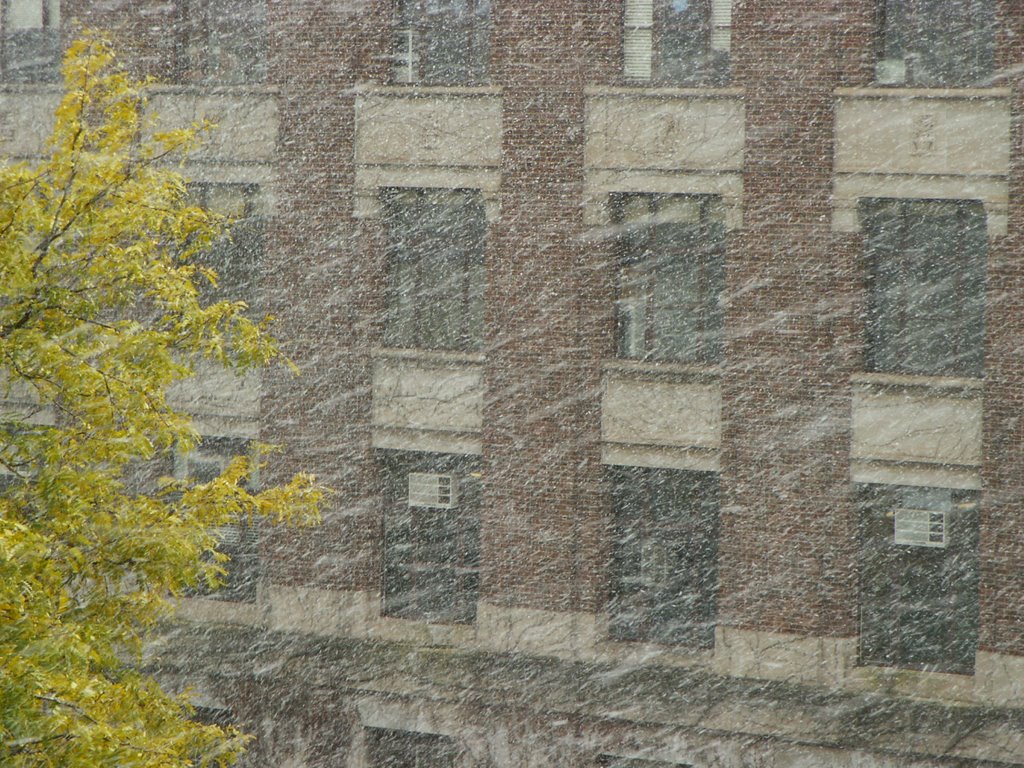
Snow Falling on UM

So, there was recently a small flurry of white stuff falling on campus. Like what fell last night, this did not stick. But is this the start of the winter? (Answer: of course it is, you dope! Autumn is the doorstep into winter; the START of winter, if you will.)

Snow on the ground.

Okay, so there wasn't a lot of snow that stayed on the ground by the time I got to the bus stop at 9:20 this morning. However, there is likely to be more tonight.

Currently, the temperature is a nice (!) 37F, but - with the wind - apparently feels like 25F. With the sun out, I think that this weather is really NICE! Ahh... Autumn - the hopefully-slow decline into winter.

I noticed one thing while waiting for the bus this morning: people do really odd things while driving in their cars. I know that this is something that shouldn't be too difficult for me to realize, but it just struck me as odd. There was one person driving with one hand, while shading her eyes with the other, driving along at 40mph, apparently mostly blinded by the sunlight reflecting off the slick road. Another person was blithely (blindly) driving along at a similar clip while applying lip gloss while looking into the rearview mirror. (Apparently, she felt that looking intently into the mirror would save her from the blinding rising sun while driving eastward.

Well, enough of that for now. I expect to have more snow photos tomorrow (I might actually post them as well).
Saturday, October 07, 2006

SNRE Campfire

The 2006 SNRE Campfire went off without too much of a hitch. Things got to a slightly late start, but there was a well-attended water relay race, followed by 16 cross-cut saw teams. Because Burt didn't do his schpiel this year, Jim put together a presentation. I felt that it was a good first try, but needs a few more iterations before reaching perfection.

I was surprised that no one other than me decided to actually feed the fire (after all, this was SUPPOSED to be a campfire event). Still, in the end, it was "all good". The hotdogs were plentiful. The desserts were tasty. The company was all good. And photos were taken...
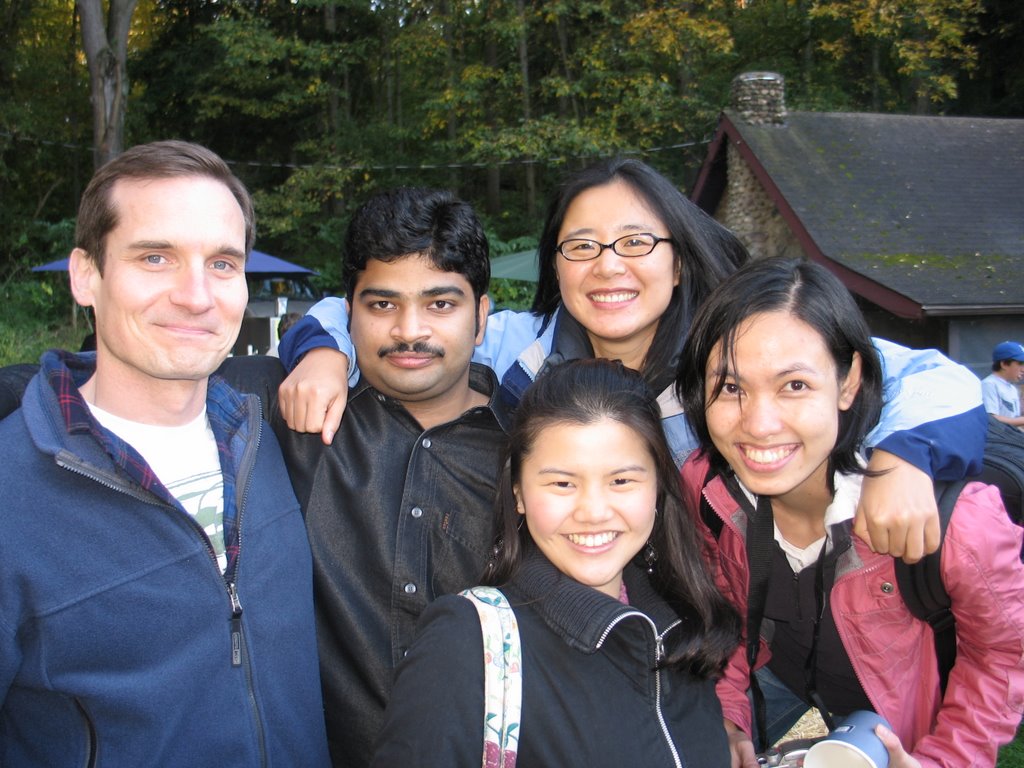
Josh, Jay, Oracha, Yuka, and Tong

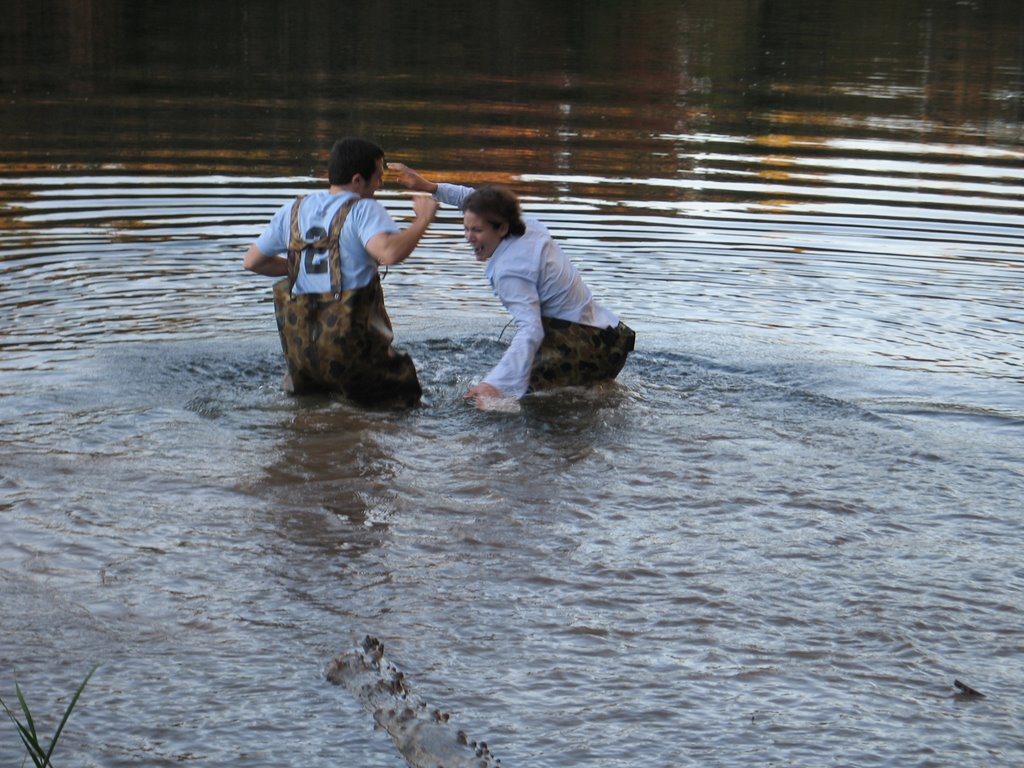
Hans fights off Sara's attempts of scuttling his waders.

Damon and Solomon attempt to beat their previous cross-cut sawing time. However, they only barely managed to beat 2 minutes. (The winning time was 1:05.) Sarah sits on the log, staring blankly into space (seemingly oblivious to the rusty saw tearing through wood not even a foot away).

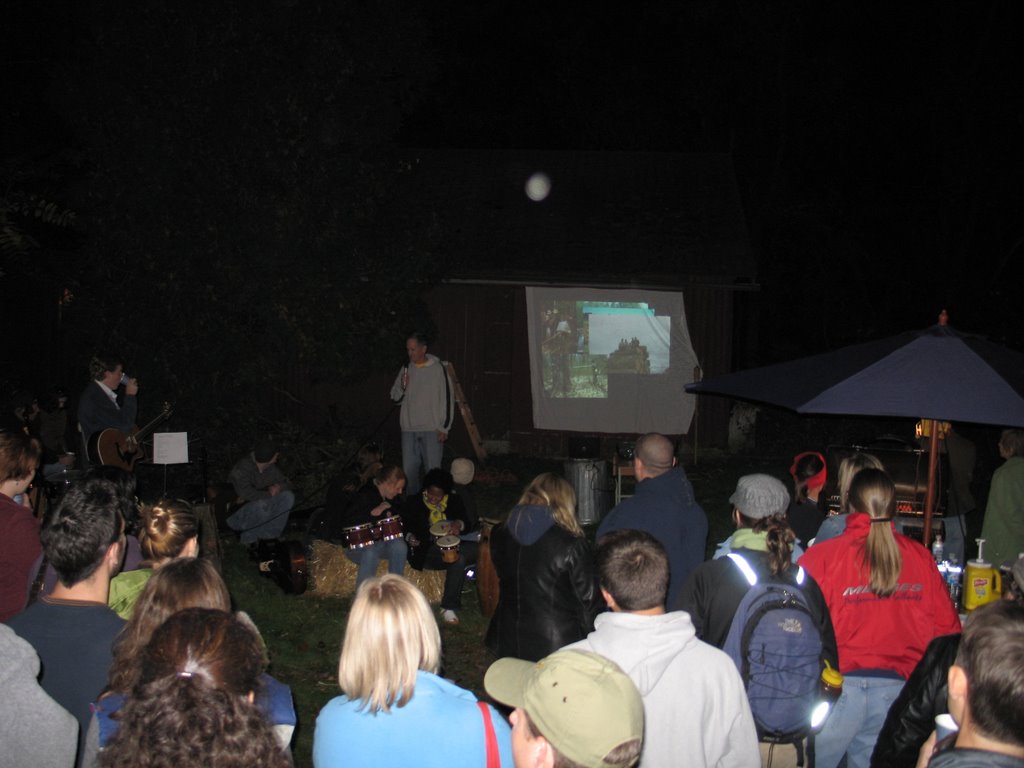
Jim gives a (humorous) presentation of the SNRE experience.
Dan, Tom, Jennifer, and Sarah "serenade" the crowd with guitar, drum kit, cello, and bongo.

Wednesday, September 27, 2006

Tired.

Late September winds and rain are making me tired. Or maybe it's my lack of food (and lots of coffee) creating a physiological imbalance leading to fatigue.

Autumn-time,
And the weather is breezy.
Leaves are blowing,
And the skys are grey.

Your's truly's tired,
And he wants to sleep.
So hurry up Mr. Clock,
Read 5 P.M.

Okay, so more bad lyic translations (apologies to the original Summertime lyrics), but that's what my head is currently spewing out.

On a side note, check THIS LINK out if you have time. It's an interesting call out on YouTube for people to speak a list of words in their own (presumably local) accent. Some are funny, but I would say that the word list doesn't do a good enough job of exploring the differences in accent. Still, the idea got a lot of apparent interest, and several responses. (I think it's interesting that there seemed to be a not insignificant number of East Asian descent respondants - all living in different places in the world.) One interesting meta-comedic (I think this is the correct word I'm tryign to use) response was an East Asian doing an FOB-like response.

Monday, September 25, 2006

Farewell Bernhard

Bernhard: have a great vacation and hope your work goes well. Sabrina and I will have to visit you von Zeit zu Zeit.

Sabrina, Bernie and Dan (looking much like stage crew members) at the very end of the night.

Mark (sitting), David, me and Bernie. (The flash was too bright.)

Sunday, September 17, 2006

Tao's new motobike (with sidecar)

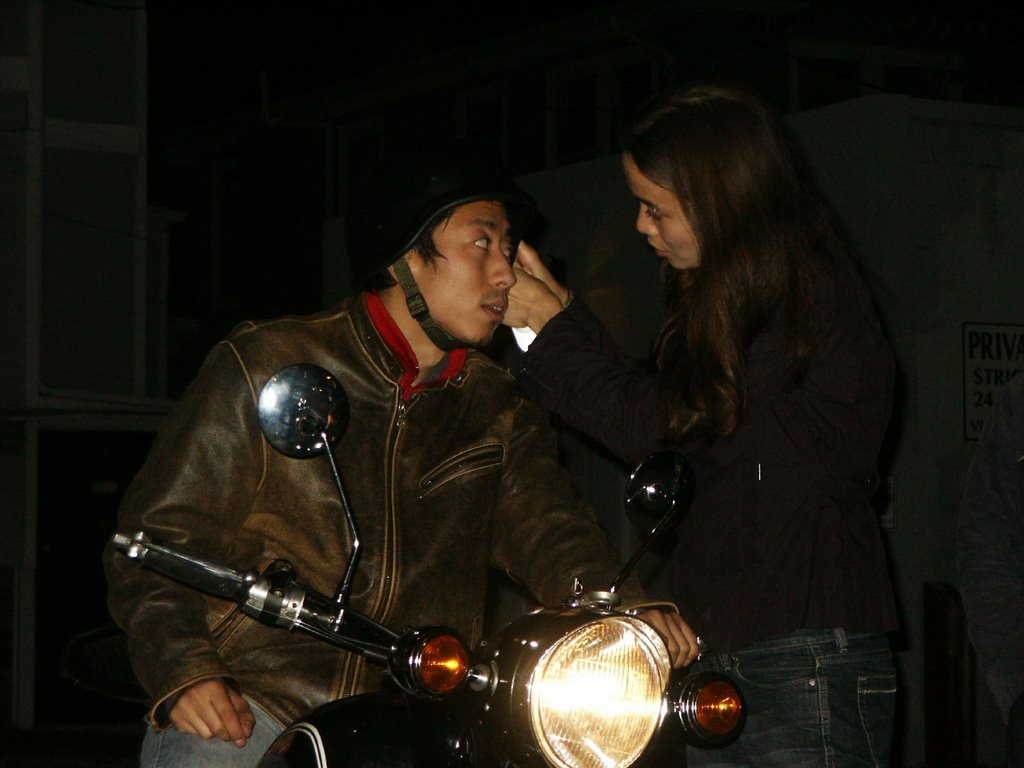
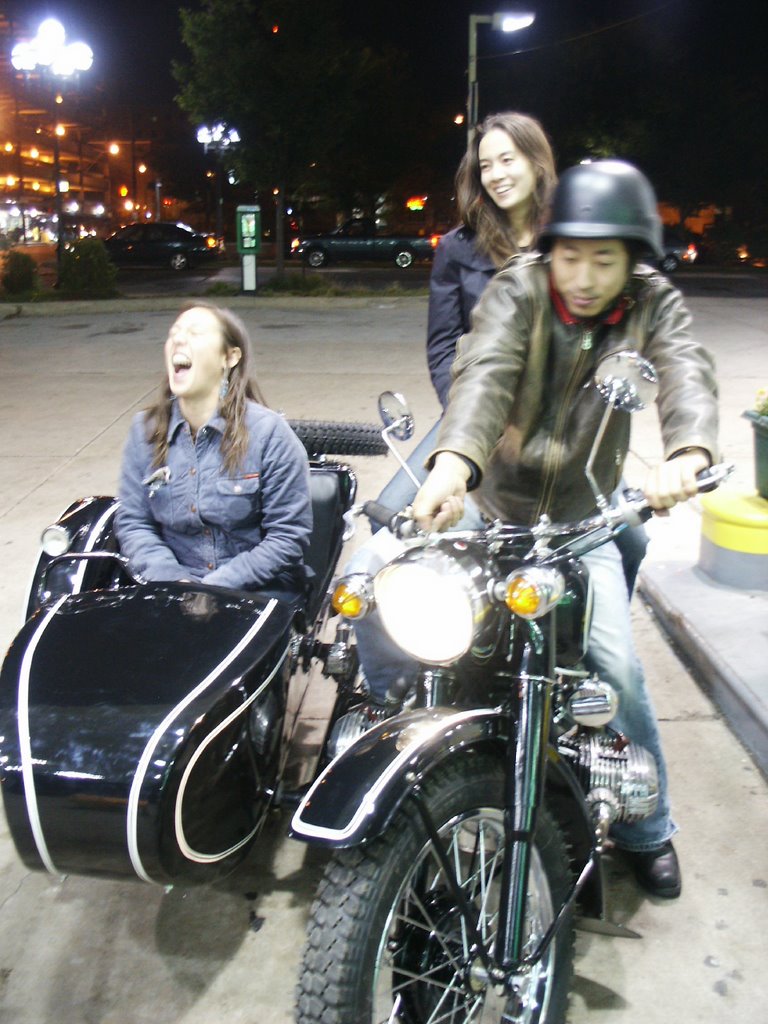
Tao got a motorbike (with sidecar) from the Chinese Army. Apparently, it was never really used from the time it was built in the mid-1960s. The bike (with sidecar) is based on a Soviet design, which was (itself) based on a BMW design from the 1930s. Last night, we all got a short ride in the side car (or on the rider seat) for a turn around town.

K takes time to ensure that Tao's noggin stays put.

Terry and K await the return from the gas station fuel tank fill-up trip.

Terry, K, and I have just run over Dan! Oh, no, Terry, keep your eyes on the road!

Tao gives a lift to Emily and Jen.

Saturday, September 16, 2006

Toledo Speedway evening.

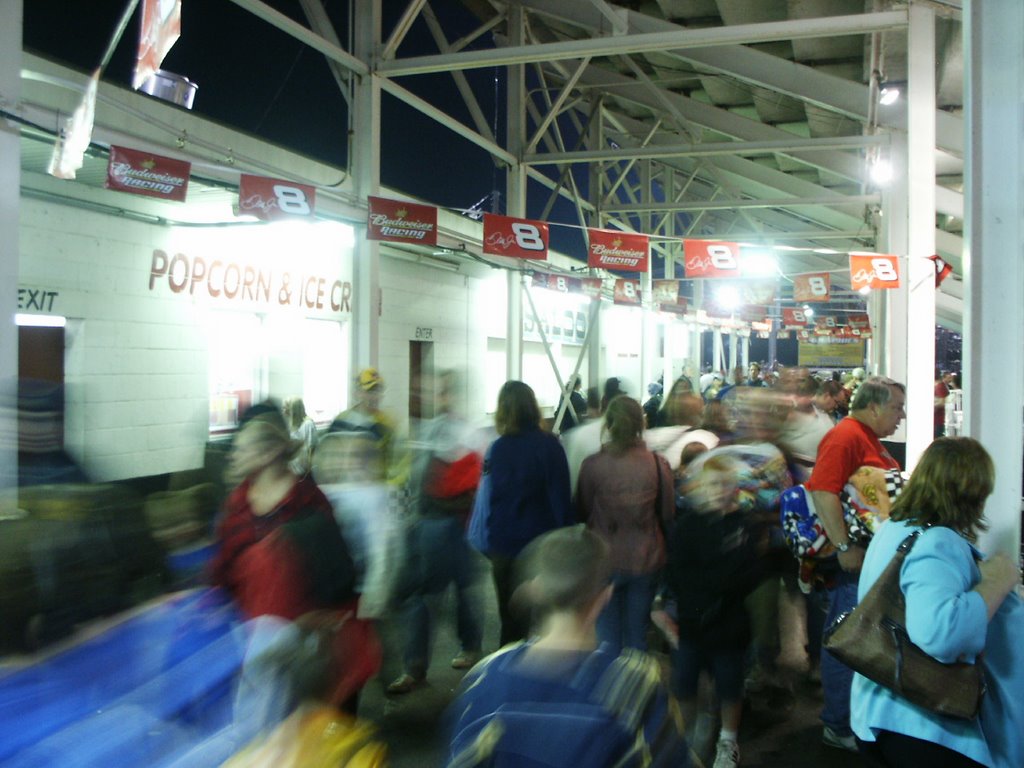
On Friday, I went with Terry and Dan to the Toledo Speedway to watch several "Figure 8" races. While not a Demolition Derby, per se, the various cars, cars-with-trailers, and school buses were likely never to be raced/used after that night. Therefore, demolition was always a factor hanging in the air. One point from that evening that I realized before even getting there was how out of place I would be; that I would be about as invisible as the full moon on a clear night in the open prairie. I was right. Admittedly, I could have taken some trouble in making myself a little less conspicuous by taking off my hip-worn camera bag, wearing a ball cap, and putting on a different t-shirt (say, a Michigan one). I didn't care to do so. Well, it meant that there was always a little bit of a shock that I would be there - talking with the people as if nothing was amiss (the look on the face of the girl working at concessions was priceless - I wish I had my camera available).

I would have taken more photos of the race action, but for two problems:

1. There was a large fence blocking access to the speedway proper (which is a good thing, in case a large piece of vehicle were to be propelled in the general direction of the stands) that reflected all the light from the flash, making photography difficult, and

2. There was a very nice, but very persuasive police man making sure that no one got close to the afore-mentioned barrier, especially during the course of a race.

So with those two caveats known, please accept my paltry slection of photographs, taken during periods of a race that involved a brief pause:

Large construction vehicles removed buses too battered to continue further in the race.


The "Chris, will you marry me?" bus wins the final race of the evening! (We all later discussed the point that it would likely be all downhill for the racer from this evening.)
The motor-madness crowds all try to find their way out of the Speedway, all at once. We decided to go to the Speedway's bar (yes, the motor speedway has a place for you to drink before driving home) in order to try and wait out the mass exodus of cars before returning to hippy-dippy Ann Arbor.

Thursday, September 14, 2006

No rain.

No rain today, and little indication of rain in the near future, however, gray skies go on and on:

Gray Skies (apologies to Irving Berlin)
I was happy, just as happy as I could be
Ev'ry day was a sunny day for me
Then good luck went a-charging out my door
Skies were clear but they're not clear anymore

Gray skies
Crying on me
Nothing but gray skies
Do I see

Corvids
Cawing a song
Nothing but corvids
All day long

Never saw the clouds building up high
Never saw things going good-bye
Noticing the days hurrying by
When you're all gray, my how they fly

Gray skies.
Sunshine is gone.
Nothing but gray skies.
From now on!

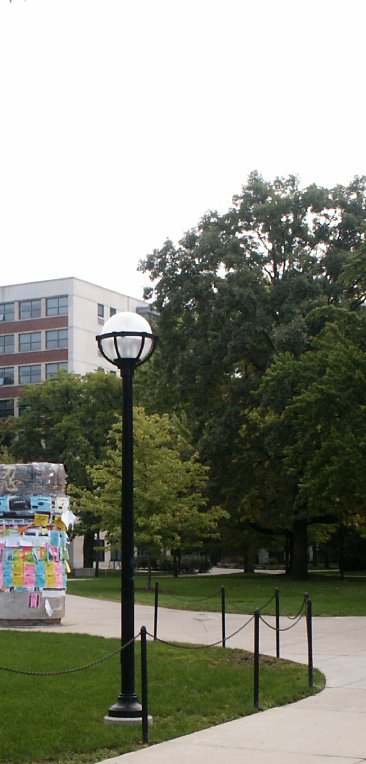
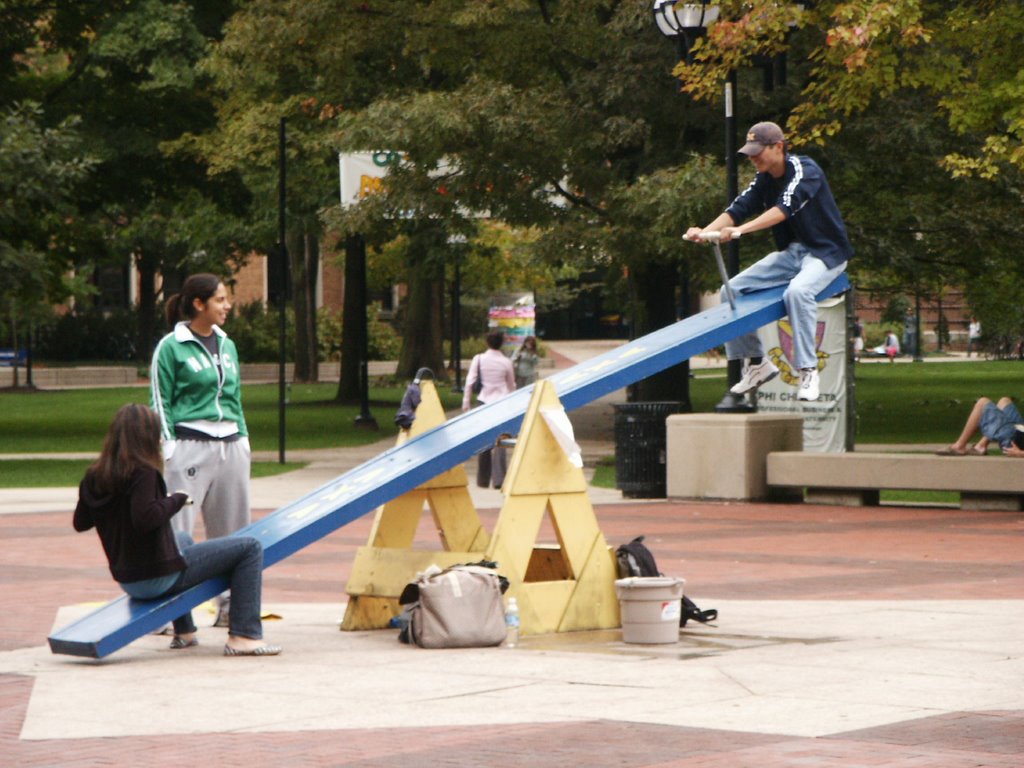
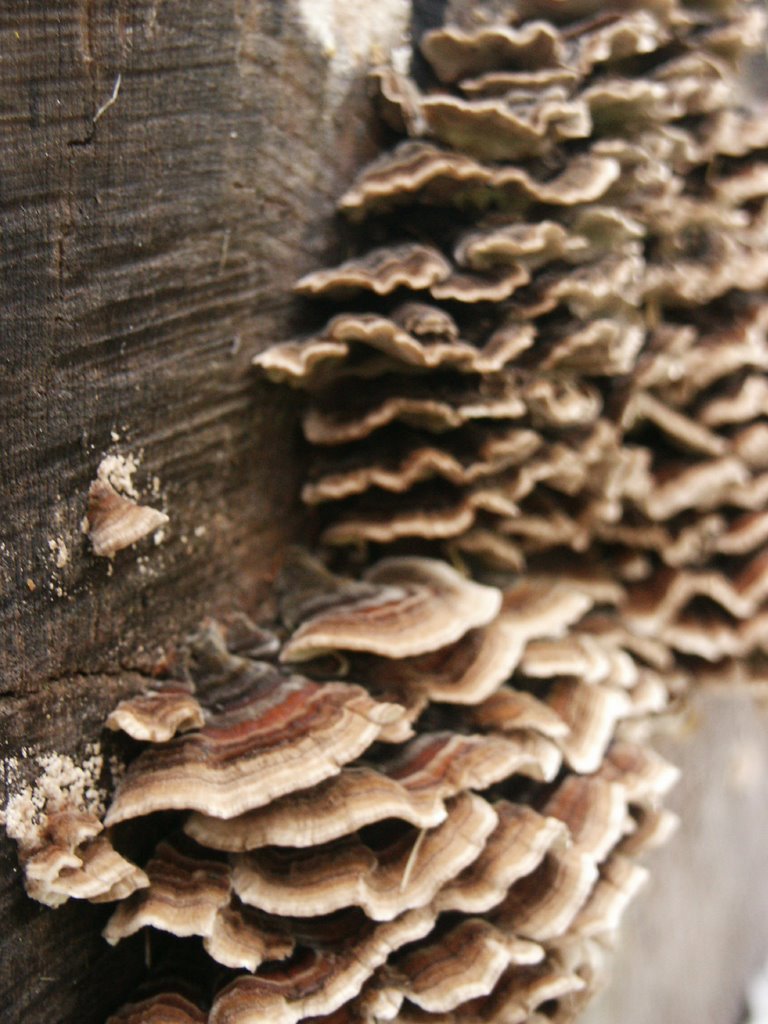
Anyway, there were a few students this morning playing on a large see-saw, raising money for charity. Also, I saw some fungi growing on the side of some railroad ties that used to form the platform base of an outdoor art installation (see below)

There was more rain yesterday than I thought!

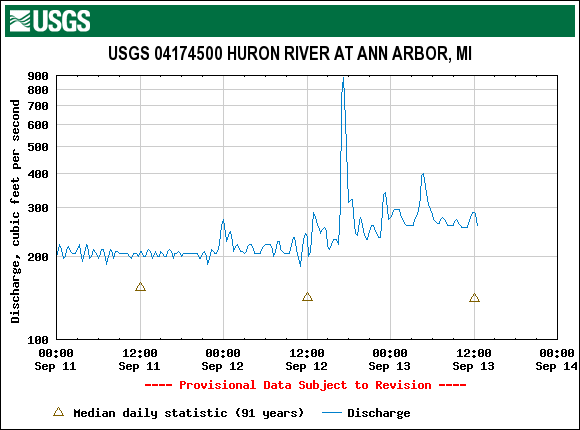
OMG! It actually got up to 2,500 cfs! More than double my prediction! Look at that response time, and then look at that quick flushing of the system. (Perhaps we had some overnight rain that caused the rise in the morning, or perhaps there was a dam release at Argo...) Hmm....

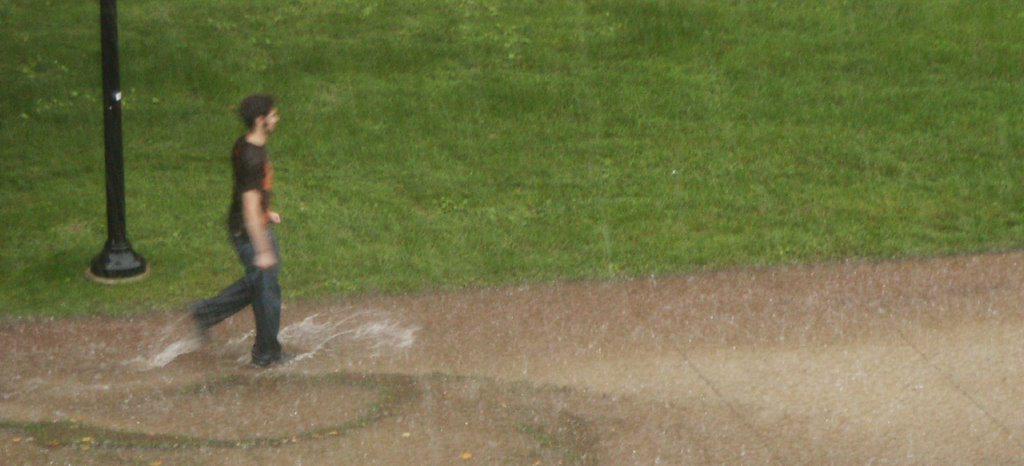
Anyway, so I promised to have some photos of people walking through the torrential downpour. Obviously, these people were rather more optimistic than I was first thing in the morning (or else, they had their umbrellas stolen at some point during the day. (Unlikely, though, since I have been seeing people each day that it has rained (the past two days, as you can see in the graph) have not carried umbrellas. (As a side note, I have a feeling that today will have some rain, too, but I have not seen students wearing raincoats or carrying umbrellas... Not to be overly-critical, but sometimes you have to wonder if peopl really have a deep-seated desire to become completely drenched.) If you want to see a short video of how bad the backwater gets, check it out here.

Wednesday, September 13, 2006

Lots of frickin rain!

Lots of rain right now. I expect there to be a very quick response in the Huron River today (considering how much of a leap happened yesterday when there seemed to far less rain). If you look at the below graph of river discharge in the Huron River at Ann Arbor, you can see that over the course of a few hours of heavy"-ish" rain, there was a four-fold increase in discharge (unfortunately, I don't have the rain gage data for yesterday). I would expect that today's rain will create a discharge of over 1000 cfs (9 times greater than the median discharge of the day - of course, I do understand that a single day's anomalous weather has little impact on the median value of a series, but it is still amazing! For this reason, this calls for some expletive! OMG!!!
Also, there will be photos of people running through the rain, and (if I can figure out how to put up some short video) a clip of people trying to wade through or pursuing a futile effort to walk around a large puddle that blocks the entire pavement. (It always causes a problem when there is a lot of rain, and becomes downright deadly when the weather turns cold enough to freeze puddles into a vast plain of slippery death.)

Friday, September 08, 2006

First social event

The first social event of AY06/07 got off to a decent start last night with many people showing up at Burns Park for some keg goodness. There were many bike-riders there, indicating where the SNERDs were (as opposed to the hundreds of other people at the Park). I dont' know how many people were there, but it seemed like about 70 people showed up (at at $3 per person, that was more than enough for covering the keg). Luckily, the weather held up quite nicely, and people played frisbee, walked dogs, and stood around bs-ing around the keg (most of the people fell in the last category). Thanks to Lekha for letting me use her Nalgene for some beer (since I didn't bring a cup, nor did I want to use one of the few cups provided for people such as myself). After the keg, we went to The Grizz for some food and (some of us) more beer. Unfortulately, some of us (Neil) forgot their ID, and so could not get any Grizzly Peak goodness. Ah, well.

Friday, September 01, 2006

Biostation Orientation was fun.

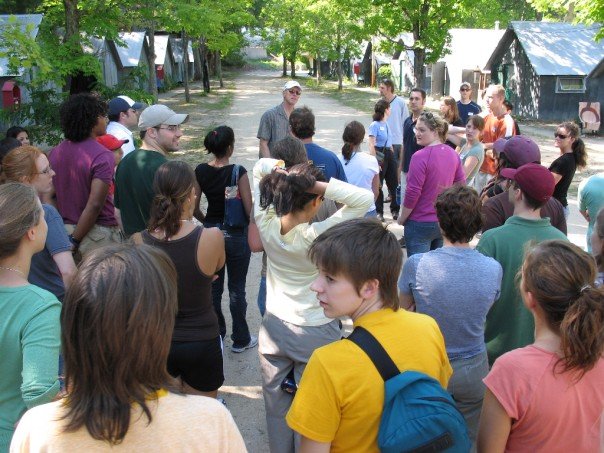
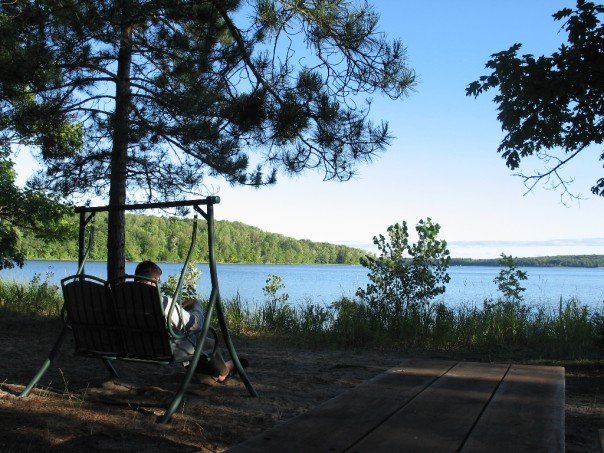
The UMBS Orientation was quite fun. Many from the incoming class attended, and I think they all had a really good time. So, now you get to see some photos of the UMBS during the late summer (there were no blackflies this year, so that was nice).


Thursday, August 31, 2006

How did you get here? Help me figure this one out.

It appears that I'm getting a lot of traffic to this page (I'm writing this on Jan 11, 2010), but I can't figure out why. Could you please leave a comment below indicating what search brought you here? It's really a puzzle to me.

Cheers.

Monday, August 28, 2006

SNRE Orientation

Leaving tomorrow to help with the SNRE Orientation. Happily, the Biostation has been reinstated as the destination, and (happily) I've been asked to help out again. Strangely, I find myself the "old hand" for going up to the Biostation, as the staff going up are newer than my stay with SNRE. (Maybe this is Fate's way of making me realize that I must accept the nice little cardigan she has already knitted for me.) Anyway, look for photos from that here (or other places where I post these things).

I really hope that people actually read the e-mails that Karen sent out vis-a-vis what to bring/not to bring. It always seemed that there were a number of people who got to the Biostation and thought, "Holy CR@P!!! This is not what I expected from my concept of Michigan!" (Since many people seem to equate Michigan with the auto industry; Robocop; or Eight Mile. All of which are actually just "Detroit" which is the same as equating Japan exclusively with Tokyo; California exclusively with LA; New York exclusively with NYC; you get the idea.)

As Michigan's tourism board is trying to get people to realize: Michigan is much, much more than Detroit. Okay, I don't know why I generally end up with a rant when writing in my blog, but maybe it's not such a BAD thing... (Or maybe I just am settling down from drinking up a large cuppa joe.) Writing about such banal things in a blog makes me think about a specific Girls with Slingshots webcomic. (It's not mine to distribute, so just click on the link and find it - and many other funny strips.)

Writing about webcomics, I am further reminded of what reminds me of my current daily grind of modeling. (Thank you PHD comics.) This comic and this comic also remind me of what I sometimes find myself doing (thanks to Commissioned Comic). Okay, enough with the procrastination from work... Back to modeling in [Awww...] HEC[k]-RAS.

Friday, August 18, 2006

Siddartha Gautama ≠ Hotei


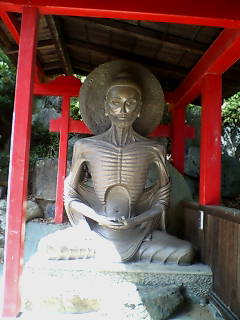
On the left is a picture depicting the Buddha, Siddartha Gautama, during his time of fasting. As you can imagine, the depiction of an emaciated spiritual leader would not have had as much of a "draw" to potential supplicants who habitually suffer from starvation, and may be looking for a benevolent spiritual savior. Still, if you want to learn more about the history of Siddhattha Gotama (aka Buddha), then I would suggest that you check out Osamu Tezuka's 8-part graphic novel of the Buddha's life.

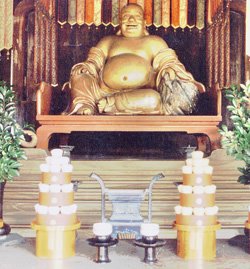
It is just a little pet peeve of mine that people in the US and Europe all associate the Buddha (Siddhartha Gautama) with the recharacterization of the Chinese Bo Dai Luohan/Shinto god Hotei (shown on the right), which - except for tertiary characteristics - are not very similar at all.

To many Americans (and possibly Westerners in general), there is little to no understanding of who the Buddha was, to such an extent that many equate a Chinese Taoism-derived deity with an historical person from northern India. To put this in analogous terms, this would be like saying that the Christian God (the Father, as depicted famously on the ceiling of the Sistine Chapel) was interchangeable with the Greek god Zeus.

Admittedly, the depiction of God in the Sistine Chapel is based on a Classical patriarchal figure, most commonly characterized by Zeus, however, most people would be able to say that the old man painted on the ceiling of the Sistine Chapel is not Zeus.

To complicate things just a little, though, in East Asian Buddhism (i.e., in China and Japan), many Taoism-derived deities, including Hotei, were folded into the Buddhism of those regions as Bodhisattvas. However Bodhisattvas are not the same as the Buddha, and Hotei was and remains a completely separate individual from the Siddhartha Gautama. This really shouldn't be too difficult to understand, especially given the ways in which characters found in Western mythos are derived from different roots. Good examples are the names of the archangels (whose names and features were derived from Babylonian mythos) and the Norse mythology, which is an amalgamation of two different Germanic pantheons, named the Aesir (with the famous gods Thor, Odin, and Baldr) and Vanir (with the less-famous gods Freyr and Freya).

But all you have to do is just look at the statues depicting the Buddha, Siddhartha Gautama, with one deity-cum-Bodhisatttva (Hotei). They are different entities.

Rant over.