Tuesday, December 01, 2009

Why don't Conservatives want to conserve?

I read this over at Andrew Sullivan's Daily Dish:

I have never understood why it is conservative to take an attitude toward the natural world of how best to exploit and use it entirely for short term benefit. (My first ever publication was a paper for Thatcher called "Greening The Tories"). The conservative, it seems to me, will not be averse to using the planet to improve our lot, and will not be hostile to the forces of capitalism and self-interest that have generated such amazing wealth and abundance in the last three hundred years.
But a conservative will surely also want to be sure that he conserves this inheritance, for its own sake and also for his future use. He will want to husband the natural world, not rape it and throw it away. He will see the abandonment of all values to that of immediate gratification as a form of insanity, if not evil.
I found this interesting for several reasons because I had a discussion with a South Korean labmate about what is "conservation" as an idea (i.e., something different than "enviornmentalism" or "preservationism"). Andrew's connection between political conservativism and conservation of natural resources seems non-relatable, at least in the modern era.

The current Michigan Department of Natural Resources (MDNR) used to be called the Michigan Department of Conservation (MDC). What was it that they were trying to conserve? Trees, rivers, and natural places? Ummm.... Not so much. More like they were in charge of conserving the ability to continue to hunt (deer and fowl) and fish. In conserving these abilities, one had to maintain natural areas, however, it was in the end done to maintain human use of these places.

The more modern environmental movement - in contrast - sought to remove humans from nature and repair the damage caused by them. In some way, the environmental movement became aligned with the left-wing social movements of the time, and that political relationship has continued (in some manner) to today. Over the years, though, environmental science (especially ecology) has changed from one that excluded human activity to slowly incorporating the impacts that humans have caused and can cause, slowly moving itself from a viewpoint more in-line with environmentalism to one that is (now, from my point-of-view) somewhere between an understanding that there are human uses (more like conservation) and a desire to remove humans from nature (more like environmentalism).

Alongside this shifting in the science, as well as the continued political ties of environmental groups to the political left, has come - in fits and starts - an understanding of some conservation groups to side with environmental groups in calling for more protections on existing areas of low human impact (i.e., "natural places"). National conservation organizations - like Ducks Unlimited and Trout Unlimited - have come to understand that climate change and diminished habitat would have future consequences on hunting and fishing activities that so many of their members liked to pursue. Similarly, these groups didn't have any strong allegiance to the political right, even though hunter groups may have had more political alliances to the right due to association with the NRA (although this is speculative).

Moving against climate change legislation, however, made good political sense at the time for "national security" reasons (national coal is less dangerous than foreign oil), "economic" reasons (subsidized coal is cheaper than non-subsidized wind or solar), "job security" reasons (coal companies hire many people that would "suddenly" become unemployed if coal had to become ramped down), "nationalist" reasons (the UN and the IPCC isn't going to run our country), "anti-tax" reasons (cap-and-trade being called "cap-and-tax"), etc. It tied into anti-governmental-regulation (i.e., "mommy-state") sentiments that were supported by many right-wing groups at the time. Such a stance could be used to link anti-climate-change stances to being against abortion, gun control, taxes, and "big government" generally speaking. However, it moved, as Andrew stated, against some of the core values of what "conservation" stands for.

It moved against the idea of conserving that very thing that is most dear to us: our world. It is from that world that we receive everything from which we can build our lives and society. We derive not only food, water, clean air, and shelter from the world, but we also derive social and personal identity from it as well. These are the fundamental things that are necessary for success in life -- those things from which we can build the self-made man. Working against those things means that one is undercutting future generations' ability to make the most of themselves. These are values that Andrew lists:
These are deeply conservative instincts, humble in the face of nature, conscious of the need to preserve for the future, aware of the limits of exploitation. These conservatives aren't utopian tree-huggers. They do not worship Gaia or see no give and take with the natural world. They believe in the harvest but also in the need for fallow years and for care and husbandry of animals and plants and environments. And they love their home for its specificity and its beauty, and do not want to see its stability and future gambled away on the casino of greed.
I would argue that for the same reasons, conservatives should be in favor of public transportation, and there have been a few articles over at treehugger.com that also support this feeling. One particularly good one (in my opinion) was on November 16, 2009, showing a short film about the new book Moving Minds: Conservatives and Public Transportation by William Lind. In another example of how public transportation might actually align with conservative values was written on April 29, 2009, and it quotes extensively from Andrew's posts on the same topic at around the same time.

So... what's up with conservatives and conservative values? Especially when it comes to those things that conservatives should be lining up in support of? Is it that they are opposed to them because of propaganda from sources that they -- for one reason or another -- trust? If so, then when propaganda finally clashes with reality, there could be problems ahead. Chinua Achebe wrote - somewhere in Things Fall Apart - "The truth that is a lie is harder to accept than the lie that is the truth" (or something like that, I can't find it anywhere in internet searches).  However, I think this is where that ironic statement "reality has a well-known liberal bias" rings true: that for whatever reason, the justifications of conservatives against conservation for propaganda "conservative truths" will eventually have to deal with a reality that shows "liberal bias."

Why denialism is pernicious

This past weekend, while I was in Scottsdale, AZ, I was able to take some time off and thinking about stuff that I had been mulling over prior to getting to AZ. Most of this stuff has been about the role of science in directing policy-making. However, I realized something: that is wrong with the my thinking about this sort of thing. The thing that was wrong was the impact that out-and-out denialism of scientists and the institutions of science as well. Where did this come from? How did it arise? Why is it effective, and how effective is it? Can/has science denialism affect science-based policy implementation?

Surely part of this comes from a misunderstanding of the nature of what science is. That science has been conflated with some sort of religion has made it into a practice that has been attacked on it's religious grounds - with people saying that since science is a religion, one form or other of it cannot be supported by the state; the separation of church and state argument.

However, even if people don't equate science with religion writ large, the misunderstanding still has had the problem of drawing false equivalences. From the definition of "materialism" to the definition of "theory, law, and hypothesis", and the implication of falsifiability vs. provability, many definitions of terms used among scientists and members of society hold different meanings and implications. Still, the meanings of words matter to understanding, and if people can turn meaning on its head or against its original use, the perceptions done by others of it would be problematic at the minimum and cynical at the maximum.  ... and yet the misinterpretations between scientific and social understanding continues to be expanded, maintained, and [falsely] argued.

Another part of this denialist reaction likely comes from mistrust of scientists. In my mind, some of this mistrust comes from unethical activities that have been publicized in the media. However, why do people just assume that if geneticist Hwan Woo Suk was unethical, all geneticists are unethical? Is it because the work he fabricated results for was related to a series of topics that many people find problematic - stem-cells and (through them) cloning? It's as if the pillorying of this scientist was done because it fit a previously determined narrative in which people who do stem-cell research are unethical, and once one is found, that only proves (falsely) the narrative correct. The same sort of hew-and-cry with the recent "climategate" that erupted with the leaking of e-mails between climate scientists: there is some evidence of climate scientists were trying to hide something, which fits into the theory of some global conspiracy of climate scientists trying to get everyone to emit less carbon (for some strange reason).

Still, if people are mistrusting scientists, using these justifications to deny the science, what are the implications? Well, due to the nature of science -- that it describes and investigates the causes and effects of physical phenomena -- ignoring the results of scientific studies carries implications. Denying the existence of climate change due to a few e-mails is unlike denying the existence of the Easter Bunny due to a classmate saying he doesn't exist are two very different beasts. On the one hand, there is no evidence of the presence or absence of an Easter Bunny, or even the physical, measurable impacts of no Easter Bunny. (In fact, there are many parts of the world in which the Easter Bunny doesn't even exist, or has existed.) However, there are predicted and predicable impacts to natural systems that would come out of a changed climate. These predictable impacts have (slightly less) predictable impacts on biology and (even less) predictable impacts on human society. Would it make sense to act on the possible presence or absence of climate change? Without any evidence, sure. With evidence of only the physical impacts, possibly. With evidence of the physical and biological impacts, quite possibly a good idea. With evidence of the physical, biological, and social impacts, most definitely yes.

And yet... people work at trying to keep the status quo alive and well. People with invested interests. It hurts when your truth gets overturned. It hurt the Catholic Church when Galileo showed that the evidence pointed toward the Earth not being in the center of the Creation. Similarly, it will likely hurt those invested in carbon-based fuels if climate change action is taken, and it is the same in other endeavors, too. Those that have a lot to lose also probably have a lot of incentive to maintain their point of view, and are likely to make efforts to keep their version of reality the only one that is forwarded. Thus, we see lobbying efforts by coal companies against climate change legislation; tobacco companies against tobacco legislation; and health care insurance companies against health insurance legislation.

End result: denialism has consequences on social association with science, with the type of science being done, and with the policy reactions to the scientific (and non-scientific rational) findings that go against certain invested "truths." Eventually, the truth will out. Hopefully, though, it isn't after preventative action can be taken.

Tuesday, November 24, 2009

Responses to 'climategate'

I like to read many different blogs and the recent hacker-released e-mails to and from scientists at East Anglia University has been causing a small furor over the blogs that I read. Termed "Climategate" (although I prefer "Climate-denialistgate"), the basic background is that last Friday (November 20, 2009), a bunch of hacked e-mails were dumped on the Interwebs and Climate Change (CC) denialists started crowing that this proved that CC is a sham, a fraud, a conspiracy of epic proportions.

Since that time, I've been curious as to the responses to these crowing claims of the end-of-CC-science. I've compiled a few of the ones that I particularly liked, below:

From Aguanomics, Dave Zetland makes an interesting economic argument:
Someone asked my opinion on the theft and revelation of data and emails related to climate change research. From my brief readings, it appears that some academics were blocking the views (preventing publication) of others they disagreed with, as well as -- perhaps deleting "inconvenient" data.

Since the blocked people were climate change skeptics (not anti-deconstructivist poets), this is a big deal for NON-academics.

My opinion is that this kind of sabotage, censorship, backstabbing and favoritism occurs all the time (just look at the editors of a journal and how many of their students and colleagues publish there...)

My opinion is that this is going to give WAY too much impetus to the "climate change is not happening" crowd.

And, you may ask, how can I trust the CC scientists, now that they are revealed to be "typical" humans? Because the gains (in career, fame, money, etc.) to ANYONE able to show that climate change is NOT happening, is all a hoax, etc. are extreme. With that kind of reward on the table (from Exxon?), anyone with a plausible analysis showing that it's not happening would be a rockstar.

But there isn't anyone, because climate change IS happening.

That line at the beginning -- Since the blocked people were climate change skeptics (not anti-deconstructivist poets), this is a big deal for NON-academics -- is great. So true. Looking at the comments that accompany many of the posts, this is so blatantly obvious (except apparently to the non-academic denialists). However, no one really can state the blindingly obvious of anything and everything statistical as Nate Silver over at FiveThirtyEight:
It's the global warming scandal of the century, says Michelle Malkin!

The exposure of the warmist conspiracy, says Andrew Bolt!

The final nail in the coffin of anthropogenic global warming, bleats James Delingpole!

A stunning tour de force -- four stars, says Leonard Maltin!

OK, so that last quote is made up. But the others aren't. What is it these conservatives are so excited about?

Apparently, the networks of University of East Anglia's Climate Research Unit were hacked into last night. Approximately 160 megabytes of files, containing hundreds or thousands of e-mails and documents were leaked as a result of the security breach, reports The Guardian.


...
... Jones is talking to his colleagues about making a prettier picture out of his data, and not about manipulating the data itself. Again, I'm not trying to excuse what he did -- we make a lot of charts here and 538 and make every effort to ensure that they fairly and accurately reflect the underlying data (in addition to being aesthetically appealing.) I wish everybody would abide by that standard.

Still: I don't know how you get from some scientist having sexed up a graph in East Anglia ten years ago to The Final Nail In The Coffin of Anthropogenic Global Warming. Anyone who comes to that connection has more screws loose than the Space Shuttle Challenger. And yet that's literally what some of these bloggers are saying!


Perhaps, though, a farce can truly be called "ripened" once it gets to the point of parody. And via Climate Progress, there is a link to the Carbon Fixated blog's parody response to this whole "conspiracy":

If you own any shares in companies that produce reflecting telescopes, use differential and integral calculus, or rely on the laws of motion, I should start dumping them NOW. The conspiracy behind the calculus myth has been suddenly, brutally and quite deliciously exposed after volumes of Newton’s private correspondence were compiled and published.

When you read some of these letters, you realise just why Newton and his collaborators might have preferred to keep them confidential. This scandal could well be the biggest in Renaissance science. These alleged letters – supposedly exchanged by some of the most prominent scientists behind really hard math lessons – suggest:

Conspiracy, collusion in covering up the truth, manipulation of data, private admissions of flaws in their public claims and much more.

But perhaps the most damaging revelations are those concerning the way these math nerd scientists may variously have manipulated or suppressed evidence to support their cause.
However, I like what most of the bloggers say: that scientists are human, and it shouldn't be surprising that some of them act ... human. However, being and acting along the foibles of humanity doesn't change the underlying testable veracity of CC science. I think Megan McArdle made a good comment in her blog on The Atlantic:
Scientists are human beings.  They react to pressure to "clean up" their graphs and data for publication, and they gang up on other people who they dislike.  Sometimes they're right--there's a "conspiracy" to keep people who believe in N-rays from publishing in physics journals, but that's a good thing.  But sometimes they're wrong, and a powerful figure or group of people can block progress in science.

...

That doesn't mean their paradigm is wrong; rather, it means we need to be less romantic about the practice of science.  No scientific consensus is ever as powerful as its proponents claim, because no scientists are ever as perfect as we'd like to imagine.

The more ardent defenders of the emailers are glossing over the fact that in some cases, they really seem to have behaved quite badly, and with less-than-stellar scientific integrity.  But I have yet to see the makings of a grand conspiracy, rather than the petty bullying of the powerful over the weak, the insider of the outsider.  I'll take the statements of this particular group of scientists with a little more salt in the future.  But as far as I can tell, the weight of the evidence--and what we know about the history of the planet, and carbon dioxide--still seems to be on their side.
That's true: the science has the weight of the evidence, regardless of how much of an asshole one (or more) scientist may be. The paradigm isn't wrong just because of the possibly petty feelings of one scientist. Indeed, if anyone of the denialists were to consider how Kuhn proposed how paradigms get overturned, the denialists need to provide a better theory than the current one (thus the reason why the particle theory of light, the ether, and hollow earth theory all took a long time to die out, even though more and more evidence mounted against them).

Sunday, November 22, 2009

What would the Earth look like with rings similar to that of Saturn?

Ahh, the wonders of the imaginative combination of astronomy, astrophysics, some mathematics, and Photoshop:

Working in public increases my productivity

I don't know why I get more work done when I'm in a coffee shop. Maybe it's because the idea of sitting in the coffee shop and playing online makes me guilty that I don't do it, thus improving my productivity. Maybe it's the idea that the people around me are judging my progress depending on what they see on my screen, thus improving my productivity. Maybe it's the relatively slow Internet connection (caused by over a dozen other people using a common-pool resource) that limits my surfing of the Web to necessary items, thus increasing my productivity. Maybe it's the fact that I am paranoid and don't want to leave my computer alone on a table to do other things like talk to other people, go to the toilet, go outside to take a breather, thus improving my productivity.

I know it's not due to the expensive coffee ($2.10 for 20oz/$1.60 for a refill compared to ~$1.00 for roughly 60oz of home-brewed coffee) and some sort of economic rationality of not wanting to waste my time. I know that it's not due to the time of day or the weather outside, from which a retreat into a cozy coffee shop is welcome relief. I know it's not that I schlepped my computer 4 miles from my house to downtown, either, since I don't easily get work done in areas other than cafes to which I bring my computer.

Okay, so, yes, I AM taking a break from work to write this. But in actuality, it is a break after about two hours of work -- the most productive two hours that I've had in several months. ... and I'm hungry, so will be going back to the forest to make some dinner.

When 1-in-1000 is no longer 1-in-1000

I started an interesting post over at Climate Progress, which made me think about the following question before I even finished that post to read the punch line:

What happens when a 1000-year-flood occurs? Well, to answer that question, first we need to answer the question of what a 1000-year-flood is. Simply put, such a flood is the statistical probability of such a flood happening once over a given period of time. In other words, every year, there is a 1-in-1000 chance that such a flood will happen, however, that kind of flooding can happen more than once during a millennium (or not at all). To that extent, calling these events 1000-year-floods (or 1000-year-storms, or the like) is a bit of a misnomer. However, what happens when the chance of deluge increases -- one expected consequence of climate change?

If we are going to enter into a period of greater rainfall intensity -- and, consequently, more flash-flooding -- then the number of expected large floods should also increase. If we continue to term floods as 1000-year-floods (or 300-year-floods, or any other X-year-floods), then shouldn't they change to meet the new understandings of flooding? I mean, if a 1000-year-flood for a particular stretch of river is currently listed as a discharge of 10,000 cfs, that means that every year, there is a 1/1,000 chance that a discharge of 10,000 cfs will be reached. However, let's assume that climate change will change the hydrological impacts for that region, increasing the intensity of flooding such that a 10,000 cfs discharge has a 1/700 chance each year. That will mean that the same 10,000 cfs discharge will now be a 700-year-flood.

What does that mean for planning? I mean, 1000-year-floods are such rare occurrences that they are unlikely to be planned for due to a variety of reasons (including prohibitive cost for construction and maintenance). However, what of the smaller floodings that are important thresholds for planning? If current 200-year-floods (which are usually cited as the minimum required limit for planning) will occur more often, then that means that future 200-year-floods will have a higher discharge than currently. That means that existing minimum-required designs will be less capable of protecting against a range of statistically likely flood scenarios. Let's assume that a current 200-year-flood occurs at a discharge of 1,500 cfs, and city flood-water management systems are developed to protect against a likelihood of flooding of 1/200. However, if the future 200-year-flood occurs at a discharge of 1,700 cfs (and the 1,500 cfs discharge were a 150-year-flood), then the existing infrastructure will only be able to protect against a likelihood of flooding of 1/150. The laws would have to change to set flooding to a lower level of safety (the old 200-year-flood discharge level), retrofits will have to be undertaken, or insurance measures would need to be undertaken by those living in the zones affected by all floodings below the new 200-year-flood levels.

Just another way in which future planning and laws will be affected by climate change.

UPDATE: the CP blog post only recounts the increased number of recent deluges in the UK, US, and Australia, but not the implications of what it means for planning.

Pre-Mardi Gras video

Next Mardi Gras, "Your Disco Needs YOU!"

Wednesday, November 11, 2009

Explaining climate vs weather

A person wrote a comment in a Treehugger entry that seems to have not recognized the difference between temperature and climate forecasting. (At least that was my perception.) This is something that people seem to have a problem understanding, so I decided to make the effort to describe what the difference is. Even when you say that climate is the long-term weather patterns, that doesn't really make sense for lots of people; that definition of "climate" remains a string of words without a significant meaning, especially since climate predictions usually revolve around temperature values, which (at least in my head) makes it seem more akin to concepts of weather.

Starting off, weather forecasting is determining the temperature, wind, cloud cover, and precipitation conditions on a day (or hour) in the future. Climate forecasting is determining the character and timing of the seasons.

Even if one knows what the climate is, that knowledge doesn't help one too much with weather forecasting. For example, if one lives in Southeast Michigan (as I do), then one would know that the climate of the region is that of four seasons, with relatively cold winters and warm summers; rainy springs and falls; snow melt usually coming around March; prevailing winds from the west-southwest; a mean air temperature of around 50F; and an average monthly precipitation of 2.8 inches. However, knowing all of this doesn't allow one to know what the temperature, precipitation, and wind speed will be tomorrow or even this weekend. All one can say with absolute confidence is that it is more likely to be like weather expected in the autumn than it is weather that would expected any other time of the year. In other words, the climate model of ascribing characteristics of a "Continental Temperate Zone" tells one as much about weather patterns occurring now as future climate models tell one of future weather.

In the same way that one cannot predict the weather this weekend even though one knows the climate of this region (although I can make informed predictions based on knowledge of my regional climate), one cannot predict the weather of the future from climate models. However, one can say that if average annual temperatures increase by 2C (~3.6F), certain trends in weather patterns (i.e., physical responses around the globe, including glacial melting leading to sea level rise, warming of oceans leading to more intense storms, melting permafrost leading to releases of formerly trapped methane, etc.) will be seen.

The problems of percentages

This morning I read a Treehugger entry on how much greater New York City is now that their bicycling metric has increased by 26% over the last year. I don't have any problem with the article message, or it's tone, except that the writer states:
"[the increase] is a lot by any measure, though it is lower than the 35% increase in 2008."
That's an example of a poor understanding of mathematics. Why? Well, the increase in cycling went from 255 in 2008 to 321 in 2009, an increase of 66 points. The increase from 2007 to 2008 was 62 points. In other words, the two years' increases were roughly the same in terms of absolute value, but not in terms of percentage.

A percent growth means that the total value must increase in ever-greater amounts. In other words, a percent growth rate of 1% means that the initial value will double after 70 years; 2% will double in 35 years; 3% will double in 24 years; and so on. If the percent growth of 26% is continued, it would take only 3 years to double the initial value; in this case to go from 321 to 642 (which would be awesome).

On the other hand, a "mere" growth of 64 points per year (the average increase over the years) means an ever-decreasing annual percentage growth. Declining from the "lower" value of 26% it will sink to 17%, 14%, 12%, 11%, and so on in succeeding years (slowly approaching a 0% increase limit). Of course, the value will still have doubled by 2014 if the increment stays constant; two years slower than if the 26% growth rate was maintained.

Thinking in terms of percent growth is problematic, since thinking of percents in this way is actually implicitly implies that one is looking at growth rates. However, a growth of 0% is not the same as a growth rate of 0%. A growth of 0% from 2008 to 2009 would have meant a value of 255 in both years. However, a growth rate of 0% would mean that 2009 would have been 317 (instead of 321). In other words, the growth rate from 2008 to 2009 was relatively close to 0%.

But let's look at the overall benefit: in the twenty years since 1989 (the low point in the graph), the metric has increased by 418%. That's awesome!

Stupid Homophobic Hateful Legislation ... sung to a tune we all know


Come one everyone, you know the chorus now!

Wednesday, November 04, 2009

New haircut

New Haircut
Got a haircut at the Douglas J Aveda school. Not too bad of a job for $16 (which included free coffee, scalp massage, shampoo, and cut), so I'll likely go back there again.

Wednesday, October 28, 2009

Sometimes I like to read blogs. (Well... many times.) The topic of global warming (aka. 'climate change') is also one of my interests here on this blog -- especially the politics of global warming. Recently, Senator Kerry presented testimony in front of the Senate Environment Committee and Public Works.

Well, apparently the Washington Post excoriated Senator Inhofe (R-OK), and the people over at Climate Progress did a commentary of the blow-by-blow.

Saturday, October 10, 2009

Chopping wood

IMG_1702

Today I chopped up some firewood. The temperature is supposed to dip below freezing tonight, so I think it would be good to make sure that I have some wood chopped and ready to be burned.

Friday, October 09, 2009

Obama wins Peace Prize

Well, since I don't listen to talk radio, I will have to wait for the analysis of the talk radio analysis of the Nobel committee's decision to award Barack Obama the Nobel prize for peace. As some people have already pointed out:

In 2007, Al Gore shared the peace prize with climate scientists who brought forward the understanding of global climate change to the world. If I recall correctly, the right-wingers had a field day with it: having used Al Gore as a point of ad hominem attacks in the past, they now were able to use the "international conspiracy" angle to attack global warming as some giant left-wing conspiracy. (Of course, many people just continued to attack Al Gore directly.)

Now, in 2009, the Nobel committee has awarded Barack Obama with the peace prize "for his extraordinary efforts to strengthen international diplomacy and cooperation between peoples." I wonder how quickly the right wing talk shows will have a conniption fit, and whether they will play the "he-hasn't-done-anything-yet" card or the "he-doesn't-cooperate-with-Republicans" card. (Or use another card, perhaps attacking the Nobel Peace Price recipients as being "too liberal" or questioning why the Nobel committee has the "right" to make these massive awards.) I admit that it is probably a little too early to say whether Obama's actions now merit the awarding of the Nobel Peace Prize, since there is still time in his presidency to either do worse or better than the ideals of the prize imply. (Remember that Kissinger won the Peace Prize, too, even though he was influential in supporting Latin American dictators...)

Among the blogs to which I have subscriptions (mostly scientists' blogs and eco-conscious blogs), the awarding of Obama has been met mostly with non-committal interest, pointing out that he hasn't actually done anything concrete to merit the award. PZ Myers states that not being Bush and not blowing up anything for a year is likely to have made any American president look like Gandhi. Chad Orzel mirrors Myers' tone, also indicating that it likely a mea culpa for Kissinger.

An interesting slant on this is from the people at Climate Progress blog, who hypothesize that the Nobel Peace Prize - the most political of the prizes awarded by the Nobel committee - might have been additional political pressure on the Obama administration to live up to the ideals of multilateralism and international cooperation. Kind of like trying to create a self-fulfilling prophesy. Of course, the people at Climate Progress see it in the lens of "looks like he'll be going to [the climate conference in] Copenhagen after all."

Right now, I'm leaning toward the position that the people at Climate Progress are making:
While some may argue that this award is premature, I disagree. This is a clear statement by the Nobel Committee not merely of the importance of US multilateralism to genuine progress toward global peace, but also of their understanding that climate change has become a critical international issue.
The prize is worth lots of kudos in the international arena, and if the United States is to play a major leadership role in the world, then bolstering the president is a good thing, even if the move was thinly veiled politics.

Looking at the list of Nobel Peace Laureates, only two presidents have received the award while in office: Teddy Roosevelt (ending the Russo-Japanese War) and Woodrow Wilson (setting up the League of Nations). Jimmy Carter won the prize in 2002, 22 years after the end of his presidency.

At the end of the day, though, at least Steven Chu will now not feel so alone as the only Nobel Laureate in the administration. :D

Thursday, October 08, 2009

Pulling the sheet over the hoophouse

The other day, I helped SJ Brines put on the plastic sheeting for his third hoophouse. Quite an experience. The video is of the first of two sheets to go onto the hoophouse.

Thursday, October 01, 2009

1 October = -1 C

Fireplace heatingIt's the morning of the first day of October, and it's literally freezing. What a great way to start the month. Yesterday, I was happy to have the people from Plant Operations come out to the Forest to turn on the pilot light for the furnace -- can't figure out why it didn't turn on when I did it... It was good to come back to a warm[er than outside] house. I also made a fire in the humongous hearth and went to sleep downstairs.

This morning, I hung the temperature-sensor fan above the furnace so as to have some heat circulation in the main room. We'll see how it goes this autumn and winter.

Sunday, September 20, 2009

Looking outside at the world


Looking outside at the world
Originally uploaded by umlud
Ahh, a sunny September Sunday afternoon. I mowed the lawn in anticipation of the SNRE campfire Homecoming event this Friday evening (lots of set up this week). Across Third Sister Lake, the trees are just starting to change color (although other areas have more marked leaf-change). If the trees on the opposite shore turn with the same simultaneity and suddenness as they did when the leafed out, then I expect that I will just wake up one day to see an entire shoreline of red-leafed trees. Ahhhh....

The nights are not yet "crisp," but is a little cool, so the feeling of autumn (for me) still hasn't come. But it seems close.... Very close.

Something I should have thought of...

Via Daily Kos:
I, ________________________, do solemnly swear to uphold the principles of a socialism-free society and heretofore pledge my word that I shall strictly adhere to the following:
I will complain about the destruction of 1st Amendment Rights in this country, while I am duly being allowed to exercise my 1st Amendment Rights.
I will complain about the destruction of my 2nd Amendment Rights in this country, while I am duly being allowed to exercise my 2nd Amendment rights by legally but brazenly brandishing unconcealed firearms in public.
I will foreswear the time-honored principles of fairness, decency, and respect by screaming unintelligible platitudes regarding tyranny, Nazi-ism, and socialism at public town halls.  Also.
I pledge to eliminate all government intervention in my life.  I will abstain from the use of and participation in any socialist goods and services including but not limited to the following:
  • Social Security
  • Medicare/Medicaid
  • State Children’s Health Insurance Programs (SCHIP)
  • Police, Fire, and Emergency Services
  • US Postal Service
  • Roads and Highways
  • Air Travel (regulated by the socialist FAA)
  • The US Railway System
  • Public Subways and Metro Systems
  • Public Bus and Lightrail Systems
  • Rest Areas on Highways
  • Sidewalks
  • All Government-Funded Local/State Projects (e.g., see Iowa 2009 federal senate appropriations)
  • Public Water and Sewer Services (goodbye socialist toilet, shower, dishwasher, kitchen sink, outdoor hose!)
  • Public and State Universities and Colleges
  • Public Primary and Secondary Schools
  • Sesame Street
  • Publicly Funded Anti-Drug Use Education for Children
  • Public Museums
  • Libraries
  • Public Parks and Beaches
  • State and National Parks
  • Public Zoos
  • Unemployment Insurance
  • Municipal Garbage and Recycling Services
  • Treatment at Any Hospital or Clinic That Ever Received Funding From Local, State or Federal Government (pretty much all of them)
  • Medical Services and Medications That Were Created or Derived From Any Government Grant or Research Funding (again, pretty much all of them)
  • Socialist Byproducts of Government Investment Such as Duct Tape and Velcro (Nazi-NASA Inventions)
  • Use of the Internets, email, and networked computers, as the DoD's ARPANET was the basis for subsequent computer networking
  • Foodstuffs, Meats, Produce and Crops That Were Grown With, Fed With, Raised With or That Contain Inputs From Crops Grown With Government Subsidies
  • Clothing Made from Crops (e.g. cotton) That Were Grown With or That Contain Inputs From Government Subsidies
If a veteran of the government-run socialist US military, I will forego my VA benefits and insist on paying for my own medical care
I will not tour socialist government buildings like the Capitol in Washington, D.C.
I pledge to never take myself, my family, or my children on a tour of the following types of socialist locations, including but not limited to:
  • Smithsonian Museums such as the Air and Space Museum or Museum of American History
  • The socialist Washington, Lincoln, and Jefferson Monuments
  • The government-operated Statue of Liberty
  • The Grand Canyon
  • The socialist World War II and Vietnam Veterans Memorials
  • The government-run socialist-propaganda location known as Arlington National Cemetery
  • All other public-funded socialist sites, whether it be in my state or in Washington, DC
I will urge my Member of Congress and Senators to forego their government salary and government-provided healthcare.
I will oppose and condemn the government-funded and therefore socialist military of the United States of America.
I will boycott the products of socialist defense contractors such as GE, Lockheed-Martin, Boeing, Northrop Grumman, General Dynamics, Raytheon, Humana, FedEx, General Motors, Honeywell, and hundreds of others that are paid by our socialist government to produce goods for our socialist army.
I will protest socialist security departments such as the Pentagon, FBI, CIA, Department of Homeland Security, TSA, Department of Justice and their socialist employees.
Upon reaching eligible retirement age, I will tear up my socialist Social Security checks.
Upon reaching age 65, I will forego Medicare and pay for my own private health insurance until I die.
SWORN ON A BIBLE AND SIGNED THIS DAY OF __________ IN THE YEAR ___.
_____________   _________________________
Signed       Printed Name/Town and State

Friday, September 18, 2009

Cutting wood


Cutting wood
Originally uploaded by umlud
I purchased a cutting wedge (the blue thing on top of the wood) at the hardware store. That little wedge really helped me cut up a lot of the hardwood that I have lying around.

Although I haven't measured it, the amount is somewhere between 2 and 3 cubic feet of wood. I've got about 6 more cubic feet of this wood to cut. Maybe this weekend...

Cutting down another elm


Cutting down another elm
Originally uploaded by umlud
The university has cut down another elm tree. While this is a sad thing to me, I do understand that they are slowly dying - if not from the remnants of Dutch Elm Disease, then from something else. I wonder what the university will put up inn its place... (Maybe a disease-resistant elm?)

Fixing the pipes


Fixing the pipes
Originally uploaded by umlud
Every year, there is construction (or reconstruction or refurbishment) on campus. This year, there are updates that are being done on the pipes leading to/from the Chemistry building. The work began in the early summer and continues daily, slowly moving toward State Street.

Thursday, September 17, 2009

Meant to curb your sugar cravings...?

I wrote about the need to change how people eat in this country, and that especially in the light of the health care debates the case for better eating isn't being discussed. Well, apparently, I am not alone in thinking this way. Via PhysOrg, there is a report of an effort that may - admittedly - have died before even leaving the gates (but at least I have experts from the NEJM on my side):
(AP) -- In a bid to ramp up the public health battle against obesity, a group of nutrition and economics experts are pushing for a tax of 1 cent on every of ounce of sodas and other sweetened beverages.

Proposals for a hefty soda tax though have repeatedly fallen flat. The idea was even floated as a way to help pay for health care reform, but government officials on Wednesday said that's not likely to happen.

The experts' plan was released by the influential New England Journal of Medicine, in a health policy article by Arkansas' surgeon general, New York City's health commissioner and five national experts on health and economics.

A soda tax would generate tax revenue while discouraging people from consuming extra calories, the authors contend. They cited a series of studies that showed higher rates of obesity and diabetes among women who drank more sugar-sweetened beverages. They argue that a steeper soda tax would borrow the same strategy that helped drive down cigarette smoking while bolstering government revenues

...

Taxes on soda aren't new - 33 states charge sales tax on soft drinks. But generally they are fairly small, with the average soda tax rate being 5.2 percent. On a 12-ounce can of soda that costs $1, that translates to about 5 cents.

The latest proposal in Thursday's issue of the medical journal calls for a 1-cent-per-ounce sales tax, an amount more than double the average state tax. It would increase the levy on that $1 soda can to 12 cents.

A national tax of that amount would generate nearly $15 billion in its first year, said proposal author Kelly Brownell, director of Yale University's Rudd Center for Food Policy and Obesity.

The money could be used for child nutrition and obesity prevention programs, the authors suggested. The tax also would lead to a yearly 2-pound weight loss for soda drinkers, on average, they estimated. For people who drink who drink a lot of soda, it could be more, Brownell said.

...

Thompson, the Arkansas surgeon general, said one reason soda taxes fail is that consumers don't view sugared beverages as an important source of their weight problems.

"That's a new concept" that may take a while to gain wide acceptance, he said.
However, neither the House or Senate bills mention anything about taxing sugary drinks (let along soda/pop). And if what Thompson says is true, then it will take a long time before anything like a soda tax is seriously contemplated. However, the numbers are out there, doing a simple search of "Coke calories" turns up this website. The numbers are there. People just have to look for them, think about their implications, and act accordingly. (A lot to ask, I know.)

Religious states have greater teen pregnancy rates

From my PhysOrg news ticker, I see this story: "Teenage birth rates higher in more religious states." The provisional paper (submitted to Reproductive Health is available online) makes the claim that at the state level, religiosity was positively correlated with teenage pregnancy. From the paper's abstract, here's the summary of the results:
Increased religiosity in residents of states in the U.S. strongly predicted a higher teen birth rate, with r = 0.73 (p<0.0005). Religiosity correlated negatively with median household income, with r = -0.66, and income correlated negatively with teen birth rate, with r = -0.63. But the correlation between religiosity and teen birth rate remained highly significant when income was controlled for via partial correlation: the partial correlation between religiosity and teen birth rate, controlling for income, was 0.53 (p<0.0005). Abortion rate correlated negatively with religiosity, with r=-0.45, p=0.002. However, the partial correlation between teen birth rate and religiosity remained high and significant when controlling for abortion rate (partial correlation=0.68, p<0.0005) and when controlling for both abortion rate and income (partial correlation=0.54, p=0.001).

What does this all mean? Well, the authors sum it up in their abstract's conclusion in this way:


With data aggregated at the state level, conservative religious beliefs strongly predict U.S. teen birth rates, in a relationship that does not appear to be the result of confounding by income or abortion rates. One possible explanation for this relationship is that teens in more religious communities may be less likely to use contraception.
What this means is that there are no strong outliers in the dataset, and this still is a positive correlation even if you take abortion rates and income into account. They also seem to have chosen to remain cautious with their list of explanations, and don't make the jump between this correlation and the religious right's opposition to actual sex eduction in schools (i.e., they don't make the jump to say that abstinence-only education, strongly supported by those with high levels of religiosity, doesn't work).

It would be interesting to see what sort of explanation abstinence-only supporters would give for this study.

Panda robots?

This story touched on so many things for me, including species conservation, robot celebrities, robot teachers, and cultural assumptions of human-robot futures. Via AFP:
TAIPEI — The world's first panda robot is taking shape at a cutting-edge lab in Taiwan where an ambitious group of scientists hope to add new dimensions to the island's reputation as a high-tech power.
The Centre for Intelligent Robots Research aims to develop pandas that are friendlier and more artistically endowed than their endangered real-life counterparts.
"The panda robot will be very cute and more attracted to humans. Maybe the panda robot can be made to sing a panda song," said Jerry Lin, the centre's 52-year-old director.
Well, this could be an interesting way of tackling the charismatic megafauna issue to conservation ... by making them even more charismatic... Of course, this is probably not like your parents' robo-panda, either.
The robo-panda is just one of many projects on the drawing board at the centre, which is attached to the National Taiwan University of Science and Technology, the island's version of Massachusetts Institute of Technology.
The Taipei-based centre also aims to build robots that look like popular singers, so exact replicas of world stars can perform in the comfort of their fans' homes.
"It could be a Madonna robot. It will be a completely different experience from just listening to audio," said Lin.
Of course, if you were to have a robot of Madonna, the world tours would be very easy to make, and could literally make Madonna (or another robo-artist) embodied and immortal. Furthermore, the artists who are made into robots can also continue to write and sing songs, being able to use their body doubles for their touring and music promotions. The term "world-tour" takes on a different meaning when you've got an army of robot doubles taking to the stage throughout the world...
Lin and his team are also working on educational robots that can act as private tutors for children, teaching them vocabulary or telling them stories in foreign languages.
There is an obvious target market: China, with its tens of millions of middle-class parents doting on the one child they are allowed under strict population policies.
"Asian parents are prepared to spend a lot of money to teach their children languages," said Lin.
Robots running amok are a fixture of popular literature but parents do not have to worry about leaving their children home alone with their artificial teachers, he said.
See? No worries in China about some Frankenstein's monster giving private tutoring lessons to your kids. Because there are different cultural norms than in the West. If this were proposed here, I think that - other than techno-utopians - there will be a hew and cry from people on all sides, including parents who might have some image of Terminator mixed together with Kindergarten Cop.

Of course, when this sort of technology gets into the hands of a wider audience, I predict one of two things happening: the film industry using them and the adult sex toy industry using them. However, in the former case, it might well be easier to make use of computer generated images than to bring in a robot (the technology for that is, after all, far more advanced than robots).

Wednesday, September 16, 2009

Processed food, obesity, health care, and societal costs

I suppose food is on my mind today (although I don't really know why, since I've eaten enough)... However, this graphic from Next Generation Food got me thinking about something else in the health care debate - something that isn't discussed: the health cost of the food we eat.

A 2005 (I believe) publication from the American Heart Association showed that 30.4% of adults in the United States were considered "obese," based on BMI. (Now, while I do have an issue with the use of BMI as a metric for individuals, at a population level, its trend does seem to work better.) What I want to draw attention to, though, is the link that the AHA makes between obesity and health and financial consequences:

The publication lists correlations with life expectancy and obesity, and has a nice table (on page 14) of increased likelihoods of diseases, too. For example, for people with a BMI greater than 35, there is a:
  • 6.16 times greater possibility of developing type-II diabetes,
  • 5.48 times greater possibility of gallstones,
  • 3.77 times greater possibility of having hypertension,
  • 2.39 times greater possibility of arthritis,
  • 1.75 times greater possibility of stroke, and
  • 1.67 times greater possibility of heart attack..
With regard to financial costs, the publication cites a 1999 paper ("The costs of body mass index levels in an employed population") that showed that as BMI increased, so did the number of sick days, medical claims and insurance costs. Furthermore, they cite a 2002 paper ("The Effects Of Obesity, Smoking, And Drinking On Medical Problems And Costs") that showed:
Obesity is associated with a 36 percent increase in inpatient and outpatient spending and a 77 percent increase in medications, compared with a 21 percent increase in inpatient and outpatient spending and a 28 percent increase in medications for current smokers and smaller effects for problem drinkers.
How does work in with the health care debate currently going on in the United States? I can see it working itself into the conversation in two ways: current denials to those who are BMI-obese and future population-level costs if it isn't effectively addressed in the future. In the first case, the husband of a friend of mine was declined health insurance because his BMI was too high. This is why I use the term "BMI-obese," since I am categorized as "obese" by the BMI table. (My previous entry on BMI talks a lot about the problems with BMI as a modern-day scale as well as the logical problem of using it as an individual measure.) Since he cannot get medical insurance, he is one more of the 40 million Americans on the uninsured lists due to a "pre-existing condition". It is likely, too that many people who are BMI-obese may have their insurance dropped if this fact is found out, or may have it drastically increased.

In the second case, let's assume that pre-existing conditions cannot be a cause for dropping (or not enrolling) a person to health insurance. Under these circumstances, the costs of the truly obese (as opposed to BMI-obese) will be borne by all of the payers. However, if rates of obesity continue to increase, then that cost burden will also become greater and greater. If there is not mechanism to award people who are healthy (as opposed to only penalizing people who are not healthy), then the financial problems of obesity will not go away.

What does this all have to do with processed food? Well, in addition to what the numbers and charts show in the graphic above, food purveyors want their customers to purchase their product. What manufactured food does is prey upon the human evolutionary desires of sugars and fats, and thus give us sugary drinks and fatty foods, which we (in turn) consume with all the evolutionarily pressured gusto we can manage before going back for more (and more and more). This cycle tends to lead to obesity in a population and (if left unchecked) obesity of a population, which (in turn) leads to increased health care costs as well as increased macro-economic costs.

That's enough navel-gazing for right now on this topic. However, it's likely to not go away from my mind any time soon...

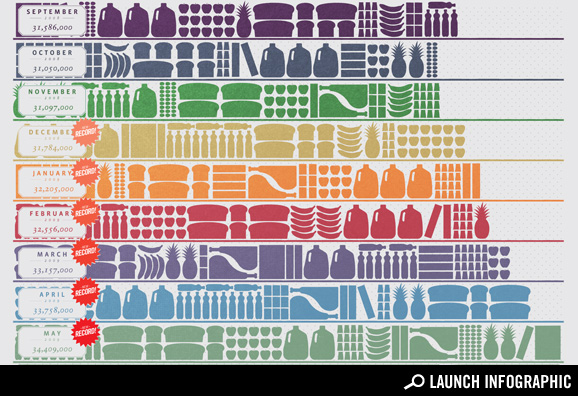
The above graphic is from GOOD (you have to click over to them in order to "Launch Infographic"), and shows the amount of money spent on food aid (in the form of food stamps) per month in the United States over the period of September 2008 to May 2009. I think that the graphic is a good one for several reasons, because it shows a trend of what this economic slump has wrought. True, there aren't food lines like there were during the Great Depression, but there wasn't a food stamps program for much of that time, either (it was first introduced in 1939). In other words, a lot of the needs of the poor have become invisible, making it difficult for people to see.

True, there are many social benefits and economic practicalities of using food stamps instead of having people wait in food lines, but the human psyche is trained to evaluate what is readily visible (i.e., can be seen "right now," covering a relatively short period of time). This "problem" of human perception is why stop-motion photography is such a wonderful mechanism to use in showing relatively slow (to the human senses) occurrences, and why Dan Gilbert said that global warming is happening too slowly. Keeping this sort of information "under wraps" (as it were) changes the political discussion that can be had, since it may be difficult to get sympathy for anonymous members that make up statistics (and makes it easy to classify them all as somehow "unworthy").

This all ties in - in some way - to the current "debate" in the U.S. about health care. I would imagine that a similar graph could be made about the growth of the uninsured (and the number of underinsured), as tied to this current recession. However, these millions of American citizens effectively remain unseen, and (therefore) are effectively outside of human perception. True, we might know that one-in-six Americans doesn't have health insurance, and we might even know one (or many). However, the sheer scale that 40 million represents cannot be grasped by the human mind. The trend of 1 million additional people per month also cannot be grasped. And these are the relatively easy numbers. The more complex ones - those involving the impacts of a status quo into the future on future national budgets, for example - are even more staggering challenges to the human mind. These inability of human perception to easily picture levels of national need and disparity make it easy for those currently against changing the status quo to cloud judgments. Even if one has scientifically enumerated facts, when those facts cannot be related to by the populace, then they are next to useless in a debate that requires an understanding of the scale and abstract nature of the facts in question.

I originally wanted to use the graphic to show that government subsidies are actually a very important thing for many Americans today, especially because of the poor economy. I was going to make a connection between the month-by-month increase in food assistance to the increases in the rolls of the uninsured. However, that got a little side-tracked. However, I believe the connection is there, and I personally wonder (with the political wonk side of my head) how many people actively protesting against "socialization" are on some sort of government program that provides them with assistance, including food stamps, unemployment compensation, Medicare, Medicaid, social security, etc. The "what if" autocrat in me wonders how many people would remain against "socialization" if the government followed their advice and stopped all these programs...

Thursday, September 10, 2009

Heckling the President.

Last night, I watched Obama's speech to a joint session of Congress, streamed live on Hulu (which is a great thing that they offer). Listening to it, when Obama got to the part of his speech where he said that his healthcare reform would not cover illegal immigrants, one could clearly hear one man yell, "You lie!" at the President. This causes a small furor that (luckily) quickly quieted down, as Obama merely repeats, "that's not true" to the accusation that illegal immigrants would be covered - this was even covered briefly by the AP.


However, it got me thinking about what the role of heckling in the American Parliament, and what the role of the President is in this country. This is not Parliament in London where "Prime Minister's Questions" is a time period that is usually shown on the highlights reel of the news, especially when spoken gaffes are made:


Yet, I don't think that even in this apparent free-for-all of questions and shouting that people would stand up and call the PM (or any other MP) a liar (at least not directly, perhaps choosing to couch the language a little more carefully to a single topic or to only shout something like that when it could be drowned out by all the other hecklers).

However, the United States is not the UK, and the leader of the country isn't another (but greatly more powerful) member of parliament. The President's Executive Branch of government is an equal and separate arm of government (which has different powers than the Legislature). Here, there is a tradition of decorum, of clapping or cheering with agreement, or not clapping when you disagreed. Even in parliamentary proceedings, the normal process is much more staid.

Representative Joe Wilson was approached by many members of his Republican party and told to apologize to the President, which he did. His statement was, "While I disagree with the president’s statement, my comments were inappropriate and regrettable," and this apology is a good thing. True, one way to think about this was that it was a political apology, either to try an save his re-election ability, or his ability to work with others in Congress in the future.

---------

We were all told to, "respect the office" of the President during the presidency of George W. Bush. We were told that protesting against the President was "anti-American" or "anti-patriotic". Yet now many of those who said that it was anti-American to protest the President are protesting the President - and going to much further an extent than many of the protests against George W. Bush did, including outright lies; paranoid statements about how government has suddenly turned into an ominously insidious body that secretly tries to kill and marginalize its citizens; single-minded ad hominem attacks by equating the President with dictators of the past; etc.

Just two days prior to the 9/9/09 speech to Congrss, President Barack Obama gave a day-after-Labor Day (i.e., the first day of school) speech to school children. And leading up to it, the paranoid calls from anti-Obama arenas erupted in full non-respect of the office. Where were those members from the right who so vociferously stated things like, "respect the office"? Jon Beilue at amarillo.com asks this question in his column, asking how we can find our way back to more decorum. It was - in some ways - a column that strangely foreshadowed the outburst from Rep. Wilson just later that night.

Wednesday, September 02, 2009

Main Street Bipartisanship

For those few people who are reading this, please watch the video:


Thank you.

Car park in Japan

In Japan, there are automatic car parks that store, retrieve, and even turn the car around for you so that you are facing the correct direction in order to leave. (The whole thing seems like it would be a little "fumigated" by the end of the day, though, what with there not being a lot of visible air circulation going on...)


This one sort of slides the car sideways.


Meanwhile, in the US, things haven't changed too much from this Seinfeld episode:

Tuesday, September 01, 2009

Vermont now marrying same-sex couples

Via various news sources this morning: Vermont is now providing marriages for same-sex couples. Huzzah! Apparently, there were no massive rushes for marriage licenses that we saw in San Francisco (during that brief period in which same-sex marriage licenses were allowed).

Some might think that is not a good thing, but I think that the fact that same-sex couples feel that they have the luxury of time to make their plans and have it "done right" (as it were) is a good thing, since it provides a sense of permanence to the whole institution. In other words, if the fifth New England state's allowance of same-sex marriage was met with throngs and throngs of people, it could also be seen as being similar to the bread lines of post-Soviet Russia: people lining up for the desperate hope of getting a scarce commodity that can run out at any time.

Furthermore, as the rest of New England starts issuing marriage licenses, there will be less of a "need" to go to Vermont in order to get married. The fact that so many New Englanders are feeling comfortable enough to wait for it to inevitably come to them is IMHO a good thing.

However, a blogger at Queerty - as well as NPR's marketplace - makes an interesting point: that this low turn out may be due to many couples wanting to get married on the anniversary of their previous civil union. (Civil unions were allowed in the state since 2000.)

Friday, August 28, 2009

I don't think I can handle Hamburger Helper anymore.

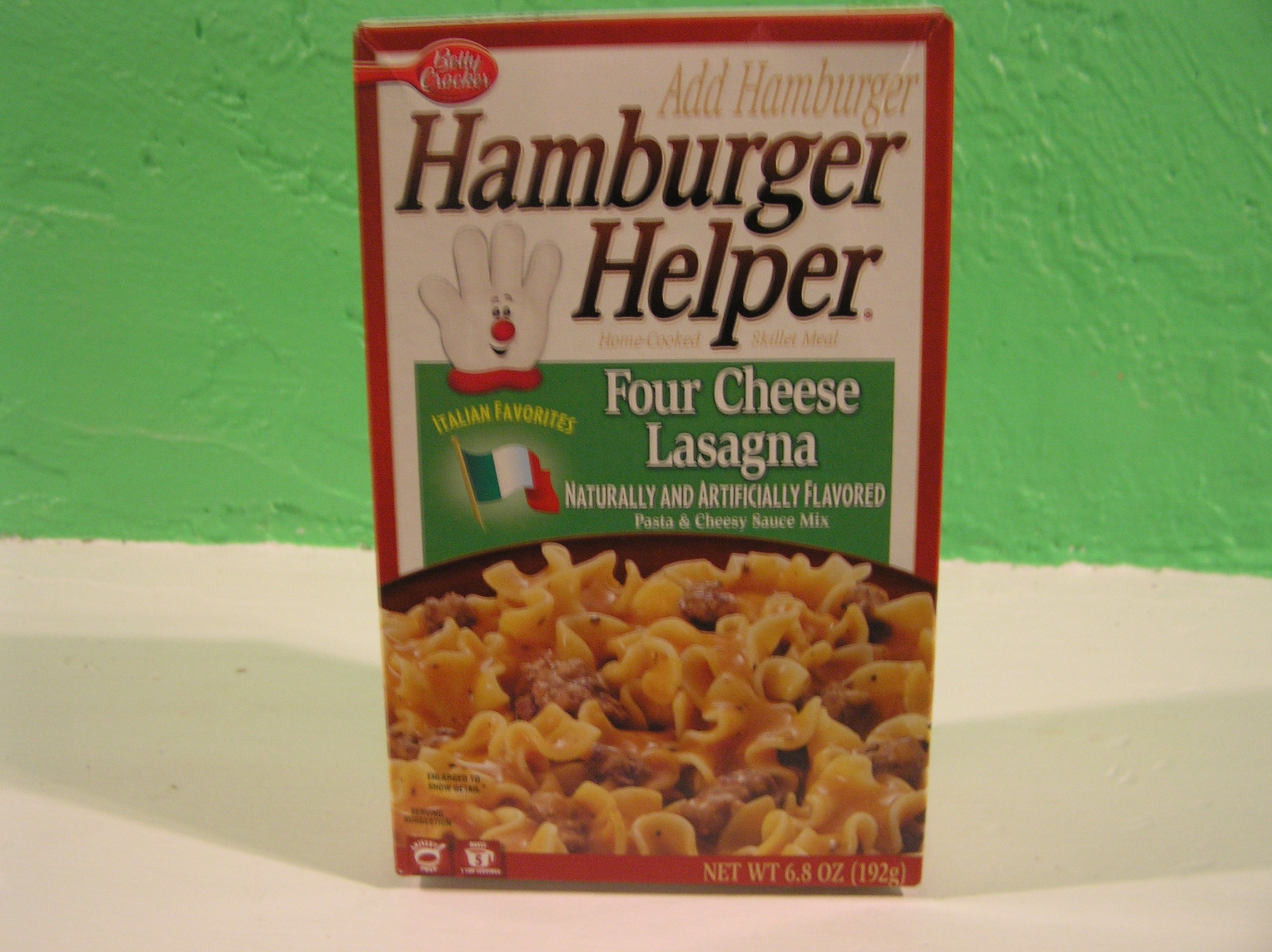
Yesterday I made some Hamburger Helper "lasagne" using a box of the stuff that I inherited from a friend when said friend moved out of town (for some reason the thought of paying to have Hamburger Helper and other boxed food was a no-go).

Anyway, as a person who doesn't want to see things go to waste, I decided to cook up some of the stuff yesterday, using some frozen ground turkey instead of beef. The taste was as expected - artificial (as it says on the box) - and wasn't really satisfying. However, late that night, I had to make a run to the toilet... Several times...

I suppose that my stomach is just no longer used to powdered foodstuffs cooked up in a pan. I've been having too much of the "good stuff" (i.e., farm-fresh vegetables, home-cooked meals, etc.) for Hamburger Helper. (Strangely, though, I still off the 99-cent menu at Wendy's on occasion, and those grease-bombs don't seem to hurt me any).

Sunday, August 23, 2009

Carying an axe in my pannier


Carying an axe in my pannier
Originally uploaded by umlud
I wanted to split some wood for winter firewood, but the axe was in serious need of sharpening. Without a car, though, it was going to be difficult to get it to the farmers' market for sharpening.

However, with a bit of rope and the help of my panniers I was able to get the axe over to the blade sharpener's at the market. I wonder, though, what people were thinking as they drove past me on the road.

The axe is nice and sharp now, and log splitting is quite easy, at least for the softwoods. I'll have to get a wedge for splitting the hardwoods, though. ... and if I'm going to get a splitter wedge, I'll also have to get a sledgehammer, I suppose.

Wednesday, August 19, 2009

No romance in candle-lit fish dinners

Based on two stories from PhysOrg, we learn that pretty much all fish has got mercury in it - not quite the beneficial nutrient. We also learn that the candles we normally purchase is a source of indoor air pollution.

What does this mean if we want to have a candle-lit fish supper? Well, we can use beeswax candles and Pacific fishes...

How not to engage at a town hall

I saw this over at Crooks and Liars:


What he says and how he says it are both correct. The woman doesn't actually want to talk about the issues at hand, yet feels a desire to derail it with hyperbole. Not only that, but the type of hyperbole is - as Frank says - "vile and contemptible." It compares Barack Obama - a person who was voted in by a massive popular vote of the entire country - directly to Adolf Hitler - a person who effectively usurped power and installed himself through force of arms.

Trying to argue with her (and those like her) are exactly like Frank said: "it's like trying to argue with a dining room table." It's pointless, and - as recent psychological studies have shown - doing so only serves to imprint the person's message in the minds of the audience. (Basically, the study showed that arguing the counterfactual to a lie by just saying, "Not X," only makes people remember "X," thus keeping the lie "alive" in the minds of the audience.)

This, and the statement from over the weekend of "facts vs. Beck" was also the right way to do this.


Of course, opponents are likely going to latch on to these two cases to try and show how congressmen are "talking down" to "real Americans." However, these stations are likely already preaching to the choir -- people who have already come to that conclusion, and will likely only agree vociferously with the voice coming out of the electronic box that supports their own pre-determined position.

Finally, is it just me, or does it seem like there are fewer cases of "storming the townhall" than there were before? If so, then does it mean that the stormers are on vacation, have started to realize the hyperbole is false, or something else? Or does it mean that more reasonable people are starting to go to townhall meetings in order to try and actually find out what's going on - rather than listen to people yelling on the TV?

Homes pollute the water

Via PhysOrg:
They say there's no place like home. But scientists are reporting some unsettling news about homes in the residential areas of California. The typical house there — and probably elsewhere in the country — is an alarming and probably underestimated source of water pollution, according to a new study reported today at the 238th National Meeting of the American Chemical Society.
In the study, Lorence Oki, Darren Haver and colleagues explain that runoff results from rainfall and watering of lawns and gardens, which winds up in municipal storm drains. The runoff washes fertilizers, pesticides and other contaminants into storm drains, and they eventually appear in rivers, lakes and other bodies of water.
"Results from our sampling and monitoring study revealed high detection frequencies of pollutants such as pesticides and pathogen indicators at all sites," Oki says of their study of eight residential areas in Sacramento and Orange Counties in California.
Preliminary results of the study suggest that current models may underestimate the amount of pollution contributed by homes by up to 50 percent. That's because past estimates focused on rain-based runoff during the wet season. "Use of pesticides, however, increases noticeably during the dry season due to gardening, and our data contains greater resolution than previous studies," Oki says.
Pollutants detected in outdoor runoff included ant-control pesticide products. Previous surveys have shown that the majority of purchased by homeowners are used to control ants. To encourage pollutant reduction, the researchers initiated community outreach programs centered on improving both irrigation control and pest management.
I wonder if this will be something that will be studied by urban planners, architects, and landscape architects. I mean, if you ever watched a sewer system being repaired, you know that there are leaks. If you ever had power cut off water distribution to your house, you have probably heard the public announcements warning residents to not drink the water for a few days -- indicating that water distribution systems leak (but that the normal positive pressure keeps the contaminants found in the ground out of the drinking water).

You also know that people use pesticides, herbicides, and fertilizers in their gardens and their lawns. True, not all places are subject to the same cycles of a Californian wet and dry season, nor do all places have the same surficial geology as found in the research area. However, irrigation (i.e., watering your lawn) continues throughout the summer months, and the desire for verdant lawns means that there is a market for fertilizer and pesticide use, and these get into the groundwater.

Now, this article also makes it seem like there are problems with the previous models, and that may well have been the case. However, I don't know that the problem was in the model, but in the groundtruthing of the model, as it was applied to a region outside where it was developed, and why not? Well, I'm assuming that the model was developed a couple (or more) decades ago -- before companies like ChemLawn came into the forefront of "lawncare". They were also probably made before the production of suburbs with massive lawns were included in the "city". In the time when the models were made, therefore, the only major source groundwater recharge came from rain, since people didn't water their lawns (so much) and (might even) have left it to go brown (or grown climate-adapted grass). In this condition, the addition of home-scale lawn chemicals wasn't at all significant, and was therefore left out of the equation.

Skip forward to today, where we live with a California with large ChemGreen lawns (nothing against ChemGreen, but it seems to be the major "lawncare" company in the Ann Arbor region.) that need constant watering (since the lawns aren't made up of climate-adapted grasses) as well as doses of pesticide and herbicide. (Thus, you have warnings of not allowing children or pets on the grass after an application by ChemLawn.) It's not surprising that this new reality in which we live needs to be considered in a different light than the reality in which the model was developed: the physical conditions have changed, and the models representing those physical conditions should also change.

... especially if we will be living in a world in which we want to use science and engineering to make policy and management choices about physical world issues. Especially, too, as we learn the various ways in which we cumulatively impact our surroundings, including those regions that we cannot directly see (e.g., groundwater). Especially, further, if we wish to have predictive capabilities for future management action and being able to incorporate the changes we will see not only form an altered climate, but also from increased population demands on the land, air, and (in this case) water.

Tuesday, August 18, 2009

SSA conference 2009 presentation

A short (for an academic) presentation by PZ Myers to the Student Secular Alliance conference (2009).

Monday, August 10, 2009

New bike-parking trial in Ann Arbor

Cycling in to the university this morning, I saw a large blue bike rack sitting in one of the parking spots on State Street, just in front of the Bivouac. It's a huge rectangular thing that acts like a barrier for parked bikes against any oncoming traffic that might just be happening to make wide turns.

The basic idea is - I think - a good one: provide more places for bikes to park that isn't impeding foot traffic, thus making it more desirable to walk and bike to the "downtown" area. This bike parking structure is only temporary, and I don't know if there are any more around town. However, it's sponsored (if that's the right word) by the Downtown Development Authority, so I would hope that one (or more) of these show up downtown.

I don't know, though, if blue is the best color to paint these, since - apart from some reflective tape - it's not highly visible even during the day. Furthermore, people aren't expecting to see something like it, so taken together with its limited visibility (especially when not in use), it's likely that drivers will complain that it's a road hazard.

However, if you've seen the bike rack and want to provide the city with your own feedback (it apparently really helped with the issue of installing the LED streetlights), then I encourage you to call in:

UPDATE: Looking at the DDA website story on this, there are two more bike rack stations: one in front of the People's Food Co-Op and the other in front of Arbor Brewing Company. Three in total... they do target places that are high-bike traffic areas, but I think there could be more penetration; for example putting one on at William and Main, to get "both ends" of Main Street by complementing the one in front of Arbor Brewing Co.

Sunday, August 02, 2009

Cycled to Dexter


Mill Creek outlet
Originally uploaded by umlud
Today I decided to take a trip out to Dexter. My main reason was to take an updated photo of the Mill Creek outlet, since someone wrote to me, saying that the bridge was almost completed, and I thought, "Hm... I should go out there and see what it looks like, and see if I can look at the amount of erosion (through the back-sedimentation) taking place."

One problem with my trip, though, is that - unlike when I was living in town - I could not easily get over to Huron River Drive to cycle along the river back and forth from Dexter, and the quickest way to get there is to take Dexter-Ann Arbor Road. Of course, I decided not to follow the directions given online, so instead of taking Dexter-Ann Arbor Road, I went the extra bit and took Miller instead. (Stupid choice, since both roads intersect anyway as one goes toward Dexter.)

I stopped in for lunch at the Lighthouse Cafe - eggs benedict with hashbrowns - and then stopped to watch the Dexter fire department put out a fire at the drugstore (ooh, exciting!) before getting some coffee and cycling back home along Huron River Drive.

The trip back from Dexter was a leisurely 45 minutes. The total distance was 27.9 km, and I was back before 2PM. The new bike works well, but the only thing I would like aerobars (or additions) to allow me to lean down to cycle with a little less wind resistance than my current more-upright position gives... or maybe some dropbars instead.