Tuesday, September 25, 2007

Scientists and government - a brief thought.

The syndrome of science as servant extends beyond the special circumstances of advisory duty in the White House. … The long-feared political imperialism of science has never mobilized, let alone gone on the march. Minor forays occur … [but] in appointive posts, …scientists perform as discreet servants of politics. In elective politics, they participate as individual voters, shunning organized efforts under the banner of science. (Greenberg, 2001)


This “syndrome” of advisory scientists as servants that Greenberg points to may be why administrations feel that it is “okay” to doctor statements given by their appointed scientists (those by the last Surgeon General and by government climate scientists come to mind here). Of course, when this comes to light, everyone is shocked that an “objective scientist” would lie to the public. Well, appointees can be asked to lie and even call their statements the truth. When they do (and are caught doing so or resign over it), that person loses credibility in his/her field of science (no one likes a liar), and (depending on the type of lies, and the impact of those lies on the public) eventually credibility amongst the populace. But, for now, this is enough about the recently-seen ramifications of Greenberg’s three statements, and on to the last one.

I wonder if Greenberg’s “organized efforts” are aimed at the efficacy of groups like the American Fisheries Society (AFS), North American Benthological Society (NABS), etc. But these are professional organizations, not politically-minded groups. However, these are organizations made up primarily of scientists within the field in question (it is unlikely that John Q Public would be a member of AFS or NABS, for example). These professional organizations’ power is based on their “objectivity”, not on their social advocacy. If the AFS asked its members to vote for candidate X, it would lose credibility from its members (since many scientists feel that they are intelligent and independent enough to make their own decisions, thank you very much), as well as from outsiders (since members of general society would feel that this would run counter to the objectivity of the scientists).

Groups which are more “boundary” (in terms of the science-policy divide) are what should fill in the void as the “organized efforts” to which Greenberg should be referring. Groups like Americans Association for the Advancement of Science work in the area between scientists and policy makers – acting not as political activists, but as enablers, trying to build a bridge between the two sides (at least that is how I view this construct).

On the other side of this “bridge” are groups like the Union of Concerned Scientists (UCS), the Sierra Club, Greenpeace, and other pro-science activist organizations. (I list environmental science groups only because these are the ones of which I am most aware, and not because I think that only environmental groups are pro-science.) The role of these organizations is to lobby and pressure decision makers. They are not scientific organizations, but do use (and sometimes hire) scientists to do research for them. However, like all other lobbying organization, their raison d’ĂȘtre is not “science” (in the sense of an objective science), but that of influence policy based on a subset of all “science”. These groups are not made up exclusively of scientists, but usually from a mix of scientists and non-scientists. I would even go so far as to hazard a guess that in most cases, scientists that are members of these advocacy organizations did not join them in their capacity as “scientists”, but as a member of society that agrees with the group’s goals. (Duh.)

The book from which this excerpt was taken was published in 2001; before the large “misuses” of a variety of sciences by the George W. Bush presidential administration ranging from doctoring scientific reports to cutting funding for future research in areas that are politically disliked. Since that time, I wonder if the consistent misuse of science by this administration (and its cronies) will lead to the coalescence of voting blocks of scientists in the 2008 election (and if there was one in 2006). Of course, there is little way of knowing whether this hypothetical movement would be a voting behavior that happens to parallel that of advocacy groups (like the UCS), or is a result of the these groups’ actions.

On another level, though, I suspect that Greenberg’s definition of a “scientist” is relegated to that of the physical scientist – the scientist of ‘big science’ – and not the environmental scientist (which, as a group, tends toward having more social advocates), nor of social scientists – this is an underlying criticism of much of what I read about “science” and “scientists” (since I am not a physical scientist, but an environmental scientist). I only bring this up since in most of the physical sciences, there is an apparent disconnect between science and policy advocacy by the vast majority of the field’s scientists (as opposed to the field of environmental science, where the distance between scientists and advocates seems – to me – to be more narrow). If this is the case (and to be repetitive, I think it is), then Greenberg’s implication reads that scientists with memberships in professional scientific organizations (and not to advocacy groups with interests in their field of science) tend to vote as individuals. This is akin to saying that members of the National Basketball Association, vote as individuals (I’m assuming that there is no such thing as an “athlete voting bloc”).

Greenberg, Daniel S. (2001) Science, Money, and Politics: Political Triumph and Ethical Erosion. University of Chicago Press, Chicago.

Monday, September 24, 2007

Obakemono Project

Now this I like. I usually don't think about all the ghost stories that are out there in Japanese literature, but let me just say that there are a lot. Growing up for a while in Japan, I was introduced to the vast panoply of these beasts through video games, manga, animation, and stories (although mostly through Gegege no kitaro).

Looking through the tubbypaws blog, I came across a beast that I haven't seen in quite a while: rokuro-kubi. After searching for her online, I came across her entry on the Obakemono Project. This has got to be one of the more fun databases of Japanese ghosts, goblins, and demons out there (at least in English), and ranks up there for fun and interest with Encyclopedia Mythica.

Odd things found whilst looking through Blogger Play

Check out Blogger Play if you haven't already! Looking through all the recently posted Blogger/Blogspot photos makes for an interesting trip of cognition (or something like that).

Some of the photos I clicked on (due to just pure interest in the photo) led to these blogs:
Rather random, and almost as interesting a collection of blogs as you might get by just pressing the "Next Blog" button at the top right of the window. Just thought I would share the amazing ways of passing the time while using a relatively new addition to the Blogger suite of procrastination tools.

Just when you thought you could eat from the seas...

... I'm linked to a web page of videos put together by Scripps students about the myriad problems occurring in the world's oceans. Check it out (if you dare).

Sunday, September 23, 2007

Notes from Kelves (1995)

The excerpt from this book (readings for class) described a rise in basic physics research in the 1960s and again in the 1980s, and that this matched a similar pattern in the production of PhDs in physics.

I wonder if this was a question of people following money or one of more opportunities for people to enter into universities (thus obtaining PhDs). It is my opinion (completely unsupported) that the number of "nerdy science" types of of people are roughly a consistent proportion of a population. With the democratization of the access to science careers, it wouldn't be surprising that the total number of these inquiring minds increased. This, coupled with increasing specialization and professionalization (requiring higher level degrees to get a job in the field) found in physics of the time, led to a faster-than-expected growth in the number of physics PhDs; a legacy of baby boomers going into university. Maybe this is a reason why so many physics and engineering faculty seem to come from that period... Of course, as I said, this is my own untested conjecture.

-----

The discussion of the development in the 1960s of superconductivity at temperatures above 10K made me ponder the difference between utility and capability. True, with the development of greater superconductor technology, superconductivity (as a concept) became more feasible (i.e., increasing capability), but pursuing the use of superconductivity was still resource-intensive (i.e., low utility). This dichotomy speaks - I feel - to the difference between the theoretical (or barely applied) physicist's motivation against that of a heavily applied environmental scientist's. Namely, the costs of doing research in a small segment of physics was conducted once it was perceived by the practitioners as being feasible to pursue (an example of the concept of feasibility tracking directly with the concept of utility). True, there shouldn't have to be a general 'signing off' on the research requests of scientists (that is the technocrat in me), but having a disconnect between what a set of specialized elite feel is feasible in an internally-perceived fertile area of inquiry seems to me to open up the group in question to criticism from those outside their discipline (especially outside the larger group of 'scientists'); a ratio not in favor of the minority of researchers.

----

High energy physicists were key figures in the nation's strategic defense and science policymaking councils. When they spoke, the American government tended to listen, mainly due to a convoluted piece of logic:

"seemingly impractical research in nuclear physics had led to the decidingly tangible result of the atomic bomb; thus particle physics had to be persued because it might produce a similarly practical surprise."

WHAT? So, just because A1 ended up causing X1, we should fund A2 because we feel that it will produce something as useful as X1? That is the same faulty logic that runs like this: We attacked Afghanistan in response to the attacks on 9/11/2001, and haven't been attacked in our homeland. Attacking Iraq in 2003 has will also also lead to not being attacked in our homeland. Okay, I digress...

Of course there was no evidence that this convoluted piece of logic would play out as intended. There is no evidence that the pursuit of physics over other science was "good" or "bad" in the past. Physics seemed to be a focus of research because the leaders of science policy were physicists. In the game Civilization III, there is a "future weapon" called an ecobomb (or something like that) which reverts an area around it "detonation point" back into a pristine condition; pre-settlement. If biologists had made an such a weapon (or something equally devastatingly analogous to the A-bomb) in WWII, would we have started the pharmaceutical revolution we now see way back in 1950?

Part of the problem with our viewpoint of science in this country was illustrated by a quote from physicist Walter Massey toward the end of the chapter:

"A major trouble ... was that people drew selectively on the past of the science to predict its future, that they started 'with World War II as if there was no science in the world or in America' before then, believing that 'the only standards' available for 'quality of life' are those that prevailed during 'the last forty years.' "

In that vein, I didn't realize that publicly funded physical science's relevance was questioned as far back in US History as the aftermath of the Civil War. However, it makes sense that the apparently esoteric research done by a minority of the perceived intellectual elite would be a target of fiscal conservatives (fearing a high-risk investment) and populists (seeing government subsidies of the rich over the poor). History doesn't quite repeat itself, but it does give out very similar story lines from time to time.

A common galvanizing call for support throughout that history is the justification of science funding because of national pride; science leadership. We wish to be leaders in science, but realize that we cannot be leaders in ALL science. Therefore, we need to choose (either implicitly or explicitly) on which science(s) we shall lead. However, once we do choose one area over another, we are going down the road of specialization, and while science (as a concept) may not proceed linearly, the people doing the science tend to stick around a long time.

By walking down the path of the SSC, the US federal government was (perhaps inadvertently) moving toward specialization. One "proof" of this was the gross difference in the amount of funding given to particle physics as compared to other fields of science: $5,000,000,000 for ~1000 particle physicists compared to ~$40,000 for areas of studies conducted outside this area. A particle physicist of the era might argue that the monetary needs of 'big science' requires a lot of money being spent. While this is true - big science costs big money - the work at issue in my previous statement is 'needs'. If physicists 'need' big science, then that need should transcend nationalism (the credo previously mentioned for continued/increased public funds). If US physicists were unable to bring the SSC adequately to completion in the US, they should cut their losses and step in to fund the more popular/cost-efficient program. Of course, what they did was try to continuously shove through more (and increased) funds for the SSC as the Cold War came to a close, as a recession hit the country, and as other Congresses were elected.

Soon "missing at the national level was what made physics ... so important since World War II - real or imagined service to national security."

In other words, as money spent increased, spendable moneis decreased, voters waited for the promises of the science given over a decade earlier. At the end of the project (1993), the political dynamics of the SSC had become divorced from tional security, and therefore became bait for domestic political attacks.

"Proponents of the SSC are from Texas, Texas, Texas, Texas, and Louisiana, and maybe someone from California. But my colleagues will also notice that the opponents are ... from all across the country." (Rep. Boehlert)

The death of the SSC was not caused by an unenlightened public, nor was it really caused by the ending of the Cold War. It was primarily killed by an unenlightened segment of the physics community that was unable to realign itself with the social and political realities that it faced. The development of the CERN facility in France/Switzerland is a testament to a well-packaged sale of a bill of goods to the relative countries that didn't have to be constantly re-justified at every turn and bouyed up by false (or still-unproven) promises. Harsh, perhaps, but there is a reason why there is no FermiLab counterpart to CERN, and much of it comes down (at the end of the day) to politics, politics, and politics.

Autumnal Equinox on Carrot Sunday

Happy Autumnal Equinox!

So, today is the Sunday afternoon before Michaelmas. Why is this important? Carrot Sunday! Well, in Scotland women once went into the fields to pull carrots, which, when found forked, indicate fertility and good luck. The finder would then present this charm as a "suggestive" gift to the unmarried man of her choice on Michaelmas (kind of like an "Olde World" version of a Sadie Hawkins Dance). These special roots were of particular value when employed to find a suitable mate at a local Michaelmas dance (the suggestive means by which this might have been employed is up to your imagination to think up), where women hid them nearby, or even carried a few (!) into the gathering.

Thursday, September 20, 2007

Which word do you hate more?

"Damp" or "Moist"

No End in Sight

I went and saw No End in Sight last night. As a documentary, it did a good job of showing the very fast lead-up to the war in Iraq, the miscommunication (or lack of communication) between the people initially sent to Iraq and the administration at home. It also did a good job of showing the frustration that true Iraq experts had in working with those running the war in the Bush Administration.

In my opinion, one of the best things that was (tacitly) held up for the audience to judge was the inability to understand/apathy of the people in the White House to the sensitivities of how the situation in Iraq would play out. Starting with the looting, moving to de-Ba'athification, and on to the disbanding of the Iraqi military. It's as if we hadn't learned anything from history (from WWII through the war in Kosovo). Leaders apparently tried to paint the actions in Iraq as a completely new phenomenon. However, after watching the film, I think that many of the decisions were made in a vacuum, with the Americans getting hole up in the Green Zone, or staying in DC. The film focused primarily on the actions in 2003 and early 2004.

Wednesday, September 19, 2007

Library Tour

I was linked to a web page with amazing photos of historic libraries. Woah...
Note: Unfortunately, this site seems to no longer exist. (Boo...)
Sometimes you just have to wonder, WTF? I came across this reason to do so from the "Idaho State Journal":

by Bryan Fischer, Executive Director, Idaho Values Alliance

A wing of the evangelical movement, headed by Richard Cizik of the National Association of Evangelicals, is hopping on the trendy environmentalism bandwagon, and linking arms with environmentally activist groups. An evangelical church in Boise is hosting a national conference on the environment this week, and the Sierra Club is actually providing scholarships for college students to attend.

It’s important for evangelicals to recognize that, as appealing as it may be to join forces with environmentalists on the left, there are profound differences in worldview that one day must be faced head on. Evangelicals who believe these differences can be held in tension indefinitely are fooling themselves.

Something will have to give, and fundamentalist environmentalists are not about to budge on their deeply held convictions. Ultimately, evangelicals will have to sacrifice their deeply held convictions if they are to continue to team up with dogmatic environmentalists.

As Rabbi Daniel Lapin observed on Dr. James Dobson’s radio program, the whole purpose of the environmental movement is to do away with Genesis 1-3.

... [Here he gives seven 'reasons' to back up his point.]

It’s naive for evangelicals to think they can keep politics out of the debate. For environmentalists, it is relentlessly about politics, and about the use of the oppressive power of the state to force their views on the rest of us.

Eventually, in this unlikely pairing of evangelicals and environmentalists, something will have to give if the partnership is to be maintained. Unfortunately, it is almost certain that it is the evangelicals who will have to give up precious principles or find themselves dismissed from the movement.

Fischer, you need to re-evaluate what it means to be an 'environmentalist.' What is your definition of 'environmentalism?' Your statements seem to be analogous with a statement that Christianity and Feminism cannot coexist; that you cannot have a Christian Feminist. Dude, you really need to update your understanding of environmentalism. (Or are you saying that since environmentalism and Christianity cannot coexist that all environmentalists are sinners?)

You seem to have a very strict definition of environmentalism, and a similarly strict definition of Christianity (or a Jew, for that matter, since you make your arguments based on Genesis). However, if you assume that environmentalists may include people who have a strong (non-religio-centric) belief in maintaining their home in a holistic fashion (and not limiting it only to hippie tree-hugging, hashish-smoking, free-loving, tie-dye hemp-wearing, nature lovers), you might find that environmentalism is more than the straw man your blog puts up.

Would you consider members of The Nature Conservancy as environmentalists? What about Greenpeace? Environmental Liberation Front? The lawyers at the National Resource Defense Council? The lobbyists of the League of Conservation Voters? What about Trout Unlimited or Ducks Unlimited members? The civil servants working in the Environmental Protection Agency, or the Fish & Wildlife Service, or Forestry Service? What about the mayor of Chicago? All of these organizations and people can be labeled in some way as "environmentalist" or "pro-environment", but many of them won't fit under your straw man definition of 'environmentalist.'

On the flip side, who is a Christian? Is Richard Cizik a Christian? What about St. Francis of Assisi - the patron saint of (among other things) the environment? Would you consider the members of the Lord's Resistance Army as Christians? What about Spain's former dictator Franco? Is Bishop Gene Robinson a Christian? Is Pope Benedict XVI? What about the Bartholomew I, the Ecumenical Patriarch of Constantinople? What about the "Hidden Christians" of Japan? The Copts? The Russian Orthodox? I doubt that many of these groups and peoples would be able to fit under your similarly stringent straw man definition of "Christian."

Next time, instead of making a straw man environmentalist to stand up against your straw man Christian, consider the breadth of the available definitions of the rather broad terms of 'environmentalist' and 'Christian.'

Ranked Air Temperatures

Yesterday I hypothesized that using ranked air temperatures would provide people with the ability to judge August air temperatures against long-term averages. One of the strengths of the method I proposed was the ability to look at how common an observed temperature was. In the graph below, I organized data collected from NOAA into three ranked air temperature lines (Minimum, Mean, and Maximum observed temperatures) for Ann Arbor from 1926-2006.


Using this graph, it is now possible to see how far removed from the median observed mean air temperature for the month of August was in the fair city of Ann Arbor. Looking at the reported average temperature (from weatherunderground.com) for August 2007, we can see that an average daily temperature of 71F means that (on average) August air temperatures were around the 25th percentile. Similarly, average daily high temperatures for August 2007 was 80F; ~37th percentile. The average daily low temperature for the same period was 55F; ~20th percentile. All three numbers point to an August that was - for Ann Arbor - cooler than the 80 year median for all three parameters.

Talk Like a Pirate Day


Aye, 'tis here! Talk like a Pirate Day! Yarrrrr!

Tuesday, September 18, 2007

Accents and dialects and goblety-gook spoken by people.

I just bounced my way over to the "Northern English" page on Wikipedia, and was reminded of the great variety of accents one might come across in their travels through northern England:

Cumbrian
Geordie
Lancashire
Northumbria
Mackem
Pitmatic
Scouse
Tyke

Ahh, such wonderful names for them as well. Go on, check out their Wikipedia pages, and then go an look for examples of people talking in each accent online (for this, though, you are on your own). If you thought that English accents only stretched as far as Cockney, then you've not been to England.

Scotland, too, is also an interesting place for accents, but I'm not going there right now.

Shakey Jake dies

For those of you who lived in Ann Arbor, you probably saw Shakey Jake at some point. He was the old man with the (usually) white suit and sun hat usually seen around the Main Street area strumming on that ubiquitous (although not always completely stringed) guitar or sitting at Afternoon Delight talking to the patrons. I suppose that even for town icons, there has to be an end to the run, and that came on September 17, 2007, when Shakey Jake died.

From the Ann Arbor News:

Shakey Jake Woods was a star in Ann Arbor, almost from the time he arrived here 34 years ago.

Wearing his trademark three-piece suit, hat and dark sunglasses, the man known simply as "Shakey Jake" could be seen playing his guitar on the street downtown for as long as many can remember. And when he stopped inside local stores or restaurants for breakfast or lunch, it was if a movie-star had walked in.

...

Woods, perhaps the city's most recognizable resident, died Sunday evening, said Felicia Epps, a property manager for the Ann Arbor Housing Commission. He was 82 years old, according to a friend and the date of birth he gave police in 2001 after he reported being punched in the stomach.

Though he played his guitar with vigor, it was often out of tune. Sometimes it had only one or two strings.

But he had a larger-than-life persona.

...

"He was so harmless," said Chera Tramontin, whose mother, Karen Piehutkoski, opened Kilwin's Chocolate Shoppe in 1983 on Liberty Street. Woods was one of the first to visit the new shop.

"It wasn't that he wanted the handout," said Tramontin. "He wanted to go out and work, and he thought he was working. He was out playing his music."

Woods was raised with 13 younger siblings on a farm in Little Rock, Ark. The family eventually moved to Saginaw, but Woods never went to school.

Music brought Shakey Jake to Ann Arbor from Saginaw in the early 1970s.

...

Reif [an accounts payable clerk at the University of Michigan who booked blues artists for shows over the years] invited Woods to play at the Ann Arbor Blues Festival in 1973. He only played for five minutes, but he made an impression. After the show, Reif said, women and girls headed backstage to fawn over Woods, thinking he was a blues star.

"I ain't never going back to Saginaw," Reif recalled Woods saying.

And he never did. Instead, he became a street legend in Ann Arbor, Reif said.

Many mornings, Woods arrived at Afternoon Delight before the Liberty Street restaurant opened for the day. He ate breakfast for free - oatmeal and wheat toast.

...

At Kilwin's, an autographed poster of a much younger Woods hangs on the wall. He often stopped there to collect a bucket for busking, and when he returned it later each day, he was treated to a cup of ice cream. Employees then called a cab for him to get home; a notecard providing instructions to new employees is taped up near the phone.

"The whole town cared for him," said Carol Lopez, owner of The Peaceable Kingdom on Main Street, who managed Woods' finances and paid his bills, among other tasks.

Even though I never knew him - having been busily crossing Main St to get to campus or home, I did see him several times, either happily strumming his guitar, or chatting with passers-by. He will be missed, I am sure.

Record summer temperatures.

The title of the NOAA report says it all to me: Sixth warmest summer on record ends with record heat in South. Some highlights from the report:

  • August 2007 was 1.2F (1.0C) warmer than the 20th century mean August temperature, and 6th warmest summer since recording such things as summer temperatures began in 1895.
    • Within the 48 contiguous states, August 2007 was 2.7F (1.5C) warmer than average.
    • Globally, the combined land and ocean temperatures for August 2007 was the 8th warmest on record, 0.85F (0.47C) above average.
    • Global land temperatures for August 2007 were the 3rd warmest on record.
  • Of the 50 states, only Texas and Oklahoma were slightly cooler than average.
    • The warmest August in 113 years occurred in West Virginia, Kentucky, Tennessee, North Carolina, South Carolina, Georgia, Alabama, Florida, and Utah.
  • Increased temperatures had concomitant increased energy requirements in the SW and SE.
  • Rainfall was below average in the Southest, mid-Atlantic, Ohio River Valley, northern Plains, and northern Rocky Mountains.
    • Forest fires in Georgia, Florida, and the Rocky Mountain states were attributed to lowered rainfalls.
  • Rainfall was above average in Texas (the wettest on record) and Oklahoma (the 4th wettest on record).
    • Heavy monsoons affected regions of South Asia, affecting millions of people.
  • Hurricane Dean - the first major hurricane of the Atlantic Hurricane Season - was the first storm to make landfall as a Category 5 storm since Hurricane Andrew in 1992.
All of that is (to me) news that doesn't do me good. However, I am wondering how long it will take for people in general come to realize that their concerns shouldn't be limited to record temperatures (i.e., the hottest summer on record, the hottest day on record, etc). Rather, people need to think about how a season's temperature relates to longer-term temperature trends. One method by which to do this is to look at temperature trends in a similar fashion as how hydrologists and fluvial ecologists investigate river water discharge patterns.

A hydrologist (or fluvial ecologist) will use what he/she might consider a representative sample of discharge data for the purposes of the problem. In this case, I used roughly 80 years of discharge data measured by the USGS for the Huron River as it flows through Ann Arbor, MI.


Unless you are a much better person than average at seeing underlying trends, all you will see in such a case will be spikes of high discharge, with most discharge occurring between ~100cfs and 1000cfs. However, there are a lot of times when discharge is higher than 1000cfs and lower than 100cfs. If I was to say that something was an event that was extremely rare (i.e., occurred only one time out of twenty), I would be at a loss to tell someone what that event would be.

For the reason of being able to assess a measured discharge against long-term trends, a ranked discharge curve is created. In this curve, the data are ranked in increasing (if one is a hydrologist) or decreasing (if one is an aquatic ecologist) order.


Looking at this ranked discharge curve (note that I used a logarithmic scale on the y-axis), you can see that events less than 90cfs and events greater than 1200cfs are extremely rare (based on the above definition). This would mean (among other things) that any event of greater than 1200cfs is a very significant discharge event; even a flow over 930cfs could be judged to be a 90th percentile discharge. If I was to check the most recent discharge value (318cfs, measured at Sep-18-2007 @ 8:45am), I would see that the river was experiencing a 47.5 percentile flow - pretty close to the annual median discharge.

Comparisons can also be made between rivers. If you compare the Huron River with New Mexico's Delaware River (both about the same watershed area), you can tell that there are some fundamental differences between how the hydrologies of each area works.


Now, if temperatures were to be measured like this, I would argue that it would be much better than the current method of comparing against the greatest value on record. You wouldn't be saying things like, "The 12th warmest summer in recorded history." A statement like this (imho) would make people think that the 12th warmest summer in recorded history is not that significant; similar to the logic that no one really cares about the 12th-place finisher of a marathon. However, if the 12th warmest summer was very close in temperature to the 4th warmest summer, a graph of ranked temperature - like the ranked discharge graph above - would more easily show how different ranked summers relate to each other. Something as simple as this is (I believe) important in having people understand the relationship between rather abstract concepts as global temperature trends.

Monday, September 17, 2007

Hand washing.

I'm not a hygienist, but I know that washing your hands is a good thing, especially when you deal with (erm) most bodily fluids. Apparently, my fellow Americans (mostly men) have decreasing rates of hand washing. Remember: wash yer hands! (After all, in this country, we have decently clean water, almost every store sells some sort of hand cleaning agent, and so you (and me, my fellow Americans) have little excuse to wash up.

Sunday, September 16, 2007

Cool temperatures.

Temperatures were at 39F as I walked home from the Fleetwood Diner. It wasn't too much warmer when I left the house a few hours earlier.

The sight of my breath in the air is something I count as a "good" thing. Bring on the coolness of autumn.

Friday, September 14, 2007

Bush's Climate Change Science Program

I'm not saying that this is analogous to Bush's Clear Skies Act of 2003 or the Healthy Forests Restoration Act of 2003, but Bush's Climate Change Science Program has recently been criticized in a review by the National Academy of Sciences (NAS) for:

"lack[ing] a focus of impacts of changing conditions and informing those who would be most affected ... [and for being] hampered by governmental policies that have grounded earth-observing satellites and dismantled programs to monitor environmental conditions on earth. ... Of the $1.7 billion spent by the program on climate research this year [2007], only about $25 million to $30 million has gone to studies of how climate change will affect human affairs, for better or worse..." (from NYTimes)


One of the greatest problem with the science side of the program is the impending (possibly inevitable) possibility of government priorities shifting away from satellite observations. If this were to happen, it would mean that a long-term scientific data record will be cut. Why would this happen? Is it internal politics within the Climate Change Science Program? Is it an appropriations issue in Congress? Is it a back door run by the Executive Branch to halt observational data gathering of earth's atmospheric changes? I don't know, but it makes my paranoia whiskers twitch.

The NYTimes story goes on to say that basic research on climate change is continuing apace, but very little of it is directed to how changes will affect local officials, farmers, water managers, etc. Dr. Ramanathan cites a lack of communication between government officials and communities that would be affected as the main reason for this shortfall.

I've taken courses on this very subject (science-society interface/communication), and I'm surprised that the federal science projects would fall for this problem yet again. The number of papers discussing the benefits of transdisciplinary research have only been increasing over the last decade, and even when I was in undergraduate education (waaaay back in the mid-1990s), the benefits of transdisciplinary research were being drilled into our young environmental biology brains. However, the program seems (if you discount a large conspiracy) to be falling down on this front, and doing the stereotypical scientist/engineer thing by being unable to tell regular people (i.e., society) why their findings are significant, and how their research will affect your average Joe. I suppose that when the government gives funding to a bunch of climate modelers who don't have a history of talking to Joe Average (or even knowing what Joe might want), and not giving any money to people/society-oriented sciences, this major science-society disconnect is what happens.

This sort of thing gets me micro-peeved in so many ways that it adds itself up to being a peeved Umludish person.

Thursday, September 13, 2007

Oh, I love blogging's witty repartee.

I was reading a ScienceBlogs entry on the need to reframe engagement policies differently, since Muslim (specifically Middle East) local politics (specifically terrorism) as something different than the Muslim religion over at the Framing Science blog.

As a response to the blog, entry, I made the following comment:

[irony] So... extrapolating this outward, you mean that it wasn't Catholicism and Protestantism that caused sectarian violence in Northern Ireland? WOW! I was completely under the impression that it was "Protestants" vs. "Catholics" out killing each other because of each other's religions. [/irony]

Why is this news to people? Of COURSE violence is politics-motivated. Islam would never have become such a widespread religion leading to culturally prosperous nations if it was a "religion of violence". If it WAS, then you can bet butter to bullets that regional religions would attempt continuous bloody overthrow of their "religion of violence" overlords.

Saying that Islam is a religion of violence is analogous to looking at the Thirty Years' War and saying (if you take the side of the Catholics) that the rise of Protestantism - a violent fundamentalist apostasy - caused the war. Of course, even a brief reading of history would show how shallow such a proposed understanding that is.

The concept I suppose I'm trying to articulate is that US citizens need to get to grips with the idea that Islam is about as violent as any other religion, including the Christianity, Judaism, Hinduism, etc.

Posted by: Umlud | September 12, 2007 11:26 AM

I feel that what I wrote - although somewhat convoluted and irony-laden - was an understandable position on the subject of needing to separate religion from politics. One of the subsequent commentators - on reading my comment - wrote this:

Umlud:
All else aside, just glancing briefly at the texts (and supposing, as you suggest, that we shouldn't look at the histories) of the other religions to which you refer would seem to indicate a pretty incredible level of violence. I'm not sure how this helps your point.

Posted by: Chris | September 12, 2007 1:21 PM

I consider myself a somewhat rational-thinking individual, so I read and re-read the comment on my comment. Maybe I was just reading his statement's assertion of my point incorrectly. (Nope, I don't see it.) Or maybe I had written something else than what I had thought I wrote, despite re-reading it several times before posting. (Nope, I had submitted the exact comments I thought I had written.) Hmmm... Now, this is a chance to do one of two things:
  1. Ignore the comment.
  2. Reply to the comment.
I chose to follow the latter course, and proceeded to write a [somewhat] pedantic rant-bordering reply to "Chris." See next:

Chris - You seem to have said that a brief reading of religious texts shows an inherent high level of violence within those religions, and this does not help my case. Please re-read what I wrote. I did NOT say that you (the reader) should take religious texts out of historical context. Rather, you CANNOT and SHOULD NOT take religion out of the context of history and, by extension, the concomitant political history of the region in question.

Religion is more than its texts. It is, among other things, relationships between peoples. In Christianity, for example, people chose to interpret different portions and versions of the Bible, based on the socio-political situation in which they found themselves. This continues to this day. For example, with regards to immigration, a large number of American Christians conveniently forget Exodus 22:20-23 and Exodus 23:9 (and related statements in Leviticus) - part of the Christian Bible - when advocating their anti-immigration stance. What does this example (and other similar ones) say about Christianity? Does it mean that Christianity (of "the Book") is a charitable religion in this instance, while Christianity (of the people/"the Body") is composed of hypocritical religious practice in this instance? Can the religion of Christianity be so easily divided into that of "the Book" or of "the Body"? Obviously not; it is both the Book and the Body. This is true of other religions (at least those that HAVE a central religious text or set of texts).

Similarly, human history is the relationships between peoples over time. There is history within institutions and history between institutions. However, when it comes down to it, history of the kind under discussion occurs between people. People have motives behind their actions; thought-out means of using social issues for personal or political advantage. This has (amongst other things) lead to fundamentally different outcomes, even within a common over-arching religion (witness the various different forms of Christianity, even within the "Protestant" mold). Disregarding the role of people and groups of people (i.e., society) through time (i.e., history) is dangerous, especially when it impinges upon what people believe as "Truth" (i.e., religion).

Finally, if I'm not mistaken, you indicate your readings of religious texts are rather cursory. This leads to certain problems. For example, you imply the Jewish Bible is violent, but the Christian Bible isn't. However, the Jewish Bible is a fundamental part of the Christian Bible. Thereby, by extension, a significant part of the Christian Bible is also violent.

I would really appreciate if you could please tell me what understanding you have gained from your cursory reading of other religious texts. For example, you say that you imply that you briefly read the text of Hinduism. However Hinduism has four holy texts. Which of the four "central texts" have you read? Also, I am puzzled to know how "glance[ing] briefly" any holy text gives a sufficient understanding of it even within the religion, let alone between religions? To be absolutely clear - and with no irony or sarcasm - I refer in the previous sentence to the importance of including history in any analysis of religion. I'm sure you know that many books and essays have been written in different religions (e.g., Talmud, Catechism, and Papal encyclicals) about interpreting a particular holy text viz a particular religion (i.e., providing historical interpretive context of the use of the holy book within the structure of the religion itself). If you are going to make the argument about holy texts (in which I am not an expert, and apparently neither are you), your point would carry more weight if your readings were a tad more thorough.

Maybe I've misread your statement, and maybe I haven't. Please elucidate.

Posted by: Umlud | September 13, 2007 11:48 AM

Let's see if "Chris" replies. I know that waiting for a reply is a little childish, but I rarely get to have the chance!

Shana Tovah, $80 oil, and fuel economy.

To all those who are aware that it is a new year: "Shana Tovah!" For all of the rest of you, Shana Tovah is not the name of a the deputy administrator of NASA, a presenter on World Poker Tour, daughter of Van Morrison, or a female reporter on 60 minutes. (You can do your own research if you are really interested and that clueless.)

As for $80/barrel oil: well, it's happened (briefly). Of course, this is (if inflation is accounted for) less than what the cost of oil was in 1980 (est. $100/barrel), but it does mark a certain level of concern for transportation, heating, and electricity generation. It hopefully will not mean that heating fuel costs will increase drastically this winter (partly because I have to pay for heating oil, but mostly because many people live in the northern latitudes of the world that will be unable to pay drastically increased prices for heating). I do not look forward to seeing news stories of people dying in their homes from hypothermia or increased transportation costs being passed on to goods, but these might well happen.

If social problems (e.g., increased incidence of hypothermia, increased cost of goods) emerge from these rises in the cost of oil, this may provide yet another nail in the coffin of business-as-usual methods of organizing our (in the industrialized North) fossil fuel use patterns as they are currently. I'm NOT saying that $80/barrel oil is the answer to solving the environmental/global warming problems, but may well lend itself to that path.

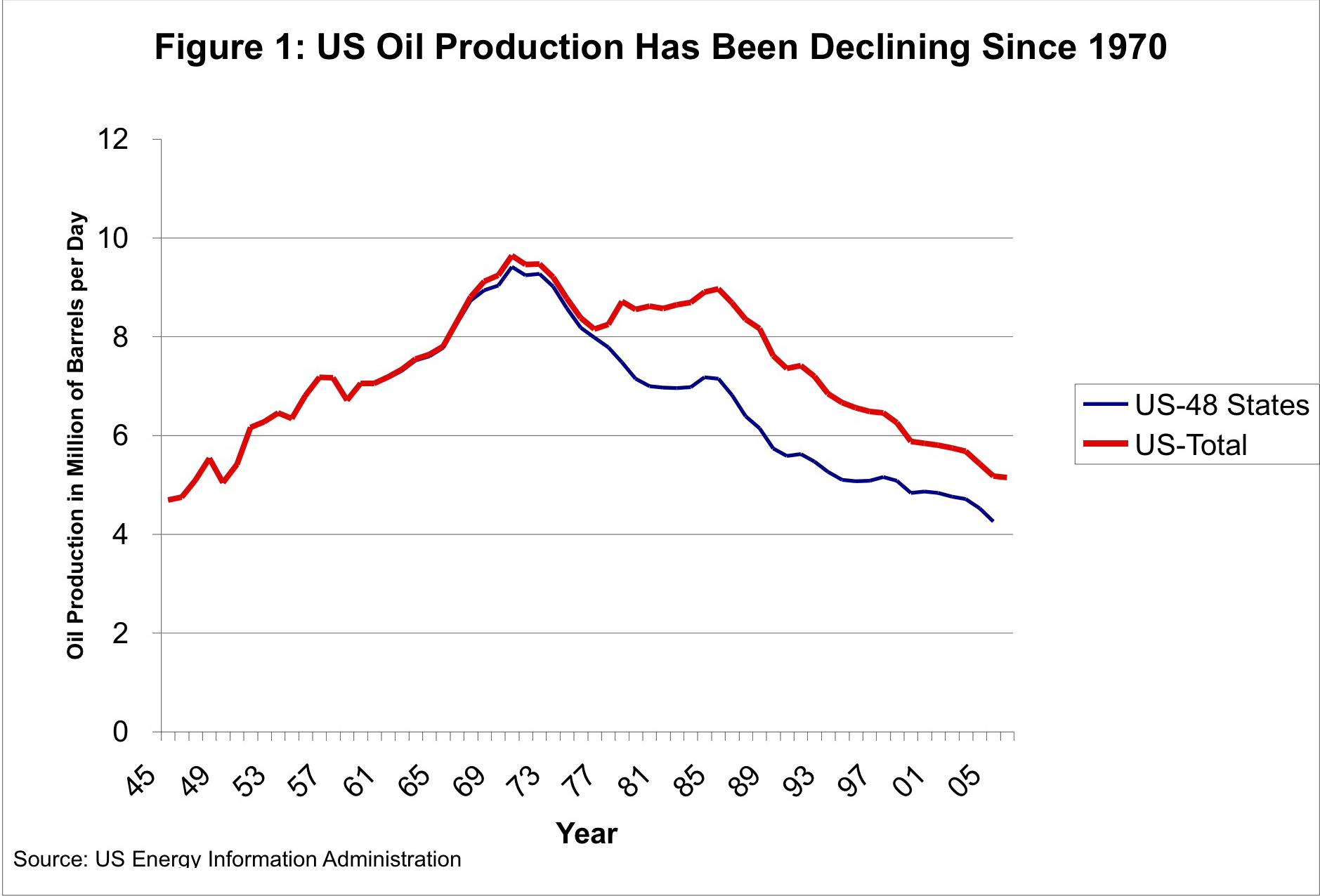
A side note on $100/barrel in 1980. While I understand that the current cost of $80/barrel is less than the equivalent price of oil in 1980, I don't personally believe that the comparison is one that can be made as directly as some might like. The geopolitical situation of the world is completely different today than 27 years ago. China, India, and Southeast Asia consume significantly greater amounts of oil. Oil production is not as controlled by OPEC countries. The United States imports more oil today than 27 years ago, and the trajectory is upward, while the production trajectory is downward, while per capita oil use has leveled off.

In somewhat related news (since the majority of vehicles on roads require some sort of petroleum), a federal judge in Vermont decided that, yes, auto makers can produce higher fuel economy vehicles without compromising safety, breaking any laws. This (hopefully) allows California and 14 allied states to move forward with plans of instituting state laws for higher fuel economy standards. And since these 15 states constitute over half of car sales in the country, this finding could become the basis of a nation-wide rise in fuel economy standards.

From the Detroit Free Press article:

"Detroit's automakers warned the judge during a 16-day trial in April of steep job cuts and financial pain if the rules stood. General Motors Corp. said it would have to abandon some states or risk missing the targets even if it spent $25 billion upgrading its vehicles.

But Vermont U.S. District Judge William K. Sessions said the industry failed to prove that the standards were too tough, would endanger drivers, or that Congress had forbidden states from setting their own fuel economy rules."

One interesting point is that the article mentions only "Detroit's automakers" warning judge (and the Congress) of negative consequences. I feel that Judge Sessions would have been more likely to find on the side of the automakers if "Detroit's, Japan's, and Europe's automakers" had warned the judge of negative consequences. However, the fact that alternate technologies are shown to be viable, the arguments of even two years ago ring hollow today, and the judge realized this.

So how does all this relate back to "Shana Tovah"? It doesn't. Honest. I just didn't want to have two separate postings.