
Sunday, May 31, 2009
xkcd tickles my funny bone for some reason...
Sometimes the jokes on xkcd are just too outside my realm of interest for me to appreciate. This one is, too, but for some reason, I found this it really funny...


Thursday, May 21, 2009
Interesing juxtaposition
 I was at Borders today and I saw this interesting juxtaposition of titles on the shelf in the Spanish-language section: a photographic guide to the Kama Sutra next to The Essential Guide to the Bible. Either someone at the store has an interesting sense of humor, or a broad definition of "religion" (since the Kama Sutra book was in the religion section).
Reuben at Sava's
After going to several of the restaurants and brasseries (since they technically aren't cafes) in Ann Arbor, I've noticed that many of them serve reubens - a favorite sandwich of mine. Therefore, I've decided that - as a semi-recurring event - I'll review the various reubens one can find around the city. Reubens will be reviewed based on presentation, taste, messiness, and cost, each rated on a 4-star scale. (Cost: $ < 5.99, $$ = 6-7.99, $$$ = 8-9.99, $$$$ = 10+)
I've eaten as Sava's (221 South State) several times before, and I personally think that it is not that bad of a State Street restaurant. Their sandwiches are not too heavy nor do they skimp on sandwich stuffers (not as generous as Amer's, but also not as expensive). The decor is light and the tables aren't set so close together as to make navigating difficult. The layout of the restaurant is a little strange, with the kitchen being hidden behind a counter area, and stretching toward the back of the restaurant. At the end of the counter is the cashier, meaning that you have to walk to the back of the restaurant to pay for food, as opposed to a pay station up at the front. (This layout makes it a little cramped in the back during busy times, but not horrible so long as people recognize that only one member in a group is needed in order to pay a bill....)

Anyway, moving on to the reuben ($6.99), it comes to you with pickle slices on a plate large enough for a side of fries, and is a pretty traditional set of ingredients: corned beef, swiss cheese, sauerkraut, on grilled rye. The presentation was nice, and the meat was shaved very thin and didn't have a lot of fat. The whole sandwich was well-cooked through, with just enough grilling to get a fried crust on both sides, but not to the point of burning. Also, the ingredients were cooked all the way through, melting the cheese, thus gluing the beef to the kraut. Overall, I think it is a good example of what a traditional reuben should taste like.
RATING:
Presentation: ***
Taste: *** ½
Messiness: **
Cost: $$
Monday, May 18, 2009
New Hampshire might allow same-sex marriage soon.
Via Dispatches, I learn this morning that - once a religious exemption (that I don't really think is necessary, since church and state should be held separate, especially in matters regarding the state) passes - the New Hampshire is willing to sign a same-sex marriage law, meaning that Rhode Island will become the only state in New England that doesn't allow for gary marriage. (Come on Rhode Island, show the rest of the nation that regional unity is not only possible, but it is also powerful.)
Inner-city Environmentalism
At some point during the U.S. environmental movement of the 1970s and 1980s, "environmentalism" became a rich (and mostly) white activity that - to some - reeked of hypocisy. Hypocisy because instead of taking actions to minimize global (or even regional) impacts, many actors "off loaded" their impacts to other places, usually those places that were less well-off. Therefore, we have the example of computer recycling leading to parts-dumping in India, Africa, China and Southeast Asia. The problem was one basically caused by the more well-off and exported to areas of poverty and little public health oversight.
The environmental movement also became to be seen as "rich" because of price premiums that were paid for "going green," along with which groups were "buying-in" on this concept (or - with the case of food stamps - able to buy at all). For example, if a family were to purchase only organic fruits and vegetables, the cost could (depending on the region, season, and vegetable) increase by 50% or more, and many food stamp programs didn't allow for their use with organic products (which leads to the question of what factors people at the governmental level were using in order to make that decision). Furthermore, even if one didn't use food stamps, the marginal cost of paying for organic is greater for people of lower incomes, and so one could easily see wealthier families purchasing organic foods. (Of course, food distribution patterns tend to follow either sale figures or expectation of sales, and so one is left with a situation today where you will find little - if any - organic produce in poorer-neighborhood grocery stores.) Once this dichotomy became established between the economic classes, I argue that it became easy to label "organic" as part of "elitism" (along with imported foods, alternative food and dietary options, etc.), and something that is "other" and unwelcome in poorer communities.
In other ways that it is seen as "rich" is that many of the concepts of "environmentalism" don't really seem to adequately address the poor. They are development projects of the "next generation" of houses, office buildings, etc.; the costly certification projects of landmark buildings; massive re-urbanization projects meant to bring in capital; etc. I would argue that these methods are drawing upon the development model that is seen in the technology sector: build expensive prototypes, get investment capital (usually from rich people/institutions), develop them for mass-marketing, and (if successful) achieve buy-in by as big a group as possible. This is a top-down approach to development, and with technological developments, this sort of thing has been shown to be necessary, short of massive investment by government (e.g., the national road network) or charitable foundations (e.g., malaria research funded by the Gates Foundation). By pursuing this course of action, though, the environmental movement has forgotten (or does not focus on) the little guy. Indeed, a technology-based solution for the "little guy" doesn't really make a whole lot of sense, because this segment of the population doesn't really make a good investment for business (i.e., they don't have a lot of potential capital to spend on future technology). However, they are the most in need of a better environment.
A few years ago, I learned about Majora Carter, an environmental justice advocate working in the New York City metropolitan area, specifically the South Bronx. During a TED talk in 2006, she showed how urban renewal can actually bring about major help to poor communities. Similar activities have recently been started in Ypsilanti (Growing Hope) and Detroit by former SNRE students, as well as in other cities around the United States. Although these projects are not major cash-generating machines, they do offer things that are of major importance to people: access to cheap and healthy food, improve peoples' lives through developing a healthy psychology, and tearing down urban barriers in neighborhoods.
Some people assume that "green collar jobs" mean the development of help for rich people. However, inner city environmental groups not only help change the paradigm of how to think about "environmentalism", they also go about bringing in environmental values to urban centers - some of the least "environmental" areas one might imagine - in ways that bolster and renew those living there. The recent "stimulus package" from the Obama administration has a major part for "green jobs." One can only hope that whomever is overseeing these funds will take a lesson from inner-city green organizations and provide funds for those people who can least affort to further hindered due to their economic inability to themselves be major players in the technology-derived environmentalism that has dominated a lot of the consciousness of the past twenty years.
GIS programs
If you do any sort of GIS work, you have almost assuredly come across the company ESRI. This for-profit company is the major-player in the field; a greater presence within GIS programming than Microsoft is in operating systems. However, like the operating systems analogy, ESRI (like Microsoft) has both for-profit and non-profit competitors.
My labmate - ebina2 - recently received an e-mail with some webpages of free/cheaper GIS software. However, since ESRI is the major-player in GIS programs, there is a need to normalize file formats, and I wonder if ESRI has made the Geodatabase file format proprietary, thus making it more difficult for others to import projects made with ArcGIS 8.x and newer.
Anyway, here are the two web pages on which these alternative GIS platforms can be found:
Of course, as with any Open Source and Free programs, debugging and help might be slow in coming. Of course, too, many highly popular Open Source programs have a large cadre of "helping hands" that provide either direct help via debugging or indirect help via forum postings. Remember, though that while these larger and more popular programs might be better-served by the online community, it does not mean that it will be the best for one's particular GIS needs.
Saturday, May 16, 2009
mid-May Photos

On South University, there are a few older buildings that still remain from many several decades ago. Currently, the house the Village Apothecary and the Redezvous Cafe.

The Hatcher Graduate Library (left) and the UGLi (right)

The Kraus "Natural Science" (aka 'biology') building

Ann Arbor Electronics, way at the southern end of Church Street

Sculpture outside Social Work Building

West Hall portal in the morning.

A view through to Tower Plaza from next to Hill Auditorium.

Sunset light on the west wall of Grizzly Peak.

New pavement on Liberty St. YAY! The previous pavement had gone to shit. Not as bad as some places might be, but still was not the nicest surface to cycle over. The crews had the road exposed all the way down to the old brick underlying many of the roads in the older city limit roads.

Starting summer renovations. This time on the Chemistry building. The University does this every year: the day after all the students leave, out come the diggers and the dump trucks, and the Diag becomes another impassable zone for weeks and sometimes months. Last year it was the tunnels between Kraus and Haven Hall. This year it's not just this renovation, but also something along Ingalls Mall, between Kraus and Chemistry...
Friday, May 15, 2009
National Bike-to-Work Day in Ann Arbor

 The morning was wonderfully sunny -- not too hot, not too cold -- but when I arrived at the Great Lakes Cycling and Fitness bike shop for our 7:30 departure, I was the only one in a shirt and t-shirt. (But I have a tendency of running warm anyway, so this was not too much of a surprise to me.) The other cyclists wsere riding a mix of bicycle types: a few road-type bikes, some mountain bikes, and a few hybrid city bikes (like me). There were a mix of men and women, as well as a good age range. (If I was forced to guess, I would say that it was about a 30-year age range.) The Ann Arbor roads were quite quiet at that time in the morning, and even Stadium -- all four-and-a-half lanes of road -- didn't have many cars on it. Normally, I ride to town about an hour later, and there is a lot more traffic on the roads. Although it didn't look like there was any central organizer for the group, people did mill about with attentiveness and purpose, talking about their bikes, their realizations about being able to ride into work, the epiphany that one did not need to buy an expensive road bike in order to bike to work, etc. However, I sat down a parking curb and, squinting into the sun, quietly drank some coffee I had brewed up prior to leaving the cabin. Anyway, a set of about a ten riders set out at 7:30 toward the Farmer's Market.
 Due to a nice pace (and the small number of lights along Liberty), I wasn't able to take a lot of photos of much of our ride (without being really unsafe in our small "peloton"), but I will remember that -- the Critical Mass ride I went on in October -- it was nice to become a major force on the roads. Ahh, the power that comes from numbers. There was one time that I recall when a car pulled pulled past me (I was riding in the back, doncha know), but -- not realizing how stretched out our group was -- slowed back down to allow us to pass so that the right-turn could be made. I don't know if the driver was angry or puzzled about our actions, but it was still a nice thing to see (having been cut off by car drivers and at least one bus driver). It was also nice when we rode down Main and Huron Streets, the ten of us taking the place of a couple of cars, while not impeding the "flow" of traffic (since traffic along Main Street was already starting to slowly pile up).


However, I did notice several cyclists that either didn't know about the event or didn't feel they wanted to participate. If that latter, then that's fine, but if the former, then in the next year, I think the city (and possibly bike shops, too) should try and publicize the event in more places than they did this year. (I mean, I didn't learn about it until I read about National Bike-to-Work Day online and didn't know about the group-ride until I went in to GLCF. All I'm saying is that there are likely others who didn't even here about it at all.)
Wednesday, May 06, 2009
Maine governor signs same-sex marriage act
And then there were two... Only two New England states (New Hampshire and Rhode Island) don't allow same-sex marriage. The only states that allow gay marriage are currently:
What's more, the federal government passed the so-called "Defense" of Marriage Act (which - one could argue - is a form of enforced "separate-but-equal"), meaning that they don't recognize same-sex marriages... which means legally married same-sex couples still have to fill out two individual tax returns, they aren't able to gain social security benefits, and a host of other problems because of this federal-level discrimination. Of course, this might come to a head with the recent passage through the Washington DC city council of a law that recognizes same-sex marriages performed in other states. This is interesting because the law needs to be approved by the United States Congress, and so if the Congress approves it, does it mean that the Defense of Marriage Act might be repealed?
- Massachusetts
- Connecticut
- Vermont
- Maine
- Iowa
What's more, the federal government passed the so-called "Defense" of Marriage Act (which - one could argue - is a form of enforced "separate-but-equal"), meaning that they don't recognize same-sex marriages... which means legally married same-sex couples still have to fill out two individual tax returns, they aren't able to gain social security benefits, and a host of other problems because of this federal-level discrimination. Of course, this might come to a head with the recent passage through the Washington DC city council of a law that recognizes same-sex marriages performed in other states. This is interesting because the law needs to be approved by the United States Congress, and so if the Congress approves it, does it mean that the Defense of Marriage Act might be repealed?
Saturday, May 02, 2009
The new NOAA center in Ann Arbor

The new center of NOAA in Ann Arbor is actually not in Ann Arbor, but slightly outside it, making it difficult for a person to get there by the use of public transportation. However, who cares about that now that they have a really large parking lot. Hmmm....
I'm not really psyched about the location's layout and landscaping either.
Monday, April 27, 2009
Spring Monday


Due to a Spanish exam that I was taking at 8AM, I found myself downtown before any traffic really started rolling. I also found myself seeing flowers on trees that were effectively bare on Friday.
 I sat down with my breakfast of some Eastern Accent coffee and a BBQ pork bun and watched as the city slowly came into life. (The exam wasn't the nicest in the world; I thought that there was too much emphasis on topics not fully covered in the course of the semester by my section, but that kind of is the way things are when you have roughly a dozen different sections all ostensibly learning the same material...)
 I sat down with my breakfast of some Eastern Accent coffee and a BBQ pork bun and watched as the city slowly came into life. (The exam wasn't the nicest in the world; I thought that there was too much emphasis on topics not fully covered in the course of the semester by my section, but that kind of is the way things are when you have roughly a dozen different sections all ostensibly learning the same material...)
As a closing comment that isn't really associated with the photos, I think that the best thing to do with the final grades of all the sections is to normalize grades across different instructors. The most fair method would be to normalize each grade fraction (e.g., all homeworks, all tests, etc.) for each section, and apply a "correction factor" unique to each section to normalize the distributions of that particular section's grade fraction. That way, not only are different instructor's sections somehow marked along a similar distribution, but also each instructor's own sections are done so as well. That means that if an instructor has a much better time teaching the same topic a second or third time during the day - and that is reflected in the grades - then the earlier sections would not be penalized for the inability for the instructor to teach as facilely as in the latter section(s). Of course, another might argue that so long as the instructor did a "fair" job of teaching to the requirements and schedule of the class, then a test across all sections is fair. Oh, well. It's over now.
Cycling the long way home
On Friday, I cycled home the long way along the Huron River before heading up Maple Road. Although it added about one mile to the trip, it was well worth it, with the balmy sunny weather. Here are some photos I took at that time.



Bright and sunshiny day on the Diag. Slightly over-exposed, but I think you get the idea. Too bad this didn't happen before the start of exams...

Some sculptures made of old concrete pavers. North Main Street.

On Barton Dam, you can see a City of Ann Arbor official benchmark. Unfortunately, there is no indication of the elevation... This website, although having a lot more information, also didn't have elevation...

Cycling up to the new High School, one can see the not-so-good-looking option the city chose for storm water management. True, it does create a berm, but does it have to look so... misplaced? Maple Road.

An older stone house on Maple Road made entirely (seemingly) of river-stones. This style of architecture used to be more common in Michigan, where the only rocks one is likely to find in this type of glacial landscape (without having to dig) is river-stone. Some houses are made with rather interesting patterns of sunbursts or geometric repetitions. This one... not so much, but quite nice to look at nonetheless. (Unfortunately, due to the time of day, there was a lot of back-lighting. I'm sure that if it were the morning, the house would look brilliant.)

The buds were just starting to get ready to burst open. This lonely tree in Westgate Shopping Mall seemed to be quietly waiting in a field of cars and asphalt for spring.

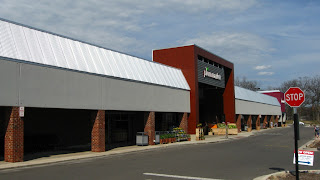
Plum Market - the West Side's version of Whole Foods - has become the lifeblood of the West Gate. I've never been in, and made a point of not going in this time either. (Although part of that could have been due to the fact that I didn't have my panniers on my bike at the time...)
Another Maunder Minimum?
According to a recent publication in the BBC, recent solar activity may indicate that we might be going into another "Maunder Minimum". What is a Maunder Minimum, and why haven't you heard of it before (unless you happen to have an interest in historical climatology, possibly radio wave physics, or have read the 1632 novels)?
Well, the Maunder Minimum was a period of time with very few sunspots and other solar activity. It's important because it was also associated with a mini-ice age. Now, this is something that the anti-climate change people will likely point to as to why global warming is actually a hoax. I'll wait and see, though, holding my breath against what is likely to be the inevitable...
Well, the Maunder Minimum was a period of time with very few sunspots and other solar activity. It's important because it was also associated with a mini-ice age. Now, this is something that the anti-climate change people will likely point to as to why global warming is actually a hoax. I'll wait and see, though, holding my breath against what is likely to be the inevitable...
Cars were apparently larger in the past...


The Detroit Free Press has a bunch of "current" photos of the inside of this now-shell of a building. There is a chance (again) that the building will be torn down. I think that it would be a shame, since the restoration of the building could be seen as part of a rennaissance of the Motor City. Still, who am I to judge? I never lived in Detroit, and have only visited there twice in all the time that I've lived in southeast Michigan...
(photos from the Detroit Free Press. Hat tip to Orac.)
Sunday, April 26, 2009
The sound of obsolete technology
Why do films and TV shows continue to use obsolete or unnecessary sounds for technology?
I was watching episode 6 of Dollhouse on Hulu and got really annoyed with the sound effect near the beginning of the episode when the guy turns off his LCD TV. Listen for it. It sounds like a 1970s cathode ray-tube monitor is being shut down. Why is this necessary? Many of us own LCD monitors and TVs (and many more have at least seen one in action). Why do we need the sound effect of a CRT monitor when the object is obviously a LCD monitor? To show how silly this use of obsolete sounds is, one equivalent would be the use of a propeller plane sound when the person sees a jet. However, if it was only this one thing, I wouldn't really be having a gripe, but it's not only the misuse of a CRT TV sound for an LCD TV, it's the general misuese by substitution of sound effects for previous technology's sounds.
It's only been recently that the stupid sound of *bleep* or the like is no longer used to indicate that a computer is doing something. It's only recently that the visual graphics of what is happening on the computer screen actually looks like something that might be on a computer screen (but that's a different issue). As an example of when this started getting really annoying for me, go and watch that admittedly horrible film The Net with Sandra Bullock. It's supposed to be all high-tech for the time. Well... seriously, what was up with those computer sound effects? I saw that film when it went to VHS (yes, VHS), and was annoyed back then about the unnecessary sound effects.
If The Net is anything to go by, it will be close to 10 years before sound effects actually mimic the real sound of the technology. (Of course, by that time, new technology will undoubtedly have come on the scene, also undoubtedly repeating the cycle...)
When I hit "Publish Post" will I have a sound effect that lets the audience of one (i.e., me) know that an action has been committed on the computer and that something will happen on the magical screen? Somehow, I doubt that it will do so now when it hasn't done so all those previous times. Why? Becaust it is not necessary!
Saturday, April 25, 2009
Al Gore and John Warner's Testimony on Climate Change Legislation
One way in which science is being used to steer the debate about politicized events such as climate change is through testimony to congressional committees (or subcommittees). On April 24, 2009, former Vice President Al Gore and former Virginian senator John Warner both testified on topics relating to global warming. Mr. Gore spoke more to the topics of science of climate change (including the "pure science" of the causes and the "applied science" of the impacts), although answered questions as to costs of possible implementation of a cap-and-trade scheme for carbon dioxide. Mr. Warner spoke on the linkage between science and national security. Almost all questions were directed to Mr. Gore and ranged on topics of the economics and science of global warming. (More on this later.)
During his recent testimony to the House of Representatives' House Energy & Commerce Subcommittee, former Vice President Al Gore provided a view point of how the science of global warming, which has become a major political flash point in the past few years. There is evidence from various different sources, such as the League of Conservation Voters and the Pew organization, that the science and politics of global warming (and the proposed legislation to deal with it) has become an issue with a clear partisan split of understanding between Democratic and Republican legislators and voters.
Al Gore presents in his opening remarks that the passage of the legislation by first presenting the ever-growing body of science on the causes together with the environmental and human impacts of global warming, presenting the names of the organizations and journals in which the findings were published - prestigious ones all - before presenting those scientific study's results . This was followed by his social justifications for acting by promoting the shift away from carbon-based energy systems as a opportunity to upgrade infrastructure systems, fund R&D opportunities, and find new "green jobs" for coal miners. He continues by increasing the scope of his statements by including the context to that of a global one by stating that the United States should not have to continue spending money and effort sending troops (an action that is becoming ever-more publicly unpopular) and should be one of the first countries to do serious action on the topic of global warming to once again become a leader - moral and scientific - of the world (a topic that is becoming more popular). He finishes by once again tipping his hat toward funding of a science-justified bill by asking for bipartisan support for the legislation.
Former senator John Warner's (R-Virginia) opening statement also made an interesting framing of science within the global warming debate. Other than making a tangential comment about a news story in the New York Times from April 24, 2009 by Andrew Revkin, which talked about the obfuscation by companies that were major polluters of scientific studies fourteen years ago that spoke to the validity of the impacts of global warming , he left the "facts" to Al Gore. Instead, Warner's points spoke more to the problems of how innovative infrastructure presents new problems, such as water usage requirements for California solar power and land acquisition for installing the next generation "smart grid". He spoke of climate change, energy, and national security were all tied closely together, and that the Congress needs to build any legislation that incorporates all three. He then continued to discuss the linkage between climate change and national security.
In that portion of his testimony, Warner quoted General Gordon Sullivan - the former Chief of Staff of the Army - saying that this message was a critical point of view to understand that climate change/national security link:
One could say that Al Gore and John Warner present two different facets of approaching the issue of global warming. Al Gore starts off with his big-guns of science; how the ever-mounting evidence of science should make it more and more obvious that action needs to be taken on this topic. On the other side, John Warner calls upon the long-term national security interests of the country to justify the investment in climate change legislation. Both of these two strands of evidence have historically been used successfully to garner funding from the Congress. However, before the joint testimony of John Warner and Al Gore - two respected former politicians from different parties - the connection between climate change science and national security investments were not placed in such a close testimonial juxtaposition. Indeed, Mr. Warner asked the Subcommittee to bring in members from the defense sector, intelligence community and private sector dealing with defense infrastructure, recognizing the benefit of bringing these other points of view that are critical in having to deal with a future in which climate change is a reality.
Senator Warner made an allusion to the 1990 passage of the amendments to the Clean Air Act in the Senate. He recalled that during that period of time, there was a lot of worry and controversy in the public regarding the possible future of manufacturing in this country as well as the costs of implementing the legislation. He recalled how it was the concerned actions of the committee chairman - calling up each member of the Senate who was wavering - to get that amendment passed. He noted that the passage of the bill forced industry to innovate, and ultimately they survived. This framing plays to the point of view of the policy-science link being kind of evolutionary in nature: new policy creates new "selection pressure" in the private sector, causing an "evolution" of (in this case) scientific innovation to optimize the industry to the new selective pressure; the image of scientific innovation being a linear process.
However, when attacking the science of global warming, most of the attacks came from the Republican party members and were directed at Al Gore. The types of attacks took several forms, including using the "there is no scientific consensus" frame (e.g., Representative Scalise R-LA , Representative Barton R-TX ), stating predictions as "theory" (as opposed to "fact") , stating that science can prove whatever end a politician wants (e.g., Representative Burgess, R-TX), citing the science as alarmist (e.g., Representative Radanovich, R-CA), or trying to directly discredit Al Gore, through claims in his film An Inconvenient Truth (e.g., Representative Barton - TX), and through Mr. Gore's apparent conflict of interests with regard to climate change legislation (e.g. Representative Scalise R-LA , Representative Blackburn R-TN).
The questions from the congress tended to focus on possible impacts of the bill to their local constituencies, whereas the comments that Mr. Gore and Mr. Warner made tended to be national and international in scope. In my opinion, these differences in scope were not sufficiently addressed by either Mr. Gore or Mr. Warner in many of the cases.
Mr. Gore made a statement during his testimony that touched a topic that seems to have a strong resonance with many Americans - their children's and grandchildren's generation. He posited the scenario of what our children and grandchildren would think when, twenty to fifty years down the line, they look at the world they inherit and ask why we - the people of today - chose to listen to the questionable science coming out of corporations and political groups who benefit from the current business-as-usual instead of listening to the global scientific consensus on the science and expected impacts of global warming. In my opinion, this argument suffers from a few problems. First, it falls into the framework of "trust the science", which is - itself - a value that doesn't resonate with those people who have been witness to what is portrayed as a "flip-flopping" of scientific findings in the media or somehow a sinister plot by a global cabal of scientists to change life as we know it. Second, it is a form of Pascal's Wager that seems to swap out "science" for "God" and "future generations" (i.e., our biological eternity) with "eternity." If taken the same conclusion as Pascal's Wager, it can be used as an argument for inaction along a specific line of policy than action along the lines of the given policy. Third, it continues to play into the frame of a "scientific priesthood" that can divine the future. While one might argue that playing this frame when it gets you the desired outcome is what really matters, the argument falls apart quickly when science is shown to not be as great a seer as its proponents claim. Fourth, it portrays an unlikely future scenario of complete non-action vis-à-vis climate change, which is a problem opposite to that of the "scientific priesthood" problem. The assumption of a future with no action - although an effective rhetorical tool - again presents a duality that can easily be refuted after the fact to make ad hominem attacks against the user as being too simplistic or even reactionary. Of course, if people are going to ignore your warnings or voice criticism against you no matter what you say, then I suppose worrying over these points is not necessary or productive.
When asked about whether Mr. Gore supported the bill, even though it did not live up to the science, he stated that he supported the bill, regardless of the shortfalls because it would catalyze future cuts that would be more in line with the science, but did not specify how he envisions this. This statement, though, plays into a linear-type model of how science affects the policy-making process in that it assumes that in the end, "the science will out." If, like in the case with Michigan's Groundwater Conservation Advisory Council, there is a formalized legal mechanism by which the decision-points are reviewed based on the updates to the science, then I think this idea bears merit. However, if not, then it is merely playing to the concept of incremental change, but one that might not be able to change national laws quickly enough to meet the future environmental challenges.
During his recent testimony to the House of Representatives' House Energy & Commerce Subcommittee, former Vice President Al Gore provided a view point of how the science of global warming, which has become a major political flash point in the past few years. There is evidence from various different sources, such as the League of Conservation Voters and the Pew organization, that the science and politics of global warming (and the proposed legislation to deal with it) has become an issue with a clear partisan split of understanding between Democratic and Republican legislators and voters.
Al Gore presents in his opening remarks that the passage of the legislation by first presenting the ever-growing body of science on the causes together with the environmental and human impacts of global warming, presenting the names of the organizations and journals in which the findings were published - prestigious ones all - before presenting those scientific study's results . This was followed by his social justifications for acting by promoting the shift away from carbon-based energy systems as a opportunity to upgrade infrastructure systems, fund R&D opportunities, and find new "green jobs" for coal miners. He continues by increasing the scope of his statements by including the context to that of a global one by stating that the United States should not have to continue spending money and effort sending troops (an action that is becoming ever-more publicly unpopular) and should be one of the first countries to do serious action on the topic of global warming to once again become a leader - moral and scientific - of the world (a topic that is becoming more popular). He finishes by once again tipping his hat toward funding of a science-justified bill by asking for bipartisan support for the legislation.
Former senator John Warner's (R-Virginia) opening statement also made an interesting framing of science within the global warming debate. Other than making a tangential comment about a news story in the New York Times from April 24, 2009 by Andrew Revkin, which talked about the obfuscation by companies that were major polluters of scientific studies fourteen years ago that spoke to the validity of the impacts of global warming , he left the "facts" to Al Gore. Instead, Warner's points spoke more to the problems of how innovative infrastructure presents new problems, such as water usage requirements for California solar power and land acquisition for installing the next generation "smart grid". He spoke of climate change, energy, and national security were all tied closely together, and that the Congress needs to build any legislation that incorporates all three. He then continued to discuss the linkage between climate change and national security.
In that portion of his testimony, Warner quoted General Gordon Sullivan - the former Chief of Staff of the Army - saying that this message was a critical point of view to understand that climate change/national security link:
"The Cold War was a specter, but climate change in inevitable. If we keep on with business as usual, we will reach a point when some of the word effects are inevitable. Back then, the challenge was to stop a particular action, now the challenge is to inspire a particular action. We have to act if we are to avoid the worst of the effects."Warner states that there is a lot of fear associated with the issue of climate change. He makes the point that some people are asking the question of whether now - with a major financial crisis and troops fighting overseas - is the right time to address this issue, especially if it is going to cost a lot of money and require national sacrifices. He cites that continued delay of action will only increase the inevitable costs of taking action, and Warner also quoted Admiral Joseph Lopez's statement, "You have a very real change in natural systems that are most likely to happen in regions of the world that are already fertile ground for extremism." To the question of whether now is the right time, he stated simply, "Yes, it is the time."
One could say that Al Gore and John Warner present two different facets of approaching the issue of global warming. Al Gore starts off with his big-guns of science; how the ever-mounting evidence of science should make it more and more obvious that action needs to be taken on this topic. On the other side, John Warner calls upon the long-term national security interests of the country to justify the investment in climate change legislation. Both of these two strands of evidence have historically been used successfully to garner funding from the Congress. However, before the joint testimony of John Warner and Al Gore - two respected former politicians from different parties - the connection between climate change science and national security investments were not placed in such a close testimonial juxtaposition. Indeed, Mr. Warner asked the Subcommittee to bring in members from the defense sector, intelligence community and private sector dealing with defense infrastructure, recognizing the benefit of bringing these other points of view that are critical in having to deal with a future in which climate change is a reality.
Senator Warner made an allusion to the 1990 passage of the amendments to the Clean Air Act in the Senate. He recalled that during that period of time, there was a lot of worry and controversy in the public regarding the possible future of manufacturing in this country as well as the costs of implementing the legislation. He recalled how it was the concerned actions of the committee chairman - calling up each member of the Senate who was wavering - to get that amendment passed. He noted that the passage of the bill forced industry to innovate, and ultimately they survived. This framing plays to the point of view of the policy-science link being kind of evolutionary in nature: new policy creates new "selection pressure" in the private sector, causing an "evolution" of (in this case) scientific innovation to optimize the industry to the new selective pressure; the image of scientific innovation being a linear process.
However, when attacking the science of global warming, most of the attacks came from the Republican party members and were directed at Al Gore. The types of attacks took several forms, including using the "there is no scientific consensus" frame (e.g., Representative Scalise R-LA , Representative Barton R-TX ), stating predictions as "theory" (as opposed to "fact") , stating that science can prove whatever end a politician wants (e.g., Representative Burgess, R-TX), citing the science as alarmist (e.g., Representative Radanovich, R-CA), or trying to directly discredit Al Gore, through claims in his film An Inconvenient Truth (e.g., Representative Barton - TX), and through Mr. Gore's apparent conflict of interests with regard to climate change legislation (e.g. Representative Scalise R-LA , Representative Blackburn R-TN).
The questions from the congress tended to focus on possible impacts of the bill to their local constituencies, whereas the comments that Mr. Gore and Mr. Warner made tended to be national and international in scope. In my opinion, these differences in scope were not sufficiently addressed by either Mr. Gore or Mr. Warner in many of the cases.
Mr. Gore made a statement during his testimony that touched a topic that seems to have a strong resonance with many Americans - their children's and grandchildren's generation. He posited the scenario of what our children and grandchildren would think when, twenty to fifty years down the line, they look at the world they inherit and ask why we - the people of today - chose to listen to the questionable science coming out of corporations and political groups who benefit from the current business-as-usual instead of listening to the global scientific consensus on the science and expected impacts of global warming. In my opinion, this argument suffers from a few problems. First, it falls into the framework of "trust the science", which is - itself - a value that doesn't resonate with those people who have been witness to what is portrayed as a "flip-flopping" of scientific findings in the media or somehow a sinister plot by a global cabal of scientists to change life as we know it. Second, it is a form of Pascal's Wager that seems to swap out "science" for "God" and "future generations" (i.e., our biological eternity) with "eternity." If taken the same conclusion as Pascal's Wager, it can be used as an argument for inaction along a specific line of policy than action along the lines of the given policy. Third, it continues to play into the frame of a "scientific priesthood" that can divine the future. While one might argue that playing this frame when it gets you the desired outcome is what really matters, the argument falls apart quickly when science is shown to not be as great a seer as its proponents claim. Fourth, it portrays an unlikely future scenario of complete non-action vis-à-vis climate change, which is a problem opposite to that of the "scientific priesthood" problem. The assumption of a future with no action - although an effective rhetorical tool - again presents a duality that can easily be refuted after the fact to make ad hominem attacks against the user as being too simplistic or even reactionary. Of course, if people are going to ignore your warnings or voice criticism against you no matter what you say, then I suppose worrying over these points is not necessary or productive.
When asked about whether Mr. Gore supported the bill, even though it did not live up to the science, he stated that he supported the bill, regardless of the shortfalls because it would catalyze future cuts that would be more in line with the science, but did not specify how he envisions this. This statement, though, plays into a linear-type model of how science affects the policy-making process in that it assumes that in the end, "the science will out." If, like in the case with Michigan's Groundwater Conservation Advisory Council, there is a formalized legal mechanism by which the decision-points are reviewed based on the updates to the science, then I think this idea bears merit. However, if not, then it is merely playing to the concept of incremental change, but one that might not be able to change national laws quickly enough to meet the future environmental challenges.
Morning discovery
This morning, I learned that one of my former schools - St. Mary's International School in Tokyo, Japan - has been undergoing a major construction/expansion. The interseting thing is that the expansion doesn't actually increase the amount of land the school owns; merely that there is an increased amount of student density. While I was a student there (1985-1992), there was already a waiting list of students that couldn't get in (and so - likely - went to the American International School in Japan).
Anyway, the important thing is that SMIS is doing a good job in forging ahead into the 21st century.
Anyway, the important thing is that SMIS is doing a good job in forging ahead into the 21st century.
Saturday, April 18, 2009
The Daily Show and Colbert Report on the TEA Parties
I love political criticism that is funny, whether it's pointing to the left or the right. John Stewart's got a team of writers that are just amazing. Here's two segments from the April 16th show about the tea-bag parties (aka T.E.A. Parties) that took place around the U.S. this last April 15th.
Brilliant. FOXNews = NPR & Democracy Now, CNN = Even more dickish FOX, MSNBC = Daily Show. Hahahah.
I really like John Oliver, because his humor is just so British and sardonic.
| The Daily Show With Jon Stewart | M - Th 11p / 10c | |||
| Nationwide Tax Protests | ||||
| ||||
Brilliant. FOXNews = NPR & Democracy Now, CNN = Even more dickish FOX, MSNBC = Daily Show. Hahahah.
| The Daily Show With Jon Stewart | M - Th 11p / 10c | |||
| Tea Party Tyranny | ||||
| ||||
I really like John Oliver, because his humor is just so British and sardonic.
Is it literally over night, or happening over a long time? ... No, no, it is literally impossible.
Friday, April 17, 2009
Subscribe to:
Posts (Atom)