Monday, June 15, 2015

Independence? That's middle class blasphemy. We are all dependent on one another, every soul of us on earth.

- George Bernard Shaw

One of the things that is often quite front-and-center when it comes to the current Republican talking points is the myth of the self-made man, which seriously rejected the notion that "it takes a village to raise a child" and cheered the idea the "I built that." It was the idea of independence - especially against the federal government - that made a Nevada rancher's self-initiated stand-off with federal officials into a short-lived hero. It is the idea of independence that keeps electing Republicans who apparently have a mission in stripping apart government, and then complaining that it isn't functioning properly.

Conversely, it is this idea of independence that casts people who are - for whatever reason - dependent upon government assistance as "unworthy," bringing about the language of "makers vs. takers" and one that seeks to castigate the poor through unnecessary drug testing, seek to humiliate single mothers, and curtail the independence of people's use of welfare (among  many others).

It is this idea of independence that brings people to politically cut off their nose to spite their face. It is a form of independence that seeks to cut funding for expansions to "Obamacare", despite such cuts deeply affecting opponents of Obama and the Democratic Party. It is a form of independence that opposes the Trans Pacific Partnership, despite it being popular to many Republicans, merely because Obama supports it (even as almost all Congressional Democrats oppose it). It is a form of independence that opposes same-sex marriage, because... "reasons" (despite it being an increase in independent choices to get into that social institution).

This idea of independence also embodies a shallow form of patriotism, bordering on nationalism, with debates over whether a presidential candidate wore a flag pin, over whether Obama castigated a Marine corporal for wearing a flag pin upside down, or whether Palin won her debate because she wore a bigger flag pin. Or even if the flag pin is worn correctly! Seriously, all this focus on flag pins - in some strange linkage with independence and the greatness of the US - reminds me of these panels from the graphic novel Pyongyang:


Seriously, the importance of flag pins shouldn't be associated with the idea of independence. It should (and is) associated with those nations that seek to implement patriotism-through-spectacle.

So, is it like GB Shaw said? Is independence a "middle class blasphemy"? Well, I would argue that it can turn into one, and without robust social institutions to push back against the conformist nature of human beings, what may start off as independence in deed may easily turn into independence as a necessary part of daily rhetoric in order to show dependent allegiance to a larger identity.

Friday, June 12, 2015

Shifting social politics in the US

The saying, "This ain't your father's Republican Party," can likely now be extended to the Democratic Party as well.

Arguably, the election of the first not-White President has done a lot to visibly shake up the right (especially the authoritarian right), and the massive recession and perceived slow recovery also shook up people all over the spectrum. It's inevitable that left-wing politics (associated primarily with the Democratic Party) is being shaken up as a result (with one of the major changes being an increase in the vocality of an "authoritarian left").

I think that there were a number of social issues that have reached "tipping points" during the period leading up to Obama's election, including LGBT rights, legalization of marijuana, gun regulation, global warming, changes in religious affiliation, and the role of religion in politics. Although I have no evidence for this, I do believe that the election of a POTUS perceived to mark the transition of an era in the country gave so many groups an impetus to push their cause over that stalled tipping point. (And although not definitive evidence, a lot of social polling seem to show that a number of these social issues started to move since 2008; some showing increased oscillation, others showing opposition, and still others showing acceleration.)

As a president who continues to be touted by the left and the right as a symbol of the US' capacity to change (whether that change is seen as "good" or not), I think that POTUS' public endorsement (or lack of one) on a number of social issues only helped speed some issues beyond their tipping points while stalling others. For example, his endorsement of SSM only accelerated the public perception in favor of the issue, and his lack of endorsement of clear cuts to carbon emissions has stalled that debate.

I would say that when people look back on the Obama years, it will be to note how quickly so many social norms just gave way after decades of stalling. Of course, the determination of whether this was a "good" or "bad" thing for the nation can only be made in hindsight.

It is undoubtedly true that (a) these past six years have witnessed major shifts in the socio-political spectrum and (b) realignment will be inevitable (possibly making your political affiliations no longer as valid as before, just like those of today don't match those of your parents or that of your grandparents). An important thing for each person to recognize is how they shouldn't keep ties to the political party of their past, solely out of habit or a feeling of loyalty, even as the general policies of that party shift away from your own.

Wednesday, June 03, 2015

More inconsistency in thinking about race

I'm almost surely never going to watch Aloha, which stars Emma Stone in the role of a Hapa on Hawai'i. But there is such a great backlash over this film, focusing primarily upon the race of Emma Stone and how it doesn't match the race of the character. However, I noticed something about this coverage: most of the coverage about how badly matched the actress was with the character's race gets the character's race wrong.

Emma Stone's character is supposed to be 1/4 Chinese, 1/4 Native Hawaiian, and 1/2 European mutt. But this is how Entertainment Weekly discussed the casting problem:
Accepting Emma Stone as an Asian-American in Aloha requires a certain suspension of disbelief and no small amount of magical thinking. In the Hawaii-set romantic comedy-drama, she portrays Allison Ng: an aggressively peppy Air Force fighter pilot of Chinese-Hawaiian-Swedish decent who falls for an existentially angst-y military contractor played by Bradley Cooper.

But in order to process this idea of Stone as a bi-racial character, as someone whose genetic lineage can be traced back to the Middle Kingdom by way of Polynesia, you must first get past the obvious stumbling blocks: her alabaster skin and strawberry blond hair, her emerald eyes and freckles—past the star’s outwardly unassailable #Caucasity—if only because the movie hammers home her cultural other-ness in just about every other scene.
And EW isn't alone in this, either. Social-justice/femenist website Jezebel doesn't do much better:
Emma Stone Playing a Half-Asian Character in Aloha: Literally Why
NBC News' coverage of the controversy shouts:
Cameron Crowe Apologizes for Casting Emma Stone as Asian American
 The Guardian's news story on this states:
Emma Stone: the whitest Asian person Hollywood could find
You get the idea.

The problem is, of course, that "Asian" in this case means someone of Asian racial ancestry. And in that sense, the character of Allison Ng is "Asian." But the character is also "Hawaiian." And the character is also "European." The mix is even explained - again and again - by the various stories that are breathlessly saying how horrible it was that the actress didn't even come close to matching the ethnicity of the character. But then they all do the easy thing and just label the character "Asian" or "Half-Asian."

Why?

Why not label her "White" or "Half-White"? Indeed, why not label her "Hawaiian" or "Half-Hawaiian"?

The US remains stuck in a discussion and conceptualization of race that revolves primarily around a "White/Black" axis. Sure, there is a recognition that there are more races than "White" and "Black," but the rules of discussing them and assigning someone to them remains effectively the same as the rules that still remain about assigning race within the "White/Black" context: you are either fully White or you are Black. Therefore, we call Barack Obama "the first African American President," despite the fact that he's half-White.

In the same vein, since the character of Allison Ng not 100% White, Allison Ng is not - and cannot be - "White." This then leaves us with determining whether she's "Asian" or "Hawaiian."

I would hazard a guess that most mainland Americans have no idea about what a Native Hawaiian looks like, what Hawaii's culture actually consists of, or even what Hawaii's history entails. I doubt that most mainland Americans can name two Hawaiians from history or even name two Hawaiian traditional dishes. In short, most mainland Americans have next to no idea about anything relating to Hawaii other than (possibly) that it's one of the States of the United States, that it's in the Pacific Ocean, it's where Pearl Harbor is located, and it's got hula dancers. But ask most mainland Americans to describe how a Native Hawaiian is different from an Asian, and I would hazard a guess that most wouldn't be able to give a straight answer (except - perhaps - a circular one, like, "A Native Hawaiian is a native of Hawaii"). Indeed, I would hazard the position that Native Hawaiians are completely absent from the minds of almost all mainland Americans.

Add to this invisibility the comparative visibility of Asian Americans, especially in TV shows that are supposed to take place in Hawaii, such as all the Asians in Hawaii Five-O (which even cast an Asian American as a Native Hawaiian!!!). Add to this the way in which official census forms have the lumped-together category of "Asian Pacific Islander." That lumping effectively extends the geographic range of this "racial category" from Turkey to Hawaii. (As if Turkey to Japan wasn't large enough.)

... and so - for a variety of reasons, her Hawaiian-ness gets completely subsumed, her Whiteness gets disqualified, and she is left as "Asian" (or "half-Asian").

No.

If you're going to write an article excoriating Crowe for casting lily-White, Northern-European-descent Emma Stone in the role of Allison Ng, you must get the race of the character right and you must never get it wrong. The simple truth is that the character of Allison Ng is more White than she is Asian. The character of Allison Ng is as Hawaiian as she is Asian. Referring to her character as "Asian" (or even "half Asian") in these articles is just so stupidly wrongheaded that it beggars belief.

The US (heck, most of the world) needs to get past the idea that 50% White, 50% Black makes you Black. They need to get past the idea that 50% White, 50% Asian makes you Asian. There needs to be a greater recognition that

Friday, May 08, 2015

Problems in explaining the problems of First Past the Post election systems

A friend of mine posted the following graphic to their Facebook page to show the problem with First Past the Post elections:


This shows the vote totals for three parties in the 2015 UK general election, and uses it as an example of the problems of fist-past-the-post (FPP) voting systems. In 2011, CGP Grey made a decent video explaining the problems inherent in FPP voting:


Now, the explanations in his video were effectively for national parliamentary elections, and it didn't focus on the effect of regional parties. But the 2015 British elections were heavily influenced by regional parties; the biggest shift being the sudden dominance of the SNP in Scotland.

Now, while it's true that FPP suffers from MANY MANY problems, using the above graphic is (IMO) a bit disingenuous, and let me explain why. The SNP is a regional party (as is - to some extent UKIP). SNP won no seats in England and Wales, but it also didn't front any candidates outside Scotland. Conversely, UKIP won no seats in Scotland, but although it did front some candidates in Scotland, it focused most of its efforts in England.

To put this in a different context, one might as well list Sinn Fein who won 4 seats with 0.176m votes, Plaid Cymru who won 3 seats with 0.181m votes, or the Ulster Unionists who won 2 seats with 0.115m votes. But this, too, wouldn't be an apples-to-apples comparison, since Sinn Fein, Plaid Cymru, and UUP winning of so many more seats than UKIP is less to do with FPP and more to do with regional politics and identity and the posting of candidates. Why? Because Sinn Fein, Plaid Cymru, and UUP are regional parties who have MAJOR sway in their respective non-England regions, whereas UKIP is (nominally) a national party (that has relatively little sway outside of England).

In short, comparing the dominance of non-England parties in their non-England regions against a (nominally) national party that has greater influence in England than outside of England is not really making a fair comparison, since the vote totals don't stem from the same regional elections. A far better comparison would be between UKIP, the Greens, and LibDems would have been a better comparison, since all of them are (effectively) national parties:

LibDems: 2,415,888votes, 8 seats
UKIP: 3,881,129votes, 1 seat
Greens: 1,154,562votes, 1 seat

The apparent message remains the same, and it's more consistent in the comparison.

I'm pretty sure that there are ways to normalize the impact of regional parties vs. national parties in vote counts, but I'm almost certain that straight-up vote counts isn't the way to do it. Let me attempt one possible way of normalizing the impact of regional parties on regional elections against national parties in the same constituencies.

However, let's look at comparisons within Scotland (i.e., the only place where SNP had candidates):

Looking at the election results from Scotland (which is not necessarily a perfect assessment, since I don't know if all parties ran candidates in all constituencies in Scotland):

SNP: 1.454m votes: 56 MPs
Labour: 0.707m votes: 1 MP
Conservative: 0.434m votes: 1 MP
Liberal Democrat: 0.220m votes: 1 MP
UKIP: 0.047m votes: 0 MPs
Green Party: 0.039m votes: 0 MPs
TUSC: 0.002m votes: 0 MPs

This is a better representation of the problem of FPP. Furthermore, it indicates that SNP won far more candidates than it "ought" to have, given the median voters/seat in Scotland is 69,000. If exact proportional representation were in place (and if the median value of voters/seat were consistent throughout Scotland), then the number of MPs from Scotland OUGHT to have been:

SNP: 21 MPs (-35)
Labour: 10 MPs (+9)
Conservative: 6 MPs (+5)
Liberal Democrat: 3 MPs (+2)
UKIP: 0.047m votes: 1 MP (+1)
Green Party: 1 MP (+1)
TUSC: 0.002m votes: 0 MPs (+/-0)

THIS is a better example of how FPP didn't provide proportional representation, since it's comparing election results within the region dominated by SNP. Similar examples can be run for N. Ireland and Wales (and likely England), undoubtedly showing similar results.

Thursday, April 09, 2015

On sectorial water use and obfuscation via statistics

So a friend of mine posted this picture on their Facebook wall, and its message seemed well-intentioned but also so very problematic.

Let me first state that I do think that California must make hard decisions about water restrictions and water use, and I don't think that the current forms of water restrictions and bans are anywhere approaching what would be an equitable diminution in water use (and never mind the problems that California's system of water laws, interstate compacts, and inter-watershed irrigation systems play in creating further problems in the legal, political, and water management worlds). However, I don't know whether this image presents a useful comparison on all fronts. Furthermore, the presentation is arguably deceptive, since the compared units are not the same, with toilets (presumably being the one thing that the viewer is supposed to be sympathetic toward, since it is placed last) being based on a very low metric of gallons/flush of one toilet, and all the rest (presumably the ones the viewer is supposed to feel antagonistically toward, since they are often held up as being "enemies" of water use) being based on really large sector-wide annual figures.

This simplistic switch of metrics undermines the presumed argument of the image on two fronts. First is the casual deception: why present sector-wide annual figures for the "bad" water uses, and personal, single-use figures for the "good" water use? This presentation does not present an easy-to-grasp comparison between water uses at the State level. (There is also the problem of using words like "million" and "trillion" to describe the amount of water used, since it is so easy for people to lose the differential scales between hundred, thousand, million, billion, and trillion, but those sorts of distinctions are better covered in places such as this visualization of what $1 trillion looks like.) In order to place the water used in Californian toilets in direct comparison with the others, we must first convert the value of 1.6 gallons/flush into a figure of gallons/year throughout California. When we do this, we find that toilet-flush water use in California is at least:

1.6 gallons/flush (x 5 flushes/person/day)
= 8 gallons/person/day (x 38,800,000 Californians)
= 310,400,000 gallons/day in California (x 365 days/year)
= 113,296,000,000 gallons/year

(I write "at least" 113,296,000,000 gallons/year, since I am using the figures for household toilets and only 5 flushes/day, even though the average is somewhat higher. This number doesn't include, of course, water use statistics for public toilets, urinals, port-a-jons, etc.)

Now let's list all the water uses presented in the picture in increasing gallons/year:

70,000,000 gallons/year (fracking)
400,000,000 gallons/year (Nestlé bottled water)
113,296,000,000 gallons/year (toilet flushes)
1,100,000,000,000 gallons/year (almond farms)

When we look at toilet flushes in this perspective, it is clear that it is 1,618 times greater than the reported value for fracking. Furthermore, it is 283 times greater than the reported value for Nestlé bottled water. Indeed, when presented in this way, California toilet-water use can be presented as being far more profligate than either fracking or Nestlé bottled water, and by a LONG shot, simply because California has SO many people, and almost 60% of that population (22,680,000 in 2010) lives in sunny, drought-ridden SoCal. This places domestic water use (which includes baths/showers, toilets, dishwashing, lawn irrigation, carwashing, etc) far ahead of most industrial water uses... save agriculture

Indeed, when compared to the reported value of almond farms, toilet-water use is a mere 10%. However, there's a problem with the number presented in the graphic for almond farms. Specifically, the number of 1.1 trillion gallons/year is 1.6 times greater than the value reported by Hanson out of UCDavis, whose figure of roughly 2.1 milion AF/year works out to roughly 680 billion gallons/year (compared to this number, toilet flush water use is roughly 16%).

Let's look, though, at water used to grow alfalfa, which is, according to Hanson, the largest agricultural water use in the State. Accordling to Hanson, alfalfa grown in California uses roughly 5.2 million AF/year, or roughly 1.7 trillion gallons/year (which is about 2.5 times greater than the amount he reports for almond and pistachio irrigation). The second-largest agricultural water use (reported by Hansen) is for forages, which uses roughly 3.3 million AF/year, or roughly 1.1 trillion gallons/year.

So we can see that -- from an argument based around comparative water uses alone -- the merits of placing fracking and Nestlé bottled water fall flat, since toilet-flush water use far outstrips both of these two uses combined. It would have been a better argument to put up alfalfa farms and forage farms. However, it's almond growers that have been in the news, and not alfalfa or forage, which is likely why it is almond growers that are shown (even though they are not the largest agricultural water users, and even though they have a far more valuable crop than either alfalfa or forage crop farms).

Now, one could still use the water use figures presented in the graphic to make associated arguments, but I was unable to find a single argument that held true against the fracking, Nestlé, and almond farms while preserving toilet flushing. For example, one argument for water conservation that is often made against fracking regards removing water from the hydrological cycle completely, and it's true that one could make the argument that water used in fracking is effectively "lost" to the immediate hydrological cycle (since fracking wastewater is often deepwell injected) and therefore cannot be used for drinking or any other use, but that argument doesn't hold for almond farming or bottled water, since both return their water to the immediate hydrological cycle (primarily as groundwater recharge, evapotranspiration, and biomass decay in the case of almond farms and as urine that is flushed down a toilet in the case of bottled water). So the argument that it's about removing water from the hydrological cycle use is not valid across cases.

Another common argument against fracking, irrigation, and bottled water is that these uses are consumptive uses. In the case of fracking, this is undoubtedly true (as laid out above), and water used in agriculture is often also considered to be consumptive. However, the charge of consumptive use can also leveled at most of California's toilet water flushes, since much of the State's water is pumped from watersheds in Northern California and the Colorado River, creating consumptive water use pressures in those areas.

The only real argument that comes to mind is that it is unfair for the government to impose water restrictions upon flesh-and-blood citizens but not impose water restrictions upon corporate "citizens." However, such an argument isn't a water volume argument, but a water rights argument, especially in how Californian water rights are not egalitarian, with a large part of this argument lying in the problems associated with California's water rights laws. Most individual Californian citizens do not own any water rights, let alone water rights that predate 1914. The date of 1914 forms the demarcation date between so-called "junior" and "senior" water rights, and those holding junior water rights will have their rights to water curtailed before those of senior water rights holders. Such a system of rights is based on a "first in place, first in right" principle, with a strong incentive for the right to be held by a non-human entity (such as a corporation, water district, or the like), since the death of an individual could lead to the "death" of that right. From an equity perspective, such distributions of water rights is inherently inequitable, since it creates structural inequalities that become evermore entrenched as the value of water increases (making the purchase or transfer of water rights less likely to occur). During times when water availability is high, such a structurally unequal distribution of water rarely impacts large swathes of citizens. In cases of drought, though, such inequalities emerge. But regardless of the structural inequalities that California's water rights system imposes upon its citizens, the percecption of unfairness in who gets the restrictions is not due to water volumes (as the graphic implies), but due to water policy and water law.

One "good" note though (if only from a perspective of masochistic schadenfreude), is that if the drought continues, it is likely that even those holding senior rights (which includes many major agricultural water users) will have their water withdrawals restricted.

In sum, while bottled water and fracking are often seen as problematic for various social, public health, and environmental reasons, the comparative water consumption in these two sectors doesn't hold a candle to the total sector-wide water consumption of toilets. Furthermore, hiding the scales of water use between different water uses in the way presented in the graphic is deceptive, and such deception can foster mistrust of the messenger or supporter of the message. In other words, in order to make the graphic less deceptive and more salient to a message associated with different types of water use, it needs more than just a simple comparison of water volumes.

Of course, this additional nuance can create problems when trying to disseminate a message...

Friday, February 20, 2015

Ride the bus!

I wish that it was this awesome when I ride the bus.

From 2012


From 2015

Thursday, February 19, 2015

Thursday Thoughts: VMAP0 shapefiles for Chile?

Presently, I'm working on creating some GIS-based analyses of Chilean rivers and river ecology. However, Chile being Chile, a lot of the data (both GIS data layers and river ecology data) are not readily available. Therefore, in order to get GIS data, I have to find whatever publicly available GIS data are online and use those.

I spent the last week developing a hydrology layer from a relatively high quality DEM, and - happily - the results of deriving hydrology from a DEM were generally confirmed by lower-quality GIS layers of water courses. (I used these lower-quality layers to assess the quality of the DEM-derived layer).

Now, though, I have encountered the problem of not being able to find a good surficial geology layer for the watershed I'm studying. I'm sure that there must be something out there, but I can't find it. I'll have a talk with some people in the lab once the summer break is over, but I wanted to start on something today. Well, after a rummage around, I found nothing usable, and so I turned back to the central source of GIS data layers that I used for my master's research: VMAP0.

Although it's somewhat old (and that's an understatement), VMAP0 does provide a decent (if somewhat coarse-resolution) data source for those data layers that don't change too quickly over time (like geology). One thing that I had forgotten was that VMAP0 is in a file format that I can't use in QGIS (which is the GIS program I'm using while I wait for the summer break to be over and I can get someone from IT to set up a remote connection to the university's license server).

Well, after a couple of searches, I found that someone had already converted all the VMAP0 regions into "shapefile" format. Harasho to the guys at GIS-lab!

EDIT: ... and it turns out that VMAP0 actually doesn't have geology layers. Darn. Well, back to the search.

Wednesday, February 18, 2015

Wednesday Omphaloskepsis: Will combining two forms of birth control increase overall birth control effectiveness?

Screen capture taken from visualoop.com, which shows the first two of three rows of the interactive graphic from the NYTimes article "How Likely Is It That Birth Control Could Let You Down?"

A friend of mine posted a link to this article on the effectiveness rates of various forms of birth control, from highly ineffective methods, such as fertility awareness based methods (i.e., the rhythm method) and withdrawal (i.e., “pulling out”) shown above, to highly effective methods, such as female sterilization (i.e., a hysterectomy) and male sterilization (i.e., vasectomy), not seen in the graph above. All of these statistics were presented as increasing rates of getting pregnant over a 10 year period, so the reader could directly compare the cumulative rates of pregnancy over time. An interesting thing is that some of the graphs show the differences between the "optimal" and "typical" rates of getting pregnant. Some of the methods, such as "spermicides" and "sponge (after giving birth)," show optimum curves that are not that better than typical curves, while other methods, such as "Pill, Evra patch, NuvaRing" and "Depo-Provera" show major differences between the optimum and typical curves. This indicates that some methods are minimally impacted by "human error" (e.g., improper use of spermicide or improper placement of the sponge), while others heavily impacted by such errors (e.g., using the Pill irregularly).

(A note to my fellow pedants: Here, I will be only considering the final (i.e., 10 year) rate, and so instead of referring to a chance of “X in 100 over 10 years,” I will refer only to a chance of “0.0X.” Yes, I know that there is a difference between “X in 100 over 10 years” vs. “0.0X,” but I don’t want to write “X in 100 over 10 years” over and over in this entry, and I assume that the reader doesn’t want to read “X in 100 over 10 years” over and over in this entry, so let’s just recognize that when I write “0.0X” in this entry, I implicitly mean “X in 100 over 10 years.”)

Interestingly, the most effective method on their chart wasn’t sterilization (which had a rate of 0.05 for women, and a rate of 0.02 for men), but actually a hormonal implant (which has a rate of 0.01). This raised a question in my mind: would it be possible to combine birth control methods in order to diminish the overall chance of getting pregnant? It is quite alluring and – on the surface – seems to make perfect sense.

Well, the more I thought about it, the more the answer was: it depends.

Although it's been several years since I studied reproductive physiology, I suppose that there would be some increased effectiveness if a couple combined two or more methods. Statistics indicates that, if the two methods were truly independent, then you multiply the two rates together (much like the chance of rolling two sixes with two dice is 1/6*1/6=1/36 and not 1/6+1/6=1/3). Therefore, if the woman uses one method and the male uses another method, then we can assume that the two methods are independent of each other, thus allowing us to multiply the two effectiveness rates together. Therefore, if a woman is using only spermicide (0.94) and if her male partner uses only the withdrawal method (0.92), then the possibility of pregnancy IS lower than the use of one of those methods alone (0.94*0.92=0.88); slightly worse than male condom alone (0.86).

However, if the two methods are not independent (like withdrawal and male condom), then one cannot simply multiply the two rates; an additional correctional factor must be multiplied to account for the codependence inherent in the two methods. Two additional hitches: (1) we don’t know what that correctional factor is, and (2) it will likely be different for each combination of codependent methods. However, even though we don't know what any of these correctional factors are, we could make the assumption that no two birth control methods will be synergistic (i.e., no correctional factor would be >1), which means that multiplying the two rates together produces an indication of the best potential effectiveness for typical use. Therefore, if the male partner uses both withdrawal and a male condom, the best potential effectiveness for typical use is (0.92*0.86=) 0.79.

However, the major take-away (at least for me) is the worlds of difference seen in the comparison between the effective pregnancy rates shown in the first two rows when compared with the third row. It’s like night and day. If one of the partners is using a method from the third row, the improvements provided from the use of any of the methods shown in the first two rows is effectively negligible. For example, if we look at combining male condom use (0.86) with female sterilization (0.05), and assume that these two method were totally independent (which is – in my opinion – a safe assumption in this case), then the resulting chance of pregnancy over 10 years of using this combination of birth control measures is (0.86*0.05=) 0.04; a change of 0.01.

The only way to see a significant improvement within this bottom row is if they were combined with another method from the third row. In the case of combining male sterilization (0.02) and female sterilization (0.05), the resulting chance of pregnancy over 10 years would be 0.001 or a 50-fold increase over female sterilization alone.

Of course, the statistics presented in the article are rates garnered at a population level. Like so many things in life, when one looks at individual cases, the picture can appear quite different. After all, in order to get that number of “5 in 100 over 10 years” for female sterilization, there had to be some women who got sterilized and also got pregnant. Part of this is due to potential errors in the medical procedure or with the medical device. Part of this is due to individual physiology. But while one can’t really change the impacts of either of these two factors, there is one other factor that alters an individual’s chance of getting pregnant: their copulation rate.

If a person's copulation rate is really high, it will have a major effect on the possibility of that particular individual getting pregnant, even if the effectiveness of their birth control method doesn't change. Why? Well, let's assume we are looking at a woman who has been sterilized (0.05). If this woman has sex only one time without any additional birth control, that chance 0.05. If that woman has sex once every single day for 10 years, then each time she has sex, there is an additive 5-in-100-over-10-years' chance that she will get pregnant. (Why is it additive and not multiplicative here? It’s for the same reason that there is a 1/6+1/6=1/3 chance of rolling at least one 6 when you roll two dice.) Of course, the chance of a resulting pregnancy (in the case of female sterilization - as with all of the cases on the bottom row) remains vanishingly small, due to the effectiveness of the form of birth control, but - given enough sexual encounters - the rate of 5-in-100-over-10-years does imply that a pregnancy will occur. And indeed, it does happen:
[A] mother from Menden, North Rhine-Westphalia, decided to have the sterilization after the birth of her second child in 2006. ... But in 2008 she became pregnant again and gave birth in 2009.
The truth is that having a copulation rate of zero (i.e., never having sex at all) is the best preventative to getting pregnant. (Keep in mind that this also means that you don't try to get in vitro fertilization, either.) Indeed, this course of "abstinence only" pregnancy control is often the method preferred by religious organizations (at least in the United Stated). Of course, what with humans being the biological animals that we are, copulation (and resulting pregnancy) tends to happen, even to men and women sworn to clerical celibacy.

Thursday, February 05, 2015

The Terrifyingly Simple Normalcy that Segregation Used to Be

I saw the following photo from a friend's Facebook newsroll:


What read while scolling through Facebook was "COLORADO ENTRANCE," and it was the incongruity of that statement (that there was an entrance specifically for people from Colorado) that made me stop at the photo and actually read it; to see that it was a color photo from the segregated South.

This made me wonder whether the fact that I unconsciously read "Colorado" instead of "colored" was an indication of the complete unthinkability that such institutionalized racism could exist made my unconscious mind immediately fill in the word as the name of the 38th State. The completely calm and completely normal-looking appearance of everything in the photo also is so foreign to me. Indeed, the utter banality of the form that segregation took in day-to-day life in the South reminded me of the phrase, "the banality of evil," first coined by Hannah Arendt. Here is a really good and easy to understand summary of Arendt's point about evil and how it is so often so banal:


The banality of evil (the subtitle of Arendt's book covering the war crimes trial in Jerusalem of Eichmann) derives from encountering Eichmann, a man conceived as being a characteristic monster, and discovering that he was an utterly normal type of man who produced evil as a matter of just doing his job, and not because he was some sort of monster. Extending this recognition to the broader populace, Arendt writes with some understanding as to why societies - filled with similarly innocuous (and even generally good) people - can cause such massive evil to take place:
The trouble with Eichmann was precisely that so many were like him. They were neither overly perverted nor sadistic. They were, and still are, terribly and terrifyingly normal... This normality was much more terrifying than all the atrocities put together...
-- Hannah Arendt, Eichmann in Jerusalem: Report of the Banality of Evil, pg. 276

This links back to what I find (and likely many find) so jarring about the photo above: its terrible and terrifying normality. It is the utter normality of the scene pictured above that is jarring. It is the dull, day-to-day reality of segregation that is worrisome. We so often learn about the harsh problems associated with Segregation - the lynchings, the beatings, the stacked juries - and we so often read about the Civil Rights movements - the marches, the sit-ins, the use of the National guard to open schools and universities to desegregation - that the picture of Segregation and the reaction to it seem so much more about action and reaction; of mostrous evil and righteous struggle. And it is easy to paint that picture. And it is easy to think in those terms. (Which makes it easier to paint the picture, and so on.) But, as the photo tacitly implies, for the vast amount of time and for the vast amount of people, Segregation was simply a boringly normal part of life.

Thinking on this, statements by some older Southern Whites who have their perspectives on life during Segregation ring even more sinister, despite their statements lacking any overt inflammatory statements about how they reveled in its more obviously monstrous aspects. One telling example is in the remembrances of former Mississippi governor, Haley Barbour, who commented that his town of Yazoo, MS, during the Civil Rights era, "wasn't that bad." In Salon, Steve Kornacki wrote about why Barbour's position on race in the South was troubling in a way that Clinton's wasn't:
The controversy that his remarks will surely stir ... underscores how problematic Barbour's political roots are for him. The simple fact that he was born in a segregated town ... isn't the issue. Bill Clinton was a product of segregation, don't forget. The problem is that Barbor, unlike Clinton, has never seemed to come to terms with what segregation meant to African-Americans throughotu the South - and what the legacy of segregation continues to mean now.
...[Barbour] has previously asserted that the integration of the University of Mississippi in 1962 - accomplished only through federal intervention and which set off riots that killed two people - was "a very pleasant experience."
He's also told of building a friendship ... at Ole Miss in 1965 with one of the school's few black students, a woman he identified ... as Verna Lee Bailey. ...Of course, the woman's real name is Verna Ann Bailey, and ... she didn't even recall meeting Barbour. She also remembered the integration of Ole Miss a little differently: "I thought my life was goign to end."
And then theres his claim that the South's wholesale transformation from Democratic to Republican stronghold had nothing to do with race.... That would be news to anyone familiar with the vote that Barry Goldwater received in Mississippi in the 1964 presidential election: 87 percent.... The truth, of course, is that the passage of Civil Rights in 1964 kicked off a steady, decades-long shift among white Southerners from the Democratic Party (which they'd been loyal to since northern Republicans had tried to impose the "humiliation" of Reconstruction on them) to the GOP.
It is hard to look back in history and not want to align yourself with the "bad guys." It is especially hard when the history you perceived was actually not that bad. In their paper, "But I'm no Bigot," authors O'Brien, Crandall, Horstman-Reser, and Warner discuss distancing strategies used by White Southerners to somehow say that they aren't racist (despite having racist attitudes). One major way was to define being racist as belonging to an openly racist and historically violently racist organization, such as the KKK, or doing outrageously racist things, such as Black lynching or cross burnings. However, as the photograph above shows, these sorts of actions wasn't what Segregation was about for most of the people most of the time. No, it was something far more troubling and worrisome, specifically for its non-overtness; it was something that was terrifying in retrospect because it was so normal as to not warrant much mention: it was the banality that everyday life with Segregation meant to the vast majority of people, Black and White.

And it was a form of racism that the vast majority of Whites supported, even as they might similarly have distanced themselves from the more overtly "evils" of Segregation (such as membership in the Klan or participation in lynchings).

And so we return to the photo of a covered entrance on which a sign marked "colored entrance" points, in shining neon lights, to an open door, outside of which stand a nicely attired woman in robin's-egg blue and girl in white with a bow in her hair. The woman appears to be putting something away in her purse while the girl waits; that somewhat bored stare that children have (while waiting, waiting, waiting for adults to do thier thing) marks her face. In the distance, a woman in a red dress walks up the street. A black-painted car shows up as as slightly blurred on the street, caught in motion as it drives down and to the right of the photo. Neon lights up the street point to other businesses, which - perhaps - also have similar signs attached to them: "colored entrance" or "White entrance." The woman in blue and girl with the bow in her hair, both standing outside the open door marked "colored entrance" are. The woman in red, walking away from the "colored entrance" is not.

... and the image, in its utter normalcy, forces the mind to think in those terms; those terms that were so normal then and so alien now; those terms that implicitly equated race with levels of purity and cleanliness. I would so much more like to change the sign to read as my unconscious initially read it: "COLORADO," but that is not what it says, and that is not was it - and the whole system of systematized and banalized malevalence that also spawned the KKK, cross burnings, church bombings, and (now) decades of post-desegregation White Southern butthurt - want us to think, in simple terms of "white" and "colored."

And so I go back and read "COLORED ENTRANCE," and I see one of the many simple, everyday evils that was Segregation. Seeing this Black woman and girl calmly and normally going about their business, I am reminded of the implicit hypocrisy and privilege inherent in statements made by Barbour and other old Southern Whites. And I am reminded of another part of American history - my history, despite having no close Southern roots - to which the myth of "American Exceptionalism" provides a tempting exit, paved (as shown by Barbour) with white-washed history and denial of any social responsibility.

Saturday, November 08, 2014

If you don't like something, don't try to couch your position with self-contradictory statements and self-rationalization

So I saw this:


The logic employed by the second person seems to either contradictory or highly selfish. His position seems to be that: On the one hand, he doesn't get it and he thinks it's offensive (and he thinks that a lot of other people would find it offensive, too), but on the other hand, if it saves the lives of even a couple people, okay, but then to go back to his first position, it's offensive to him, so no.

First, off, let's recognize that his initial position is couched as in the false logic of argumentum ad populum.
"I just find it offensive, and a lot of other people would as well."
First, this is a relative statement. How many - exactly - constitutes "a lot of other people"? A majority of a population? Well, no. After all, if - in a city the size of Sydney (5.6 million) - you gathered 1,000 people to actively congregate in front of the pink-condom-covered pillar, that could easily be considered to be "a lot of people," despite it being a mere 0.00018% of the city's population. Conversely, if you were considering a tiny town of only 100 residents, "a lot of people" might well mean something approaching the majority (which could never approach anything more than a mere 10% of the hypothetical crowd of 1,000 around the condom-covered Sydney statue). So the phrasing, "and a lot of other people would [agree with me] as well," is a false argument in that it doesn't work to designate an objective measure, but merely refers (in a purely arm-waving fashion, since the person makes no attempt to bracket his statement) to an unknown quantity of people (likely merely presumed to exist by the speaker) that is implied to be of significant numbers (but - as we might argue in the case of 1,000 people gathered in a square in Sydney to be - not necessarily anything close to 1% of a city's population).

Second, even while there is truth in the statement that - in a city of 5.6 million people - you will probably find a large number (say >1,000) of people who are against covering a statue with a large pink condom, it does not mean much more than that in a city the size (and with the diversity) of Sydney, there will be many people who support almost any position that you propose. For example, if you did a poll on the number of people who believe that all English tourists should pay a 100 Australian Dollar tourist tax, there would likely be more than 1,000 Sydney residents who would agree with that decision. However, the fact that you can find 1,000 people in a city of 5,600,000 people means next to nothing. This leads us to the next point.

Third, while one might well find "a lot of people" who find a pink-condom-covered column to be offensive, it does not automatically follow that there aren't "a lot of people" who find a pink-condom-covered column to be affirmative. (And the first person in the clip is one who fits this camp; likely she, too, has "a lot of people" who support her position.) Furthermore, it does not automatically follow that there aren't "a lot of people" who don't give two shits either way. (The numbers of voters showing up to vote in elections where voting is not mandatory is an indication of the number of people who can't really be bothered to vote on their own futures - for whatever reason.)

Fourth, this appeal to the people is not what modern democracies are based upon. The tyranny of the majority is something that many Western democracies, including Australia (and the UK, where the second individual appears to be from), have structured their governments to try and avoid. Under modern democracies, the presence of a constitution that provides rights to all citizens cannot (in theory and in principle) be superseded by the mere will of the voting majority. It is from this that we get the rights of women, the rights of children, the rights of minority groups, etc. In this case, the point of covering a column with a pink condom was to promote HIV/AIDS prevention. HIV/AIDS affects a minority of the Australian population, with 85% of transmission occurring being MSM, and 63% of the cases being among those practicing MSM, which makes it roughly 0.001% of the national population who has HIV/AIDS. This population is a diminishingly small minority of the country, and one for whom protections against the tyranny of the majority ought to be considered. In short, to base public decisions that affect minority populations upon the actions deemed appropriate by a voting majority runs counter to one of the fundamental bases of Western democracies, to which (I imagine) this individual would likely state his personal support.

In sum, the mere fact that you have "a lot of people" who agree with you doesn't mean that your group is of significant size (see point one), it doesn't mean that it's representative (see point two), it doesn't mean that other groups aren't as big or bigger (see point three), and it's not the sole form of decision-making in Western democracies, especially when the protections of minorities are in question (see point four). What it does mean is that you've employed a fundamentally flawed argument.

But these are just four points that undercut the first part of his argumentation. The next thing he says is:
"If it stops a couple of people from getting HIV... brilliant."
This seems to contradict his previous point, since it appears that he is saying here that he does support the pink-condom-covered pillar. But in his next statement, he jumps back to stating that he's against it:
"[pointing to statute] No. That is so... wrong."
So, if he is a person who wants to save the lives of others, then his logic is self-contradictory, since his final stance - that he's against it - runs counter to his position that it could save lives. However, the fact that his final position is to be against it because it is offense to his sensibilities - despite his recognition that it could save lives - then he's saying that he places his personal sensitivities ahead of the lives that could be saved.

To me, it seems like he added his apparently self-contradictory statement as a means of saying, "I'm not really that bad of a guy." It's another example of the "But I'm not a bigot" mentality that I wrote about back in 2010 (and also discussed back in 2012):
In their recently published paper "But I'm no Bigot: How Prejudiced White Americans Maintain Unprejudiced Self-Images", Laurie O'Brien, Christian Crandall, April Horstman-Reser, and Ruth Warner delve into the means by which white Americans can harbor racial prejudice while still viewing themselves as "unprejudiced".
That the case here is of an Englishman in Sydney commenting on a monument covered over with a pink condom to raise awareness about a disease that overwhelmingly affects homosexual men, who (as a population of infected individuals) comprise a vanishingly small population within Australia, makes it slightly different in the performance of the individual's rationalization the he's not a bigot, that he's not prejudiced, etc. However, the same processes are effectively taking place. Putting in phrases like, "If it stops a couple of people from getting HIV... brilliant," appears (to me) to be evidence that this man understands that HIV/AIDS primarily is a disease that affects a group of people that are accorded minority protections (and - by many - special consideration), and this man appears (to me) to be using his phrase as stating that he's not there to be a bad guy. Even though his overall position is to remove the item that he finds so offensive that - even "if it stops a couple of people from getting HIV" - he's against it.

So, in sum, the second individual uses two flawed arguments to state his position that he's against a pink-condom-covered column (in a city and country in which he's not a citizen). I don't know whether he understands why his arguments are logically so flawed, but in my opinion, his position would have been far more logically consistent and - at least to me - valid if he had simply stated, "I find it offensive. [pointing to statute] No. That is so... wrong." All the other false justifications and attempts at self-rationalization merely serve to undercut his entire position. At least in my eyes.

Wednesday, November 05, 2014

Waiting at government offices is stressful and frustrating. Especially when you have to do it twice over.

I hear that sharing frustrations with people can help you diminish your stress level. To that end, I've decided to write about what was a stressful and highly frustrating two days of waiting at government offices.

I spent much of Tuesday standing in a line at one government office, only to find out that I actually had to first stand all day in a different line in a different office before I could stand all day in the line in which I was initially standing. Why? Because I didn't file my paperwork on time, and so I needed to get a piece of paper from that office to give to the person at this office in order for this clerk to process the papers as normal. *Sigh.* It's really hard not to let frustration turn to anger, even though many people might interpret my state of frustration as a state of anger. (Nope: they are not the same; I actively avoid getting angry.) Since it was already past 2pm - and since Chilean government offices (just like Chilean banks) close at 2pm - I would have to try again the next day. On the plus side, she said that I could come directly to her station when I did get the paper, which would (at least) save waiting in line again at this office. (Ah, the small blessings that come from not getting angry at clerks, who can't change the rules that govern their actions, but can either cut you a break if you're nice to them or make things even more difficult for you if they feel like you're being overly bitchy and/or assholey.)

Side note: The need to go to a different government office in order to pay a fine for not doing a particular piece of paperwork in time was due to a misunderstanding and lack of communications due to presumed knowledge and expected actions due to that fundamental misunderstanding of how the Chilean governmental bureaucracy works. Every bureaucracy has its annoyances, but these can be minimized (at least for people like me) if I understand the internal logic of the particular system. Of course, being a foreigner, I don't know the things that I don't know to ask about (and being nationals, the people I talk to don't know that I don't know until it's way too late). Of course, one of the main annoyances about Chilean government is that some offices are grossly understaffed (i.e., the ones I had to go to), of which I had an inkling on this day, but which I would find out when I went to the other government building.

After returning to my apartment (frustrated, fatigued, and trying to figure out explanations to questions that I was pretty sure I was not formulating correctly), I decided that I should probably figure out what my visit would likely entail, and after a lot of figuring and guessing and asking and trying to figure out yet again what the heck is meant by certain legal phrases (because government websites - even those aimed at foreigners - are written by people who implicitly understand the bureaucracy, which means that there's a lot of assumed knowledge that requires additional searching and additional frustration), I finally started to pull together an idea of what I had to do. People - like me - who have to pay a fine to this government agency, need to first wait in line to get a piece of paper from a clerk that says how much is owed. Then I would have to go to the government-run bank and wait in line to pay that amount (I suppose this might be to minimize petty bribes, which is a good thing, I guess, but why you can't just pay directly with a credit card or debit card - which also would minimize petty bribery - is beyond me), from which you will receive a receipt of payment. (Why the automated banking system of the government-run bank couldn't tell the government clerks the same thing as the piece of paper, I don't know; I'm guessing that it's just an anachronism that has remained from pre-cmoputerized banking days.) Then I would have to go back to the same office, and wait in line (again!) in order present the receipt of payment from the government-run bank to the government clerk in order to get the piece of paper that the original government clerk said I needed to have before she could process my paperwork.

Or, to put it more basically, I would need to go to a government office, get a number, wait in line, get a piece of paper from a clerk that says how much I need to pay, go the the bank, get a number, wait in line, pay the amount listed on the paper, get a piece of paper that said I paid, go back to the government office, get a number, wait in line, get piece of paper that confirms that I payed the fine, go back to the original government office (where I was the day before), and go see the clerk I originally saw there in order to get the business done for which I had originally waited in line.

*Sigh* Don't get angry. Don't get angry. Don't get angry. After all, all bureaucracies have really frustrating aspects. The only thing that getting angry would do is to (directly or indirectly) hurt me. Better just wake up early. (Yeah, I suppose this is turning into a mantra.)

Today, I woke up at 6am after a stressful night. *Grogginess.* I left the apartment at 7am, and got to the correct government office at 7:50am. As I pulled up to the main entrance, I noticed that there was no line, and my spirits were buoyed; perhaps this wouldn't take so long after all. But no. When I went in, I was greeted by a line stretching out a side entrance. Following that line, I exited the lobby and found that it literally was already stretched almost to the end of the block. I got in line far closer to the corner of the next street than the entrance to the building and proceeded to wait for the doors to open. Starting at 8:30, the line slowly started to shuffle forward, and at about 9am, I got my waiting-room number: R122 (the monitors were showing R008, alongside three other sets of numbers, against which I would - apparently - be competing). Well, at least I would definitely have enough time to go and get a coffee. This option was far more tempting than waiting in an already-crammed waiting room; so I left in search of an open coffee shop.

Coffee shops in Santiago don't always open early. In fact, many small cafes don't open until 10 or 10:30, but I was able to find one in the main downtown plaza, had a coffee, and forced myself to try and relax. (Forced leisure is difficult, especially when you are in my head space.) During that time, I tried to channel my stress and frustration into something (somewhat) constructive, and I came up with an idea about how to minimize crowding in government waiting rooms that are obviously waaaaay too small to adequately handle the numbers of people waiting in them. I'll talk with the Office of Technology Transfer at the university to see if it might be of use or interest. Fingers crossed.

After stretching out a relatively small and quite expensive coffee for an hour, I went back to the waiting room, only to find that the number had gone up to R018. *Argh!* Well, off again outside I go! I found a couple of Indian textile importers down the street from the government office, some electronics stores, a whole gallery of handbag shops, another gallery of barbers and hairdressers, and yet another gallery of various levels of jewelry. I also noticed scantily dressed women who "just happened" to be standing at regular intervals along the street, doing nothing much more than stand and look at people. Apparently there were many goods and services on sale around the area.

I returned to the waiting room at 11:30 to find that the number had risen to D025. *Sigh.* Well, off again outside I go! Since I was near the old central plaza, the main cathedral, and a couple of old churches, I decided that I'd play tourist for a bit. To that end, I checked out the cathedral (lots of school kids on field trips, very few worshippers, and renovation work going on all around), as well as another stonking big church nearby (a nearly empty mass presided over by a priest who literally mumbled and stumbled through his holy litany) and then decided to get lunch (arroz con pollo at a small eatery tucked between two government buildings and looking out on a fountain).

Back to the waiting room at noon. In the intervening 30-ish minutes (yes, it was a very quick lunch, and a very quick look around the churches), the number had "rapidly" climbed to D055. Well, considering that the offices would close their doors at 2pm, I decided to stay (with the hope that things would continue along at the rate of the previous 1/2 hour, instead of at the rate of the initial 2 hours). However, at the back of my head, I knew that I had to *still* go the bank, wait there and then return to this same waiting room before going back to where I was yesterday.

Arse...

During the next 1/2 hour, I played sudoku, and after one (somewhat) tough game, I looked up to see: D107! Well, I'd best get ready, then! My number was thrown up on the board at 1pm. Forward I stepped, and just as I looked for which clerk I needed to see, the D123 was called, and I was left in the lurch, not knowing where I was supposed to go. Luckily, the guard helped me out and one of the clerks said that I could see her after she was done with the person she was helping at the time. *Phew.* I was already having images of having to wait in line all over again, but luckily that didn't happen.

I then proceeded to wait nervously in front of the withering gaze of the hundreds of people stacked in the waiting room, with me seeming like I jumped the queue. Ah, well, screw 'em. I was supposed to be here, and anyway the clerk was finishing up.

I was called forward, and the clerk went through the papers and told me perhaps the best news of my predicament that I could have heard: there would be no charge for the paperwork I needed. This mean that that she would issue me the paper immediately. I therefore wouldn't need to stand in line at the bank, and I therefore wouldn't need to stand in line again at this same office. However, there was one catch. The paper she would issue me was an extension for only this day, which meant that I needed to go back to the first government office within the next hour (since they would close at 2pm), or else I'd have to come back tomorrow to get another copy of the piece of paper she was handing to me.

Three things went through my mind: "Yay!" "Crap." and "Fuck that." There was no chance that I would stand in line yet again, so back I biked to the offices I was at yesterday, and, there, I skipped the queue and went directly to the clerk who I met with the day before. (Hello, do you remember me? Yeah, I was the guy who did this, and who you told that, and I've come back with all the appropriate papers. Oh, and do you remember that you told me to come to see you directly? Yeah, I'm back. Hello again.) Luckily she did remember me, and after about 10 minutes, I was done.

Yeah, I know that I will likely have to wait at government offices again. But at least it won't be for a while yet.

Thursday, October 09, 2014

Support for SSM continues to grow, but unevenly. (Also, what constitutes a "large portion" of a population?)

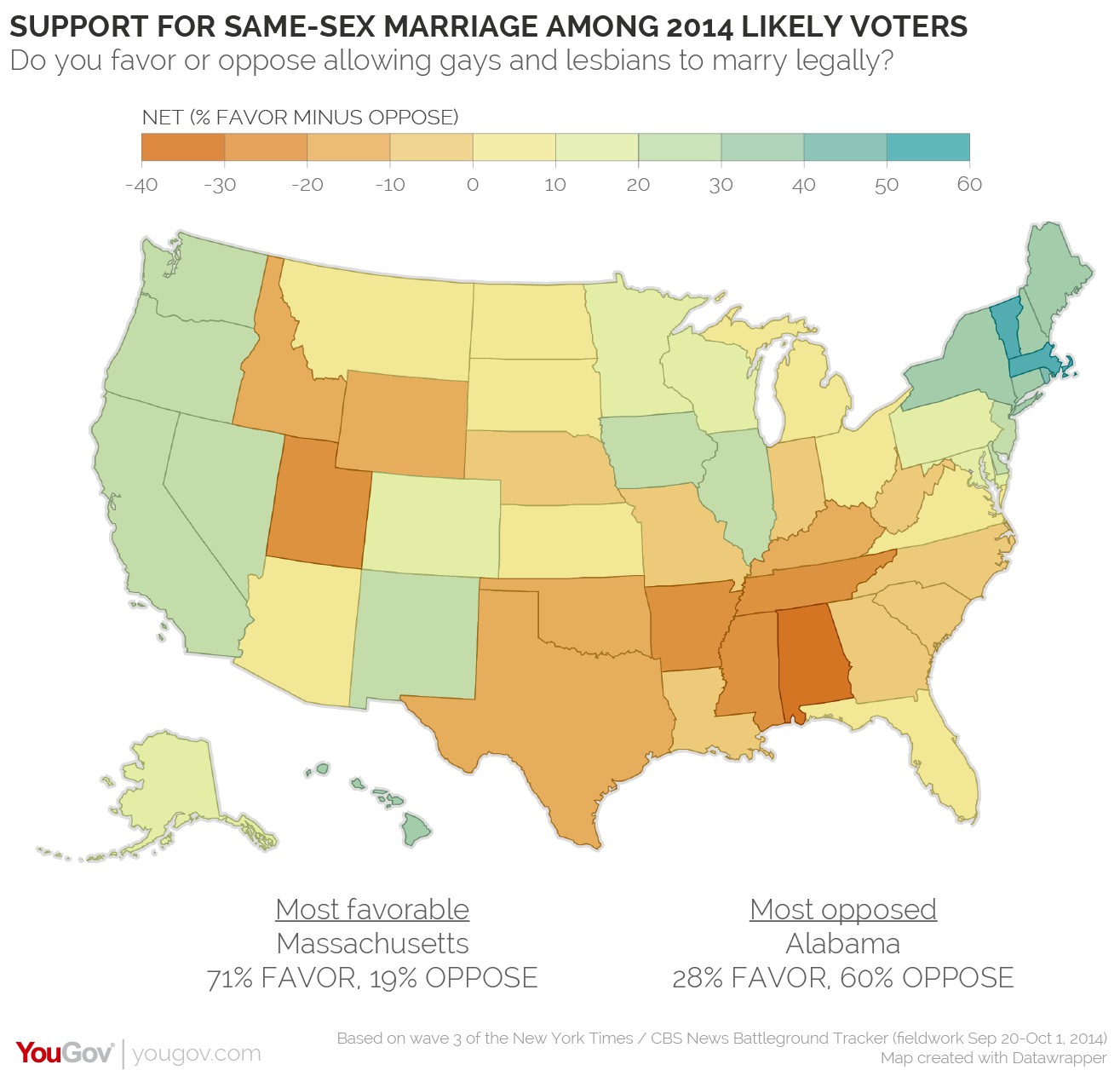
I recently saw this graphic from YouGov about the various levels of support and opposition for same-sex marriage:


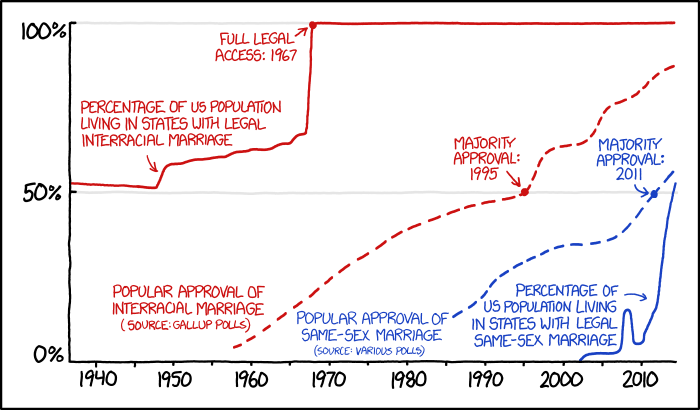
Pretty cool graphic. The accompanying text pointed out that "Americans who are likely to vote in the upcoming elections tend to support (48%) rather than oppose (39%) allowing gays and lesbians to marry." This confirms reporting about polls showing general support in the US population for SSM. And - unlike inter-racial marriage - the popular position is leading the legal position, as xkcd shows in another of his amazing graphs:


Pretty neat stuff, especially for data, graph, and map nerds like me.

And then... I read the comments...
Well, I made the mistake of reading the comments, and I found - at the end of one relatively short string of back-and-forth - a statement by "William," who (for some reason) couldn't understand how the non-discrimination language of the 14th Amendment worked to alter the 1st Amendment. (In brief - and remember: IANAL - the 1st Amendment disallows Congress from making state laws about the establishment and practice of religions. The 14th Amendment disallows any state from discrimination, even if it's religiously justified discrimination. There. Not too hard to understand.) This is what he wrote:
Where is the lack of equal protection? Gay people have equal protection. What gay people want is a special classification for their perverted behavior and for everyone to accept that perverted behavior. Acceptance of the homosexual perverted behavior will Never be accepted by a large portion of the United States.

Concerning sentences 1 & 2
Well... The first two sentences are a patent misunderstanding (whether deliberate or not) of why anti-SSM creates a lack of equal protections. Maybe William should go read explanations online (such as at Wikipedia).

Concerning sentence 3
The third statement (discounting the obvious and heavily biased point of view) is just a case of special pleading on his part. As Ricky Gervais points out:
Same sex marriage is not gay privilege, it's equal rights. Privilege would be something like gay people not paying taxes. Like churches don't.
I couldn't have said it more succinctly. But perhaps William just doesn't like Ricky Gervais. Well, the edited volume by Rimmerman and Wilcox has a better explanation as to why SSM isn't a "special classification" and isn't actually the conferral of special privileges:
Antigay groups insist that allowing gay couples to marry represents granting gay people a special right on top of the right they already have. ... The Family Research Council compares laws restricting marriage to opposite-sex couples to laws preventing cousins from marrying and laws preventing adults from marrying children... "since these restrictions apply equally to every individual" (Sprigg 2003).
          In other words, since a gay man could marry a woman and a lesbian could marry a man (as many gay people have done -- often resulting in unhappy and dysfunctional marriages), they have the right to marry. But for a person who is attracted to and capable of falling in love with someone of the same sex, such freedom or right is pretty meaningless. In fact, these restrictions do not "apply equally to every individual" but limit the ability of gay people only to protect their life partner relationships.
          People on death row, mass murderers, rapists, and child molesters can all get married as long as they are marrying someone of the opposite sex. Yet gay and lesbian people are denied this fundamental right because the people they love are of the same sex. Their right to marry someone of the opposite sex doesn't mean much; it doesn't allow them to marry the person they love.
(Emphasis mine. Emphasis in the original.)

Perhaps William would respond with some version of the slippery slope argument (since many anti-SSM arguments usually fall back on some version of the argument of, "Well, if we allow men to marry other men, then what's to stop plural marriage, incest, or bestiality?" I'll let John Corvino take this one.


Concerning Statement 4 (the real "Hunh?!?" statement to me at this time)
But it was the last statement that had me scratching my head: "Acceptance of the homosexual perverted behavior will Never be accepted by a large portion of the United States."

Ummm... But SSM is already accepted and supported by the majority of the United States population. This - by definition - means that SSM IS "accepted by a large portion of the United States."

A recent Pew poll shows a 54% majority in favor of same-sex marriage, and the anti-SSM position is only 39% and falling.

In other words, "the homosexual perverted behavior" that William contends will "Never be accepted by a large portion of the United States" is actually - right now, today, throughout the United States - accepted by the majority of the populace. This means that the largest portion of the United States supports "the homosexual perverted behavior" (or at least allowing people who are homosexual to get married to another person of the same sex).

Now, William could say that what he actually meant by "large portion" is actually some portion of the population that is smaller than the majority, but that is still "large." But that raises the question of when is a "large portion" no longer large? Based on nothing more than the idea of a pluarlity being a portion large enough to become a ruling party (and assuming a three-party system like in the UK), I'd argue that 33.333% (i.e., 1/3 of the population) is scraping the bottom of credulity for what it means to be a "large portion." (I could have used the Italian multi-multi-multi-party system, but that case is far more complex than the three-majority-party system of the UK.)

(As a side note, I'd extend the above logic to say that  anything less than 1/3 changes is no longer a "large portion," and it enters into "minority" territory, although I'd be generous and say that anything more than 1/10 makes a group a "sizeable minority," but a minority nonetheless. In other words, if a position is supported by less than 1/3 of the population, I'd argue that it's not a position held by a "large portion" of the population.)

Now time for a thought experiment!
Okay, now that we've got a cut-off of what a (semi-credible) definition of "large portion" actually might be (I'm saying that it's 1/3 of the population), we need to determine how quickly the anti-SSM position will fall below that threshold. We have data from Pew on anti-SSM polling, and it's apparent that - since 2009 - there has been a relatively linear trend (whereas before 2009, anti-SSM sentiment bounced around without any major trend). Now, given this strong trend since 2009, let's just assume that the popular trends of anti-SSM from the Pew poll continue along the paths of the that they have been on since 2009. (Yes, I am well aware of the problems of doing linear extrapolations into the future, but this is just a simple thought experiment.) Plugging the data into Excel, we get a linear trend for the anti-SSM from 2009-2014 has an R^2 of 0.9069 (which is pretty friggin' high, given that the maximum is an R^2 of 1), and using the regression equation, we get the following projection:

2015: 36.07%
2016: 33.44%
2017: 30.81%
2018: 28.19%
2019: 25.56%
2020: 22.92%

Yowzers. If the anti-SSM trend continues (and that's a big if, supported by nothing other than arm-waving conjecture), then it will be around 2016 that the portion of the US that holds William's position drops below 1/3 of the country, and - as such - it can no longer be counted as a "large portion." Furthermore, it will be sometime in 2020 that the portion of the US that holds William's position can no longer (at least in my books) be counted as a "sizable minority."

But what if I took the entirety of Pew's polling, and go all the way back to 1996? Well, the slope will be less steep, which does change the resulting percentages (but the R^2 drops to 0.8853, which - admittedly - is still pretty good):
2015: 40.73%
2016: 39.34%
2017: 37.96%
2018: 36.57%
2019: 35.19%
2020: 33.80%

So... not as drastic. If we assume (again, based on nothing) that the overall trend from 1996-2014 is actually the more realistic trend in the anti-SSM position, then William's position will only cease to be a "large portion of the US population" sometime in 2021 by this estimation. Still 7, years is still a lot faster than his contention of "Never."

Of course, there's a reason for this trend: a major generational shift. As Pew reports on this crucially important fact:
"Currently, 68% of Millennials favor [SSM], compared with 55% of Gen Xers, 48% of Boomers and 38% of the Silent generation."

Or, to put it another way the kids (aged 5-13) in the video below will become eligible voters in 2018-2026 (when the members of the Silent generation will be aged from 73-88 in 2018 and 81-96 in 2026):

Sunday, August 31, 2014

When symbology means something completely different to you

I saw that one of my friends changed his Facebook profile pic to this:


The first thought that came into my head was, "Well, so, too, were the dodo and the passenger pigeon..."

The next was, "...and shouldn't it read, 'You are the result' - unless the message is for a 3rd person plurality, which is strange given how signs accompanied by messages to "you" are generally meant for the 2nd person...?"

My thoughts on grammar continued with, "...and shouldn't it be '... evolutionary successes...' since evolution is a process requiring consistent - and relatively constant - successes in mating and survival...? I know that the sign could mean to use success in the uncountable form, but that would be incongruous, given how "results" is used in its countable form."

My thoughts then strayed back to the implications of the wolf, given the message, and it was something like, "...and what's the point of using a wolf... a species that has been extirpated in much of its native range, and is - in many ways - a prime example of a species that, despite it being the culmination of billions of years of evolution, has until recently been going the way of the dodo and the passenger pigeon?"

Maybe - as an ecologist with an evolutionary background and a great interest in grammar - I'm just thinking about this too much?

Saturday, August 30, 2014

Apparently Russia and Canada can't agree on what belongs to Russia

NPR had a fun-with-maps story about how Canada's delegation to NATO tweeted the following map to show where Russia is (and isn't):
This was in response to Russia claiming that the Russian military convoys and vehicles that had entered Ukraine were just lost... or something similarly implausible.

However, look at the map that the Canadian delegation sent. It fails to label Kaliningrad as being part of Russia. By the way, here's a handy map showing you where Kaliningrad is:
Whoops! Apparently the GIS program that the Canadians were using didn't automatically include Kaliningrad as Russia. But the lack of recognizing Kaliningrad as part of Russia was apparently less important than showing that Crimea was Russian and that Abkhazia wasn't Georgian. This is the "corrected" map that Russia tweeted back to the Canadians:
(Never mind that almost the entire world doesn't recognize Abkhazia. Never mind that almost the entirety of the world doesn't recognize Russia's claim to Crimea, either.)

Friday, August 29, 2014

Mozart rap: Great advice for growing up

Wish I knew some of these things when I was a teen. Wish that I had followed up earlier on some of these things that I knew.

Thursday, August 14, 2014

When People Do and Don't Listen to Scientists

I saw the following on a friend's Facebook wall:


This reminded me of a talk that was given by Dan Gilbert back in 2007. As I summarized when I wrote about this, this is because:
Four features global warming lacks:

A face: understanding what other people are doing is so crucial that our brain has developed an obsession about human agency. This is why we see faces in the clouds, but not clouds in peoples' faces. Global warming is not trying to kill us, and that's a shame.
A violation of moral suasion: Visceral emotions are aroused by things our brains have been concerned: food and sex. NOT atmospheric chemistry. Societies are built around who you can sleep with and what you can eat, and not about how much you can consume.
A threat to the present: The brain is an exquisitely designed "get-out-of-the-way" machine. Only recently has our brain been able to think about the future and take actions againt a future event, which is why we use dental floss and invest in 401k plans. However, global warming is still in the "R&D" version.
Ability to see absolute changes: Because we are so bad at perceiving changes gradually, we are more likely to tolerate it since it was a day-to-day gradual change, not an abrupt one.
 While global warming lacks these things, ebola has all of them.
A face: ebola is carried around by people.
A violation of moral suasion: There are many social hangups about the sick, and some people (and societies) explain one's sickness as an outcome of one's past moral choices.
A threat to the present: Over and over again, one of the most prominent things that is said about ebola in its description is it's high mortality rate: up to 90% mortality. That's a pretty immediate threat to the present.
Ability to see absolute changes: One day a person is well, the next day that person is sick, another day and that person is dead; very, very absolute changes.
 So, yeah, when people are talking about global warming, who cares about what the scientists are saying? (Because global warming doesn't punch the "reactionary buttons" that we have evolved.)

Conversely, when people are talking about ebola, who cares about what the scientists are saying? (Because ebola punches - and punches hard - all of the evolved "reactionary buttons" that we have.)

Here's the video of Dan Gilbert's 2007 talk:

Monday, July 28, 2014

The difference between "few" and "a few"

It's one of the things that many non-native speakers of English get wrong: the distinction between few and a few. For example, let's take the following pair of sentences:
At the start of the 2014 World Cup, there were few signs that the final would include Germany.
At the start of the 2014 World Cup, there were a few signs that the final would include Germany.
What's the difference? While most native English speakers would immediately recognize the difference, to many English-language learners that I have encountered in the past, there is no discernible distinction. This could get them into a bit of a pickle in writing.

The simple explanation of the difference is that few means "almost zero" and is generally of a negating connotation, while in contrast a few means "a small amount, but definitely not zero" and is generally of a positive/additive connotation. Therefore, the above sentences would mean something like:
At the start of the 2014 World Cup, there were almost no signs that the final would include Germany. (i.e., It was unimaginable that Germany would make it to the final.)
At the start of the 2014 World Cup, there were some signs that the final would include Germany. (i.e., It was possible to think that Germany would make it to the final.)
As to why this distinction exists, it's partly because few is an adjective, while a few is a noun.

As an adjective, it implies that the expected value is vanishingly small. Therefore, if we initially had a high expectation that Brazil would reach the finals, the possibility that it wouldn't was approaching zero.

In contrast, as a noun, it implies that the actual amount was more than zero. Therefore, if we initially had an expectation that Germany would fail to go to the finals, our perception of that possibility would have been that it was greater than zero.

In reality, the number in question (e.g., the number of signs that Brazil wouldn't reach the finals) could be known or determined. The difference is how you interpret that number. For example, if we stated that the odds for making the finals of the 2014 World Cup stated on July 5, 2014 were:
Odds for World Cup semi-finals:
Brazil wins 80.09 %
Germany wins 19.91 %
Argentina wins 61.60 %
Netherlands wins 38.40 % 
It means that - on July 5th - there was an expected 19.91% chance that Germany would win their semi-final match to enter the finals against the winner of Argentina vs. Netherlands. This is almost a 1-in-5 chance that they would make it. And here is the crux in how our interpretations of the same number would change the meaning of the sentence.

If we had interpreted that 1-in-5 as a vanishingly small chance, then we'd use, "...there were few signs that the final would include Germany."

However, if we had interpreted that 1-in-5 as a distinct (if small) possibility, we'd use, "...there were a few signs that the final would include Germany."

... and that's basically it. Simple, no?

One additional note: The meanings for few and a few remain consistent when the thing your talking about is stated as a negative. For example:
There were few signs of Brazil not reaching the final.
Here, the direct implication is, "There were almost no signs of Brazil not reaching the final." After doing the trick in English of transforming two negatives into a positive, we have the implicitly understood interpretation of this statement as something like, "There were many signs that Brazil would reach the final." The use of a few leads to a contrasting sentence, similar to the examples using Germany:
There were a few signs of Brazil not reaching the final.
Here, the direct implication is, "There were some signs of Brazil not reaching the final," which is almost the direct opposite of the implication of the previous statement.

So, in short:

  • If you want to emphasize the near-zero quantity of something, use few.
  • If you want to emphasize the not-at-all-zero quantity of something, use a few.


Addendum: Of course, there is also the use of the few. However, as with most uses of the to convert an adjective into a noun (e.g., the elderly, the hungry, the poor, the tired, the wealthy, the powerful, etc.), it is referring to a distinct and defined (either implicitly or explicitly) group, usually of people. Thus we understand the recruiting phrase used by the US Marine Corps, "The few, the proud, the Marines," as referring to an implicit exclusivity that is associated with the culture of the US Marine Corps. Similarly, given the interchangeability of pronouns for articles, we can understand the following use of we few from the St. Crispin's Day speech in Henry V:
From this day to the ending of the world,
But we in it shall be remembered-
We few, we happy few, we band of brothers;
... and an excuse to post this lovely rendition of the St. Crispin's Day speech: