SciShow recently did a video about some of the taboos in science:
For a long, long, long time, the science of human sexual intercourse was also taboo. Really bad. Many of us now know of (or have heard of) the Kinsey Report. Some more of us might well have seen Kinsey. There has been a lot of additional scientific research into human sexual intercourse, continuing to (quietly) dismantle the taboo of researching sex. There are even journals like the Journal of Sex Research that present research on findings of human sexual intercourse. Still, though, in many cultures (including many in the so-called "enlightened" and "liberal" countries of the "West"), the scientific study of human sexual intercourse remains a taboo (even though it is an activity that almost every adult will do at some point during their lives). A recent book by Mary Roach - Bonk: The Curious Coupling of Science and Sex - provides an interesting and humorously written account of the history of human sex and science.
In fact, Mary Roach has written several books that touch on topics that are somewhat taboo in science (or at least somewhat taboo in the social perspective of what science is doing), these are - including Bonk - Stiff: The Curious Lives of Human Cadavers, Spook: Science Tackles the Afterlife, and (somewhat less controversial in topic matter; at least socially so) Packing for Mars: The Curious Science of Life in the Void.
There are many types of social taboos, too, that have been raised through time, and Gribben does a great job of wending the way through Western science (primarily from 1542, but he does delve back in time to explore the "roots" of certain areas of science) in his highly readable account: The Scientists: A History of Science Told Through the Lives of Its Greatest Inventors. Through this, we discover that there are many times when scientific theories have been postulated that then get overturned by the work of (often) one (often) man, even though the reality of the time may have been a little bit more of a battle field of ideas. (Indeed, he makes allusions to this when he describes why Newton wrote the line that included the now-famous phrase, "standing on the shoulders of giants".) Still, Gribben - possibly due to his not wanting to focus too much on processes of change through history - didn't focus on the what Thomas Kuhn wrote (not so eloquently) about in The Structure of Scientific Revolutions; namely that changes a scientific paradigm involves a certain amount of addressing topics that may be taboo within the scientific community (but not necessarily taboo in general society, since the implications of such changes are not readily apparent or readily understandable).
Showing posts with label book review. Show all posts
Showing posts with label book review. Show all posts
Sunday, August 05, 2012


Friday, March 30, 2012
A bit of a disappointment

I just finished The Gunslinger, and I have to say that I was a bit disappointed with it. I don't know if I will be continuing the series any time soon. Oh, well. I guess that I'll just have to find another series to start reading.
Friday, July 02, 2010
Nothing to Envy
I just finished reading Nothing to Envy by Barbara Demick. It is a recounting of oral hisotries given by six North Korean defectors to South Korea. The tales are well-researched, moving, and powerful in their simplicity and horror. What spoke to me the greatest was the description of how the people came to their individual disillusionments of the regime. The stories -- chosen from over one hundred interviews -- interweave the lives of these six people in such a way that, even though, some of them didn't know each other, the reader (by being able to examine each person's life) is able to gain a much greater (and more powerful, harsh, and sad) understanding of life leading up to and following the death of Kim Il-Sung.
The death of Kim Il-Sung in July of 1994 marked the beginning of the utter collapse of the nation's social and physical infrastructure, and this is recounted in the book, as seen through the six sets of eyes, as well as a social interpretation of the greater context befalling the DPRK. Demick never seems to stray into reveling in the details of prison life, torture, executions, and death, as might be so easily done with the subject matter. Instead, the narratives lay out the horrors of the regime and the disintegration of life in a manner that is both starkly painful and yet not intrinsically repulsive. Reading between the lines, however, one can imagine that the descriptions -- as bleak as they are -- are themselves the examples of the silver lining, rather than of the darkness.
I don't know exactly when I became interested in life in North Korea. It might well have been when I was given a small assignment on North Korea when I was doing research for a political science professor. The news clippings from the Los Angeles Times (where Demick works) as well as releases from Amnesty International, the UNHCR, and the US State Department all piqued my interest in this seeming "parallel dimension" that exists on the Korean Peninsula. It was the first time that I read about the devastating famine that killed off so many people, but yet was something that I had never heard about. True, the tragic events in the Balkans during the mid-to-late 1990s was more present in my mind, since I was living at the time in Hungary, just "next door" to the fighting. Still, reading first the pieces I dug up in research, and other works on North Korea, and now Demick's book, I have always felt some sort of strange attraction to this time in history, and I don't really know why.
I had leafed through a copy of Guy Delisle's Pyongyang one day at my local Borders, and was intrigued by the graphical depictions of life in the city. I also watched short videos from North Korea on the History and Discovery channels, as well as on YouTube. A part of me has this strange, moribund interest in visiting the "Hermit Kingdom," so that I can see it "before it collapses" (as Demick notes many tour packages to the country are sold on). However, as of now, I have only books and video on the country, its history, its people, and their conditions. While that curious part of me wishes to visit before the collapse of the regime, a larger part of me, wishes the whole thing to dissolve; to fade eventually into a nightmare that quickly becomes just a hazy memory in the light of day. Of course, as Demick points out in her book, this reunification (if it were to happen), would be several orders of magnitude more monetarily expensive than the reunification of Germany... and since the Koreas have been separated for longer than the Germanies were, the social costs of reunification also continue to trouble the South Korean government as well as cause a greater re-calculation of costs among South Korea's youth.
Thursday, July 16, 2009
Friends Like These
Before traveling to Britain, I had no idea who Danny Wallace was. Indeed, I didn't know anything about the book until I was making my way back to my friend's R.M.'s house in Charlton (near London): there was a poster of the book plastered on the side of some building (or maybe it was a bus), and I read the subtitle: "How far would YOU go to get the old gang back together?" This subtitle piqued my attention because I felt that - having lived in several different countries, lost touch with some good friends over the years, and having just celebrated by 32nd birthday - the idea of getting the "old gang" back together was something that I could relate to; a yearning that I have had in the past that led me first to Friendster, MySpace, and Bebo, and leading (now) to Facebook, and connecting (even just today) with friends - both close and casual - from different periods of my past.
 The book describes in first-person narrative, the travels of Danny Wallace as he goes to find and meet up with the twelve people who were the most important to him growing up. (So important, in fact, that they were the only ones that made it into his special address book.) It's a trip not only of rediscovery, but also of approaching, inevitable adulthood taking him from London to Loughborough, Berlin, LA, Melbourne, Tokyo and Dundee in order to find the people who were the most significant to him.
I still don't really know much about Danny Wallace, but after reading his book Friends Like These, I think I know more about him. Similar to his mother, I know that mine is holding boxes in the crawlspace in their house full of my "stuff" from school (she has other boxes of my brother's stuff, too). There are yearbooks full of people I haven't seen or really thought about in years (decades in some cases).
The book took place in 2006, and now - three years later - some of the events seem haunting. The recent death of Michael Jackson was juxtaposed quite strangely in my head as I read all the references to MJ in the book, for who could deny that Jackson was a major cultural figure to people born in the late 1970s, like Danny and me. Still, learning about Danny's journeys two weeks after the death of the King of Pop was somewhat haunting, since it seemed like - for a moment - two realities existed simultaneously: the reality of the book (taking place in an indefinite "present") where Danny ends up going to a Michael Jackson concert with one of his old friends (sorry for the spoiler) and the reality of (well) reality.
Another thing that the book did for me was make me start to realize that I, too, am growing older. The book depicts events leading up to Danny's 30th birthday in 2006. It is now 2009, and I just celebrated my 32nd, learning yet more about myself and the connections I have to my own friends from my undergraduate studies in St Andrews. Time flies when you're having fun, and yet (and yet) it is with only a certain few that robust connections - no matter how thin - remain. However, although these connections are thin, their strength allows one to build stronger bridges upon them - a network of connections holding together that social fabric against which we identify ourselves.
This book may not be for everyone. Indeed, I think that Danny's voice is very strong in the book (it is, after all, written in the first person about personal events and personal thoughts), and it may not be for everybody. It might be difficult - for example - to identify with a man who grew up in different parts of the UK and Europe with friends from a similarly diverse background. It might be difficult, too, understand some of the cultural references or significances of certain types of statements about pubs, mates, and display cushions. However, if you are a kind of person who is interested and trying to reconnect with childhood friends (even passively through online "social networking" sites like Facebook), then this book might just be for you.
(Also, as a person who lived in Japan, his chapters about finding his friend in Japan, and his experiences in Tokyo and outside it, had me cracking up with laughter. But then again, most Westerners' takes on the "bizarre" nature of Japan - Tokyo in particular - often seem to be quite humorous to me, since I am able - I believe - to see both sides of that Lost in Translation coin.)
The book describes in first-person narrative, the travels of Danny Wallace as he goes to find and meet up with the twelve people who were the most important to him growing up. (So important, in fact, that they were the only ones that made it into his special address book.) It's a trip not only of rediscovery, but also of approaching, inevitable adulthood taking him from London to Loughborough, Berlin, LA, Melbourne, Tokyo and Dundee in order to find the people who were the most significant to him.I still don't really know much about Danny Wallace, but after reading his book Friends Like These, I think I know more about him. Similar to his mother, I know that mine is holding boxes in the crawlspace in their house full of my "stuff" from school (she has other boxes of my brother's stuff, too). There are yearbooks full of people I haven't seen or really thought about in years (decades in some cases).
The book took place in 2006, and now - three years later - some of the events seem haunting. The recent death of Michael Jackson was juxtaposed quite strangely in my head as I read all the references to MJ in the book, for who could deny that Jackson was a major cultural figure to people born in the late 1970s, like Danny and me. Still, learning about Danny's journeys two weeks after the death of the King of Pop was somewhat haunting, since it seemed like - for a moment - two realities existed simultaneously: the reality of the book (taking place in an indefinite "present") where Danny ends up going to a Michael Jackson concert with one of his old friends (sorry for the spoiler) and the reality of (well) reality.
Another thing that the book did for me was make me start to realize that I, too, am growing older. The book depicts events leading up to Danny's 30th birthday in 2006. It is now 2009, and I just celebrated my 32nd, learning yet more about myself and the connections I have to my own friends from my undergraduate studies in St Andrews. Time flies when you're having fun, and yet (and yet) it is with only a certain few that robust connections - no matter how thin - remain. However, although these connections are thin, their strength allows one to build stronger bridges upon them - a network of connections holding together that social fabric against which we identify ourselves.
This book may not be for everyone. Indeed, I think that Danny's voice is very strong in the book (it is, after all, written in the first person about personal events and personal thoughts), and it may not be for everybody. It might be difficult - for example - to identify with a man who grew up in different parts of the UK and Europe with friends from a similarly diverse background. It might be difficult, too, understand some of the cultural references or significances of certain types of statements about pubs, mates, and display cushions. However, if you are a kind of person who is interested and trying to reconnect with childhood friends (even passively through online "social networking" sites like Facebook), then this book might just be for you.
(Also, as a person who lived in Japan, his chapters about finding his friend in Japan, and his experiences in Tokyo and outside it, had me cracking up with laughter. But then again, most Westerners' takes on the "bizarre" nature of Japan - Tokyo in particular - often seem to be quite humorous to me, since I am able - I believe - to see both sides of that Lost in Translation coin.)
Wednesday, June 17, 2009
The Prodigal Tongue
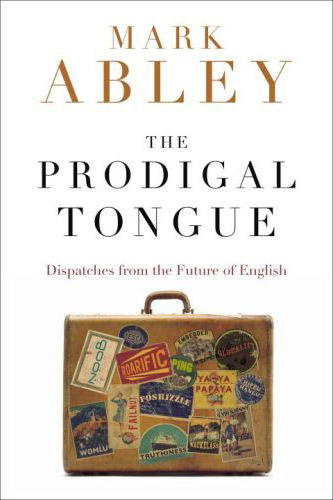 Just finishing up the book The Prodigal Tongue by Mark Abley. It is a really good read, put together along themes built around the author's travels around the world. Indeed, the book is kind of put together like a travel memoir, with each chapter not only based in a place, but also based around a concept of the changing nature of the English language.
He travels not only the "English-speaking" world, but also large swaths of the geography of the English language itself, starting with dictionaries and the creation of new words, the amazing vibrancy of "Asian English" (i.e., English spoken in Singapore), the infusion of English into other languages, the "special case" of Japan, the interplay of English and Español in Los Angeles, the influence of rap and R&B on US and world English, possible future trends in English, the impact of cyberspace on English communication, and finally the "usability" of English. In all, it's quite a heavy-hitting trek through the world of spoken (and written) English of the early 2000s (and even then, only a small part of it).
Some interesting things that he writes come up as truisms to me, especially when I recall those days when I was in highschool in Taiwan and traveled to other countries in Southeast Asia. Listening to the clipped tones of spoken English - complete with borrowed words and grammar - brought those sounds vividly to my mind as I read thinks like this:
"Your mouth is your tiger" - so says a Malay proverb. Given the sheer number of people in the region and the tigerish leap of their economies, it's possible that far in the future, Standard English will reflect an Asian norm rather than an Anglo-American one. Think of how syllables are stressed. In Britain, Australia and North America, variations in verbal stress are crucial to how people speak - the rythm of songs and poems depends on it. To a Western ear, the result sounds oddly percussive. That doesn't mean wrong.Having grown up for part of my childhood in Japan, having Japanese family members, and having studied Japanese in school, the chapter on English in Japan (Chapter 5: "Hippu Hangu") held more than a few topics that confirmed many of the things that I had remembered, as well as gave me a new insight into the Japan that had developed since I left it. For example, in order to discuss some of the psychological setting in which Japanese finds itself - in a world replete with English - Abley needed to first describe the condition of the grammar:
The absence of word-ending consonants can also disconcert. One day in Singapore I overheard a young man talking on his handphone to a past, present or future girlfriend. "You want me to repect you?" he asked. Except that it sounded closer to "Ya wa'me ta respe'ya?" In the unlikely event that an American were to ask "Got or not?" a Singaporean would probably hear "Gawd er nawd?" But an American listening to a Singaporean might hear "Gah'ah'nah?" If this sounds peculiar today, it may seem natural to our grandchildren. Beauty is in the ear of the listener.
For all the complications and elaborations of its script, spoken Japanese can be extremely concise. Pronouns are usually implied, not stated. Take the following brief exchange: "Did you go to the movie with Kazuki?" "Yes, I went." In Japanese, this might be rendered as "Kazuki to eiga e itta no?" "Un, itta yo." A literal translation would read: "Kazuki with movie to went that?" "Yes, went, final particle." Apart from its role as a name, kazuki can signify "pleasant peace" or, when written with different kanji, "shining one." Words look unseasy on their own. Conttext is everything.With regard to the (apparently) still-popular trend of using random English on Japanese items of clothing (kind of like how Westerners like to use random Chinese and Japanese on clothing and tattoos), Abley shares this piece of insight:
All of which begins to explain why the Japanese can appear so opaque to outsiders. "Eloquence is not one of the virtues people have been encouraged to cultivate," Masayoshi Shibatani writes in his book The Languages of Japan. "In fact, persuasion of others by means of linguistic skills is largely discouraged as direct confrontation in general is avoided ... It is the person's ability to arrive at an intended conclusion rather than the persuader's logical presentation that is evaluated. Thus, one who does not get the point by merely hearing hints is considered a dull person." From Periclean Athens to Hide Park Corner, the European tradition of rhetoric has aimed at convincing a listener by force of logic and argument. Japan's tradition is one that cherishes nuance and tolerates ambiguity, inviting a listener to come up with an implied meaning. If a man says that a woman is kirei, is he praising her beauty, her purity or her cleanlisness - or some combination of those attributes?
...
Foreigners who strive to master Japanese are often baffled by its remarkable system of keigo, or polite speech. Its rules place vocabulary at the mercy of social context. "Will X come to Osaka tomorrow?" seems a simple question. But depending on the setting, the speaker, the person being addressed and the person being asked about, it could be posed in more than twenty ways. Identity in Japan is fluid, open-ended, almost shockingly changeable. A male teacher might call himself watakushi (I, formally), boku (I, informally), ore (I, intimately or vulgarly), otosan (I as a father, talking to my children), sensei (I as a teacher, talking to my class), ojisan (I as an uncle, talking to other children) or niisan (I as an older brother).
... Once you start reading other people's clothing, it's hard to stop. Hard for me, anyway. A young blood in the station sported a T-shirt with the slogan The Sea Roars a Lullaby. Another T-shirt mysteriously declared: Happy Endless Bivis. ... For decades, sentences like these went by the name Japlish; but .. another name has recently come to the fore: Engrish. Websites are devoted to it. Engrish, like Japlish, cna refer to gnarled gobbets of language from all across East Asia. ... Why do they make such blunders anyway?
There are, as it happens, three good reasons. The main one is that English often functions simply as a design element in Japanese products. The words are not intended to carry any precise meaning - or rather, the meaning they're out to convey is that the product in question is hip, cool, ultranew. If you're manufacturing a T-shirt, the sea may as well roar a lullaby as murmer a pandemonium. A second reason is that in matters of grammer and phonetics, as well as vocabulary and social context, the differences between English and Japanese are huge. ... And third, some apparently inexplicable errors can be traced back to mistranslation. Why would a Japanese package of coffee have the name Ease Your Bosoms? The answer, almost certainly, is an inept rendering of the English phrase "Take a load off your chest."
There are many more interesting chapters and insights, but I'm not going to type them out here. (After all, I have to finish the book!) But if you are interested in learning about the breadth of the usage of English in today's world, then check out this book.
Monday, September 10, 2007
Thomas Kuhn and the Structure of Scientific Revolutions: Part I
I started reading Kuhn's The Structure of Scientific Revolutions the other day, mainly for a class I am currently taking in the Ford School of Public Policy. Having read about Kuhn makes reading his actual (long) essay on the structure of science/scientific revolutions pretty easy-going. I wonder how much of this is goblety-gook for the policy students in the course. (Of course, for the majority of students in the course - scientists and engineers - much of this might be obvious. But then again, maybe not. In any case, the discussion of the concepts of physical science to which Kuhn alludes should not be difficult for them to understand.) So far, my main complaint with Kuhn is that he doesn't get straight to the point, but uses several examples to flesh out his point. In this way, this work is similar to what he writes about in a pre-paradigm period:
I'm not saying that Kuhn's writing is encyclopedic, but he uses so many examples to discuss his point without actually stating directly what his point is.
I like the (apparent) jibes he makes of scientists, as well:
I start chapter V. More on Kuhn later.
"But though this sort of fact-collecting has been essential to the origin of many significant sciences, anyone who examines, for example, Pliny's encyclopedic writings or the Baconian natural histories of the seventeenth century will discover that it produces a morass. One somehow hesitates to call the literature that results scientific. The Baconian "histories" of heat, color, wind, mining, and so on, are filled with information, some of it recondite. But they juxtapose facts what will later prove revealing (e.g., heating by mixture) with others (e.g., the warmth of dung heaps) that will for some time remain too complex to be integrated with theory at all. ... Only very occasionally, as in the cases of ancient statics, dynamics, and geometrical optics, do facts collected with so little guidance from pre-established theory speak with sufficient clarity to permit the emergence of a first paradigm."
I'm not saying that Kuhn's writing is encyclopedic, but he uses so many examples to discuss his point without actually stating directly what his point is.
I like the (apparent) jibes he makes of scientists, as well:
"One of the reasons why normal science seems to progress so rapidly is that its practitioners on problems that only their own lack of ingenuity should keep them from solving."
I start chapter V. More on Kuhn later.
Monday, July 30, 2007
Painting the flagpole and HP:tDH
 This is the first time that I've actually seen this happening. Yes, every once in a while, the university must repaint the flagpole to a pristine white. (Why the U didn't do this before the Fart Fair is a mystery to me.)
Today is looking to be a "nice" day, although 85 F is not my personal idea of "nice." (Let the kvetching start up again!) Of course, some people might say that I should be happy that it isn't in the 90s F. To that I retort that the temperature in town even by tomorrow will be in the 90s F. (What do you think of that?) Of course, I could wait and see if I am vindicated or not. Or (as I choose to do at this time) I can kvetch.
On a completely different note: I finished the last Harry Potter book in the original English. Now, for all of you who still haven't read it, I'm not going to give away any spoilers as to plot. However, I will say that - like the other volumes before this one - the UK version differed from the US version in several ways:
- The pages aren't synchronous.
- The UK version physically smaller than the US version (much easier to carry around without looking like you are lugging around a copy of the King James).
- In the US version, each chapter has a little picture showing a highlight of the upcoming pages.
- The UK version has (IMHO) much better cover art than the US versions (and one can choose to purchase either the "Children's" cover version or an "Adult's" cover - there are no content differences between versions).
Wednesday, June 06, 2007
Book Review
 I am currently reading Christopher Hitchens' book God is not Great. Now before all of you start calling me an evil, godless, atheist, let me state a few things:
1. It has been - for a very long time - my view that people misinterpret holy scripture.
2. I do not know that I can interpret holy scripture properly (especially when considering issues of translation between language and across time; transcription errors; church politics through time; etc.).
3. I do not know who is interpreting holy scripture properly.
4. Doing things in the name of someone or something with the near-certainty of misinterpretation is more of an infraction against that person or ideal than doing nothing.
5. You do not need to be a follower of an organized religion to be a good person or do good deeds.
The book makes many of the similar points that I have stated above, and goes much further. However, I would not go so far as some of the points that Hitchens makes - mainly because he borders on hypocrisy. There are also a few factual errors that he makes (e.g., saying that the Rwandan genocide started in 1992, and mis-naming the Yasukuni Shrine). However these factual errors are minor, and do not disrupt the veracity of the author's argument about the hypocritical stances that religions have made over and over throughout time.
Okay, so this isn't the best book review that you might ever read (either here or elsewhere). However, I must say that the importance of rational thought is, more often than not, being pooh-poohed in much of what we call rational society. The idea that one cannot be moral without religion has always seemed bizarre to me, especially with the history pointing to several immoral activities backed by the Catholic Church (and its various Protestant progeny). These include (as a short list) the Crusades; the Spanish Inquisition; forced conversion of the peoples of the New World; Calvinist purges in Geneva; church-endorsed slavery; Franco's crujada otherwise known as the Spanish Civil War; Mussolini's church-backed fascist regime; the backing of Hitler's Nazi Party and the Third Reich; the various church-backed dictatorships in South and Central America; the religious and ethnic genocide in Rwanda; the religious and ethnic genocide in the former Yugoslavia; and the systematic rape, mental abuse, and physical abuse of children by clergy. The list goes on, but these are the major ones, including only those that stem from the Catholic and various Protestant churches. If you include the immoral activities of Eastern & Greek Orthodoxy, the various sects of Islam, branches of Buddhism, myriad beliefs of Hindus, the different groups of Jews, and the other more-minor religions of Asia, Africa, and the New World have all done things highly immoral by a humanist definition.
The only way that this book really threatens to fall down is in the Howl-like diatribe it sometimes dips into. Hitchens calls for rationalism, but he apparently doesn't always mean a calm rationalism.
Okay, enough for now. You probably realize that I'm not the most devout person in the world. However, even if you are a religious person, you should probably read through the book. If you want to know what non-believers think of religion (and therefore hope to come up with a rational argument against them) reading this book is a good tactic. If you are interested in how a rationality can stand independent of organized religion (while realizing that as a rationalistic person, you have to think through your reactions to the book), I think it is a good book to read, as well.
Subscribe to:
Posts (Atom)