Showing posts with label wonders of science. Show all posts

Saturday, July 30, 2016

To non-scientists, science is something that you can believe in

A friend of mind posted the following article to their Facebook wall. 
 
 
While I understand that some scientists feel annoyed with the framing of "belief in science," I thought that the author (and many of those scientists) got so many points wrong that it required a lengthy response.
 
Several points. 1. The author states, "Science is not a philosophy." Patently wrong; science is a philosophy. Indeed, for a long time, it went by the name "natural philosophy," since it is a framework of knowing about the natural world.

2. "It is a methodology." If this is all that the author thinks science is, then the author has a dim view of science. Science is far more than either a single methodology or even merely methodology. It is, as I wrote above, a means of knowing the natural world.

3. "[Science] is not something you believe in." Sorry, but this is also false. For non-scientists, who are not involved in the process of collecting, assessing, and interpreting information through the various methodologies of science, there is a belief that the whole institution works; that the whole institution provides reliable answers; that the whole institution is usable for more than the purpose of navel-gazing.

4. "Of course, the word 'science' has come to represent much more than the scientific method." For someone writing an article about what science is and isn't this is so bloody obvious that it's the very first thing taught in many philosophy of science courses (which - apparently - this author never took).

5. "[Belief in science] has also become political shorthand." Yes, this is true. But the way the author addresses this point is irrelevant in terms of the acceptance of different types of science. Hillary likely doesn't really want to "believe" in the science that doesn't fit into the platform of her party, such as the carbon benefits of constructing loads of nuclear power plants. However, the 'science-as-fig-leaf' use of science in politics is neither new nor surprising to anyone who has spent even a modicum of time looking at how science has been used, abused, ignored, or highlighted during the past two decades.

6. "'The idea that you can believe your own facts is an unfortunate consequence of the whole climate denial movement.'" I would argue that both the author and Prof. Russell are right, but speaking irrelevantly, since most people are not in the business of doing science (even once or twice removed). In other words, the point of stating "belief" or "non-belief" in one field of politicized science (be it evolution or climate change) is not about scientific knowledge and understanding of the subject matter, but more an issue of identity (both personal and political). And in that framework, speaking about "belief" is far more accurate and useful than speaking about "knowledge" and "understanding," simply because people can't be bothered to spend the time to get to know the science (just like everyone has some parts of life that they just can't be bothered to learn about to have a working knowledge of, and so merely just presume it to be so, like how a GPS works or how a car operates; unless you know, you are basically just believing that everything is working as it should).

7. "But Republicans could hear her tone as mocking not their candidate, but them." Umm... if the point of stating belief or non-belief in climate science is to present political identity (which the author does acknowledge above), then any tone Hillary takes is going to be seen as mocking them, and not their candidate. This isn't about convincing the people who incorporate climate-change denial into their political identity; this is about convincing the people who are on the fence (yeah, there are people on the fence) or who do believe in/understand climate change science that Trump is not their man.

8. "People who remain unconvinced that humans are a significant contributor to climate change are not necessarily anti-science (whatever that means." True, but when given the choice of a person who supports big government programs, then the type of person the author is talking about is likely going to be highly distrustful of her, anyway. It's like the author is thinking that it's an all-or-nothing gambit.

9. "It changes the practice of science from a method for understanding into a dangerous political weapon." Yeah... it's her fault. I mean science as *never* independently categorized into "good science" and "bad science" under the Bush administration... Oh, yeah, it was. And science has *never* been used for political purposes before 2000... Oh yeah, it was. Hell, even the creation of the NSF was done for the purpose of using science to help the government. Arguably, the use of science in agencies - from NASA to USGS - all are pursued for public policy purposes, and those purposes can be changed due to political winds. (Remember how the Republicans have threatened again and again to stop payments for Earth-monitoring satellites and "reminding" NASA that their mission is not to look at Earth, but to look out at the universe?) And let's not forget about how military science progresses, if *not* for a specific and applied used of political weaponry. So let's not get lulled into this utopian idea that science and politics are two separate worlds that have never and should never mix; they have been bedfellows for decades and decades and decades.

10. "At its best and most objective, science can heal divides, answer questions, solve problems." Let's take those one at a time. If the best science can heal divides, then it *is* being used for political reasons, which the author *just said* was when science would be diminished. Seriously; pick a side here. Next, the point of science is not about answering questions; some scientists would argue that science is about learning to ask better questions. Indeed, in the context of the larger question of "what is science," many scientists (and philosophers of science) would argue that science can never prove something to be true, but only that something is false. As such, we are left with the question of whether answering what something *isn't* is actually positively answering a question, since - in order to get a positive answer out of statements of what something isn't - one must negate the infinite set of what things it isn't in order to show that it is something. Finally, the question of whether science can solve problems depends on what problems you are asking science to solve (and the frameworks of science that you are using to try and solve the problem). Wicked problems (usually those that involve society) generally are not completely amenable to science, while those problems that science is really good at solving (usually those that completely exclude society) are - by their nature - not often relevant to society. In addition, there is the "science-as-the-genie" problem (my own phrase; I can't remember what the "technical term" is for this phenomenon), where science creates a new understanding or leads to a technological breakthrough that creates a whole new paradigm in which existing social norms and laws are no longer applicable or capable of addressing the advance. In such cases, science can be seen as creating a whole host of new problems... which may require science to solve again (a commonly cited example is the splitting of the atom and the ushering in of the nuclear age). So, no: by the factors listed by the author (and also by a myriad of factors the author failed to list), this assertion is just wrong, wrong, and wrong.

In short, it seems that the author is cleaving to a very narrow (and very limited) definition of what science is in order to make a very shallow and limited argument. I would suggest that the author - and people who think much along the lines of the author - read the book Honest Broker. It explains how science is used to support (or not) various political positions by various types of actors. I would also suggest that people pick up Michael Specter's Denialism, which discusses the problems of science denialism and also touches on pseudoscience and the question of "belief" in and of science. Finally, it might help the person who agrees wholeheartedly with the fundamental miscontrual of science to read even a primer on the philosophy of science to discuss what is science (the Oxford press's short introduction to Philosophy of Science is a decent book to pick up); science is - after all - far more than methodology and facts. It is - indeed - a means of knowing of the natural world (i.e., "natural philosophy").

Monday, November 23, 2015

Facts about the human body. Did you find them as (un)fascinating and (un)weird as me?

A friend posted a link on his FB wall whose click-bait title blares, "23 Fascinating and Weird Facts About The Human Body. Wow."

When friends post these sort of fact lists, I often like to go through them to challenge their initial premise (usually that I will be shocked, amazed, fascinated, tickled, or some other sharp reaction). I have yet to find a list that actually I actually found lived up to its premise, and I have also yet to find a list of facts that is 100% factual.


So here's the list of the 23 "Fascinating and Weird Facts" and my responses to them:

1.The brain doesn’t feel pain: Even though the brain processes pain signals, the brain itself does not actually feel pain.

Not fascinating; the brain was not evolved to be in direct contact with the environment. If the brain actually could feel any pain, *that* would be fascinating.

2. Women have a better sense of smell better than men: Women are better than men at identifying smells.

Women - on average - have a better sense of smell than men - on average. Again - on average - women are better than men - on average - at identifying smells. Many specific cases will differ.

3. Babies are stronger than oxen: On a pound for pound basis, that is. For their size, babies are quite powerful and strong.

This is not only limited to babies and oxen. This is a general characteristic among any group of animals of a type. Pound-for-pound, a mouse is stronger than an elephant; an ant is stronger than a samurai beetle; and a house cat is stronger than a great dane. But so what? This is due to issues of scaling and inherent limitations of physics and biology that come with larger body size.

4. A higher I.Q. equals more dreams: The smarter you are, the more you dream. A high I.Q. can also fight mental illness. Some people even believe they are smarter in their dreams than when they are awake.

I am skeptical. I haven't heard of the study that came up with this result, and given the problems of whether IQ tests actually measure intelligence and the many flaws with dream recollection studies, I'm wondering how much validity this statement carries.

5. Your smell is unique: Your body odor is unique to you — unless you have an identical twin. Even babies recognize the individual scents of their mothers.

No duh. Just like finger prints and DNA. Even between identical siblings; if one sibling eats only Indian food and the other eats only Japanese food, they will have different body odors. If they grow up in different places, they will also have different body odors.

6. A sneeze can exceed 100 mph: When a sneeze leaves your body, it does so at high speeds — so you should avoid suppressing it and causing damage to your body.

Yes, this is true. But learned once, its repetition hardly fascinates any more.

7. Your nose remembers 50,000 scents: It is possible for your nose to identify and remember more than 50,000 smells.

Yes, this is true. But learned once, its repetition hardly fascinates any more.

8. Your hearing decreases when you overeat: When you eat too much food, it actually reduces your ability to hear. So consider eating healthy — and only until you are full.

Ah. This is something new. And now that I have read the blurb, it is no longer fascinating.

9. Babies always have blue eyes when they are born: Melanin and exposure to ultraviolet light are needed to bring out the true color of babies’ eyes. Until then they all have blue eyes.

This is blatantly false. Go to East Asia. Go to the maternity wards. Look at the eyes of the East Asian babies. You can go through ward after ward without coming across a blue-eyed newborn. (Although blue-eyed East Asian babies do exist; they are really friggin' rare.) I was not born with blue eyes. My wife was not born with blue eyes. Our daughter was not born with blue eyes. The only fascinating thing about this "fact" is that it blatantly isn't.

10. Most men have regular erections while asleep: Every hour to hour and a half, sleeping men have erections — though they may not be aware of it.

Not really fascinating; if you are male then you have personally experienced this, and (unless you are a solipsist or an egomaniac) you likely have come to realize that you are not a special case. If you are female, you likely don't really think about this.

11. Sex can be a pain reliever: Even though the “headache” excuse is often used to avoid sex, the truth is that intercourse can provide pain relief. Sex can also help you reduce stress.

If you've had sex in the past, you might well have encountered the many psychological and physiological benefits that sexual intercourse *can* bring about. If this is a fascinating fact, you either haven't had sex, or you haven't had sex that moved you in this manner.

12. Your brain operates on 10 watts of power: It’s true: The amazing computational power of your brain only requires about 10 watts of power to operate.

Key word here is *about* 10 watts. The other thing though, is to recognize that your brain is an energy *hog* - and that energy conversion from food is not terribly efficient. A significant portion (if not the majority) of your caloric use during the day actually goes to feeding your brain.

13. Chocolate is better than sex: In some studies, women claim they would rather have chocolate than sex. But does it really cause orgasm? Probably not on its own.

Chocolate is better than sex for some women and almost no men.

14. Your feet can produce a pint of sweat a day: There are 500,000 (250,000 for each) sweat glands in your feet, and that can mean a great deal of stinky sweat.

See comment on #8.

15. Throughout your life, the amount of saliva you have could fill two swimming pools: Since saliva is a vital part of digestion, it is little surprise that your mouth makes so much of it.

See comment on #8.

16. You probably pass gas 14 times a day: On average, you will expel flatulence several times as part of digestion.

See comment on #8.

17. 80% of the brain is water: Instead of being relatively solid, your brain 80% water. This means that it is important that you remain properly hydrated for the sake of your mind.

See comment on #8.

18. Bones can self-destruct: It is possible for your bones to destruct without enough calcium intake.

Yeah. It's called osteoporosis.

19. You are taller in the morning: Throughout the day, the cartilage between your bones is compressed, making you about 1 cm shorter by day’s end.

See comment on #6.

20. Your tongue is the strongest muscle in your body: Compared to its size, the tongue is the strongest muscle. But I doubt you’ll be lifting weights with it.

See comment on #3.

21. Being right-handed can prolong your life: If you’re right-handed, you could live up to nine years longer than a lefty.

As a lefty, I learned about this study a long time ago. It's based on correlation, not causation. Also, see comment on #6.

22. It takes more muscles to frown than to smile: Scientists can’t agree on the exact number, but more muscles are required to frown than to smile.

See comment on #6.

23. Pinkie toe: There is speculation that since we no longer have to run for our dinner, and we wear sneakers, the pinkie toe‘s evolutionary purpose is disappearing — and maybe the pinkie itself will go the way of the dodo.

Or it could go the way of the appendix. This is not so much fact as wild conjecture. True, there is no apparent value to the presence of a pinky toe, but there also isn't any natural selection pressure to get rid of the pinky toe.

So, yeah, a bunch of *yawn*, with one blatant falsehood (#9) and one general arm waving (#23). I remain unfascinated.

Wednesday, September 25, 2013

The Rhetoric of the Scientific "95%"

When scientists say that they are "almost certain" or "virtually certain," this does not mean that the scientists are not sure. Just like "theory" doesn't mean the same thing in scientific discourse as it does in public discourse, the idea of certainty is also not at all the same in science as it is in public life. Take the following sets of statements; the first is written in a more regular manner of speech, and the latter is written with scientific recognition of contingency, but they mean the same thing:

Regular speech mode: This is going to be the best weekend party, ever!
Scientific speech mode: This will likely be the best weekend party that we have yet gone to.

Regular speech mode: John is a fireman.
Scientific speech mode: All the available evidence indicates that John is a fireman.

Yes, it sounds robotic. Yes, it sounds kind of annoying. Yes, it is overly pedantic. But it is also more accurate and more precise. The party this weekend cannot literally be the best weekend party throughout all of time. Unless you have objective information about the quality of parties in the future and in the distant past, you are likely to be able to project the likelihood that this upcoming party is better than similar ones from your past experiences.

Well, what about "John is a fireman"? If he works at a fire station, he is certified to be a fireman, is in a union for firemen, and actually goes out and fights fires, what more evidence is needed to prove that John is a fireman? Well... it's not about proving that he is a fireman. It's about whether there is evidence to show that he isn't a fireman. So far, we have no credible evidence to show that he isn't, which means that we can only say that the available evidence is indicative, but not proof-positive, that John is a fireman.

Yeah, it's annoying to have to deal with positivistic statements in regular day-to-day life while simultaneously having to recognize that scientists - when speaking scientifically - often appear to prefer speaking in terms that indicate the possibility that the statement in question can be falsified. (See what I did there?)

Anyway, with the latest IPCC report on climate change coming out, remember that it's a science-based document written (primarily) by scientists and to be based on the justifications surrounding the practice of science itself. In other words, it's chock-a-block full of apparently uncertain statements. But what is publicly meant and what is scientifically meant by the same words are not the same thing. Check it out:
Top scientists from a variety of fields say they are about as certain that global warming is a real, man-made threat as they are that cigarettes kill.

They are as sure about climate change as they are about the age of the universe. They say they are more certain about climate change than they are that vitamins make you healthy or that dioxin in Superfund sites is dangerous.

They'll even put a number on how certain they are about climate change. But that number isn't 100 percent. It's 95 percent.

And for some non-scientists, that's just not good enough.

There's a mismatch between what scientists say about how certain they are and what the general public thinks the experts mean, experts say.

That is an issue because this week, scientists from around the world have gathered in Stockholm for a meeting of a U.N. panel on climate change, and they will probably issue a report saying it is "extremely likely"—which they define in footnotes as 95 percent certain—that humans are mostly to blame for temperatures that have climbed since 1951.

One climate scientist involved says the panel may even boost it in some places to "virtually certain" and 99 percent.
Some climate-change deniers have looked at 95 percent and scoffed. After all, most people wouldn't get on a plane that had only a 95 percent certainty of landing safely, risk experts say.

But in science, 95 percent certainty is often considered the gold standard for certainty.

"Uncertainty is inherent in every scientific judgment," said Johns Hopkins University epidemiologist Thomas Burke. "Will the sun come up in the morning?" Scientists know the answer is yes, but they can't really say so with 100 percent certainty because there are so many factors out there that are not quite understood or under control.

George Gray, director of the Center for Risk Science and Public Health at George Washington University, said that demanding absolute proof on things such as climate doesn't make sense.

"There's a group of people who seem to think that when scientists say they are uncertain, we shouldn't do anything," said Gray, who was chief scientist for the U.S. Environmental Protection Agency during the George W. Bush administration. "That's crazy. We're uncertain and we buy insurance."
With the U.N. panel about to weigh in on the effects of greenhouse gas emissions from the burning of oil, coal and gas, The Associated Press asked scientists who specialize in climate, physics, epidemiology, public health, statistics and risk just what in science is more certain than human-caused climate change, what is about the same, and what is less.

They said gravity is a good example of something more certain than climate change. Climate change "is not as sure as if you drop a stone it will hit the Earth," Princeton University climate scientist Michael Oppenheimer said. "It's not certain, but it's close."

Arizona State University physicist Lawrence Krauss said the 95 percent quoted for climate change is equivalent to the current certainty among physicists that the universe is 13.8 billion years old.

The president of the prestigious National Academy of Sciences, Ralph Cicerone, and more than a dozen other scientists contacted by the AP said the 95 percent certainty regarding climate change is most similar to the confidence scientists have in the decades' worth of evidence that cigarettes are deadly.

"What is understood does not violate any mechanism that we understand about cancer," while "statistics confirm what we know about cancer," said Cicerone, an atmospheric scientist. Add to that a "very high consensus" among scientists about the harm of tobacco, and it sounds similar to the case for climate change, he said.

But even the best study can be nitpicked because nothing is perfect, and that's the strategy of both tobacco defenders and climate deniers, said Stanton Glantz, a medicine professor at the University of California, San Francisco and director of its tobacco control research center.

George Washington's Gray said the 95 percent number the Intergovernmental Panel on Climate Change will probably adopt may not be realistic. In general, regardless of the field of research, experts tend to overestimate their confidence in their certainty, he said. Other experts said the 95 percent figure is too low.

Jeff Severinghaus, a geoscientist at the Scripps Institution of Oceanography, said that through the use of radioactive isotopes, scientists are more than 99 percent sure that much of the carbon in the air has human fingerprints on it. And because of basic physics, scientists are 99 percent certain that carbon traps heat in what is called the greenhouse effect.

But the role of nature and all sorts of other factors bring the number down to 95 percent when you want to say that the majority of the warming is human-caused, he said.

Friday, August 23, 2013

No, Ki Energy Does Not Explain the Unbendable Arm (Not even when the assertion is published in an academic journal)

A few years ago, I saw a link to an article titled, "The Physiological Study of Ki in Ki Aikido (2)" (PSoKiKA2) published in the Journal of International Society of Life Information Science in 2001. As a person who used to practice aikido (a lot) and who still dabbles in it from time to time, the concept of Ki and the practice of Ki Aikido were familiar to me.

And I've long felt they they were bunk.

What is ki?
Okay, so I've revealed my position right away, but the evidence for the physical existence of ki is paltry at best; along the lines of evidence for ghosts, bigfoot, and the yeti. Indeed, the idea of ki is an embedded concept in Japanese culture, and it is used in forming many words (denki: electricity, kibun: mood, tenki: weather, and aikido: literally "harmonious-spirit way"), and it also has a spiritual/religious meaning. A good analogue of ki is the word (and concept of) pneuma, which has the double meaning of "breath" and "spirit/soul": it has both a physical and a mystical meaning. Indeed, like pneuma, ki is often associated in its physical manifestation as breath, especially in the spiritualistic extremes of Aikido practice. It also has a history of deep associations with Far-Eastern religions (much like pneuma had a history of deep mystical and religious associations in Classical Greek society and - through the works of Aristotle and the Stoics - the pre-Enlightenment concept of medicine, too).

Assessment of PSoKiKA2
Anyway, back to "The Physiological Study of Ki in Ki Aikido (2)." The article is built on the whole notion that the ki in Ki Aikido is a quantifiable physical phenomenon, with the very first sentence in the introduction unequivocally stating:
Aikido is a Japanese martial art, in which Ki is very important and is not always a physical power. (1,2)
Yes. There are references.  In fact, the article cites a total of three references, each one of them about Ki Aikido. In this case, references 1 and 2 are books in the popular press about Ki Aikido (Ki Energy for Everybody and Ki in Daily Life). The final reference is actually the complement to this study (or "PSoKiKA1"), which was published in the March issue of the same journal.

The methodology seems to be okay, but remember that the whole article is resting on the (untested) axiomatic premise that ki is real and can be measured. The introduction continues, though, thusly:
To identify what Ki is in Aikido, we studied what physiological state is controlled when the unbendable arm is performed. The experiments to study the state of the unbendable arm consist of three different conditions: (1) the state of the arm being unbendable by applying only physical power, (2) the state of the arm being unbendable by being powerless without resistance, and (3) the state of the arm being unbendable by extending Ki. Through analysis of the differences among the three states examined, the difference between physical power and Ki should be understood.
Um... Yeah. A little explanation is needed here, I think. First, what is "the unbendable arm"? Here is a quick video explanation (with a bunch of mumbo-jumbo, but not that much of it) that also shows the three conditions of the experiment (the guy in the video calls state (2) "floppy arms"):


In short, when you do the unbendable arm, your arm cannot be (easily) bent by your partner, even if they are trying really hard to bend your arm (which is why it's called "unbendable arm"), and it's a concept that exists in other martial arts, too. All the stuff about the poses is hooey, and you definitely can do it as a party trick to impress people. (But it rarely does impress people, unless you use it to show a person doing pull-ups on your arm.)

Going back to the PSoKiKA2, the researchers hooked up a Ki Aikido master a bunch of apparatuses to see what physiological effects and brain activity there are when the master is (1) actively using muscular strength to resist someone trying to bend his arm, (2) using nothing to resist the person bending his arm, and (3) using the unbendable arm technique to resist someone trying to best his arm.

Not really a bad set-up, except for the premise that what makes the unbendable arm function is ki. *sigh*

Still, PSoKiKA2 gets what looks like decent data and shows that the physiology and brain wave activity is different between condition (1) and condition (3). (Side note: condition (2) is treated as if it were a refractory period between the two tested conditions, and ought to be no different than the baseline condition that was measured prior to condition (1)). Specifically, the results showed:
  • Relative to condition (2), the heart rate was elevated under condition (1) but not condition (3).
  • There was more blood flow at the neck under condition (1) than condition (2).
  • Both condition (1) and condition (3) showed almost instant blood pressure increase, but it was higher for condition (3).
  • GSR increased sharply under condition (1) but not condition (3).
  • Abdominal respiration ceased under condition (1) but was continued under condition (3).
  • Neck temperature decreased under condition (1) but increased under condition (3).
  • Condition (1) showed both alpha and beta wave brain activity, but condition (3) showed only alpha wave brain activity and no beta wave brain activity compared to condition (2).
Now, I would look at these results, and I would say that this conclusively shows that this Ki Aikido master is doing something very different between condition (1) and condition (3). In fact, that's all that PSoKiKA2 can show. If I had data from other subjects (like other aikido masters or complete off-the-street novices who were taught the basics of the unbendable arm mere seconds before testing), then I would be more comfortable to say that condition (1) and condition (3) are not merely artifacts created by the practitioner. (As an aikido practitioner, though, I would say that they aren't, but the data of one individual do not support my personal experiential - and therefore potentially subjective - observation.)

However, this isn't what PSoKiKA2 concludes. Indeed, here's what the authors thought the results meant:
... when resisting with Ki, the subject kept breathing and the exhalation dominated when starting to resist the power, this is presumably the factor functioning to resist the power applied.

... Coordinative function of the frontal lobe of the left-brain with the region for vision in the right brain was observed. The force through Ki might generate this connection.
Yeah, mumbo-jumbo that is also self-confirmatory. Ki and breath are always connected, as is ki and the mind. Finding these things is not proof of ki, but is either an explanation of acculturation or associative physiological processes. For example, in Aikido, we are taught a form of demonstrating the unbendable arm in which we don't breathe when physically resisting. See what the instructor does from 1:00? He purses his lips when not talking; when watching a similar demonstration in other dojos, this is often done unspeaking and with a clenched position. To one extent, it's play-acting. To another extent, it is true that if we are actively resisting, it's difficult to breathe easily, but for the purposes of demonstrating the unbendable arm, it's not so difficult as to cause you to cease all breathing. (Here, the Aikido master in the study either consciously or unconsciously play-acting the role assumed in the active resistance portion of the demonstration.)

So what do I think causes the unbendable arm, if it isn't ki? Well, I think that it's two things: mechanical advantage in work and physiology.

Mechanical advantage in work (aka the dot product of orthogonal vectors)
Waaay back in undergraduate (or maybe high school), when we took physics, one of the things that we learned as a part of kinematics was the concept of the dot product. Now, dot products are important in kinematics, since forces can be represented as vectors, and vectors can be manipulated using that specialized area of algebra called linear algebra.

One of the more important lessons that we learned in basic physics (the one that tries to teach kinematics without relying on the students' knowledge of linear algebra) is that the dot product of orthogonal vectors is always equal to zero. In other words, the net work done by perpendicular forces is nothing. Nada. Zilch. Zeeero. (And - conversely - the net work done by parallel forces is always equal to one or negative one, depending on directions of the vectors.)

Why is this important?

Well, the unbendable arm is actually - on one level - about the application of forces. The one trying to bend the arm (the "partner") is actively exerting force on the arm of the one resisting the arm-bending forces (the "practitioner"). In order to not have his arm bent, the practitioner must be exerting a force, because of the Law of the Conservation of Energy.

When the practitioner is actively resisting by pressing back on the partner's force, they are effectively creating a force vector that is parallel to the partner's force vector. In practical terms, this means that the maximum potential force can be imparted in the task, and the person exerting more force will be able to bend the arm in the direction they want. Since the partner has better leverage (and is usually using two arms), the partner is almost always able to overcome practitioner's ability to exert the force necessary to keep his arm extended.

However, when in the unbendable arm, the practitioner actually exerts force perpendicular to the forces exerted by his partner. Watch the video again, especially from 1:30. The force that the instructor is exerting is actually in the direction in which his fingertips are pointing: roughly perpendicular to his partner's hand positions. Since the angle between the forces approaches 90 degrees, the total amount of force that can be exerted by the partner on the practitioner approaches zero, which makes it very easy for the practitioner to utilize muscle force to counteract the remaining force exerted by the partner.

This isn't only the case when you have a partner using their hands and arms to try and bend the practitioner's arm. It also works with simple weights strapped across the arm at the inside elbow (provided the practitioner can stabilize his wrist and hand on something). So long as the practitioner extends a forward force, the weights will not bend his arm. It still takes work, though, since the force vectors are not at precisely 90 degrees, nor is there any feedback that the practitioner can receive from the weights, which is why it's actually harder (at least in my experience) to do unbendable arm with dead weights. But this leads to the next factor: physiology.

Physiology (specifically the stretch reflex response)
The actions of the human body are not purely the realm of abstract kinematics. The forces it creates are derived from the musculature. No surprise there. However, human skeletal muscle has a stretch reflex response, and:
When a muscle lengthens, the muscle spindle is stretched and its nerve activity increases. This increases alpha motor neuron activity, causing the muscle fibers to contract and thus resist the stretching. A secondary set of neurons also causes the opposing muscle to relax. The reflex functions to maintain the muscle at a constant length.

Gamma motoneurons regulate how sensitive the stretch reflex is by tightening or relaxing the fibers within the spindle. There are several theories as to what may trigger gamma motoneurons to increase the reflex's sensitivity. For example, gamma co-activation might keep the spindles taut when a muscle is contracted, preserving their stretch-sensitivity even as the muscle fibers become shorter. Otherwise the spindles would become slack and the reflex would cease to function.
In short, skeletal muscle has a way of maintaining a certain level of stretch in them that helps maintain the lengthened arm position by creating fine-level manipulations within the muscle fibers to ensure that the overall tension of the musculature is maintained unconsciously. This is important when describing the difference between doing the unbendable arm with a partner and with weights.

When practicing with a partner, the stretch reflex response continuously recruits different muscle fibers to optimize maintaining the position of the arm in its outstretched position. As the partner shifts his leverage (even minutely), muscle fibers in the practitioner's arm are automatically recruited and relaxed, which means that the practitioner isn't consistently using the same muscle fibers to continue keeping the arm extended.

Conversely, when practicing with weights, there is no shifting. (At least, there shouldn't be.) The weights have a constant, unchanging downward force due to gravity, and (if the stabilization point is a fixed surface) the stabilization point is also exerting a constant, unchanging upward force on the back of the hand. The stretch reflex response is to continue to keep the exact same muscle fibers recruited and leave others unrecruited. This means that the arm quickly tires (unless the practitioner moves his position or unless the practitioner uses the partner's shoulder as a stabilization point, or both).

Indeed, we would encounter this type of problem were we to simply keep an arm raised at shoulder height. We might start off by keeping the arm perfectly still, but our shoulder would quickly start to fatigue, and we would be sorely tempted to either drop the arm or move it to a different position. Even rotating the arm or changing the angle of the shoulder or bending the arm at the elbow will suddenly make the task feel easier (at least for a time). This is because the stretch reflex response recruits different unfatigued muscle fibers and releases fatigued ones in order to maintain the new position.

Closing Remarks
I don't know for certain that the unbendable arm is actually caused by the realization of the dot product of forces combined with the stretch reflex response in the arm, but these two things actually have an internal logic and consistency to them that ki doesn't have. If we believe that it was actually ki energy that kept the arm straight, that would mean that the practitioner can convert the partner's physical energy into ki energy. It also means that the process of such energy conversion just happens to look like it takes advantage of the dot product of orthogonal vectors on the physics side and the stretch reflex response on the physiological side.

In short, one doesn't need to rely on mumbo-jumbo non-explanations like, "it must be associated with ki," unless you happen to be using the concept of ki purely in its ineffable sense. However, to write a physiology paper that effectively says that we can measure and observe ki in the body's response to a set-piece in Aikido circles is akin to citing the "power of intercessionary prayer" in healing the cataracts in Sam's mum:


... and the evidence about the studies of the efficacy of the power of intercessionary prayer is that the studies are heavily biased with internal assumptions that cannot be tested, are - at best - serendipitously aligned with the outcomes that the experimenters expect to see, and so riddled with confirmation bias that negative or null outcomes are often explained away or not even included as "valid" results.

Take home messages:

  1. The PSoKiKA2 study does nothing to actually show the existence of ki.
  2. The unbendable arm can be explained through simple kinematics and physiology.
  3. Heavily biasing your scientific research with predetermined causative effects means that you will certainly draw the wrong conclusions from your science (even if your method of obtaining the data was decent or even good).

Wednesday, August 07, 2013

Musings on Lactose Persistence

An interesting map of lactase persistence from Nature:


Differences in Gene Expression & Hybridization
An interesting things from the article:
Most people who retain the ability to digest milk can trace their ancestry to Europe, where the trait seems to be linked to a single nucleotide in which the DNA base cytosine changed to thymine in a genomic region not far from the lactase gene. There are other pockets of lactase persistence in West Africa (see Nature 444, 994–996; 2006), the Middle East and south Asia that seem to be linked to separate mutations3

Since lactase persistence in West Africa, the Middle East and South Asia all seem to be linked to separate mutations, I wonder:

  1. if the different mutations for lactase persistence are differently efficient, and
  2. if people who have parents from different lactase hotspot regions have significantly different lactase production capability.
Since the mutations of lactase persistence occurred independently in these different populations, it means that it is possible that each population might have a different efficiency of producing lactase. (It's not necessarily true, but it is possible.) For example, if Northern European populations could digest x milliliters of cow milk in t seconds, would West African populations be able to digest the same quantity in the same amount of time? Would this hold for all quantities? For commonly drunk types of milk (e.g., cow milk, goat milk, sheep milk, mare's milk, camel milk, etc.)? And for all hotspot populations? These would be interesting things to check out (especially if you were a cereal company who wants to open new markets...)

With regard to the question of whether genetic hybrids would have better capacity of producing lactase, it is important to determine whether the trait is dominant or recessive. In a comparative study between the Northern European and the Middle Eastern mutations for lactase persistence, the authors assume that the genetics of both mutations are dominant traits, which would mean that only one gene is necessary for the trait to be expressed. If a person had both the Northern European mutation and the Middle Eastern mutation, therefore, it is likely that they could well express both lactase persistence mutations. (The assumption of dominance is also more likely, considering that upwards of 90% of the populations in the hotspots can digest lactase, which strongly implies that it's a dominant trait, since a recessive trait is unlikely to emerge at such a high rate, unless there were some strong selective pressures for that trait.)

The Mongol Question
In another note, the article is mum about Mongolia. Indeed, the shading of lactase persistence is at a pretty low resolution (as it is for much of Asia), but it estimates it at around ~45%. This strikes me as a little odd, since much of the population does consume mare's milk, and some regions also consume yak milk and others consume camel milk (i.e., in those regions where they herd yak and camels, respectively). From these milks, different products are made, which serve as a major food source throughout the year. Now, maybe ~55% of the Mongolian population is lactose intolerant, and just go around with the runs and bad gas all the time, but I couldn't find any information about Mongolia. Instead, when I looked for lactose tolerance data for Mongolia, I kept pulling up a 1984 study of ethnic populations in China, including Inner Mongolia. One note, though: Inner Mongolia has a very different demography than the nation of Mongolia, and it's not clear from the reviews of the study that the authors tested ethnic Mongols (who are a minority in Inner Mongolia), Han Chinese (who are the dominant majority), or other minorities (e.g., Manchus, Hui, Daur), or even if they determined the level of hybridization of the subjects (since determination of ethnicity is a social construction - in which a person who is half-Han could still be considered to be Mongol and other ethnic minorities are also considered to be Mongol - whereas lactase persistence is based on biology). I'm going to guess - based on only anecdotal evidence and inference - that the degree of lactose persistence in Mongolia is higher than that of Inner Mongolia and that it could well be higher than the ~45% indicated on the map.

Even though the resolution of the data is pretty sparse in Asia (apart from South Asia), it's interesting to note that if we assume that the darker band of lactose persistence in northern and eastern Asia are due to the Mongols (which I think is justifiable, based on the wealth of evidence that Mongols do consume significant amounts of milk products), then the dark spot of lactose persistence in Japan's main island is additionally interesting. If true, it would appear to bolster some minor lines of genetic evidence that link Japanese populations to Mongolia and potentially explain why lactose persistence is a far more common trait in Japan than it is in the nearby Korean peninsula.

In any event, it would be interesting (and somewhat fulfilling) to see more data from northern Asia (especially from the herding ethnic groups found in that vast - and under-sampled - area).

Of course, I'm not a geneticist, but when I see maps like these, they make me wonder about the interesting implications of genetics.

Friday, March 08, 2013

Unit Conversions and Significant Figures

Getting around in science requires that you learn how to convert units and also know how (and when) to do your rounding. Here are some pointers/reminders:


(NOTE: The video forgot to round up at 09:57, but the rest of the video is good.)

The benefit of knowing how to do unit conversion is that you can - literally - switch between different units, so long as you know the appropriate conversion factor. Recently, I was trying to determine how many gallons of water were pumped from the ground each day on an average Michigan farm in the production of corn. I had the following information:
  • # Farms of >14 acres: 114 farms
  • # Irrigated acres: 9,899 acres
  • 2006 Estimated Water Withdrawn: 4.85 million gallons per day (MGD)
  • Average Farm Acreage: 179 acres/farm
I need a final unit of gallons per day/179 acre farm, which means that I can do the following unit conversion:

gpd/average farm = [(1,000,000 gallons/day)/# farms]/[irrigated acres/# farms]*179 acres/average farm
=[(1,000,000 gallons/day)/114 farms]/[9,899 irrigated acres/114 farms]*179 acres/average farm
=[42,543.86 gpd/farm]/[86.83 irrigated acres/farm]*179 acres/average farm
=489.95 gpd/irrigated acre*179 gpd/average farm
=87,700.78 gpd/average farm

Final Answer (with sig-figs): 87,700 gpd/average farm

Monday, February 11, 2013

Sorry Sen. Casperson, but Humans DO Cause Losses to Biological Diversity

Last week a number of Michigan senators decided that they wanted to severely limit the ability of the Michigan Department of Natural Resources (DNR) to set aside lands for the purposes of preservation and restoration. The Herping Michigan Blog summarizes Michigan Senate Bill 78:
CONTENT

The bill would amend several parts of the Natural Resources and Environmental
Protection Act to do the following:


  • Prohibit the Department of Natural Resources (DNR) and the Natural Resources Commission from promulgating or enforcing a rule or an order that designates or classifies an area of land specifically for the purpose of achieving or maintaining biological diversity. 
  • Delete the conservation of biological diversity from the DNR's duties regarding forest management, and require the Department to balance its management activities with economic values. 
  • Eliminate a requirement that the DNR manage forests in a manner that promotes restoration.
  • Provide that a State department or agency would not have to designate or classify an area of land specifically for the purpose of achieving or maintaining biological diversity.
  • Eliminate the restoration of natural biological diversity from the definition of "conservation."
  • Eliminate a reference to "unusual flora and fauna" in the definition of "natural area."
  • Delete a legislative finding that most losses of biological diversity are the result of human activity.

Perhaps Senator Casperson should watch the following video, so as to understand what's wrong with the bill's suppositions (especially the supposition that humans don't cause losses of biological diversity):


Note to Senator Casperson: just writing a bill that denies reality does not change reality; only the official recognition of what is real, which actually creates perverse actions and outcomes that often run counter to the very point of the public good that bills like this one lead to. In this case, the bill is ostensibly for preserving the ability for hunters to hunt and loggers to log. However, without lands that operate as functioning habitat for deer (and all the things that help deer thrive, including predators), you won't have robust and resilient deer herds, and the state will have to pay for stocking forests with farm-raised deer so that hunters will have something to hunt. Similarly, without a functioning habitat for trees, the state will have to pay large costs for fertilization and pest management so that monoculture forest plantations are productive enough for a contractor to come in and cut down the trees. (And I'm not even going to consider the impacts of clear-cutting on soil quality, changes in local deer populations, and the knock-on impact to hunters - one of the groups this bill is ostensibly written to help.)

The fact that Senator Casperson also appears to be a believer in the Agenda 21 conspiracy also makes me wonder whether he actually understands that (A) the UN is not going to swoop in and take away private property rights because of biodiversity (after all, the UN can't be both an incompetent bureaucracy and a highly organized world-wide government hell-bent on using military tactics to take away American citizens' private property), (B) that conservation of natural resources OUGHT to be a conservative principle, (C) that all systems (ecological, social, economic, etc.) are connected, and if you change things in one area, you'll have knock-on effects on another.

Monday, January 28, 2013

Using Known Technological Limitations to Prove that the Moon Landing Hoax is a Hoax

People apparently forget what film and video technology was like in the late 1960s and early 1970s. To put it simply, it was more simple for NASA to send people to the moon and bring them back to Earth than it was for NASA to make a hoax of the moon landing.

Monday, December 17, 2012

Whence come trees?

As you walk around Saginaw Forest - or actually any area with trees - you might not have wondered where the trees actually came from. I mean, it was probably never a question that you asked. But do you really know where all that "stuff" that makes the tree actually came from?

Before you check out this video from Veritasium, stop for a moment and make a prediction.

Got it?

Okay, now click, "PLAY":


For all of you who don't have a background in biology, was your prediction correct?

So now that you know where all the mass of a tree comes from, you might have an additional appreciation for why forests (and also deforestation) is important when thinking about the future.

Saturday, October 06, 2012

Night sky treats for October 2012

via Andromeda's Wake


The October skies are full of treats. This video is primarily intended for stargazers in the Northern Hemisphere. Twitter! http://www.twitter.com/tomkerss

Meteor observations should be submitted to http://www.imo.net

BBC Sky at Night at the Brecon Beacons Starparty (an event organised by yours truly :P) http://www.bbc.co.uk/programmes/p00z9r75

Wednesday, September 26, 2012

Wednesday Wonderings: What is a popular PIN?

With 10,000 options for a 4-digit pin number (0000 through 9999), and with many PINs being personal choices, the distribution pattern of combinations is not going to be anything like random. However, what IS the pattern for the most common PIN numbers? And what is the least common?

Well, the blog Data Genetics did some number crunching on PIN numbers based on "data condensed from released/exposed/discovered password tables and security breaches", and this is what was found to be the 20 most common PIN numbers:
     PIN   Freq
#1   1234  10.713%
#2   1111   6.016%
#3   0000   1.881%
#4   1212   1.197%
#5   7777   0.745%
#6   1004   0.616%
#7   2000   0.613%
#8   4444   0.526%
#9   2222   0.516%
#10  6969   0.512%
#11  9999   0.451%
#12  3333   0.419%
#13  5555   0.395%
#14  6666   0.391%
#15  1122   0.366%
#16  1313   0.304%
#17  8888   0.303%
#18  4321   0.293%
#19  2001   0.290%
#20  1010   0.285%
To put the popularity of "1234" another way:
The most popular PIN code of 1234 is more popular than the lowest 4,200 codes combined!
The very least common PIN number (i.e., the 10,000th most common) was 8068. However, the blog author adds this warning to the result:
Now that we’ve learned that, historically, 8068 is (was?) the least commonly used password 4-digit PIN, please don’t go out and change yours to this! Hackers can read too! They will also be promoting 8068 up their attempt trees in order to catch people who read this (or similar) articles.

Check out about the Nash Equilibrium
For everyone out there using a PIN that starts with "19--"; there's some worrying news for you, too:
Many of the high frequency PIN numbers can be interpreted as years, e.g. 1967, 1956, 1937 … It appears that many people use a year of birth (or possibly an anniversary) as their PIN. This will certainly help them remember their code, but it greatly increases its predictability.

Just look at the stats: Every single 19?? combination can be found in the top fifth of the dataset!
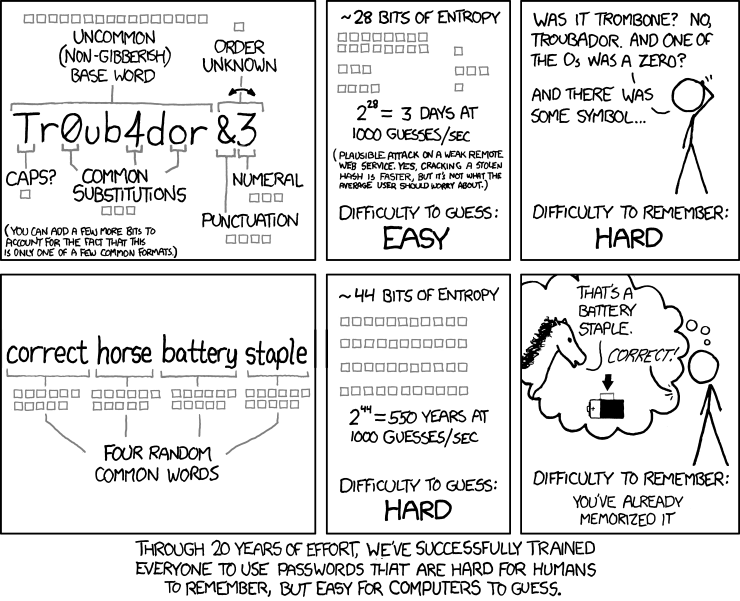
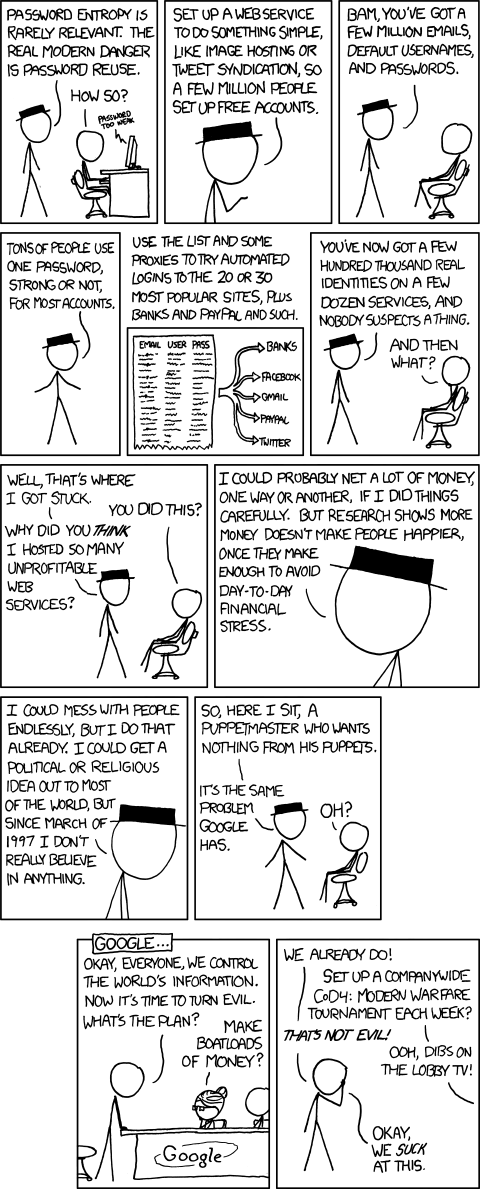
There is a lot more information (including lots of graphics) over at Data Genetics, and so I'd check it out... (especially his "Conclusions" section) and then take some advice and maybe change your PIN (especially if it's 1234, 1111, 0000, 1212, or any of the top 20). As with many things that intersect society and numbers, xkcd has made some comics, and (like with Data Genetics) I will end with them here:


Side note: I really find it humorous that "6969" is in the top 10 most common 4-digit PIN combinations (ahead of several PIN combinations of just the same number, like "9999" or "6666").

Saturday, September 22, 2012

Saturday Omphaloskepsis: The Equinox

The equinox isn't really equal lengths of night and day:


Yeah, it's a quibble point in all of these cases, still: happy southward equinox for 2012! (I would say "Autumnal Equinox", but - of course - in the Southern Hemisphere, it's actually the "Vernal Equinox"...)

Thursday, September 20, 2012

Thursday Thoughts: What does Ryan's claim of body fat content imply?

Apparently, Ryan is now saying that he keeps his body fat content between 6-8%. Bill Gifford at Slate explains why this is either a continuation of the bizarre lies of Ryan about his physical abilities or a kind of scary indictment of Ryan's physical ability to actually do his job.

First Ryan (bizarrely) claims that he ran a marathon an hour-plus faster than his actual time. Then Ryan (bizarrely) claims that he didn't really remember his time, because it was a long time ago. Now Ryan (still bizarrely) claims that he maintains the body fat content lower than the body fat content of a professional cyclist.

If Ryan is lying about the small and inconsequential (to governing) things, what does this say about his character? As Gifford writes:
Ryan wouldn’t be the first guy to dissemble about his physical attributes. But with him it’s become a pattern: first the marathon, then the dubious mountain climbs, as well as some minor confusion about the exact level of his skiing prowess. (He told Ryan Lizza of The New Yorker that he was on Janesville Craig High School’s “ski team,” when in fact the school only maintains a ski club.) “Sounds a lot like when guys say they can also bench 300 pounds, run a 4.5 forty, etc.,” says Rooney.
But what if Ryan is actually telling the truth? What if his body fat content is maintained between 6 and 8%? Well, the sciences of physiology and psychology tell us the scary possibility of what this might mean:
At very low body-fat levels, strange things start happening. Starved for energy, the body starts consuming muscle instead of fat, in what’s known as a catabolic state. Low fat levels also affect immune function. In the 1940s, the legendary nutritionist Ancel Keys (father of the military’s K-rations) subjected a group of 36 men to a severely restricted diet, amounting to about half what they were used to eating. ... Keys took precise body-fat measurements of his subjects, and found that they bottomed out around 5 percent—1 percent below Ryan’s claim. Whether from lack of body fat, or plain lack of food, they basically went crazy.
Yeah... kinda scary, and if Ryan knew anything about physiology or sports science, he likely wouldn't have make the comment that he has a body fat content of 6-8%. (Hell, if he recognized the simple point that there are sports fanatics out there that make body fat content a major part of their life obsessions, just like there are a lot of runners out there that make knowing what a marathon time means!)

If it's a lie, then it's further indication that he is dishonest about things that have little impact on governing, but is about something for which he obviously prides himself in - his fit body (and don't get me wrong, he is physically fit). However, if he has a tendency of lying about things that he perceives as being his strengths, and he is known as being a serious and capable numbers guy in Washington, then is he actually lying about this personal accomplishment, too? If so, then suddenly his lies do have impacts on governing....

However, and perhaps more scarily, if he isn't lying, then we have to ask the next phycho-physiological question: how mentally stable is this man?

Monday, July 09, 2012

WTF IS the Higgs Boson?

This kind of describes what we expect it to be.


... as well as potentially what it isn't.

Yay, science!

Saturday, June 30, 2012

Are you ready to extend your day by 0.001157 percent?

Yes, today is June 30, and it's a LEAP-SECOND DAY! Be cheerful, because for this day, thanks to more precise measurements of Earth's wobble - and that understanding leading to good time-keeping course-correction - we are all going to be able to spend an extra ONE SECOND to enjoy this last day of June. (Even for people living in East Asia, you'll still have time to get in on the game, since - unlike the the insertion of February 29 occurs as a whole day, and lasting a whole day, in everyone's one local - a leap second is inserted (almost magically into our construct of measured time) between 23:59:59 and 00:00:00 of the chosen UTC, which means that the whole globe will simultaneously experience this added second!

If you are getting worried about how scientists are trying to change the whole concept of lived time vs measured time - if the extra day in February (added every four years, save for each century) - gets you really wigged out and/or annoyed with the universe, then hopefully adding an extra second at the end of June (or sometimes at the end of December), then don't worry: a body of scientists that you've never heard of will decide (between now and 2015) whether to continue keeping radioactive time tied to solar time:
A leap second will be introduced on 30 June 2012 following a decision made by the International Earth Rotation and Reference Systems Service (IERS) earlier this year. This could potentially be one of the last ever leap seconds added, as a decision may be made in the next few years to abolish the practice.
I mean, all of these added seconds - done irregularly once (or twice or never) every year - is just going to play all sorts of havoc in a world in which clock precision seems to be weighing ever more heavily in people's lives (international trading, for example, happens second-to-second and never stops; additions of a second here could prove problematic). However, it also seems really strange and stupid that no one has been able to design a clock that - you know - incorporates these changes automatically.

So: in one corner, corner of learning about leap seconds is a bit of a "wonder of science", but recognizing that some people don't like it because it may prove difficult for them (but seem unable to actually figure out that technology can help them with adding this into the time-keeping) is a bit "short-sightedness of people in the face of science that they don't like"...

Friday, June 29, 2012

Work on magnets

I don't study magnets. In fact, I don't know much about magnets beyond what I learned in undergraduate level physics. However, one of the things that I do remember is that scientists (at that time at least) didn't really know why magnetism worked; they merely knew some of the how.

Well, in my PhysOrg newsfeed this morning, I saw two stories about magnets.

In the first story, researchers de-magnetized a magnet in order to see how magnets worked, and - possibly - to make smaller magnets. Kinda cool.
In the material studied at EPFL, the atoms are arranged in pairs in a very particular way: the magnetic field of one atom is the opposite of that of its neighbor. As a result, the total magnetic field of each pair is practically nil. The entire material thus loses its magnetization.

To unveil the secrets of this strange magnet, the scientists bombarded a lithium-erbium-fluoride sample with neutrons. The radiation allowed them to measure the structure of the crystalline network and its magnetic properties at very high resolution. The experiment had to be conducted at very low temperatures in order to prevent the atoms’ Brownian motion from obscuring the results.

[W]hen they measured the magnetic properties of their sample, the physicists obtained an unexpected result. In this experiment, even though the sample was much thicker, it had the magnetic properties of a single layer.
Why is this cool? Well, because of miniaturization of hard disks:
Data are stored in binary form by changing the magnetic polarity of an area of the disk. With miniaturization, however, the problem is that sectors close to one another can influence each other, and spontaneously change polarity. The data would then be lost. “With these special materials, miniaturization could continue; each sector of the disk could be one of these magnetization-free pairs. The probability that the magnetic field of one atom would influence the magnetic field of its neighbor is practically nil.”
But that's still years off. Still, here's a pretty cool story that points to a the HDD analogue of Moore's Law being allowed to continue onward.

The next story is about how magnetism works in Helium-3 thin films (yeah, who knew such a thing existed?):
Thin films of helium atoms with nuclei of two protons and one neutron—helium-3—intrigue physicists because they have exhibited unusual and unexpected magnetic behavior in experimental investigations. ... The [researchers'] model also predicts the appearance of a new quantum state in solid helium-3 films. [The researchers] focused on solid-state helium-3 because it enabled them to study a phenomenon known as frustration. Helium-3 thin films are ‘frustrated’ by interactions between localized areas of magnetism known as spins. The atoms in these films are organized into a triangular lattice, so the interaction between nearest-neighbor-pairs requires that spins act in the same direction—a mechanism known as ferromagnetism. At the same time however, exchange interactions between multiple spins are antiferromagnetic; that is, alternating spins act in opposite directions. ... They found a previously unknown ground state that has a so-called octahedral spin nematic order; that is, the spins are arranged such that they point along a particular direction, and these ‘directors’ are orthogonal to each other.
Much of the brief runs over my head, but there is something between these two papers that I think is additionally cool: they both potentially describe the same underlying phenomenon! In the first brief, we read the following observation:
But when they measured the magnetic properties of their sample, the physicists obtained an unexpected result. In this experiment, even though the sample was much thicker, it had the magnetic properties of a single layer.
and in the second paper:
the spins are arranged such that they point along a particular direction, and these ‘directors’ are orthogonal to each other. Momoi and colleagues believe that it is this unusual arrangement that causes the anomalous magnetic behavior of two-dimensional solid helium-3.
They both are stories that try to explain how effectively 2-dimensional magnetic fields are formed.

Yeah, I know that it's kinda nerdy that I find all this interesting, even though magnetism isn't part of my research, but there you go. Too, I admit that I may well be wrong about my reading of the two papers - and maybe the whole 2-D magnetic field thing was already known, but I still think that it's cool, because it wasn't known at least to me.

Tuesday, June 05, 2012

Watching the transit of Venus

I'll be (hopefully) watching the transit of Venus tonight at Saginaw Forest. Hopefully:

A) it will be clear enough to see the sun,
B) the viewing glasses will be dark enough not to blind me,
C) there will be enough friends and acquaintances there to share this event that won't happen again until 2117 AD.

If you are not in a place to see the transit (or don't have a means to see it directly), you can watch it live via the NASA site:
http://www.nasa.gov/connect/chat/venus_transit.html

If you live in a city that will have a view, head over to your planetarium; they will likely be quite crowded, but you should also be able to avail yourself to their services (and exuberance) there.

And just in case you don't know if your city is in the viewing area, here's the map of where the transit will be visible:


And - because it is a solar event - the starting time will be at the same relative time around the world: roughly 6pm on June 5, 2012 (if you happen to be living in the same timezone as Michigan, that is).

Thursday, May 17, 2012

Tractor beams?!?


Yeah, not quite at the StarWars level (unless by "Millennium Falcon" you mean "small translucent particle").

Sunday, May 13, 2012

Two good vids

From SciShow, some good information about breaking-science(ish) news:


From IllDoc (a few days ago), a video about President's statement from a cis male's viewpoint and the discussion from the LGBT community:

Thursday, May 03, 2012

Why is there sexual reproduction?

Just in case you didn't learn this in biology/evolution class (or didn't take an evolution class), and you want to know why sexual reproduction persists, here's a good video (and, yes, it's SFW):