Showing posts with label risk society. Show all posts

Thursday, August 14, 2014

When People Do and Don't Listen to Scientists

I saw the following on a friend's Facebook wall:


This reminded me of a talk that was given by Dan Gilbert back in 2007. As I summarized when I wrote about this, this is because:
Four features global warming lacks:

A face: understanding what other people are doing is so crucial that our brain has developed an obsession about human agency. This is why we see faces in the clouds, but not clouds in peoples' faces. Global warming is not trying to kill us, and that's a shame.
A violation of moral suasion: Visceral emotions are aroused by things our brains have been concerned: food and sex. NOT atmospheric chemistry. Societies are built around who you can sleep with and what you can eat, and not about how much you can consume.
A threat to the present: The brain is an exquisitely designed "get-out-of-the-way" machine. Only recently has our brain been able to think about the future and take actions againt a future event, which is why we use dental floss and invest in 401k plans. However, global warming is still in the "R&D" version.
Ability to see absolute changes: Because we are so bad at perceiving changes gradually, we are more likely to tolerate it since it was a day-to-day gradual change, not an abrupt one.
 While global warming lacks these things, ebola has all of them.
A face: ebola is carried around by people.
A violation of moral suasion: There are many social hangups about the sick, and some people (and societies) explain one's sickness as an outcome of one's past moral choices.
A threat to the present: Over and over again, one of the most prominent things that is said about ebola in its description is it's high mortality rate: up to 90% mortality. That's a pretty immediate threat to the present.
Ability to see absolute changes: One day a person is well, the next day that person is sick, another day and that person is dead; very, very absolute changes.
 So, yeah, when people are talking about global warming, who cares about what the scientists are saying? (Because global warming doesn't punch the "reactionary buttons" that we have evolved.)

Conversely, when people are talking about ebola, who cares about what the scientists are saying? (Because ebola punches - and punches hard - all of the evolved "reactionary buttons" that we have.)

Here's the video of Dan Gilbert's 2007 talk:

Wednesday, September 26, 2012

Wednesday Wonderings: What is a popular PIN?

With 10,000 options for a 4-digit pin number (0000 through 9999), and with many PINs being personal choices, the distribution pattern of combinations is not going to be anything like random. However, what IS the pattern for the most common PIN numbers? And what is the least common?

Well, the blog Data Genetics did some number crunching on PIN numbers based on "data condensed from released/exposed/discovered password tables and security breaches", and this is what was found to be the 20 most common PIN numbers:
     PIN   Freq
#1   1234  10.713%
#2   1111   6.016%
#3   0000   1.881%
#4   1212   1.197%
#5   7777   0.745%
#6   1004   0.616%
#7   2000   0.613%
#8   4444   0.526%
#9   2222   0.516%
#10  6969   0.512%
#11  9999   0.451%
#12  3333   0.419%
#13  5555   0.395%
#14  6666   0.391%
#15  1122   0.366%
#16  1313   0.304%
#17  8888   0.303%
#18  4321   0.293%
#19  2001   0.290%
#20  1010   0.285%
To put the popularity of "1234" another way:
The most popular PIN code of 1234 is more popular than the lowest 4,200 codes combined!
The very least common PIN number (i.e., the 10,000th most common) was 8068. However, the blog author adds this warning to the result:
Now that we’ve learned that, historically, 8068 is (was?) the least commonly used password 4-digit PIN, please don’t go out and change yours to this! Hackers can read too! They will also be promoting 8068 up their attempt trees in order to catch people who read this (or similar) articles.

Check out about the Nash Equilibrium
For everyone out there using a PIN that starts with "19--"; there's some worrying news for you, too:
Many of the high frequency PIN numbers can be interpreted as years, e.g. 1967, 1956, 1937 … It appears that many people use a year of birth (or possibly an anniversary) as their PIN. This will certainly help them remember their code, but it greatly increases its predictability.

Just look at the stats: Every single 19?? combination can be found in the top fifth of the dataset!
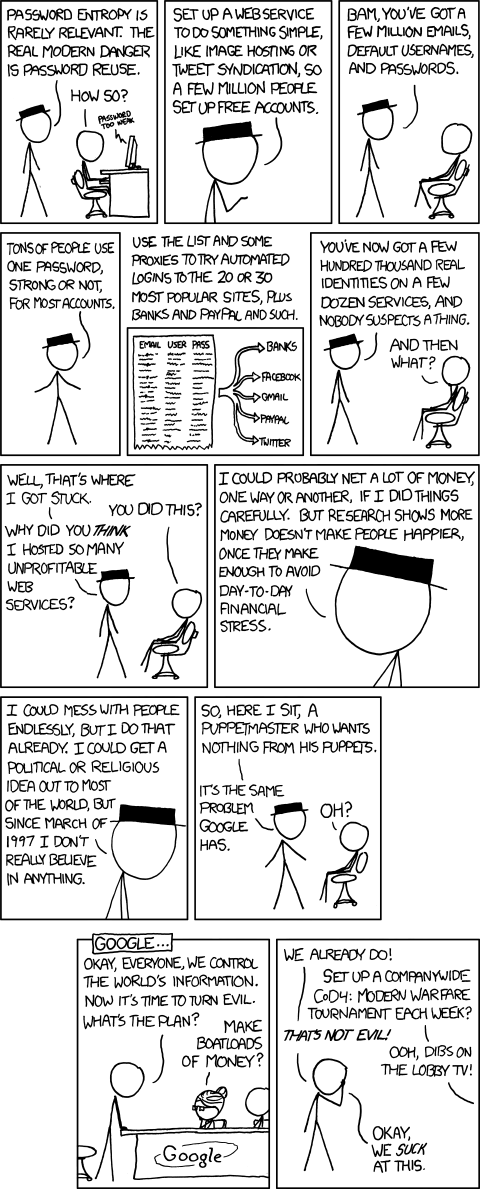
There is a lot more information (including lots of graphics) over at Data Genetics, and so I'd check it out... (especially his "Conclusions" section) and then take some advice and maybe change your PIN (especially if it's 1234, 1111, 0000, 1212, or any of the top 20). As with many things that intersect society and numbers, xkcd has made some comics, and (like with Data Genetics) I will end with them here:


Side note: I really find it humorous that "6969" is in the top 10 most common 4-digit PIN combinations (ahead of several PIN combinations of just the same number, like "9999" or "6666").

Monday, September 24, 2012

Monday Musing: Literal translation of bad facts

A few days ago, the New Yorker produced a time line of American history, based on statements of historical fact made by conservatives. Now, we know that all conservatives aren't historians (well, most aren't), and so they might be given a little bit of leeway on getting dates and actual people's names absolutely correct, and we know that the New Yorker is specifically choosing quotes that are wrong. However, the timeline that is produced is quixotic, funny, and properly sourced. Some examples:
1500s: The American Revolutionary War begins: “The reason we fought the revolution in the sixteenth century was to get away from that kind of onerous crown.”—Rick Perry

1619-1808: Africans set sail for America in search of freedom: “Other than Native Americans, who were here, all of us have the same story.”—Michele Bachmann

1776: The Founding Synod signs the Declaration of Independence: “…those fifty-six brave people, most of whom, by the way, were clergymen.”—Mike Huckabee

1812: The American War for Independence ends: “ ‘The Star-Spangled Banner’…that song—written during the battle in the War of 1812—commemorates the sacrifice that won our liberty.”—Mitt Romney

1908: The real Pledge of Allegiance is written: “I pledge allegiance to the Christian flag, and to the Savior, for whose Kingdom it stands, one Savior, crucified, risen, and coming again, with life and liberty for all who believe.”—Dan Quayle

1961: Barack Obama is born, in Africa: “And one thing that I do know is his having grown up in Kenya.”—Mike Huckabee

1961: The Soviet Union brainwashes its first Marxist terrorist spybot: “Soviet Russian Communists knew of Barack from a very early date… he was raised and groomed Communist to pave the way for their future.”—Janet Porter

1967: Indonesia brainwashes its first Islamic terrorist spybot: “Why didn’t anybody ever mention that that man right there was raised—spent the first decade of his life, raised by his Muslim father—as a Muslim and was educated in a Madrassa?”—Steve Doocy

1993: Barack Obama appears in the hip-hop video “Whoomp! There It Is!”: “Pay close attention to his ears poking out, the shape of his nose, and skin color.”—Tennessee Sons of Liberty

September 11, 2001: Nothing happened: “We had no domestic attacks under Bush.”—Rudy Giuliani

May, 2004: Abu Ghraib pranksters pull some funny ones: “This is no different than what happens at the Skull and Bones initiation … I’m talking about people having a good time, these people, you ever heard of emotional release?”—Rush Limbaugh

2010: Flying Jihad Terror Babies invade America: “It appeared they would have young women who became pregnant. They would get them into the United States to have a baby, they wouldn’t even have to pay anything for the baby, and then they would return back where they could be raised and coddled as future terrorists.”—Representative Louie Gohmert

2011: President George W. Bush kills Osama bin Laden: “Thanks to George Bush…. Because if Obama had his way we wouldn’t have gotten bin Laden, you know that.”—Sean Hannity

Thursday, August 09, 2012

Thursday Thoughts: Some disturbing stats

In a recent opinion piece in the New York Times, Larry M. Bartels and Lynn Vavreck describe the results of polling on prospective voters' viewpoints on social topics. The piece "Meet the Undecided" is pretty interesting to read, but I want to focus on some points that are - to me - somewhat disturbing.

From the article:
Undecided Republicans are twice as likely as other Republicans to say they favor gay marriage (40 percent), twice as likely to express positive or neutral attitudes toward African-Americans (31 percent), and only half as likely to deny the existence of global warming (23 percent). Only 42 percent  favor repealing Obamacare (compared with 78 percent of other Republicans).
Why is this disturbing to me? Well, let's "unpack" those numbers by looking at what these mean for people who state that they are "decided Republicans" by rewriting the paragraph and extrapolating the numbers based on the estimates and factors of difference listed above:
Among decided Republicans, 20 percent favor gay marriage, 15.5 percent express positive or neutral attitudes toward African-Americans, 46 percent deny the existence of global warming, and 78 percent favor repealing Obamacare.
... or to put it another way:
Among decided Republicans, 80 percent oppose gay marriage, 84.5 percent express negative attitudes toward African-Americans, 54 percent deny the existence of global warming, and 78 percent favor repealing Obamacare.
That's disturbing for a number of reasons. It's disturbing because decided Republicans appear to be taking a reactionary stance on things that are definitely not in the best interest of their Party, let alone governance.

With successive court cases striking down the Defense of Marriage Act (which denies federal civil benefits for same-sex couples and doesn't recognize any sort of civil marriage or civil union), with successive state supreme courts finding that bans on same sex marriage are unconstitutional, with increasing numbers of people saying that they support same sex marriage (and that marriage is a civil matter), these "decided Republicans" are standing on the opposing side of history.

With the realization that the United States is moving increasingly toward a majority-minority country (i.e., a country in which no one racial group makes up 51% of the population), having so many people continue to have negative attitudes toward one of the largest racial minority group - and the one with which the current President associates himself - is only a recipe for increased racialized politics from the party. Even if they officially might not have an explicitly racial platform, having - as a base of their party - a group that overwhelmingly holds negative viewpoints of one of the largest racial minority groups will undoubtedly color their policy decisions. Combine this with results from Gallup back in 2008 concerning mixed-race marriages (something that will undoubtedly also become more common in years and decades to come), and you get a level of confirmation about conservative and Republican positions against black-white marriage: in 2011, conservatives and Republicans were against black-white marriages at rates of 22% and 23%, respectively; the highest rates in any cross-tab of the sample.

With the increasing scientific consensus (consensus among scientists as well as consensus in the data) about the existence of global warming having reached near unanimity almost a decade ago, the scientific community has already moved on to other, more interesting questions, like "when" and "how much" and "what to do" about the problems of global warming. Scientists have - for the vast majority - already also recognized that human action is the cause of the very real - and very recordable and visible - climate change that is currently happening. Having a major part of one of the two major parties running this country made up of people who not only don't believe that humans are causing global warming, but also don't believe the global warming is happening at all (even though July 2012 is the warmest July in US history) is troubling to say the least. It's troubling not only because of the massive cognitive dissonance and conspiracy theories that one has to buy into in order to actually continue to believe that there is a global scientific and governmental conspiracy all aimed at shutting down American production and creativity, but it's further troubling that a major party has - as its ravenously voting base - a basic position that acts as a litmus test for scientists (saying, effectively, that the scientists won't be trusted if they report on the near-unanimous consensus that climate change is happening and having some major impacts on the country). It is finally majorly concerning that the base of one party is getting officials elected that will likely not take actions based on scientific forecasts and predictions of global warming, which will then have major down-the-road impacts on the country that they were elected to protect and serve.

With the recognition that the Affordable Care Act is a political ball, it's still crazy to me that the base of the GOP constantly espouse how much they hate a law that his heavily based on the very popular and highly effective bill that their Presidential nominee proposed and passed while he was governor in Massachusetts. It's further crazy that - when the heart of the ACA was declared constitutional - they preferred to play a long game of reality denial, finger-pointing, and imprecatory prayer against SCOTUS. It's also mind-blowing to me that they defend Israel's health care - which goes much farther in directions that they state to dislike about the ACA - while simultaneously calling the ACA a step too far. With the recognition that the United States was the only country in the OECD with no federal mandate for health care provision for the populace, with the recognition in 2008 that the health care system in the United States was bankrupting thousands of Americans, with the recognition that health insurance companies produce their own "death panels" and decisions to ration care, with the recognition that employer-based health insurance literally cannot help Americans when the number of full-time jobs shrank between 2007 and 2009, with the recognition that the employer-provided health insurance produced a series of perverse incentives for both employers (e.g., preferring to employ more part-time workers with no health insurance than  to employ fewer full-time workers with health care) and insurance companies (e.g., being allowed to exclude pre-existing conditions - that might have been covered before a lapse in insurance - when someone joins a new healthcare plan), it's still amazing to me that people are so entrenched against this bill; and the entrenchment and negativity are based - for much of the rhetoric - on things that are either complete hyperbole (recall "death panels"?) or have yet to be determined (since they haven't been implemented yet).

Finally, it's worrying, because - of the 10,000 surveyed - the undecideds comprised only 592 people, or just 5.9% of the surveyed group. This means that almost everyone in the survey who was going to vote Republican are included in those disturbing statistics above. This further means that - if the survey is representative of the US public - most Americans who know that they are going to vote Republican are likely to share the statistics above. What's worrying - disturbing in fact - is that (if the survey is representative of the US public), 84.5% of Republicans have a negative view of African-Americans (including people like the President and the Attorney General), 80% of Republicans want to exclude LGBTs from the government-recognized institution of marriage, 78% of Republicans want to repeal a healthcare coverage law that is based on a successful program initiated by their Presidential nominee (and praised in Israel), and 54% of Republicans don't believe that global warming is even occurring (let alone want to admit that humans are its cause), preferring (perhaps) to ignore scientists and science and (perhaps) preferring to believe in unproven, unscientific, and baseless conspiracy theories about Agenda 21, a one-world government, and a world-wide scientific conspiracy.

That's what's worrying.

Friday, April 20, 2012

Warmer weather means more pollen

Just another reason to despise increased CO2 levels and increased warming: pollen. New research has tracked the increase in pollen count in Europe as under controlled CO2 conditions as well as tracking warmer weather patterns. From PhysOrg:
Lab experiments and a small number of open-air studies have shown that increased concentrations of carbon dioxide (CO2) in the air can boost plant growth and subsequently pollen production. Warmer temperatures and invasive species are also leading to longer pollen seasons.
So, I guess that it will be a warm and hay-fevery world. And then we'll die from/as a result of fungal disease. Yay?

Saturday, April 14, 2012

Just when we thought that it couldn't get worse...

... it likely will. According to a new study from Nature:
we're already heading for huge fungal damage to vital crops and ecosystems over the coming decades. If we don't do more to stop these diseases' spread, their impact could be devastating.
Awww... shoooooot.... So we'll have massive economic impacts due to the widespread death of crops. Could it get any worse? Well...
But the threat has gained a new urgency lately, and crops aren't the only thing at risk. More and more of these killer fungi are appearing, and they're increasingly attacking animals.
What!?!!?!
Emerging fungal epidemics already account for 72 per cent of extinctions from disease – more than bacteria and viruses put together. For instance, amphibians are being wiped out at an unprecedented rate by a deadly chytrid fungus that's been spread by the global animal trade; at least 500 species are thought to be at risk. Likewise, bats are being struck down by so-called White Nose Syndrome, which has spread all over North America since it was first spotted in 2006.
Yeah, but bats are icky and amphibians do what for us? I mean, it can't be that bad for humans, right?
In many cases there are direct consequences for humans. For example, bats eat insects that would otherwise attack crops; studies suggest White Nose Syndrome could end up costing farmers some $3.7 billion a year. But even organisms that aren't obviously useful to us will have unpleasant consequences somewhere down the line if they disappear.

"Ultimately you can't separate ecosystem health from human health – eventually, these birds will come home to roost," Fisher says, adding that the less diverse ecosystems become, the less they can stand up to sudden changes.
Oh yeah... it's an ecosystem that we live in. So, does that mean that we're also causing this to happen to everything (including us)? Yes, yes we are:
Fungal diseases are even making climate change worse; scientists estimate that the trees they've killed or damaged would otherwise have absorbed 230-580 megatonnes of CO2 – around 0.07 per cent of the total in the atmosphere.
And what's the solution for attempting to halt a kingdom of species that we know relatively little about, that can swap out parts of their genomes with other species in order to better adapt, that are almost impossible to get rid of once they've become established? Well, prevention's about the only thing that is likely to work:
Fisher says we need to start taking biosecurity far more seriously – cutting down the amount of living material we transport around the world, quarantining what we do transport far more rigorously, and doing more to stop the illegal trade in plants and animals. Eventually, breakthroughs in genetic diagnostic technology may make it possible to screen plants and animals for fungus or spores. But in the meantime, we need to do more to prevent outbreaks, and move quickly to control those that do happen before they get out of hand.
Of course, I'm sure that lots of people who want to increase world capital or develop markets are just going to be so behind this idea. Like I said: "Just when we thought that it couldn't get worse, it likely will."

Story from PhysOrg

Monday, January 30, 2012

Insights about Minnesota lakes: implications about Third Sister Lake

Hopefully, no one is naive to the fact that this winter's temperatures have been far above the long-term average. In fact, although we reached a low of 10F (well below the mean temperature for the night of Jan 29/Jan 30), the trend for most the entire previous week was that of above-average daytime and nighttime temperatures (and 20 of the previous 30 days in January have been above average, too, and today through February 4 is supposed to be not only above average - which is a daytime high temp of 28F - but above freezing, too).

This has meant many things for the forest, but it has meant a very critical thing for Third Sister Lake: the ice cover this year remains un-set: a small open pool remains toward the center of the lake, filling in only when temperatures stay below freezing, but opening again once the snows melt (and the rain falls). It is with this reality in mind that I was interested to read this story from Greg Laden's Blog titled, "Global Warming is Ruining Minnesota Winter".

In the post, Greg points out a few things about Minnesotan lakes that appear to generally hold true for Third Sister Lake as well:
Since the water is cold at the time of freezing, there is more oxygen in some of the lakes than there might otherwise be. Since some of the lake surface is covered with ice but not a thick layer of snow, sunlight gets into the lakes during the winter promoting photosynthesis in the algae living beneath the ice, which enhances oxygen supply. The occasional break-through of ice during the winter, if there is a warm up and sufficient wind, adds additional oxygen.

Meanwhile, if the ice gets thick fast and stays thick, fishermen and women can ice fish early, often, and well into the season. Many Minnesota lakes sport regular fish contests and festival's during the winter that depend on this thick ice.
Third Sister Lake has seen similar trends over the past couple of years, being able to literally support some illegal ice-fishing on the lake. Last year's ice sheet was quite thick and stayed set up well into March (and the ice didn't go away until April). However, there was also a lot of snow; the 8th most snow recorded in Ann Arbor. In some Minnesotan lakes, high levels of snow actually led to fish die-offs:
In recent years, there have been some changes owing to global warming. In a warmer world, there will be some years (but certainly not all) where Minnesota experiences much more snow than it used to. This happened last year. Some lakes had so much snow on them last year that the algal activity was stifled and there was less oxygen in the water, and so those lakes experienced large die-offs of fish. Die-offs happen every year in some lakes, but it seems that the extra snow may have caused more fish to die than usual.
Luckily for the bass and bluegill, this didn't happen in Third Sister Lake, despite the additional snow in the region (although a die-off of Gizzard Shad did occur elsewhere in Southeast Michigan). This could have been due to the existence of groundwater seeps into Third Sister Lake, but this is merely conjecture on my part.

While we cannot definitively say that the 2010-2011 winter's snowfall was caused by global warming, scientists do recognize that, under conditions of global warming, greater amounts of snowfall is expected in regions where snowfall is possible, such as the upper Midwest. (For an explanation as to why, check out this article from Feb 2010.)
In warmer years, such as we are experiencing this winter (and in many previous winters) the lack of thick ice has caused numerous accidents and even fatalities as Minnesotans wandering around on insufficiently frozen lakes, falling in now and then. This, to me, is the ultimate form of Global Warming Denialism. One ignores through ignorance, or willful ignorance, the obvious change in our climate and as a result dies. The number of people falling through ice and drowning in Minnesota seems to be on the rise (though even with increased numbers, the quantities are small enough that a statistical test may be impossible). An excellent indicator of the increased dangers of ice with global warming can be found in what is happening with fishing contests. Contests on lakes in the central part of the state have been repeatedly canceled, and in the case of the Big Lake contests, permanently abandoned as an activity after being canceled several years in a row. In other words, global warming has caused Big Lake to no longer reliably freeze. It's simply a new reality. 
Third Sister Lake has not - yet - set up. There remains a small hole toward the center of the lake, which opens up when the weather climbs above freezing and especially when there is rainfall. It could cause problems not only for the illegal ice-fishers, but also for the ecology classes that come out in February.

Wednesday, January 11, 2012

Re-using water

If you ever learned anything about water in the natural world, you've probably learned about the water cycle. You know, water evaporates from the oceans (or lakes, or rivers, or anywhere, really, but it's usually depicted as the oceans, since this is where most evaporation occurs in the world), condensates to form clouds, and then precipitates (either as rain or snow) to fall upon the land, where it is either intercepted by plants or finds its way to the ground, and then into rivers or the groundwater, to eventually flow back (ultimately) to the oceans. True, there are parts of this that are complicated by the presence of other things that use the water - like animals drinking it and excreting it as sweat or waste - but the water that ends up in the oceans is the water that started in the ocean, and so it continues...

But let's focus on that little interruption: the "like animals drinking it and exreting it" part. We humans do a great job of collecting, concentrating, and treating (to a degree) water we use for drinking. We humans also do a great job of collecting, concentrating, and treating (to a degree) water we have urinated or defecated into. Such treated waste water invariably ends up in a water body, and if we are not next to the ocean, that waterbody tends to be the nearest one around (usually a river or a lake), and after a stretch of several tens of miles, there is a place where water is withdrawn (usually from a river or a lake, but also often from groundwater) for use as drinking water without people having an *ick* reaction.

If you were one of the people who remembers the bru-ha-ha that happened in June 2011, when Portland emptied an 8-million gallon reservoir after a man urinated in it, then you will likely think that what more scientists and planners propose in the future is going to be gawdawful: reuse municipal wastewater to augment drinking water supplies. If you're gagging in your coffee right now, then let me first say a few things about the Portland incident:
  • the human bladder can contain between 200-800 mL of urine (0.05-0.21 gallon).
  • rounding 0.25 gallon of urine (let's assume the Portland guy had a really big bladder that was completely full), the concentration of urine was 0.25 gallons urine/7800000 water = 0.000000032 gallons urine/gallon water (and that's assuming that the water in the reservoir was pure water, and the urine was pure urine).
In other words, as Dave Zetland said at the time (which is also relevant here):
They are basically implying that the reservoirs are full of Evian when they are full of water that's going to be treated anyway. They claimed that people in the area "may" have thrown objects in the water, but those people were questioned. Seems like they were more interested in finding an excuse to drain the water.

The pity is that people are NOW going to think their reservoirs are super clean (not!) and that water recycling is way too gross (not!).
And water recycling (if done correctly) is not gross. It is - after all - what astronauts have done for a long time, and what the city of Singapore has been doing for over a decade now. Further (to use points from the post at PhysOrg):
Potable water reuse projects account for only a small fraction of the volume of water currently being reused. However, many drinking water treatment plants draw water from a source that contains wastewater discharged by a community located upstream; this practice is not officially acknowledged as potable reuse.

The concentrations of chemicals and microbial contaminants in reuse projects designed to augment drinking water supplies can be comparable to or lower than those commonly present in many drinking water supplies.

Water reuse projects tend to be more expensive than most water conservation options and less expensive than seawater desalination and other new supply alternatives. Although the costs of reclaimed water are often higher than current water sources, the report urges water authorities to consider other costs and benefits in addition to monetary expenditures when assessing reuse projects. For example, water reuse systems used in conjunction with a water conservation program could be effective in reducing seasonal peak demands on the drinking water system. Depending on the specific designs and pumping requirements, reuse projects could also have a larger or smaller carbon footprint than existing supply alternatives or reduce water flows to downstream users and ecosystems.
If you are still gagging a little to think about these sorts of things, then the next point might not give you too much peace of mind about the current state of affairs with regard to governance:
Water reuse regulations differ by state and are not based on risk-assessment methods, the report says. Adjustments to the federal regulatory framework could help ensure a high level of public health protection, provide a consistent minimum level of protection across the nation, and increase public confidence in potable and non-potable water reuse.

Tuesday, November 15, 2011

The CIA should be more honest... about the threats from Climate Change

While a majority of Republican voters as well as representatives and senators consistently align on the side of global warming denial, they also tend to be the side of the political spectrum that demands that good government "listen to the generals" and "hear from the experts" and "be concerned with national security."

However, what happens when "listen to the generals" isn't actually what they are doing when it comes to climate change? What happens to "hear from the experts" isn't what they're doing when it comes to climate change?

Well, you can ignore the experts by claiming that there isn't a consensus on climate change (which is a specious argument, but that's a topic for another time), and you can try to discredit military planners about the defense fallout from climate change. However, what happens when "be concerned with national security" extends to not listening to the CIA?

In a recent piece by The Guardian, Suzanne Goldenberg reports that the US Defense Science Board (which is an expert panel of civilian scientists and advisers for the military) has, in a recent report, urged the CIA to release its information about climate change and national security; to stop treating climate change as a national security issue. The report attacks the manner in which the CIA disseminates (or fails to do so) information that will be critical for what the generals (as in "listen to the generals") understand climate change to be: a threat-multiplier.

So, will the CIA comply? Will the GOP - so quick to justify and defend the CIA's torture techniques - try to quash the information that they deem to be (as Sen. John Inhofe always puts it) "the greatest hoax perpetrated upon the American people"?

Tuesday, September 13, 2011

Shinto Shrine Code?

Over at AltJapan, there's a story about a video that shows that Shinto Shrines act as a visual code to show the break line of tsunamis along the coast! WOAH! A tsunami hit Fukushima... and none of the shrines got destroyed?! That's got to be some major divine mojo working there!


20110820 原発建設 警告は無視された? by PMG5

... or it's just Shinto shrines being built at the location where historical tsunami broke against the shore. As explained over at AltJapan:
It is not for nothing that Shinto shrines are generally built on high ground. One resident interviewed in the piece relates how local lore, handed down from parent to child, said to take refuge at the local shrine in the event of a tsunami. It proved true during the disaster, saving many lives.
Like the "tsunami stones" and folktales found throughout the region, these shrines represent an attempt from those who lived long ago to communicate the dangers of tsunami to future generations. It seems likely that's precisely why they were built in these specific locations.
Woah... a set of religious structures built based on observations of natural phenomenon, acting as a predictive guide to the impact of occasional catastrophic seismic events? Now that's religious encoding that works! It's almost like evidence-based predictions of flood-zones, but done before such user-friendly tools like Google existed. It's almost...... scientific! (If only they had relied on a better form of knowledge dissemination, other than oral tradition...)

It would be interesting for someone to look at sea-side Shinto shrines and correlate their location (elevation and location) based on historical records as well as predicted tsunami impacts.

Monday, August 29, 2011

A ramble about physical sciences, human systems, and governance

Let's first lay down some basic assumptions:

  1. The physical environment follows physical laws.
  2. Biological systems are affected by the physical environment.
  3. Humans are part of the biological systems.
  4. Humans can affect the physical environment.
  5. Humans create and work within social realities.
  6. Human social realities intersect with the physical environment.
  7. Humans create social laws that help govern humans' association with the physical environment (i.e., social laws moderate basic assumption #4).
  8. Physical laws trump social laws.
If we take each of these statements as true, then we must also take the set of these assumptions to be true as well. Therefore, it follows that:
  • Physical laws impact biological systems.
  • Physical laws impact human social realities.
  • Human social realities impact the physical environment.
  • Changes to the physical environment caused by humans will follow physical laws.
  • Changes to the physical environment will affect human society.
These deductions -- made by combining different statements from above -- form the basis for a social expectation for ecological and physical sciences. Indeed, just as political scientists, economists, and public policy experts are called upon to determine impacts to governing systems, ecologists and physical scientists need to understand that physical and social systems are interlinked, and not only are they interlinked, but due to increasing technological capability combined with increasing human populations, the degrees of freedom within which to move are becoming evermore diminished.

Understanding that the region-scale physical sciences can provide a lot of insight into the workings of the social world, help anticipate some of the physical impacts of decisions that governments (or other social institutions) make that will affect themselves (or others) in the future is an important step for people to make. There are differences between "advocacy" and "informing" (although the line can often be a thin one), and while advocacy -- through various means -- can be problematic, especially since it often is led by a presumption and not by observation or fact. However, sterile information from a virginal white "honest broker" scientist figure is also problematic when viewed through the light of interconnection between social and physical environment.

Just as we all make decisions based on a lack of perfect information, so, too, we make decisions about governing, and it seems ludicrous to me that there should be a double-standard about moving forward on relatively very good scientific evidence that consistently supports one side -- so long as there is the will and ability to continuously test and determine the principles upon which those decisions were initially made. (You know: do iterative science!)

More rambling on this topic later -- no doubt.

Tuesday, June 28, 2011

Increasing number of strong hurricanes

I'm reading Changing Planet, Changing Health, and I came across a mention of increased number of more intense storms:
Studies over the last five years have shown that hurricanes are getting stronger. In a 2005 paper in Nature, meteorologist Kerry Emanuel of the Massachusetts Institute of Technology described a new measure, the power dissipation index, that captures the amount of energy that flows through a hurricane over its lifetime. ... The same year, Peter Webster's team at Georgia Tech University reported in Science that while the total number of tropical cyclones per year stayed roughly constant worldwide, the strongest storms -- category 4 and 5 storms ... -- nearly doubled over thirty-five years.
Then, the figure from the Webster et al paper was presented. However, the data that was included was from 1970-2004. Looking at that, I realized that there was enough of a time interval since the publication of the paper to extend it by another lustrum. While waiting for students, I decided to track down the data for the period of 2005-2009. Using the various hurricane records from Wikipedia (and roughly estimating the lustral hurricane values published by Webster et al), I was able to come up with the following (expanded) graphic:


As you can see, the most recent lustrum was characterized by a slight decline in Category 1 storms, a serious decline in Category 2 & 3 hurricanes, and a very small increase in the number of Category 4 &5 hurricanes worldwide.

Recalculating to collapse the categories into decades, we can look at how many more (or fewer) storms were occurring worldwide during the 2000s relative to the 1970s. From the data, we find that there were 25% fewer Category 1 storms, 10% fewer Category 2 &3 storms, and 91% more Category 4 &5 storms worldwide in the 2000s compared to the 1970s! To quote further from the book about the significance of this trend:
Top hurricane researchers do agree that as the globe warms, hurricanes will intensify, though the total number of hurricanes will remain relatively constant, or perhaps even drop.

While I don't have worldwide data on this, it seems to track with the trend in the record-high-temp-to-record-low-temp ratio over the continental United States over the same period of time does indicate continued warming:


The trends of an increasing number of high power storms corresponds to the expectation of increased magnitudes of storms caused by increasing global temperatures, and the high-record-temperatures across the continental United States corresponds with expectations of larger-scale warming trends that are being seen throughout the world.

What does all this mean? Well:
In 2010, Science published a study by Morris Bender, Tom Knutson, and Robert Tuleya ... [that] concluded from modeling studies that category 4 and category 5 hurricanes will double in frequency in the Atlantic this century because of ocean warming.
And with an increased number of hurricanes globally comes increased incidence of disease outbreaks, famine, and price spikes in commodities (e.g., food, fuel) increasing the likelihood of war (or at least some sort of punitive action by one group of people against another; state-sanctioned or not).

ADDENDUM: The number of storms in the 1975-1979 and the 2005-2009 lustra were both well below the lustral average of ~240 storms/lustrum; '75-'79 had ~206 storms, and the '05-'09 had 217. All the other lustra experience between ~232 and ~270 storms.

ADDENDUM: Webster et al use the term "pentad" to refer to a period of five years, while I prefer the use of the term "lustrum". Looking at the Wikipedia entry for "lustrum", one finds that "pentad" is synonymous, as is "quinquennium." However, "pentad" is a general term that means a group of five things, while "lustrum" specifically means a period of five years. Of course, "quinquennium" also means a period of five years. However, it's a lot more difficult to spell than either "lustrum" or "pentad".

ADDENDUM (06/30/11): I tried to extend the graph to earlier lustra, but soon realized that this might be difficult, since gaps in the data exist on Wikipedia. (The gaps might not be problematic ... if I actually wanted to wade through all the raw data.) Therefore, since I don't want to commit too much more time on this, I'll be leaving the analysis (as much as it's an analysis) as is.

Thursday, July 29, 2010

A simple way to help the Gulf Coast: add your name to the petition

I was #119971 to sign the "Be the One" petition to help clean up the Gulf Coast.

[Video removed due to apparent greenwashing attempts.]

Although I have never been to the Gulf of Mexico, I know that it is an essential part of the United States' economy as well as the local livelihoods and ways of life. It is also a place with now-critical ecosystems that need help. Therefore, although I might not ever eat a Louisiana oyster, dive in that blue stretch of the world's surface, nor catch fish out of those waters, I do believe that action is necessary to keep it safe for those who will do so in the future, to help those who do so today, and to prove tho those who came before us that we are not destroying their legacy.

UPDATE: Just after I signed the petition below, I learned that this whole thing is a greenwashing campaign, funded by the American Petroleum Institute. Okay, maybe you shouldn't show your support for a front group for the API, but still, you can write to your congress critter (rep or sen) to let him or her know that you want to help protect and restore the Gulf Coast.

So: don't sign the petition. Do contact your rep and sen to let them know that you would like some action, please, and please do so with all haste.

Wednesday, April 28, 2010

Exercising in the big city

I remember something that one of my friends said when I was living in Taipei. It was during his interview for the school newspaper having been awarded the school's male athlete of the year. In response to the question to tell what were the most healthy and most unhealthy things that he did, his response was (something like), "The most healthy thing that I do is to exercise for several hours every day. The most unhealthy thing that I do is to exercise for several hours every day in Taipei."

This was wa~ay back in 1993 or 1994, and I haven't been back to Taipei since I left it in June of 1994, so I don't know if air pollution levels have improved significantly over the intervening 16 years. However, I do remember it having quite a lot of air pollution during that time, partly due to an already-crowded road network made even more so during the simultaneous construction of a subway system and an elevated train system (meaning that some major avenues were being torn up to install the subway, while others would have many lane closures because of overhead work). Since the only real way to travel to and from school was to take the bus, I was stuck in the middle of all that car exhaust.

I was reminded of all this when I read a summary of a new scientific finding from Mexico City that showed that the air pollution of Mexico City had deleterious effects on the hearts of young people. Caveat time: I understand that there are many variables that differ between Mexico City and Taipei, but both have car- and people-clogged streets, so I would imagine that the general principle holds true. I wonder, then how sadly true my friend's statement was, and how much damage his long-distance running did to his heart (and lungs). I also wonder what effect it had on my own heart and lungs, since I was quite active in competitive swimming at that time. (Traveling to swim-meets in other Southeast Asian capitol cities likely didn't ameliorate the situation much, either.)

In contrast, currently as I cycle in Ann Arbor, I am reminded of something that another friend of mine commented on when he came to visit: "Wow! You can actually breathe here, and it feels refreshing!" (And it wasn't a particularly bracing or fresh day, but one from mid-late summer.) Compared to living in Chicago, I suppose this is true; it's definitely true in comparison with Taipei. However, this statement rings true for me since I am rarely bothered by the exhaust of the car next to me as they pass me by or as I wait with them at a stoplight.

"The solution to pollution is dilution," is a phrase that, in addition to its mnemonic quality, seems somewhat apt here, for (although one cannot dilute what we breathe by adding more air) the dilution factor is controlled by the amount of pollutants in the atmosphere, and the fewer pollutants, the better the breathing.

To compare (non-rigorously) air quality measurements:

Saturday, February 28, 2009

Personal comments on ecosystem services

From Aguanomics:

Discuss the possibility of monetizing the value of the environment, i.e., ecosystem services

One thing that I feel needs to be included in an analysis of ecosystem services is the issue of existence value, and without trying to sound like I'm setting up a strawman argument, I think this sets up a situation that I don't think is suitable to economics.

What is the existence value of human life? What is the existence value of a blue whale or even a fire ant? What is the existence value of those individuals compared to each other? Would you say the blue whale is worth less than the human since it does not produce goods and services to others? Could economics turn the question on its head and ask if the blue whale is not more valuable than the human, since the human's impact upon the resources of the blue whale are greater than the other way around?

How can any of this this be equally calculated while taking into account the fact that members in an ecosystem (including humans) work upon each other? The cards are stacked on the sides of favoring humans, since economics -- not to mention law, governance, etc -- is geared toward the benefit toward humans (and because of our biological perspective as humans).

What is the benefit of any human conscious action for an ecosystem? Taken from the point-of-view of economics, an ecosystem has no needs other than existence. An ecosystem is always operating at 100%. If you change something in an ecosystem so that it is producing more of some product, then that ecosystem is still operating at 100%, but as a different ecosystem than previously. The fact that there is a measurable difference is of significance to us, but not to that of the ecosystem.

The concept of "ecosystem services", however, is that we can measure benefits to us from the ecosystem. Looking at benefits to us is still working within the paradigm of how ecosystems benefit humans, not how humans benefit ecosystems. Trying to figure out how to conduct an exchange between ecosystems and humans (which we could well argue are key drivers of ecosystem change) would be more useful, imho, than discussing the topic of "ecosystem services", which is ultimately a discussion of determining how ecosystems are of greater or lesser benefit to us.

Even if we use the arguement that measuring ecosystem services is a good method of determining conservation agendas, it ultimately embraces the concept of not paying the ecosystem for its services (again, unless I am wildly mistaken).

Am I making an argument that we should not cause impacts to nature? Well, I think that no matter what we do, we make impacts. I think, though, that before we take a view of "ecosystem services" as a general benefit to humans that we look at ameliorating "human costs" to ecosystems and figure a way of paying for them, either through improving efficiency, decreasing population, or both.

Tuesday, February 17, 2009

Role of government in science.

I was thinking about this for a while before Obama made that statement of putting science in its rightful place during his inauguration. Since that time, Scienceblogs has been abuzz with contributors writing about what (exactly) is the "rightful place of science"? I've been keeping track of some of these discussions, but since they are written mainly by scientists, I think there is a bit of a bias... (Note: I am of a science background, I still do science, but I also investigate policy. Thus the wierdness of the hats displayed in this blog.)

Anywho... I've been keeping a greater interest in the back-and-forth presented on The Questionable Authority. Today, there was another response-post on this topic. It got me into the writing mood, and I made a response. All of it was off-the-cuff, but I think that one of the major points that both Dunford and Sandefur don't discuss at length (maybe I missed it in other exchanges) is the environment as a public good. So I decided to respond.

You also don't describe those things that are otherwise listed as "externalities" of concern by business. Things like public goods or club goods.
For example, air and water quality affect many people, but the pollution of it is also caused by many people. (You could also argue that the people affected create a feedback loop of creating more pollutant because the want to buy stuff, the manufacture of which causes pollution.) However, there are two problems with air quality (or water quality) versus profit.

1) Air quality is a public good that is not (or not completely) considered in the course of business. These are costs that are spread out among the public, that are effectively paid by no one and suffered from by everyone.
2) Shifting baselines. (I don't mean the SciBlog.) People's memories are not good at remembering what things were like a long time ago, and completely fail at remembering what things were like before they were born, even when it is described to them.

Pollution of large public-goods like air and (large bodies of) water mean that changes occur slower than the ability of the human brain to acknowledge on its own (reducing us to use numbers and graphs to show long-term trends, and we all know where that argument can lead to -- just look at the AGW 'debates'). Therefore, one cannot bring a free market argument against industry on long-term incremental negative changes without an infusion of funding of science.
Incorporating the externalized factors of pollution is not something that is popular for business to do, especially if the subject is not shown to have 'serious scientific consensus' or if people don't see it as clearly as the nose on their face (again, look at the issue of AGW -- or cigarettes).

Furthermore, the first company to change to incorporate higher production costs relative to its competitors will likely be the first one to have the highest financial burden of shifting, and not likely to increase the loyalty of its purchasers (at least not until the reason for the switch becomes highly accepted in society -- again, look at shifts to CFLs and how it's framed in the AGW vs. energy efficiency meme). Due to this high cost burden of shifting (not to mention the need to change or upgrade manufacturing or training infrastructure), companies are likely going to put off the option until the option to change is better than the option of not changing (not the many reasons given for the failure of the US's Big Three).

On the other hand, governmental science can be used to help protect the access and quality of public goods, such as air quality and water quality. After all, there is little incentive for private industry to maximize public goods, unless they are allowed a monopoly on them and required to minimize profits. Then they become only slightly more expensive than the government, but still aching to change toward higher profit-margins (see how Blue Cross/Blue Shield of Michigan has been moving from non-profit to for-profit over the past couple years).

Of course, one could well argue that one job of government is to protect public goods from destruction or decimation. However, entrusting the management of public goods to a government that has few checks, balances, or oversight means that we can get things like China's "Blue Skies" indexes, or Bush 43's forest 'management' and air pollution [non]reduction measures.

Winston Churchill said something about democracy being the worst form of government (save for all the others). I would say that government is the worst form of company to manage public goods (save for all the others). There's my 2 pennies. Now I'll stick this on my own blog. :)

Tuesday, December 16, 2008

Two questions to those evolutionary biologists out there:
  1. Could allergies act as a negative selection pressure?
  2. Could the internet act as a sexual selection pressure?
The first one is a little in-depth, so I will return to it later. The latter came to mind when I read this article from PhysOrg:
Web or sex? Nearly half of women would rather go online
Nearly one out of two women would rather give up sex for two weeks than go without the Internet, according to a survey released Monday.
Far fewer men would choose to go without sex, according to the survey of 2,119 adults carried out by the online research firm Harris Interactive and sponsored by Intel Corp., the world's biggest computer chip maker.
Forty-six percent of the women polled said they would rather go without sex for two weeks than give up access to the Internet for the same period of time, according to the survey, "Internet Reliance in Today's Economy."
Only 30 percent of men said they would rather forgo intimate relations than cyber ones.
Ninety-five percent of those surveyed said it is "very important, important or somewhat important" to be able to access the Internet.
Sixty-five percent of those surveyed rated Internet access above other discretionary spending items such as cable television subscriptions (39 percent), dining out (20 percent), shopping for clothes (18 percent) or a health club membership (10 percent).
Sixty-one percent of the women surveyed said they would rather give up watching television for two weeks than give up access to the Internet for one week.
Harris Interactive and Intel said the survey was conducted November 18-20. They did not provide a margin of error for the results.
Now if this is something that is inherent in human behavior, then it might have a significant impact on human selection pressure - by diminishing it. What do you think? I mean, if 46% of women and 30% of men said they would forgo intimate relations than cyber ones, then that could mean that there could be a maximum of 30% of the population not procreating. And this is of people surveyed in the United States. What if this was rolled out to the rest of the world? I mean, governments could give greater internet access to people as a means of population control! And if the internet and computing continue to advance toward a neural-integrative state, then virtual lives could become even more important and facinating than real lives. That number of 30% and 46% could increase even further!

Furthermore, for those out there who would argue that these people are "merely saying this" and that they would likely continue to create the next generation, think about how that might change if virtual sex were to be incorporated into a neural-integrative computer. It could be made "better" or "more intense" than "real" sex, possibly diminishing people's desire to pursue biological mating, thus population control.

The other point - allergies as a selection pressure - was something that I thought of today. It smacks of eugenics, but bear with me for a bit. If allergies have a genetic component, then it stands to reason that there would be a chance of inheriting them. If someone has an allergy to a food or medication, then they could pass it on to their children, thus maintaining that allergy in the population. In today's world, there are many medications and treatments that can be taken to alleviate the effects of allergies. These allow people to not die if they accidentally ingest or come into contact with the allergen, thus increasing the possibility of passing along their genes. However, these medications will also allow for the prolonging of the genes in the population.

Now comes the eugenics part: if having one allergy makes a person susceptible to developing another one, and if this susceptibility is based on genetics, then we are - because of the presence of allergy medications - we are breeding a population that is increasingly susceptible to allergens. This brings me to the selection pressure thing.

If this is prevalent in society, then there will be more people in the future with severe allergies to foods. This will mean that they are likely to just not eat the foods to which they are allergic - since it is an easier thing than to take medication for eating those foods. In this group of people, the ability to eat that particular food is effectively selected against, but by continuing to live and procreate, that genetic selection will remain in the population. Combined with medications for that allergy and effectively random mating (since there is no heavy social stigma about having allergies), it might be possible for these genetics-based allergies to be established in a population, thus creating a population-based selection pressure.

However, with increased movement of people within a country such as the United States, then it is also possible that these genetic selections might be spread across the country. On the other hand, it is unlikely that they will progress faster in the gene pool than any future advances in gene therapy, so this is likely to be all hypothetical.

Saturday, November 29, 2008

Funny

I'm writing my prelims right now... but saw this funny via PhD comics.

Thursday, November 20, 2008

Differences in POV

I saw this article come across my newsfeed from PhysOrg: New material could make gases more transportable. Looking through the article, I saw nothing about using this as a preventative against increased methane production in northern latitudes as an outcome of global warming. That was the first thing that I was thinking about.

I was all like, "I wonder if this compound - "a material made out of a mixture of silica and water" - is environmentally problematic." Looking throughout the document, I see nothing about this aspect to the problem. Hmm... With all the discussions about geo-engineering our way out of the "global warming" problem, I'm surprised that these engineers missed this one.

Of course, this could be a problem of thinking within a discipline. It could well be that the engineers on this team didn't think about the potential of capturing methane from melting permafrost areas to help minimize the impacts to the greenhouse effect. It could be that the didn't know that the permafrost was melting. It could also be that they didn't check to see what the environmental impacts of their compound would be, and therefore didn't want to forward its use in this manner as a suggestion...

Remember, though, that methane is roughly 24x more potent of a GHG than CO2. Providing a mechanism for mitigating its release from the high-latitudes would be a good way of minimizing the forcing in the not-so-distant future. (I wonder if there are contact e-mail addresses for the authors.)

UPDATE: Looking over at the Prof.'s lab's website, I see the following:
But there remain many obstacles to making this a viable industrial process. For one thing, the hydrate remains stable only if kept cold. It must be refrigerated to about minus 70°C at atmospheric pressure, although this temperature threshold is higher if the hydrate sits within an environment of pressurized methane. The methane is released again if the material warms up.
So not very useful as a preventative for global warming, then. Still, though, quite interesting.

Now that she's won her election...

... she doesn't have to recognize reality, history, or what she said before the election. Strange... she looks young enough to realize that these things are taped and can be reviewed in the future...

October 17, 2008


November 18, 2008