Monday, February 18, 2013

Why the "Overthow a Tyrannical Regime" Justification Doesn't Hold Water

Over the past months and years, I've been encountering the following premise as to why we have a Second Amendment and why we need a Second Amendment, expressed most recently (and publicly) by the NRA's Wayne LaPierre:
Our Founding Fathers wrote the Second Amendment so Americans would never have to live in tyranny.

For any foreign entity to attempt to encroach on that great freedom is offensive to every American who has ever breathed our free air, or who has ever used a firearm to fend off an evil attacker – whether a criminal breaking into their home, or in defense of their family against a tyrant halfway around the world.

Our Second Amendment is freedom’s most valuable, most cherished, most irreplaceable idea.  History proves it.  When you ignore the right of good people to own firearms to protect their freedom, you become the enablers of future tyrants whose regimes will destroy millions and millions of defenseless lives.
A brief search for "second amendment tyrannical regime" throws up a number of websites that - to a large degree - parrot this premise, what I call the "overthrow of a tyrannical regime" premise. There are many reasons why I find the arguments that use this premise to be disturbing, and one of them is that it's just indefensible on so many fronts, especially Constitutional, historical, and definitional ones. (I'm not even going to cover the completely laughable logic-fail that even a quick assessment of the tactical lopsidedness of civilian armament versus military armament, which the DailyKos did a good job of covering from a historical context as well.)

Not a Valid Equal Protections Defense
The US extends all the protections of the Bill of Rights to all citizens in addition to all residents of and visitors to the nation. A Kyrgyz tourist has the same Bill of Rights protections as a Spanish work visa holder, a Vietnamese holder of a green card, a naturalized Pakistani, and a "native born" US citizen. (And the point that the Bill of Rights extends to everyone in the US, including non-US citizens, ought not to be a controversial position.) As David Cole wrote:
In particular, foreign nationals are generally entitled to the equal protection of the laws, to political freedoms of speech and association, and to due process requirements of fair procedure where their lives, liberty, or property are at stake.
Indeed, Cole points to Founding Father James Madison as to the rationale behind this position that many xenophobic citizens and lawmakers in the past and present (conveniently) fail to fully recognize:
[I]t does not follow, because aliens are not parties to the Constitution, as citizens are parties to it, that whilst they actually conform to it, they have no right to its protection. Aliens are not more parties to the laws, than they are parties to the Constitution; yet it will not be disputed, that as they owe, on one hand, a temporary obedience, they are entitled, in return, to their protection and advantage
In short, if you have to follow the rules of the Constitution, then you should be protected by those rules and enjoy those right, just like every US citizen that has those protections and enjoyments. That's just fair. Indeed, the Founding Fathers only limited the following two things to US citizens:
  1. the right to vote
  2. the right to run for federal office
Nothing else was written into the US Constitution as specific rights and liberties that only US citizens could have.

All of this is important, because you have to recognize that the entirety of the Constitution is effectively a protection for all people who follow the laws of the United States, citizen and non-citizen alike. (You do something illegal, especially a felony, and then your rights become curtailed, and if you're not a citizen, they can get curtailed significantly more than for citizens, since citizens don't get deported or held for deportation.)

What this preamble means, though, is that "Arab-looking" male non-US citizens have the same right to purchase and carry firearms as the average US-citizen gun owner (i.e., a White man). If you find this problematic, then you don't actually believe in the Bill of Rights and the Constitution. Your position on the gun regulation debate is therefore invalid.

Let's move further, though, and use the logic behind many gun-rights proponents who say that the PURPOSE of the Second Amendment is so that people can overthrow a tyrannical regime. If you believe that this is true, and you believe that the Bill of Rights covers all people in the US, then you must also believe that foreign nationals should be allowed to purchase weapons for the purpose of overthrowing a tyrannical regime (and since no definition is ever really given for what a "tyrannical regime" is, other than a hint that it's what the speaker says it is, we will have to also allow foreign nationals to use their own definitions). If you find this problematic, then you either don't actually believe in the universality of the Second Amendment, or you can start to see the problem of the "logic" used by anti-gun-regulation groups.

In short, you can't both say (A) that the Bill of Rights protects citizen and foreigners alike while they are in the US and (B) foreign nationals cannot take up arms against what they perceive to be a tyrannical regime, but US nationals can. If you believe (A) to be true, you must believe (B) to be true if you do believe in the "overthrow of a tyrannical regime" premise. If you don't believe them both to be true, then there is a fault in either (A) or (B).

Not a Valid Historical Defense
One might argue that a foreign national who tries to overthrow the US government is committing an act of war. Well, but a US citizen who tries to overthrow the US government is committing an act of treason (and possibly an act of war, too). The reason why these would be acts of war and treason is simply because there is no Constitutional protection for taking up arms against the US government, even if you are a US citizen. This ought to be pretty clear when you look at the history surrounding the Civil War and every assassination attempt (whether successful or not). If it were legal to try and overthrow the US government, then the Union's entering into a Civil War would not have happened for the reasons that it did. Furthermore, if it were legal for individual citizens to try to overthrow the US government by getting rid of a tyrant, then that should have been a justifiable line of defense during trials of assassins, would-be assassins, and conspirators. The fact that overthrowing a tyrannical government was never used (let alone used successfully) as a defense for the actions taken to try to topple or overthrow the government should (in a sane world) imply that it's not a valid defense of this line of argumentation.

Furthermore, we can look at the reason why the Second Amendment was written: Shay's Rebellion. It was also first tested in the Whiskey Rebellion. As Pierre Atlas wrote over at IndyStar:
One reason the framers replaced the Articles of Confederation with the Constitution in 1787 was the inability of that older system to aid Massachusetts in putting down Shays' Rebellion -- an armed insurrection by men who believed their government had become tyrannical. Shays' Rebellion was on everyone's minds at the Philadelphia convention, and the Constitution they crafted empowers the national government to suppress any armed resistance to its authority.

A few years after Shays' Rebellion, another group of men used their guns to resist what they believed was a tyrannical government. Only this time the country was operating under the Constitution, not the weaker Articles of Confederation. In 1794, proclaiming that the federal government had no right to tax whiskey, hundreds of armed men in western Pennsylvania went on a rampage, terrorizing local tax inspectors and a U.S. Marshal. President George Washington called up an army of 13,000 men from four states and, leading the force himself on horseback, put down the Whiskey Rebellion.
Indeed, the arguments used for gun ownership at the time of the writing of the Constitution and the subsequent Bill of Rights was not that of overthrowing a tyrannical regime. Pierre Atlas describes the prevailing anti-regulation sentiments of the time:
Here is how those constitutional skeptics understood gun rights in 1787: "That the people have a right to bear arms for the defense of themselves and their own state and the United States, or for the purpose of killing game; and no law shall be passed for disarming the people or any of them unless for crimes committed, or real danger of public injury from individuals." Significantly, these original pro-gun activists did not suggest a right to own weaponry in order to defy the government.
In short, there is no historical evidence to point to the rights of gun ownership stemming from a need for the citizens to overthrow a tyrannical regime. Not at the founding. Not at the time of the Whiskey Rebellion. Not at the time of the Civil War. Not at the various times when assassination was attempted.

Not a Valid Definitional Defense
People who use the "overthrow of a tyrannical regime" logic seem to fail to recognize that there appears to be no actual legal definition of how to determine exactly what constitutes a tyrannical regime; one which would be Constitutionally legal to overthrow. Indeed, many people who use this rationale appear to be implying that their definition is the correct one; that they know best, and that if your definition doesn't match with theirs then your definition is wrong, and you're a criminal. This is one of the major problems that comes about when a Constitutional, legislative, regulatory, or judicial definition doesn't exist (or isn't widely promulgated): the public tend make up their own (or adopt the arbitrary definition held by a group). And many in the public believe themselves to be reasonable (and - by extension - their personal definitions are reasonable), which makes positions opposite to theirs unreasonable. Therefore, even while citizen A and citizen B might both agree with the "logic" behind the "overthrow of a tyrannical regime," if they don't agree on whether this government (or any successive government) is sufficiently tyrannical, then each will consider the other to be a criminal for even proposing its overthrow. In short: definitions are important, but we don't have a working definition of "tyrannical regime", which means that the public are making up their own individual definitions.

Part of the reason why such a definition doesn't exist is that it would either need to already be defined by the US government (which is the very body that would not relish defining the terms of its violent-yet-legal overthrow) or be defined after a successful coup d'etat. Since there doesn't exist any definition, then we have to presume that "tyrannical regime" would be defined after a successful coup d'etat (which is usually how coup d'etats work).

Since there is no valid definition of "tyrannical regime", any military action taken against any regime could easily be argued to be criminal, and it wouldn't be surprising that the justice system of that regime would be inclined to agree that the action was criminal and rule accordingly. Therefore, the lack of a definition of "tyrannical regime" makes for a very dangerous (and irresponsible) justification for armed revolt.

However, let's presume that an armed revolt against the government was successful (even though there was no prior definition that outlined how that government actually was tyrannical). After the successful armed revolt, there effectively is no US government and no US Constitution. To the victors go the spoils, and - much like the founding of the country, one gets to re-conceive and re-write the rules. In short, the justifications of the entire US Constitution as they currently stand are null and void, and this also negates the entire "overthrow of a tyrannical regime" premise.

Not a Valid Constitutional Defense
Finally, the "overthrow of a tyrannical regime" premise is not a good Constitutional argument against governmental gun regulation. The Second Amendment actually calls for a well regulated condition for the bearing of arms. Indeed, the premise of not wanting to maintain a large standing army in the new (and heavily indebted) nation of the early 1780s meant that Congress wanted each of the states to maintain well-regulated militias for the purpose of secondment to the US Army, if the US were ever to go to war again. These regulations were executed staring with the 1792 Militia Acts and culminated in the 1903 Militia Act that effectively disbanded the structure of the militias and reformed them as the national guard. The Founding Fathers did want regulation in the ownership and bearing of arms that they wrote the words "well-regulated" directly into the Second Amendment.

Also, let's not forget that the last SCOTUS decision actually said that there could be Constitutional regulations placed on gun ownership. As Justice Scalia stated in a recent interview:
What the opinion Heller said is that it will have to be decided in future cases. What limitations upon the right to bear arms are permissible. Some undoubtedly are, because there were some that were acknowledged at the time. For example, there was a tort called affrighting, which if you carried around a really horrible weapon just to scare people, like a head ax or something, that was I believe a misdemeanor. So yes, there are some limitations that can be imposed. What they are will depend on what the society understood was reasonable limitation.
In short, the presence of government regulation is written into the Second Amendment. Government regulation is Constitutional, even if you might argue about the interpretation of the SCOTUS decision under Heller.

Conclusions
I presented four lines of argumentation that show how the whole "overthrow a tyrannical regime" line of argumentation is just plain false. It's false on so many fronts that it's still amazing to hear people using it. (And knowing why it's just so plainly wrong makes it really annoying that it continues to be used as if it were a real, justifiable, and defensible position.) To summarize the above arguments against the logic of "overthrow a tyrannical regime" as a valid reason to halt any gun regulation:
  1. If you don't relish the idea of foreign nationals being allowed to purchase guns to overthrow what they believe to be a tyrannical regime, then you really shouldn't be swallowing this brand of anti-gun-regulation rhetoric.
  2. If you recognize that the US Civil War and the myriad assassinations and assassination attempts have not been justified upon the "overthrow of a tyrannical regime" logic, then you really shouldn't be swallowing this brand of anti-gun-regulation rhetoric.
  3. If you recognize that there is no valid definition of what is a "tyrannical regime," and that a successful overthrow of the government means that you don't need a definition, which throws the whole premise of the justification out the window, then you really shouldn't be swallowing this brand of anti-gun-regulation rhetoric.
    • Furthermore, since there is no definition, the operational definitions that people use are the ones they make up by themselves (or adopt as a member of a group), which means that there is no consistent social definition, either, which is why you really shouldn't be swallowing this brand of anti-gun-regulation rhetoric.
  4. If you recognize that the Constitution actually stipulates that the bearing of arms is to be well-regulated and that one of the most conservative members of the current SCOTUS openly states that certain regulations on gun ownership are Constitutional, then you really shouldn't be swallowing this brand of anti-gun-regulation rhetoric.
To put it more elegantly (and with more historic and military perspective):
No, the Second Amendment has never guaranteed individuals a right to use their arms to resist the government or its laws. As I learned myself when I enlisted in the Army more than 25 years ago, all personnel joining the Armed Forces swear to "support and defend the Constitution of the United States against all enemies, foreign and domestic." Domestic enemies are those who would attempt to overthrow, or resist with violence, the government of the United States.

    Friday, February 15, 2013

    Regarding the Names of Countries: Who Gets to Decide what they're Called in English?

    Recently, Andrew Sullivan at the Dish wrote briefly about President Obama's use of Rangoon and Burma instead of Yangon and Myanmar during the State of the Union:
    10.02 pm. A personal note of thanks for using the words Rangoon and Burma. Then the Arab Spring: it will be messy, we cannot control events, but we should back freedom. Pretty much: stay out of the way. A minor note on Israel: emphasizing security and a “just peace.”
    This apparently occasioned people to write in and offer their two cents about who gets to decide what a country - and its various cities, presumably - are called, and Sullivan posted one response:
    I also used to make a big deal about using the terms ”Rangoon” and “Burma”.  That was before I actually had been there. On each visit, I found that everybody in Myanmar says they live in Myanmar and that their capital is Yangon. Foreigners don’t get to decide that for them; they declare it stoutly, even if those changes were made by their despicable military regime.  We can all mourn the lost years in Myanmar, but we don’t need to fixate on the linguistics of their own place names. Several people, certainly not military sympathizers in any way, will point out that Myanmar is the country’s original name, that the Brits changed it to Burma to reflect the overweening power of the majority Bamar ethnic group in civic life. ... I think it’s fine to call it Burma or Myanmar, and certainly folks there wouldn’t bother to correct you.  I just think it’s time to stop being smug about using the term Burma to indicate a political viewpoint that in Myanmar itself is pretty irrelevant.
    I read this reply and I was a little bit torn between sentiments of fairness and recognition of the reader's bloody obvious double-standard. The latter won out as the list of countries (and cities) that - in English - carry labels that were totally standardized as foreign constructs grew and blossomed, and ballooned. Therefore, even while I do agree with the spirit of what the reader states, I'll bite when he starts referring to Zhōngguó, Nihon or Nippon, Hanguk or Joseon, etc., instead of "China," "Japan," and "Korea". There are many countries that carry with them Anglicized versions of (often) other European names for countries (like "China," "Korea," and "Japan"). (Sullivan also apparently recognized the reader's double-standard, writing, "I’ll agree when my reader is fine visiting München and Москва with me. Till then I’ll call it Burma – which is an anglicized version of what Brits heard when they listened to the locals.")

    If the responder doesn't like whether "foreigners don’t get to decide [what to call their country and capital city] for them", then the responder will have to make a lot of changes, even throughout England's continental neighbors. On a short list, you've got to stop referring to Deutchland as Germany, learn how to pronounce Österreich instead of Austria (and while we're at it, why are we going to still call it the foreign name of "Australia", or does hundreds of years of British colonial rule dissolve the whole "foreigners don't get to decide it for them" requirement?), learn to pronounce France as [fʁɑ̃s] and not /ˈfræns/, recognize that the countries of northern Central Europe are actually supposed to be called Polska, Slovensko, Česká republika, and Magyarország (U+2190.svg and learn how to pronounce those properly, too, btw) instead of the foreigner-decided "Poland," "Slovakia," "the Czech Republic," and "Hungary."

    And what are we going to do when referring to countries and cities throughout Africa, where the names of many current countries and cities were so obviously a result of being named by foreigners, just as their borders were written by foreigners? Liberia? What's that except a name that was bestowed by foreigners. Ivory Coast? That's definitely NOT a name that has a single shred of a link to pre-colonial cultural, linguistic, or national heritage, but is derived from an objectified label of the commodity that was traded from that area. Nigeria? That country's name was coined by the future wife of the colonial administrator after the river that was also named by foreigners. One could easily go on and on and on.

    So, in sum, go ahead and try to be equitable in the rights of people to determine the name of their country, but if you're going to insist that we do it for the citizens of Myanmar who "say they live in Myanmar and that their capital is Yangon," but also, " wouldn’t bother to correct you [if you refer to them as 'Burma' and 'Rangoon']", then you will have to do the same thing for all the countries and all the cities for all those people who - when speaking within their own language and with their own countrymen - refer to their country and cities by different names than what English speakers would use (and who also wouldn't likely correct an English speaker for using the English name). In other words, try - as an example - to have a conversation with people about how - for example - "The foreign policy decisions of Deutchland will have ramifications in newer EU countries, especially Magyarország and Polska, let alone the more-central countries of Elláda and España" and see how many of your English-speaking conversation partners think you're being insightful and liberating instead of "smug about using the [foreign name of a country] to indicate a political viewpoint that in [that country] is pretty irrelevant."

    Finally, would the responder allow for transliteration of foreign names that were written in Latin script? (I'm assuming that the reader would allow for transliteration of foreign names written in non-Latin script, since I'm assuming that the reader is somewhat sensible to what would be obvious flaws in their argumentation.) If so, then would we now have to spell "Deutchland" as "Doychlahnd"; "France" and "Frahns"; "Magyarország" as "Mahjahrohrsagg"; etc., which would then impose a foreign decision upon the spelling of their name just as much as the imposition of transliterating into Latin script from non-Latin script imposes a foreign decision upon the spelling of the names of so many other countries.

    Thursday, February 14, 2013

    Nerdy Valentine's Day Videos

    Just a little techy-geeky video by one of the founders of OKCupid on this Valentine's Day:


    And the Science of Love:


    And methods to determine if that person you're going to dinner with tonight is a psychopath:


    And for those budding writers out there, 10 tips to writing fantastic sex:


    And now that you've had a good dose of the mathematics of matchmaking and the physiology of love, here's a remake of Willie Nelson's Valentine that I really like:

    Monday, February 11, 2013

    Sorry Sen. Casperson, but Humans DO Cause Losses to Biological Diversity

    Last week a number of Michigan senators decided that they wanted to severely limit the ability of the Michigan Department of Natural Resources (DNR) to set aside lands for the purposes of preservation and restoration. The Herping Michigan Blog summarizes Michigan Senate Bill 78:
    CONTENT

    The bill would amend several parts of the Natural Resources and Environmental
    Protection Act to do the following:


    • Prohibit the Department of Natural Resources (DNR) and the Natural Resources Commission from promulgating or enforcing a rule or an order that designates or classifies an area of land specifically for the purpose of achieving or maintaining biological diversity. 
    • Delete the conservation of biological diversity from the DNR's duties regarding forest management, and require the Department to balance its management activities with economic values. 
    • Eliminate a requirement that the DNR manage forests in a manner that promotes restoration.
    • Provide that a State department or agency would not have to designate or classify an area of land specifically for the purpose of achieving or maintaining biological diversity.
    • Eliminate the restoration of natural biological diversity from the definition of "conservation."
    • Eliminate a reference to "unusual flora and fauna" in the definition of "natural area."
    • Delete a legislative finding that most losses of biological diversity are the result of human activity.

    Perhaps Senator Casperson should watch the following video, so as to understand what's wrong with the bill's suppositions (especially the supposition that humans don't cause losses of biological diversity):


    Note to Senator Casperson: just writing a bill that denies reality does not change reality; only the official recognition of what is real, which actually creates perverse actions and outcomes that often run counter to the very point of the public good that bills like this one lead to. In this case, the bill is ostensibly for preserving the ability for hunters to hunt and loggers to log. However, without lands that operate as functioning habitat for deer (and all the things that help deer thrive, including predators), you won't have robust and resilient deer herds, and the state will have to pay for stocking forests with farm-raised deer so that hunters will have something to hunt. Similarly, without a functioning habitat for trees, the state will have to pay large costs for fertilization and pest management so that monoculture forest plantations are productive enough for a contractor to come in and cut down the trees. (And I'm not even going to consider the impacts of clear-cutting on soil quality, changes in local deer populations, and the knock-on impact to hunters - one of the groups this bill is ostensibly written to help.)

    The fact that Senator Casperson also appears to be a believer in the Agenda 21 conspiracy also makes me wonder whether he actually understands that (A) the UN is not going to swoop in and take away private property rights because of biodiversity (after all, the UN can't be both an incompetent bureaucracy and a highly organized world-wide government hell-bent on using military tactics to take away American citizens' private property), (B) that conservation of natural resources OUGHT to be a conservative principle, (C) that all systems (ecological, social, economic, etc.) are connected, and if you change things in one area, you'll have knock-on effects on another.

    Tuesday, February 05, 2013

    Complaint Choirs: Who Says you Can't Complain in an Upbeat Manner?

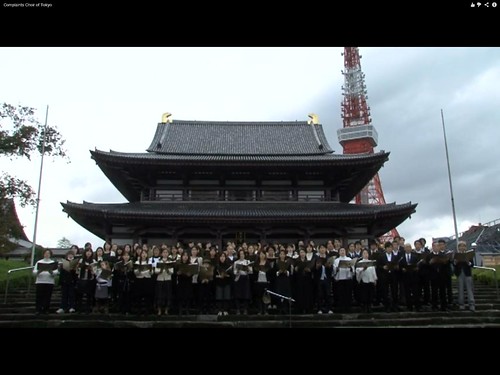
    In a recent jaunt through YouTube, I came across the Tokyo Complaint Choir:

    Tokyo complaint choir


    And from there to so many more:

    Birmingham, England


    Helsinki, Finland


    Hamburg, Germany


    St. Petersburg, Russia


    Budapest, Hungary


    Chicago, USA


    Singapore


    Hong Kong


    Florence, Italy


    Turns out that this is really an organized thing, complete with a website and a Wikipedia entry:
    Complaints Choir is a community art project that invites people to sing about their complaints in a choir together with fellow complainers. The first Complaints Choir was organized in Birmingham (UK) in 2005, followed by the Complaints Choirs of Helsinki, Hamburg and St. Petersburg in 2006. The project was initiated by artists Tellervo Kalleinen and Oliver Kochta-Kalleinen. A video installation consisting of the documentation of the public performances of the four choirs were shown at Kiasma (Helsinki, Finland), S.M.A.K. (Ghent, Belgium) and Museum Fridericianium Kassel (Germany) among other venues. When the video clips of the choirs were distributed through online magazines and video sharing websites, the idea spread quickly to many other countries. To date additional Complaints Choirs have been organized in Bodø (Norway), Poikkilaakso primary school (Helsinki, Finland), Budapest (Hungary), Chicago (Illinois, United States), Juneau (Alaska), Gabriola Island (Canada), Melbourne (Australia), Jerusalem (Israel), Singapore, Breslau (Poland), Hong Kong, Philadelphia, Enschede in The Netherlands (as part of its international Grenswerk art festival) in the Netherlands and Tokyo (Japan).
    I guess the shitty world economy has exacerbated the desire to kvetch, but to do it in style. After all, anyone can bellyache, squawk, and whine all they want. However, melodious complaining makes it all the more fun to actually listen to.

    A YouTube search for "Complaint Choir" also pulls up a lot of other places. Interestingly, I don't find any complaint choir entries for France, or in Latin America. Hrm. Maybe I'm just not looking hard enough.

    Monday, February 04, 2013

    "We Are the World": A Song the Blast from the Past

    I was living in Japan. I was in third grade. This song was literally E.V.E.R.Y.W.H.E.R.E. We sang it in choir. I sang it on my way home. We saw the video on TV alongside those heartwrenching photos of famine and death that were coming out of Africa that year. It was the massive, worldwide hit, We Are the World that written by Michael Jackson and Lionel Richie and gathered and directed by Quincy Jones.


    What I find amazing about this video, watching it through the eyes of an adult, is that this is such a great array of popular vocal talent from that time, but they are all singing together. True, there are solos, and a lot of the assembled singers get to belt out a phrase or two, but much of the song - and of the video - shows these super-A-list singers standing together as a chorus; melding their voices together.

    And that I now find so amazing.

    After 25 years, in 2010, there was a re-make of the song:


    in addition to a Spanish version - Somos El Mundo - to raise funds for rebuilding after the Haiti earthquake.


    Woah. To me, they are still powerful songs, and (hopefully) they remain powerful political songs.

    Friday, February 01, 2013

    Response to Soc. Images. Re: Are Conservatives Happier than Liberals?

    Yes, it's again with Soc. Images. This time, though, it's on the post entitled, "Are Conservatives Happier than Liberals?" Let's just gloss over the inherent difficulties in defining what happiness actually is, let alone measuring it in any meaningful manner. Let's just assume that there is some sort of objective metric that can be pulled together, like in this post:
    In the New York Times, Arthur Brooks argues that conservatives are happier than liberals.

    Brooks starts with a reference to Barack Obama’s remark four years ago about “bitter” blue-collar Whites who “cling to guns or religion.” Misleading, says Brooks. So is a large body of research showing conservatives as “authoritarian, dogmatic, intolerant of ambiguity, fearful of threat and loss, low in self-esteem and uncomfortable with complex modes of thinking.”

    Despite that research, it’s conservatives, not liberals, who identify themselves as happy. And, Brooks adds, the farther right you go on the political spectrum, the more happy campers you find.

    ...

    Sure enough, by about 10 percentage points, more conservatives identify themselves as “very happy” than do liberals. The difference is even higher among the extreme conservatives. As Brooks says, “none, it seems, are happier than the Tea Partiers, many of whom cling to guns and faith with great tenacity.”

    ...

    Maybe conservatives were happy because until recently, they didn’t have much to be bitter about. The US was their country, and they knew it. Then Obama was elected, and ever since November 2008 conservatives have kept talking about “taking back our country.” (See my “Repo Men” post from 2 1/2 years ago.)

    What if we look at the data from the Obama years?

    Maybe that bitter Tea Party image isn’t such a distortion. ...

    For all I know, Brooks’s general conclusion may be correct, but the recent data do at least raise some questions and suggest that the political context is itself a relevant variable.
    I looked at the article and thought, hmmm... I see something like a cross-correlation going on here, based on the political context, much like the author is indicating when he writes, "Maybe conservatives were happy because until recently, they didn’t have much to be bitter about. The US was their country, and they knew it." After doing a little recollection of recent presidential political history, I wrote a confirmatory comment:

    I feel that this sort of study is potentially missing the massive social correlation of prevailing political climate. It's not surprising that conservatives have felt happy during the period of 1972-2008, since most years during that time were under conservative political climates. For example, if you look at the presidencies from 1972-2008, you'll notice that 25 of the 37 years (67.6% of those years) were under a conservative president:

    Nixon (1969-1974; 3 years if counting from 1972; conservative)
    Ford (1974-1976; 2 years; conservative)
    Carter (1977-1980; 4 years; not conservative)
    Reagan (1981-1988; 8 years; conservative)
    Bush (1989-1992; 4 years; conservative)
    Clinton (1993-2000; 8 years; not conservative)
    Bush (2001-2008; 8 years; conservative)

    Therefore, if one assumes (and it's an assumption, but I think it's rather valid) that non-conservatives feel "happier" under non-conservative government and conservatives feel "happier" under conservative government, then it's a valid argument that you're not measuring the same sort of environment. Indeed, if you look at the 2009-2010 graph, you can see what appears to be evidence that (partially) supports my assumption: conservatives are less "happy" under this non-conservative government (non-conservatives do not appear to be any more or less happy).

    I suspect that this isn't so much a measurement of "conservatives are happy in general" but more a measurement of "conservatives were happier under conservative political climates," which shouldn't be too surprising.
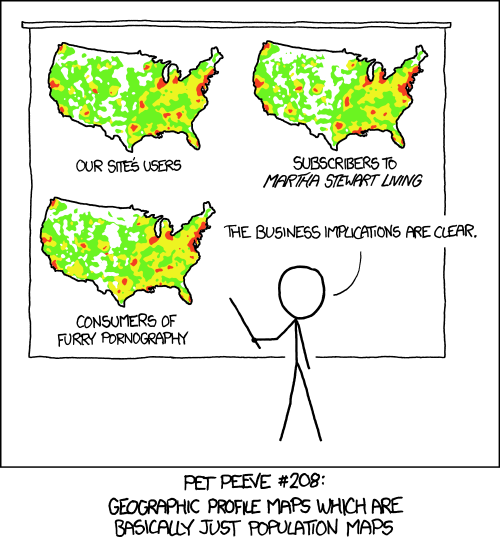
    It all reminds me of a (relatively) recent XKCD comic:

    Thursday, January 31, 2013

    Responses to Soc Images. Re: "Children's Books and Segregation in the Workplace"

    I really do like SocImages. Really. I do. Even though I often critique the articles written there.

    No. I'm being honest: I like the site.

    However, I sometimes think that there is a bit of jumping-the-shark that goes on with the stuff that they write about. Recently, there was a post titled, "Children's Books and Segregation in the Workplace" in which the post author wrote the following summary of a book:
    As children, many of us encountered Richard Scarry’s book, What Do People Do all Day? A classic kid’s book, it uses animals to represent the division of labor that exists in “Busytown.” The book is an example of a brilliant piece of analysis by sociologist John Levi Martin (full text).

    To oversimplify greatly: Martin analyzes nearly 300 children’s books and finds that there is a marked tendency for these texts to represent certain animals in particular kinds of jobs. Jobs that allow the occupant to exercise authority over others tend to be held by predatory animals (especially foxes), but never by “lower” animals (mice or pigs).

    Pigs in particular are substantially over-represented in subordinate jobs (those with low skill and no authority), where their overweight bodies and (judging from the plots of these books) congenital stupidity seems to “naturally” equip them for subservient jobs. Here, see this additional image from Scarry’s book, showing construction work being performed by the above-mentioned swine.

    In effect, Martin’s point is that there is a hidden language or code inscribed in children’s books, which teaches kids to view inequalities within the division of labor as a “natural” fact of life – that is, as a reflection of the inherent characteristics of the workers themselves. Young readers learn (without realizing it, of course) that some species-beings are simply better equipped to hold manual or service jobs, while other creatures ought to be professionals. Once this code is acquired by pre-school children, he suggests, it becomes exceedingly difficult to unlearn. As adults, then, we are already predisposed to accept the hierarchical, caste-based system of labor that characterizes the American workplace.
    This seemed to me to be a - to put it mildly - "odd" assessment to make. And so I wrote my first reply:
    Yes, in the Babar series, it's all about this exact "hidden language or code inscribed in children's books". In the Babar series, we learn that elephants "ought to be professionals," because "jobs that allow the occupant to exercise authority over others [like Babar the king] tend to be held by predatory animals," which we all know elephants to be!

    ... oh, wait.

    Okay, that one's an exception. Definitely, though with the Frog and Toad series, we can see two laze-about predators who represent upperclass toffs who go about just talking, reading, and riding bikes. Never an example of hard work between the two of these predatory animals who - since we know them to be predatory - must be characterized as being able "to exercise authority over others".

    ... oh, wait.

    Okay, maybe the author is talking about the Berenstain Bears, you know that series with the corporate executive father and university professor mother and their two children who are in officer training school. Oh, wait... that's not right; the father is a carpenter who is clumsy and bumbling, the mother is a homemaker that gardens and makes quilts. You know... just like your average bears: in jobs that exercise authority over others.

    ... oh, wait.

    Okay, maybe the author is trying to talk about how My Little Pony would be subservient to Thundercats? (I mean, I knew this to be true when I was a boy, even if my neighbor kept saying that I was stupid and a poopoo face for thinking that sort of thing. Still, what did she know?) The findings of this article indicate help indicate the inherent truth that - of the popular 1980s cartoons - Thundercats was the one that held the greatest authority over other animal-based cartoons, which were (in descending order of authority): Thundercats and Care Bears (and effective tie, since these are populated by top-predators), Garfield (who comes in next, since he's a tame predator that doesn't actually predate), Teenage Mutant Ninja Turtles (they totally destroy those peperoni pizzas), and finally My Little Pony (sorry, but they're all indolent herbivores).

    ... oh, wait.

    I'm starting to scrape the barrel on my memories of childhood storybooks with animals making up the majority of the cast of characters... Does Curious George count? Or does he not count, since he is a monkey in a human world, and not an anthropomorphized monkey in an anthropomorphized world? What about Finn Family Moomintroll? Nah, those are fantasy creatures. And anyway, they're not majority-culture American, either. Probably, the Southwest Native American stories about coyote also don't count, either. Nor the Japanese stories about tanuki, swallows, or the animal companions of Momotaro. Nor Chinese stories like children's adaptation of the famous Journey to the West, which had two anthropomorphic animal characters (Sun Wukong and Zhu Baije) Nor German stories like the Brementown musicians.

    ... oh, wait, I think I get it now:

    I must have been given the wrong books to have read to me as a child.
    Yeah, kinda snarky, even for me. However, another point really started to itch in the back of my mind: the problem of categorizing animals into the simplistic "predator/prey" dichotomy. This categorization is not useful. It's a bifurcation that mean that an animal is either a predator or it is prey. It provides too much agency to the predator, and the prey is only given the option of "receiving" the predator in order to die. It's replete with cultural bias and ecological fallacy. (Not surprising, this last part; many cultural biases are scientifically erroneous.) It also leads to (what I think of as) lazy thinking, and what precipitated me to write out my critique of this categorization was a comment by "Lori S.": Gender correlation is even stronger. I'm thinking children's clothes here. Boys get to wear (and be represented by) predators: lions, tigers, T. rex. Girls get to wear (and be represented by) prey: giraffes, zebras, bunnies. It's kind of disturbing after a while. (We are all aware of the associations between gender and agency, yes? Okay, moving on.) With that in mind, I wrote:

    After thinking about this for a bit, I've come to realize that there is a major problem of ascribing these animals into the categories of "predator" and "prey" instead of "carnivores," "omnivores," and "herbivores." (Let alone talking about them in finer shades, such as making distinctions between "obligate carnivores" and "facultative carnivores.")

    I find the generalized implications of "predator" and "prey" (as seen in the comments section and in the article) to be simplistic and kind of sloppy. Collapsing animals into only the categories of predator and prey fails to recognize the more complex nature of inter-species dynamics, such as:

    A) evolutionary strategies of carnivore avoidance,
    B1) presence of danger incurred by carnivores when hunting,
    B2) ability of many herbivores to kill carnivores, and
    C) social cues among groups of animals.

    Where, then, are the omnivores? They're completely missing from the above assessment. What are the assumptions of the social roles that they play? For example, pigs are not merely docile, objectified "prey" species, but can be predators and scavengers themselves. Indeed, the very concept of a pig being a "prey" species is ludicrous when you think of wild and feral pigs: those suckers are dangerous to almost any hunter, much like hippos can easily tear up any potential threat, and are far from any idea of "prey" species that you can imagine.

    What's Martin's justification of collapsing his assessment into the false dichotomy of "predator/prey"? Where are the assessments of the different types of carnivory (that then precipitate to the various forms of predation), herbivory (that make certain animals less or more prone to predation from the other locally present fauna), omnivory (are these animals "predator" or "prey" or both, but how could they be both if it's a binary classification?), and scavenging (recognizing the thorny point that you can't classify vultures, condors, and hyenas so easily into the "predator" OR "prey" categories)?

    Furthermore, animal behavior is far more complex than functional feeding group (which I focused on here), but also include group/herd/pack formation vs. individual, levels of matricarchy vs. patriarchy, and a whole slew of things that animal behavior scientists study and any half-way interested 8 year old would already know something about. .... and which appear to be completely missing from Martin's "assessment".

    So maybe there also ought to be an assessment of the ecological validity of the illustrators' (assuming that Martin looked at multiple illustrators' works) depictions of animals in conjuction with the pigeon-holing that Martin forces these illustrated animals into.
    Yes, I understand that depictions of anthropomorphic animals are likely to rest heavily on our socialized assumptions of the animal in question as well as the socialized assumptions of gender (and the gender that we might most commonly apply to that animal). It's why we think that Santa's reindeer are male (even though male antler retention among male caribou is highly unlikely when the night of December 24th rolls around), and why we have films that completely balls up the gender and social roles of animals (especially anthropomorphized insects, most infamously in Antz and Bee Movie, but also - strangely - with the male cows in Barnyard).

    Wednesday, January 30, 2013

    Around the World

    I like Rémi Gaillard's video of people dancing from all around the world, all wearing a black t-shirt that appears to bear the message "L'est en faisant n'importe quoi qu'on devient n'importe qui."


    It isn't as seamless as the Where the Hell is Matt videos. However, it made the TCK part of me happy.

    Tuesday, January 29, 2013

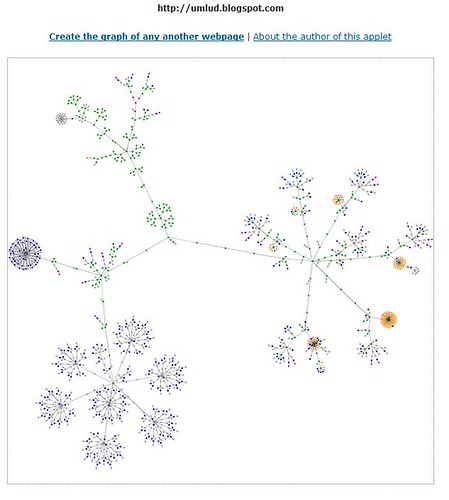
    How linked is your Website? (Ver 2)

    Back in 2007, I had stumbled across a website that showed how linked a website was. Back then, this blog was a pretty little flower


    What a difference a few years make (especially considering that I've actually continued writing on this blog):

    Website connectivity

    Maybe in a few more years (if the graph-making site is still active or if I remember to do it), I'll be able to make a "Ver. 3" that will be even more connected. Of course, at that time, the graphic might have become too complex to actually view it while being able to actually appreciate the different scales of linkages. We'll see.

    Monday, January 28, 2013

    Using Known Technological Limitations to Prove that the Moon Landing Hoax is a Hoax

    People apparently forget what film and video technology was like in the late 1960s and early 1970s. To put it simply, it was more simple for NASA to send people to the moon and bring them back to Earth than it was for NASA to make a hoax of the moon landing.

    Friday, January 25, 2013

    That Rhetoric of Obama's Inaugural Address

    On Wednesday, January 23rd, Jon Stewart did a bit about the President's inauguration speech, and how it twisted back the "makers and takers" language that Rep. (and former VPOSTUS candidate) Paul Ryan made during the 2012 campaign:


    Stewart corrects Ryan's false assertion that the President used a "straw man." (Yet another lie that Ryan makes for no apparent reason, other than because it was a dig against Ryan.) Although Stewart ends with a verdict of, "Plagiarism!" he is technically not correct.

    According to VirtualSalt.com, the rhetorical device was:
    • Antimetabole is reversing the order of repeated words or phrases (a loosely chiastic structure, AB-BA) to intensify the final formulation, to present alternatives, or to show contras.
    The line in Obama's speech is, "They do not make us a nation of takers; they free us to take the risks that make this country great." Here, you can see how "make us a nation of takers" is (kind of) reversed to make, "take the risks that make this country great." Okay, so it's not a perfect example of an inaugural antimetabole, but it's not bad, especially considering that it's doing additional duty in referencing Rep. Ryan's statement during the campaign while simultaneously blunting Ryan's statement and inserting the President's own message.

    More pure (and well-known) examples of antimetabole were made by JFK in his inaugural speech by JFK:
    • Ask not what your country can do for you, ask what you can do for your country.
    • Let us never negotiate out of fear. But let us never fear to negotiate.

    Now, Ryan's own construction of "we are becoming a nation of makers and takers" is also based on a rhetorical device that is based in the Latin expression Repitio mater memoriae, "Repetition is the mother of memory." As Joe Romm states in his book Language Intelligence:
    Consider one of the most popular figures of repitition: rhyme. Studies suggest that if a phrase or aphorism rhymes then people are more likely to view it as true. People more readily believe "woes unites foes" describes human behavior accurately than they do "woes unite enemies." All these years after the 1995 O. J. Simpson murder case, defense attorney Johnnie Cochran's phrase "If it doesn't fit, you mush acquit" still sticks in the mind. It's a powerful mnemonic that hardwires what the jurors saw in the courtroom - when Simpson tried on the bloodstained "murder gloves" they didn't fit - with the verdict Cochran wanted and ultimately won for his client. Even simple repetition remains powerfully persuasive.
    Of course, while rhyme is repeatedly used to advance an assertion of truth (i.e., Ryan's "makers and takers" trope), if it isn't resting on factual evidence, it is necessary to recognize that it is merely standing on the logical fallacy of an "argument by rhyme," which can only be strengthened by repetition (and, boy, did Ryan really get to repeat that smoldering, smelly, sack of lies). As Bo Bennett describes in Logically Fallacious:
    The argument by rhyme uses words that rhyme to make the proposition more attractive. ... Rhymes tend to have quite a bit of persuasive power, no matter how false they might be. The best defense against this fallacious rhetoric is a good counter attack using the same fallacy.

    Whomever smelled it, dealt it!
    Whomever denied it, supplied it!
    In this it is no small wonder that Obama's line ("They do not make us a nation of takers; they free us to take the risks that make this country great.") stands as an effective countermeasure to Ryan's baseless claim of "we are a nation of makers and takers"), since it not only powerfully flips the words of the spoken phrase (i.e., it's an example of antimetabole), but it also makes use of the rhyming construction of the original lie to install a new message.

    Finally (and this has nothing to do with the example of revenge-rhetoric), it was plainly obvious that Obama was using another rhetorical device - anaphora - when he repeats his opening phrase (five times in all), "We, the people." This echoed the opening words of the US Constitution. This echoed the anaphora and cadence that Martin Luther King, Jr. used when he repeated "I have a dream" eight times to underscore his message. Finally, too, it resonated with Lincoln's own (far more brief) use of epistrophe (which is the inverse of anaphora) in the Gettysburg Address in referring three different times - and in succession - to "the people".

    Thursday, January 24, 2013

    Reasons to Ride a Bike

    Now that Ann Arbor is gripped in real winter weather again, it's interesting to see how many people are still cycling.

    Back on September 8, 2011, Intelligence Squared posted their "Cycling Festival" podcast that went into the many reasons why people start (and continue) cycling. (You might not really appreciate the "high-falutin'" argumentation of the lead presenter, though.) I felt it a perfect fit to where my mind is currently: thinking about what I would have done if I didn't start riding my bike:
    Two wheels, a frame, and two pedals. Nothing could be simpler than a bicycle. People start cycling for practical reasons or for fun but before they know it, it's become a passion, an obsession, a career, an instrument of self-torture.

    It's an antiquated mode of transport, and yet hundreds of thousands take it up every year in Britain. Clean, green and cheap, it can turn your journey from A to B into a flight of inspiration, give you a sense of speed, grace and limitless potential, and add a frisson of danger to your otherwise humdrum existence.

    Intelligence² are bringing together the most articulate amateurs and professionals from the world of cycling to celebrate the endeavour and endurance, the risk and reward of this extraordinary partnership between man and machine.

    Taking part will be:

    Bella Bathurst, author of "The Bicycle Book", who will introduce us to the diverse and unpredictable world of the bicycle with stories from the past and quirky anecdotes from her more recent observations.

    Vin Cox, record holder for circumnavigating the globe by bike, will argue that the bicycle is the fastest and slowest form of transport you'll ever need.

    Geoff Dyer, novelist and keen amateur cyclist, will discuss how photography can capture the romantic allure of two-wheeled bliss – and nowhere is that bliss more ecstatically displayed than at the Burning Man festival in Nevada.

    Patrick Field, founder of the London School of Cycling who’ll be proposing a city cycling manifesto for the 21st century.

    Graeme Obree, Scottish cyclist who twice broke the world hour record on a home-made bicycle who'll be talking about design and innovation.

    Will Self, writer and keen amateur cyclist who’ll expand on his love of the bicycle’s purity and simplicity.

    I really like the advice that Patrick Field gives, especially starting around 29 minutes, basically stating that there is no "correct" way to go about bicycling. Looking at all the rusting bikes that appear abandoned in the winter snows around campus, this lesson from Patrick Field is important to bear in mind:
    If you treat a modern, aviation-grade bike, designed primarily for Americans to ride about in the sunshine, like the bike your great-grandfather rode to the mine, it will fail. Feed a racehorse on thistles, and it doesn't turn into a donkey. It dies. It's not a moral question. Nobody goes to heaven for having a clean bike, but the people who invented and perfected the derailleur would be with anyone starting a journey on a dirty bike. You don't have to use a machine exactly as its users intended, but you do need to understand what it was designed for.
    In short: don't treat your bike like crap, based on the ideas of what you grew up thinking a bike to be.

    Tuesday, January 22, 2013

    The Debt Limit Explained

    Thank you, again, C.G.P. Grey:


    So, in brief:

    The debt limit is something set up by Congress (and can only be extended by Congress) to cover expenses that Congress approved and that the President is obligated to honor.

    Monday, January 21, 2013

    Happy Martin Luther King, Jr. Day

    I have never listened to the whole speech, until today. While the final quarter of the speech (which starts at 12:00) is uplifting (and is also the best known portion of the speech), I find the first three-quarters of the speech (i.e., most of the speech) to be quite enlightening.


    The full text (from here):
    I am happy to join with you today in what will go down in history as the greatest demonstration for freedom in the history of our nation.

    Five score years ago, a great American, in whose symbolic shadow we stand today, signed the Emancipation Proclamation. This momentous decree came as a great beacon light of hope to millions of Negro slaves who had been seared in the flames of withering injustice. It came as a joyous daybreak to end the long night of their captivity.

    But one hundred years later, the Negro still is not free. One hundred years later, the life of the Negro is still sadly crippled by the manacles of segregation and the chains of discrimination. One hundred years later, the Negro lives on a lonely island of poverty in the midst of a vast ocean of material prosperity. One hundred years later, the Negro is still languishing in the corners of American society and finds himself an exile in his own land. So we have come here today to dramatize a shameful condition.

    In a sense we have come to our nation's capital to cash a check. When the architects of our republic wrote the magnificent words of the Constitution and the Declaration of Independence, they were signing a promissory note to which every American was to fall heir. This note was a promise that all men, yes, black men as well as white men, would be guaranteed the unalienable rights of life, liberty, and the pursuit of happiness.

    It is obvious today that America has defaulted on this promissory note insofar as her citizens of color are concerned. Instead of honoring this sacred obligation, America has given the Negro people a bad check, a check which has come back marked "insufficient funds." But we refuse to believe that the bank of justice is bankrupt. We refuse to believe that there are insufficient funds in the great vaults of opportunity of this nation. So we have come to cash this check -- a check that will give us upon demand the riches of freedom and the security of justice. We have also come to this hallowed spot to remind America of the fierce urgency of now. This is no time to engage in the luxury of cooling off or to take the tranquilizing drug of gradualism. Now is the time to make real the promises of democracy. Now is the time to rise from the dark and desolate valley of segregation to the sunlit path of racial justice. Now is the time to lift our nation from the quick sands of racial injustice to the solid rock of brotherhood. Now is the time to make justice a reality for all of God's children.

    It would be fatal for the nation to overlook the urgency of the moment. This sweltering summer of the Negro's legitimate discontent will not pass until there is an invigorating autumn of freedom and equality. Nineteen sixty-three is not an end, but a beginning. Those who hope that the Negro needed to blow off steam and will now be content will have a rude awakening if the nation returns to business as usual. There will be neither rest nor tranquility in America until the Negro is granted his citizenship rights. The whirlwinds of revolt will continue to shake the foundations of our nation until the bright day of justice emerges.

    But there is something that I must say to my people who stand on the warm threshold which leads into the palace of justice. In the process of gaining our rightful place we must not be guilty of wrongful deeds. Let us not seek to satisfy our thirst for freedom by drinking from the cup of bitterness and hatred.

    We must forever conduct our struggle on the high plane of dignity and discipline. We must not allow our creative protest to degenerate into physical violence. Again and again we must rise to the majestic heights of meeting physical force with soul force. The marvelous new militancy which has engulfed the Negro community must not lead us to a distrust of all white people, for many of our white brothers, as evidenced by their presence here today, have come to realize that their destiny is tied up with our destiny. They have come to realize that their freedom is inextricably bound to our freedom. We cannot walk alone.

    As we walk, we must make the pledge that we shall always march ahead. We cannot turn back. There are those who are asking the devotees of civil rights, "When will you be satisfied?" We can never be satisfied as long as the Negro is the victim of the unspeakable horrors of police brutality. We can never be satisfied, as long as our bodies, heavy with the fatigue of travel, cannot gain lodging in the motels of the highways and the hotels of the cities. We cannot be satisfied as long as the Negro's basic mobility is from a smaller ghetto to a larger one. We can never be satisfied as long as our children are stripped of their selfhood and robbed of their dignity by signs stating "For Whites Only". We cannot be satisfied as long as a Negro in Mississippi cannot vote and a Negro in New York believes he has nothing for which to vote. No, no, we are not satisfied, and we will not be satisfied until justice rolls down like waters and righteousness like a mighty stream.

    I am not unmindful that some of you have come here out of great trials and tribulations. Some of you have come fresh from narrow jail cells. Some of you have come from areas where your quest for freedom left you battered by the storms of persecution and staggered by the winds of police brutality. You have been the veterans of creative suffering. Continue to work with the faith that unearned suffering is redemptive.

    Go back to Mississippi, go back to Alabama, go back to South Carolina, go back to Georgia, go back to Louisiana, go back to the slums and ghettos of our northern cities, knowing that somehow this situation can and will be changed. Let us not wallow in the valley of despair.

    I say to you today, my friends, so even though we face the difficulties of today and tomorrow, I still have a dream. It is a dream deeply rooted in the American dream.

    I have a dream that one day this nation will rise up and live out the true meaning of its creed: "We hold these truths to be self-evident: that all men are created equal."

    I have a dream that one day on the red hills of Georgia the sons of former slaves and the sons of former slave owners will be able to sit down together at the table of brotherhood.

    I have a dream that one day even the state of Mississippi, a state sweltering with the heat of injustice, sweltering with the heat of oppression, will be transformed into an oasis of freedom and justice.

    I have a dream that my four little children will one day live in a nation where they will not be judged by the color of their skin but by the content of their character.

    I have a dream today.

    I have a dream that one day, down in Alabama, with its vicious racists, with its governor having his lips dripping with the words of interposition and nullification; one day right there in Alabama, little black boys and black girls will be able to join hands with little white boys and white girls as sisters and brothers.

    I have a dream today.

    I have a dream that one day every valley shall be exalted, every hill and mountain shall be made low, the rough places will be made plain, and the crooked places will be made straight, and the glory of the Lord shall be revealed, and all flesh shall see it together.

    This is our hope. This is the faith that I go back to the South with. With this faith we will be able to hew out of the mountain of despair a stone of hope. With this faith we will be able to transform the jangling discords of our nation into a beautiful symphony of brotherhood. With this faith we will be able to work together, to pray together, to struggle together, to go to jail together, to stand up for freedom together, knowing that we will be free one day.

    This will be the day when all of God's children will be able to sing with a new meaning, "My country, 'tis of thee, sweet land of liberty, of thee I sing. Land where my fathers died, land of the pilgrim's pride, from every mountainside, let freedom ring."

    And if America is to be a great nation this must become true. So let freedom ring from the prodigious hilltops of New Hampshire. Let freedom ring from the mighty mountains of New York. Let freedom ring from the heightening Alleghenies of Pennsylvania!

    Let freedom ring from the snowcapped Rockies of Colorado!

    Let freedom ring from the curvaceous slopes of California!

    But not only that; let freedom ring from Stone Mountain of Georgia!

    Let freedom ring from Lookout Mountain of Tennessee!

    Let freedom ring from every hill and molehill of Mississippi. From every mountainside, let freedom ring.

    And when this happens, when we allow freedom to ring, when we let it ring from every village and every hamlet, from every state and every city, we will be able to speed up that day when all of God's children, black men and white men, Jews and Gentiles, Protestants and Catholics, will be able to join hands and sing in the words of the old Negro spiritual, "Free at last! free at last! thank God Almighty, we are free at last!"

    Tuesday, December 25, 2012

    Christmas in St. Andrews

    St Andrews University - my alma mater - uploaded a series of videos for Christmas about what students like about St. Andrews University:


    The video from around the (older parts) of the town bring back memories. Unfortunately, it doesn't look like they interviewed many biologists... (Or Scots.)

    Regardless of whether I liked (or you liked) the videos, I hope you have a very Happy Christmas day.

    Thursday, December 20, 2012

    Wednesday, December 19, 2012

    Gov. Snyder vetos concealed weapons law; gun supporters make bad arguments about why this is a bad thing

    In a bit of a surprise, Governor Snyder vetoed the concealed carry law that passed both houses along mostly party lines.

    Already you're getting people saying, "Well, that won't stop criminals!" Of course it won't stop criminals. Neither does the threat of jail. Or the threat of the death penalty. Why? Because people who want to break the law will do so.

    To all the people who think that social laws actually, directly cause people to do things, you're missing the point of what laws do, and I think you know that to be the case. Laws are not magical incantations that will cause people to change their minds, which is basically what you're saying laws amount to when you say, "Well that won't stop criminals!" Stop it: you're making yourself look stupid.

    Okay, so what do laws do? Well, they provide guidance to the public as to what things are socially permissible and within what guidelines of permissibility. Don't want to follow those laws? Okay, well, there's a legally defined penalty. Don't like these laws? Well, you can try to change the guidelines or you can move to a place that doesn't have those guidelines. Laws also provide guidance to government as to what priorities for governance are as well as the procedures for pursuing that form of governance.

    Using the argument of, "Well that won't stop criminals," for this ban makes you look both stupid and hypocritical when you try to ban abortions without applying your argumentation of, "Well that won't stop criminals."

    It makes you look stupid and hypocritical when you try to ban drugs without applying your argumentation of, "Well that won't stop criminals."

    In fact, you make yourselves look stupid and hypocritical when you try to ban anything that doesn't fit with your sense of morality when you don't apply your argumentation of, "Well that won't stop criminals."

    Do you see the problem with your line of argumentation? It doesn't work, because people will break laws that they don't want to follow. Why? It's because the purpose of the law is not there for the benefit of the criminal, but to benefit society. And you know that. I'm sure you know that.

    ADDENDUM: On December 16th, Annabel Park wrote a piece called "Replying to my pro-gun friends", and it's interesting to note that many of her points can be extended to the pro-gun crazies that are saying that this veto is the worst thing in the world, because it will lead to bad shit happening. (Never mind that you can't logically prove that the lack of something led directly to the outcome of a shitty thing at a later date.)

    Monday, December 17, 2012

    Whence come trees?

    As you walk around Saginaw Forest - or actually any area with trees - you might not have wondered where the trees actually came from. I mean, it was probably never a question that you asked. But do you really know where all that "stuff" that makes the tree actually came from?

    Before you check out this video from Veritasium, stop for a moment and make a prediction.

    Got it?

    Okay, now click, "PLAY":


    For all of you who don't have a background in biology, was your prediction correct?

    So now that you know where all the mass of a tree comes from, you might have an additional appreciation for why forests (and also deforestation) is important when thinking about the future.

    Sunday, December 16, 2012

    Myths about the Maya Calendar (which doesn't have anything to do with the end of the world)

    Many people (apparently as much as 22% of Americans, even) apparently believe that the world is going to end, and that the Maya calendar has something to do with it all. Uhhh... No. It doesn't. Here are two good videos and a decent radio spot (with a conversation with a real, living, breathing Mayan).

    Recently from SciShow:


    Almost a year ago from CPG Grey:


    Recently, on The Story Christina Croc sat down with Phoebe Judge to talk about growing up with the Mayan calendar and what it definitely does not say is going to happen on December 21, 2012.

    If none of these - or other pieces of evidence - persuade you, then all I can say is to please just wait until December 22nd before you do anything rash. After all, if the end of the world is coming, you can't do anything to change it, but if it's a hoax, then you would have done something silly despite all the real evidence.

    Saturday, December 15, 2012

    Raking trails in Saginaw Forest

    Much of the trails in Saginaw Forest have been raked - by yours truly.

    IMG_5082

    IMG_5098

    Why did I do all of this? After all, next year, it will all get covered again, right?

    Well, each of the last few years, I've had to negotiate walking along the pathways in the springtime, with them in a treacherous semi-frozen, semi-slushed, semi-muddy mess. Over the year, the walking of the trails crushes the leaves, breaking them down. And then, when the snows come, the ground (and leaves and mashed leaves) gets saturated. When this starts to thaw, the leaves produce discontinuous layers of ice, frozen leaves, water, slosh, wet leaves, etc. In other words: a mess.

    The idea is that - since most of the soil of the property is sand, and the majority of the paths are gravel laid atop this sand - if I rake the leaves, there will be greater amounts of infiltration in the spring. Furthermore, even in places where the leaf litter buildup and decomposition have accumulated a significant enough layer of soil, raking away the leaves will allow for this soil to be more easily washed away, revealing the gravel path below (thus improving the quality of the pathways - as pathways).

    I even raked a trail out to Westview Way, so that it will be easy to stay off the untrodden ground (we don't like unnecessary soil compaction) while walking into the facility:

    Thursday, December 13, 2012

    An a capella song from St. Andrews students: Christmas Gets Worse Every Year


    The Other Guys are an a capella group from my alma mater, St. Andrews. Above, you can see them in the Scottish hills, two of them sporting college scarves (the Bute medical college and the university). Represent!

    Here's their wonderfully upbeat cynical song of Christmas that so wonderfully captured the feeling that I saw surrounding me each of the four years that I was a student in St. Andrews. Lord, but I miss this cynical, negative, and depressing nature that so many Brits seem to look forward to (and dread) every year.

    Enjoy the upbeatedness of British Christmas cynicism:


    h/t to my friends from St. Andrews who posted this on Facebook. :)

    Wednesday, December 12, 2012

    12/12/12 1212: A good opportunity to look at date/time notation

    This is the last day for another 88 years and 20 days until we will get to the next DD/MM/YY combination that will be all the same (i.e., 01/01/[21]01). (And I've scheduled this to post at 12:12, which really takes the biscuit for "clocking in" to the current - and dominant - mode of time-keeping on the planet.)

    Kinda sad, I s'pose. Still, I was able to live during a period of time that I was able to see so many "calendrical" and astronomical events. ... and remember them, too. Heh.

    One nice thing about days like this is that I don't have to worry about what date notation convention to present the numbers in. Should I use the US date convention (month/day/year), the most-of-Europe date convention (day/month/year), or the Japanese date convention (year/month/day)?


    I much prefer the year/month/day convention, especially when I have multiple drafts or versions of a document or project; it allows for automatic sorting of the title to display both the evolution of the file as well as present, in explicit notation, the date when the file was last saved. This is in contrast to some people who prefer to use notation like "v2," "v3" etc., which can become cumbersome (after all, how much change is necessary to indicate a new version?) or even the massively cumbersome notation of "new" and "newer", which usually devolves into some sort of hybrid of relative notations (e.g., "new2" or "new2_newer").

    Some people might say that the European date and time notation (day/month/year) makes the most sense, since the time increments are increasing from left to right. This is usually used as an extension of the argument that the United States' conventions for measurement are quite arbitrary, antiquated, and confusing:

     
    However, the expectation of left-to-right being equivalent to small-to-big is a normative assumption that has no more logical basis than saying that left-to-right is equivalent to big-to-small. (Similarly, it may be more simple to think in terms of base-ten - as one does with metric - but that choice is also arbitrary, and we could just think in terms of 360; which is also an arbitrary choice. But along that line of questioning madness lies!) Furthermore, the European version of annotation creates large problems of file sorting by name, since the same 28 days (or 30 days if you don't consider February to be important) will be recycled 12 times within a year, meaning that a file that is being worked on for more than one month will encounter sorting confusion:

    01012002 = 1 Jan 2002
    01022001 = 1 Feb 2001
    01032001 = 1 Mar 2001
    02022001 = 2 Feb 2001

    Here, 2 February 2001 should come before 1 March 2001, since dates in January do come before dates in February. Furthermore, 1 January 2002 should be at the bottom of this list, since 2002 comes after all dates in 2001. These problems go away when you use the Japanese date reporting format:

    20010101 = 2001 Feb 1
    20010102 = 2001 Feb 2
    20010201 = 2001 Mar 1
    20020101 =2002 Jan 1

    See? No problems.

    Earlier today, a friend of mine wrote:
    I don't get this 12-12-12 hype. Unless I've somehow time-traveled, we're neither in the year 12 and Jesus is alive, nor are we in 1212 and the crusades are in full swing. 20th of December this year is a lot more interesting to me, if we're talking symmetrical dates.
    I couldn't help but respond with this comment:
    Heh. Presumably, you'd also be especially interested at 8:12 PM. However, that only works if you're using European date convention of 20-12-2012 20:12. If you're using the Japanese date convention, December 20 would be: 2012-12-20, which is kinda palindromic, but not really.

    Once you recognize that date notation is culturally biased and somewhat arbitrary (especially once you consider the various standardization changes that happened to date notation and calendar format that occurred even prior to the standardization that was the Julian calendar in addition to the later restandardization that left us with the Gregorian calendar), then the allowance of letting people get rid of the "20" in front of the "12" makes today kind of fun.

    In the end, I recognize that this loosening of the rules for date notation may not be as much fun as having access to a time machine might be, but I'm not one to really wish to travel back to the years 12 (don't know enough Latin) or 1212 (don't want to be burned as a heretic or infidel), and if we did have a time machine the calculations that we'd have to make to ensure that we actually get to that era's notation of a repetitive date value would also take a bit of the romanticism out of the whole thing. 

    Anyway... enough proselyzation about date numbering formats; today is one of the twelve that come about every century that make such discussions meaningless - at least for those singular days.

    Looking to the future, here's to hoping that in 100 years from today, 12/12/2112, we won't have completely gone and screwed ourselves over, thanks to our evolutionarily stone-age brains being unable to adequately comprehend the intricacies of an increasingly complex, interconnected, non-linear system that is what we call "existence." Hopefully, too, Doraemon will actually be created in September of that year!

    Saturday, December 08, 2012

    Saturday Omphaolskepsis: They aren't the oldest trees in the world, but...

    In reading through my news items for today, I came across an article describing the fragility old trees in a changing climate:
    A report by three of the world's leading ecologists in today's issue of the journal Science warns of an alarming increase in deathrates among trees 100-300 years old in many of the world's forests, woodlands, savannahs, farming areas and even in cities.
    The reason behind this increased rate of die-off among old trees? Well, it's not only because the trees are reaching the end of their lives (some trees can live for several centuries, after all), but because the environments in which these trees live are changing. And why is this happening? Well:
    "According to one popular theory, trees get a double-whammy when the thermometer rises. "During the day, their photosynthesis shuts down when it gets too warm, and at night they use more energy because their metabolic rate increases, much as a reptile's would do when it gets warmer." With less energy being produced in warmer years and more being consumed just to survive, there is less energy available for growth. "This hypothesis, if correct, means tropical forests could shrink over time," Professor Laurance said. "The largest, oldest trees would progressively die off and tend not to be replaced. Alarmingly, this might trigger a positive feedback that could destabilize the climate: as older trees die, forests would release some of their stored carbon into the atmosphere, prompting a vicious circle of further warming, forest shrinkage and carbon emissions."
    In Saginaw Forest, we don't think of the trees as being particularly "old" - at least I doubt that many people think of Saginaw Forest as some sort of primeval wood, but it's important to remember that some of the trees on the property have joined the century club, having been planted waaay back in 1904. And these trees are dying off, although whether it's due to being planted too close or due to physiological exacerbations caused by climate stress (since many of these old Saginaw Forest trees are actually native to more northerly regions of the state), I can't say.

    Still, it's something to think about when you're walking through the forest, recalling (in some deep recess of your mind) that you are walking through a forested landscape that - while not a "natural" forest - is in the range of 60-100+ years old. It's still a relatively "new" forest in that way, having not "matured" to be dominated by the climax community that we would have experienced way back in the early 1800s: a hardwood forest of oak, maple, and beech. It may also be sobering to recall that - thanks to climate change and the changed driving forces that our new and future climate have on the local ecology - Saginaw Forest will not be changing to resemble that 1800s forest of Southeast Michigan so much as a forest that would have been more typical of central Ohio.

    In sum - and to bring it back to the topic of the paper - the century-plus old trees on the northern side of the property will likely die faster now than they would have if the climate hadn't changed, that those trees will also be more quickly releasing their stored carbon into the atmosphere, and that those reaches of the property are on a destined path toward a climax forest that would have been more recognizable around the Columbus, OH of 1800 than the Ann Arbor, MI of that same time.

    Wednesday, November 21, 2012

    SSM update: 15.86% of the US lives in states where SSM is legal

    Thanks to the 2012 election, three states voted to allow Same-Sex Marriage (SSM): Maine (reversing a 2009 referendum), Maryland, and Washington. This brings the total to 9 states and the District of Columbia (DC) that allow SSM. The total population of people living in this area (using numbers from the 2010 census) is 48,955,409, which amounts to 15.86% of the national population now living in states where equality stretches to same-sex couples in terms of legal rights and protections of marriage. (Yeah... I'm not talking about what religions choose to do with prosecuting their beliefs upon the adherents to their faiths.)

    What's interesting is that Minnesota voted down an amendment to deny SSM. There is also increasing discussion about allowing SSM there, as well as in California, Illinois, and New Jersey. If these four states were to all end up allowing SSM, then the number of people living in such states would more than double, rising to 113,135,816, or 36.64% of the population.

    More interesting still is that the states of Nevada, Oregon, and Wisconsin are eying the allowance for "civil unions" for same-sex couples. If we count these states' populations into the total of places where - for purely governmental purposes of guaranteeing and protecting rights and benefits - same-sex couples would have the rights as heterosexual couples, this would represent 125,354,427 people or 40.60% of the population.

    These projections of potential allowances for SSM and civil unions are not my own conjectures - they're from the Economist:


    This could mean that - by the next presidential election in 2016 - just slightly more than 40% of the US population could be living in a state where state-sanctioned and state-participatory discrimination against same-sex individuals' right to have a state-recognized, state-protected, and state-guaranteed marriage (or civil union). But a recent poll in Michigan is something that is raising the possibility that it could well be more than 40.60%:
    A recent survey found that 56 percent of the state's residents support gay marriage while 39 percent oppose it. Two years ago, 48 percent supported gay marriage and 51 percent were opposed.
    The walls seem to be tumbling down ... at least away from the Deep South. And if Michigan's shift on this position - along with the shifts seen in Minnesota, Wisconsin, Illinois, Oregon, California, and Maine - is anything to go by, it's likely that the shifting position on gay marriage rights is shifting in the same direction in other states that share some of Michigan's demographic and political leanings: Ohio and Pennsylvania.

    If (and that's a big "if") both Ohio and Pennsylvania were to vote to allow SSM or civil unions by 2016, then that could bring the total population living in such states to 159,476,950, or 51.65% of the nation's population (and - of course - if other states vote the same way, then that number can only climb).

    Still, let's not assume that all our eggs will hatch, or that all the chicks even grow into chickens. Let's sit down and actually be really friggin' happy that we now have 15.86% of the population living in a state where SSM-rights have been granted. Let's be even more happy that the public tide has turned to much that public referenda are now granting these rights.

    As people come to recognize that same-sex couples aren't the monsters that paranoid traditionalists want to make them out to be, there will be more positive shifts in opinion. As people come to recognize that same-sex individuals are among their friends, their colleagues, and their families, there will be more positive shifts in opinion. As people come to recognize that same-sex marriage does not destroy heterosexual marriages, there will be more positive shifts in opinion.As people come to recognize that same-sex partnerships are often about love, commitment, and raising families in a safe and caring environment, there will be more positive shifts in opinion. And, as people come to recognize that the growing number of states that allow same-sex marriages and unions are not turning into burning pits of Hell, that pedophilia is not going rampant, or that divorce rates of heterosexual couples is not increasing, there will be more positive shifts in opinion.

    Thursday, November 15, 2012

    More on identity politics and the politics of identity

    Yesterday, I posted a video about why Asian Americans didn't vote for Romney. Today, here's a post by Razib Khan about an additional reason (made a little hotly): religion. I don't always agree with the positions that Khan makes, but this is an interesting piece, even if I think that he makes the connections between religion and voting options a little stronger than I'd think:
    I was at ASHG this week, so I’ve followed reactions to the election passively. But one thing I’ve seen is repeated commentary on the fact that Asian Americans have swung toward the Democrats over the past generation. The thing that pisses me off is that there is a very obvious low-hanging fruit sort of explanation out there, and I’m frankly sick and tired of reading people ramble on without any awareness of this reality. We spent the past few months talking about the power of polls, and quant data vs. qual (bullshit) analysis, with some of my readers going into full on let’s-see-if-Razib-is-moron-enough-to-swallow-this-crap mode.

    In short, it’s religion. Barry Kosmin has documented that between 1990 and 2010 Asian Americans have become far less Christian, on average. Meanwhile, the Republican party has become far more Christian in terms of its identity. Do you really require more than two sentences to infer from this what the outcome will be in terms of how Asian Americans will vote?

    Over half of Asian Americans are non-Christian. The track record of non-Christians voting for Republicans in today’s America is not good. In contrast, Asian American lean toward Republicans is fine, assuming that they are Christian (the Evangelical group above excludes historically black churches). Asian American Catholics are somewhat more Democrat than white non-Hispanic Catholics, but far less than Hispanic Catholics. But the issue is that Christians, aggregating the Evangelical, Mainline, and Catholic categories together, only make up ~40 percent of the Asian American population. In 1990 60 percent of Asian Americans were Christian. Today 30 percent follow non-Christian religions. In 1990 15 percent did.

    Read the rest (and check out the data) over at Gene Expression.

    Wednesday, November 07, 2012

    Presidential firsts (yes, there are more!)

    In 2008, Barack Obama was the first not-White man to win the Presidency. This was obvious, and it was a point made by many people.

    Another thing was that Obama/Biden was the first Democratic ticket to win an election without having any Southerner (and - by "Southerner" I am not including someone from Delaware or Maryland, which may be historically "Southern", but I'm referring to the "Solid South") on the ticket since FDR/Wallace in 1940!

    Of course, his ticket (Obama/Biden) was the first Democratic ticket to win the presidency WITHOUT having to win any Southern state. True, Obama/Biden won North Carolina, Virginia, and Florida, but he didn't need those electoral college votes in order to win:

    In 2008, Obama won 365 E.V. If he didn't have NC (15 E.V.), VA (13 E.V.), or FL (27 E.V.), he would have had 310 E.V., 38 electoral votes MORE than necessary to win.


    These were Presidential "firsts" from 2008. In 2012, there are three additional firsts (although they are all "firsts" due to re-election):

    The obvious thing is - like the beginning - that Obama is the first not-White man to win re-election as President. This is also an obvious point made by many people.

    With regard to not having Southerners on the re-elected ticket, Obama/Biden is THE FIRST Democratic ticket to win re-election without having a Southerner on the ticket since Wilson/Marshall's re-election in 1916.

    In 2012, (as of this writing) Obama won 303 E.V., while also carrying VA. (FL's 29 E.V. haven't been allocated yet.) This means that Obama would have won (with 290 electoral votes) EVEN IF Virginia didn't vote for him.


    Is this the end - for now - of the importance of the South in presidential politics? After all, Obama is a not-White man, Obama/Biden aren't from the South, and Obama/Biden and could have won the presidency BOTH times without even winning any of the Solid South states.

    ... does this spell the end for the Southern Strategy? I already described why looking at "White Southern men" is not an electorally important distinction, since Obama wouldn't need them to win (and he didn't; he lost the overall male vote, and probably REALLY lost the White Southern male vote). Part of this is due to the demographics of the nation (let alone in the South). If the GOP doesn't change their party politics, they're not going to be a viable party in 12 years' time; the demographics - a fundamental of a country that uses democratic measures to make political choices - are just not with their current preferences.

    Monday, November 05, 2012

    Happy November: Got one chapter done. Working on another

    In order to complete my dissertation, I must complete three research chapters and tie them all together into a nice product by adding introduction and conclusion chapters. Smart person as I am, I decided to research three somewhat-interconnected (but not really overlapping at all in terms of methodology, scope, or data set) things. This has meant overall slow progress (and a tendency to procrastinate through blog writing).

    However: as of last Thursday, I submitted my first research chapter to my adviser for review, and I'm aiming to have another chapter written by the end of the month. We'll see if that works.

    Fingers crossed!