Wednesday, May 22, 2013

Ruminations on miscegenation

Recently, there was a Heritage Foundation study that a liberalized immigration policy would cost the United States $6.3 trillion. The Colbert Report did a good job of explaining why the context of the Heritage Foundation's report is just ... huh?


Over at The Dish, Andrew Sullivan started up a series of posts - "Is Race Only A Social Construct?", and the posts (in usual Sullivan style) have been thought-provoking.

In the most recent installment - "Racists Love Race Science" - Sullivan concludes the post with this:
I cannot analyze myself – but I’m sure I am affected by my history on this. One part, as I’ve written before, is that my entire education was made possible by an IQ test at age eleven, which gave me entrance to what Americans would call a magnet school. I owe a lot to that test – and it was initiated by the left. Today’s liberals forget that testing IQ was once a leftwing idea. It was designed to rescue the poor from the trap of poverty by giving bright kids from poor backgrounds a swift entry to the British elite. That was the left of the 1940s – and you can look up Keynes and eugenics for further insight into how socialist this idea was in origin. Another part was, indeed, the reaction to my convening a debate on “The Bell Curve” at TNR, in the best-selling issue in that magazine’s history. I saw how some liberals really do not believe in free debate where race is concerned.

But I do not believe that critics of the whole project are fueled by groupthink or emotion alone. There’s a very solid case against race as anything meaningful in our culture, and an even stronger case that in the process of constant miscegenation, we are rendering the whole idea of race moot. I sure hope so. There’s also a strong argument that IQ is of extremely limited use – and, in fact, misses a whole range of intelligences that are often more important to our lives and cultures as humans.

I just refuse to wish the data away. The data shocked me when I first read it, and shocks me still.
As a person who grew up - like Sullivan - in a cultural milieu different from the United States, the structures of "race" were rather puzzling to me when I found myself "back" in the US in 1999. The subsequent fourteen years have given me perspective on the issue, but it continues to remain somewhat of a "foreign" perspective than my own, and I find that I don't have as strong or as deep a sense of (the American construction of) race. However, I do fully recognize that I am the product of miscegenation: a White parent and an Asian parent, and I see no problem with that.

I also sense that there is - in my generation and the ones following mine - less knee-jerk animosity or revulsion to the idea of being mixed-race. After all, it's not my "fault" that my parents didn't live up to someone else's idea about racial purity; I can't change my racial past anymore than anyone else. Being mixed race is - therefore - a moot point when it comes to the concepts of racial purity. I didn't ask to be born this way; I'm not asking to be different; if you can't deal with it, tough cookies.

Of course, the increasing presence of mixed-race (aka "hapa") people - I hope - seriously call into question the very concept of miscegenation, since it presumes that there are distinctions of race that can be made in the first place. However, if I'm half-Asian/half-White, and I get married to a halfie, then are my wife and I engaging in miscegenation, too? In an absolutist sense, the answer is yes: mixed-race individuals who procreate with mixed-race individuals are - by definition - mixing races. However, in the social contexts in which the term is used, the answer is far murkier.

The history of the term "miscegenation" revolves around ideas of racial identity and racial purity. Indeed, it is a relatively recent word, being coined in the US in 1863, in a pamphlet entitled "Miscegenation: The Theory of the Blending of the Races, Applied to the American White Man and Negro", as part of a political hoax to discredit Lincoln and his party by ascribing ideas of mixing the races (only seen as "white" and "negro" at the time; never mind that there were Asians and Native Americans around), which was seen by many Whites as disgusting. This animus of disgust - along with the associated idea of maintaining racial purity - has continued to be associated with the term. Indeed, even after the Civil War, there were laws made to make miscegenation illegal in certain states, and these were maintained through almost 100 years, until the SCOTUS decision in Loving v Virginia. Even after, though, the social taboo of miscegenation continued.

However, for my generation and for those following me, the idea that you could marry someone you love and want to spend your life with is not so strange, even if it means marrying outside your "race" or social class (or both). Of course, there are still some hold-outs (especially among the social conservatives), and a "good" example of this was the reaction among mostly White, mostly conservative, mostly Republican supporters of John Boehner to the marriage of his daughter to a black Jamaican who sported a respectable mane of dreadlocks. To say that the responses from the conservative base were all happy felicitations for the newlywed couple (i.e., the standard, polite, and well-meaning response) would be missing the mark. Indeed the Daily Mail had to stop any further commenting and expunged the existing comments. However, over at the New York Daily News, the comments by these readers were FAR from generous. Looking at the first dozen, we get a few prominently racist comments (and more were found throughout the comments section):
Michelle837 days ago
so many beautiful women ending up with human vomit on legs these days...
norman west7 days ago
she is just another white woman who went black except for who her father is.....she did this to hurt someone....most probably herself....she loathes who she is and despises her life and lifestyle....this is a real psycho that is laying a trip on her family and laying this nap head....with a 14 inch pipe for certain.......
HoChin7 days ago
Dominic doesn't look like he has a whit of education I bet the bride puffs the pipe as well.
Jon Player7 days ago
Boehner is actually darker than him lol
Based on the tone of these comments, it's pretty clear (to me) that they were fueled by anti-miscegenation, racial purity, and social maintenance sentiments. But what about their future children (presuming that they have any)? What sense does the idea of "racial purity" have when you are not at all "pure" and see no problem with it? What happens when more and more Americans are less and less "pure"? The number of mixed-race individuals in the US is growing; according to the US Census Bureau, it grew by three-and-a-half times in the last decade, and in some places - especially in West-Coast cities (and Hawaii), mixed-race Americans make up significant portions of the population.

... so what will "racial politics" look like among a group of people who aren't a single race? Will social pressures (either overt or covert) pressure mixed race citizens to "choose sides" in the dirty politics of racial hatred and bigotry? Will a refusal to do so mean that we are left out completely? Will it be possible to create a "we-don't-care-about-your-single-race-politics" bloc that tries to move thing away from (at minimum) a discussion of "race-is-white-and-black-only" into the realm of increased nuance and understanding that will become our future?

Furthermore, what will "miscegenation" mean to groups of children for whom mixed-race is the norm? When the population of mixed-race individuals tops 50%, will "racially pure" families become the ones who are strange and unnatural? Will there be pressures going the other way; to push more-pure people to meet, date, and marry more-pure people from another mixed-race grouping? Or will people just stop caring about using race as a predominant way to group people? After all, into what stereotypical race-based category would you a "1/2 filipino, 1/2 scottish/german/english" young girl, a "hawaiian, chinese, english, irish, puerto rican" woman, a "half white (irish/german/swedish/italian), half asian (cambodian/thai/chinese)" little boy, a chinese, english, irish, and fijian man, or any person like me and those on the Hapa Project?

Thursday, May 09, 2013

Liking that song from ... Wait... WHEN did you say that was released?!?

I just realized that Laid by James:


... was released in 1993. That's 20 years ago. That means that this song came out when many of this year's crop of juniors at university were born.

Which got me thinking: what was a major song when I was born; a song that would be the analogue to Laid for that 20-year-old junior? A song that would likely have been playing as a "soundtrack throughout my life"? (Well, I don't know if Laid would have played so often in the US, but it was all over the airwaves in the UK whilst I was living there.)

On the week of my birthday, the chart-topper in the US (for people interested in the UK chart-toppers for that week, here you go) was Undercover Angel (I said, "What?"):


...Da Doo Ron Ron (which I did hear quite often growing up) was climbing the charts, moving in at #2:


... Coming in at #3 was Looks Like We Made It, up two places:


... and Bill Conti's Gonna Fly Now (better known as the theme from Rocky) dropped from #1 to #4:


Looking through the list of the top 40 for that week, I notice Margaritaville (in at #9), another song that's dogged me my whole life,


Abba's Knowing Me, Knowing You (in at #19), a song that was on the cassette (and later, the CD) that my mom would play in the car,


Life in the Fast Lane by the Eagles (at #21), and


Kenny Rogers' Lucille (#25).


ALSO: the main theme of StarWars debuted on the week I was born:


cool, but ... yeah, I'm getting old.

Wednesday, May 01, 2013

Sometimes I Just Can't Understand Religiously Motivated Reasoning

In the comments section of a Mother Jones article, titled "Charts: How Much Danger Do We Face From Homegrown Jihadist Terrorists?", I found a comment that I just couldn't wrap my head around, since it was so poorly constructed (weird formatting and bad grammar in the original):
You
can find no justification for the crimes perpetrated by Christians in the
teachings of Jesus. When Christians do evil, it is because they deviate from
what Jesus taught. When Muslims do good deeds, it is because they disobey their
prophet. When they follow him they become evil. A good Christian becomes Mother
Theresa. A Good Hindu becomes Gandhi. A good Buddhist becomes Dalai Lama. A
good Muslim becomes Osama Bin Laden. Today
the secular and liberal western culture is influenced by the repressive Islamic
culture. We punish people who speak the truth against Islam. This insanity is
not because of secularism. It is the blasphemy law slowly seeping into our
secular laws. Western secularism is becoming Islamized.
Hrm. How does any of this make sense historically, religiously, or ontologically?

"You can find no justification for the crimes perpetrated by Christians in the teaching of Jesus." This must mean that either (A) all potential crimes carried out by Christians weren't actually crimes if they followed some interpretation of what was written as a teaching of Jesus or (B) there aren't a lot of Christians out there. If you believe that Jesus made Peter the first Pope, and that the Pope is therefore the mouthpiece of God here on Earth, then none of the actions of the Crusades or Inquisitions (against the Muslims, against heretical sects of Christianity, against the Central and South American peoples) were actually crimes, since these were commanded by Jesus through the Pope. OR these acts were crimes, because the Pope isn't the mouthpiece of God here on Earth, which means that the bloody wars of the Reformation MUST NOT have been crimes, since these were done to restore the Church to their original meaning. OR these acts were crimes, because the Pope actually is the representative of God here on Earth. Similarly, the American Revolution had to be a crime since it was done in direct opposition to the divine right of the King of England. Or maybe it wasn't a crime, since the Anglican Church didn't recognize the nature of the Pope. Of course, this argument is highly problematic, since the leaders of the American revolution weren't Catholic... But this type of argumentation would definitely work to explain why the French Revolution was a crime... until Napoleon re-took the throne. Of course, his reign was destined to fail once he committed the crime of emancipating the Jews and Protestants... Unless you believe the Pope to not be the divine representative of God, and then ....

... oh, wait. This whole thing is just too complicated, and none of the commentator's original statement makes any relevant sense to this discussion. At all. In fact, its own logic chases its own tail and ultimately - like Oroborus - eats itself.

The next two sentences - "When Muslims do good deeds, it is because they disobey their prophet. When they follow him they become evil." - make no sense to me for a couple of reasons. First is the question of who decides "good" and "evil." (The ontological question if you will.) As outsiders to a group, we can only consider the actions of that group based on our own group's sense of "good" and "evil." However, we must also recognize that members of that other group will likely have their own classifications for those things. Furthermore, the definitions of these things change over space and time, too, even within the same "group." For example, if we could somehow travel back to a Georgian plantation in 1800, slave ownership would not be considered to be "evil", while - several states north - it would... but members of both locations would each consider themselves to belong to the same group: "Americans". Travel forward 100 years to 1900, and then you will find discord around that Georgian plantation about whether the practices of slavery were actually "evil". Travel forward yet another 100 years to 2000, and you will find that the question of slavery being "evil" has been accepted, even in around that Georgian plantation. Similar examples can be found with most issues that we break down into "good" and "evil" (including the morality of women wearing trousers). To claim any deed of another group to be "good" or "evil", one must first recognize that one is imposing their personal definitions upon what they see. To not do this is... troubling... to say the least.

Next, though, is the bald assertion that amounts to "good Muslims do evil things". WTF? This assertion is doubly bald-faced when it is found in a comments section of an article that actually described how few Muslim Americans are perpetrating violence of any kind. Now, to be charitable, one could interpret this commentator's meaning to be, "Well, look at all the bloodshed from North Africa to Pakistan!" Okay... let's do that: Syria is currently in a civil war, while Libya, Algeria, Egypt, Iraq, and Afghanistan are countries in which revolution and government overthrow just recently has taken place. Let's take a look at the comparative level of violence in the United States during those periods.

During the US Civil War, ~750,000 soldiers died and ~50,000 civilians (~2.6% of a population of ~31,000,000) using mid-19th century armament and medicine. (These figures may well represent an underestimate, given the problems of tracking deaths during those years.) Currently, the Syrian civil war has killed ~120,000 (~0.5% of population of ~23,000,000) using late-20th/early-21st century armament and medicine. So, compared the US Civil War, the Syrian Civil War has a long way to come to be as violent as the US Civil War (which was fought primarily by people who considered themselves to be Christian; a good number likely considering themselves to be "good Christians").

But surely the violence in Libya, Algeria, Egypt, Iraq and Afghanistan are all pretty high, too, showing the violence of these vastly Islamic-identifying countries, right? Well, the years following the US Revolutionary War weren't all peace-filled idyllic years. Following the defeat of the British in 1783, the United States had to contend with a series of violent "incidents" (including a major military attempt at rebellion), most of which are characteristic of a young government that hasn't (yet) established robust governance structures. In fact, the US has been - until very, very recently - a place where violent incidents have been the norm. And this is what the Mother Jones piece described. In comparison to the heavily-Christian United States, the countries of the Arab Spring, along with Iraq and Afghanistan, cannot reasonably be stated to be more violent than the United States of 1783-1793, nor can one reasonably state that any of this violence is specifically caused by the predominant religions of the countries. (Indeed, even when religion is invoked as a reason for armed conflict, it's often just a justification for political motivations, but even if you do count these as the actual justification of the associated wars, Christian holy wars against other Christians lead the death toll, followed by Christian holy wars against non-Christians.)

While one might allow the logical problems behind labeling things as "good" and "evil", the actual lack of historical accuracy in these two sentences is just ... really bad. However, the fact that these two sentences - devoid of any historical accuracy - pale in comparison to the lack of logical coherency that follow in the next four sentences.

Since when does "A good Christian becomes Mother Theresa"? Are this commentator saying that all real "good Christians" are Albanian nuns working (and conducting some questionable actions) in Kolkata? If so, then that's a pretty small group of people who can be "good Christians." In fact, by that definition, almost no one can be a "good Christian." But even if this commentator didn't specifically mean Mother Theresa, it implies that one has to be invested in the Catholic Church to be a "good Christian." Sorry, but wars have been fought over that question. ... wars fought (on both sides) by "good Christians." Furthermore, you would have been hard-pressed to find slave-owners in the American South who didn't consider themselves to be "good Christians", either. Among the membership of many white-supremacist groups, one will also find many who believe themselves to be "good Christians." And - outside, among the vast swath of "moderate Christians" - one would be hard-pressed to find many who would actively protest who can and can't choose to call themselves "Christians." So... this definition of "good Christian" is laughable at best.

Since when does "A good Hindu becomes Gandhi"? "Gandhi" is a family name, not a religious status, a position in a religious hierarchy, or anything like that. The commentator might erroneously be referring to Mohandas Gandhi's religious title of "Mahatma". However, if one looks at the actions of religious Hindus through the history of the Indian sub-continent, one will find many (many, many, many) who justify violence against others. Indeed, Gandhi was - until that time - a bit of an exception when it came to advocating non-violence as the sole means of anti-colonial activism, and he was a major exception when it came to embodying his advocacy. At the time, he was considered by many prominent Hindus to be religiously (or dogmatically) suspect, and not what embodied a "good Hindu". So... this definition of "good Hindu" is also laughable at best.

Since when does "A good Buddhist becomes Dalai Lama"? What about all the other branches of Buddhism? Is the commentator really saying that a member of the Japanese Jodoshinshu sect of Buddhism (for example) can become Dalai Lama? If so, you are betraying a massive ignorance of Buddhism. Indeed, this statement makes even less sense than stating, "A good Christian becomes Pope." No. Not even... No. *facepalm* This definition of "good Buddhist" is even more laughable than the definitions of "good Christian" and "good Hindu".

Finally, since when does "A good Muslim becomes Osama Bin Laden"? Even if we say, okay, you really meant to say, "... LIKE Osama Bin Laden", where is evidence for this? The commentator hasn't got any, other than the sayings of fundamentalists who want to emulate people like bin Laden. Taking what fundamentalists say as gospel would be the same thing as taking what the members of the Westboro Baptist Church say makes a good Christian and only using that metric to discuss all of Christianity. If the commentator were smart enough recognize the Westboro Baptist Church is an extremist group claiming to be Christians, and is - therefore - not allowing them to dictate the commentator's definition of "good Christian", then why does the commentator allow him/herself to fall for what a Muslim extremist group claims to be the definition of what "good Muslims" are? The commentator proves to have failed at maintaining logical consistency with the real world. However, considering the "evidence" and "logic" you have displayed above, this statement is not surprising.

Finally, this commentator appears incapable of recognizing that there is a double standard that people like him/herself are perpetrating in the name of equality. Commentators like this person often feel that their religion (Christianity) is being unfairly punished for the actions of a few people who claim to be Christian, but fail to recognize that they are doing the same thing to all non-Christians. It's in this mindset that the final lines of this comment are seen: "We punish people who speak the truth against Islam. This insanity is not because of secularism. It is the blasphemy law slowly seeping into our secular laws. Western secularism is becoming Islamized." Apparently, "Western secularism" can only be that thing if we punish people who speak this commentator's "truth" about Islam. Going further, it's likely that it's only if we impose this commentator's viewpoint of Christianity (it's conveniently never defined) that we can save "Western secularism" (failing to note that secularism specifically deals with "the principle of separation of government institutions, and the persons mandated to represent the State, from religious institutions and religious dignitaries".

Thursday, April 25, 2013

The Steam Vents at the University of Michigan

They're all over the Central Campus, often acting as notice boards for student organizations; plastered with paper and wrapped with layers of tape. The vents are supposed to be used to literally let off steam, and - now that it's cool enough to see the condensation - we can see just how much steam there is to be released...

IMG_5214

Wednesday, April 24, 2013

And I thought I had a big bike

Well, it's not so much a LONG bike as a friggin' TALL bike:

Richie Trimble’s 14.5 ft. Tall Bike


I read about L.A.'s CicLAvia a few years back, and I've thought that it was a great idea to encourage cycling in the city as something more than a recreational hobby for men in lycra. Of course, this sort of event tends to bring out everyone (except maybe the road-racers) for a nice and easy ride through the streets.

...including a man on a 14.5 foot bike. :D

Craziness!

Friday, April 12, 2013

Spring

The crows are back,
Cawing in the rain-beaten morning.
Black heralds of spring.

Wednesday, April 10, 2013

Console Themes in Acapella

I remember these games. And now you can listen to them sung acapella by a man with long hair and a long beard.

Heh. :)

Street Fighter 2 - Guile Theme Acapella


Castlevania - Bloody Tears Acapella


Final Fantasy VII - JENOVA Theme Acapella


Final Fantasy VII - Aerith's (Aeris) Theme Acapella

Saturday, April 06, 2013

Cool website: Sustainable China

I just came across the Sustainable China website today. While the title of the site may - for people like me - evoke images of ecosystem sustainability, of industrial sustainability, or of economic sustainability and the dystopic landscape that we (in natural resource management) often hear about, this site is actually filled with issues regarding how Chinese people in different regions of mainland China and Taiwan are associating themselves with ideas of sustainability. In other words, instead of doom-and-gloom reporting about the terrible smog in Beijing (or dead pigs floating through Shanghai, algae growth choking bays, mine tailings poisoning the waters of countless villages, day-long traffic jams, drying rivers, etc., etc.), this blog talks about how local and regional culture shapes how people interact with their landscape.

The most recent story -
green spirituality and the limits to modernityhttp://www.sustainablechina.info/2012/06/26/green-spirituality-limits-modernity/
- ties the sustainability mission to the rise and return of spirituality in the country:
In China, the quest for a sustainable future is mirrored in the “back to the future” rise of religions. For sure this is a complex phenomenon: people pray to the gods for wealth and happiness, not for a lower ecological footprint. But at the same time, Chinese religions send messages about reducing desire, non-violence to living beings, harmony with nature, and the value of balance and moderation.
In another story - religious diversity and ecological sustainability - the author posts his defense of why we - outside China - need to change our view of what a modern China is and how a modern China thinks of itself:
it is necessary to resist the simplistic construction of “New China” as exclusively “secular”, “modern”, or “materialistic.” The resurgence of religious expression in contemporary China, the attention paid to minority nationalities throughout China’s diverse environmental contexts, and the resuscitation of Confucius as supreme icon of Chinese culture together compel us to pay attention to the cultural and religious diversity of contemporary China. Doing so leads us to question the binary taxonomies of tradition / modernity, sacred / secular, rural / urban, religion / science that inform the ideology of mo- dernity, and to pay particular attention to the way their attendant ideologies and narratives serve to construct and authorize particular views of nature and environment.
I have to say that this sort of website is really useful in helping non-native scholars and activists for sustainability understand how to think of the China/Taiwan region and its people. One mantra for (ecological) sustainability is, "Think globally, act locally," and one of the most important parts of being able to accomplish the second part is to divest yourself of your previous assumptions (especially in a rapidly changing part of the world) and invest strongly in information that best informs you about the root causes and motivations of the people that you are trying to reach.

I have, myself, been interested in trying to learn what the social and personal motivations are for people entering the area of natural resource conservation. We aren't all hippy tree-huggers and we aren't also all hunters and fishers (nor do we all get along). Our personal stories are all different, but I imagine that most US citizens likely share some similar themes. Getting to those themes - especially as we move further from the environmental movement of the 1970s, when the major themes of environmentalism in the US emerged - is going to be important in maintaining relevance in natural resource conservation efforts within the US; the activists of Earth Day 1970 are (if they are still alive) 43 years older now, and their university-age counterparts were born as much as 25 years after that first Earth Day. Understanding how to connect and keep relevant the message of environmentalism and (now) sustainability will require connecting it to robust existing social structures, and I believe this is already happening.

However, that is merely "acting locally" within the context of the United States. In an increasingly globalized world that is increasingly less willing to just take social policy that we foist upon them, and one that is moving ever faster toward inescapable effects of climate change, an important aspect of creating "buy-in" to the ideas of sustainability is to learn what the cultural resonances are between the goals of sustainability and already existing social institutions. Scholars like James Miller are doing this work in China and Taiwan. Similarly motivated scholars are working on this question in various parts of the world, too.

... and I think that it's a good thing that they're doing.

Friday, April 05, 2013

Wednesday, March 27, 2013

Religious justifications for government support of anti-SSM positions are not valid (and are not useful)

I am caught up in what's happening with how two issues of same-sex marriage (SSM) are being framed and argued before the Supreme Court of the United States (SCOTUS). I am also looking at how others in my Facebook are talking about the framing issue (taken mostly by the anti-SSM side).

One friend quoted another's position that using a Christian justification for maintaining an anti-SSM approach is not valid Constitutionally:
Why do we debate gay marriage? People against gay marriage cite religion. They are not for separation of church and state. They feel the state should be THEIR church, not someone else's, and thus gets to define marriage for everyone. We're lucky they are OK with Hindus getting married without the True God's blessing.. as I'm pretty sure the church doesn't recognize those marriages. There's no arguing with that. Why do people repeat the same ostensibly self evident arguments over and over again about equality? They don't care about equality. They want everyone to bend to their faith, and for other people's faith to not count. They want the government to give THEIR faith preeminence over other faiths. That's their faith. That's why some people demonize the concept of faith and stay within the realms of reason, leaving the vast world of what is unknowable just that.
And he's right: if you are a Hindu (or any non-Christian, or even if you are a different kind of Christian), then it's not at all likely that any Christian church will recognize your marriage in their church. ... but the state will recognize your marriage. If the argument against SSM is because it's not something in Christian doctrine, then it's a bad argument.

Extending this further, another friend wrote:
I just don't get it... The constitution calls for a separation of Church and State, and so I don't want to hear any religious arguments to preserve Proposition 8 or DOMA. America was created, and legitimized in the Constitution, to protect people from the same religious hate-mongering they experienced in the Old World. If you want to be in the Old World, then go back in time and to the Old World! It is no wonder that many conservatives favour ruling Proposition 8 and DOMA unconstitutional - it is because they are "constitutionalists", and not the extreme tea-partiers that have helped put this country into regression.
Exactly. I agree with this sentiment exactly. Why do some people not understand that marriage is a government-regulated, government-enforced, government-documented legal agreement IN ADDITION TO something that a religion might do? After all, there is no major problem between (A) naming a baby and registering that name with the government at the birth of that child and (B) a religious naming ceremony, such as a christening. Nor is there is no major problem between (A) having a male child register for "selective service" at the time of adulthood and (B) a coming-of-age ceremony, such as confirmation or bar mitzvah. There are, in fact, many civic and religious acts that are analogous to each other and that don't cause any real problems. Why, when it comes to marriage, does the civic aspect of marriage-as-a-legal-arrangement fly out the window? It's just a really bad civic argument.

Even Bill O'Reilly - not known as being a supporter of SSM - seems to get it:
The compelling argument is on the side of homosexuals. That is where the compelling argument is. We’re Americans, we just want to be treated like everybody else. That’s a compelling argument, and to deny that you’ve got to have a very strong argument on the other side. And the other side hasn’t been able to do anything but thump the Bible.”

Furthermore, trying to debate what you believe your god to say a social issue is one thing; saying that your interpretation of what your god says is the way that society should be governed is a completely different thing. And it's not surprising that Christians do understand this (just as any religious minority immediately understands it), and have even discussed why being pro-SSM is the Christian position. Of course, even religious arguments for a position that one favors is not a good thing. To a Buddhist, what is the value of a Christian argument against (or for) same-sex marriage? Arguably, it has the same value as the Buddhist argument does to the Muslim, Jew, Christian, Wiccan, etc.: not a whole lot, except in the case where the non-religious, civic action matches between individuals. However, to hang a constitutional argument upon the framework of one person's religion (or even that person's perspective of their religion) automatically serves to alienate all others who don't share that religion (or that perspective). Right from the get-go.

However, beyond the lack of a good civic argument, thumping the Bible as your main argument against SSM is also a bad moral argument, since there are so many examples of heterosexual Christians who effectively make a mockery of this supposedly sacred institution.

Now, however, the DOMA decisions have been released. Time for a time-suck as I read them.

Friday, March 08, 2013

Unit Conversions and Significant Figures

Getting around in science requires that you learn how to convert units and also know how (and when) to do your rounding. Here are some pointers/reminders:


(NOTE: The video forgot to round up at 09:57, but the rest of the video is good.)

The benefit of knowing how to do unit conversion is that you can - literally - switch between different units, so long as you know the appropriate conversion factor. Recently, I was trying to determine how many gallons of water were pumped from the ground each day on an average Michigan farm in the production of corn. I had the following information:
  • # Farms of >14 acres: 114 farms
  • # Irrigated acres: 9,899 acres
  • 2006 Estimated Water Withdrawn: 4.85 million gallons per day (MGD)
  • Average Farm Acreage: 179 acres/farm
I need a final unit of gallons per day/179 acre farm, which means that I can do the following unit conversion:

gpd/average farm = [(1,000,000 gallons/day)/# farms]/[irrigated acres/# farms]*179 acres/average farm
=[(1,000,000 gallons/day)/114 farms]/[9,899 irrigated acres/114 farms]*179 acres/average farm
=[42,543.86 gpd/farm]/[86.83 irrigated acres/farm]*179 acres/average farm
=489.95 gpd/irrigated acre*179 gpd/average farm
=87,700.78 gpd/average farm

Final Answer (with sig-figs): 87,700 gpd/average farm

Thursday, March 07, 2013

ISO 8601: The Best, Most Useful Way to Write the Date

I wrote about this on 12/12/12, but now I found an xkcd comic that captures the whole thing much better:


I didn't know that there was an ISO for what I figured out on my own several years ago, but it makes sense that this was made into an industry standard. For more info, check out the Wikipedia page for ISO 8601.

The hidden text for the comic is just perfect: "ISO 8601 was published on 06/05/88 and most recently amended on 12/01/04." Just perfect.

Tuesday, March 05, 2013

After Lunch in Llay-Llay

It sits well and good,
Lunch in Llay-Llay.
The sun sidles down, soaking
Leaves, roof tiles, walls, and road.

Dogs lie down after eating
Lunch in Llay-Llay.
Their sides heaving up and down, panting
Looking to find a place to nap.

In the cool office after
Lunch in Llay-Llay,
I look to a side street that borders a plaza,
Sandias y melones are for sale.

Women's voices chat over
Lunch in Llay-Llay.
In sideways discussion over the town's life,
Noting, examining, judging, and moving on.

Life rumbles to a halt during
Lunch in Llay-Llay,
And the repast is a side-effect of this daily event,
Reaping smiles from what was sowed.

Monday, March 04, 2013

Once Again: On BMI

It seems like I write something about BMI each year (2009, 2010, 2011), save (strangely) last year. The main thing that I keep pointing out is that BMI is:
  1. An objective measurement that is
  2. Used improperly, which leads to
  3. People imbuing tons of social construction into BMI, because
  4. Objective numbers (for some reason) are psychologically powerful (probably because they can't be refuted on their own).
Well, we should all know by now that BMI is definitely not a measurement of an individual's health, of fat, or or anything else other than weight/(height^2).

And what is the significance of weight/(height^2)? About as much as the significance of:


which provides the user with the annual average water discharge of India's Ganges River, based on the total upstream watershed area (A), the annual precipitation of the upstream watershed (P), and the % of the upstream watershed that is in the Himalaya mountains. It's actually a highly predictive formula, with an R-squared of 95.5%, which is - for such large-scale modeling - pretty damn good for using only three variables.

However, this formula is next to useless in determining what the flow of the Ganges river is in any one year, in any one season, or during any one day. Why? Because it doesn't actually measure any of those.

And BMI - much like the simple equation I derived for my master's work - does not measure health or fat simply because it doesn't actually measure those things. It is merely a statistical regression equation that is based on a specific population (19th Century Belgian men) and split into arbitrary categories that mapped (during the 1970s or 1980s) onto concepts of health and obesity.

The BBC World Service did an episode on the efficacy of the BMI and a possible new equation for calculating BMI. (The story did a good job of also showing why the new formula is about as useful for giving individual advice as the existing formula.)


Wednesday, February 20, 2013

Minimum Wage, Inflation, and What Rep. Blackburn Apparently Never Knew

Presently, there is a discussion about increasing the federal minimum wage to $10/hour, and (unsurprisingly) there is political talk around this issue. I'm not going to discuss the merits of any side here, except to point out that any or argument made based on the principle, of, "I remember when I used to work for much less money when I was a teenager," is invalid for many of today's US Congress-critters.

And here's why:

Age, Inflation, and Relative Monetary Value of "When I was 18" vs Now:
In the 113th Congress (i.e., the current one):
With these ages, we can use an inflation calculator to determine how much the equivalent pay would have been when these Congress-critters were 18 years old. Below is the list showing the year when the Congress-critter in question was 18 and what the equivalent value of $10 in 2012 was in that year:
  • Average US Senator: 1970, $1.71
  • Youngest US Senator: 1992, $6.20
  • Oldest US Senator: 1942, $0.72
  • Average US Representative: 1978, $2.88
  • Youngest US Representative:  2002, $7.90
  • Oldest US Representative: 1942, $0.72
Therefore, to all those Congress-critters that remember the "good-old-days" when they were hard working teenagers that were making so much less than $10, I have two things to say to you:
  1. Congratulations on having a work ethic when you were younger.
  2. Inflation exists, don't forget about it, or you'll undercut your own argument.
Case Study in Inflation Ignorance:
In fact, the perfect person to refer these points to is Representative Blackburn, who blindly and blithely failed to recognize that she was undercutting her own argument against raising the minimum wage when she made the following statement:
What we’re hearing from moms and from school teachers is that there needs to be a lower entry level, so that you can get 16-, 17-, 18-year-olds into the process. Chuck, I remember my first job, when I was working in a retail store, down there, growing up in Laurel, Mississippi. I was making like $2.15 an hour. And I was taught how to responsibly handle those customer interactions. And I appreciated that opportunity.
Representative Blackburn - for all that she sits on committees that have to deal with the impacts of inflation - completely forgot that she's no young'un any more, and that - as she aged - the value of the dollar that she earned when she was 16-18 years old is now worth far less. Rep. Blackburn is presently 60 years old, and therefore, when she was 16-18 years old (in 1969 - 1971), the value of her $2.15/hour job was $13.20-$12.02/hour if she were paid in 2012-equvalent dollars. In other words, when Rep. Blackburn was a teenager of 16-18 years, she was paid at a value that exceeded the $10/hour rate that she is arguing against.

... and she didn't even recognize this!

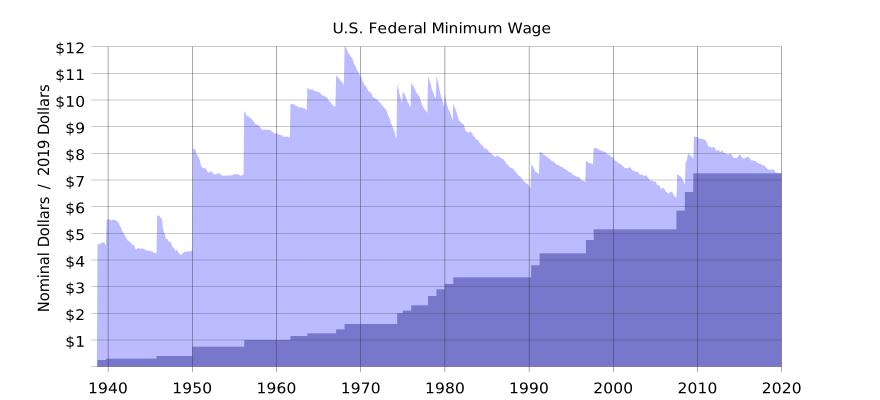
Now, if we assume that inflation is real (which it is), and if we assume that the value of $7.25/hour was valid back in 2009, then we should at least presume that it should keep track with that value, and this means pegging the minimum wage to the inflation rate. If we even did that minor action, it would place the current minimum wage at $7.74/hour in 2012 dollars. However, if we look at the nominal value (or the equivalent value between two years) of the US minimum wage over the decades in which minimum wages existed, you can see that it reached as high at $10/hour (in 2009 dollars; $10.67 in 2012 dollars). That was back in 1968, only one year before Rep. Blackburn started working at her rate of $2.15/hour. What's more, the rate that Rep. Blackburn was paid as a teenager was higher than minimum wage, which was $1.60/hour between 1969-1971.

... and she doesn't even recognize this!

Now, if you calculate the 2012 value of the minimum wage rate that existed when Rep. Blackburn was 16-18 years old, you get $9.88-$8.95/hour, which is still higher than the current minimum wage rate of $7.25/hour that she's saying should not be increased!

... and she doesn't even recognize this, either!

Therefore, let's "correct" Rep. Blackburn's statement by recognizing that inflation exists, and that a significant time has passed since she was 16-18 years old:
What we’re hearing from moms and from school teachers is that there needs to be a lower entry level that still ought to pay a decent wage, so that you can get 16-, 17-, 18-year-olds into the process without them thinking that a work ethic is only tied to what one "costs" a company, and that they can easily be let go once they might cost more than the next inexperienced kid. Chuck, I remember my first job, when I was working in a retail store, down there, growing up in Laurel, Mississippi. I was making like $2.15 an hour, which was 55 cents higher than the minimum wage at the time and would be the equivalent of $12-$13 an hour in today's terms. And I was taught - while being paid more than the minimum wage of $1.60 an hour - how to responsibly handle those customer interactions. And I appreciated that opportunity for useful training while being treated like a human being and not a potential cost to the company. In fact, did you know that today's equivalent value of the $1.60 an hour that was minimum wage when I was 16-18 years old would be almost $10 an hour in today's terms?

There now. All fixed. See how the facts completely undermine her argument of "when I was a kid, I wasn't paid the grand sum of $10/hour!" since the fallacy of her point is made clear by the very evidence that she presents as the example of her own hard-work-at-low-pay, her nose-to-the-grindstone-ness, and her pulled-myself-up-by-my-bootstraps attitude. It just shows her (apparent) self-righteousness to be blithely ignorant blather, wrapped in nostalgia for a "simpler time" and tucked into bed with a healthy dose of political ideology of "the rugged individual" that actually never existed. Will Rep. Blackburn's office release a statement, explaining her misstatement of the facts? Don't hold your breath.

Side note: You can also do the same thing with figures that are found in those "can you believe it?!?" e-mails that show how much "simpler" and "cheaper" it was to live back in 1910, 1920, etc. Without a conversion that takes inflation (and hyperinflation) into account, they're next to worthless. (Also, without any recognition of the benefits that have accrued in society and technology since that time, these sites are similarly worthless.) Sites like The Cost of Living, though, make for a better-informed relative comparison with the past.

Tuesday, February 19, 2013

Getting Rid of Only the Penny vs. All "Cents"

Canada recently stopped issuing pennies, and likely will phase out accepting pennies. Last year, I wrote about why pennies might be a good thing to get rid of in the US, too. Recently, an episode on the BBC World Service made me wonder when all "cent" coins should be gotten rid of. They were asking people what the smallest denomination coin they used to buy something was, and this was immediately after being made aware of the fact that the Zimbabwean 5 cent coin was next to useless and rarely (if ever) encountered, but that the 20 cent could still be used to buy "a bunch of spinach" at the market.

This reminded me of the Hungarian filler. When I moved to Hungary in 1994, there were still fillers used in circulation, but even at that time inflation made them next to useless as a means of transaction. Sure, you might find something that would give change in filler, but you generally had to go well out of Budapest to find a place like that. In my case, I ended up with a small tin filled with tin fillers. (Pun intended.) I remember there being a 50 filler, a 20 filler, and the really occasional 10 filler. (The 2 filler and 5 filler had already been discontinued in 1992, two years before I moved to Budapest, and the 1 filler was never even used after 1939.) What got rid of the filler? The answer is the same as what has effectively done away with the Zimbabwean 5 cent piece and the Canadian penny: inflation.

However, unlike Zimbabwe and Canada, Hungary got rid of the entirety of its decimal coinage. After 1999, the Forint no longer had any decimalized coinage, and the idea of 1/2 Forint - something that was real and actually meant something in the mid-1990s suddenly (in 1999) no longer meant anything at all. This quick trip down memory lane brought me to realize that the same thing happened to Japan after World War II (both times characterized by hyperinflation). I remember my mother showing me a box of old coins from before World War II, complete with sen coins intermixed with yen bills of 500 yen and less.

Good luck finding sen coins today (or even many Japanese who even remember them). And the loss is no longer felt as a tragic one or even an economic one. Indeed, the Japanese may well be considering the value of continuing with 1 yen coins...

Of course, all of this could be done away with if we moved to a completely digitalized currency system. In a completely digital currency system, the somewhat arbitrary nature of being limited to only 100 cents would go away. Why let gas stations get away with always taking 0.9 cents for every gallon they sell? at $X.999? Why let banks pocket the remainder of the interest that has accrued (but remains) below 1 cent? Why let companies keep all the less-than-one-cent portions of salaries? Why allow the government(s) to collect on all the taxes below 1 cent?

Why? Why? Why?

Is it because we don't think of the value of money less than 1 cent to be worth out consideration? If that's true, then why worry about the value of money less than 5 cents or less than 10 cents? After all, almost nothing can be had in much of today's United States at a value of 9 cents or less. And if you're going to make the argument that we should keep the penny, you are effectively also making an argument for giving away all money accrued at values less than that penny. (Or maybe you're just making an argument from emotional, nostalgic, hamburgers-used-to-cost-a-nickel days of the childhoods of people born in the 1940s.)

Monday, February 18, 2013

Why the "Overthow a Tyrannical Regime" Justification Doesn't Hold Water

Over the past months and years, I've been encountering the following premise as to why we have a Second Amendment and why we need a Second Amendment, expressed most recently (and publicly) by the NRA's Wayne LaPierre:
Our Founding Fathers wrote the Second Amendment so Americans would never have to live in tyranny.

For any foreign entity to attempt to encroach on that great freedom is offensive to every American who has ever breathed our free air, or who has ever used a firearm to fend off an evil attacker – whether a criminal breaking into their home, or in defense of their family against a tyrant halfway around the world.

Our Second Amendment is freedom’s most valuable, most cherished, most irreplaceable idea.  History proves it.  When you ignore the right of good people to own firearms to protect their freedom, you become the enablers of future tyrants whose regimes will destroy millions and millions of defenseless lives.
A brief search for "second amendment tyrannical regime" throws up a number of websites that - to a large degree - parrot this premise, what I call the "overthrow of a tyrannical regime" premise. There are many reasons why I find the arguments that use this premise to be disturbing, and one of them is that it's just indefensible on so many fronts, especially Constitutional, historical, and definitional ones. (I'm not even going to cover the completely laughable logic-fail that even a quick assessment of the tactical lopsidedness of civilian armament versus military armament, which the DailyKos did a good job of covering from a historical context as well.)

Not a Valid Equal Protections Defense
The US extends all the protections of the Bill of Rights to all citizens in addition to all residents of and visitors to the nation. A Kyrgyz tourist has the same Bill of Rights protections as a Spanish work visa holder, a Vietnamese holder of a green card, a naturalized Pakistani, and a "native born" US citizen. (And the point that the Bill of Rights extends to everyone in the US, including non-US citizens, ought not to be a controversial position.) As David Cole wrote:
In particular, foreign nationals are generally entitled to the equal protection of the laws, to political freedoms of speech and association, and to due process requirements of fair procedure where their lives, liberty, or property are at stake.
Indeed, Cole points to Founding Father James Madison as to the rationale behind this position that many xenophobic citizens and lawmakers in the past and present (conveniently) fail to fully recognize:
[I]t does not follow, because aliens are not parties to the Constitution, as citizens are parties to it, that whilst they actually conform to it, they have no right to its protection. Aliens are not more parties to the laws, than they are parties to the Constitution; yet it will not be disputed, that as they owe, on one hand, a temporary obedience, they are entitled, in return, to their protection and advantage
In short, if you have to follow the rules of the Constitution, then you should be protected by those rules and enjoy those right, just like every US citizen that has those protections and enjoyments. That's just fair. Indeed, the Founding Fathers only limited the following two things to US citizens:
  1. the right to vote
  2. the right to run for federal office
Nothing else was written into the US Constitution as specific rights and liberties that only US citizens could have.

All of this is important, because you have to recognize that the entirety of the Constitution is effectively a protection for all people who follow the laws of the United States, citizen and non-citizen alike. (You do something illegal, especially a felony, and then your rights become curtailed, and if you're not a citizen, they can get curtailed significantly more than for citizens, since citizens don't get deported or held for deportation.)

What this preamble means, though, is that "Arab-looking" male non-US citizens have the same right to purchase and carry firearms as the average US-citizen gun owner (i.e., a White man). If you find this problematic, then you don't actually believe in the Bill of Rights and the Constitution. Your position on the gun regulation debate is therefore invalid.

Let's move further, though, and use the logic behind many gun-rights proponents who say that the PURPOSE of the Second Amendment is so that people can overthrow a tyrannical regime. If you believe that this is true, and you believe that the Bill of Rights covers all people in the US, then you must also believe that foreign nationals should be allowed to purchase weapons for the purpose of overthrowing a tyrannical regime (and since no definition is ever really given for what a "tyrannical regime" is, other than a hint that it's what the speaker says it is, we will have to also allow foreign nationals to use their own definitions). If you find this problematic, then you either don't actually believe in the universality of the Second Amendment, or you can start to see the problem of the "logic" used by anti-gun-regulation groups.

In short, you can't both say (A) that the Bill of Rights protects citizen and foreigners alike while they are in the US and (B) foreign nationals cannot take up arms against what they perceive to be a tyrannical regime, but US nationals can. If you believe (A) to be true, you must believe (B) to be true if you do believe in the "overthrow of a tyrannical regime" premise. If you don't believe them both to be true, then there is a fault in either (A) or (B).

Not a Valid Historical Defense
One might argue that a foreign national who tries to overthrow the US government is committing an act of war. Well, but a US citizen who tries to overthrow the US government is committing an act of treason (and possibly an act of war, too). The reason why these would be acts of war and treason is simply because there is no Constitutional protection for taking up arms against the US government, even if you are a US citizen. This ought to be pretty clear when you look at the history surrounding the Civil War and every assassination attempt (whether successful or not). If it were legal to try and overthrow the US government, then the Union's entering into a Civil War would not have happened for the reasons that it did. Furthermore, if it were legal for individual citizens to try to overthrow the US government by getting rid of a tyrant, then that should have been a justifiable line of defense during trials of assassins, would-be assassins, and conspirators. The fact that overthrowing a tyrannical government was never used (let alone used successfully) as a defense for the actions taken to try to topple or overthrow the government should (in a sane world) imply that it's not a valid defense of this line of argumentation.

Furthermore, we can look at the reason why the Second Amendment was written: Shay's Rebellion. It was also first tested in the Whiskey Rebellion. As Pierre Atlas wrote over at IndyStar:
One reason the framers replaced the Articles of Confederation with the Constitution in 1787 was the inability of that older system to aid Massachusetts in putting down Shays' Rebellion -- an armed insurrection by men who believed their government had become tyrannical. Shays' Rebellion was on everyone's minds at the Philadelphia convention, and the Constitution they crafted empowers the national government to suppress any armed resistance to its authority.

A few years after Shays' Rebellion, another group of men used their guns to resist what they believed was a tyrannical government. Only this time the country was operating under the Constitution, not the weaker Articles of Confederation. In 1794, proclaiming that the federal government had no right to tax whiskey, hundreds of armed men in western Pennsylvania went on a rampage, terrorizing local tax inspectors and a U.S. Marshal. President George Washington called up an army of 13,000 men from four states and, leading the force himself on horseback, put down the Whiskey Rebellion.
Indeed, the arguments used for gun ownership at the time of the writing of the Constitution and the subsequent Bill of Rights was not that of overthrowing a tyrannical regime. Pierre Atlas describes the prevailing anti-regulation sentiments of the time:
Here is how those constitutional skeptics understood gun rights in 1787: "That the people have a right to bear arms for the defense of themselves and their own state and the United States, or for the purpose of killing game; and no law shall be passed for disarming the people or any of them unless for crimes committed, or real danger of public injury from individuals." Significantly, these original pro-gun activists did not suggest a right to own weaponry in order to defy the government.
In short, there is no historical evidence to point to the rights of gun ownership stemming from a need for the citizens to overthrow a tyrannical regime. Not at the founding. Not at the time of the Whiskey Rebellion. Not at the time of the Civil War. Not at the various times when assassination was attempted.

Not a Valid Definitional Defense
People who use the "overthrow of a tyrannical regime" logic seem to fail to recognize that there appears to be no actual legal definition of how to determine exactly what constitutes a tyrannical regime; one which would be Constitutionally legal to overthrow. Indeed, many people who use this rationale appear to be implying that their definition is the correct one; that they know best, and that if your definition doesn't match with theirs then your definition is wrong, and you're a criminal. This is one of the major problems that comes about when a Constitutional, legislative, regulatory, or judicial definition doesn't exist (or isn't widely promulgated): the public tend make up their own (or adopt the arbitrary definition held by a group). And many in the public believe themselves to be reasonable (and - by extension - their personal definitions are reasonable), which makes positions opposite to theirs unreasonable. Therefore, even while citizen A and citizen B might both agree with the "logic" behind the "overthrow of a tyrannical regime," if they don't agree on whether this government (or any successive government) is sufficiently tyrannical, then each will consider the other to be a criminal for even proposing its overthrow. In short: definitions are important, but we don't have a working definition of "tyrannical regime", which means that the public are making up their own individual definitions.

Part of the reason why such a definition doesn't exist is that it would either need to already be defined by the US government (which is the very body that would not relish defining the terms of its violent-yet-legal overthrow) or be defined after a successful coup d'etat. Since there doesn't exist any definition, then we have to presume that "tyrannical regime" would be defined after a successful coup d'etat (which is usually how coup d'etats work).

Since there is no valid definition of "tyrannical regime", any military action taken against any regime could easily be argued to be criminal, and it wouldn't be surprising that the justice system of that regime would be inclined to agree that the action was criminal and rule accordingly. Therefore, the lack of a definition of "tyrannical regime" makes for a very dangerous (and irresponsible) justification for armed revolt.

However, let's presume that an armed revolt against the government was successful (even though there was no prior definition that outlined how that government actually was tyrannical). After the successful armed revolt, there effectively is no US government and no US Constitution. To the victors go the spoils, and - much like the founding of the country, one gets to re-conceive and re-write the rules. In short, the justifications of the entire US Constitution as they currently stand are null and void, and this also negates the entire "overthrow of a tyrannical regime" premise.

Not a Valid Constitutional Defense
Finally, the "overthrow of a tyrannical regime" premise is not a good Constitutional argument against governmental gun regulation. The Second Amendment actually calls for a well regulated condition for the bearing of arms. Indeed, the premise of not wanting to maintain a large standing army in the new (and heavily indebted) nation of the early 1780s meant that Congress wanted each of the states to maintain well-regulated militias for the purpose of secondment to the US Army, if the US were ever to go to war again. These regulations were executed staring with the 1792 Militia Acts and culminated in the 1903 Militia Act that effectively disbanded the structure of the militias and reformed them as the national guard. The Founding Fathers did want regulation in the ownership and bearing of arms that they wrote the words "well-regulated" directly into the Second Amendment.

Also, let's not forget that the last SCOTUS decision actually said that there could be Constitutional regulations placed on gun ownership. As Justice Scalia stated in a recent interview:
What the opinion Heller said is that it will have to be decided in future cases. What limitations upon the right to bear arms are permissible. Some undoubtedly are, because there were some that were acknowledged at the time. For example, there was a tort called affrighting, which if you carried around a really horrible weapon just to scare people, like a head ax or something, that was I believe a misdemeanor. So yes, there are some limitations that can be imposed. What they are will depend on what the society understood was reasonable limitation.
In short, the presence of government regulation is written into the Second Amendment. Government regulation is Constitutional, even if you might argue about the interpretation of the SCOTUS decision under Heller.

Conclusions
I presented four lines of argumentation that show how the whole "overthrow a tyrannical regime" line of argumentation is just plain false. It's false on so many fronts that it's still amazing to hear people using it. (And knowing why it's just so plainly wrong makes it really annoying that it continues to be used as if it were a real, justifiable, and defensible position.) To summarize the above arguments against the logic of "overthrow a tyrannical regime" as a valid reason to halt any gun regulation:
  1. If you don't relish the idea of foreign nationals being allowed to purchase guns to overthrow what they believe to be a tyrannical regime, then you really shouldn't be swallowing this brand of anti-gun-regulation rhetoric.
  2. If you recognize that the US Civil War and the myriad assassinations and assassination attempts have not been justified upon the "overthrow of a tyrannical regime" logic, then you really shouldn't be swallowing this brand of anti-gun-regulation rhetoric.
  3. If you recognize that there is no valid definition of what is a "tyrannical regime," and that a successful overthrow of the government means that you don't need a definition, which throws the whole premise of the justification out the window, then you really shouldn't be swallowing this brand of anti-gun-regulation rhetoric.
    • Furthermore, since there is no definition, the operational definitions that people use are the ones they make up by themselves (or adopt as a member of a group), which means that there is no consistent social definition, either, which is why you really shouldn't be swallowing this brand of anti-gun-regulation rhetoric.
  4. If you recognize that the Constitution actually stipulates that the bearing of arms is to be well-regulated and that one of the most conservative members of the current SCOTUS openly states that certain regulations on gun ownership are Constitutional, then you really shouldn't be swallowing this brand of anti-gun-regulation rhetoric.
To put it more elegantly (and with more historic and military perspective):
No, the Second Amendment has never guaranteed individuals a right to use their arms to resist the government or its laws. As I learned myself when I enlisted in the Army more than 25 years ago, all personnel joining the Armed Forces swear to "support and defend the Constitution of the United States against all enemies, foreign and domestic." Domestic enemies are those who would attempt to overthrow, or resist with violence, the government of the United States.

    Friday, February 15, 2013

    Regarding the Names of Countries: Who Gets to Decide what they're Called in English?

    Recently, Andrew Sullivan at the Dish wrote briefly about President Obama's use of Rangoon and Burma instead of Yangon and Myanmar during the State of the Union:
    10.02 pm. A personal note of thanks for using the words Rangoon and Burma. Then the Arab Spring: it will be messy, we cannot control events, but we should back freedom. Pretty much: stay out of the way. A minor note on Israel: emphasizing security and a “just peace.”
    This apparently occasioned people to write in and offer their two cents about who gets to decide what a country - and its various cities, presumably - are called, and Sullivan posted one response:
    I also used to make a big deal about using the terms ”Rangoon” and “Burma”.  That was before I actually had been there. On each visit, I found that everybody in Myanmar says they live in Myanmar and that their capital is Yangon. Foreigners don’t get to decide that for them; they declare it stoutly, even if those changes were made by their despicable military regime.  We can all mourn the lost years in Myanmar, but we don’t need to fixate on the linguistics of their own place names. Several people, certainly not military sympathizers in any way, will point out that Myanmar is the country’s original name, that the Brits changed it to Burma to reflect the overweening power of the majority Bamar ethnic group in civic life. ... I think it’s fine to call it Burma or Myanmar, and certainly folks there wouldn’t bother to correct you.  I just think it’s time to stop being smug about using the term Burma to indicate a political viewpoint that in Myanmar itself is pretty irrelevant.
    I read this reply and I was a little bit torn between sentiments of fairness and recognition of the reader's bloody obvious double-standard. The latter won out as the list of countries (and cities) that - in English - carry labels that were totally standardized as foreign constructs grew and blossomed, and ballooned. Therefore, even while I do agree with the spirit of what the reader states, I'll bite when he starts referring to Zhōngguó, Nihon or Nippon, Hanguk or Joseon, etc., instead of "China," "Japan," and "Korea". There are many countries that carry with them Anglicized versions of (often) other European names for countries (like "China," "Korea," and "Japan"). (Sullivan also apparently recognized the reader's double-standard, writing, "I’ll agree when my reader is fine visiting München and Москва with me. Till then I’ll call it Burma – which is an anglicized version of what Brits heard when they listened to the locals.")

    If the responder doesn't like whether "foreigners don’t get to decide [what to call their country and capital city] for them", then the responder will have to make a lot of changes, even throughout England's continental neighbors. On a short list, you've got to stop referring to Deutchland as Germany, learn how to pronounce Österreich instead of Austria (and while we're at it, why are we going to still call it the foreign name of "Australia", or does hundreds of years of British colonial rule dissolve the whole "foreigners don't get to decide it for them" requirement?), learn to pronounce France as [fʁɑ̃s] and not /ˈfræns/, recognize that the countries of northern Central Europe are actually supposed to be called Polska, Slovensko, Česká republika, and Magyarország (U+2190.svg and learn how to pronounce those properly, too, btw) instead of the foreigner-decided "Poland," "Slovakia," "the Czech Republic," and "Hungary."

    And what are we going to do when referring to countries and cities throughout Africa, where the names of many current countries and cities were so obviously a result of being named by foreigners, just as their borders were written by foreigners? Liberia? What's that except a name that was bestowed by foreigners. Ivory Coast? That's definitely NOT a name that has a single shred of a link to pre-colonial cultural, linguistic, or national heritage, but is derived from an objectified label of the commodity that was traded from that area. Nigeria? That country's name was coined by the future wife of the colonial administrator after the river that was also named by foreigners. One could easily go on and on and on.

    So, in sum, go ahead and try to be equitable in the rights of people to determine the name of their country, but if you're going to insist that we do it for the citizens of Myanmar who "say they live in Myanmar and that their capital is Yangon," but also, " wouldn’t bother to correct you [if you refer to them as 'Burma' and 'Rangoon']", then you will have to do the same thing for all the countries and all the cities for all those people who - when speaking within their own language and with their own countrymen - refer to their country and cities by different names than what English speakers would use (and who also wouldn't likely correct an English speaker for using the English name). In other words, try - as an example - to have a conversation with people about how - for example - "The foreign policy decisions of Deutchland will have ramifications in newer EU countries, especially Magyarország and Polska, let alone the more-central countries of Elláda and España" and see how many of your English-speaking conversation partners think you're being insightful and liberating instead of "smug about using the [foreign name of a country] to indicate a political viewpoint that in [that country] is pretty irrelevant."

    Finally, would the responder allow for transliteration of foreign names that were written in Latin script? (I'm assuming that the reader would allow for transliteration of foreign names written in non-Latin script, since I'm assuming that the reader is somewhat sensible to what would be obvious flaws in their argumentation.) If so, then would we now have to spell "Deutchland" as "Doychlahnd"; "France" and "Frahns"; "Magyarország" as "Mahjahrohrsagg"; etc., which would then impose a foreign decision upon the spelling of their name just as much as the imposition of transliterating into Latin script from non-Latin script imposes a foreign decision upon the spelling of the names of so many other countries.

    Thursday, February 14, 2013

    Nerdy Valentine's Day Videos

    Just a little techy-geeky video by one of the founders of OKCupid on this Valentine's Day:


    And the Science of Love:


    And methods to determine if that person you're going to dinner with tonight is a psychopath:


    And for those budding writers out there, 10 tips to writing fantastic sex:


    And now that you've had a good dose of the mathematics of matchmaking and the physiology of love, here's a remake of Willie Nelson's Valentine that I really like:

    Monday, February 11, 2013

    Sorry Sen. Casperson, but Humans DO Cause Losses to Biological Diversity

    Last week a number of Michigan senators decided that they wanted to severely limit the ability of the Michigan Department of Natural Resources (DNR) to set aside lands for the purposes of preservation and restoration. The Herping Michigan Blog summarizes Michigan Senate Bill 78:
    CONTENT

    The bill would amend several parts of the Natural Resources and Environmental
    Protection Act to do the following:


    • Prohibit the Department of Natural Resources (DNR) and the Natural Resources Commission from promulgating or enforcing a rule or an order that designates or classifies an area of land specifically for the purpose of achieving or maintaining biological diversity. 
    • Delete the conservation of biological diversity from the DNR's duties regarding forest management, and require the Department to balance its management activities with economic values. 
    • Eliminate a requirement that the DNR manage forests in a manner that promotes restoration.
    • Provide that a State department or agency would not have to designate or classify an area of land specifically for the purpose of achieving or maintaining biological diversity.
    • Eliminate the restoration of natural biological diversity from the definition of "conservation."
    • Eliminate a reference to "unusual flora and fauna" in the definition of "natural area."
    • Delete a legislative finding that most losses of biological diversity are the result of human activity.

    Perhaps Senator Casperson should watch the following video, so as to understand what's wrong with the bill's suppositions (especially the supposition that humans don't cause losses of biological diversity):


    Note to Senator Casperson: just writing a bill that denies reality does not change reality; only the official recognition of what is real, which actually creates perverse actions and outcomes that often run counter to the very point of the public good that bills like this one lead to. In this case, the bill is ostensibly for preserving the ability for hunters to hunt and loggers to log. However, without lands that operate as functioning habitat for deer (and all the things that help deer thrive, including predators), you won't have robust and resilient deer herds, and the state will have to pay for stocking forests with farm-raised deer so that hunters will have something to hunt. Similarly, without a functioning habitat for trees, the state will have to pay large costs for fertilization and pest management so that monoculture forest plantations are productive enough for a contractor to come in and cut down the trees. (And I'm not even going to consider the impacts of clear-cutting on soil quality, changes in local deer populations, and the knock-on impact to hunters - one of the groups this bill is ostensibly written to help.)

    The fact that Senator Casperson also appears to be a believer in the Agenda 21 conspiracy also makes me wonder whether he actually understands that (A) the UN is not going to swoop in and take away private property rights because of biodiversity (after all, the UN can't be both an incompetent bureaucracy and a highly organized world-wide government hell-bent on using military tactics to take away American citizens' private property), (B) that conservation of natural resources OUGHT to be a conservative principle, (C) that all systems (ecological, social, economic, etc.) are connected, and if you change things in one area, you'll have knock-on effects on another.

    Tuesday, February 05, 2013

    Complaint Choirs: Who Says you Can't Complain in an Upbeat Manner?

    In a recent jaunt through YouTube, I came across the Tokyo Complaint Choir:

    Tokyo complaint choir


    And from there to so many more:

    Birmingham, England


    Helsinki, Finland


    Hamburg, Germany


    St. Petersburg, Russia


    Budapest, Hungary


    Chicago, USA


    Singapore


    Hong Kong


    Florence, Italy


    Turns out that this is really an organized thing, complete with a website and a Wikipedia entry:
    Complaints Choir is a community art project that invites people to sing about their complaints in a choir together with fellow complainers. The first Complaints Choir was organized in Birmingham (UK) in 2005, followed by the Complaints Choirs of Helsinki, Hamburg and St. Petersburg in 2006. The project was initiated by artists Tellervo Kalleinen and Oliver Kochta-Kalleinen. A video installation consisting of the documentation of the public performances of the four choirs were shown at Kiasma (Helsinki, Finland), S.M.A.K. (Ghent, Belgium) and Museum Fridericianium Kassel (Germany) among other venues. When the video clips of the choirs were distributed through online magazines and video sharing websites, the idea spread quickly to many other countries. To date additional Complaints Choirs have been organized in Bodø (Norway), Poikkilaakso primary school (Helsinki, Finland), Budapest (Hungary), Chicago (Illinois, United States), Juneau (Alaska), Gabriola Island (Canada), Melbourne (Australia), Jerusalem (Israel), Singapore, Breslau (Poland), Hong Kong, Philadelphia, Enschede in The Netherlands (as part of its international Grenswerk art festival) in the Netherlands and Tokyo (Japan).
    I guess the shitty world economy has exacerbated the desire to kvetch, but to do it in style. After all, anyone can bellyache, squawk, and whine all they want. However, melodious complaining makes it all the more fun to actually listen to.

    A YouTube search for "Complaint Choir" also pulls up a lot of other places. Interestingly, I don't find any complaint choir entries for France, or in Latin America. Hrm. Maybe I'm just not looking hard enough.

    Monday, February 04, 2013

    "We Are the World": A Song the Blast from the Past

    I was living in Japan. I was in third grade. This song was literally E.V.E.R.Y.W.H.E.R.E. We sang it in choir. I sang it on my way home. We saw the video on TV alongside those heartwrenching photos of famine and death that were coming out of Africa that year. It was the massive, worldwide hit, We Are the World that written by Michael Jackson and Lionel Richie and gathered and directed by Quincy Jones.


    What I find amazing about this video, watching it through the eyes of an adult, is that this is such a great array of popular vocal talent from that time, but they are all singing together. True, there are solos, and a lot of the assembled singers get to belt out a phrase or two, but much of the song - and of the video - shows these super-A-list singers standing together as a chorus; melding their voices together.

    And that I now find so amazing.

    After 25 years, in 2010, there was a re-make of the song:


    in addition to a Spanish version - Somos El Mundo - to raise funds for rebuilding after the Haiti earthquake.


    Woah. To me, they are still powerful songs, and (hopefully) they remain powerful political songs.

    Friday, February 01, 2013

    Response to Soc. Images. Re: Are Conservatives Happier than Liberals?

    Yes, it's again with Soc. Images. This time, though, it's on the post entitled, "Are Conservatives Happier than Liberals?" Let's just gloss over the inherent difficulties in defining what happiness actually is, let alone measuring it in any meaningful manner. Let's just assume that there is some sort of objective metric that can be pulled together, like in this post:
    In the New York Times, Arthur Brooks argues that conservatives are happier than liberals.

    Brooks starts with a reference to Barack Obama’s remark four years ago about “bitter” blue-collar Whites who “cling to guns or religion.” Misleading, says Brooks. So is a large body of research showing conservatives as “authoritarian, dogmatic, intolerant of ambiguity, fearful of threat and loss, low in self-esteem and uncomfortable with complex modes of thinking.”

    Despite that research, it’s conservatives, not liberals, who identify themselves as happy. And, Brooks adds, the farther right you go on the political spectrum, the more happy campers you find.

    ...

    Sure enough, by about 10 percentage points, more conservatives identify themselves as “very happy” than do liberals. The difference is even higher among the extreme conservatives. As Brooks says, “none, it seems, are happier than the Tea Partiers, many of whom cling to guns and faith with great tenacity.”

    ...

    Maybe conservatives were happy because until recently, they didn’t have much to be bitter about. The US was their country, and they knew it. Then Obama was elected, and ever since November 2008 conservatives have kept talking about “taking back our country.” (See my “Repo Men” post from 2 1/2 years ago.)

    What if we look at the data from the Obama years?

    Maybe that bitter Tea Party image isn’t such a distortion. ...

    For all I know, Brooks’s general conclusion may be correct, but the recent data do at least raise some questions and suggest that the political context is itself a relevant variable.
    I looked at the article and thought, hmmm... I see something like a cross-correlation going on here, based on the political context, much like the author is indicating when he writes, "Maybe conservatives were happy because until recently, they didn’t have much to be bitter about. The US was their country, and they knew it." After doing a little recollection of recent presidential political history, I wrote a confirmatory comment:

    I feel that this sort of study is potentially missing the massive social correlation of prevailing political climate. It's not surprising that conservatives have felt happy during the period of 1972-2008, since most years during that time were under conservative political climates. For example, if you look at the presidencies from 1972-2008, you'll notice that 25 of the 37 years (67.6% of those years) were under a conservative president:

    Nixon (1969-1974; 3 years if counting from 1972; conservative)
    Ford (1974-1976; 2 years; conservative)
    Carter (1977-1980; 4 years; not conservative)
    Reagan (1981-1988; 8 years; conservative)
    Bush (1989-1992; 4 years; conservative)
    Clinton (1993-2000; 8 years; not conservative)
    Bush (2001-2008; 8 years; conservative)

    Therefore, if one assumes (and it's an assumption, but I think it's rather valid) that non-conservatives feel "happier" under non-conservative government and conservatives feel "happier" under conservative government, then it's a valid argument that you're not measuring the same sort of environment. Indeed, if you look at the 2009-2010 graph, you can see what appears to be evidence that (partially) supports my assumption: conservatives are less "happy" under this non-conservative government (non-conservatives do not appear to be any more or less happy).

    I suspect that this isn't so much a measurement of "conservatives are happy in general" but more a measurement of "conservatives were happier under conservative political climates," which shouldn't be too surprising.
    It all reminds me of a (relatively) recent XKCD comic: