Wednesday, February 15, 2012

India won't censor social media (except when they will)

Yesterday, I saw this from PhysOrg: India won't censor social media: minister. "Yay!" I thought to myself. "This must mean that the pluralistic right to be annoying at anyone you wish to - and to be called out for being annoying to anyone you wish to - will be honored!"

But no. Look at this interesting and round-about logic that amounts to Indian governmental officials saying, "We won't censor social media. We'll just censor social media."
"I want to say once and for all, without any obfuscation, no government in India will ever censor social media," Telecoms Minister Kapil Sibal told an IT summit in Mumbai.

"I never wanted to censor social media and no government wants to do so. But like the print and electronic media, they have to obey the laws of the country."
Okay, so Minister Kapil Sibal is merely saying that social medial needs to follow the laws of the country. That sounds reasonable. So... what are the laws of the country?
Local laws prohibit the sale or distribution of obscene material as well as those that can hurt religious sentiments in overwhelmingly-Hindu India.
Hmm.... So, prohibiting the distribution of material (which - if you consider words and ideas to be material - is something that social media excels at doing) that can hurt religious sentiments isn't censorship?

This is like a white supremacist who isn't a member of any racist group (like neoNazis or the KKK) saying that s/he isn't a racist, because s/he isn't a member of a racist organization.

This is like a evolution denier who isn't a Christian creationist saying that s/he isn't an evolution denier, because s/he supports intelligent design and thinks that Christian creationism is hooey.

This is like a government that says that there aren't any censorship laws, because there are no laws that are specifically titled "censorship laws." ...oh, that seems like something I've outlined above...

At least not everyone is falling for this ruse. Pranesh Prakash is - perhaps - a little more savvy about information than the Indian Telecoms Minister:
Pranesh Prakash of the Bangalore-based Centre for Internet and Society said he was "glad Sibal does not believe in censorship and that companies operating in India should follow local laws."

"But on the other hand he has asked them to evolve new guidelines and actively monitor user content which is not legally sanctioned. This makes him look two-faced," Prakash added.
All this hubbub is taking place while the Delhi High Court is telling Google and Facebook that they need to follow local laws, or else ... India will have to do something like China is doing:
Google and Facebook said earlier this month they had removed the allegedly offensive content used as evidence in the court cases.

The groups have appealed to the Delhi High Court asking for the cases against them to be quashed on the basis they cannot be held responsible for their clients' actions.

The comments of a judge hearing the case raised further fears that freedom of expression online could be restricted.

"You must have a stringent check. Otherwise, like in China, we may pass orders banning all such websites," the judge said at the January hearing.

Facebook is banned in China and Google moved its operations out of the country in 2010 in protest at censorship laws there.
So, to sum up: The Telecoms Minister is saying that social media won't be censored; that social media needs to follow laws that are de facto censorship. The Delhi High Court is saying that Google and Facebook need to follow laws that are de facto censorship or else the Delhi High Court might pass actual censorship laws. But India is supportive of free speech and against censorship.

HUH?

Tuesday, February 14, 2012

Some civics & history points in the appendix to a judicial ruling in TX

In the second (!) appendix to a judicial ruling about school prayer in a Texas public school, Judge Biery writes - quite succinctly - about the problems of allowing government association with religion and why we have a separation of "Church and State". It starts - on page 3 of Appendix II - with a section titled "Diversity of Homo Sapien [sic] Religious and Life After Death Beliefs". Following the standard of written judgments, there are plenty of footnotes that pepper the document, and by page seven - and the title "The American Colonial Religious Experience" the document racked up 23 footnotes.

To present the reason why the United States ultimately resolved to separate itself from religion, Judge Biery's statement makes the following observations of history:
The Alsatians who immigrated to the Medina Valley [where the ruling of the case took place] were neither the first nor the last group to come to America in search of freedom from government controlled religion. Before them came the Pilgrims persecuted by the government-controlled Church of England, the French Protestant Huguenots persecuted by the French Catholic government of Louis XIV, and the European Jews persecuted by European Christian governments.

They voted with their feet for separation of church and state by coming to the new world. But old practices die hard, and the American colonists themselves established official government religions. For instance, the Rhode Island Charter of 1663 promised to "preserve unto [its inhabitants] that liberty in the true Christian faith and worship of God." Other Rhode Island laws restricted admission to the colony to those professing the Christian religion. Similar laws existed in Massachusetts and New York. In Virginia in 1776, although it was declared "all men are equally entitled to the free exercise of religion, according to the dictates of conscience," it was also declared that "it is the mutual duty of all to practice Christian forbearance, love, and charity towards each other." In Maryland, which was originally settled as a safe haven for Catholics, a Protestant majority became dominant and persecuted and marginalized Catholic residents. Seventh-Day Adventists were similarly persecuted by the majority for their beliefs." (pp 7, 8)
In short, people left Europe because of the problems of Church being combined with the state, but they set up similar forms of church-state interactions in the new world, resulting in state-justified persecutions that were analogous to the ones they left Europe over in the first place. Judge Beiry continues, in the section "Government and Religion Joining Hands":
If government-run public schools also joined hands with religion and had the power to impose religious views, questions arise: Which holy books and prayers would be preferred? The Torah? The Book of Mormon? The Catholic Bible? The New Testament? The Bible as edited by Thomas Jefferson? The Koran? Would Christians be required to face Mecca or observe Hebrew prayer? Would Jews and Muslims be obligated to stand and recite the Lord's Prayer? (p 9)
It's questions like these that I think that many people who want to increase government associations with religion don't ask themselves. Which religion? How much religion? How much coersion?
By page 12, Judge Beiry starts with the civics lesson:
The Constitution invokes, and is based upon, the people as having ultimate sovereignty and power over the three branches of government through the electoral and amendment processes vested in them. That power, for example, has been exercised to allow women to vote, to prohibit, and then allow, liquor and to limit the President of the United States to two terms.

The people could exercise that same power to amend the Constitution to favor a particular religion, to turn the United States into a religious state such as Israel or Iran or to suppress religion as in the Soviet Union, China or Cambodia under the Khmer Rouge.

Thus far, that power has not been exercised in such a manner, and this Court's obligation is to follow the Constitution as written, as intended by the Framers and as interpreted by the Supreme Court of the United States.
In other words, if people DID want to have a religious government, there is a mechanism to do it: the amendment process. However, the Supreme Court - not political pundits - is there to interpret the Constitution. Indeed, Judge Beiry's commentary under the section "Original Intent of the Framers of the United States Constitution" is pretty boiler-plate stuff (unless you happen to buy in to the false notion that Christianity is a fundamental part of the Constitution - that just happened to be left out of it completely):
Reasonable minds differ on the Constitution as a living, evolving document or one to be interpreted strictly as the Framers originally intended. Some issues not foreseen by the leaders of an agrarian slave holding nation do not lend themselves to providing insight into the intent of those authors. (p 13)
I like that he pointed this out. The Framers lived in the world of 230+ years ago. It was a world in which Joseph Priestly had just discovered - in 1774 - that the atmosphere is made up of stuff, and that oxygen is what allows stuff to burn (although it wasn't until 1777 that it was called "oxygen"). It was a world in which manned flight of any sort wasn't yet around (the famous French demonstration of humans in a hot air balloon wasn't to happen until 1783). It was only a few years after Edward Jenner successfully used his smallpox vaccine idea to stop an outbreak in England (but still about two decades before the idea of vaccination would catch on in the medical world). And the list goes on. In other words, the world of the late 18th Century was a completely different world than the one we live in today. (It's even completely different from the world of the most observant Amish!) Therefore, as Judge Beiry notes, it's not inconceivable that some things aren't going to be covered directly by the Constitution nor by the correspondence and literature written by the Founders.

However, religion ain't one of them:
Religion though and its relationship to government was one on which the Founders did speak clearly. Having witnessed and learned from the bloodshed and persecution of European church-state partnerships the Founders wrote [the First Amendment].
Judge Beiry also provides James Madison's written and expressed intent behind those words, Thomas Jefferson's letter to the Danbury Baptist Association (1802) and personal correspondence in 1822, John Adams' 1817 letter to Thomas Jefferson, Benjamin Franklin's perspectives from 1780, and Thomas Paine's statements of the time. (See pp 13-15.) They are all of the opinion that they did NOT want a country that mimicked the church-state relationship that was seen in the very country that they had just fought a bloody war against; one that was ruled (titularly) by a king, who was given divine authority by God, and which had - not even 100 years previously - been rocked by a civil war that had been - in part - due to church-state issues.
The last three pages of Appendix II fleshes out the point Judge Beiry made about Supreme Court interpretation of the Founders' intent, and it starts with the first decision made - in 1890 Wisconsin - about the promotion of particular religious viewpoints in public schools, which found:
The priceless truths of the Bible are best taught to our youth in the church, the Sabbath and parochial schools, the social religious meetings, and, above all, by parents in the home circle. There, these truths may be explained and enforced, the spiritual welfare of the child guarded and protected, and his spiritual nature directed and cultivated, in accordance with the dictates of the parental conscience. The constitution does not interfere with such teaching and culture. It only banishes theological polemics from the district schools. It does this, not because of any hostility to religion, but because the people who adopted it believed that the public good would thereby be promoted, and they so declared in the preamble. Religion teaches obedience to law, and flourishes best where good government prevails. The constitutional prohibition was adopted in the interests of good government; and it argues but little faith in the vitality and power of religion to predict disaster to its progress because a constitutional provision, enacted for such a purpose, is faithfully executed.
This isn't a communist or socialist plot. (Heck, Marx's Communist Manifesto had only been published in English - in England - in 1888.) It was, instead, a decision based in an American context, predating - one can safely surmise - any sort of "Red Scare". It sought to limit - in plain language - government endorsement of religion in schools, because religious teaching was not the function of the government.

Appendix II can be found here.
The commentary on this case (and of the appendix comments by Judge Beiry) is from Dispatches from the Culture Wars.

Happy Valentine's Day

Although many of us will be celebrating Valentine's Day with flowers, chocolates, romantic dinners, wine, etc., do we know what the origins of this festival are? Well, one Islamic cleric seems to think that it's got something to do with a bacchanalia that surrounded Lupercalia and the subsequent death of St. Valentine which occurred later as a result of preaching against it.

Ummm... no. Although it is just Wikipedia, nothing appears to be mentioned about pairing and free sex under the Lupercalia entry at Wikipedia.

Looking, instead, to the entry for Valentine's Day, we find that its associations with romantic love have more to do with Chaucer than with the Romans (or even Pope Gelasius I, who named the day in honor of St Valentine in 496 AD). It has - obviously - evolved since the Middle Ages of England. The style of celebration of today will be completely unrecognizable by Chaucer (that is, if he even deigns to notice its celebration, what with all that he might be transfixed by all the marvels of today's world).

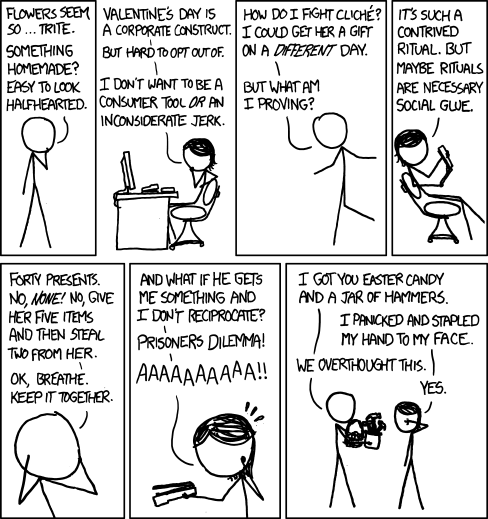
In the end, I hope that you celebrate Valentine's Day without overthinking about it too much:
 Via xkcd

UPDATES (Valentine's Day-related research studies): Two somewhat-of-a-stretch news releases of research tangentially related to Valentine's Day - because they deal with the topic of relationships - that were framed as being related to Valentine's Day:

Cut your Valentine some slack:
A new Northwestern University study shows that the more you believe your partner is capable of change and perceive that he or she is trying to improve, the more secure and happy you will feel in your relationship. That is true even if you think your partner could still do more to be a better partner.

"Many of us tend to under appreciate our partner's efforts to improve the relationship, simply because we do not have enough faith in those attempts," said Chin Ming Hui, the lead author of the study and a fourth-year graduate student in the department of psychology at Northwestern University's Weinberg College of Arts and Sciences. "When we see those efforts in a positive light, we can enjoy our relationship much more."

"A secret to building a happy relationship is to embrace the idea that your partner can change, to give him or her credit for making these types of efforts and to resist blaming him or her for not trying hard enough all of the time," Molden said.

Men are not from Mars, women are not from Venus:
Professor Mari Ruti of the Department of English and Drama at the University of Toronto Mississauga has written about love for both academic and mainstream audiences. Her newest book, The Summons of Love, portrays love as a much more complex, multifaceted phenomenon than we tend to appreciate—an experience that helps us encounter the depths of human existence.

The main argument is that the image of romantic love that the self-help industry tries to sell is based on a few misconceptions. The first is the idea that love is a game with winners and losers. The second is the idea that men and women are inherently different so that to make romance work, women need to learn to read the so-called male psyche.

I argue that there is no such thing as the male psyche and I also argue that the more we try to manipulate our romantic lives, the more we think of love as a game, the less authentically we are able to love. So basically, whoever came up with the idea that love is a game destroyed its soul.

As a university professor, I teach 18- to 22-year-olds. I know from experience that their understanding of gender is a lot more fluid than what these self-help books portray.

As research for my book I read 20 to 25 self-help books. Their portrait of men in particular is really strange. Book after book tells us that men are these cave men who are wired to hunt women. They’re wired to cheat on you. They don’t understand emotions. They will forget your birthday. They’re commitment phobic. The young women I teach don’t think of men in these terms and the young men I teach don’t think of women as prey to be conquered. There’s a lot more fluidity and there’s a lot more mutual respect than these authors are suggesting. When you look at younger people you see this clearly.
 In short: relationships are not formulae with deterministic solutions (let alone a single solution). It's a big, "No duh" that hopefully we can remember while we have the candle-lit dinners with our significant others tonight - as well as the other 365 days this year (and 364 days when it's not a leap year like it is this year).

Monday, February 13, 2012

I want to go back to see Japan...

It's been over a decade since I went to Japan. The last time I was there was 2001. It's been even longer since I went to visit Yokohama (about 2 decades). The photos of a day in Yokohama during winter - from Danny Choo - really pulls on my sense of nostalgia. However, it's not just a feeling of nostalgia about the Japan of 2001 (or 1992), but of the changes that have happened since then - the good, the bad, and the ugly changes. However, Choo rarely shows the bad and the ugly, so enjoy some of the good:


Sunday, February 12, 2012

Beastie Boys + Alien

Two things that I came to like years after their release: Beastie Boys and Alien. Enjoy this mashup from okarola.

Saturday, February 11, 2012

How furry and relatable does an invasive animal have to be to get the "awww" factor?

When Wisconsin proposed an ordinance in 2005 to allow for killing feral cats (an introduced, non-native species) that were decimating song bird populations, people were horrified:

I think that it should stay illegal for the people to hunt house cats. That is an act of animal cruelty, like they said. and there are so many songbirds in the USA and other countries. So the birds can take care of themselves, the cats need help. DON'T SHOOT THEM! AND DON'T MAKE IT LEGAL!

When New Zealand continued its yearly Easter hunt for invasive and non-native rabbits, people were aghast: "The poor rabbits! How cruel!"

When river managers in the US try to figure out ways to increase the interest in carp meat to cull the invasive and non-native Asian carp species, people weren't too fussed with the idea of fishing for carp, instead pointing out the flaws of the author as well as offering commentary about the quality of the fish as "game":
wow, the author has no clue about asian carp and wrote an article, then gave a recipe that not only requires 2 days to cook the fish, but a smoker as well, something most people wont have. did you even bother watching the link you sent people to about cooking the fish? they dont feed on the bottom, they are mid/top feeders and are known to be cleaner than the rest of the fish in the water. if the dnr gives ANY fish in your water a clean bill of health, the asian carp is cleaner. oh yeah, and comparing pcb contents to the common carp filets is a bad idea, the fish arent even remotely similar biologically, they only share a name.
and
The carps we call "Asian carps" here in the USA are not that particularly great (for their size) on rod and reel. Common carp is a pretty good fighter. Grass carp are wimps, for their size (but because they can be large, they can be exciting on light tackle). It is pretty hard to hook and line grass carp because of their vegetarian habits, and very, very hard to hook and line silver or bighead carp, being filter feeders, although some people snag them or shoot them with a bow and arrow. I have done both. If you hook them just right, they can be big fighters. But often like bringing in a big wet towl. Good to eat though, if they are not losing weight. Asian carps are losing weight from lack of food over large parts of their invaded range and those fish are not good eating.

My conclusion up to now: charismatic invasive mammals will elicit an "awww" factor that clouds many environmentalists' determinations about looking at protecting <i>the environment</i>, whereas uncharismatic invasive animals (such as most ichythofauna) are merely looked at as nuisances in the environment with few problems of culling (so long as that method doesn't affect native species or desired species). In my opinion, when a species is protected by the "awww" factor, it's deleterious role in the environment is superseded by the personal attachment that we hold for the animal. I would say that - in general - species that we have come to think of as "pet species" tend to have the greatest "awww" factor (witness the shock and horror that people have when faced with the realization that cats, dogs, and rabbits - mammals all - might have a huge negative impact on native ecosystems) whereas "non-pet species" tend to have the lowest "awww" factor. Note: this is (in my opinion) different from "characteristic megafauna" (such as pandas, mountain gorillas, elephants, etc) in that "characteristic megafauna" are almost all under ecological duress, and exist in far fewer numbers - are at the opposite end of the proliferation scale.

Now we are presented with a quadruped that many people have as pets that is a non-native species causing ecological havoc and also happens to be a food source: iguanas in Puerto Rico. It will be interesting to note whether people outside of Puerto Rico will tend toward the "awww" factor (iguanas are a relatively popular "pet species") or tend toward the nuisance perspective (although a "pet species" they aren't mammalian).

Friday, February 10, 2012

One of the best YouTube videos I have seen

A number of years ago - during the height of the "let's teach creationism in school" episode - I got a little bit into the whole world of creationism/intelligent design. (I am still reading on these topics from time to time.) However, this video seemed to speak well to me, both with the simplicity of its argumentation as well as the clarity of its imagery.

Enjoy:

"Evolution IS a Blind Watchmaker"

Thursday, February 09, 2012

UM Natural History Museum collections on the move

This argument against legalizing marijuana is just... ludicrous

From The Dish, Patrick Appel points out a pretty poorly reasoned argument against legalizing marijuana that was sent to emissourian.com. Although I do not use - nor have ever used - marijuana, I do support its legalization. For various reasons. However, this letter to the editor is - as Appel insinuates - bordering on hallucination:
To The Editor:
Starts off okay.
In regard to the petition to legalize marijuana. Well, here we go down the wrong road again. We legalized alcohol finally, and what happened? It was supposed to be in moderation and for social purposes. It really had no medicinal purpose that I know of other than a form of sterilization of a wound possibly. But, our government saw it was a way that it might as well collect tax on rather than let it continue to run out of control as something it couldn’t stop.
First, we RE-legalized alcohol production, transportation, and sales. The consumption of alcohol wasn't - itself - made illegal. Further, medicinal alcohol sales were permissible. And special dispensations were specifically made for Christian ceremony. So, even during Prohibition, alcohol - as a drink - was not illegal in all cases. What do you mean that "it was supposed to be in moderation"? Where in the repeal of Prohibition was it written that consumption ought to be in moderation? You're projecting your own personal "oughts" onto the written and legal "is". Logic fail.

As for the reasons why the government repealed the 18th Amendment, they were many, but you can be assured that government was well aware of the ability to tax alcohol sales and alcohol production PRIOR to Prohibition. To imply otherwise is just plain silly. But let's move on.
The amount of alcohol-related deaths to date is staggering. It climbs continuously every time somebody has too much or decides to get mad at their loved ones under its influence. I would venture to say 90 percent or close to it would be a close number for calls that law enforcement answer where alcohol is related.
The first statement is true, provided that you share the sentiment of the reader (which I do). However, it doesn't climb "continuously every time somebody has too much". This sentence means that all intoxicated people will cause a death every time they get intoxicated. I'm sorry, but that's just plain wrong. There will be times when an intoxicated person will cause a deal (either to him/herself or to someone else), but there will be more cases when the intoxicated person causes damage to him/herself or someone or something else. And there will be many more cases when the intoxicated person does no damage to anyone (save their liver). Logic fail.

The second part of the sentence is also ludicrously wrong: "[Alcohol-related deaths] climb continuously every time somebody ... decides to get mad at their loved ones under its influence". I'm sorry, but HUH? Take a look at what you're asserting: drunk people kill their loved ones every time they get angry at them. Again: logic fail.
But, we’re not talking about alcohol we’re talking about marijuana, a controlled substance that slows down the thinking process and motor nerves in one’s body. The longterm effects are not known. Neither was alcohol at the time it was introduced. Marijuana, on the other hand, does have a medicinal use. Although, still new in this area I can see a possible use for it there.
"We're not talking about alcohol"? You were talking about alcohol just now, in the previous paragraph. Perhaps, though, this is your attempt at a segue. Okay, fine. I'll give it to you, but it's a poor segue. Style fail.

The fact that it's controlled is not because it "slows down the thinking process and motor nerves in one's body." By this logic, cocaine, crack, speed, and methamphetamine ought to be legal, since they speed up the thinking process and one's reaction times. You are mistaking a effect for a cause. Logic fail. Again.

"The longterm [sic] are not known"? Seriously? You are telling me that there aren't any studies on people who have readily used marijuana for 1 year, 2 years, 5 years, 10 years, 20 years, or more? Hmmm... Somehow I doubt the veracity of your statement. Let's do a Google Scholar check for "long term effects of marijuana". Oh, good lord, look at all the citations! Logic fail. Again!

And what do you mean by "Neither was alcohol at the time it was introduced"? In what reality are you living? The introduction of alcohol into society? Did you know that society existed prior to the 18th Amendment (aka Prohibition)? Did you know that people DID know about the effects of alcohol at that time (and it was one of the motivations for that misguided movement)? Did you further know that during the 18th and early 19th centuries, part of one's payment may have included forms of alcohol? In short, what do you mean by this statement?!? History fail! Also: logic fail!
But, as a controlled substance, it should be regulated through a doctor’s prescription and purchased through a pharmacy. Marijuana can be cut with other drugs to make it more potent and dangerous. Do you really think that if you let people openly grow this that they won’t find a way to abuse it?
Alcohol is a controlled substance. Tobacco is a controlled substance. You can buy neither of these without the proper identification showing that you are of-age to purchase these products. The fact that not anyone can purchase them means that they are controlled substances. None of these require a doctor's prescription. None of these need be purchased through a pharmacy. See? Two readily available examples of controlled substances that don't fit into your poor definition of "controlled substance". (And you even used one to start your letter to the editor!) Definition fail!

Did you know that beer can also be "cut" (or mixed) with other types of alcohol to make it more potent? Did you know that alcohol can also be mixed with "energy drinks", and these have been shown to have a greater taxing effect on your body? Did you also know that these are legal to purchase, provided you have the ability to prove that you are over 21 years of age? One quite popular mixture in this vein is called a "vodka and Red Bull". Perhaps you have heard of it. Logic fail!

And people are allowed to brew their own alcohol. In many places people are also allowed to distill their own spirits. Selling them without paying state and local taxes is, however, illegal. However, growing grain or grape on your property for the expressed purposes of making alcohol isn't illegal. Logic fail!
The next thing to think about is who really wants it legalized? What is the main purpose in mind? I can’t imagine honest, hard-working citizens in the United States actually wanting to legalize something that could harm them or their children. If this is the case and it’s a minority that is introducing it, then we should not let this happen because it may offend some smaller group or hurt their feelings. You know I am impressed with one aspect of this. At least the minority introducing this is actually getting the consideration of a vote. I sure don’t recall a vote when it came to taking God out of the schools and our American heritage doctrines.
No... the next thing to think about is who really wants it to remain illegal? However, one could argue that this is where the main point of philosophical contention stems, so I will give you a pass on this one (as well as the rhetorical - and unnecessary - question that is your second sentence).

You can't imagine anyone wanting to legalize something "that could harm them or their children." But we have so many of these things already: tobacco, sedentary lifestyles coupled with poor dietary choices, alcohol (but I know that you are already against alcohol), toxins, motor vehicles, guns, and sex. And all of these cause more deaths in the United States than drug abuse as a whole does. In other words, EVEN IF all the deaths caused by drug abuse were due solely to marijuana, it would still be less than the ones listed. Based solely on the amount of time, money, effort, and shouting that gun-rights advocates make around gun ownership, I would say that I can imagine honest, hard-working citizens of the United States actually wanting to keep legal something that has a record of causing harm to sizable numbers every year. Statistics and logic fail.

Your next statement of, "if a minority introduces something that the majority doesn't like, we shouldn't do it because a smaller minority wouldn't like it" is just bonkers. What does this even mean?!? Logic fail!

You weren't alive when the vote to remove God from government occurred. It happened 200+ years ago. Also, God is not in our "American heritage documents" (I am assuming here that you mean the Constitution and the Bill of Rights) because God was never in them to begin with. History fail!
This would be the answer to our penal systems’ prayers. Overcrowded, just turn them loose. In the future at this rate what crime is great enough to even pass judgment on? Just lower our standards and keep lowering them till there’s nothing left. If one would just think for a few moments and take a close look at the United States to date, I think you would see that the road we’re heading down is much like that. Our forefathers would be turning over in their graves if they could see us now. What started out in good faith for the people by the people has somehow been altered, ratified, changed, or just plain screwed up.
Apparently, you won't likely agree with the scholarly literature about drug courts and about drug rehabilitation programs for marijuana use, so I won't mention them here. However, your statement of, "In the future at this rate what crime is great enough to even pass judgment on?" has been partially answered by the context of this letter! You started this letter by referring to the repeal of Prohibition ("We legalized alcohol finally and what happened?"). Do you remember writing that? Yes? Well, after the repeal of Prohibition, did all the laws of the country disappear? Nope. Newsflash: we will still have plenty of crimes to pass judgment on. Even if you use the argument that we are in a downward spiral that started with the 21st Amendment, I would still say that your argument holds no water, because are making the stupid slippery-slope argument with no proof (and poor argumentation to boot). Logic fail!

Apparently, you only did think for only a few moments, instead of pondering deeply about the course of history that the United States has tracked since the Declaration of Independence was penned in 1776. It's only when you don't spend enough time thinking about these things that you end up making illogical arguments like what we have come through so far. Argumentation fail!

As for our forefathers "turning over in their graves if they could see us now", I'm sorry, but I don't go in for that superstition. If our forefathers could see us now, they would likely be wondering why they were still alive after two centuries (and we would likely be studying them to figure out how to market their solution to long life or to reincarnation or something). However, if you were meaning to use the phrase as a marker to describe how ashamed they might be, then I ask you how you know what they would think. How do you know their morality? How do you know how they would react to things for which they didn't have the dimmest conception when they were alive? In other words, you are projecting your own biased opinion of how the founding fathers might look upon us today. Logic fail!

Also, you make references in your letter to being Christian. Isn't one of the major sins in Christianity the worship of false idols? I'm only pointing this out, because you are imbuing the founding fathers with as much rhetorical standing as one might give to a deity in one's arguments. (I.e., you are substituting a disembodied "other" to carry your own opinions and points of view, because you don't have a good argument and you lack facts to reinforce any shred of an argument that you have.) Religious practice fail!

Furthermore, didn't you know that many of the founding fathers - indeed, many landowners of the day - grew hemp? History fail!
If Mom and Dad can have a 10 by 10 plot, in their own backyard what about the children?
This whole paragraph is poorly integrated into the rest of your letter. Combining it with the body of the next paragraph would do nothing to diminish it's lack of substance, but it would mean that there would at least be some grist (or attempt at it) to accompany the hand wringing. Style fail.
What kind of a message does it send and how will they react when Mom and Dad are gone and they’ve watched and been taught by Mom and Dad how to use it? What about the children’s day care workers? If they smoke it and their senses are dulled by its use and they drop little Johnny on his head, whose fault is it now? If it’s legalized, there is no crime and no recourse for problems it causes. You may be able to sue for a wrongful death or injuries incurred, but other than that there’s been no crime.
 I imagine that it would be the same message that would be taught if their parents were vintners or brewers. Or gunsmiths. Or car enthusiasts.... I don't see what the problem is... unless by "gone" you  mean that Mom and Dad are dead. (If so, why not just say "dead" instead of resorting to a euphamism?) Oooh! An sideways attempt at instilling fear in the reader. (Use of hyperbole: argumentation fail!) How did the parents die? Did they smoke too much tobacco? Have a heart attack? Die in a car accident? Get shot? Die from toxic shock? Hmmm...

If a day care worker dropped "little Johnny on his head", it would be the fault of the day care worker. Really. No. It really would. Unless the law were changed to give immunity from prosecution to people who were intoxicated (i.e., "high") on marijuana, it would likely be something similar (or identical) to what would happen if the day care worker were intoxicated on alcohol (i.e., "drunk"): he or she would face penalties under the law. It's really not too difficult to imagine. Legalizing a substance doesn't abrogate a person from their own responsibilities. Just like it is a constitutional right to own a hand gun, it doesn't mean that it's legal to go on a shooting spree. Just like it is not illegal for people over the age of 21 years old to drink alcohol, it isn't legal to drive while intoxicated. Logic fail!!!

Your last point is absolutely correct (although - not being a lawyer - I cannot say that the types of crimes that you outline are the only thing under which charges can be brought).
The same situation will apply if the driving under the influence of it causes an accident. The police can’t intervene on a situation that isn’t a crime. Please think about these things, it is a big deal and it opens a can of worms that we will pay for the rest of our lives. Any local, state, federal, or other representative who doesn’t think this is a big deal needs to re-evaluate why he is in the position he’s in. It is a big deal.
Again, you fail at your logic. No sane person is saying that marijuana use and possession indemnify a person from any and all legal outcomes that may result in abusing the substance. Therefore, your comment, "The police can't intervene [if the driving under the influence of marijuana causes an accident]" is just illogical. Continued. Logic. Fail!

You ask us, "Please think about these things," and I would ask you to stop and spend more than just the "little bit" of time that you have taken to think about such weighty matters. I'm not even asking you to stop and think about why you should legalize marijuana. I'm asking you to, instead, think about what you have said. Stop and think about how absolutely incorrect your starting premises are. Stop and think about how poorly though out your argumentation is. Stop and think about how your commentary holds no internal logic. But you aren't going to do that. So, we must continue.
Anything that can be used can be abused. Pain sufferers should have what it takes to relieve pain without question. Growing it in your backyard, come on, people, ridiculous. We have an obligation to our children if nothing else. If this doesn’t send all the wrong messages then I don’t know of anything that would.
"Anything that can be use can be abused." Much like your abuse of logic.

I agree that growing marijuana in your back yard is ridiculous. Just as ridiculous as it is to grow tobacco or hops or barley or grapes in your back wine to make cigarettes, beer, or wine. They should be available for purchase at a licensed and state approved location.

Your appeal to "our children" is, again, poor argumentation, and if its repeated used doesn't send the wrong message about good skills in rhetoric and debate, I don't know what possibly could.
In closing I’d like to say this... we all have a conscience, I think if you ask yourself if this is right or wrong and give yourself an honest answer, I think surely you would have to see this is clearly wrong. Religiously speaking, I would surely think that most Christian majority U.S. religions would not endorse this. As a Christian myself, I know that my God does not endorse it.
We do all have a conscience (well, perhaps, save for psychopaths). That is, we all have a "conscience", if you want to use that rather nebulous word to describe the socially and evolutionarily constructed and constrained methods of thinking about and relating to those we consider closer and farther from our "group". If that's what you mean, then this is an obvious statement and is, therefore, irrelevant to the logic of an argument. Style fail.

Your phrase, "I think if you ask yourself ... this is clearly wrong," is based on a logical fallacy. You presume a shared singular morality, and that's where your logical failing begins. You also presume that the evidence - such as it is - supports your personal constructed morality, and that 's where you dig yourself further into error. You finally presume that - since you perceive yourself to be moral, that you presume others to share your morality, and that the people will agree with the poor "evidence" you have cited - people will agree with you. This is merely solipsism, and yet another logic fail.

What is a "Christian majority U.S. religion"? The largest single denomination Christian faith in the U.S. is Catholicism. However, Catholicism isn't a U.S. Christian religion. It's a worldwide religion. You can't mean the mainline Protestant forms of Christianity, since they are also international. Perhaps you mean one of the Evangelical Christian churches in the U.S.? If so, then it cannot be a majority of the population, since evangelicals are ~26% of the population (i.e., hardly a majority). I know that you can't mean the Black Protestant churches, since these are - by definition - a minority. Definition fail!

Based on what I find online, it does seem that Catholic bishops tend to be against the use of marijuana. (Since I've posited that the Catholic Church is the only major single sect of Christianity in the U.S., I will stop there. It's not my job to track down all the clergy of notable rank of all the church sects in the U.S. to determine who supports and who doesn't support marijuana use.) However, this amounts to an argument from authority, and is thus another logic fail. (Did you see the metahumor of linking to a definition of argument from authority?)
Thanks for listening and this is not meant as a slam, but rather as a plea to please do the right thing if the need arises.
You're welcome. It was definitely a slam, since you used faulty logic, a-historicity, poor argumentation, and a lack of facts to make a point that is only based upon arguments from authority (your god, your opinion of what the founding fathers would have thought, and of religious clergy). My plea to you is to improve your argumentation skills in the future.

Back at The Dish, Appel links to Scott Morgan's response to the above letter. I only read through the one paragraph that Appel used from Morgan's response before I wrote my paragraph-by-paragraph response to the "argumentation" from emissourian.com. It's good to note that my perceptions of the piece were shared by someone else:
You may think legalizing marijuana is such a great idea, but what if it's actually the worst idea ever? Here's someone who believes the latter, and they've written a letter to their local newspaper explaining why.
What about the children’s day care workers? If they smoke it and their senses are dulled by its use and they drop little Johnny on his head, whose fault is it now? If it’s legalized, there is no crime and no recourse for problems it causes. You may be able to sue for a wrongful death or injuries incurred, but other than that there’s been no crime.
...
The same situation will apply if the driving under the influence of it causes an accident. The police can’t intervene on a situation that isn’t a crime. Please think about these things, it is a big deal and it opens a can of worms that we will pay for the rest of our lives. [emissourian.com]
If even one sentence of this impressively incoherent editorial made any sense at all, I suppose I'd be in a different line of work. Heck, I might even be dead. We might all be dead, slaughtered ironically by the very people whose job it was to care for us while our parents were at work. After all, at the risk of terrifying the above editorial's author, marijuana is already being grown, sold, and smoked in every neighborhood in America (except the South Bronx, where they've now captured every single offender).

Fortunately, things aren't actually that bad in real life, especially if you're not a paranoid idiot. For example, our foremost concerns about bad things happening at day care centers can be resolved satisfactorily in almost every case simply by choosing a facility with a good reputation for not killing the children.

What we have here, and it's hardly a rarity in the marijuana debate, is a bit of a mix up between the rather divergent concepts of legalizing simple possession of marijuana vs. legalizing extraordinary acts of recklessness or insanity whose perpetrator happens to have consumed marijuana prior to the incident. The idea is that walking down the street with a gram of pot in your pocket would no longer be a crime. Walking down the street throwing snakes at people and screaming voodoo curses would still be illegal, but the amount of pot in your pocket at the time would be considered irrelevant at trial.

In other words, the answer to the question "whose fault is it now?" would be the same after legalization as before. If you drop a kid, crash a car, or throw a snake at somebody, it's your fault. If marijuana was involved, it's still your fault for consuming marijuana, not marijuana's fault for being consumed by you. That's the rule for alcohol, and in case anyone somehow managed not to notice, it has yet to turn our day care centers into drunken death camps.

Wednesday, February 08, 2012

Cycling vs. driving: which makes a faster commute?

My commute is roughly 4 miles each way, and although I don't own a car, I recently wondered which would make for a faster door-to-door commute: driving or cycling. Before I decide to rent a car or ask someone to do the drive for me, I want to estimate the difference.

My average "easy-commuting" speed (door-to-door) is about 10mph in the winter and 12mph in the summer, meaning that I get from my front door to the university in 24minutes and 20minutes, respectively. This is a total time that includes waiting for signals. My average moving speed is closer to 15mph during the winter and 18mph during the summer (meaning that if I didn't tire and I didn't have to stop, I would reach the university in 16 minutes and 13 minutes 20 seconds, respectively). However, since stop lights, stop signs, pedestrian flow, etc. exist, I will use the 24minute and 20minute figures for comparison.

Now, let's presume the fastest (legally) possible trip from my house to the University (i.e., no acceleration; one is immediately moving at the speed limit; no stops):
  1. Cabin to the gate (0.4mi) can be driven at 20mph (1.2mins).
  2. From the gate to Scio Ridge Road (0.9mi) is at 45mph (1.2mins).
  3. From Scio Ridge to Virginia (1.3mi) is at 35mph (2.2mins)
  4. From Virginia to First St (0.8mi) is at 30mph (1.6mins)
  5. From First St to the Church St Parking Structure (1.0mi) is at 25mph (2.4mins)
    • TOTAL: 4.4mi, 8.6minutes
However, we know that this is not a reasonable answer, since acceleration (and deceleration) occur, stop lights and stop signs exist, and we often cannot drive at the speed limit in the city due to traffic. Okay, so let's start to make this more realistic by adding in stop lights. If we assume that we will wait an average of 1 minute for each stop light, and 0.2 minute (12 seconds) for each stop sign, then we get:
  1. Cabin to the gate: 1.2mins
  2. Gate to Scio Ridge: 2.2mins
  3. Scio Ridge to Virginia: 4.2mins
  4. Virginia to First St: 2.8mins
  5. First St to Church Street Parking: 9.2mins
    • TOTAL: 19.6minutes
Already, the amount of time spent due to stop lights and stop signs brings this a lot closer to my summer travel time of 20 minutes! And we didn't even take acceleration into account. However, what is the average acceleration of a typical car? Well, according to hypertextbook.com, it's somewhere between 3m/s/s and 4m/s/s. Let's be generous and use the example with the higher acceleration (something like the 2000 Mitsubishi Eclipse GT). Now, we need an equation, something from elementary physics. Something like:

v = at + u
t = (v - u)/a

where t is the amount of time (in seconds), v is the final velocity (the speed limit, converted to meters/sec), u is the starting velocity (0m/s at stops, the previous speed at transitions), and a is the constant acceleration (4m/s/s). This will give us the time that it takes to reach the speed limit. Then we can find the distance it traveled over that acceleration time:

s = ((v + u)/2)t

where s is the distance traveled (in meters). The remaining distance will be traveled at the speed limit. (Stopping will be calculated in a similar fashion, and will assume 15fps (~4.6m/s/s). Now, running it through Excel (and adding all the stops), we get:
  1. Cabin to the gate: 1.21min
  2. Gate to Scio Ridge: 2.33min
  3. Scio Ridge to Virginia: 4.25min
  4. Virginia to First St: 2.73min
  5. First St to Church St Parking Structure: 9.97min
    • Total: 20.49minutes
Already it's on par with my average summer cycling commute time. And this is considering maximum acceleration and deceleration of a 2000 Mitsubishi Eclipse GT (i.e., stomps on the brake at each stop and floors it after each stop). If we assumed a more conservative driver, and take only 2/3 of the maximum acceleration and deceleration (still a bit of a lead foot, though), we get:
  1. Cabin to the gate: 1.22min
  2. Gate to Scio Ridge: 2.38min
  3. Scio Ridge to Virginia: 4.30min
  4. Virginia to First St: 2.79min
  5. First St. to Church Street Parking Structure: 10.19min
    • Total: 20.88minutes
Not much of a change in travel time (about 24seconds of difference if you don't have such a heavy foot). However, this doesn't take into account the additional time needed to find a parking spot (about 4 minutes) and to walk to the department building from the car (about 5 minutes), increasing the time to almost 30 minutes. If we add in things like waiting in traffic (the above calculations assume that you're the only car stopping at the stop lights and the only one stopping for the stop signs), and you can likely add another 2-5 minutes to the estimate.

In the end, using simple physics and reasoning, we can determine a few things:
  1. It would take about 30 minutes to get from the cabin to my department using a car.
  2. Driving at reckless acceleration and deceleration wouldn't really help reduce this figure.
  3. Using a bike gives me 25 minutes of exercise in the morning (and about 30 minutes of exercise in the evening for my return trip), which I wouldn't get by driving, and would therefore need to spend at the gym as additional time.
Therefore, in addition to the points about cost that I mentioned earlier, riding a bike is, for me, a good way to travel for me. Still, I don't think that I'll be spending THIS much time on my bike:


THE MAN WHO LIVED ON HIS BIKE from Guillaume Blanchet on Vimeo.

UPDATE (4/11/2012): I took a quick drive to and from my house (via Zipcar), and on my way back, I actually clocked the driving time, which turned out to be 13 minutes (caught lots of green lights, and parked at a lot west of campus, meaning that I didn't have to drive through campus), followed by 10 minutes of walking from the parking lot back to my office. In contrast, my bike commute time that morning was 22 minutes.

Tuesday, February 07, 2012

Bilingualism and me

I think that I've written about this before: my level of bilingualism. I'm not fully bilingual; I cannot speak, read, nor write very well at all in Japanese - probably only at a 4th or 5th grade level in writing, perhaps a little bit higher in speaking. However, my comprehension of spoken Japanese is... a few grade levels higher. In contrast, my ability to speak, read, and write Spanish is far more advanced than Japanese (partly because Spanish and English share far more cognates than Japanese and English). When I consider how I personally relate to each of these two languages, however, I find that the quality of my understanding of Japanese is far deeper than that of Spanish. While the breadth of my vocabulary is far greater in Spanish, the words don't carry as much inherent meaning in that language as in Japanese, regardless of the fact that I actually know fewer words in Japanese.

The only thing that I can think of to account for this is that I grew up with my first few years listening to Japanese every day (and possibly, too, that I was living in Japan from 3rd through 9th grade), whereas I learned Spanish after the age of 30. (Maybe, too, there is some additional part of this that has to deal with the fact that - perhaps due to the myriad homonymous words between Japanese and Spanish - there is some level of internal discord between the languages in my mind.)

Would I have liked to have had Japanese as a greater part of my spoken environment (and education) while growing up? Sure. I think that if my parents had decided to keep my brother and me immersed in a spoken-Japanese environment, then I think that I would have had a good option of knowing my "other mother tongue." However, I think that my brain is "set up" as a bilingual, however, I've never looked into metrics of bilingualism, such as this recent one:
A. Karmiloff-Smith’s (1990) task of drawing a nonexistent object is considered to be a measure of cognitive flexibility. The notion of earlier emergence of cognitive flexibility in bilingual children motivated the current researchers to request 4- and 5-year-old English–Hebrew and Arabic–Hebrew bilingual children and their monolingual peers to draw a flower and a house that do not exist (N = 80). Bilinguals exhibited a significantly higher rate of interrepresentational flexibility in their drawings (e.g., ‘‘a giraffe flower,’’ ‘‘a chair-house,’’ found in 28 of 54 drawings), whereas the level of complex intrarepresentational change was similar across groups. Interrepresentational drawings were previously reported only for children older than 7 years. The specific mechanisms by which bilinguals’ language experience may lead to interrepresentational flexibility are discussed.
Why might I be thinking about this? Well, as much as conservative Republicans might like to mock and denigrate presidential candidates who speak another language (such as mocking Mitt Romney's ability to speak French; Newt Gingrich's ability to speak French is likely waiting in the wings, at least until they find audio or video evidence) as well as so many Americans desiring to make English the official national language of the US (and some people's desire to force new immigrants to assimilate into the English speaking majority).

Never mind that many Americans who can only speak English have been mocked of their inability to write in the language that they want to force others to learn (presumably as well as they know it). On Discover Blogs, "The Crux" wrote about the "Mental Costs of Linguistic Assimilation". Money quote (at least to me):
In the end, it’s clear that English is not under threat in the U.S. —bilingualism is. And the greatest cognitive benefits of bilingualism are likely to be reaped by those who are able to use their non-English language with neighbors, teachers, and bank tellers, those who can talk to other bilinguals in speech that is spangled with Spanglish or Chinglish or Franglais. In other words, those who are lucky enough to have the kind of bilingual environment that my kids never had. Just the kind of environment that English-only advocates seek to obliterate.

Monday, February 06, 2012

Why I hate Hoekstra's ad

I didn't actually see this ad when it aired during the Superbowl on Sunday night. However, when I saw it pop up on the Dish, I watched it, read the commentary that Bodenner collected, and decided to add my own. First, the video a screen capture from the video (now removed from YouTube):
(Source ABC)

Transcript:
Thank you Michigan Senator Debbie Spenditnow. Debbie spend so much American money. You borrow more and more -- from us. Your economy get very weak. Ours get very good. We take your jobs. Thank you Debbie Spenditnow.

And now the two pieces of commentary from the page at the Dish:
The ad is predictably pissing people off:
The spot has already invited a barrage of negative reactions, from a coalition of black ministers in Detroit ("The Asian woman speaking in this video would be no different than him having a black person speaking in slave dialect") and an Asian-American voting group ("It is very disturbing that Mr. Hoekstra's campaign chose to use harmful negative stereotypes that intrinsically encourage anti-Asian sentiment") to Republican strategist Mike Murphy ("Pete Hoekstra Superbowl TV ad in MI Senate race really, really dumb. I mean really.")
Of all the representations of a Chinese person to make an enemy of the American worker, Hoekstra had to pick a peasant girl? Not a financial tycoon in Shanghai, or a factory owner in Guangzhou? Damn those peasants for trying to escape abject poverty! Fallows provides a keen analysis along those lines:
The ad's words are about trade, budgets, and jobs, but its images are about -- 'Nam!!  Of course some parts of southern China look the way this ad does, with rice paddies, palm trees, no big buildings, people wearing conical straw hats and bicycling along dike tops. But this is nothing like how the typical big-factory zone looks in China, or the huge cities that would exemplify Chinese wealth and the country's rise -- ie, the subjects of this ad. So why this rural setting? I think it's because it offers a kind of visual dog-whistle, for those Americans who, either through experience or through Apocalypse Now-style imagery, associate smiling-but-deceptive Asians in a rice-paddy setting with previous American sorrow.
The point that makes me mad about this ad overlaps with these two reasons, but is also distinct. I am really offended that they used an obviously Asian American (listen to the accent) speaking in an obviously fake Asian patois of English. Seriously, who wrote that copy? Who did that casting?

What angers me most about the ad is that I'm supposed to swallow this racialized bullshit that goes beyond the message and the messenger (but extends to the expectation that Americans are EXPECTED to have a knee-jerk reaction to "Asians" who act in a stilted manner that is more akin to the Charlie Chan and Mr. Moto movies of the 1930s, 40s, and 50s than what an actual Asian from what is apparently northern Vietnam or southern China actually sounds like).

It's only steps away from the nonsensical, highly offensive, all-East-Asians-sound-speak-like "Ching-chong ching-chong" or the "you-likey-very-muchy". Seriously? Hadn't we gotten over that already? Who does this really appeal to? Obviously not to any Asian Americans. Obviously not to any American who has traveled to Asia (or even to a China town). Obviously not to anyone who can see through the not-at-all-veiled historical White American racial stereotypes of a few generations ago -- like when Hoekstra was growing up...

Even if I were to agree with the message of the ad - the Sen. Debbie Stabenow spends tons of money in South East Asia or China - the manner in which Hoekstra's ad fails on so many levels to actually make even a half-way decent portrayal of East/Southeast Asians in favor of thinly hidden stereotypes of Asians taken from Americanized depictions drawn from his childhood makes me want to barf. And this is one of his ads: it's posted on his YouTube page and ends with, "I'm Pete Hoekstra, and I approve this message" only says to me, "I'm Pete Hoekstra, and I approve of shallow, horribly out-moded racial stereotypes."

Bah!

UPDATE (2012-02-06): In the IHT Rendezvous blog, Mark MacDonald has an additional few comments about the video.
Mr. Hoekstra told The Detroit Free Press, “There’s nothing racist in this ad,” and he noted that there was no specific mention of China.

“The Chinese benefit from the recklessness of U.S. spending,” he said. “It doesn’t criticize the Chinese at all.”
Did he just make a comment that was critical of the Chinese and then say that it doesn't criticize the Chinese? Yes. Yes he did. Also, it looks like he's suffering from the typical "But I'm not a bigot" mentality: since he isn't affiliated with a racist organization (or an organization that he considers to be racist), he cannot - by definition - be a racist. (Am I the only one who sees a logical fallacy there?) However, let's continue with MacDonald's post:
Cweezy, a commenter on the 8Asians blog, said the “message of the ad isn’t ‘anti-Asian,’ but it does weirdly reinforce stereotypes/ignorance/xenophobia to make a point about the national debt. I got very uncomfortable watching it.’’
I'm with Cweezy: it isn't (obviously) "anti-Asian" ... in the sense that it doesn't say things like, "Asians suck," or the like. However, it is weird. It does reinforce stereotypes. It is uncomfortable to watch. (Partly because of the cringe factor, partly because you know that there are people who agree with it... and that in some places they may be a majority of the local population.)

However, MacDonald also doesn't catch on to the fact that the actress is obviously Asian American, and that if you met her on the street, she would probably sound like any other second (or more) generation Asian American. (You know: having a local accent that would match with most everyone around her.) However, MSNBC's Lawrence O'Donnell did apparently figure that obvious point out, and called out the actress for doing such a stupid gig, saying:
"I've done things in show business...that I'm not proud of. But I've never done anything that I'm ashamed of."

UPDATE (2012-02-17): The actress, Lisa Chan, offered what appears to be a sincere apology, posting the following message publicly on her Facebook wall:

"I am deeply sorry for any pain that the character I portrayed brought to my communities. As a recent college grad who has spent time working to improve communities and empower those without a voice, this role is not in any way representative of who I am. It was absolutely a mistake on my part and one that, over time, I hope can be forgiven. I feel horrible about my participation and I am determined to resolve my actions."
In the political outfall of this, Hoekstra looks to have dropped severely in the polls, now trailing Stabenow by 30+%. In other news, the Hoekstra campaign took down the video (although some mirrored versions still seem to exist online) and they also took down the website that it showed. I can only hope that this proves a point, but with 16% of Republicans saying that they saw the ad and it made them more likely to vote for Hoekstra, I think that it's a faint hope for a sizable minority.

Smart bullets are here: oh shit.


 Via the Danger Room at Wired magazine:
The U.S. military has been after self-guided bullets for years. Now, government researchers have finally made it happen: a bullet that can navigate itself a full mile before successfully nailing its target.

The breakthrough comes courtesy of engineers at the government’s Sandia National Laboratories. They’ve successfully tested a prototype of the bullet at distances up to 2,000 meters — more than a mile. The photo above is an actual image taken during one of those tests. A light-emitting diode was attached to the bullet, showing the amazing pathway that the munition made through the night sky

The article goes on to describe the on-the-ground implications of this technology:
Even with an ace marksman, researchers found that a typical unguided bullet — operating in real world conditions that might include crosswinds or changes in air density — would miss a target that was a half-mile away by nine meters. A guided bullet, however, could get within eight inches of that same target.

For a little more perspective, consider the world record in shooting accuracy: It currently belongs to British Army sniper Corporal Craig Harrison, who shot two Taliban operatives from a mile-and-a-half away. And Harrison performed that feat under “perfect” conditions.
I only have two words, written in both awe and fear: "Oh shit."

Sunday, February 05, 2012

Seeing is believing. However what you see isn't always what actually happens.

They say that "Seeing is believing," and it's a fundamental basis of a lot of science. Of course, "seeing" in a scientific sense doesn't always mean, "with your eyes," but can include doing statistical analysis on results, using objective measuring devices, using standard protocols, etc. Of course, we know (or ought to know) that the human eye isn't perfect, and that we can be tricked by having what we see manipulated by someone. Stage magic is a famous example of this perception manipulation.

However, according to new research from the University of Queensland (via MedicalXPpress), we learn that people's perceptions about their team's actions (see? a perfect topic for Super Bowl Sunday!) are unconsciously biased:
Lead researcher Dr Pascal Molenberghs said results showed the brain responded differently when people saw actions of their team members compared to the opposing side, but that this was not as simple as a bias in opinion.

“Our study found that people quickly identified with their group and that they consistently judged their own team's actions as being a fraction of a second faster than those of non-team members, when in reality the actions were identical,” Dr Molenberghs said.
Furthermore, this unconscious effect of biasing one's own team members' actions as better (or in this case faster) than the other team members' actions has serious repercussions on how one reacts to decisions made "against" one's own team:
“It's not simply that we decide to favour the actions of our team because we think they are the best. Rather, because we feel an affiliation with the team, our brain processes the actions of own team members more favourably.

“So next time you think an umpire has made an unfair call against your team, bear in mind that your team allegiance could be affecting the way your brain is processing what you saw.”
And this has further implications outside of sports:
“Our findings could help explain discrimination between all kinds of groups - including those of race, gender and nationality - because our study suggests that we see the actions of non-group members differently and what we see is what we believe.”
The evidence for this is known to exist: we see it every day when we point out hypocrisies that people hold about members of an "out group" compared to the actions of the "in group." Perhaps it's described as a parent being "blind" to the bad actions of the child. Research has shown, too, that many people (at least in the US) approach politics like sports: aligning with a team and having their team duke it out with the other team. This research shows that unconscious bias will play a role in the interpretation of actions of those who aren't on "your team" or aren't supporters of "your team."

Finally, remember, just because you believe that your team did something right and that the umpire's/referee's call against your team is wrong, your mind might be tricking your thoughts to see what you want to see. (Hopefully, though, the Superbowl - and other sporting events - doesn't fall to bad calls.)

Saturday, February 04, 2012

What happens to winter sports if winter doesn't come?

By New Year of 2010, Vancouver had built its Olympic village. It had built its courses and tracks. However, there was one major missing ingredient for a good Winter Olympics: snow. This had been a problem in 1998, when Nagano - known in Japan for having snow - was running ever-closer to the start of the Olympics without enough powder to actually make it worthwhile. Both times, Olympic organizers were biting their nails (or perhaps had already gotten to gnawing on the skin) when - luckily - their major venture was saved by the timely arrival of the snow. In both cases, the countries were feeling the effects of El Nino (aka ENSO), when precipitation patterns shift and global temperatures rise. Indeed, the fact that it was an El Nino year was pointed out each time, not as an excuse for the weather, but as a frustrating explanation as to why snow-machines might have to be called in to do the heavy lifting (and I remember some punditry about whether this would help or hinder the various outdoor events).

This winter (2011/2012) is taking place during a La Nina (when global temperatures drop), although you wouldn't know it if you were experiencing winter in much of the United States in 2012, especially in the northeast. While the normal trend of La Nina is to have temperatures that are slightly cooler than the surrounding years (save for 1999 and 2000, which witnessed back-to-back La Nina years), this part of the world has seen record warm-spells. To look at the current condition of the US winter of 2012:
For the Lower 48, January was the third-least snowy on record, according to the Global Snow Lab at Rutgers University. Records for the amount of ground covered by snow go back to 1967.

Forget snow, for much of the country there's not even a nip in the air. On Tuesday, the last day in January, all but a handful of states had temperatures in the 50s or higher. In Washington, DC, where temperatures flirted with the 70s, some cherry trees are already budding -weeks early.
However, this condition of no snow is only within the "Lower 48":
Valdez, Alaska, has had 328 inches of snow this season - 10 feet above average - and the state is frigid, with Yukon hitting a record 66 below zero over the weekend.

Nearly 80 people have died from a vicious cold snap in Europe, and much of Asia has been blanketed with snow. This January has been the ninth snowiest since 1966 for Europe and Asia, though for the entire northern hemisphere, it's been about average for snow this season.

The weather is so cold that some areas of the Black Sea have frozen near the Romanian coastline, and rare snowfalls have occurred on islands in the Adriatic Sea in Croatia. Ukraine alone has reported 43 fatalities, many of the victims homeless people found dead on streets.
Why is this the case? Because of the unexpected interaction between two north-latitude oscillations:
The reason is changes in Arctic winds that are redirecting snow and cold. Instead of dipping down low, the jet stream winds that normally bring cold and snow south got trapped up north. It's called the Arctic Oscillation. Think of it as a cousin to the famous El Nino.

When the Arctic Oscillation is in a positive phase, the winds spin fast in the Arctic keeping the cold north. But in the past few days, the Arctic Oscillation turned negative, though not in its normal way, Halpert said. The cold jet stream dipped in Europe and Asia, but is still bottled up over North America.

That's because another weather phenomena, called the North Atlantic Oscillation is playing oddball by staying positive and keeping the cold away from the rest of North America. About 90 percent of the time, the North Atlantic and Arctic oscillations are in synch, Halpert said. But not this time, so much of the United States is escaping the winter's worst.
In other words, this warm weather is only really being felt in the "lower 48" states of the US, whereas Europe and Asia are far colder than normal. Furthermore, although the explanation for these causes of a lack of winter in much of the populated areas of North America can be made, it cannot be predicted, especially not when the decision of hosting city is made years in advance.

What if - for example - this were a Winter Olympic year, and the Olympics were scheduled to be in Morristown, Vermont (a state where skiing is normally a major part of winter tourism)? What would that town be doing to take care of not just a lack of snow but also temperatures ~10F (~5C) above freezing? Snow-making machines won't cut it (at least it was below freezing in the snow-less weeks leading up to the Nagano and Vancouver games). Would the games be cancelled - save for the indoor events? Postponed? Who would pay for the incurred costs? What about refunding the ticket sales? It will be far more disappointing to a far greater audience if something like what happened to the Red Bull Linecatcher event in France that was supposed to happen on January 11-18, 2012:
Just four days before the Red Bull Linecatcher was scheduled to begin in France, the event has been canceled due to unfavorable weather in France's Vars region. The event, which had a strong lineup of international athletes scheduled to arrive, was due to be held from Jan. 11-18.

"I feel ashamed to have to give you this news, but we are having really unfavorable weather in Vars right now," said Red Bull organizer Jean-Robert Bellanger. Rushed meetings had been held with the Vars safety guides and tourism office and with a heavy heart, Bellanger was forced to cancel the competition at this late date. "In Vars right now there is just not enough snow that has settled on the Eyssina Face. With sunshine and high temperatures ready to set in this week the decision was made that it would be too dangerous for the skiers."

There was a rumor of a potential change of location, but that was quickly put to rest by Bellanger. "There's just too much that has gone into this location, it's just not possible to change the resort at such a late date," he said.

This news comes as an additional blow to the ski industry, at a time where many American resorts are struggling to get their seasons underway. Europe's winter is off to a slightly better start, with much of eastern Switzerland and Austria getting snow, and resorts like St. Anton currently on hold due to too much snow.
This sort of question made me wonder what the major winter sports organizations are doing to talk about the problems that variable climatic conditions and (by extension) climate change will have on the pursuit (and investment in) their sports. Does the IOC have a position about climate change? Well, there is this report, put out in the lead-up to Vancouver, which seems to focus mostly on the Vancouver games and not on strategies for the IOC in general. Most of the search results for "climate change" and "global warming" on the www.olympics.org page are written for or before the Vancouver Olympic games. Worrying.

What about the Winter X-Games? Luckily, Aspen, CO had enough snow to permit the go-ahead of the 2012 X-Games, but if they had been - like in the example above - held in the Appalachians, a greater spotlight would likely have been put on how a combination of a lack of snow and high temperatures will kill international winter sporting competitions.

Who knows, though? Perhaps winter sports will all follow the lead that was taken by skating sports (and curling) and move indoors. Perhaps, then Dubai - with its indoor ski facilities - will be able to host a Winter Olympics... Dubai 2100 anyone?

Friday, February 03, 2012

Answering a religious birther's mad spoutings

I was reminded that Birthers still exist, and they occasionally spout silly statements about the eligibility of President Obama to actually be POTUS. I was reminded of this when reading an entry from Dispatches from the Culture Wars. I'm going to use the same blockquote of the interview transcript from Titus that was used there (important parts in bolded by me):
Titus: What’s important is to realize that being a natural born citizen is based upon the law of nature. Any natural law is based on a law of nature which is revealed by God. And the notion is that no one is accidentally born in any particular nation to any particular parent. You’re not born by accident, you’re born by design. And who’s the designer? Well, God’s the designer. So if you’re born of two parents, that is a mother and father, who are of the same citizenship, then you have been ordained by God to be a citizen of the nation of your parents. That’s why he’s a natural born citizen. So, there’s a design in this that goes all the way back to scriptural principles.


Schneider: Dr. Titus, when this issue has come up time and time again to either the president or his press secretary, they are now referring to the long-form birth certificate that they released in 2011. In your opinion, does the presentation of this long-form certificate, as they have given it and said, ‘See, there’s the evidence,’ in your opinion does this satisfy the matter?


Titus: Well, I think it does if your definition of natural born citizen is that the parents have to be citizens of the United States. Because the form that was produced by the Obama administration indicates that his father was not an American citizen. Where people said, where race usually you put ‘black’ but it has ‘African.’ Well, it shows that he had a national citizenship that was not the United States. So, you don’t need anything more than the evidence that’s already been furnished by the Obama administration themselves. You don’t have to go behind it, you don’t have to determine whether it’s a fraudulent certificate. It says it on its face.


…


Titus: The people have a responsibility here to make sure that the Constitution is followed as it is written. I mean, if people don’t like the natural born citizen requirement, then they can amend the Constitution. I think in this particular case, it demonstrates why the natural born citizen requirement is so important, because I think this president does have a divided loyalty. I think he is more loyal to his African father than he is to the American nation, and I think that’s been well-documented.
Ed - and the commentators there - did a good job of debunking (and mocking) these claims. However, no commentator actually pointed to the US Code that says what accounts for being a citizen at birth. The US Code is "a compilation and codification of the general and permanent laws of the United States." Titus (and all Americans who want to know about what the law actually is) should go to United States Code TITLE 8 > CHAPTER 12 > SUBCHAPTER III > Part I > § 1401, which deals with: “NATIONALS AND CITIZENS OF UNITED STATES AT BIRTH”

Obama fits the requirements for “Citizen of the US at birth” under category (A): “a person born in the United States, and subject to the jurisdiction thereof.” He was born in Hawaii, which meets the requirement.

If you don’t believe (for whatever silly reason) that he was born in the United States or a US outlying possession (hello Titus and other birthers!), then he is still Citizen of the US at birth under category (G): “(g) a person born outside the geographical limits of the United States and its outlying possessions of parents one of whom is an alien, and the other a citizen of the United States who, prior to the birth of such person, was physically present in the United States or its outlying possessions for a period or periods totaling not less than five years, at least two of which were after attaining the age of fourteen years” His mother was a citizen of the US. She was living in the US for a continuous period of MORE than two years – all of which were after attaining the age of 14 – before she would have gone to Kenya or somewhere else to give birth to her son. (NOTE: According to commentator "slc1", the US Code changed after Obama was born. It was previously a 5-year requirement, and this got changed to the 2-year requirement that I quote above. However, I can't find a version of the US Code that was in force in 1961 - when Obama was born - and the Office of the Law Revision Council's website on "Prior U.S. Code" only goes back to 1988.)

The only way that President Obama couldn’t be Citizen of the US at birth is if he wasn’t born in Hawaii (which he was) AND his mother wasn’t actually Ann Dunham (which she was) OR that Ann Dunham didn’t live for a total of two years in the United States after reaching 14 years of age and before she gave birth to Barack Obama (which would have been a trick for her to have all the US university education that she finished when Barack was born). In other words, the argument against President Obama being a Citizen of the United States at birth are logically warrantless.

Yes, yes, I know that “Citizen of the United States at birth” is not the same thing as “natural born citizen,” but it’s the closest thing that matches and it’s the thing that was used to justify George Romney’s citizenship requirement as well as John McCain’s citizenship requirement. (Both of these white Republican presidential candidates were born outside of the United States – Romney in Mexico and McCain in the Panama Canal Zone.) [UPDATE: An anonymous commentator below pointed me to an entry at Tan Horizons that shows the Wong v Ark case as an example "that the majority opinion in Wong did in fact bring up Article II section 1, and that 19th century judges tended to use “natural-born” and “native-born” interchangeably."]

Furthermore, since the US Code is the codification of the general and permanent federal laws of the United States, it is the closest legal definition for "natural born citizen" that we have. For people who argue against this point (saying, for example that it's not the Constitution), I would just say that - following their logic - most (if not all) of the US Code isn't in the Constitution, and therefore, arguments they might make about federal regulation over things like drugs (under Title 21), labor (under Title 29), phones (under Title 47), and other things that the founding fathers didn't conceive of are similarly invalid under their argumentation.

Additionally, contrary to Titus' argument that "natural law" requires that both parents need to be of the same citizenship, we have had presidents whose one parent wasn’t an American citizen: Thomas Jefferson (English mother), James Buchanan (Irish father), Chester Arthur (Irish father), Woodrow Wilson (English mother) and Herbert Hoover (Canadian mother). Therefore, Titus’ argument of “if you’re born of two parents, that is a mother and father, who are of the same citizenship, then you have been ordained by God to be a citizen of the nation of your parents” is historically unfounded. Maybe, though, Titus is really annoyed that Jefferson, Buchanan, Arthur, Wilson, and Hoover were allowed to be president, after all, he is saying that his definition of "natural born citizen" means that both parents need to be American.

We’ve even had a president with two immigrant parents: Andrew Jackson (which also goes against Titus' position that both parents need to be American).

Of course, Titus is using a Christian definition of "natural law"; which is something that I don't understand, since it deals mostly with metaphysical (i.e., NOT natural) things, and actually has changed a lot over time. However, someone should point out to him that Christianist natural law and the natural law of American jurisprudence aren't the same thing! With that in mind, the Christianist natural law definition has as much justifiable use in this argumentation as claiming that "natural born citizen" means a citizen that was parturated using natural childbirth, which would mean that the founding fathers actually didn't want anyone born via c-section.

Obviously, this meaning of "natural born citizen" is not what the founding fathers meant, but if Titus is going to misappropriate the term "natural" to fit his biases, then why not put forward something that holds just as well (i.e., only to a strained reading of the definition). What the founding fathers arguably argued for under "natural law" and a "Nature's God" that is akin to Spinoza's god, since Jefferson's writings do seem to align with Spinoza's. As written in "Negri on Spinoza":
Before starting to discuss Negri on Spinoza's political and legal philosophy, I would like, in passing to draw your attention to an aspect of the influence of Spinoza's political philosophy which has not yet found the interest it deserves: the influence he had during the founding period of the Constitution of the United States. As Guiseppa Saccaro Battisti has shown, there were three books of Spinoza's in Thomas Jefferson's library - the Opera Posthuma, the Tractatus Theologico-politicus, which Jefferson himself "ordered from Paris in 1792 (Saccaro Battisti, p. 1), and the English translation of that same work dating from 1789. Besides the reflections on the different forms of government or constitution in the Tractatus Politicus, especially on a federalist form of the state ... special attention has to be given to Spinoza's theory of civil religion ... as the secular complement of positive religion. While positive religion, because of its inherent particularism, divides people, civil religion is, according to Spinoza in the TTP, the necessary medium of political integration on the level of imagination - imagination being the level on which collective political thought is effective. The religious pluralism of the founding period of the United States demanded such a unifying religiously founded common belief, and as far as I can see, it is Spinoza's theory of civil religion that inspired the Founding Fathers, especially Jefferson, to push forward this concept.
Ergo (working back through the argumentation presented above): The founding fathers (at least Jefferson, who was heavily influential in the writing of the founding documents) believed in a "natural law" that was quite divorced from that of Titus. Therefore, Titus' definition of "natural" is very likely not that of the founding fathers. Therefore, Titus' extrapolations from his definition are likely wrong.

Next, Titus' argument that - under his definition of natural law - both parents must be US citizens for the children to be "natural born citizens" is proven incorrect, since we have had six presidents with at least one non-US parent. Therefore, Titus' arguments for the definition of "natural law" are not historically founded.

Next, the US Code is the codification of the federal laws of the United States. As such, it provides the closest thing to getting to the definition of "natural born citizen", at least until SCOTUS rules on it or a constitutional amendment is written on it. Therefore, ignoring the US Code is not very rational.

Next, looking at the pertinent US Code, we find that President Obama would be a Citizen of the United States at Birth under requirement G of the appropriate code even if he had been born outside of the United States. Therefore, birthers' standard argument that Obama wasn't born in the US, and is therefore ineligible to be POTUS, doesn't comport with the US code. In fact, the only way that Obama wouldn't be a Citizen of the United States at Birth would be if a foreign woman - not Ann Dunham - was his mother OR if Ann Dunham didn't live for a total of 2 years between 1956 (when she turned 14) and 1961 (when Obama was born). In other words, birthers' arguments don't hold any legal water. (NOTE: If slc1's point about it being a 5-year requirement in 1961 is accurate, then this would provide a means to challenge his Citizen of the United States at Birth status, only if it can be proven that the State of Hawaii as well as local newspapers lied about Obama's being born in Hawaii.)

Next, looking at the same US Code we find that President Obama - who was born in the state of Hawaii - is a Citizen of the United States at Birth under requirement A of the appropriate code. Therefore, Titus' argument that both parents need to be US citizens is legally incorrect.

Bottom line: Obama is a Citizen of the United States at Birth according to the US Code, and Titus' Christianist mumbo-jumbo is an invalid metric.

Thursday, February 02, 2012

Groundhog Day explained

For those of you for whom "Groundhog Day" only means a rather humorous Bill Murray film.

Via CGPGrey: