St Andrews University - my alma mater - uploaded a series of videos for Christmas about what students like about St. Andrews University:
The video from around the (older parts) of the town bring back memories. Unfortunately, it doesn't look like they interviewed many biologists... (Or Scots.)
Regardless of whether I liked (or you liked) the videos, I hope you have a very Happy Christmas day.
Tuesday, December 25, 2012


Thursday, December 20, 2012
The Other Guys: Hark!
Last week, I posted a cynically "lyricked" video from The Other Guys. This week, it's "Carols from Not Kings"
Wednesday, December 19, 2012
Gov. Snyder vetos concealed weapons law; gun supporters make bad arguments about why this is a bad thing
In a bit of a surprise, Governor Snyder vetoed the concealed carry law that passed both houses along mostly party lines.
Already you're getting people saying, "Well, that won't stop criminals!" Of course it won't stop criminals. Neither does the threat of jail. Or the threat of the death penalty. Why? Because people who want to break the law will do so.
To all the people who think that social laws actually, directly cause people to do things, you're missing the point of what laws do, and I think you know that to be the case. Laws are not magical incantations that will cause people to change their minds, which is basically what you're saying laws amount to when you say, "Well that won't stop criminals!" Stop it: you're making yourself look stupid.
Okay, so what do laws do? Well, they provide guidance to the public as to what things are socially permissible and within what guidelines of permissibility. Don't want to follow those laws? Okay, well, there's a legally defined penalty. Don't like these laws? Well, you can try to change the guidelines or you can move to a place that doesn't have those guidelines. Laws also provide guidance to government as to what priorities for governance are as well as the procedures for pursuing that form of governance.
Using the argument of, "Well that won't stop criminals," for this ban makes you look both stupid and hypocritical when you try to ban abortions without applying your argumentation of, "Well that won't stop criminals."
It makes you look stupid and hypocritical when you try to ban drugs without applying your argumentation of, "Well that won't stop criminals."
In fact, you make yourselves look stupid and hypocritical when you try to ban anything that doesn't fit with your sense of morality when you don't apply your argumentation of, "Well that won't stop criminals."
Do you see the problem with your line of argumentation? It doesn't work, because people will break laws that they don't want to follow. Why? It's because the purpose of the law is not there for the benefit of the criminal, but to benefit society. And you know that. I'm sure you know that.
ADDENDUM: On December 16th, Annabel Park wrote a piece called "Replying to my pro-gun friends", and it's interesting to note that many of her points can be extended to the pro-gun crazies that are saying that this veto is the worst thing in the world, because it will lead to bad shit happening. (Never mind that you can't logically prove that the lack of something led directly to the outcome of a shitty thing at a later date.)
Already you're getting people saying, "Well, that won't stop criminals!" Of course it won't stop criminals. Neither does the threat of jail. Or the threat of the death penalty. Why? Because people who want to break the law will do so.
To all the people who think that social laws actually, directly cause people to do things, you're missing the point of what laws do, and I think you know that to be the case. Laws are not magical incantations that will cause people to change their minds, which is basically what you're saying laws amount to when you say, "Well that won't stop criminals!" Stop it: you're making yourself look stupid.
Okay, so what do laws do? Well, they provide guidance to the public as to what things are socially permissible and within what guidelines of permissibility. Don't want to follow those laws? Okay, well, there's a legally defined penalty. Don't like these laws? Well, you can try to change the guidelines or you can move to a place that doesn't have those guidelines. Laws also provide guidance to government as to what priorities for governance are as well as the procedures for pursuing that form of governance.
Using the argument of, "Well that won't stop criminals," for this ban makes you look both stupid and hypocritical when you try to ban abortions without applying your argumentation of, "Well that won't stop criminals."
It makes you look stupid and hypocritical when you try to ban drugs without applying your argumentation of, "Well that won't stop criminals."
In fact, you make yourselves look stupid and hypocritical when you try to ban anything that doesn't fit with your sense of morality when you don't apply your argumentation of, "Well that won't stop criminals."
Do you see the problem with your line of argumentation? It doesn't work, because people will break laws that they don't want to follow. Why? It's because the purpose of the law is not there for the benefit of the criminal, but to benefit society. And you know that. I'm sure you know that.
ADDENDUM: On December 16th, Annabel Park wrote a piece called "Replying to my pro-gun friends", and it's interesting to note that many of her points can be extended to the pro-gun crazies that are saying that this veto is the worst thing in the world, because it will lead to bad shit happening. (Never mind that you can't logically prove that the lack of something led directly to the outcome of a shitty thing at a later date.)
Monday, December 17, 2012
Whence come trees?
As you walk around Saginaw Forest - or actually any area with trees - you might not have wondered where the trees actually came from. I mean, it was probably never a question that you asked. But do you really know where all that "stuff" that makes the tree actually came from?
Before you check out this video from Veritasium, stop for a moment and make a prediction.
Got it?
Okay, now click, "PLAY":
For all of you who don't have a background in biology, was your prediction correct?
So now that you know where all the mass of a tree comes from, you might have an additional appreciation for why forests (and also deforestation) is important when thinking about the future.
Before you check out this video from Veritasium, stop for a moment and make a prediction.
Got it?
Okay, now click, "PLAY":
For all of you who don't have a background in biology, was your prediction correct?
So now that you know where all the mass of a tree comes from, you might have an additional appreciation for why forests (and also deforestation) is important when thinking about the future.
Sunday, December 16, 2012
Myths about the Maya Calendar (which doesn't have anything to do with the end of the world)
Many people (apparently as much as 22% of Americans, even) apparently believe that the world is going to end, and that the Maya calendar has something to do with it all. Uhhh... No. It doesn't. Here are two good videos and a decent radio spot (with a conversation with a real, living, breathing Mayan).
Recently from SciShow:
Almost a year ago from CPG Grey:
Recently, on The Story Christina Croc sat down with Phoebe Judge to talk about growing up with the Mayan calendar and what it definitely does not say is going to happen on December 21, 2012.
If none of these - or other pieces of evidence - persuade you, then all I can say is to please just wait until December 22nd before you do anything rash. After all, if the end of the world is coming, you can't do anything to change it, but if it's a hoax, then you would have done something silly despite all the real evidence.
Recently from SciShow:
Almost a year ago from CPG Grey:
Recently, on The Story Christina Croc sat down with Phoebe Judge to talk about growing up with the Mayan calendar and what it definitely does not say is going to happen on December 21, 2012.
If none of these - or other pieces of evidence - persuade you, then all I can say is to please just wait until December 22nd before you do anything rash. After all, if the end of the world is coming, you can't do anything to change it, but if it's a hoax, then you would have done something silly despite all the real evidence.
Saturday, December 15, 2012
Raking trails in Saginaw Forest
Much of the trails in Saginaw Forest have been raked - by yours truly.
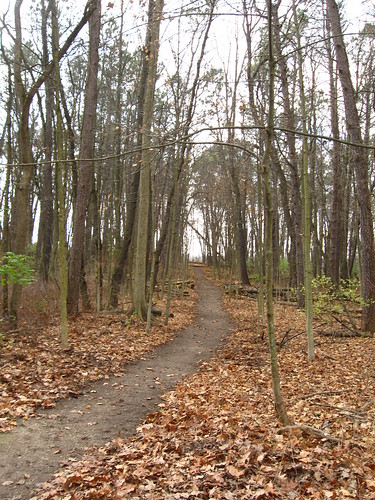
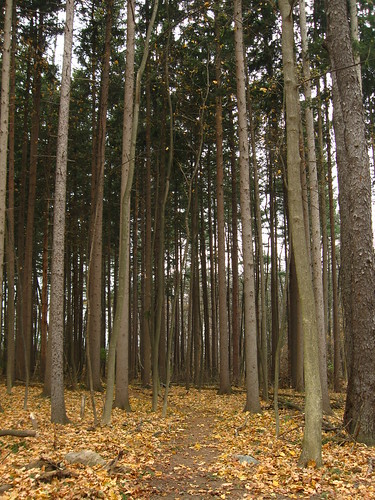
Why did I do all of this? After all, next year, it will all get covered again, right?
Well, each of the last few years, I've had to negotiate walking along the pathways in the springtime, with them in a treacherous semi-frozen, semi-slushed, semi-muddy mess. Over the year, the walking of the trails crushes the leaves, breaking them down. And then, when the snows come, the ground (and leaves and mashed leaves) gets saturated. When this starts to thaw, the leaves produce discontinuous layers of ice, frozen leaves, water, slosh, wet leaves, etc. In other words: a mess.
The idea is that - since most of the soil of the property is sand, and the majority of the paths are gravel laid atop this sand - if I rake the leaves, there will be greater amounts of infiltration in the spring. Furthermore, even in places where the leaf litter buildup and decomposition have accumulated a significant enough layer of soil, raking away the leaves will allow for this soil to be more easily washed away, revealing the gravel path below (thus improving the quality of the pathways - as pathways).
I even raked a trail out to Westview Way, so that it will be easy to stay off the untrodden ground (we don't like unnecessary soil compaction) while walking into the facility:
Why did I do all of this? After all, next year, it will all get covered again, right?
Well, each of the last few years, I've had to negotiate walking along the pathways in the springtime, with them in a treacherous semi-frozen, semi-slushed, semi-muddy mess. Over the year, the walking of the trails crushes the leaves, breaking them down. And then, when the snows come, the ground (and leaves and mashed leaves) gets saturated. When this starts to thaw, the leaves produce discontinuous layers of ice, frozen leaves, water, slosh, wet leaves, etc. In other words: a mess.
The idea is that - since most of the soil of the property is sand, and the majority of the paths are gravel laid atop this sand - if I rake the leaves, there will be greater amounts of infiltration in the spring. Furthermore, even in places where the leaf litter buildup and decomposition have accumulated a significant enough layer of soil, raking away the leaves will allow for this soil to be more easily washed away, revealing the gravel path below (thus improving the quality of the pathways - as pathways).
I even raked a trail out to Westview Way, so that it will be easy to stay off the untrodden ground (we don't like unnecessary soil compaction) while walking into the facility:
Thursday, December 13, 2012
An a capella song from St. Andrews students: Christmas Gets Worse Every Year

The Other Guys are an a capella group from my alma mater, St. Andrews. Above, you can see them in the Scottish hills, two of them sporting college scarves (the Bute medical college and the university). Represent!
Here's their wonderfully upbeat cynical song of Christmas that so wonderfully captured the feeling that I saw surrounding me each of the four years that I was a student in St. Andrews. Lord, but I miss this cynical, negative, and depressing nature that so many Brits seem to look forward to (and dread) every year.
Enjoy the upbeatedness of British Christmas cynicism:
h/t to my friends from St. Andrews who posted this on Facebook. :)
Wednesday, December 12, 2012
12/12/12 1212: A good opportunity to look at date/time notation
This is the last day for another 88 years and 20 days until we will get to the next DD/MM/YY combination that will be all the same (i.e., 01/01/[21]01). (And I've scheduled this to post at 12:12, which really takes the biscuit for "clocking in" to the current - and dominant - mode of time-keeping on the planet.)
Kinda sad, I s'pose. Still, I was able to live during a period of time that I was able to see so many "calendrical" and astronomical events. ... and remember them, too. Heh.
One nice thing about days like this is that I don't have to worry about what date notation convention to present the numbers in. Should I use the US date convention (month/day/year), the most-of-Europe date convention (day/month/year), or the Japanese date convention (year/month/day)?

I much prefer the year/month/day convention, especially when I have multiple drafts or versions of a document or project; it allows for automatic sorting of the title to display both the evolution of the file as well as present, in explicit notation, the date when the file was last saved. This is in contrast to some people who prefer to use notation like "v2," "v3" etc., which can become cumbersome (after all, how much change is necessary to indicate a new version?) or even the massively cumbersome notation of "new" and "newer", which usually devolves into some sort of hybrid of relative notations (e.g., "new2" or "new2_newer").
Some people might say that the European date and time notation (day/month/year) makes the most sense, since the time increments are increasing from left to right. This is usually used as an extension of the argument that the United States' conventions for measurement are quite arbitrary, antiquated, and confusing:

However, the expectation of left-to-right being equivalent to small-to-big is a normative assumption that has no more logical basis than saying that left-to-right is equivalent to big-to-small. (Similarly, it may be more simple to think in terms of base-ten - as one does with metric - but that choice is also arbitrary, and we could just think in terms of 360; which is also an arbitrary choice. But along that line of questioning madness lies!) Furthermore, the European version of annotation creates large problems of file sorting by name, since the same 28 days (or 30 days if you don't consider February to be important) will be recycled 12 times within a year, meaning that a file that is being worked on for more than one month will encounter sorting confusion:
Here, 2 February 2001 should come before 1 March 2001, since dates in January do come before dates in February. Furthermore, 1 January 2002 should be at the bottom of this list, since 2002 comes after all dates in 2001. These problems go away when you use the Japanese date reporting format:
See? No problems.
Earlier today, a friend of mine wrote:
Anyway... enough proselyzation about date numbering formats; today is one of the twelve that come about every century that make such discussions meaningless - at least for those singular days.
Looking to the future, here's to hoping that in 100 years from today, 12/12/2112, we won't have completely gone and screwed ourselves over, thanks to our evolutionarily stone-age brains being unable to adequately comprehend the intricacies of an increasingly complex, interconnected, non-linear system that is what we call "existence." Hopefully, too, Doraemon will actually be created in September of that year!
Kinda sad, I s'pose. Still, I was able to live during a period of time that I was able to see so many "calendrical" and astronomical events. ... and remember them, too. Heh.
One nice thing about days like this is that I don't have to worry about what date notation convention to present the numbers in. Should I use the US date convention (month/day/year), the most-of-Europe date convention (day/month/year), or the Japanese date convention (year/month/day)?
I much prefer the year/month/day convention, especially when I have multiple drafts or versions of a document or project; it allows for automatic sorting of the title to display both the evolution of the file as well as present, in explicit notation, the date when the file was last saved. This is in contrast to some people who prefer to use notation like "v2," "v3" etc., which can become cumbersome (after all, how much change is necessary to indicate a new version?) or even the massively cumbersome notation of "new" and "newer", which usually devolves into some sort of hybrid of relative notations (e.g., "new2" or "new2_newer").
Some people might say that the European date and time notation (day/month/year) makes the most sense, since the time increments are increasing from left to right. This is usually used as an extension of the argument that the United States' conventions for measurement are quite arbitrary, antiquated, and confusing:

However, the expectation of left-to-right being equivalent to small-to-big is a normative assumption that has no more logical basis than saying that left-to-right is equivalent to big-to-small. (Similarly, it may be more simple to think in terms of base-ten - as one does with metric - but that choice is also arbitrary, and we could just think in terms of 360; which is also an arbitrary choice. But along that line of questioning madness lies!) Furthermore, the European version of annotation creates large problems of file sorting by name, since the same 28 days (or 30 days if you don't consider February to be important) will be recycled 12 times within a year, meaning that a file that is being worked on for more than one month will encounter sorting confusion:
01012002 = 1 Jan 2002
01022001 = 1 Feb 2001
01032001 = 1 Mar 2001
02022001 = 2 Feb 2001
Here, 2 February 2001 should come before 1 March 2001, since dates in January do come before dates in February. Furthermore, 1 January 2002 should be at the bottom of this list, since 2002 comes after all dates in 2001. These problems go away when you use the Japanese date reporting format:
20010101 = 2001 Feb 1
20010102 = 2001 Feb 2
20010201 = 2001 Mar 1
20020101 =2002 Jan 1
See? No problems.
Earlier today, a friend of mine wrote:
I couldn't help but respond with this comment:
Heh. Presumably, you'd also be especially interested at 8:12 PM. However, that only works if you're using European date convention of 20-12-2012 20:12. If you're using the Japanese date convention, December 20 would be: 2012-12-20, which is kinda palindromic, but not really.
Once you recognize that date notation is culturally biased and somewhat arbitrary (especially once you consider the various standardization changes that happened to date notation and calendar format that occurred even prior to the standardization that was the Julian calendar in addition to the later restandardization that left us with the Gregorian calendar), then the allowance of letting people get rid of the "20" in front of the "12" makes today kind of fun.
In the end, I recognize that this loosening of the rules for date notation may not be as much fun as having access to a time machine might be, but I'm not one to really wish to travel back to the years 12 (don't know enough Latin) or 1212 (don't want to be burned as a heretic or infidel), and if we did have a time machine the calculations that we'd have to make to ensure that we actually get to that era's notation of a repetitive date value would also take a bit of the romanticism out of the whole thing.
Anyway... enough proselyzation about date numbering formats; today is one of the twelve that come about every century that make such discussions meaningless - at least for those singular days.
Looking to the future, here's to hoping that in 100 years from today, 12/12/2112, we won't have completely gone and screwed ourselves over, thanks to our evolutionarily stone-age brains being unable to adequately comprehend the intricacies of an increasingly complex, interconnected, non-linear system that is what we call "existence." Hopefully, too, Doraemon will actually be created in September of that year!
Saturday, December 08, 2012
Saturday Omphaolskepsis: They aren't the oldest trees in the world, but...
In reading through my news items for today, I came across an article describing the fragility old trees in a changing climate:
Still, it's something to think about when you're walking through the forest, recalling (in some deep recess of your mind) that you are walking through a forested landscape that - while not a "natural" forest - is in the range of 60-100+ years old. It's still a relatively "new" forest in that way, having not "matured" to be dominated by the climax community that we would have experienced way back in the early 1800s: a hardwood forest of oak, maple, and beech. It may also be sobering to recall that - thanks to climate change and the changed driving forces that our new and future climate have on the local ecology - Saginaw Forest will not be changing to resemble that 1800s forest of Southeast Michigan so much as a forest that would have been more typical of central Ohio.
In sum - and to bring it back to the topic of the paper - the century-plus old trees on the northern side of the property will likely die faster now than they would have if the climate hadn't changed, that those trees will also be more quickly releasing their stored carbon into the atmosphere, and that those reaches of the property are on a destined path toward a climax forest that would have been more recognizable around the Columbus, OH of 1800 than the Ann Arbor, MI of that same time.
A report by three of the world's leading ecologists in today's issue of the journal Science warns of an alarming increase in deathrates among trees 100-300 years old in many of the world's forests, woodlands, savannahs, farming areas and even in cities.The reason behind this increased rate of die-off among old trees? Well, it's not only because the trees are reaching the end of their lives (some trees can live for several centuries, after all), but because the environments in which these trees live are changing. And why is this happening? Well:
"According to one popular theory, trees get a double-whammy when the thermometer rises. "During the day, their photosynthesis shuts down when it gets too warm, and at night they use more energy because their metabolic rate increases, much as a reptile's would do when it gets warmer." With less energy being produced in warmer years and more being consumed just to survive, there is less energy available for growth. "This hypothesis, if correct, means tropical forests could shrink over time," Professor Laurance said. "The largest, oldest trees would progressively die off and tend not to be replaced. Alarmingly, this might trigger a positive feedback that could destabilize the climate: as older trees die, forests would release some of their stored carbon into the atmosphere, prompting a vicious circle of further warming, forest shrinkage and carbon emissions."In Saginaw Forest, we don't think of the trees as being particularly "old" - at least I doubt that many people think of Saginaw Forest as some sort of primeval wood, but it's important to remember that some of the trees on the property have joined the century club, having been planted waaay back in 1904. And these trees are dying off, although whether it's due to being planted too close or due to physiological exacerbations caused by climate stress (since many of these old Saginaw Forest trees are actually native to more northerly regions of the state), I can't say.
Still, it's something to think about when you're walking through the forest, recalling (in some deep recess of your mind) that you are walking through a forested landscape that - while not a "natural" forest - is in the range of 60-100+ years old. It's still a relatively "new" forest in that way, having not "matured" to be dominated by the climax community that we would have experienced way back in the early 1800s: a hardwood forest of oak, maple, and beech. It may also be sobering to recall that - thanks to climate change and the changed driving forces that our new and future climate have on the local ecology - Saginaw Forest will not be changing to resemble that 1800s forest of Southeast Michigan so much as a forest that would have been more typical of central Ohio.
In sum - and to bring it back to the topic of the paper - the century-plus old trees on the northern side of the property will likely die faster now than they would have if the climate hadn't changed, that those trees will also be more quickly releasing their stored carbon into the atmosphere, and that those reaches of the property are on a destined path toward a climax forest that would have been more recognizable around the Columbus, OH of 1800 than the Ann Arbor, MI of that same time.
Wednesday, November 21, 2012
SSM update: 15.86% of the US lives in states where SSM is legal
Thanks to the 2012 election, three states voted to allow Same-Sex Marriage (SSM): Maine (reversing a 2009 referendum), Maryland, and Washington. This brings the total to 9 states and the District of Columbia (DC) that allow SSM. The total population of people living in this area (using numbers from the 2010 census) is 48,955,409, which amounts to 15.86% of the national population now living in states where equality stretches to same-sex couples in terms of legal rights and protections of marriage. (Yeah... I'm not talking about what religions choose to do with prosecuting their beliefs upon the adherents to their faiths.)
What's interesting is that Minnesota voted down an amendment to deny SSM. There is also increasing discussion about allowing SSM there, as well as in California, Illinois, and New Jersey. If these four states were to all end up allowing SSM, then the number of people living in such states would more than double, rising to 113,135,816, or 36.64% of the population.
More interesting still is that the states of Nevada, Oregon, and Wisconsin are eying the allowance for "civil unions" for same-sex couples. If we count these states' populations into the total of places where - for purely governmental purposes of guaranteeing and protecting rights and benefits - same-sex couples would have the rights as heterosexual couples, this would represent 125,354,427 people or 40.60% of the population.
These projections of potential allowances for SSM and civil unions are not my own conjectures - they're from the Economist:

This could mean that - by the next presidential election in 2016 - just slightly more than 40% of the US population could be living in a state where state-sanctioned and state-participatory discrimination against same-sex individuals' right to have a state-recognized, state-protected, and state-guaranteed marriage (or civil union). But a recent poll in Michigan is something that is raising the possibility that it could well be more than 40.60%:
If (and that's a big "if") both Ohio and Pennsylvania were to vote to allow SSM or civil unions by 2016, then that could bring the total population living in such states to 159,476,950, or 51.65% of the nation's population (and - of course - if other states vote the same way, then that number can only climb).
Still, let's not assume that all our eggs will hatch, or that all the chicks even grow into chickens. Let's sit down and actually be really friggin' happy that we now have 15.86% of the population living in a state where SSM-rights have been granted. Let's be even more happy that the public tide has turned to much that public referenda are now granting these rights.
As people come to recognize that same-sex couples aren't the monsters that paranoid traditionalists want to make them out to be, there will be more positive shifts in opinion. As people come to recognize that same-sex individuals are among their friends, their colleagues, and their families, there will be more positive shifts in opinion. As people come to recognize that same-sex marriage does not destroy heterosexual marriages, there will be more positive shifts in opinion.As people come to recognize that same-sex partnerships are often about love, commitment, and raising families in a safe and caring environment, there will be more positive shifts in opinion. And, as people come to recognize that the growing number of states that allow same-sex marriages and unions are not turning into burning pits of Hell, that pedophilia is not going rampant, or that divorce rates of heterosexual couples is not increasing, there will be more positive shifts in opinion.
What's interesting is that Minnesota voted down an amendment to deny SSM. There is also increasing discussion about allowing SSM there, as well as in California, Illinois, and New Jersey. If these four states were to all end up allowing SSM, then the number of people living in such states would more than double, rising to 113,135,816, or 36.64% of the population.
More interesting still is that the states of Nevada, Oregon, and Wisconsin are eying the allowance for "civil unions" for same-sex couples. If we count these states' populations into the total of places where - for purely governmental purposes of guaranteeing and protecting rights and benefits - same-sex couples would have the rights as heterosexual couples, this would represent 125,354,427 people or 40.60% of the population.
These projections of potential allowances for SSM and civil unions are not my own conjectures - they're from the Economist:
This could mean that - by the next presidential election in 2016 - just slightly more than 40% of the US population could be living in a state where state-sanctioned and state-participatory discrimination against same-sex individuals' right to have a state-recognized, state-protected, and state-guaranteed marriage (or civil union). But a recent poll in Michigan is something that is raising the possibility that it could well be more than 40.60%:
A recent survey found that 56 percent of the state's residents support gay marriage while 39 percent oppose it. Two years ago, 48 percent supported gay marriage and 51 percent were opposed.The walls seem to be tumbling down ... at least away from the Deep South. And if Michigan's shift on this position - along with the shifts seen in Minnesota, Wisconsin, Illinois, Oregon, California, and Maine - is anything to go by, it's likely that the shifting position on gay marriage rights is shifting in the same direction in other states that share some of Michigan's demographic and political leanings: Ohio and Pennsylvania.
If (and that's a big "if") both Ohio and Pennsylvania were to vote to allow SSM or civil unions by 2016, then that could bring the total population living in such states to 159,476,950, or 51.65% of the nation's population (and - of course - if other states vote the same way, then that number can only climb).
Still, let's not assume that all our eggs will hatch, or that all the chicks even grow into chickens. Let's sit down and actually be really friggin' happy that we now have 15.86% of the population living in a state where SSM-rights have been granted. Let's be even more happy that the public tide has turned to much that public referenda are now granting these rights.
As people come to recognize that same-sex couples aren't the monsters that paranoid traditionalists want to make them out to be, there will be more positive shifts in opinion. As people come to recognize that same-sex individuals are among their friends, their colleagues, and their families, there will be more positive shifts in opinion. As people come to recognize that same-sex marriage does not destroy heterosexual marriages, there will be more positive shifts in opinion.As people come to recognize that same-sex partnerships are often about love, commitment, and raising families in a safe and caring environment, there will be more positive shifts in opinion. And, as people come to recognize that the growing number of states that allow same-sex marriages and unions are not turning into burning pits of Hell, that pedophilia is not going rampant, or that divorce rates of heterosexual couples is not increasing, there will be more positive shifts in opinion.
Thursday, November 15, 2012
More on identity politics and the politics of identity
Yesterday, I posted a video about why Asian Americans didn't vote for Romney. Today, here's a post by Razib Khan about an additional reason (made a little hotly): religion. I don't always agree with the positions that Khan makes, but this is an interesting piece, even if I think that he makes the connections between religion and voting options a little stronger than I'd think:
Read the rest (and check out the data) over at Gene Expression.
I was at ASHG this week, so I’ve followed reactions to the election passively. But one thing I’ve seen is repeated commentary on the fact that Asian Americans have swung toward the Democrats over the past generation. The thing that pisses me off is that there is a very obvious low-hanging fruit sort of explanation out there, and I’m frankly sick and tired of reading people ramble on without any awareness of this reality. We spent the past few months talking about the power of polls, and quant data vs. qual (bullshit) analysis, with some of my readers going into full on let’s-see-if-Razib-is-moron-enough-to-swallow-this-crap mode.
In short, it’s religion. Barry Kosmin has documented that between 1990 and 2010 Asian Americans have become far less Christian, on average. Meanwhile, the Republican party has become far more Christian in terms of its identity. Do you really require more than two sentences to infer from this what the outcome will be in terms of how Asian Americans will vote?
Over half of Asian Americans are non-Christian. The track record of non-Christians voting for Republicans in today’s America is not good. In contrast, Asian American lean toward Republicans is fine, assuming that they are Christian (the Evangelical group above excludes historically black churches). Asian American Catholics are somewhat more Democrat than white non-Hispanic Catholics, but far less than Hispanic Catholics. But the issue is that Christians, aggregating the Evangelical, Mainline, and Catholic categories together, only make up ~40 percent of the Asian American population. In 1990 60 percent of Asian Americans were Christian. Today 30 percent follow non-Christian religions. In 1990 15 percent did.
Read the rest (and check out the data) over at Gene Expression.
Wednesday, November 14, 2012
Identity politics and political identity
Saw this and wanted to share:
Visit NBCNews.com for breaking news, world news, and news about the economy
Wednesday, November 07, 2012
Presidential firsts (yes, there are more!)
In 2008, Barack Obama was the first not-White man to win the Presidency. This was obvious, and it was a point made by many people.
Another thing was that Obama/Biden was the first Democratic ticket to win an election without having any Southerner (and - by "Southerner" I am not including someone from Delaware or Maryland, which may be historically "Southern", but I'm referring to the "Solid South") on the ticket since FDR/Wallace in 1940!
Of course, his ticket (Obama/Biden) was the first Democratic ticket to win the presidency WITHOUT having to win any Southern state. True, Obama/Biden won North Carolina, Virginia, and Florida, but he didn't need those electoral college votes in order to win:
In 2008, Obama won 365 E.V. If he didn't have NC (15 E.V.), VA (13 E.V.), or FL (27 E.V.), he would have had 310 E.V., 38 electoral votes MORE than necessary to win.
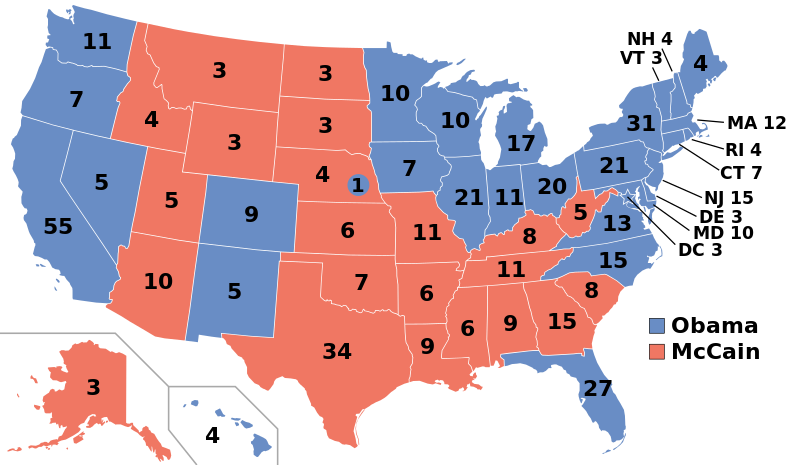
These were Presidential "firsts" from 2008. In 2012, there are three additional firsts (although they are all "firsts" due to re-election):
The obvious thing is - like the beginning - that Obama is the first not-White man to win re-election as President. This is also an obvious point made by many people.
With regard to not having Southerners on the re-elected ticket, Obama/Biden is THE FIRST Democratic ticket to win re-election without having a Southerner on the ticket since Wilson/Marshall's re-election in 1916.
In 2012, (as of this writing) Obama won 303 E.V., while also carrying VA. (FL's 29 E.V. haven't been allocated yet.) This means that Obama would have won (with 290 electoral votes) EVEN IF Virginia didn't vote for him.
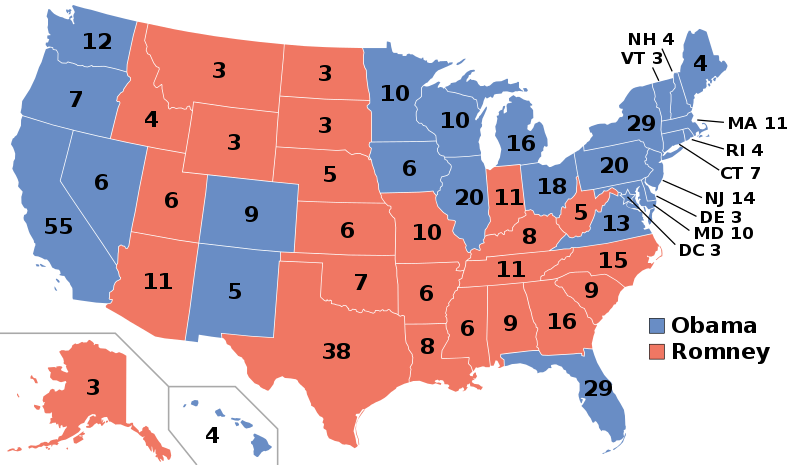
Is this the end - for now - of the importance of the South in presidential politics? After all, Obama is a not-White man, Obama/Biden aren't from the South, and Obama/Biden and could have won the presidency BOTH times without even winning any of the Solid South states.
... does this spell the end for the Southern Strategy? I already described why looking at "White Southern men" is not an electorally important distinction, since Obama wouldn't need them to win (and he didn't; he lost the overall male vote, and probably REALLY lost the White Southern male vote). Part of this is due to the demographics of the nation (let alone in the South). If the GOP doesn't change their party politics, they're not going to be a viable party in 12 years' time; the demographics - a fundamental of a country that uses democratic measures to make political choices - are just not with their current preferences.
Another thing was that Obama/Biden was the first Democratic ticket to win an election without having any Southerner (and - by "Southerner" I am not including someone from Delaware or Maryland, which may be historically "Southern", but I'm referring to the "Solid South") on the ticket since FDR/Wallace in 1940!
Of course, his ticket (Obama/Biden) was the first Democratic ticket to win the presidency WITHOUT having to win any Southern state. True, Obama/Biden won North Carolina, Virginia, and Florida, but he didn't need those electoral college votes in order to win:
In 2008, Obama won 365 E.V. If he didn't have NC (15 E.V.), VA (13 E.V.), or FL (27 E.V.), he would have had 310 E.V., 38 electoral votes MORE than necessary to win.
These were Presidential "firsts" from 2008. In 2012, there are three additional firsts (although they are all "firsts" due to re-election):
The obvious thing is - like the beginning - that Obama is the first not-White man to win re-election as President. This is also an obvious point made by many people.
With regard to not having Southerners on the re-elected ticket, Obama/Biden is THE FIRST Democratic ticket to win re-election without having a Southerner on the ticket since Wilson/Marshall's re-election in 1916.
In 2012, (as of this writing) Obama won 303 E.V., while also carrying VA. (FL's 29 E.V. haven't been allocated yet.) This means that Obama would have won (with 290 electoral votes) EVEN IF Virginia didn't vote for him.
Is this the end - for now - of the importance of the South in presidential politics? After all, Obama is a not-White man, Obama/Biden aren't from the South, and Obama/Biden and could have won the presidency BOTH times without even winning any of the Solid South states.
... does this spell the end for the Southern Strategy? I already described why looking at "White Southern men" is not an electorally important distinction, since Obama wouldn't need them to win (and he didn't; he lost the overall male vote, and probably REALLY lost the White Southern male vote). Part of this is due to the demographics of the nation (let alone in the South). If the GOP doesn't change their party politics, they're not going to be a viable party in 12 years' time; the demographics - a fundamental of a country that uses democratic measures to make political choices - are just not with their current preferences.
Monday, November 05, 2012
Happy November: Got one chapter done. Working on another
In order to complete my dissertation, I must complete three research chapters and tie them all together into a nice product by adding introduction and conclusion chapters. Smart person as I am, I decided to research three somewhat-interconnected (but not really overlapping at all in terms of methodology, scope, or data set) things. This has meant overall slow progress (and a tendency to procrastinate through blog writing).
However: as of last Thursday, I submitted my first research chapter to my adviser for review, and I'm aiming to have another chapter written by the end of the month. We'll see if that works.
Fingers crossed!
However: as of last Thursday, I submitted my first research chapter to my adviser for review, and I'm aiming to have another chapter written by the end of the month. We'll see if that works.
Fingers crossed!
Saturday, October 27, 2012
Saturday Omphaloskepsis: I like small houses, but this is a bit extreme
I am enamored with small houses, and I like the idea of living in a small house: you have to pare down the things that you have, since (unless you buy a storage facility) you just don't have enough space to put things in a small house. In addition, much like in a boat, the need to conserve space means that you have to multi-purpose many pieces of furniture, doing things like making a staircase act as the framing for a storage area or having multifunctional furniture. I find these projects interesting, because I find the solutions need to be innovative and, therefore, the construction and design challenges interest me.
Of course, there are cases where small might be a little TOO small. Thus is (potentially, at least for me) the case with the Keret House in Warsaw, billed as the "world's narrowest house" (probably not, but who's really counting).

Via Inhabitat:

Kinda narrow and a little too vertical for my tastes. After all, I am a kind of broad-in-the-shoulders guy, and so a house that narrows to about 3 feet will be a little... close. Furthermore, in a previous story on Keret House, Inhabitat reported the following about the amenities:
It's all kind of cool and fun and interesting, but - for me at least - it takes things just a little bit further than my interest.
Of course, there are cases where small might be a little TOO small. Thus is (potentially, at least for me) the case with the Keret House in Warsaw, billed as the "world's narrowest house" (probably not, but who's really counting).
Via Inhabitat:
Could you live in house no wider than a door frame? Etgar Keret can. The Israeli writer is now the proud owner of the world’s narrowest building, a home so tiny that you might not even notice it if you’re not looking hard. The house, which is less than five feet across at its widest part (three feet at its narrowest) was designed by Polish architect Jakub Szczesny and is located in Warsaw, the country’s capital.
Kinda narrow and a little too vertical for my tastes. After all, I am a kind of broad-in-the-shoulders guy, and so a house that narrows to about 3 feet will be a little... close. Furthermore, in a previous story on Keret House, Inhabitat reported the following about the amenities:
Electricity will be provided by a neighboring host building, and a water and sewage system in the small space will be free-standing, much like systems used on boats. The first floor of the living space is a work space and a lounge. The second level, reachable by ladder, fits a sleeping loft with a skylight. The top space can be used for storage.I wonder how much sunlight this house actually gets, and how would one go about cleaning that skylight?
It's all kind of cool and fun and interesting, but - for me at least - it takes things just a little bit further than my interest.
Friday, October 26, 2012
Gonna disconnect for a bit
It's pretty clear that writing itself is not really a problem for me. Nor, too, is the quality of the framing and the composition of my writing. In 2012, I've already written more blog posts (by far) than in any other year. I do, however, have this small thing called a "dissertation" to which I actually need to focus my time and attention.
To that end, I'll be disconnecting myself from all the social media that have been picking away at my time and attention. No more blogging, no more Facebook, and no more Google news feed. I'll also try to limit e-mail to the first and last things at work.
By diminishing sources of inconsistent and unpredictable rewards (e.g., e-mail, Facebook), I will hopefully be able to focus my time and attention more efficiently, rather than spending time procrastinating and being distracted (and stressed over things that I can't really control).
There will be some posts that will go up -- things that are scheduled for posting -- but after that, nothing for a little bit.
Adios for now!
To that end, I'll be disconnecting myself from all the social media that have been picking away at my time and attention. No more blogging, no more Facebook, and no more Google news feed. I'll also try to limit e-mail to the first and last things at work.
By diminishing sources of inconsistent and unpredictable rewards (e.g., e-mail, Facebook), I will hopefully be able to focus my time and attention more efficiently, rather than spending time procrastinating and being distracted (and stressed over things that I can't really control).
There will be some posts that will go up -- things that are scheduled for posting -- but after that, nothing for a little bit.
Adios for now!
Friday Photos: Autumn Pictures from Saginaw Forest
Some photos of the changing season:

The poison ivy are about to lose their leaves. (Still bad to touch them, though.)

The maples near the gate are slowly moving toward their color shifts.
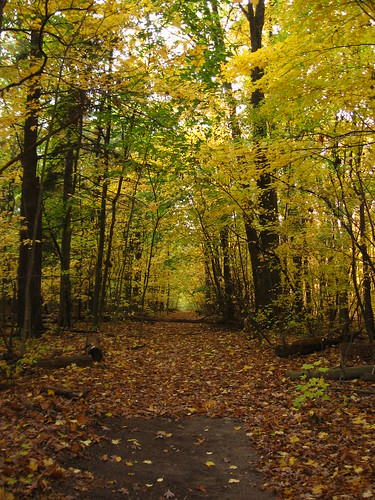
I decided to quit my raking of the path after I realized how much work was going to be falling from branches in the coming weeks. Still: they need to be raked so that they don't turn into muddy lanes come the spring.

Almost stepped on this guy as I was going back into the cabin. He wasn't any wider than my finger!
The poison ivy are about to lose their leaves. (Still bad to touch them, though.)
The maples near the gate are slowly moving toward their color shifts.
I decided to quit my raking of the path after I realized how much work was going to be falling from branches in the coming weeks. Still: they need to be raked so that they don't turn into muddy lanes come the spring.
Almost stepped on this guy as I was going back into the cabin. He wasn't any wider than my finger!
Wednesday, October 24, 2012
Wednesday Wonderings: What if you fixed the false statements that Romney keeps making?
It seems like Mr. Romney has a habit of saying false things (there are two pages of Romney falsehoods on PolitiFact). I’m not saying that he came up with these lies, but he is definitely choosing to use them for his own gain. However, I’d like to take this time to correct some of the things he said.
There are many more falsehoods listed on the Politifact page, and only a few are closely related statements. I wonder when Politifact will start rating his false statements from the three debates. Perhaps it will asplode their website, though...
“Regulations havequadrupledstayed the same. The rate of regulationsquadrupledeffectively remained the same under this president.”
"In one yearOver the course of several years of investments in local projects, (President Obama) provided $90 billionin breaksto the green energy world … into solar and wind, roads and rail, cars and trains, tax credits and interest subsidies, and direct loans and loan guarantees, to Solyndraand Fisker and Tesla andEner1, local government projects, state government transit infrastructure, energy retrofits for private homes and small businesses, environmental restoration projects, clean coal technology development, wind turbine manufacturing, and solar panel manufacturing, among many other things that brought about a great deal of local and regional stimulus."
"The president said he’d cut the deficit in half.Unfortunately, he doubled itHe has diminished the deficit from $1.41 trillion in 2009 to $1.09 trillion in 2012, which is not halving it, but it is far better than what he inherited."
"Where did all the Obama stimulus money go? ... Electric cars from Finland.Electric car development by the company Fiskers got money at the end of the George W. Bush administration, and it only happened to get disbursed during the Obama administration."
" ‘Obamacare’ stops private insurance companies putting panels of actuaries that ration care that you've paid for while simultaneously actively lobbing to put the federal government between you and your doctor."
"[When I was governor of Massachusetts,] wedidn’t just slowincreased the rate of growth of our government, we actuallycutgrew it by 5% per year."
"We have to open up markets for our goods. We haven'tdone that under this president. ... This president has opened upnonethree new markets, despite the best effort of the GOP to stop him: South Korea, Colombia and Panama. If the GOP worked with him, doubtless there would be more trade agreements."
"Today (February 11, 2012) there are more men and women out of work or working in part-time jobs in the United States of America than there are people working in Canada, which has a total population 1/9th the size of the US. And in the month of January, Canada created more new jobs than we did. But these numbers only work if we really fudge the crap out of them."
"Neverbeforein American history has its president gone before so many foreign audiences to apologize for so many American misdeeds, and President Obama is no exception. My party's intolerance of anything that approaches the idea of being realistic about the not-always-stain-free history of the United States makes us truly believe that Obama made apologies for the United States' past actions, both real and imagined. We also don't want to remember that George W. Bush apologized to the Iraqis and the Afghans for the seriously poor judgement of many of our soldiers, as well as apologizing to the Chinese for spying on them. We also don't want to remember that George H. W. Bush apologized to Japanese Americans for their treatment in World War 2."
"Idon'thave a whole boatload of lobbyists running my campaign."
There are many more falsehoods listed on the Politifact page, and only a few are closely related statements. I wonder when Politifact will start rating his false statements from the three debates. Perhaps it will asplode their website, though...
Tuesday, October 23, 2012
Monday, October 22, 2012
Monday Musings: Why do people park in front of the No Parking sign?
Yesterday, I encountered a few vehicles that were parked at the gate, despite the plain signage that says that it is not legal to park there. For example, there was this SUV that was parked right in front of the "No parking" sign (just in case you had a difficult time to recognize the sign, what with all the colorful foliage, I've highlighted the sign):
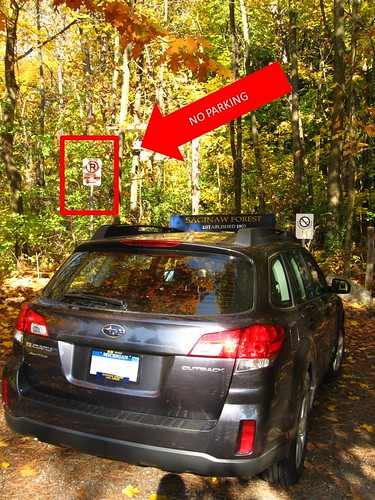
What's more, I decided to look up how many of the previous caretakers kvetched about no parking.
In 2007, in 1991, in 1989 (twice), and in 1987 In other words, it's been a consistent problem.
And I'm sure that the previous caretakers didn't note every single instance of having to report a vehicle (and not every caretaker wrote in the log book, either). I think that the number of people parking at the gate has diminished, but it is still higher than what would be the case if people followed the law.
What's more, I decided to look up how many of the previous caretakers kvetched about no parking.
In 2007, in 1991, in 1989 (twice), and in 1987 In other words, it's been a consistent problem.
And I'm sure that the previous caretakers didn't note every single instance of having to report a vehicle (and not every caretaker wrote in the log book, either). I think that the number of people parking at the gate has diminished, but it is still higher than what would be the case if people followed the law.
Subscribe to:
Posts (Atom)