Wednesday, February 13, 2008

The crazies are out of the box (and I can't fit them back!)

From today's reading of Dispatches, I was offered a walk down crazy lane. (Uaragh!) I'm just paraphrasing each paragraph from crazy lane below so you won't have to torture yourself so much. Please bear with me. If you think this is markedly shorter than the original (having glanced over there briefly before you ran screaming from your computer), please realize that I've left out almost all of blokey's supporting drivel (but added parenthetical commentary).

Intro-bit
Athiests are trying to appeal to the gay community because of a perception of religion being anti-gay. Blokey feels like homosexuality has taken up too much of his time, doesn't fit with the teachings of "the Lord", doesn't like the homophobic culture (specifically rap), or the homosexual culture (specifically hedonism). High levels of sexuality common in hedonism is "squalid" regardless of sexual orientation. Blokey then basically says, "I don't come to praise homosexuality, but to bury the notion that atheism is good for the gays." (My own horribly pathetic reference to Julius Caesar.)

Pro-Homosexual Attitudes in Paganism
"Pagan" religions have been tolerant of homosexuality. Here are lots of examples: Babylon, Canaan, Ishtar, look I have done my google research, Greeks, Neo-Paganism, more research on the googles, shamans, Scythians. Sexually-transmitted disease! Transvestism is dangerous. Individual religions may (or may not) condemn the gays.

Lack of Basis for Tolerance to Gays in Atheism
Athiesm is a rejection of theism and theistic values, but not acceptance or tolerance of homosexuality. A BBC poll - which must have included secularists (I love how he mashes "secularist" together with "atheist") - showed that 3/4 of the Brits were against gay marriage. BBC Radio 4 had a documentary on hatred of homosexuals in Caribbean cultures, which Xtian ministers feel was due to the "masculine culture". Blokey guesses that there is a little redirection of hatred going on, since Jamaican gov't has been highly corrupt since the 1980s, and these rappers are just taking it out on the gays.

Postmodernist philosophy is fashionable, but intolerant despite its claim to the opposite. British gay spokesperson was not happy with nihilism, and gays should go beyond this. Apparently going more negative than Nihilism embraces the positive. (Silly little gay Limey.) Nihilism seems to be a fashionable position for those feeling oppressed by society. One cannot condemn gay-bashing without overarching morals necessary for society. Nihilism rejects society (ergo, gays must not hate gay-bashing?). Blokey uses Brothers Karamazov which I haven't read, so I'm not covering here. Blokey then tries a half-hearted attack against Dawkins via proxy, and fails horribly.

Hostility to Homosexuality in Atheist and Anti-Christian Ideologies
Many athiest ideologies can be traced to anti-gay roots. Freudianism. (I didn't know Freud was an "-ism"!) Stalinist Soviet Union. Nazi Germany. (Apparently it wasn't Christian.)

Materialistic Conceptions of Humanity No Guarantee of Tolerance
Scientific claim that there might be a genetic link with homosexuality was done "as part of a campaign to remove the perceived prejudice against gays". (Wow. How nice and well-organized of the scientists. Here's a hand for you/us.) Blokey provides examples from literature with no citation apparent, save for the sole questioning one.

Science tries to overthrow the views of how society is supposed to be run. Science proposes explanations of origins, but no philosophical justification of morals. However, scientific justifications of morals is wrong. Blokey cites Haldan's back-of-the-envelope altruism calculation, but says altruism doesn't work based on kin selection, but on a belief of what is right.

Materialism a Threat to Human Dignity
Much of atheism is based on materialism. Materialism undercuts morality. Reductionist scientists think of humans as organic automatons, but people act as if there is an id. (Oh, the humanity!) Theists believe that the basis of altruism is "the belief that the suffering experienced by people is ... real pain suffered by a real person" This basis of belief will save the gay and the straight from dehumanization!

Reproductive Technology and Children's Right to Life, regardless of Predicted Sexuality
Christian (apparently we've moved from pagan to theist to Xtian) objections to designer babies will save the gays, since legislating a ban on designer babies will ensure that - if there is a gay gene - parents-to-be can't get rid of the gay gene. Xtians believe people are more than the sum of their genes! They have free will! A right to choose! (Wait...) Xtians moral attitudes to the unborn will protect the nascent gay and straight alike!

Christian Attitudes to Homosexuality: A Middle Way
Xtians are right now waging holy Crusades over the morality of gay-ness, but there's a THIRD WAY: Love the sinner hate the sin! (Oh, why didn't someone think of that earlier!) Therefore, while the traditional Xtian hates homosexuality (ya don't say), the Xtian love of the transcendent subject - made in the image of an ineffable being - just might (maybe, if we cross our fingers and wish REALLY hard) protect both the gay and the straight from the dehumanization and mechanism of atheism.

End of blokey's tract.

n.b. I don't think this guy's firing with all cylinders. I also don't think that his pals are, either. If you find something wrong with my paraphrasing of his tract, please feel free to let me know. (And I will feel free to consider correcting the perceived mistake.)

Tuesday, February 12, 2008

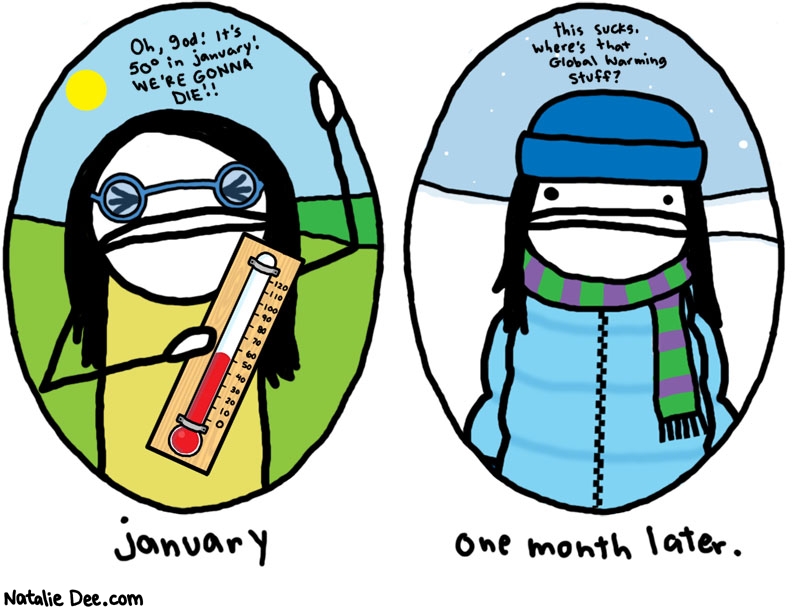
Weather: Freezing (with snow)

It's pretty cold, this start of February, and I had to walk home in it...

natalie dee
nataliedee.com

Bleugh. Mind you, I normally like walking through the cold, but it was particularly "snowy-and-blowy" this evening, and the police had closed down one of the highway entrances. This meant that everyone was parked in the streets from 5PM, waiting for some forward movement in any direction. Such gridlock makes me happy and frustrated. Happy because I don't drive, and it provides me with a good dose of schadenfreude - especially since I have to suffer first-hand the biting wind and billowing snow. It makes me frustrated with the whole stupidity of the system:
  1. Why not allow people to work from home?
  2. Why not allow for flexible work hours?
  3. Why even feel the need to buy a house BFE?
  4. Why not have a reasonable lightrail system?
The first option - allowing people to work at home - would mean fewer cars on the road on any day (regardless of weather) during rush hour. It also allows for the possibility (for those jobs that allow it) to have workers not come in to work if the forecast shows inclement weather, or to leave the office early (making up the time in the evening) if there is an incoming severe weather front.

The second option -allowing flexible work hours - would mean that the "rush hour" would be less severe, as people leave work anywhere between (for example) 3PM and 7PM, instead of peaking out at 5PM. Another benefit of this option would be to allow parents to schedule their work hours to coincide with school hours, meaning that parents with jobs allowing for greater flexibility wouldn't have to pay for as much after-school daycare. Put together with the first option (telecommuting), this option could dramatically reduce the impact of a 5PM rush hour. A further benefit would be garnered by small local businesses that might need to keep "traditional" 9-5 hours. Owners of these businesses would see more activity, since workers that are allowed flexible work hours won't have a complete overlap of working times. This would allow such a worker to go to businesses either soon after opening (if that person chooses to work from 10-6) or before closing (if that person chooses to work from 8-4).

The third option - not buying a home BFE - is not something that employers can really do much about, but it would mean shorter commutes for all workers. Shorter commutes will likely mean that people would be less-inclined to drive in to work (especially if they live near a bus line or within walking distance), further dropping the number of vehicles on the road come the general end-of-the-day.

The fourth option - having a decent light rail system - is not something that most employers can also do much about. (Apparently, the light rail system in Cleveland, OH was built by the president of a major company, ensuring that the layout of the transport system had the company headquarters as its hub.) However, a light rail system is superior to a bus system. A light rail train system can be built to have either exclusive train lanes or to share the road with cars. In the former case, these exclusive lanes can be used as a route for emergency vehicles traveling during a high-traffic period, but otherwise it will allow trains the ability to travel unimpeded by other surface traffic conditions. In the latter case, the train can easily take up the entire width of a lane that less road-crowding would take place, allowing for a slightly smoother (if still quite slow) commute.

Okay, my rant's done.

Happy Birthday, Mr. Dawrin!

Although I think Mr. Charles Robert Darwin might have been a little mortified by a sultry Marilyn Monroe-type person wishing him a "happy birthday", I (in my twisted mind) can picture the scene. (And now you are likely thinking about it, too.)

Today is Mr. Darwin's 199th birthday, and, although he would never have lived to see it, I think he would impressed to know how major an impact his "little theory" has had (for good and bad) on the intervening years. I also think that he might find it humorous that his book (Origin of Species) was being quote-mined by Christian creationists about as much as much as the average Christian quote-mines the Bible. (What is it with Christians, quote-mining, and non-existent contextualization?)

So long as Mr. Charles Robert Darwin remains as a man, and never reaches the dogmatic position of a "saint of science", I will be happy to wish the memory of the man a happy birthday each year on this day (since I can't really with the "man" a happy birthday, seeing as he is no longer alive with very little of his physical remains left, most likely).

Anyway, "Happy Birthday, Darwin!" (It really was a shame, though, how your cousin Galton misused your ideas to justify the ideas of eugenics.)

More evidence of environmental problems in China

A while ago, I wrote on the problems of obfuscating CO2 emissions numbers from the Bush administration. That entry was motivated by reading a story about how China surpassed the US in the CO2 emissions factor.

Now, NASA has released some photos accompanying their web report of their 2006 report NASA: Supporting Earth System Science 2006. The one photo that I found really startling (and illustrative, pardon the pun) was the one toward the bottom of the page, of [gray] cloud cover over China. Go over there and check it out.

The NYTimes have written a series of pieces about air pollution and the Beijing Olympics:
(Registration required)

These pieces all point to a serious problem of air pollution in China (or they are all lying and have doctored several hundred/thousand photos). The photo the kite-flier in the "Beijing's Olympic Quest" really hits home for me, because it was taken outside the gates to the Forbidden City, near a location I stood at in 2000. In my photo, the red gates with Mao's painting is clearly visible over my shoulder (like the photos in the Wikipedia entry of Tiananmen Square). However, one can only barely make out the imposing outer wall and gateway to the forbidden city in photo accompanying the NYTimes story.

The scale of the impacts on China are so massive that they defy one's normal ability to comprehend it. However, the problems are there, and they are compounded by other systemic problems, by the immense number of people (all those independent degrees-of-freedom), by the perceptions of growth and development, the urgency of showcasing the country for the Olympics, the struggle of the central government to maintain power, the Westward expansion of development within China to non-Han regions, etc. One can only get a snap-shot of these major social issues taking place both within China, and outward from China.

The environmental stories (due to my own background and biases) are perhaps the most alarming, and the NYTimes can only really cover a small number of them. Combining the known changes (listed above) taking place with stories of water pollution, falling water levels, disappearing animal species, increased coal mining, and others discussing the hazardous growth of the country, I have to wonder how the future of such a large nation can be maintained, even in the short-term.

To me - right now - that photo on the NASA page is a great summary of the scale of environmental impacts on China. It is scary. It is real.

Post 200: Discovery Channel's "Earth Live"


The Discovery Channel obviously worked very diligently on putting this flash-based tool together. Check it out!

(Woo-hoo, two years in and I've finally got to 200 posts.)

Monday, February 11, 2008

Statements rich in meaning.

I have been thinking about English lately, and have realized that some simple sentences have rich layers of meaning. These are not always obvious, but become so when one starts to peel away each layer.

"East Asians orient ..."

This one is rather simple in its layered meaning. First, the word "orient" originates from the Latin word "oriens" literally meaning "east". It's meaning of "to ascertain the bearings of" is the transitive verb form of the word (as it is intended on being used in this case), and (possibly) derives from a Mediaeval practice of placing East at the top of maps. Anyway, by changing out "East" with "orient", we get:

"Orient Asians orient ..."

Then we look at the noun form of "orient", which refers to areas east of Europe: Asia. (Technically, this used to mean only the area we now call the "Middle East", but now generally refers to the continent, as well as the peoples and nations in that continent.) Therefore, if we change out "Asians" (people from Asia) with "Orientals" (people from the Orient), we get:

"Orient Orientals orient ..." or, going the other way:
"East Easterners east ..."

Yes, the whole thing falls down into gibberish. However, recognizing the meanings of the word "orient" makes the phrase "East Asians orient ..." one rich with hidden repetition.


The second one is:

"The typical American likes to drink a cup of coffee."

Nothing there, right? Well, this one requires that you remember your American colloquialisms from the middle of the 20th Century. The image of the "common man," the "everyday man," the "every man," the "typical citizen" was the "Average Joe," sometimes shortened to just "Joe." Changing out "typical American" for "average Joe" gets you:

"The average Joe likes to drink a cup of coffee."

Once you make this first change, one might see where the layered meaning comes in, since it is still rather common (I think) to call a cup of coffee a "cup of joe." Changing this out gets you:

"The average Joe likes to drink a cup of joe."

If one shortens "the average Joe" to just "Joe" and "cup of joe" to just "joe", and imply the action of drinking, one gets:

"Joe likes joe."

This might be a serendipitous linguistic connection between coffee and its image of being the drink of the common man. In any case, the original statement has a rich meaning that underlines (and encircles) the connection between the everyday American and the hot caffeinated drink of Americans.

Georgia can't move its border, right?

UPDATE (2/26/08): Georgia says it is really going to pursue this one. Tennessee introduces a resolution meant to counter Georgia's previously passed resolution.

UPDATE (2/22/08): Tennessee is stating that it won't go along with the resolutions passed in Georgia. I wonder why this is even happening.

UPDATE (2/21/08): Georgia's legislature passed two resolutions to have the border resurveyed, and have the whole thing wind up in the Supreme Court if TN and NC don't agree to go along.

UPDATE (2/15/08): Georgia tried another water grab - demanding extra water from the Lake Lanier Reservoir. That one got shut-down in court.

The state of Georgia is trying to move its border 1.1 miles north to intersect with the Tennessee River.

Wait, can they do that?

Um.... No. I don't think that the state legislature of Georgia can move its border. It was my understanding that it is the Federal government that can create the borders of new states of the Union from Territorial areas.

What gets me is this:
"The Tennessee River was part of Georgia long before there was a state of Tennessee," said Sen. David Shafer (R-Duluth), the resolution's sponsor. "I don't understand why a water-sharing agreement can't be worked out between the two states."

In this paragraph, Senator Shafer says two things that appear to be diametrically opposed. First, he says that the Tennessee River historically belongs to Georgia. Then he says that water-sharing shouldn't be a topic of concern for Georgia and Tennessee. What? If Georgia was supposed to have a border 1.1 miles to the north, why didn't Georgia shout bloody murder when the border was first drawn, or when the "mistake" was first discovered? Why wait until a year into a major drought before considering the possibility of moving the border? Surely, the silence of 211 years (Tennessee was made a state in 1796) provides some backing for Tennessee's claim on its borders?

Shifting the border of the state would require that the Congress of the United States approve the border shift (unlikely to happen). Even if it did happen, the approved border shift would (based on my understanding of the law) require the border shift to be retroactive, since a shift in the border alone would not guarantee Georgia all the water that is in Nickajack Lake. Since the lake was created by the TVA, the TVA has the right to apportion water as it feel necessary. If Georgia doesn't get a retroactive border shift to before the creation of the TVA, then Georgia's water claim post-dates the TVA's water management strategies, and Georgia would have to go to court to fight for those water rights.

All of this for some water? Why doesn't Georgia suck it up, realize that it is in a major drought? Why doesn't it realize that you can't sustain a major city like Atlanta on a river like the Chattahoochee? When are they going to come out with a realistic water conservation strategy, instead of a set of partial-measures?

And if this is all for water, then Georgia isn't seriously considering all the implications of all the property tax structures, service provisions, congressional redistricting, census tallies, etc that would have to out when such a border shift were to happen? Does Sen. Shafer consider these in his bill?

(Just as a side-point, the graphic in the AJC is wrong. It includes areas west of the Georgia/Alabama border. So far as I know, Alabama is not arguing about the movement of the its border with Tennessee.) I redid the map, showing a more-proper proposed border shift. (Seriously, the AJC needs to find someone that knows how to use GIS!)


Friday, February 08, 2008

The Character "Doctor Manhattan"

I recently cited the graphic novel The Watchmen's character Rorschach, and had a video of a guy doing some extemporaneous throat-singing.

Well, he's put up another video. He hasn't made any statement that he was trying to use special effects that made him look like characters from The Watchmen, but with the glowing blue skin, he looks a lot like Dr. Manhattan.

I wonder which one of the characters he will be next?

Wednesday, February 06, 2008

"Foreign-born" Presidents

I might eventually want to run for the office of the President. However, I was born on Guam. In order to meet the requirements for that office, I must, at the time of my inauguration, be:

  • at least 35 year's old,
  • inhabitant of the United States for at least fourteen years, and
  • a natural born citizen (or a "Citizen of the United States, at the time of the Adoption of this Constitution").

I will meet the first two requirements by the time of the next election (2012), if I were to choose to run, but what about the third one; what is a "natural born citizen"? Everyone agrees that anyone born in the 50-state union of United States is a natural born citizen. Most people seem to agree that if someone was born in Washington, D.C. that they be considered a "natural born citizen." But apparently there isn't much agreement (or any precedent) beyond this.

Guam is an organized unincorporated Territory of the United States. Digging a little deeper, there seem to be several types of Territories of the United States. The Territorial type may well allow people born there to eventually become the President of the United States. I don't know this to be true, but I'm going to assume that there is a hierarchy of Territory types. (NOTE: this classification system is my own musings, and not based on any Constitutional law.)

  1. Incorporated organized Territories: Lands contiguous with a full-fledged state, and with a set of laws put forth through an Organic Act by the national Congress.
  2. Unincorporated organized Territories: Lands not contiguous with a full-fledged state, and with a set of laws put forth through an Organic Act by the national Congress.
  3. Incorporated unorganized Territories: Lands contiguous with a full-fledged state, and without a set of laws put forth through an Organic Act by the national Congress.
  4. Unincorporated unorganized Territories: Lands not contiguous with a full-fledged state, and without a set of laws put forth through an Organic Act by the national Congress.

What's a Territory?
Under Article IV (Sec. 3, Clause 2) of the United States Constitution: "The Congress shall have power to dispose of and make all needful Rules and Regulations respecting the Territory or other Property belonging to the United States; and nothing in this Constitution shall be so construed as to Prejudice any Claims of the United States, or of any particular State."

So... Article IV provides definitions of what Congress can do with Territories (or other property) belonging to the United States, but does not provide a definition of what a Territory is. However (without doing a Constitutional study of the meaning), it appears that the working definition of "Territory" falls generally in a rough definition of "lands won or bought by the United States government" (my own words). This matches with the creation methods of Alaska Territory, Louisiana Territory, Oregon Territory, Hawaii Territory, etc.

Since Guam was ceded from Spain after the Spanish-American War in the Protocol of Peace, it (as well as Puerto Rico and the Philippines) became a Territory of the United States; won as a consequence of that war.

The Panama Canal Zone (PCZ) is an interesting case, since it was effectively purchased from the newly-independent country of Panama in the Hay-Bunau Varilla Treaty. Admittedly, this was done as a mechanism to provide monetary backing for building and maintaining the Panama Canal, but the United States effectively purchased the area through which the Panama Canal ran, thereby making the PCZ a Territory of the United States (through purchase). Due to the governance of the Territory (first by a military governor, then by President-appointed civil governors), it is likely that, while the PCZ was an American Territory, it would have been classified as an Incorporated (not an “Insular Area” Territory) Unorganized (had no Organic Act) Territory, but I can find no evidence that this was the case.

Creation of the (Un)Organized Category
The presence or absence of an "Organic Act" is what determines a Territory’s “Organized” status. The act sets forth the rules for government (a pseudo-Constitution, if you will) in a Territory of the United States, establishing, in the case of Guam, branches of government, and moving its federal governance from the Dept. of the Navy to the Dept. of the Interior, and providing a level of independent governance. I assume that Organic Acts for other organized Territories are similar in the creation of government bodies and federal oversight. Just as a reminder, "organized" Territories have Organic Acts, "unorganized" Territories don't have an Organic Act.

Creating the (Un)Incorporated Category
Early in 1901, there were a series of Supreme Court decisions regarding the status of import duties (DeLima v. Bidwell), export duties (Dooley v. United States), and whether Article I, Section 8, clause 1 of the Constitution included the newly acquired Territory of Puerto Rico (Downes v. Bidwell) - and, by extension, the other Territories acquired by the United States. The Supreme Court ruled 6-3 on DeLima and 5-4 on Dooley, effectively stating that no import or export duties could be levied on trade with Puerto Rico. However, the Bidwell decision (5-4 against Downes) effectively stated that without an Act of Congress, all Territories of the United States (at that time including Arizona, New Mexico, and Oklahoma, as well as the Spanish-American War acquisitions) did not have equal constitutional rights. It wasn't until three years later (1904), that this decision was effectively overturned in the Dorr v. United States case, and this Supreme Court decision effectively created the categories of "incorporated" and "unincorporated" Territories. Management of unincorporated Territories - all technically “Insular Area” Territories – is by the Office of Insular Affairs in the Department of the Interior (ironic, no?)

In both incorporated and unincorporated Territories, "fundamental rights" under the Constitution apply. "Procedural rights" only automatically apply to incorporated Territories. Unincorporated Territories can only gain these procedural rights by an Act of Congress. (Yay for the executive decision - backed by Congress - on creating a reactive legal framework for the Philippines, which tacked U.S. fundamental rights onto Spanish procedural rights when forming the Philippine Commission, which then formed the precedent needed to extended the decision to all Territories won from Spain.)

Incorporated Organized Territories (IOTs)
Since the creation of the state of Hawai'i in 1959 (as the 50th state of the Union), there have been no incorporated organized Territories. How Hawai'i, located thousands of miles off the West Coast of the mainland, could geographically be considered "incorporated" (i.e., contiguous with the United States "mainland") is beyond my comprehension. However, since it wasn't acquired from Spain, it was legally defined as incorporated. Hawai'i got later became "organized" when with its Organic Act (section 3: "That a Territorial government is hereby established over the said Territory, with its capital at Honolulu, on the island of Oahu.")

So, what do we learn from the case of Hawai'i? It indicates that if the U.S. Congress says that a Territory is incorporated (regardless of its land borders, or lack thereof), then it is legally incorporated, and since it was able to get an Organic Act, it was on its way to statehood.

I placed IOTs at the highest "level" of Territory, since IOTs are legally contiguous with the mainland of the Union, and have a federally organized government that runs the Territory. In addition, all IOTs eventually have became full members of the Union.

What about Washington, D.C.?
Isn't D.C. technically an IOT? According to thegreenpapers.com, it is the only one left, but is a special case (being a federal district specially created by the Constitution), but I don't want to get into that discussion. However, one can look here for some history about DC's slow march toward self-representation.

Unincorporated Organized Territories (UOTs)
Those possessions the United States gained following the Spanish-American War (Philippines, Guam, Puerto Rico), became the first Territories of the United States that were unincorporated, that is, they were not legally contiguous with the United States mainland.

Since these Territories are organized, they all have an Organic Act that outlines how the Territory is to be governed, written by the United States Congress. No UOT has yet become a full-fledged state in the Union, but I feel that this is just a matter of time.

I placed UOTs at the second-highest "level" of Territory, since these Territories do have an Organic Act, but do not meet the benefits of full Constitutional protections that are guaranteed to incorporated Territories.

Incorporated Unorganized Territories (IUTs)

I’ve only been able to find one current example of an IUT: Palmyra Atoll. It was created when it was split off from Hawai’i Territory once Hawai’i became a state in 1959. Since the Hawai’i Territory was technically considered to be “incorporated,” the Palmyra Atoll inherited that distinction upon its being shorn from the new state of Hawai’i.

I placed IUTs at the third-place “level” of Territory, since they do not have an Organic Act, even though the residents do get full Constitutional protections. The lack of an Organic Act, however, means there is not a document describing how the Territory is to be governed. The need for an Organic Act, I feel, is greater than the need for “incorporation,” since an Act of Congress can allow for the increased Constitutional protections guaranteed to incorporated Territories, while the lack of an Organic Act means the chance for self-governance is limited.

Unincorporated Unorganized Territories (UUTs)
There are many UUTs, almost all of which are in the Pacific Ocean and uninhabited. There is one major exceptions, however: American Samoa.

American Samoa passed its last governing constitution in 1967, it is only technically an unorganized Territory (it doesn’t have an Organic Act), but is effectively self-governing, thanks to that constitution. As an exception to the rule, I will not be discussing it in detail here. American Samoa was not won in the Spanish-American War, but was gained as a settlement with Germany after an unfought battle over control of the Samoan archipelago. However, even though it wasn’t won from Spain, is considered an “insular Territory” in that it is managed by the Office of Insular Affairs, and is therefore unincorporated.

The other islands (Baker Island, Howland Island, Jarvis Island, Johnston Atoll, Kingman Reef, Petrel Island, Serranilla Bank, Midway Islands, Navassa Island, and Wake Atoll) are all either uninhabited or have no indigenous population. Wake Atoll does have non-military residents, but serving only as contractors from the Marshall Islands.

I placed UUTs at the bottom “level” of Territory, since they do not have an Organic Act, and don’t have all the Constitutional protections as incorporated territories. Also, due to a lack of indigenous populations, they are unlikely to ever have an Organic Act, let alone have an Act of Congress passed providing them with the full protections of the Constitution.

The 14th Amendment
Now, my original question was whether I could run for President, and it seems to me that none of the above – while interesting and highly informative – directly answers that question. Therefore, I look again to the Constitution to see the requirements of citizenship. I’m assuming that if one can claim citizenship at birth – due to the geographic location of birth – that one can call oneself a “natural born” citizen.

The text of the 14th Amendment (Section 1) states:

All persons born or naturalized in the United States, and subject to the jurisdiction thereof, are citizens of the United States and of the State wherein they reside. No State shall make or enforce any law which shall abridge the privileges or immunities of citizens of the United States; nor shall any State deprive any person of life, liberty, or property, without due process of law; nor deny to any person within its jurisdiction the equal protection of the laws.”
The key clause in my case is (apparently), “All persons born … in the United States, and subject to the jurisdiction thereof, are citizens of the United States…” This clause apparently provides birthright citizenship. More specifically, the Supreme Court decision in United States v. Wong Kim Ark (1898) supported (6-2 decision!) the language of the first clause by stating:
The Fourteenth Amendment of the Constitution …contemplates two sources of citizenship, and two only: birth and naturalization. Citizenship by naturalization can only be acquired by naturalization under the authority and in the forms of law. But citizenship by birth is established by the mere fact of birth under the circumstances defined in the Constitution. Every person born in the United States, and subject to the jurisdiction thereof, becomes at once a citizen of the United States, and needs no naturalization. A person born out of the jurisdiction of the United States can only become a citizen by being naturalized, either by treaty, as in the case of the annexation of foreign territory, or by authority of Congress, exercised either by declaring certain classes of persons to be citizens, as in the enactments conferring citizenship upon foreign-born children of citizens, or by enabling foreigners individually to become citizens by proceedings in the judicial tribunals, as in the ordinary provisions of the naturalization acts.
Although I was not born in a state of the United States, I was born in a territory “subject to the jurisdiction thereof,” thereby immediately becoming a U.S. citizen. By the justification of this statement alone, babies born in any sovereign American territory (IOTs, UOTs, IUTs, and UUTs) are automatically citizens.

What about the “natural born” language? Well, the Wing Kim Ark decision also has quotes from Chancellor Kent addressing language of “natural born,” taken from the common law roots of American law:

Natives are all persons born within the jurisdiction and allegiance of the United States. This is the rule of the common law, without any regard or reference to the political condition or allegiance of their parents, with the exception of the children of ambassadors, who are in theory born within the allegiance of the foreign power they represent. . . . To create allegiance by birth, the party must be born not only within the territory, but within the ligeance of the government. If a portion of the country be taken and held by conquest in war, the conqueror acquires the rights of the conquered as to its dominion and government, and children born in the armies of a State, while abroad and occupying a foreign country, are deemed to be born in the allegiance of the sovereign to whom the army belongs. It is equally the doctrine of the English common law that, during such hostile occupation of a territory, and the parents be adhering to the enemy as subjects de facto, their children, born under such a temporary dominion, are not born under the ligeance of the conquered.
I could base the question of whether I am “natural born” on this argument. Unfortunately, the Wing Kim Ark case does not directly specify whether or not I am “natural born”, since Ark was born in the United States proper.

So, can I run for President? Well, if Senator McCain wins the Republican nomination, this question will probably be answered for me. I believe he will be the first Presidential candidate born in a territory not in the mainland of the United States (or in 13 Colonies). Barry Goldwater (1964 Presidential candidate) was born in Arizona Territory (technically a IOT), and is the last presidential candidate to be born in a Territory. Al Gore was born in Washington, D.C. (I'm not counting D.C. as a "true" Territory, since it was explicitly created from another state as a federal district) and is the only person born not born in a state (or in the 13 Colonies) to become Vice President. McCain was born in the PCZ (possibly a UUT). (This is why I alluded to the PCZ above. Tricky bugger, aren’t I?) If McCain becomes the Republican Presidential candidate, I am sure highly competent legal scholars will be asked to weigh in on the issue of whether he is natural-born or not. (However, it looks like common law is on McCain's side.) If legal scholars (or the Supreme Court) decide that McCain is fit to run, then I'm pretty sure that I'll be in the clear to run in the future, too. (One more reason why I hope he gets the nomination.)

UPDATE (February 12, 2008): Based on an online conversation over at Dispatches, "Alex" made me aware of George W. Romney's (admittedly unsuccessful) Presidential bid in 1968. G.W. Romney was Galeana, Mexico. When he made his bid, he had to defend his "natural born" status, which - due to the extension of common law blockquoted above - he was eventually considered to be. If G.W.R. was able to run for the G.O.P. nomination for President in 1968, having been born outside the jurisdiction of the United States, then there is no reason why McCain shouldn't also be allowed to do so. (That G.W.R. didn't eventually get the nomination - which went to Nixon - is beside the point.)

In addition, Steve Reuland also pointed out that Title 8 of the US Code (Chapter 12, Subchapter III, Part 1, Section 1401) sets out the criteria for citizenship at birth. More specifically (for McCain's purposes), section 1403 states:

(a) Any person born in the Canal Zone on or after February 26, 1904, and whether before or after the effective date of this chapter, whose father or mother or both at the time of the birth of such person was or is a citizen of the United States, is declared to be a citizen of the United States.

(b) Any person born in the Republic of Panama on or after February 26, 1904, and whether before or after the effective date of this chapter, whose father or mother or both at the time of the birth of such person was or is a citizen of the United States employed by the Government of the United States or by the Panama Railroad Company, or its successor in title, is declared to be a citizen of the United States.
Looks like Jonny's in the clear. As for me, seeing that I was born on Guam, section 1407 pertains to me:
(a) The following persons, and their children born after April 11, 1899, are declared to be citizens of the United States as of August 1, 1950, if they were residing on August 1, 1950, on the island of Guam or other territory over which the United States exercises rights of sovereignty:

(1) All inhabitants of the island of Guam on April 11, 1899, including those temporarily absent from the island on that date, who were Spanish subjects, who after that date continued to reside in Guam or other territory over which the United States exercises sovereignty, and who have taken no affirmative steps to preserve or acquire foreign nationality; and

(2) All persons born in the island of Guam who resided in Guam on April 11, 1899, including those temporarily absent from the island on that date, who after that date continued to reside in Guam or other territory over which the United States exercises sovereignty, and who have taken no affirmative steps to preserve or acquire foreign nationality.

(b) All persons born in the island of Guam on or after April 11, 1899 (whether before or after August 1, 1950) subject to the jurisdiction of the United States, are declared to be citizens of the United States: Provided, That in the case of any person born before August 1, 1950, he has taken no affirmative steps to preserve or acquire foreign nationality.

(c) Any person hereinbefore described who is a citizen or national of a country other than the United States and desires to retain his present political status shall have made, prior to August 1, 1952, a declaration under oath of such desire, said declaration to be in form and executed in the manner prescribed by regulations. From and after the making of such a declaration any such person shall be held not to be a national of the United States by virtue of this chapter.

Hmm... let's see this is how the parts of section 1407 read for me:
(a): "The following persons [born before I was] are declared to be citizens of the United States as of August 1, 1950, if they were residing on August 1, 1950, on the island of Guam or other territory over which the United States exercises rights of sovereignty:

(a)(1): [Not applicable.]

(a)(2): [Not applicable.]

(b): All persons born in the island of Guam [well before I was] subject to the jurisdiction of the United States, are declared to be citizens of the United States: Provided, [a non-applicable case].

(c): [Not applicable.]"

Apparently, therefore, I'm "natural-born"!

Tuesday, February 05, 2008

High-speed trains better than flying?

So, I've been thinking about this for a long time: how to make train use more ubiquitous in the United States, especially high-speed trains. This interest was piqued again when I read the Treehugger article "Spain's New High-Speed Rail Service Challenges the Airlines." So, just how much better is it to take a high-speed train (at various average speeds) over that of flying?

I made the following assumptions when making my back-of-the envelope calculations:
  1. Three average speeds of high-speed trains (HSPs) were calculated: 100mph, 150mph, and 200mph. This allows for possible stops on the way.
  2. The train travel distance is the same as a driving distance. Driving distances were measured using Google Maps. This assumption does not always hold, but I do not know of any railroad distance measurements.
  3. All flights are non-stop direct flights (i.e., no layovers or transfers).
  4. Flight times were estimated by looking at flight times of actual flights using Orbitz.com.
  5. Travel times to and from terminals were consistent estimates (1 hour for trains, 2 hours for airplanes).
  6. The requirement to arrive early at the terminal remained consistent across estimates (1 hour for trains, 2 hours for airplanes).
  7. The requirement of staying at the terminal for baggage pick-up remained consistent across estimates (0 hours for trains, 1 hour for airplanes).
With these understandings, the following estimates (very rough) were found:

Mode

From

To

Distance

Total time

HSP100

New York

Richmond

342

5.42

HSP150

New York

Richmond

342

4.28

HSP200

New York

Richmond

342

3.71

Plane

New York

Richmond

6.50

HSP100

New York

St. Louis

950

11.50

HSP150

New York

St. Louis

950

8.33

HSP200

New York

St. Louis

950

6.75

Plane

New York

St. Louis

8.00

HSP100

New York

Austin

1741

19.41

HSP150

New York

Austin

1741

13.61

HSP200

New York

Austin

1741

10.71

Plane

New York

Austin

9.5

HSP100

New York

San Diego

2801

30.01

HSP150

New York

San Diego

2801

20.67

HSP200

New York

San Diego

2801

16.01

Plane

New York

San Diego

11.50


Obviously, the longer the distance of travel, the faster the trip is made by plane in comparison to the train. However, if you add in the time for possible layovers or transfers (anywhere from 1 to 3 hours), airplane travel times (even on longer trips) increase beyond the level of the type of train travel times that you might expect, based on the speeds of the new Spanish trains.

Therefore, it may make more sense - in terms of travel times - to take a fast train, rather than to fly. Add into this the comfort issue (trains have more space than airplanes) and the fuel cost issue (trains use less fuel per passenger), and one may well think that adding in a HSP system to the United States' transportation options may be a good one to make, especially serving those cities that already have railway infrastructure.

Monday, February 04, 2008

Rorschach, the character.

For those of you who have read the Watchmen DC comic, then you know of the character called Rorschach. Recently, there has been talk (what with all the other comics-to-film that have been coming out) of translating this rather dark graphic novel to celluloid.

Well, I found a new video out there of a rorschach-like effect of a guy playing guitar and throat-singing extemporaneously. Check it out.

Friday, February 01, 2008

Listening to debate between evolution and anti-evolution

If you are interested in listening to a terribly one-sided "debate" between an evolutionary biologist (PZ Meyers) and anti-evolutionary person (Simmons), listen to this debate. I'm surprised how poorly prepared Simmons seems to have been. If this wasn't hosted by a Christian radio station, I would have thought that Simmons was brought on to be a punching bag for Meyers' intellectual boxing pleasure.

The bit I like the most was PZ Meyer's statement: "Your ignorance about the state of the fossil record is not evidence there are holes in evolutionary theory."

Here's a bit of my transcription of the back-and-forth (starts roughly half way through the mp3) that was common throughout the discussion.

When asked why the debate of evolution isn't discussed, Meyers answered:
We do debate evolutionary theory all the time. Some of the debates get pretty fierce as well. ... There's a lot of argument about issues that matter. ... What's being brought up by the Intelligent Design group is an issue that don't matter, and they are often using falsified scraps of incorrect evidence, ah, a perfect example of what you did with whale fossils. You've written a book that says there're billions and billions of missing links, you've written a book that says, "here's what Darwin didn't know," and you you haven't even bothered to look at the current record for one of your examples: the evolution of whales? Don't you find that a little bit embarrassing?

Simmons: I don't think you answered my question for one, and for two, I don't think we're gonna get settled on this whale issue. The question is why can't [mp3 break] issues ... I'm not talking about scientists talking among themselves about their theory on water boiling or evo-devo is worthwhile or what's wrong with it. I'm talking about what's wrong with evolution, and what are the problems with it, and .. how can we address them. At least let the students hear where the flaws are. I mean it's like the door's absolutely closed to talking about - it's like reverse inquisition from 300 or how many years ago that was.

Meyers: This is absurd.

Simmons: No it isn't absurd.

Meyers: You know nothing about the field. Um. I'll recommend a book to you. Look up a book by Mary Jane West-Eberhard called Developmental Plasticity in Evolution, and this is a book by a credentialed academic, a very smart woman who's done a lot of really good work in evolutionary biology, and one of the first things she does in this book is she lists all the problems in modern theories of evolution. She documents them and says, "here's things we have to ... here's things we have to research further. ... [repeats the author's name for Simmons] The difference though is that she is also proposing other explanations. She is making a positive approach. She's saying, "here's a flaw in evolution." So for instance, she discusses the concept of adaptive landscapes - which is a term we use a lot in certain fields of evolutionary biology - she says, "there's a real problem with this metaphor of adaptive landscapes and heres a list of the problems and here are some solutions people have proposed to these problems. These are things we have to pursue." So it is seriously discussed. However, we don't sit there and say, "whales didn't evolve." Okay? uh ... That's just infantile and ludicrous. This is not the kind of thing that biologists discuss.

Simmons: Well I think the word "infantile" falls on the same level as as the previous word, and I really don't want to get into an insulting discussion. Let me give you an example of where I'm coming from, is take the human brain. Three ... thirty-five trillion cells. Many of which, if not all of which have as many as ten thousand connections. Most of which, if not all, have at least forty chemicals at each one of those chem... ah, connections. And they disclose those in different packets and different concentrations to send messages to each other. And they work in groups of millions and billions at a time. It's beyond my comprehension that this could have come about by trial-and-error. And this isn't discussed in books that discuss the Theory of Evolution.

Meyers: Yes it is.

[talking over each other]

Simmons: Explain that.

Meyers: I'm a developmental biologist. I'm afraid you're stepping right into my field here with that question. [Simmons tries to say something.] We do discuss this in great detail and actually know quite a bit about how the brain forms and how it works, and you may be surprised to hear this, but there is a lot of trial-and-error that goes on. ... Ah, when you study the development of the brain what you quickly learn is that neurons grow out at a frantic pace and tend to make ten times as many connections as are appropriate for the adult. And what happens then is progres- in development as it progresses, it is that inappropriate connections are pruned. By trial-and-error. Ones that make appropriate connections are retained. The ones that do not are lost. [Simmons tries to say something.] A perfect analogue to natural selection.

Simmons: Or perhaps they're pruned by design.

Meyers: I mean you don't know how they're pruned or why they're pruned. [Simmons laughs.] And there's no way you could know.

The discussion continues from here, mostly on Meyer's side. In my opinion, Meyers won this debate. What I find humorous is that during the breaks, the radio show was touting their upcoming trip to the Creation Museum. I wonder what Meyers thought about that, but I think Meyers already knows of the trip and has already stated some views of this wondrous place.

More on Peak Oil

Yet another posting from treehugger.com about peak oil. Admittedly, this might be a hot topic because of a syzygy of events:
  • Growing understanding (in this country) of the existence of climate change.
  • Increasing petroleum costs for vehicular use.
  • Increasing number of home foreclosures (many of which are located on the fringes of cities, to where people must drive in order to work).
I think the presence of new-home mortgage walk-away websites is telling. Telling of what, I cannot immediately say, but I can imagine that the presence of this new trend of websites is another troubling tell on the state of the US economy and may also show how fragile an urban system that is so dependent on upon private vehicular access is.