Friday, August 12, 2011

Wait... Muslims aren't a monolithic group?

There's been some interest in a recent Gallup report from the Abu Dhabi Gallup organization that investigates the viewpoints of Americans on different topics, splitting them out based on stated religion. The survey also had questions about perceptions of Muslims, splitting these out also by stated religion. This report has been discussed at The Atlantic magazine, and it was nice to see many of the points that seemed so obvious to me when I was growing up in Japan and Taiwan with classmates who were Muslim.

I think that a lot of the reactions to these polling results are quite telling about stereotypes that people hold about other groups -- groups with whom they are not familiar. I grew up internationally, grew up with friends who were Muslim, Buddhist, Hindu and (yes) Christian. These weren't people whose families were all about "killing the infidel" and "death to America." Indeed not. On the contrary, they were people who -- although some came from Iran -- intimately knew of the problems that their governments were responsible for (and that some of these were conducted in the name of Islam was also troubling).

However, there is -- I would argue -- no country in the Western world that is officially Christian that also uses Christianity to officially justify imprisonment, war, trade sanctions, etc. To that extent, many people in the West are very prone to making an incorrect association between the political stance of nations that are officially Islamic with the stance of people who practice Islam. For example, Great Britain is officially a Christian country -- the Church of England is the official state church -- but we don't perceive a Christian motivation to their military actions in the Falklands during the 1980s, in Kuwait in the 1990s and in Iraq in the 2000s. We don't point and say, "Look at that! Anglicanism is a war-like religion!" because we understand that there is a difference between the practitioners of it and its position as an official government religion. (Yes, I understand that Thatcher, Major, and Blair didn't invoke Anglicanism when going to war, but I would argue that it (A) is implied in any official action and (B) if doing so were politically expedient -- or politically uncostly -- they would likely have done so.) Even during the Troubles in Northern Ireland, most nationalists wouldn't have said that Anglicanism was a violent religion, being able to separate out the difference between the religion of many unionists and their political stance viz Northern Irish independence/merging with Ireland.

To people who say, "Well, if moderate Muslims feel this way about the use of force, etc., then they should be out in the streets protesting against the extremists," I would state two things: 1) many Muslims do speak out against violence that is advocated for by extremists, but they are not picked up in the media (for various reasons), and 2) most people -- regardless of their faith -- are just not that politically motivated to rally for action if they don't see any major benefit or impending disaster that affects them (just like the Troubles in Northern Ireland, where were the Anglicans and Catholics out on the streets, rallying for peace? They were there, but see, the previous point as to why most of us don't remember this point.) On this point, the Gallup report says:
That a significant minority of Americans doubt U.S. Muslims’ loyalty to their country seems to suggest they may expect Muslim Americans to somehow prove their loyalty. Similarly, members of the media and the public often ask why Muslim Americans do not speak out against terrorist attacks more often, as if their silence somehow condones such acts. Most major religious groups (including Muslims themselves) are split on this question, with about one-half in each faith group saying U.S. Muslims are obligated to speak out more than others, and one half saying they are not. If Americans of most faiths are split in their perception of Muslim Americans’ obligation to speak out against terrorism, they are not divided in their perception of whether Muslim Americans do so often enough. Most believe they do not. ... That compares with 72% of Muslim Americans, a mismatch suggesting U.S. Muslims have not found the right “bullhorns” to make themselves heard. It also reflects the frustration Muslim Americans often express that their repeated condemnations of terrorism seem to go unheard. (pp 35, 36)
Moving on to a point that wasn't discussed in the report: how -- for many items -- Muslim Americans and No Religion/Athiest/Agnostic Americans (which I will refer to as "Nones" from now on) were more similar to each other than other religious groups. (Yeah, yeah, I know: "Atheism" and "Non-believer" aren't religions, and calling them such falls under a functionalist definition of "religion", which carries with it its own set of problems, but I'm not going to address that here.) When one looked at many of the topics, the patterns were similar between the two groups:

  • Nones were second only to Muslims when it came to a change in perception between George W Bush and Barack Obama (p 19);
  • Muslims and Nones were less than 80% confident with the military (all the other groups were 91-97% satisfied) (p24);
  • Muslims and Nones were less than 70% confident in the FBI (all the other groups were 75-79% satisfied) (p 24);
  • Muslims and Nones are the youngest groups, average ages of 36 and 41, respectively (all other groups averaged 46-55) (p 26);
  • Muslims, Jews, and Nones are more likely to cite the Iraq war as a mistake (67-83% compared to 32-49%) (p 27);
  • Muslims and Nones are more likely to cite the Afghanistan war as a mistake (both at 47% compared to 22-29%) (p 27);
  • Muslims and Nones are more likely to reject military violence against civilians always (79% and 58% compared to 33-43%) and sometimes (21% and 43% compared to 52-64%) (p30);
  • Muslims, Nones, and Jews are more likely to believe that Muslims have no sympathy for Al Qaeda (92%, 75%, and 70% compared to 56-63%) (p 32);
Not surprisingly, there were some major differences between Nones and Muslims, especially when it came to questions of religion, religious tolerance, and religious identity. (Many of the questions didn't really seem to fit with the broad stances that many Nones seem to take, and so I don't really think that the comparisons are valid in this section of the report. Indeed, for many of the topics of religion and spirituality, the report drops the responses of the Nones.)


Finally, I am interested to see how much the responses among Muslims were influenced by prevailing sentiments of many Americans to Muslims, and whether -- if there is greater acceptance of Muslims over time (just like there has been a greater acceptance of Catholics over time) -- their attitudes on these questions will migrate closer to the other segments of American society.

Richer people spend more money on alcohol, but why is that interesting?

I saw this posted on the Daily Dish:


and I wanted to put in my tuppence: If you divide the amount spent on booze for each group by the groups median annual income, you’ll get a slightly more informative number:

  • Less than HS: 0.88% of median annual income. 
  • High School: 0.95% 
  • Some College: 1.02% 
  • Associates Degree: 1.03% 
  • Bachelor Degree: 1.33% 
  • Advanced Degree: 0.90%* 
Still, this doesn’t provide any information about the amount of alcohol drunk by the groups, the cost of the alcohol, nor the purpose of the purchases. However, it does add the wrinkle that advanced degree holders may* be acting differently than the rest of the trend.

There has been analysis on the alcohol drinking trends of various income groups before. To summarize (via Kevin Drum):

  • Expenditures on beer double between the lowest and highest income quintiles. 
  • Expenditures on wine quintuple. 
  • Expenditures on "other" (mostly mixed drinks, I assume) also quintuple. 
  • Expenditures on alcohol consumed at home go up 170% while expenditures on alcohol consumed elsewhere go up 600%.
Also, via James Joyner:
Increasing levels of education correlates with increased income and, presumably, more disposable income. As people attain more education and income, they’re likely to switch from cheap beer (Miller Lite) and cheap booze (Seagrams gin, Jim Beam bourbon) to better and more expensive beer (say, Dogfish Head 120) and booze (Bombay Sapphire gin, Macallan 12 Scotch). Also, they’ll drink wine that comes in bottles not boxes. Additionally, they’ll be more likely to drink at bars and pricey restaurants, thinking nothing of paying $6 for a pint of beer, $9 for a glass of wine, or $12 for a cocktail.
I personally feel that the initial graph provides an answer to the wrong question, because (as Kevin and James point out), there are several other things going on here; the graph doesn't show useful information from which we can draw useful (and predictive) conclusions about the behavior of any one group (other than  richer people spend more money on booze than poorer people). Looking at the percent of annual income is being spent on booze is a better way of starting to look at a meaningful analysis, and -- if we believe the numbers -- people who have a bachelor degree spend the most of the group (as a part of their annual pay), while people with less than a high school degree, and people with advanced degrees spend the least. Furthermore, while the actual amount of money spent by people with less than a high school degree is about  1/3 that of advanced degree holders, the fact that these two groups spend almost the same amount of money out of their paychecks on booze is interesting, and merely underscores (to me at least) the important recognition was summarized by Kevin: that what and where people drink is heavily related to their level of income.


* For the category of advanced degree, I took the average of the values listed for masters, doctorate, and professional.

Wednesday, August 10, 2011

Time lapse of one day in California

I love time-lapse films, and many of them have a sort of serene quality about them; gliding and elfin. Today, though, I present a time-lapse film that has a different feel: it looks a lot more like stop-motion animation using really high-quality models and miniatures. (The train and highway traffic starting at 0:45 really look like that to me. As do many other pieces there.) Perhaps this is because it's photos with a relatively more narrow frame of reference compared to most of the landscape-wide views. Perhaps, too, it's because the time lapse is shorter than in those vista-scapes; with photos being taken ~1/sec versus 1/min or more. Anyway, enjoy:

A Day in California from Ryan Killackey on Vimeo.

h/t: Daily Dish

Sunday, August 07, 2011

Biting flies and purple loosestrife

The weather is perfect for all the biting flies that are buzzing around throughout the forest in the late afternoon. It makes maintenance annoyingly "piquant", and it makes me not actually want to do things outside, despite the lowered temperatures.

... and that's a bad thing, since I have noted several clumps of purple loosestrife around the lawn (near the lake) as well as in the wetland on the west side of the property. Without removing them, they will just take over the area in a few years, and -- as "lovely" as the flowers may seem to some -- their larger-picture problem (of taking over an area) far outweigh the "beauty" of their flowers. (In case it wasn't clear, I don't agree with the perception that they look nice. True, they look nicer than some other flowering plants, but they are -- to me -- far from pretty.)

Friday, August 05, 2011

Move, Eat, Learn

Although I doubt that it was done in response to Eat, Pray, Love, this series of three short films are incredible. From Rick Mereki's Vimeo page:
3 guys, 44 days, 11 countries, 18 flights, 38 thousand miles, an exploding volcano, 2 cameras and almost a terabyte of footage... all to turn 3 ambitious linear concepts based on movement, learning and food ....into 3 beautiful and hopefully compelling short films.....

= a trip of a lifetime.
MOVE:

MOVE from Rick Mereki on Vimeo.

EAT:

EAT from Rick Mereki on Vimeo.

LEARN:

LEARN from Rick Mereki on Vimeo.

(H/T: The Daily Dish)

Tuesday, August 02, 2011

In defense of teachers

I saw a clip of Matt Damon being interviewed by a free-market-will-save-the-world reporter about why job security should be based on a desire to make money (comparing her perception of Matt Damon's incentive to work hard as an film actor to the motivations that teachers "ought" to have). I saw that clip earlier today with very little context as to where it took place, and why he was being interviewed about teachers.

On tonight's "Last Word", Lawrence O'Donnell did a great segment in defense of teachers (and -- by extension -- public education).

Some of what I think were good excerpts:

I also hated and did badly in anything involving writing of any kind, which is kind of like wicked ironic, since I then grew up to be a writer. That just points to the unpredictable ways we learn things. I couldn't be taught writing in school, but later, as an adult on my own, I could somehow get the hang of it. None of the teachers who tried and failed to teach me how to write should be blamed for my failure as a writing student.

[Teachers] were told to take the blame for any disappointing academic achievement statistics in America. Republicans targeted teachers as soon as they saw teachers aligning themselves so often with the Democratic Party. Now, which party should the teachers' unions have seen as best representing their concerns? The party that wanted to cut taxes and cut spending on public schools, cut sports programs, cut arts education, cut the band, cut educational resources across the board so that we could then have even more tax cuts? Or the party that wanted to deliver to teachers the resources they need in the classroom and the resources that every school enedst o provide a full educational experience?

It has never occurred to the teacher haters that teachers want to be teachers for any reason other than job security. It has never occurred to them that teachers might want to be teachers because they like teaching, because they love teaching, and because they care about their students.

Watch the whole segment (10 min 29 sec):

Visit msnbc.com for breaking news, world news, and news about the economy


Wednesday, July 27, 2011

Language, dog-whistles, and extremism

I often read the blog entries over at Dispatches from the Culture Wars each day. Ed usually posts four or five short posts in the morning, and I almost always find the posts interesting, and I enjoy reading (and sometimes contributing to) the commentary; the other commentators there are (usually) civil enough.

There was one entry today -- "Those Scary Muslim Words" -- that was one of those posts that really made me want to post a reply... and upon greater reflection, to cross-post it here.

Ed quoted from a story from the NYTimes about people in the Phoenix, AZ area who didn't like the fact that the massive sand and dust storms that had hit them twice this year had an Arabic name: "haboob". Never mind that the Arabic words are not Muslim words, but some people were making that conflation, and going to extreme lengths of politically charged language to try and pressure someone (I don't know who) to change the use of the word (much like the silly change of name from "french fries" to "freedom fries" on the Congressional cafeteria menus way back in 2002):
"I am insulted that local TV news crews are now calling this kind of storm a haboob," Don Yonts, a resident of Gilbert, Ariz., wrote to The Arizona Republic after a particularly fierce, mile-high dust storm swept through the state on July 5. "How do they think our soldiers feel coming back to Arizona and hearing some Middle Eastern term?"
Many of the commentators did -- admittedly -- focus on this comment, showing how much of a boob Don Yonts was with regard to the haboob. Many extended the comment that Ed made in his blog:
As Adam Serwer points out, there are lots of words we use every day that are rooted in Arabic words: sofa, admiral, magazine, mattress and many more. And for God's sake, don't let grandma knit any more afghans. Those poor soldiers will be so offended!
To this, I just had to also throw in my attempt at showing how silly such reasons for not using a particular word were. If "haboob" was just too much of a "Middle Eastern term", then why not try to expunge other words from Arabic? My comment tried to highlight the extent to which Arabic words already exist quite commonly within the English language, even though England wasn't overrun by Muslim hordes during the Crusades:
Well, I suppose we ought to get rid of all those loanwords from Arabic. 
I mean, we can't have soldiers, sailors, generals or admirals getting into their alcohol (especially apricot schnapps or mint juleps). I mean, the haboob has also affected farmers' alfalfa, artichokes, Pima cotton, lemons, limes, spinach, tangerines and oranges, and so referring to it using such a vulgar word could make them feel even worse. The dust could also have infiltrated jars of coffee, jasmine, sugar and other foodstuffs (and your candy, too), and no one appreciates gritty foods.
I mean, the word is almost just a garble of sounds that you can't barely decipher! I have zero tolerance for this sort of a racket. This will end up being an albatross around the necks of our poppinjay leaders! Throw down your magazines! Get off your sofas! Get off your mattresses! March out of your alcoves and your adobe colored houses! This is checkmate!

I don't always find Jack Black that funny.

For example, while I liked School of Rock, I don't like Tenacious D:

The Marriage of Figaro (with drum kit!)

This piece is one of my earliest memories of classical music:

The Marriage of Figaro: I fell in love with it an an early age; the sounds are so emotive, the composition just so perfect to my ear. I cannot say how much I love this piece.

And now I love it even more:

Blogging reactions to Rush Limbaugh's theory of global warming as I listen to it for the first time

"I have a theory on global warming," he announced. "I have a theory about why people think it's real."

Oh, really, I thought to myself. This ought to be rich, coming from a shock-jock who has proven -- time and again -- to be a global-warming denier. What, exactly is your "theory" then?

"Go back... thirty, forty years."

Uh, huh....


"When there was much less air conditioning... in the country."

Ooooh, boy. This is going to be balls-out nuts, isn't it? This is going to turn into a "it's all in your mind, so it's not real" sort of an argument, isn't it? Is that why he's taking so many breaks and talking so slowly? Is his hesitation an indication that he's making this up as he goes on; that he didn't really have a theory before he said that he had a theory?


"When you didn't have air conditioning, and you left the house... *snort* It may, in fact, have gotten a little COOLER out there. Because sometimes houses become hot boxes.... 'Specially if you're on the second or third floor of a house in the summer time and all you've got is open windows and maybe a window fan, or you have some SERVANT standing there, fanning you with a piece of paper."

"Piece of paper"?!? If I had a servant, I thought, I'd be wanting to be fanned by something other than a mere piece of paper. Hell, even the internal logic of this construct is ludicrous.


"When you walked outside... no big deal: it's still hot as hell."

When did you describe it being "hot as hell" outside? I thought that you said that it would be hotter inside. Or are you saying that inside is just a hotter part of hell than outside? Where's the consistency in your theory?


"Now, thirty, forty years later: all this air conditioning... And it's a HUGE difference when you go outside. When you go outside now, my GOLLY is it hot. Whooo..."

Oh, so it is all in my head? Funny: I don't have an air conditioner in my house, and it's still hot outside. In fact, it's as hot outside when I leave my non-air-conditioned home as it is when I leave my air-conditioned office. And it doesn't really feel hotter when I leave my office as compared to when I leave my home: 90F and humid feels equally hot to me. So... maybe this guy's got something strange with his senses?


"GLOBAL WARMING! ... It's all about the baseline you're using for comparison.."

Well, yes, he's right on this one thing. Taken out of context from everything else. And if you know what the term "baseline" means in the context of global warming science. And you know how to use it. And you know how to compare. And you know how to interpret your results. And if you were to read the statement without the whining sarcasm that spills from his mouth.

Sunday, July 17, 2011

Naming children with numbers

As part of the cultural gulf between the US and Japan -- something that is topical for today's Women's FIFA World Cup final between the US and Japan -- I present the following clip about what baby names Rosie Pope likes and dislikes:

Visit msnbc.com for breaking news, world news, and news about the economy


Now, I know that Rosie Pope probably isn't an American (her accent sounds British), but the point is that when it came to using numbers as names, both she and the interviewer were negative to the idea of using numbers as a name (indeed, the interviewer didn't even know that people did this). While I don't know how common the practice is anymore in Japan, the use of a number in the name was not uncommon historically. Indeed, the high school principal of my school in Tokyo had the given name "Saburo" (三郎), which literally means "third son." Also, the name "Ichizō" (一三) literally means "one three": a number (and also the name of one of my uncles).

Okay, okay, okay, the naming conventions of Japan shouldn't be at the forefront of white Americans (and Brits), but in a world where Americans are naming their children after fruit (like Apple), natural features (James Mountain Inhofe), etc., the idea that someone might name their child after a number -- even in English -- shouldn't be too surprising.

Monday, July 11, 2011

Linked through "NetworkedBlogs"

If this all works out, then I will have connected this blog with my Facebook and Twitter feeds. We'll see how that works, though.

The "need" for connecting various communication platforms is something that -- in a multi-platform world of greater communication (but perhaps diminished actual contact) -- is becoming increasingly necessary (well, if you've hooked in already). Thus, the wonder of tools like "Tweet Deck" that you can either install on your computer, or use as an app in Google Chrome. And the Android device that can query your Gmail account, your Facebook account, and even your Skype account to pull in different contact details for your friends, family, colleagues, etc.

Of course, with this increased connectivity between communication resources, a part of me wonders about the amount of privacy that I'm giving up. For example, now that this is connected to Facebook even more obviously (other than a link to the blog on my "info" page), what is the benefit of using a pseudonym? Also, what amount of information am I sharing anyway? Should I start up a blog with my real name or just keep on trucking with this one, since my online identity is it's own thing anyway.

In the end, I believe that the increased number of platforms that are hooked into communications will only work if people either all buy in to one or another platform or if platform-linking services like NetworkedBlogs and TweetDeck help take up the slack for people who don't have the time or intent to get onto every single social networking and communication tech and app that comes online. Of course, a possible trade-off is privacy, but I'm not one that is in a good position to determine the exact degree of this trade-off. Therefore, like someone hoping for herd-protection, I march onward, partially hoping that -- if privacy concerns occur -- breaches occur to someone else and not to me, perhaps conveniently forgetting that privacy information "predation" is less like lions attacking a herd of wildebeest (i.e., only one gets pulled from the herd), but more like drag-net fishing (i.e., it's a technologically driven, targeted, mass capture).

Friday, July 01, 2011

Six days, 102 miles.

Okay, so it's not a century in the true sense (i.e., 100 miles in one day). However, my bike ain't a road bike, so with a relatively heavy bike, I think that it's pretty good (especially if I'm working during the day, and all the miles are commuting miles).

Basic stats:

  • Distance: 101.68 miles
  • Time: 7.35 hours.
  • Average speed: 13.83 mph
I'd say that it's not too shabby.

Thursday, June 30, 2011

A HEPA-type air-filtration system for ~$25.

I'm just getting over my allergies -- that were causing me troubles for much of the springtime. It was with this in mind that it made me very happy to see a story about building a cheap air purification system.

To avoid indoor allergens, many doctors recommend using an air purifier with a High Efficiency Particulate Air (HEPA) filter. The cost of these machines can run from $75 up to $800 for high-end systems. For those who are looking for a cheaper alternative for high-use rooms such as the bedroom, Terrell offers a do-it-yourself solution at a fraction of the cost. “This is a filtration system that you can put together with items from your local hardware store for $25 to $30 and use in your home to cut indoor allergens by about 90 percent,” says Terrell.


h/t: Inhabitat

Tuesday, June 28, 2011

Increasing number of strong hurricanes

I'm reading Changing Planet, Changing Health, and I came across a mention of increased number of more intense storms:
Studies over the last five years have shown that hurricanes are getting stronger. In a 2005 paper in Nature, meteorologist Kerry Emanuel of the Massachusetts Institute of Technology described a new measure, the power dissipation index, that captures the amount of energy that flows through a hurricane over its lifetime. ... The same year, Peter Webster's team at Georgia Tech University reported in Science that while the total number of tropical cyclones per year stayed roughly constant worldwide, the strongest storms -- category 4 and 5 storms ... -- nearly doubled over thirty-five years.
Then, the figure from the Webster et al paper was presented. However, the data that was included was from 1970-2004. Looking at that, I realized that there was enough of a time interval since the publication of the paper to extend it by another lustrum. While waiting for students, I decided to track down the data for the period of 2005-2009. Using the various hurricane records from Wikipedia (and roughly estimating the lustral hurricane values published by Webster et al), I was able to come up with the following (expanded) graphic:


As you can see, the most recent lustrum was characterized by a slight decline in Category 1 storms, a serious decline in Category 2 & 3 hurricanes, and a very small increase in the number of Category 4 &5 hurricanes worldwide.

Recalculating to collapse the categories into decades, we can look at how many more (or fewer) storms were occurring worldwide during the 2000s relative to the 1970s. From the data, we find that there were 25% fewer Category 1 storms, 10% fewer Category 2 &3 storms, and 91% more Category 4 &5 storms worldwide in the 2000s compared to the 1970s! To quote further from the book about the significance of this trend:
Top hurricane researchers do agree that as the globe warms, hurricanes will intensify, though the total number of hurricanes will remain relatively constant, or perhaps even drop.

While I don't have worldwide data on this, it seems to track with the trend in the record-high-temp-to-record-low-temp ratio over the continental United States over the same period of time does indicate continued warming:


The trends of an increasing number of high power storms corresponds to the expectation of increased magnitudes of storms caused by increasing global temperatures, and the high-record-temperatures across the continental United States corresponds with expectations of larger-scale warming trends that are being seen throughout the world.

What does all this mean? Well:
In 2010, Science published a study by Morris Bender, Tom Knutson, and Robert Tuleya ... [that] concluded from modeling studies that category 4 and category 5 hurricanes will double in frequency in the Atlantic this century because of ocean warming.
And with an increased number of hurricanes globally comes increased incidence of disease outbreaks, famine, and price spikes in commodities (e.g., food, fuel) increasing the likelihood of war (or at least some sort of punitive action by one group of people against another; state-sanctioned or not).

ADDENDUM: The number of storms in the 1975-1979 and the 2005-2009 lustra were both well below the lustral average of ~240 storms/lustrum; '75-'79 had ~206 storms, and the '05-'09 had 217. All the other lustra experience between ~232 and ~270 storms.

ADDENDUM: Webster et al use the term "pentad" to refer to a period of five years, while I prefer the use of the term "lustrum". Looking at the Wikipedia entry for "lustrum", one finds that "pentad" is synonymous, as is "quinquennium." However, "pentad" is a general term that means a group of five things, while "lustrum" specifically means a period of five years. Of course, "quinquennium" also means a period of five years. However, it's a lot more difficult to spell than either "lustrum" or "pentad".

ADDENDUM (06/30/11): I tried to extend the graph to earlier lustra, but soon realized that this might be difficult, since gaps in the data exist on Wikipedia. (The gaps might not be problematic ... if I actually wanted to wade through all the raw data.) Therefore, since I don't want to commit too much more time on this, I'll be leaving the analysis (as much as it's an analysis) as is.

Tuesday, June 14, 2011

Hurricane Categories: Why are we only using five categories?

In reading books and articles written about a future in which we have to adapt to a certain amount of climate change, one is struck by the consistency of using New Orleans and Hurricane Katrina as an example that illustrates many of the social considerations that future planning must incorporate. This make sense, since we wouldn’t care about the effects of climate change if it were happening elsewhere (i.e., we don’t care about how the climate is or isn’t changing on the planet Xenu, nor how it is affecting what may be living there). This is analogous to the underlying meaning behind the question, “If a tree falls in the woods, and no one is there to hear it, does it make a sound?” (The question never made sense to me, because I grew up with the “strange” notion that sound is a byproduct of the motion of air, and so it doesn’t matter who may – or may not – be in proximity of any object that makes a sound; it will happen. Considering the implication of the question to be something more than a physical description didn’t dawn on me until my 20s.)

In the last days of August, 2005, the city of New Orleans was hit by the eleventh Atlantic hurricane, named Katrina. It had – prior to landfall – reached a “Category 5” condition, but by the time it made landfall, had diminished to “Category 3.” Still, due to several factors – the greatest of which were undoubtedly the catastrophic failure of the levees, the lack of a city-wide evacuation order, and the systematic loss of buffering wetlands and barrier islands – the city suffered widespread flooding, and the death toll shocked the nation and the world. Many of us know these basic facts about Hurricane Katrina; many of us know additional facts. However, my most recent reading of these facts piqued a question: “In a world that is warmer, how strong might the hurricanes get?” From that, as series of other questions, including, “Why is ‘Category 5’ the strongest category?” or, to put it in another way, “Why are there only five categories?”

Looking online, it is easy to discover the basic facts of the “Category” system (called the Saffir-Simpson Hurricane Scale, or SSHS for short): there are five enumerated categories, as well as additional classifications of “tropical depression” and “tropical storm” that below the “Category 1” hurricanes; that Category 1 hurricanes have wind speeds of 74-95mph, Category 2 of 96-110mph, Category 3 of 111-130mph, Category 4 of 131-155mph, and Category 5 of >155mph; and that the system is used by the US (other places may use other systems). Doing a query for the fastest wind speed ever recorded in a hurricane, I found that Hurricane Camille (1969) maxed out the meter at around 205mph; 50mph faster than the minimum for a Category 5 hurricane, which is a much greater interval difference than any other category. True, Hurricane Camille-strength equivalents do not often show up in recorded history, making them a statistical rarity, and it would therefore make sense that their consideration might not have been deemed “necessary” at the time when the SSHS was conceived in 1971 – even though it was derived after Camille.

As a side note, looking at the historic hurricane data from NOAA, there have been 77 weeks – in the corrected data record – during which there has been a hurricane with wind speeds at or exceeding 155mph, 48 weeks of which exceeded 160mph, 12 weeks of which exceeded 170mph, and 3 weeks of which exceeded 180mph. As of the writing of this entry, the NOAA site has records for 1949-2010 for the Eastern North Pacific and for 1851-2010, with possibly some years missing (i.e., check the website for the most up-to-date stuff). For example, I cannot find the data for Camille in the NOAA data that I used to get these hurricane wind speed frequencies. However, even looking at the historic hurricane record of the waters near the US, it is pretty clear that there have been times when the winds have been significantly stronger than 155mph. In these conditions, wouldn’t it be better to have other categories in order to compare and discuss differences between hurricanes?

Now back to my original train of thought.

If we are going to be approaching a world in which hurricanes will be stronger, then wouldn’t it be likely that Camille-class hurricanes will be more likely? If so, then why not extend the range into Category 6 and possibly beyond? I mean, just because one has not yet encountered such a hurricane doesn’t mean that one cannot set aside a classification for it. Helpfully, the Wikipedia page for the HHSH presents a formula for deriving the maximum wind speed for Categories 1 through 4 (remember that Category 5 has no stated maximum) as: 83x10^(c/15) mph, where c is the category number, rounding the final number to the nearest multiple of 5. (One thing to note is that if you plug in c=4, then you will get a value of 147.8mph, which, even when rounding to the nearest multiple of 5, will only get you 150mph, which is kind of screwy. In my calculations, I will use the calculated value of 150mph, instead.) The resulting Categories 1-7 are:

Category 1: <95mph
Category 2: 96-110mph
Category 3: 111-130mph
Category 4: 131-150mph
Category 5: 151-175mph
Category 6: 176-205mph
Category 7: 206-235mph

If we assume that Camille did, indeed, exceed the 205mph that was recorded before the measuring device broke, then it would place that hurricane just inside Category 7; two categories higher than what the current system can allow, and thus making it possible to show just how much stronger those winds were. Furthermore, using 150mph as the corrected break point between a Category 4 and Category 5 hurricane, this would mean that there were 114 weeks of hurricanes at or exceeding 150mph! (Recall, too, that some data are – at this point – missing from the historical analysis, so it is likely that the true number is larger.) Of these 114 weeks, 5 of them would be classified as Category 6, and – because of the incomplete data set – none exist in Category 7 (save anecdotally for Camille).

Being able to say that there had been at least one Category 7-hurricane as well as at least five weeks of Category 6-hurricanes presents a very different description of hurricane activity than saying that they are all Category 5s. Furthermore, with wind speeds of future hurricanes expected to increase due to increased sea temperatures, we may well need to start adding higher categories as a normal course of action.

UPDATE: Looking at Wikipedia, someone had also listed a Category 6 criticism, with a quote from a former NOAA hurricane center administrator and co-inventor of the SSHS that, "there is no reason for a Category 6 on the Saffir-Simpson Scale because it is designed to measure the potential damage of a hurricane to manmade structures. If the wind speed of the hurricane is above 155 mph (249 km/h), then the damage to a building will be 'serious no matter how well it's engineered'." However, this sounds like the wrong logic. Why not have a Category 6, 7, 8 or more, since the metric isn't potential damage to structures (which might be expressed as a percent), but is rather wind speed. The implication of a wind speed is that there will be concomitant structural damage, but wind speed is not a measure of structural damage. Furthermore, the presumption is that it is impossible to build a structure to withstand the occasional 155mph sustained wind. Once people build structures that can withstand 155mph of sustained wind, the whole premise of the "argumentation" falls apart, since now there's a structure that is well-enough engineered to withstand the high winds. Hey, granddad! Technology progresses! I know that you invented the SSHS, but don't hobble us with your generational thinking and personal biases!

UPDATE: The Taipei 101 tower is a 101-floor skyscraper that was designed to withstand sustained 136mph winds. The Gateway Arch in St. Louis is designed to flex 18 inches in sustained 150mph winds. Furthermore, according to one site, "Most steel buildings that are engineered to resist hurricane damage can withstand wind forces up to 170 mph." (This claim can be seen elsewhere on the interwebs.) Sorry, Bob, what were you saying about buildings not being able to withstand 155mph winds? Tell us again, using your incomplete and now falsified reasoning, as to why we don't need a Category 6?

Friday, June 10, 2011

Peak oil and what counts as a "big" find

Andrew Sullivan displays a graph of new discoveries of oil.


It's important to note that this is new oil discoveries using the MOST OPTIMISTIC estimates of the finds. Further, it's important to note that on top of these discoveries of oil, there is a world that is using increasing amounts of oil. (In other words, it's not just about your country's use of oil, but the world's use of oil.)

Unless companies, governments, and academics are all in on a secret cabal, we have reached peak oil, and we're on the downward slope, and it makes all the current discussions (in the US) about gas prices being too high (even though it is much lower in real and relative amounts than compared to any OECD country) absurd.

In a future world that is post-peak, one needs to learn how to find new sources of energy and learn how to diminish energy consumption. ... or create even more serious inequalities between rich and poor.

Tuesday, May 31, 2011

Cost of my commute

Andrew Sullivan has been posting commentary about riding a bike versus driving to work. I looked at the responses in his latest post on the topic, and felt an urge to state something plain about one commentator:
What about the opportunity costs of the extra time a bike commuter spends to get to work?  My 15-mile car commute takes 25-30 minutes.  To ride that same distance, it would take me at the very least 1.5-2 hours, each way. My round trip commute could go from one to four hours.  All those extra hours are ones I could have spent working - or you know, doing anything besides commuting.
This is a problem of mixed apples-and-oranges. The commentator obviously lives at a greater distance to work than would be useful to bike the whole way. Placing a single response to this issue is nonsensical. It's like me making the argument that I could cycle from Ann Arbor to Detroit every day, but that would create a huge opportunity cost for me.

Well, duh. In my example, I have multiple options: drive (if I owned a car), take AmTrak, or carpool. Note that none of these options actually change the distance I need to commute to make bike commuting competitive, but at least I'm not mixing apples and oranges. If I wanted to only have a barrel of apples (i.e., compare the costs and benefits of cycling against driving), I need to put things into a perspective that makes sense: by either moving the location of my job or the location of my domicile (i.e., live closer to where I work). This option isn't available to many people who have already made the decision to subsidize their living standard with a higher travel cost (i.e, people who wanted to live in a larger house way outside of the city compared to living in a smaller apartment in the city), and since it's not available to these people, they shouldn't be commenting as if their situation is equivalent. It just plain isn't.

Now the other comment was:
I'm all for being green and fit. Unfortunately though, the whole concept of biking to work is nonsense. I've worked with about 1000 people in my life and I have known 1 person who regularly biked to work. I can't bike to work because biking results in my body sweating, thus offsetting the purpose of my morning shower. So next time we calculate the cost of biking, can we factor in the cost of smelling like sweat all day and getting fired because no one wants to sit within 15 feet of you?
My response to this is that one could find a place to take a shower near to where one works. If this isn't possible, then you are in a situation in which you are comparing apples with kumquats. It's hot and humid today in Ann Arbor (likely going to be another 90F/90%humidity day), and I biked my 4 miles this morning, headed to the gym to take a shower, and then came to the office. (No, I didn't take a shower before leaving home; that would have been pointless in the overall picture.) I am a person who sweats quite liberally at any provocation (cycling in the Michigan winters creates the potential problem of my sweat freezing when I stop), but I haven't had problems with "smelling like sweat all day and getting fired" because I have access to shower facilities. If you don't have access to shower facilities, this is a separate issue than the costs of biking versus driving in general, since it is a variable that is independent of either. I could easily make an analogous argument that I can't drive to work in in Tokyo because I can't find a place to park near where I work, and the extra time it takes for me to walk from the parking lot to work will make me late, "so can we factor in the cost of walking from the distant parking lot and getting fired because I will likely be late to work?"

When couched in these latter terms, I would imagine that the reasons why the argument is a non-generalizable one will be more clear: the availability of showers (or the willingness to take one outside of one's home and closer to one's work) is not a general problem that people have. Therefore, it's not a comparable cost of biking and driving in general.

So the next time someone says that they are "all for biking, but..." examine the premises of their arguments. Sometimes (often in my experience) they are comparing apples with non-apples, and as tasty as these non-apple fruit may be, their tastiness doesn't make them an equivalent fruit for comparison.

Wednesday, May 25, 2011

Google is like kratom

Well... using Google Correlate, it is anyway. If you go to the site, you can type in any search query, and (if it is popular enough to have enough of a hit history with Google), you will get a list of other searches that have a high correlative search history with yours.

Typing in "Google" came back with "kratom" with a correlation value of 0.9807.

What is kratom? It's a "trendy" medicinal herb. So, I guess that Google is as correlatively as trendy as a medicinal herb. (Or is it the other way around?)

Moving Beyond the Automobile

In a series of ten short videos, StreetFilms has put together a collection of public work projects in cities that help move their populaces away from relying on cars. (True, most of the filming takes place in NYC, but although NYC is a common theme in StreetFilms' videos, there are plenty of other cities that are investigated as well.)

Examinations of the urban environment is an important (and ought to be integral) part of what it means to investigate "the environment." StreetFilms' various series on sustainable transportation and re-claiming the streets speak to a portion of that realization.

Enjoy:
Part 1: Transit-Oriented Development


Part 2: Bycling


Part 3: Car Sharing


Part 4: Bus Rapid Transit


Part 5: Congestion Pricing


Part 6: Highway Removal


Part 7: Traffic Calming


Part 8: "Road Diet"


Part 9: The Right Price for Parking


Part 10: Parking Reform

One thing that you can do to show (during the summer) how much you don't rely on your car (if you one one in the first place) is to go to 2MileChallenge, join a team, and log your biking miles and challenge others to do the same!

Sunday, May 22, 2011

Sitting at the Corner Brewery

It was already warm when I work up this morning, and although waking up at 10 am is, in some quarters, considered "late", I did just have a work day at the forest, and (although not sweating-bullets hard work) it was warm and humid enough to be exhausting, and so (coupled with the lack of good sleep leading up to last night), I was able to tuck into 11 hours of sleep with no problem.

What to do, what to do, what to do? Ran through my mind.

There was the outside possibility that a community member who helped out at yesterday's clean-up would come by to help use the two-man cross-cut saw to chop out the large Scots Pine that had been downed on the other side of the lake for a few weeks' time now.... However, I did also need to seriously knuckle down on writing a paper for an upcoming conference... and -- come to think of it -- I needed to seriously get cracking on figuring out what sorts of questions to be asking people in my interviews for this summer... and I really wanted to get out of the forest, out of Ann Arbor, and (in some way) out of my skin.

Well, Ypsilanti was a good solution to most of the problems. Well... at least the physical, positional problems. So, I packed up my bike and headed out of the already bird-calling, insect chir-chir-chirrr-ing forest and onto the (somewhat) open road toward the border-to-border trail that basically follows the Huron River as it flows in from Livingston County to the north and out to Wayne County to the east. The 10-mile (ish) section between Ann Arbor and Ypsilanti is one that is well-traveled (possibly the most traversed part of the whole thing).

This time, to change things up a little bit, I decided to stay on Dixboro Road instead of following the BtoB along behind St. Joe's Hospital, and soon I found myself approaching Washtenaw Ave (a bane of cycling and walking, having been expanded with the sole purpose of pushing cars down an ever-widening (now six-lane beast) of a roadway, and damn the people who don't want to drive).

Wooops! Gotta turn around now.... Hrm.... Clark Road? It seems to ring a bell. I'll take that one.... Oh, yeah... the EMU stadium. That looks familiar. And the BtoB is really tempting now that there's a bastard of a Ford Focus riding my tail as if I didn't have a right to the roadway. Read the law, you bastard!

Drinking Mackinac Fudge Stout at the Corner BreweryEventually, I made it to the Corner Brewery, at which I was hoping for a little bit of quiet repast in addition to my mug of locally brewed magic. However, the latter was not to be: there was a pub crawl in session. Oh well, at least I've got Ypsilanti Wireless and a fresh 1/2 liter of Mackinac Fudge Stout to help me through before I go out and try to find a coffee shop with WiFi and a plug-in. I'm thinking Bombadill's on Michigan Ave.

UPDATE: Well, Bombadill's is apparently no more. Long live B-24's!
Iced coffee at B-24's.

Wednesday, May 18, 2011

Obama as a TCK

I grew up as a kind of Third Culture Kid. True, my father's culture is "American", and I did grow up until the age of 8 in the US, and true, my mother's culture is Japanese, and I lived the following 7 years in that country. However, in neither case was it as an "American" or "Japanese" family. In that way, the culture inside my house was the culture of neither parent (although a strange synergistic hybrid of the two).

However, going to school in Japan with international students, as I did in Taiwan and Hungary, really did expand my horizons. I was introduced to the concept of TCKs by a friend of mine after I had started graduate school (I never knew that there was a term for this differently socialized group of people), but once I learned it, certain things did start to make sense.

When Obama won the Democratic ticket in 2008, I was very happy that a mixed-race, TCK candidate had the chance of being the president. As a mixed-race TCK, I felt the ineffable strengths that such a worldview could bring. Predictably (perhaps depressingly so), very few people in the popular press seem to have actually delved into the points about Barack Obama's cultural heritage and TCK upbringing. Recently, though, I came across some collected snippets of commentary on this point, posted over at The Daily Dish:
You are indeed right regarding Cornel West. He is a an articulate, well-read, pseudo-intellectual who plays the part of the black Yoda well, but is ironically very provincial. His world is literally black and white which limits his analytic powers and makes him ineffective as a true intellectual and impotent as a true force for change. Contrast this with Barack Hussein Obama.
Obama, is what we call, a TCK—A Third Culture Kid. TCK’s grow up as the children of missionaries, or as military brats, or as the children of businessmen. It means that you grew up during your early developmental years in a culture outside of your parents’ home culture.
And  in a continuation, some detractors of the TCK viewpoint (written, it seems, by people who didn't grow up that way):
Travel the world and try to transcend your culture all you want, but you won't ever succeed.  Not really.  As Alasdair Macintyre put it, we are never more (and sometimes less) than the co-authors of our own narratives.  There will always be a part of us that it is the product of the time and place and family in which we first came of age, perhaps especially when we are reacting to that experience and trying to "transcend" it.  And even if by some miracle we actually succeeded in that project, then whatever else we may have gained, we will also have lost the ability to be truly a part of any culture from the inside. 
Myself, I have known many TCKs. Some have gone to do amazing things. Some have gone to do average things. Some, less so. However, they all share that interesting view of the world: a world that is somehow more united and common than our peers who grew up in once place, to one culture have seen the world. Not a different world; the same world, just seen and experienced more broadly (if not deeply).

Sunday, May 15, 2011

A daze of Saginaw Forest

A meal of morels (and things bought at the store)

While I love mushrooms, I love even more wild mushrooms, and recently I was able to sit down with some friends (who had been out all day hunting mushrooms) for a repast of morels... and items purchased at a local store.

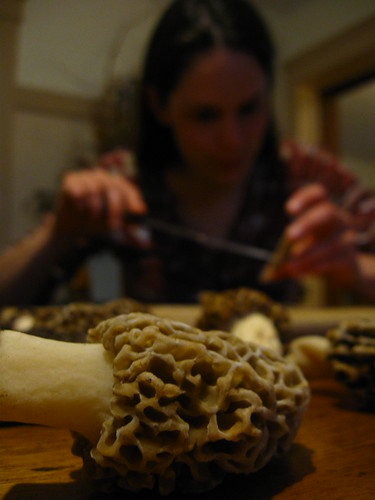
Hunting the elusive morelI was able to join in on the last leg of the morel hunt, which took place in town (yes, they do grow here, but they can be hard to find). With my mycologist friend (BC) moving out of town, he was less reluctant to bring along some friends (PE, who was interested in learning how to hunt for mushrooms, and me, who was less interested in the hunting, and more interested in the company). BC and PE had already been to a few sites that day and, on their swing through town, picked me up for their last search site. (We stopped to pick up some additional fare: beer and complementary comestibles.)

Two morelsAfter about an hour at our last site (sorry folks, no comment), we only had two morels to show for it, and they were both found by BC. Still, these two would add to the small haul that BC and PE had managed to get earlier in the day.

Preparing the morelsWe headed back to BC's house. Together with other friends and housemates, we set to making a wonderful dinner for seven. The cutting preparation of the morels required a bit of work to ensure that bugs and worms (which often crawl up the fruiting body to live and enjoy the tasty morel, too) were removed before cooking. (As much as I don't mind a little extra protein, I felt that this step is warranted when one wants to have a nice meal.)

The final meal (chips with freshly made guacamole, grilled grass-fed beef steaks, organic pork chops, scalloped potatoes, chopped bacon and cabbage, peas cooked in butter, and (of course) the morels), was a wonderful combination of very earthy flavors, and melded flavors so very simply and very well.
The meal

The conversation softened as people tucked into their plates, BC playing the part of the host and making sure that all got enough food before sitting down himself. After about a minute of silent eating (well, silent eating interrupted with exclamations of how good everything tasted), the conversation started to meander lazily along many streams, flowing like a river lazily reaching its delta: slowly pushing through dense stands of personal experience, returning to the main channel of conversation, breaking off to surround and build memory sandbar, slowing down to near-stillness of pregnant pauses of conversation.

The evening ended, as evenings eventually must, and we all left, saying our good-byes, promising to help BC with his packing, loading, and moving come the start of the week. It was, in all, a great meal for a great friend.

Sunday, May 08, 2011

At the AUT Bar

I'm sitting in the AUT Bar, having finished a nice repast while sitting next to two couples that don't really know what an "indoor voice" is. I've learned that one of them is trying to finish her dissertation (and another person at the table is telling her to make a schedule and stick to it; again and again she's saying this to her). Two others at the table are (apparently) nuclear/particle physicists (or engineers). The older of the two men is French and quiet. The younger is definitely not French and definitely not quiet. They spent most of the time that I was seated talking about this, that, and the other; merging conversations with as much skill as ... well, stereotypical physicists (or engineers).

However, the food was brilliant -- as usual. The weekend brunch is in celebration of three simultaneous things: the 25th anniversary of the AUT Bar, the recent Cinco de Mayo celebrations (with the bar being decked out with red, white and green; sunbursts and globes; different color palette on the tables; and paper cut-outs of sombreros and cacti), and Mother's Day (which is actually today, while the others are -- likely -- not). In celebration of their 25th Anniversary, I decided to get their Chile Relleno with eggs... y fue excelente y delicioso! (It it weren't for the discussions of dissertation-writing schedules and particle physics, it would have been like being back in one of the taquerias in Mexico City. ... Well, facing the full bar was a little different than the taqueria.)

IMG_8689

In town on a Sunday

Yup, it's another Sunday of some memorialization during which I find myself in town. A couple of weeks ago, it was Easter, now it's Mother's Day. Soon it will be Memorial Day, and then Father's Day. Now don't get me wrong: I really have no problem with the days themselves; I enjoy Easter celebrations (well, most of them), I really do love my Mother and Father, and I really don't have anything against remembering the servicemen and servicewomen that have died in service to the US.

However, I really don't like the implication of the day. Living in Saginaw Forest, I get to 'enjoy' the (usually) significantly greater number of people who are out in the forest. *Sigh* I really don't mind that people are there, either, but I do mind when they decide to flout the rules. Well, I really don't like it when people flout the rules at any time, but I really don't like it when I get the response of, "But it's [X]'s Day. Can't I [break this rule]?" To me, this makes no sense at all. Would the people really be okay with encountering a burglar in their home on [X]'s Day saying, "Why can't I break the burglary law, it's [X}'s Day!"

Sure, no one is immediately being harmed by having a dog off of leash, however, for me, it's both a cumulative effect of people seeing other people with dogs off-leash then feeling that they can also do it along with the feeling that people really don't have much respect for the property.

So, instead of confronting people on a day that they are more happy than other days, I just avoid them by coming into town. After all, I don't want to be confrontational, either. Nor do I wish to remain ensconced in my house.

Saturday, May 07, 2011

Help day in Stinchfield Woods

Today was a help-day out at Stinchfield Woods. I decided to ride the 15 miles to Stinchfield Woods (mainly because I don't have a car, of course), and it turned out that the day was a really good one for removing invasive species: sunny and breezy for much of the afternoon.

IMG_8679
The final chop up (well the second half of what we pulled out of the area we worked).

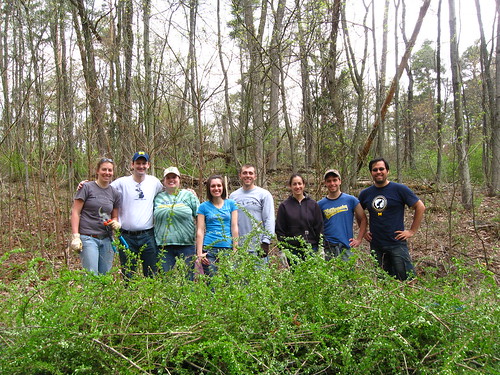
After about 4 hours of doing some hard work, we decided to scratch the final hour -- partly because of impending rain, partly because the tarp was completely filled with Japanese barberry, and partly (mainly perhaps) because we were dog-tired. Therefore, we went up to the caretakers' cabin and had some hamburgers and hotdogs (and lots and lots of water).

IMG_8685
Don't we all look really tired? :D

I raced back (along with another helper) most of the way back to Saginaw Forest, mainly because we (well, me, anyway) were trying to beat the threatening rain.

In the end, it was a great day of physical exertion. The only thing that I hope is that I didn't get too much poison ivy.

UPDATE: I just calculated my average speed to and from Stinchfield Woods to be 17mph. A personal best for a distance greater than 10 miles. Maybe I will have to change out my handlebars for something that gives me better aerodynamics.