Sunday, August 28, 2011

A couple of responses to a(nother) post at SocImages

I really do like reading SocImages, since it often brings up issues that are not relevant to my own area of study. However, many of the topics are germane to everyday life as well as perspectives on it. Furthermore, because of this, it's quite interesting to look at the reactions that people (including myself) have about their interpretation (and -- inevitably -- the interpretations of others). Occasionally, the author of a blog post seems to reach a little too far to make a point -- we are all guilty of that on occasion -- and often get called out on it. Sometimes, though, the reaching seems to go unnoticed (or perhaps I just notice it early on, since it shows up on my RSS feed), and I point it out. This happened in a recent post about how the Rikers Island prison didn't have any hurricane evacuation status and linking this lack of evacuation status to a perceived lack of compassion for prison inmates seen during the aftermath of Hurricane Katrina. While I didn't have a lot of problem with the many of the points made in the post, it seemed to me to be less objective with the facts than it could have been, and it didn't seem to me that the author considered alternative explanations for the same facts.
From your quote from the NYTimes blog, the problem appears to be as much an administrative one as a physical one (that then results in a combined administrative and logistical problem):
no hypothetical evacuation plan for the roughly 12,000 inmates that the facility may house on a given day even exists. Contingencies do exist for smaller-scale relocations from one facility to another.
This speaks -- to me -- more to the department of corrections being blind-sided by this event; something that hasn't happened since 1938. Yes, pulling together contingency plans for awhat if scenario for evacuating Rikers Island in the event of a hurricane could have been undertaken following the 1938 hurricane, but it would also have to have been periodically updated as conditions in the area (and in the prison) changed, and the investment would likely have been seen as wasteful spending during eras of budget cuts (and likely scrapped, thus needing another administration to re-start investments in the planning process).
Voters don't like what is perceived to be "wasteful government spending", and continuous spending to update evacuation plans for an island prison complex due to a 100-year-event (as the flooding from the hurricane was forecast to be) could well fall inside that perception of "wasteful government spending."
Could not the city have started moving people out to other facilities ahead of time? Well, perhaps, but I don't know (and likely most readers of this blog don't know) the logistic difficulties that are inherent with scaling up the NYTimes blog's statement of, "Contingencies do exist for smaller-scale relocations from one facility to another." How much police effort would have to be shifted from other public-safety operations? What would the political heat on the city be if New Yorkers discovered that the city government was (to put easy spin on it) 'spending money saving criminals instead of the innocent citizens of the city'? 
I noted earlier that it seemed to me that the department of corrections was blind-sided by this event. I previously established that it was popularly quoted as being a potential 100-year flood event (and thus likely was not planned for -- or had updated plans maintained). If you can agree that it was highly unlikely that there was decent planning (and updated plans) available, then let's look at the problem in light of the time line, because (given enough time), perhaps Rikers could have transferred some of the inmates, using their contingency plans. I looked around the NOAA site, but could not find accurate information that confirms what I recall: the hurricane forecasts placing the storm over NYC didn't start to come out until last Monday (August 21), which would mean that Rikers would have had less than six days to move out a significant number of inmates to other facilities based on plans that were only meant for contingencies of moving a smaller number of inmates.
If we were -- in sum -- a people who did care a modicum more about these people who are in our custody (extrapolated from us, since we have an ostensibly representative government), then we would likely have had adequate flooding predictions to include Rikers (instead of having to extrapolate -- sans data -- to say things like "despite the fact that the island is surrounded by areas with the second highest evacuation rating") as well as monies to put toward adequate planning to cover such rare occurrences as this one. (After all, a 100-year flooding event means that each year there is a statistical 1/100 chance that it will happen, not that a flooding event won't happen for another 100 years.) However, we are a society that (more often than not) praise law enforcement officials and politicians who are "tough on crime" (which usually means "no compromising with felons" and often means "don't give prisoners more stuff"), and therefore we get situations like a prison island that has no viable plan to relocate an house its inmates in the face of a hurricane. (And this is exacerbated by the fact that hurricanes don't have a history of hitting NYC -- or come close to hitting it -- very often).
If we are to have the responsibility of governance as a people (think: "We the people" and "government of the people, by the people, for the people"), then we need to learn to think about those whose lives are held by us. However, while I state this point of humanist governance, I would also caution people to (seemingly) jumping directly to conclusions of the one above. The historical condition viz hurricanes is significantly different than New Orleans. Likely, too, Rikers is a very different sort of prison than those in New Orleans, requiring a very different level of logistical and administrative coordination. (And don't forget about the vastly different legal, political, and social differences between New York and Louisiana nor New York City and New Orleans.) Making the direct link -- without making reference to these differences and the ones I outlined above -- is sloppy analysis.
I think that my meta-analysis is right: for various reasons, the explanation given in the post was not a very good analysis of the problem as one that matched the author's apparent thesis: that New York City didn't care about it's inmates leading up to Hurricane Irene, just like New Orleans didn't care about its inmates leading up to Hurricane Katrina.

In doing some online investigation for my response, I noticed something in the author's post that I couldn't square with the Wikipedia entry about the history of Rikers Island. The Wikipedia entry stated that it was purchased by the Dutch in the 17th Century, but the article made it sound that it was potentially all built on reclaimed land. The author provided a link to the source article for that sentence, but when I looked at it, I noticed something a little more problematic (from an academic point of view, that is):

Re: "Solitary Watch reports that Rikers Island was built on landfill, which is especially vulnerable to disasters."
This is an incorrect citation of the fact and a fudging of the implications in two parts.
First, the incorrect citation: Solitary Watch did, indeed, have this information, but it clearly cited its source as the New York City Department of Corrections' website (not themselves). Proper citation should mention this, rather than merely pointing to Solitary Watch. Therefore, something like "Solitary Watch -- reporting figures from New York City's own Department of Corrections -- reports that..." would have been far more accurate. (Sorry, but freshmen would have been marked down for that mistake in my classes.)
The first of what seems to me to be fudging: You state that it "was built on landfill", which -- without greater knowledge of the facts -- makes no distinction between the entirety of the island vs a portion of the island. Looking again at Solitary Watch, we find that their figure (from NYCDoC) is that "more than three-quarters" is built on landfill. Now, while that is a huge percent, it is a fudging of the original cited figure. Since you have a PhD, this being a mere slip-up seems rather dubious, since the number is right there in the citation, and because the island pre-existed the settlement by the Dutch in the 17th Century (i.e., it couldn't have all been "built on landfill"). (Sorry, but more points off for massaging the data.)
The second of what seems to me to be fudging: You state that it "is especially vulnerable to disasters," which is again not what Solitary Watch said, which was that it "is generally thought to be more vulnerable to natural disasters." As a writer, the difference between your "is especially vulnerable" and the original "generally thought to be more vulnerable" are worlds apart. Your use is a declarative statement of fact, while Solitary Watch's is not, so unless you are an engineer qualified in determining the structural integrity of such an island add-on, then you should not make the definitive statement of "is". (Sorry, again, but mangling the difference between "is" and "thought to be" only seems to point to again massaging the data to make it fit your narrative.)
I am not arguing that Rikers Island is now mostly constituted of landfill. Nor am I arguing that reclaimed land is more structurally sound than natural geological landforms. (However, I am arguing that you did a poor job of citing the source of the fact that Rikers was partially built on landfill.) 
I am pointing out, though, that within one sentence, you have committed three distinct academic fouls that would have lowered many a student's grade for what would be countenanced as factual sloppiness at best. Furthermore, recognizing these fouls only diminishes the strength of your argument, since I now have to wonder about the verisimilitude of your entire argument. (And holding a PhD only makes these errors more egregious in my opinion, since I would expect you to know better.)
Yes, I'm no fan when people with PhDs go around and mis-attribute facts and less of a fan of PhDs who go around and bend wording into such phrasing as to lead to a different reading of the points in question. The author should have acted with intellectual honesty and provided the source for the fact of Rikers being partially built on reclaimed land as the New York City Department of Corrections, and not Solitary Watch. One must cite the original source of factual data or -- if the actual original source (say, in this case, a surveyor's report) is not available -- a reputable and/or authoritative source that can attest to the fact. Failing this, one should make it clear that a source (such as Solitary Watch) is secondary. The verb "report" does not imply one way or another whether the source was primary or secondary, but merely that a written account was given of something investigated (primary source) or received (secondary source). To many people, this may seem a nit-pick, but it in academia, this can be a quite important distinction.

Also, for some people, the difference between "is" and "thought to be" as well as the difference between "was built on landfill" and "more than three-quarters is on a landfill" are word-choice differences. However, if you add up enough of these small "word-choice differences" you can get a very different message. For example, while the original source's wording can be generously read as, "almost all of the prison is built on reclaimed land, which many people think can be a problem in natural disasters," the author's wording provides an even greater generous reading of, "the whole prison is built on reclaimed land, which is a problem in natural disasters." This is a set of differences, which (if continued over the course of a lengthy discourse or series of discourses) can lead to final interpretations as distinct as Catholicism and Unitarianism.

What puzzles me the most about this one sentence that I pulled out for examination was how unnecessary its interpretation was. The author could just as easily taken a direct quote from the Solitary Watch website, since the sentence is a mere re-wording of a sentence on that page.

Where is...?

Where is that fresh flush of life?
Wherefore stolid complacency stagnant in my gut?
Where went the cold edge pulled from a sheath,
Shining proud in the sun, ready to cut?

How dull it is now, tarnished red with age,
Unoiled and unsharpened, naked to the sky?
How much cold iron is left below the rust?
What mettle is held in that core?

Shall we burnish it and see;
Rasp the edge until it is once again sharp?
Reveal the cold beauty of the sword:
Serene and archaic symbol of ancient times.

Can it slay our modern creature comforts,
Cut through the Gordion knot wound about us?

(Yup, I'm in a funk once again: writing bad poetry in between bouts of practicing martial arts outside.)

Saturday, August 27, 2011

August photos

Thanks to a battery cover that is breaking on my camera, I've been rather remiss about uploading photos to Flickr (since I taped up the cover, and peeling off the tape to get to the memory card is annoying). However, this photo group (and the June and July ones) should get people "caught up" to the random photos taken around town.

IMG_9402
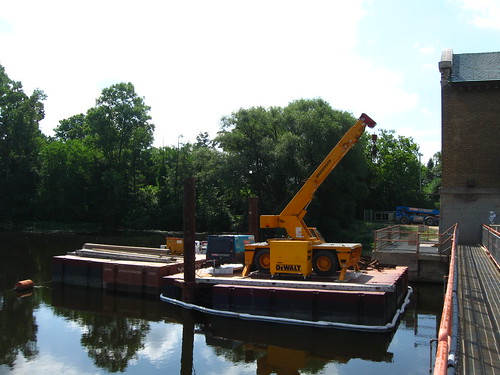
Repair crane sitting on a pontoon on Barton Pond.

IMG_9413
A scrumptious dinner of (clockwise from top-center) chanterelles, chicken burgers & kale, chicken-of-the-woods, and fried rice (cooked in the juice of the chanterelles).

IMG_9425
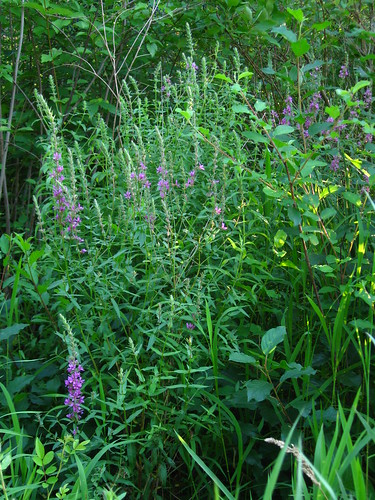
Damnable purple loosestrife!

IMG_9426
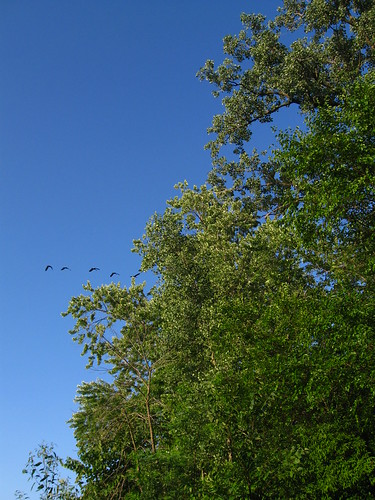
The migrations are starting.

IMG_9441
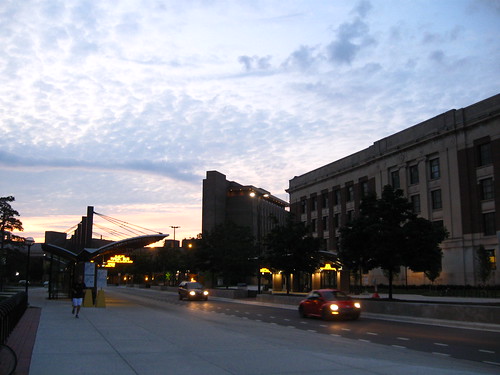
The bus shelters on North University (new as of January).

IMG_9465
Feasting on milkweed.

IMG_9539
Misty morning on Third Sister Lake

IMG_9556
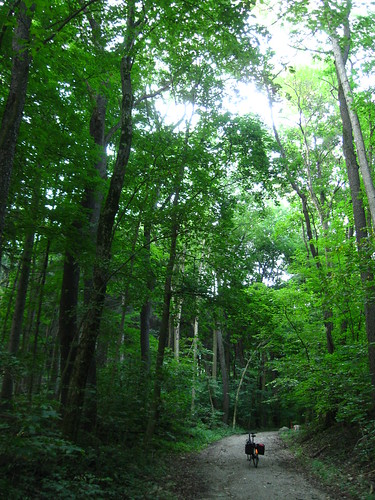
Cycling up the driveway in Saginaw Forest.

IMG_9560
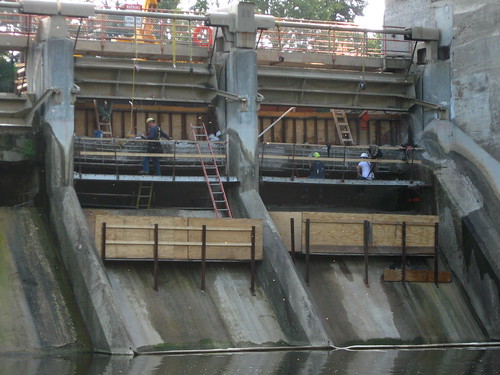
Repair work on Barton Dam (closing off the gangway above to pedestrian traffic).

IMG_9567
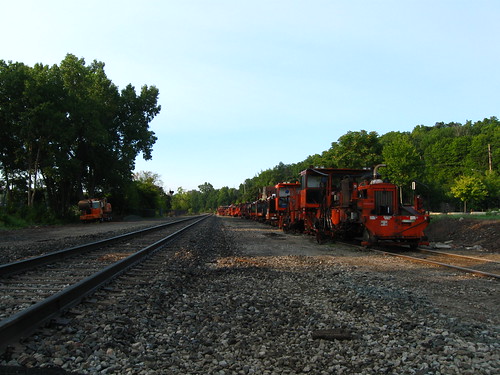
Railroad repair vehicles. (I suspect that some of these are meant to pull out and replace the railroad ties, since I saw many stacked up haphazardly along other sections of the railroad.)

July photos

IMG_9140
Sandhill cranes (shot at maximum digital zoom, thus the pixelation)

IMG_9155
Roughly 1 quart (~1 liter) of raspberries, picked near the campfire ring in Saginaw Forest.

IMG_9207
Jiffy mixes in Chelsea

IMG_9245
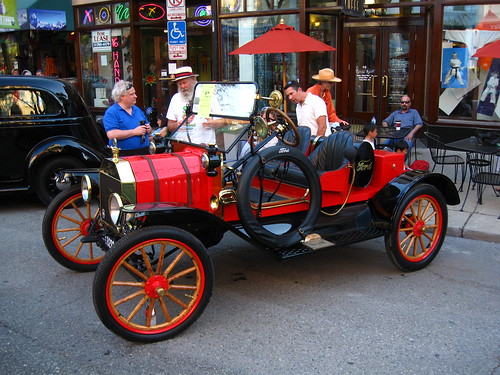
A 19XX Ford at the Rolling Art car show in downtown Ann Arbor.

IMG_9256
A huge luna moth decided to spend some time hanging out on the gate post to Saginaw Forest

IMG_9283
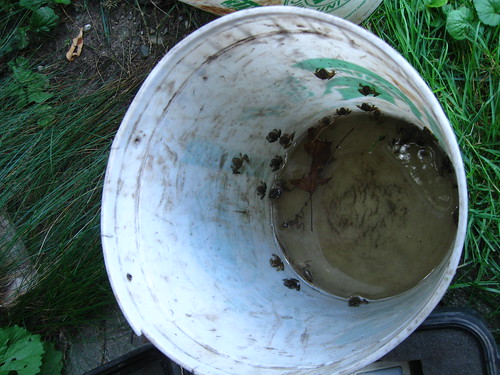
A sampling bucket from the "frog guy".

June Photos

IMG_8977
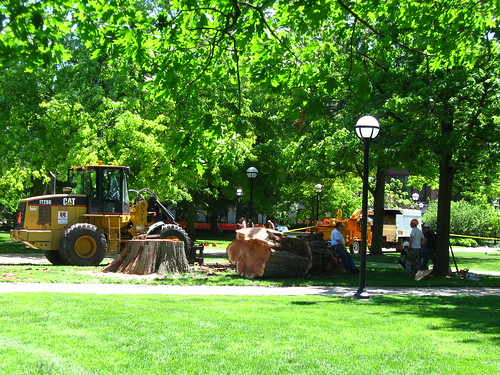
Chopping down one (more) of the elms.

IMG_8980
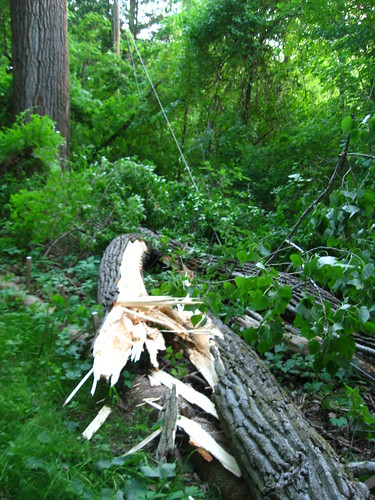
Massive branch from the dogwood tree takes out the electricity line in Saginaw Forest.

IMG_9045
A gorgeous peony

IMG_9063
Morning dew

IMG_9105
Ripening raspberries

Friday, August 26, 2011

Cycling around the U: 13 months

Over the past thirteen months, I've been using a Garmin to track where I've been cycling. No surprise that I'm focused mostly around the university...


Colors range chronologically from red (July 2010) to yellow/orange (August 2011).

1204 Granger

A reader requested this one, and I happened to be cycling by that location a little while ago, so...

IMG_9448

What people call streams... or brooks... or runs... or something else

If you've done work in rivers in the US, you will quickly learn that names for those flowing bodies of water smaller than a "river" are given different names in different places in the country. Some EFL individuals may think that there is a hierarchical nature to the relationship between a "stream", a "brook", a "run", a "wash", etc. Often, though, there isn't; all these things are similar to each other in that they all mean "a small river" or something akin to that. Looking at the Flowing Data website today, I saw a link to a map by Derek Watkins that lays out the geographic distribution of the various toponyms that describe "small rivers" around the US.


Just to show how similar the definitions for many of these different words are, I present their (relevant) definitions [and etymologies], taken from dictionary.com.
  • Branch: a tributary stream or any stream that is not a large river or a bayou; Chiefly South Midland and Southern U.S. branch water.  [1250–1300; Middle English bra (u) nche < Anglo-French; Old French branche &lt; Late Latin branca paw, of uncertain origin]
  • Run: a small stream; brook; rivulet. [before 900; (v.) Middle English rinnen, rennen, partly < Old Norse rinna, renna, partly continuing Old English rinnan; cognate with German rinnen; form run orig. past participle, later extended to present tense; (noun and adj.) derivative of the v.]
  • Fork: a principal tributary of a river. [before 1000; Middle English forke, Old English forca &lt; Latin furca fork, gallows, yoke]
  • Brook: a small, natural stream of fresh water. [before 900; Middle English; Old English brōc stream; cognate with Dutch broek, German Bruch marsh]
  • Kill: (US) a channel, stream, or river (chiefly as part of place names) [C17: from Middle Dutch kille; compare Old Norse kīll small bay, creek]
  • Stream: a body of water flowing in a channel or watercourse, as a river, rivulet, or brook. [before 900; (noun) Middle English streem, Old English strēam; cognate with German Strom, Old Norse straumr; akin to Greek rheîn to flow (see rheum); (v.) Middle English streamen, derivative of the noun]
  • Bayou: a marshy arm, inlet, or outlet of a lake, river, etc., usually sluggish or stagnant; any of various other often boggy and slow-moving or still bodies of water. [1710–20, Americanism < Louisiana French, said to be &lt; Choctaw bayuk river forming part of a delta]
  • Swamp: a tract of wet, spongy land, often having a growth of certain types of trees and other vegetation, but unfit for cultivation. [1615–25; < Dutch zwamp creek, fen; akin to sump and to Middle Low German swamp, Old Norse svǫppr sponge]
  • Slough: an area of soft, muddy ground; swamp or swamplike region; Also, slew, slue. Northern U.S. and Canadian. a marshy or reedy pool, pond, inlet, backwater, or the like. [before 900; Middle English; Old English slōh; cognate with Middle Low German slōch, Middle High German sluoche ditch]
  • Wash: a tract of land washed by the action of the sea or a river; a marsh, fen, or bog; a small stream or shallow pool; a shallow arm of the sea or a shallow part of a river; a depression or channel formed by flowing water; Also called dry wash. Western U.S. the dry bed of an intermittent stream. [before 900; Middle English washen (v.), Old English wascan (cognate with Dutch wasschen, German waschen, Old Norse vaska) < Germanic *watskan, equivalent to *wat- (root of water) + *-sk- v. suffix + *-an infinitive suffix]
  • Cañada: Chiefly Western U.S. a dry riverbed; a small, deep canyon. [1840–50;  < Spanish, equivalent to cañ ( a ) cane + -ada noun suffix]
  • Arroyo: Chiefly southwest U.S. a small steep-sided watercourse or gulch with a nearly flat floor: usually dry except after heavy rains. [1800–10, Americanism ; < Spanish; akin to Latin arrūgia mine shaft]
  • Rio: a river [Spanish rio, from L. rivus "brook, stream"]

How do most people seem to find this blog?

According to the Sitemeter tracker and the Blogger tracker, most people who come to my site find it by doing a search for "unit conversion" or "conversion table" or something similar. A number of years ago, I had written about a fun site that does unit conversions from standard units into more fun units. So, for example, you could know how far 500 miles was in units of "Great Walls of China" or you could find out how wide 5 feet in terms of CD cases, etc.

For some reason, though, out of the past 100 page views, Sitemeter shows that the page about unit conversions had 53 initial hits, with the next greatest being the archive page that has the entry about unit conversions at 31 initial hits. So, 84 out of the past 100 hits to my site have been related to unit conversions... Furthermore, according to the Blogger stats for the site, out of the 26,429 hits recorded since July 2009, 7177 of them have been to the unit conversions page (and over the past 24 hours, 123 of the ~300 hits have been to that page). This is kind of interesting, because there are definitely better sites that have to do with unit conversion, so why are people coming to this one? What is the logic behind Google putting my blog at a high enough level for people to click through to it so often?

Hmmm...

Thursday, August 18, 2011

A bit of video humor

A few years ago, I saw a video of a mime of Natalie Imbruglia's Torn:


Later, I saw some other mimes of songs done by Johann Lippowitz (aka David Armand). Recently, I found some more...


And a 14-minute compilation of his interpretive dances done for the Fast and Loose show on the BBC.


Two more. Human


Man in the Mirror

Evolution of... (in video)

The evolution of dance


 The evolution of rap  

 The evolution of computers
  

 The evolution of Final Fantasy chocobos  

 The evolution of Harry Potter  

 The evolution of the mobile phone (1985-2008)  

 The evolution of the TV (1920-2008)  

 The evolution of the car (1908-2008)  

 The evolution of the touchdown dance

Friday, August 12, 2011

Wait... Muslims aren't a monolithic group?

There's been some interest in a recent Gallup report from the Abu Dhabi Gallup organization that investigates the viewpoints of Americans on different topics, splitting them out based on stated religion. The survey also had questions about perceptions of Muslims, splitting these out also by stated religion. This report has been discussed at The Atlantic magazine, and it was nice to see many of the points that seemed so obvious to me when I was growing up in Japan and Taiwan with classmates who were Muslim.

I think that a lot of the reactions to these polling results are quite telling about stereotypes that people hold about other groups -- groups with whom they are not familiar. I grew up internationally, grew up with friends who were Muslim, Buddhist, Hindu and (yes) Christian. These weren't people whose families were all about "killing the infidel" and "death to America." Indeed not. On the contrary, they were people who -- although some came from Iran -- intimately knew of the problems that their governments were responsible for (and that some of these were conducted in the name of Islam was also troubling).

However, there is -- I would argue -- no country in the Western world that is officially Christian that also uses Christianity to officially justify imprisonment, war, trade sanctions, etc. To that extent, many people in the West are very prone to making an incorrect association between the political stance of nations that are officially Islamic with the stance of people who practice Islam. For example, Great Britain is officially a Christian country -- the Church of England is the official state church -- but we don't perceive a Christian motivation to their military actions in the Falklands during the 1980s, in Kuwait in the 1990s and in Iraq in the 2000s. We don't point and say, "Look at that! Anglicanism is a war-like religion!" because we understand that there is a difference between the practitioners of it and its position as an official government religion. (Yes, I understand that Thatcher, Major, and Blair didn't invoke Anglicanism when going to war, but I would argue that it (A) is implied in any official action and (B) if doing so were politically expedient -- or politically uncostly -- they would likely have done so.) Even during the Troubles in Northern Ireland, most nationalists wouldn't have said that Anglicanism was a violent religion, being able to separate out the difference between the religion of many unionists and their political stance viz Northern Irish independence/merging with Ireland.

To people who say, "Well, if moderate Muslims feel this way about the use of force, etc., then they should be out in the streets protesting against the extremists," I would state two things: 1) many Muslims do speak out against violence that is advocated for by extremists, but they are not picked up in the media (for various reasons), and 2) most people -- regardless of their faith -- are just not that politically motivated to rally for action if they don't see any major benefit or impending disaster that affects them (just like the Troubles in Northern Ireland, where were the Anglicans and Catholics out on the streets, rallying for peace? They were there, but see, the previous point as to why most of us don't remember this point.) On this point, the Gallup report says:
That a significant minority of Americans doubt U.S. Muslims’ loyalty to their country seems to suggest they may expect Muslim Americans to somehow prove their loyalty. Similarly, members of the media and the public often ask why Muslim Americans do not speak out against terrorist attacks more often, as if their silence somehow condones such acts. Most major religious groups (including Muslims themselves) are split on this question, with about one-half in each faith group saying U.S. Muslims are obligated to speak out more than others, and one half saying they are not. If Americans of most faiths are split in their perception of Muslim Americans’ obligation to speak out against terrorism, they are not divided in their perception of whether Muslim Americans do so often enough. Most believe they do not. ... That compares with 72% of Muslim Americans, a mismatch suggesting U.S. Muslims have not found the right “bullhorns” to make themselves heard. It also reflects the frustration Muslim Americans often express that their repeated condemnations of terrorism seem to go unheard. (pp 35, 36)
Moving on to a point that wasn't discussed in the report: how -- for many items -- Muslim Americans and No Religion/Athiest/Agnostic Americans (which I will refer to as "Nones" from now on) were more similar to each other than other religious groups. (Yeah, yeah, I know: "Atheism" and "Non-believer" aren't religions, and calling them such falls under a functionalist definition of "religion", which carries with it its own set of problems, but I'm not going to address that here.) When one looked at many of the topics, the patterns were similar between the two groups:

  • Nones were second only to Muslims when it came to a change in perception between George W Bush and Barack Obama (p 19);
  • Muslims and Nones were less than 80% confident with the military (all the other groups were 91-97% satisfied) (p24);
  • Muslims and Nones were less than 70% confident in the FBI (all the other groups were 75-79% satisfied) (p 24);
  • Muslims and Nones are the youngest groups, average ages of 36 and 41, respectively (all other groups averaged 46-55) (p 26);
  • Muslims, Jews, and Nones are more likely to cite the Iraq war as a mistake (67-83% compared to 32-49%) (p 27);
  • Muslims and Nones are more likely to cite the Afghanistan war as a mistake (both at 47% compared to 22-29%) (p 27);
  • Muslims and Nones are more likely to reject military violence against civilians always (79% and 58% compared to 33-43%) and sometimes (21% and 43% compared to 52-64%) (p30);
  • Muslims, Nones, and Jews are more likely to believe that Muslims have no sympathy for Al Qaeda (92%, 75%, and 70% compared to 56-63%) (p 32);
Not surprisingly, there were some major differences between Nones and Muslims, especially when it came to questions of religion, religious tolerance, and religious identity. (Many of the questions didn't really seem to fit with the broad stances that many Nones seem to take, and so I don't really think that the comparisons are valid in this section of the report. Indeed, for many of the topics of religion and spirituality, the report drops the responses of the Nones.)


Finally, I am interested to see how much the responses among Muslims were influenced by prevailing sentiments of many Americans to Muslims, and whether -- if there is greater acceptance of Muslims over time (just like there has been a greater acceptance of Catholics over time) -- their attitudes on these questions will migrate closer to the other segments of American society.

Richer people spend more money on alcohol, but why is that interesting?

I saw this posted on the Daily Dish:


and I wanted to put in my tuppence: If you divide the amount spent on booze for each group by the groups median annual income, you’ll get a slightly more informative number:

  • Less than HS: 0.88% of median annual income. 
  • High School: 0.95% 
  • Some College: 1.02% 
  • Associates Degree: 1.03% 
  • Bachelor Degree: 1.33% 
  • Advanced Degree: 0.90%* 
Still, this doesn’t provide any information about the amount of alcohol drunk by the groups, the cost of the alcohol, nor the purpose of the purchases. However, it does add the wrinkle that advanced degree holders may* be acting differently than the rest of the trend.

There has been analysis on the alcohol drinking trends of various income groups before. To summarize (via Kevin Drum):

  • Expenditures on beer double between the lowest and highest income quintiles. 
  • Expenditures on wine quintuple. 
  • Expenditures on "other" (mostly mixed drinks, I assume) also quintuple. 
  • Expenditures on alcohol consumed at home go up 170% while expenditures on alcohol consumed elsewhere go up 600%.
Also, via James Joyner:
Increasing levels of education correlates with increased income and, presumably, more disposable income. As people attain more education and income, they’re likely to switch from cheap beer (Miller Lite) and cheap booze (Seagrams gin, Jim Beam bourbon) to better and more expensive beer (say, Dogfish Head 120) and booze (Bombay Sapphire gin, Macallan 12 Scotch). Also, they’ll drink wine that comes in bottles not boxes. Additionally, they’ll be more likely to drink at bars and pricey restaurants, thinking nothing of paying $6 for a pint of beer, $9 for a glass of wine, or $12 for a cocktail.
I personally feel that the initial graph provides an answer to the wrong question, because (as Kevin and James point out), there are several other things going on here; the graph doesn't show useful information from which we can draw useful (and predictive) conclusions about the behavior of any one group (other than  richer people spend more money on booze than poorer people). Looking at the percent of annual income is being spent on booze is a better way of starting to look at a meaningful analysis, and -- if we believe the numbers -- people who have a bachelor degree spend the most of the group (as a part of their annual pay), while people with less than a high school degree, and people with advanced degrees spend the least. Furthermore, while the actual amount of money spent by people with less than a high school degree is about  1/3 that of advanced degree holders, the fact that these two groups spend almost the same amount of money out of their paychecks on booze is interesting, and merely underscores (to me at least) the important recognition was summarized by Kevin: that what and where people drink is heavily related to their level of income.


* For the category of advanced degree, I took the average of the values listed for masters, doctorate, and professional.

Wednesday, August 10, 2011

Time lapse of one day in California

I love time-lapse films, and many of them have a sort of serene quality about them; gliding and elfin. Today, though, I present a time-lapse film that has a different feel: it looks a lot more like stop-motion animation using really high-quality models and miniatures. (The train and highway traffic starting at 0:45 really look like that to me. As do many other pieces there.) Perhaps this is because it's photos with a relatively more narrow frame of reference compared to most of the landscape-wide views. Perhaps, too, it's because the time lapse is shorter than in those vista-scapes; with photos being taken ~1/sec versus 1/min or more. Anyway, enjoy:

A Day in California from Ryan Killackey on Vimeo.

h/t: Daily Dish

Sunday, August 07, 2011

Biting flies and purple loosestrife

The weather is perfect for all the biting flies that are buzzing around throughout the forest in the late afternoon. It makes maintenance annoyingly "piquant", and it makes me not actually want to do things outside, despite the lowered temperatures.

... and that's a bad thing, since I have noted several clumps of purple loosestrife around the lawn (near the lake) as well as in the wetland on the west side of the property. Without removing them, they will just take over the area in a few years, and -- as "lovely" as the flowers may seem to some -- their larger-picture problem (of taking over an area) far outweigh the "beauty" of their flowers. (In case it wasn't clear, I don't agree with the perception that they look nice. True, they look nicer than some other flowering plants, but they are -- to me -- far from pretty.)

Friday, August 05, 2011

Move, Eat, Learn

Although I doubt that it was done in response to Eat, Pray, Love, this series of three short films are incredible. From Rick Mereki's Vimeo page:
3 guys, 44 days, 11 countries, 18 flights, 38 thousand miles, an exploding volcano, 2 cameras and almost a terabyte of footage... all to turn 3 ambitious linear concepts based on movement, learning and food ....into 3 beautiful and hopefully compelling short films.....

= a trip of a lifetime.
MOVE:

MOVE from Rick Mereki on Vimeo.

EAT:

EAT from Rick Mereki on Vimeo.

LEARN:

LEARN from Rick Mereki on Vimeo.

(H/T: The Daily Dish)

Tuesday, August 02, 2011

In defense of teachers

I saw a clip of Matt Damon being interviewed by a free-market-will-save-the-world reporter about why job security should be based on a desire to make money (comparing her perception of Matt Damon's incentive to work hard as an film actor to the motivations that teachers "ought" to have). I saw that clip earlier today with very little context as to where it took place, and why he was being interviewed about teachers.

On tonight's "Last Word", Lawrence O'Donnell did a great segment in defense of teachers (and -- by extension -- public education).

Some of what I think were good excerpts:

I also hated and did badly in anything involving writing of any kind, which is kind of like wicked ironic, since I then grew up to be a writer. That just points to the unpredictable ways we learn things. I couldn't be taught writing in school, but later, as an adult on my own, I could somehow get the hang of it. None of the teachers who tried and failed to teach me how to write should be blamed for my failure as a writing student.

[Teachers] were told to take the blame for any disappointing academic achievement statistics in America. Republicans targeted teachers as soon as they saw teachers aligning themselves so often with the Democratic Party. Now, which party should the teachers' unions have seen as best representing their concerns? The party that wanted to cut taxes and cut spending on public schools, cut sports programs, cut arts education, cut the band, cut educational resources across the board so that we could then have even more tax cuts? Or the party that wanted to deliver to teachers the resources they need in the classroom and the resources that every school enedst o provide a full educational experience?

It has never occurred to the teacher haters that teachers want to be teachers for any reason other than job security. It has never occurred to them that teachers might want to be teachers because they like teaching, because they love teaching, and because they care about their students.

Watch the whole segment (10 min 29 sec):

Visit msnbc.com for breaking news, world news, and news about the economy


Wednesday, July 27, 2011

Language, dog-whistles, and extremism

I often read the blog entries over at Dispatches from the Culture Wars each day. Ed usually posts four or five short posts in the morning, and I almost always find the posts interesting, and I enjoy reading (and sometimes contributing to) the commentary; the other commentators there are (usually) civil enough.

There was one entry today -- "Those Scary Muslim Words" -- that was one of those posts that really made me want to post a reply... and upon greater reflection, to cross-post it here.

Ed quoted from a story from the NYTimes about people in the Phoenix, AZ area who didn't like the fact that the massive sand and dust storms that had hit them twice this year had an Arabic name: "haboob". Never mind that the Arabic words are not Muslim words, but some people were making that conflation, and going to extreme lengths of politically charged language to try and pressure someone (I don't know who) to change the use of the word (much like the silly change of name from "french fries" to "freedom fries" on the Congressional cafeteria menus way back in 2002):
"I am insulted that local TV news crews are now calling this kind of storm a haboob," Don Yonts, a resident of Gilbert, Ariz., wrote to The Arizona Republic after a particularly fierce, mile-high dust storm swept through the state on July 5. "How do they think our soldiers feel coming back to Arizona and hearing some Middle Eastern term?"
Many of the commentators did -- admittedly -- focus on this comment, showing how much of a boob Don Yonts was with regard to the haboob. Many extended the comment that Ed made in his blog:
As Adam Serwer points out, there are lots of words we use every day that are rooted in Arabic words: sofa, admiral, magazine, mattress and many more. And for God's sake, don't let grandma knit any more afghans. Those poor soldiers will be so offended!
To this, I just had to also throw in my attempt at showing how silly such reasons for not using a particular word were. If "haboob" was just too much of a "Middle Eastern term", then why not try to expunge other words from Arabic? My comment tried to highlight the extent to which Arabic words already exist quite commonly within the English language, even though England wasn't overrun by Muslim hordes during the Crusades:
Well, I suppose we ought to get rid of all those loanwords from Arabic. 
I mean, we can't have soldiers, sailors, generals or admirals getting into their alcohol (especially apricot schnapps or mint juleps). I mean, the haboob has also affected farmers' alfalfa, artichokes, Pima cotton, lemons, limes, spinach, tangerines and oranges, and so referring to it using such a vulgar word could make them feel even worse. The dust could also have infiltrated jars of coffee, jasmine, sugar and other foodstuffs (and your candy, too), and no one appreciates gritty foods.
I mean, the word is almost just a garble of sounds that you can't barely decipher! I have zero tolerance for this sort of a racket. This will end up being an albatross around the necks of our poppinjay leaders! Throw down your magazines! Get off your sofas! Get off your mattresses! March out of your alcoves and your adobe colored houses! This is checkmate!

I don't always find Jack Black that funny.

For example, while I liked School of Rock, I don't like Tenacious D:

The Marriage of Figaro (with drum kit!)

This piece is one of my earliest memories of classical music:

The Marriage of Figaro: I fell in love with it an an early age; the sounds are so emotive, the composition just so perfect to my ear. I cannot say how much I love this piece.

And now I love it even more:

Blogging reactions to Rush Limbaugh's theory of global warming as I listen to it for the first time

"I have a theory on global warming," he announced. "I have a theory about why people think it's real."

Oh, really, I thought to myself. This ought to be rich, coming from a shock-jock who has proven -- time and again -- to be a global-warming denier. What, exactly is your "theory" then?

"Go back... thirty, forty years."

Uh, huh....


"When there was much less air conditioning... in the country."

Ooooh, boy. This is going to be balls-out nuts, isn't it? This is going to turn into a "it's all in your mind, so it's not real" sort of an argument, isn't it? Is that why he's taking so many breaks and talking so slowly? Is his hesitation an indication that he's making this up as he goes on; that he didn't really have a theory before he said that he had a theory?


"When you didn't have air conditioning, and you left the house... *snort* It may, in fact, have gotten a little COOLER out there. Because sometimes houses become hot boxes.... 'Specially if you're on the second or third floor of a house in the summer time and all you've got is open windows and maybe a window fan, or you have some SERVANT standing there, fanning you with a piece of paper."

"Piece of paper"?!? If I had a servant, I thought, I'd be wanting to be fanned by something other than a mere piece of paper. Hell, even the internal logic of this construct is ludicrous.


"When you walked outside... no big deal: it's still hot as hell."

When did you describe it being "hot as hell" outside? I thought that you said that it would be hotter inside. Or are you saying that inside is just a hotter part of hell than outside? Where's the consistency in your theory?


"Now, thirty, forty years later: all this air conditioning... And it's a HUGE difference when you go outside. When you go outside now, my GOLLY is it hot. Whooo..."

Oh, so it is all in my head? Funny: I don't have an air conditioner in my house, and it's still hot outside. In fact, it's as hot outside when I leave my non-air-conditioned home as it is when I leave my air-conditioned office. And it doesn't really feel hotter when I leave my office as compared to when I leave my home: 90F and humid feels equally hot to me. So... maybe this guy's got something strange with his senses?


"GLOBAL WARMING! ... It's all about the baseline you're using for comparison.."

Well, yes, he's right on this one thing. Taken out of context from everything else. And if you know what the term "baseline" means in the context of global warming science. And you know how to use it. And you know how to compare. And you know how to interpret your results. And if you were to read the statement without the whining sarcasm that spills from his mouth.

Sunday, July 17, 2011

Naming children with numbers

As part of the cultural gulf between the US and Japan -- something that is topical for today's Women's FIFA World Cup final between the US and Japan -- I present the following clip about what baby names Rosie Pope likes and dislikes:

Visit msnbc.com for breaking news, world news, and news about the economy


Now, I know that Rosie Pope probably isn't an American (her accent sounds British), but the point is that when it came to using numbers as names, both she and the interviewer were negative to the idea of using numbers as a name (indeed, the interviewer didn't even know that people did this). While I don't know how common the practice is anymore in Japan, the use of a number in the name was not uncommon historically. Indeed, the high school principal of my school in Tokyo had the given name "Saburo" (三郎), which literally means "third son." Also, the name "Ichizō" (一三) literally means "one three": a number (and also the name of one of my uncles).

Okay, okay, okay, the naming conventions of Japan shouldn't be at the forefront of white Americans (and Brits), but in a world where Americans are naming their children after fruit (like Apple), natural features (James Mountain Inhofe), etc., the idea that someone might name their child after a number -- even in English -- shouldn't be too surprising.

Monday, July 11, 2011

Linked through "NetworkedBlogs"

If this all works out, then I will have connected this blog with my Facebook and Twitter feeds. We'll see how that works, though.

The "need" for connecting various communication platforms is something that -- in a multi-platform world of greater communication (but perhaps diminished actual contact) -- is becoming increasingly necessary (well, if you've hooked in already). Thus, the wonder of tools like "Tweet Deck" that you can either install on your computer, or use as an app in Google Chrome. And the Android device that can query your Gmail account, your Facebook account, and even your Skype account to pull in different contact details for your friends, family, colleagues, etc.

Of course, with this increased connectivity between communication resources, a part of me wonders about the amount of privacy that I'm giving up. For example, now that this is connected to Facebook even more obviously (other than a link to the blog on my "info" page), what is the benefit of using a pseudonym? Also, what amount of information am I sharing anyway? Should I start up a blog with my real name or just keep on trucking with this one, since my online identity is it's own thing anyway.

In the end, I believe that the increased number of platforms that are hooked into communications will only work if people either all buy in to one or another platform or if platform-linking services like NetworkedBlogs and TweetDeck help take up the slack for people who don't have the time or intent to get onto every single social networking and communication tech and app that comes online. Of course, a possible trade-off is privacy, but I'm not one that is in a good position to determine the exact degree of this trade-off. Therefore, like someone hoping for herd-protection, I march onward, partially hoping that -- if privacy concerns occur -- breaches occur to someone else and not to me, perhaps conveniently forgetting that privacy information "predation" is less like lions attacking a herd of wildebeest (i.e., only one gets pulled from the herd), but more like drag-net fishing (i.e., it's a technologically driven, targeted, mass capture).

Friday, July 01, 2011

Six days, 102 miles.

Okay, so it's not a century in the true sense (i.e., 100 miles in one day). However, my bike ain't a road bike, so with a relatively heavy bike, I think that it's pretty good (especially if I'm working during the day, and all the miles are commuting miles).

Basic stats:

  • Distance: 101.68 miles
  • Time: 7.35 hours.
  • Average speed: 13.83 mph
I'd say that it's not too shabby.

Thursday, June 30, 2011

A HEPA-type air-filtration system for ~$25.

I'm just getting over my allergies -- that were causing me troubles for much of the springtime. It was with this in mind that it made me very happy to see a story about building a cheap air purification system.

To avoid indoor allergens, many doctors recommend using an air purifier with a High Efficiency Particulate Air (HEPA) filter. The cost of these machines can run from $75 up to $800 for high-end systems. For those who are looking for a cheaper alternative for high-use rooms such as the bedroom, Terrell offers a do-it-yourself solution at a fraction of the cost. “This is a filtration system that you can put together with items from your local hardware store for $25 to $30 and use in your home to cut indoor allergens by about 90 percent,” says Terrell.


h/t: Inhabitat

Tuesday, June 28, 2011

Increasing number of strong hurricanes

I'm reading Changing Planet, Changing Health, and I came across a mention of increased number of more intense storms:
Studies over the last five years have shown that hurricanes are getting stronger. In a 2005 paper in Nature, meteorologist Kerry Emanuel of the Massachusetts Institute of Technology described a new measure, the power dissipation index, that captures the amount of energy that flows through a hurricane over its lifetime. ... The same year, Peter Webster's team at Georgia Tech University reported in Science that while the total number of tropical cyclones per year stayed roughly constant worldwide, the strongest storms -- category 4 and 5 storms ... -- nearly doubled over thirty-five years.
Then, the figure from the Webster et al paper was presented. However, the data that was included was from 1970-2004. Looking at that, I realized that there was enough of a time interval since the publication of the paper to extend it by another lustrum. While waiting for students, I decided to track down the data for the period of 2005-2009. Using the various hurricane records from Wikipedia (and roughly estimating the lustral hurricane values published by Webster et al), I was able to come up with the following (expanded) graphic:


As you can see, the most recent lustrum was characterized by a slight decline in Category 1 storms, a serious decline in Category 2 & 3 hurricanes, and a very small increase in the number of Category 4 &5 hurricanes worldwide.

Recalculating to collapse the categories into decades, we can look at how many more (or fewer) storms were occurring worldwide during the 2000s relative to the 1970s. From the data, we find that there were 25% fewer Category 1 storms, 10% fewer Category 2 &3 storms, and 91% more Category 4 &5 storms worldwide in the 2000s compared to the 1970s! To quote further from the book about the significance of this trend:
Top hurricane researchers do agree that as the globe warms, hurricanes will intensify, though the total number of hurricanes will remain relatively constant, or perhaps even drop.

While I don't have worldwide data on this, it seems to track with the trend in the record-high-temp-to-record-low-temp ratio over the continental United States over the same period of time does indicate continued warming:


The trends of an increasing number of high power storms corresponds to the expectation of increased magnitudes of storms caused by increasing global temperatures, and the high-record-temperatures across the continental United States corresponds with expectations of larger-scale warming trends that are being seen throughout the world.

What does all this mean? Well:
In 2010, Science published a study by Morris Bender, Tom Knutson, and Robert Tuleya ... [that] concluded from modeling studies that category 4 and category 5 hurricanes will double in frequency in the Atlantic this century because of ocean warming.
And with an increased number of hurricanes globally comes increased incidence of disease outbreaks, famine, and price spikes in commodities (e.g., food, fuel) increasing the likelihood of war (or at least some sort of punitive action by one group of people against another; state-sanctioned or not).

ADDENDUM: The number of storms in the 1975-1979 and the 2005-2009 lustra were both well below the lustral average of ~240 storms/lustrum; '75-'79 had ~206 storms, and the '05-'09 had 217. All the other lustra experience between ~232 and ~270 storms.

ADDENDUM: Webster et al use the term "pentad" to refer to a period of five years, while I prefer the use of the term "lustrum". Looking at the Wikipedia entry for "lustrum", one finds that "pentad" is synonymous, as is "quinquennium." However, "pentad" is a general term that means a group of five things, while "lustrum" specifically means a period of five years. Of course, "quinquennium" also means a period of five years. However, it's a lot more difficult to spell than either "lustrum" or "pentad".

ADDENDUM (06/30/11): I tried to extend the graph to earlier lustra, but soon realized that this might be difficult, since gaps in the data exist on Wikipedia. (The gaps might not be problematic ... if I actually wanted to wade through all the raw data.) Therefore, since I don't want to commit too much more time on this, I'll be leaving the analysis (as much as it's an analysis) as is.

Tuesday, June 14, 2011

Hurricane Categories: Why are we only using five categories?

In reading books and articles written about a future in which we have to adapt to a certain amount of climate change, one is struck by the consistency of using New Orleans and Hurricane Katrina as an example that illustrates many of the social considerations that future planning must incorporate. This make sense, since we wouldn’t care about the effects of climate change if it were happening elsewhere (i.e., we don’t care about how the climate is or isn’t changing on the planet Xenu, nor how it is affecting what may be living there). This is analogous to the underlying meaning behind the question, “If a tree falls in the woods, and no one is there to hear it, does it make a sound?” (The question never made sense to me, because I grew up with the “strange” notion that sound is a byproduct of the motion of air, and so it doesn’t matter who may – or may not – be in proximity of any object that makes a sound; it will happen. Considering the implication of the question to be something more than a physical description didn’t dawn on me until my 20s.)

In the last days of August, 2005, the city of New Orleans was hit by the eleventh Atlantic hurricane, named Katrina. It had – prior to landfall – reached a “Category 5” condition, but by the time it made landfall, had diminished to “Category 3.” Still, due to several factors – the greatest of which were undoubtedly the catastrophic failure of the levees, the lack of a city-wide evacuation order, and the systematic loss of buffering wetlands and barrier islands – the city suffered widespread flooding, and the death toll shocked the nation and the world. Many of us know these basic facts about Hurricane Katrina; many of us know additional facts. However, my most recent reading of these facts piqued a question: “In a world that is warmer, how strong might the hurricanes get?” From that, as series of other questions, including, “Why is ‘Category 5’ the strongest category?” or, to put it in another way, “Why are there only five categories?”

Looking online, it is easy to discover the basic facts of the “Category” system (called the Saffir-Simpson Hurricane Scale, or SSHS for short): there are five enumerated categories, as well as additional classifications of “tropical depression” and “tropical storm” that below the “Category 1” hurricanes; that Category 1 hurricanes have wind speeds of 74-95mph, Category 2 of 96-110mph, Category 3 of 111-130mph, Category 4 of 131-155mph, and Category 5 of >155mph; and that the system is used by the US (other places may use other systems). Doing a query for the fastest wind speed ever recorded in a hurricane, I found that Hurricane Camille (1969) maxed out the meter at around 205mph; 50mph faster than the minimum for a Category 5 hurricane, which is a much greater interval difference than any other category. True, Hurricane Camille-strength equivalents do not often show up in recorded history, making them a statistical rarity, and it would therefore make sense that their consideration might not have been deemed “necessary” at the time when the SSHS was conceived in 1971 – even though it was derived after Camille.

As a side note, looking at the historic hurricane data from NOAA, there have been 77 weeks – in the corrected data record – during which there has been a hurricane with wind speeds at or exceeding 155mph, 48 weeks of which exceeded 160mph, 12 weeks of which exceeded 170mph, and 3 weeks of which exceeded 180mph. As of the writing of this entry, the NOAA site has records for 1949-2010 for the Eastern North Pacific and for 1851-2010, with possibly some years missing (i.e., check the website for the most up-to-date stuff). For example, I cannot find the data for Camille in the NOAA data that I used to get these hurricane wind speed frequencies. However, even looking at the historic hurricane record of the waters near the US, it is pretty clear that there have been times when the winds have been significantly stronger than 155mph. In these conditions, wouldn’t it be better to have other categories in order to compare and discuss differences between hurricanes?

Now back to my original train of thought.

If we are going to be approaching a world in which hurricanes will be stronger, then wouldn’t it be likely that Camille-class hurricanes will be more likely? If so, then why not extend the range into Category 6 and possibly beyond? I mean, just because one has not yet encountered such a hurricane doesn’t mean that one cannot set aside a classification for it. Helpfully, the Wikipedia page for the HHSH presents a formula for deriving the maximum wind speed for Categories 1 through 4 (remember that Category 5 has no stated maximum) as: 83x10^(c/15) mph, where c is the category number, rounding the final number to the nearest multiple of 5. (One thing to note is that if you plug in c=4, then you will get a value of 147.8mph, which, even when rounding to the nearest multiple of 5, will only get you 150mph, which is kind of screwy. In my calculations, I will use the calculated value of 150mph, instead.) The resulting Categories 1-7 are:

Category 1: <95mph
Category 2: 96-110mph
Category 3: 111-130mph
Category 4: 131-150mph
Category 5: 151-175mph
Category 6: 176-205mph
Category 7: 206-235mph

If we assume that Camille did, indeed, exceed the 205mph that was recorded before the measuring device broke, then it would place that hurricane just inside Category 7; two categories higher than what the current system can allow, and thus making it possible to show just how much stronger those winds were. Furthermore, using 150mph as the corrected break point between a Category 4 and Category 5 hurricane, this would mean that there were 114 weeks of hurricanes at or exceeding 150mph! (Recall, too, that some data are – at this point – missing from the historical analysis, so it is likely that the true number is larger.) Of these 114 weeks, 5 of them would be classified as Category 6, and – because of the incomplete data set – none exist in Category 7 (save anecdotally for Camille).

Being able to say that there had been at least one Category 7-hurricane as well as at least five weeks of Category 6-hurricanes presents a very different description of hurricane activity than saying that they are all Category 5s. Furthermore, with wind speeds of future hurricanes expected to increase due to increased sea temperatures, we may well need to start adding higher categories as a normal course of action.

UPDATE: Looking at Wikipedia, someone had also listed a Category 6 criticism, with a quote from a former NOAA hurricane center administrator and co-inventor of the SSHS that, "there is no reason for a Category 6 on the Saffir-Simpson Scale because it is designed to measure the potential damage of a hurricane to manmade structures. If the wind speed of the hurricane is above 155 mph (249 km/h), then the damage to a building will be 'serious no matter how well it's engineered'." However, this sounds like the wrong logic. Why not have a Category 6, 7, 8 or more, since the metric isn't potential damage to structures (which might be expressed as a percent), but is rather wind speed. The implication of a wind speed is that there will be concomitant structural damage, but wind speed is not a measure of structural damage. Furthermore, the presumption is that it is impossible to build a structure to withstand the occasional 155mph sustained wind. Once people build structures that can withstand 155mph of sustained wind, the whole premise of the "argumentation" falls apart, since now there's a structure that is well-enough engineered to withstand the high winds. Hey, granddad! Technology progresses! I know that you invented the SSHS, but don't hobble us with your generational thinking and personal biases!

UPDATE: The Taipei 101 tower is a 101-floor skyscraper that was designed to withstand sustained 136mph winds. The Gateway Arch in St. Louis is designed to flex 18 inches in sustained 150mph winds. Furthermore, according to one site, "Most steel buildings that are engineered to resist hurricane damage can withstand wind forces up to 170 mph." (This claim can be seen elsewhere on the interwebs.) Sorry, Bob, what were you saying about buildings not being able to withstand 155mph winds? Tell us again, using your incomplete and now falsified reasoning, as to why we don't need a Category 6?

Friday, June 10, 2011

Peak oil and what counts as a "big" find

Andrew Sullivan displays a graph of new discoveries of oil.


It's important to note that this is new oil discoveries using the MOST OPTIMISTIC estimates of the finds. Further, it's important to note that on top of these discoveries of oil, there is a world that is using increasing amounts of oil. (In other words, it's not just about your country's use of oil, but the world's use of oil.)

Unless companies, governments, and academics are all in on a secret cabal, we have reached peak oil, and we're on the downward slope, and it makes all the current discussions (in the US) about gas prices being too high (even though it is much lower in real and relative amounts than compared to any OECD country) absurd.

In a future world that is post-peak, one needs to learn how to find new sources of energy and learn how to diminish energy consumption. ... or create even more serious inequalities between rich and poor.