Going at this speed, I was able to make it to the ELI three minutes faster than the bike estimate on Google Maps (and at about the same time as it took the driver that I kept catching up with). I also passed two other cyclists (safely, in the bike lane).
Okay, so my total time for the 3.99 miles was 17 minutes and 15 seconds (13.9 mph), which is still pretty good for a commuter bike with two boxy panniers... and having to wait for a few stops.
Still, I'm happy.
Wednesday, March 30, 2011


Wednesday, March 16, 2011
Sometimes, rebuttals take time, while at other times, they almost write themselves.
In a recent post at Treehugger.com (entitled "What If Every Environmentalist is Actually Wrong?"), I saw some pretty blatant denialist rants.... and so I (of course) had to reply.
From a "ghendric":
To which I replied (spending time on each strange point raised, but not spending enough time on editing):
Another commenter, Brian Ladwig, wrote the following one-sentence-per-paragraph post:
"Where to begin with all of these?" was my first thought. However, I quickly realized that, whereas Brian just made axiomatic claims with no supporting evidence nor lines of argumentation, I could just re-word his post to make a similarly axiomatic "counter-argument", thusly:
Sometimes, I really like it when people do most of the writing work, and all I have to do is copy-editing.
Finally, some people really make some strange arguments:
UPDATE: I really wasn't that happy about that paragraph about Mars, so I added more stuff to round out the explanation:
From a "ghendric":
In the 1970's global cooling was all the rage and we were going to throw ourselves into an ice age because we just wouldn't stop polluting.. Jump forward 40 yrs... Global warming is now the debate and we are all going to burn in a sudden flash of heat and then get put out by the rising water from all that melted ice from the polar poles.. You know, I've been around for a good 5 decades now and I know a scam when i see one. The truth of the matter is, it's really all about control. Those in high places think that we can't govern ourselves and that we are too ignorant to think that we can solve this on our own. Instead of offering solutions to "fix climate change", we get rules and regulations that prevent us from doing the right thing. All these rules and regulations do is weaken our country as a whole and makes us vulnerable. America is in a steady decline now because of these things. If they really wanted to fix the climate, they would do something about it instead making Al Gore filthy rich by buying his carbon credits. Buying carbon credits will not change the climate. All it does is make people poorer and Al Gore rich. Want to do the right thing? Expose Al Gore for the fraud he is. Give us real solutions.
To which I replied (spending time on each strange point raised, but not spending enough time on editing):
The "1970s were all about global cooling" is a canard. Anyone who has read anything objective about the politics of this topic can see through this point. You are either oblivious to it's outright falsehood or are consciously complicit in its spread.Following this, there was some more back-and-forth between ghendric and other commenters, with ghendric falling back on the "I'm older than you, so I'm right" argumentation that I find so confusing. If age were the determining factor of who was right, then my argumentation that I'm much older than his 10-year-old self who saw how global cooling was "all the rage" in the 1970s ought to be the only piece of "evidence" I need, especially since he later says, "I don't have to present any scientific evidence. I was there junior.. I know what happened." Yes, ghendric may have been there, but ghendric was 10 years old, while I am much older now (when I am looking at the evidence for global warming) than when he was looking at the evidence for global cooling, and (using his own logic), I don't have to present scientific evidence (or even rational reasoning, as I did) to be right.
"We are all going to burn in a sudden flash of heat..." is an acutely obvious straw man argument. No one credible has made this outrageous caricaturization of what global warming is. (Before you --- or anyone else --- says it, Al Gore didn't make this claim in his slide-show film. If you believe that he did, your memory has been affected by your personal biases. Go back and watch it again.)
Attacks against one specific person (Al Gore in in this case) is ad hominem and utterly fails to actually talk to the actual science of global warming. While I have no personal like or disdain for the former vice president, I really don't understand how vilifying him (specifically and repeatedly) actually helps do anything other than to create a (false) target for attack. Ad hominem attacks of this nature do nothing positive, advance no positive proposition, and appear to show a lack of insight of the situation by the person making the argument.
Randomly introducing a topic that was never discussed in the actual piece (which also happens to be framed in a red-herring manner) --- I'm talking about your sudden dropping of carbon credits into your comments --- but happen to have a tangential association with a solution that you then inveigh against without actually substantiating the basis for your annoyance. Beyond insinuating that this is "all about control" (by whom and for whom you never say, and I doubt that Al Gore --- as much as you appear to hate him --- is not the one seeking this control), you fail to back up your assertions (let alone provide an iota of evidence that you know what you are talking about when it comes to carbon credits).
You say that you've been around "for a good 5 decades now", but have you learned over that period of time how to actually make a genuine, intellectually honest and well-reasoned argument, or are you having an off day? I only ask because the evidence above seems to indicate that, while you have managed to cultivate good diction, in my opinion this is the only erudite facet of your entire comment.
(Note: this last paragraph, unlike ghendric's comments of Al Gore isn't an ad hominem attack, since I use evidence presented by ghendric to show how his --- I am assuming that ghendric is male --- comments demonstrably rely on false argumentation, are not each developed fully, and have been falsified repeatedly elsewhere. As opposed to ghendric's comments about Al Gore and carbon credits --- if one can make ad hominem attacks against non-human entities that ghendric appears to have reified --- which are --- to restate the above in slightly different terms --- based on intellectually dishonest, knee-jerk, multiply-debunked arguments that are maintained only through non-genuine argumentation of various forms of false logic.)
Another commenter, Brian Ladwig, wrote the following one-sentence-per-paragraph post:
This cracks me up. There is no legitimate science behind climate change claims at ALL, PERIOD!!
There can be no legitimate scientific claims regarding climate change PERIOD!!
Why you ask? Because we do not have enough data, nor can we ever have enough data.
We have roughly 150 years or so of real pertinent climate data. The earth has exist for 4.5 BILLION years.
This means the data that we have to work with is ~.000000003% of the data that could exist had climate been recorded since day 1.
The ignorance of the "green" movement is unbelievable.
If global warming is true then why does Mars have atmosphere of 95% CO2 yet it does not warm noticeably faster than the earth?
Most green movement people do not even realize the REAL definition of a greenhouse gas. CO2 cannot be a greenhouse gas because it is a natural part of our environment and atmosphere.
The problem is the chicken little effect.
The brutal truth is, we are NOT crusading to save our environment. The planet was here billions of years before humans and will be here billions afterwards. Human existence is but a blink of an eye in the sands of time.
The fact of the matter is the GREEN movement is doing much more damage to humans than pollution ever has or ever will by destroying economies, dictating political importance and and creating division among human beings.
I am doing my part though, I only buy items packaged in disposable plastic packaging, I only buy bottled water, and I make sure I never own a vehicle that gets more than 20 MPG.
I leave every single light I have in or outside my house on 24/7 I keep my AC on 365 days a year set to 65 with the Windows open and I make sure absolutely NOTHING goes into a recycle bin.
Why is it that none of the green movement people ever talk about the fact that volcanic eruptions are the largest producers of CO2 on the planet.
Mt. St. Helens by all reasonable estimates released about 25% as much CO2 in a single eruption as humans have since the beginning of the industrial revolution.
Let's talk facts here and not supposition based on ~0.000000003% of the actual data needed to determine what is going on.
"Where to begin with all of these?" was my first thought. However, I quickly realized that, whereas Brian just made axiomatic claims with no supporting evidence nor lines of argumentation, I could just re-word his post to make a similarly axiomatic "counter-argument", thusly:
This type of comment cracks me up. There is legitimate science behind climate change claims, PERIOD!!
There are legitimate scientific claims regarding climate change, PERIOD!!
Why you ask? Because we do have sufficient data, and we are continuing to accumulate more data.
We have roughly 150 years or so of real pertinent climate data. The earth has existed for 4.5 BILLION years, but has never had the impact of human activity until this final ~.000000003% of the existence of the earth.
The ignorance of the "skeptic" movement (read: "denialist") is unbelievable.
Since global warming is true, Mars (with its atmosphere of 95% CO2) is much warmer than it ought to be, considering its distance from the earth.
Most denialist movement people do not even realize the REAL definition of a greenhouse gas. CO2 is a greenhouse gas and is also a natural atmospheric constituent molecule.
The problem is the ostrich-in-the-sand effect.
The brutal truth is, we are NOT crusading to save our environment. The planet was here billions of years before humans and will be here billions afterwards. Human existence is but a blink of an eye in the sands of time, but could be a very short blink if we don't learn to adapt.
The fact of the matter is the DENIALIST movement is doing much more damage to humans than pollution ever has or ever will by destroying economies, dictating political importance and and creating division among human beings.
I am doing my part though, I only buy items with minimal packaging, don't buy bottled beverages, and I make sure I minimize my automobile use.
I turn off my lights when I'm not in the room, I don't use air conditioning, but leave the windows open (because I don't want to spend money heedlessly) and I make sure that as much as possible goes into a recycle bin.
Why is it that the skeptic movement people only ever want to talk about the fact that volcanic eruptions are the largest producers of CO2 on the planet, forgetting that there is a difference between constant and dispersed CO2 generation by people and temporally and spatially concentrated CO2 generation by volcanoes?
For example, Mt. St. Helens by all reasonable estimates released about 25% as much CO2 in a single eruption as humans have since the beginning of the industrial revolution, but did so over a much shorter period of time, and has effectively stopped doing so since, while humans continue to emit CO2 (and at an increasing global rate).
Let's talk facts here and not obfuscate and confuse actual data for misunderstandings of scale, source, and effect.
Sometimes, I really like it when people do most of the writing work, and all I have to do is copy-editing.
Finally, some people really make some strange arguments:
The last time we had a spate of "global warming" (CO2 1000ppm) the earth invented... chocolate.I really didn't know what to make of this one. Was this commenter mistaking climate for weather? Was this an argument that we don't know what's happening because climate has changed in the past? Was this an argument that humans couldn't possible affect climate, but that it's all because of the sun? ... and what is this about the evolution of chocolate, anyway? Given so many choices, I decided to answer the "it's changing" canard, while also (later) having a go at the "evolution of chocolate" statement:
Think long and hard before you think you've got it all down pat. Cooling, warming,... it's all changing all the time. How many peer-reviewed studies on global warming considered the totality of the variations in the input from... the sun?
So... we don't need to worry because humans never caused global warming before, and so we can pretend that the conditions of a pre-human earth are somehow equivalent to today (even though there is plenty of evidence that we are the main reason for the release of CO2 into the atmosphere, a process that was PREVIOUSLY driven by the wobble of the Earth's axis, the arrangement of the continents, and the influence of the sun)?
... or are you saying that since global warming happened at the same time as the evolution of chocolate, more global warming would necessarily create the conditions under which more delectable delights would evolve?
UPDATE: I really wasn't that happy about that paragraph about Mars, so I added more stuff to round out the explanation:
Since global warming exists, Mars (with its atmosphere of 95.32% CO2) is much warmer than it would be, considering its distance from the sun, than if it had an atmospheric CO2 concentration more similar to that of earth's (~0.039%). However, the Martian atmosphere isn't being affected by increases in anthropogenic CO2 (since there are no humans on Mars releasing CO2) nor decreases caused by photosynthesis (since there are no plants on Mars utilizing CO2 to make sugars), and its surface temperatures are therefore affected by purely physical processes analogous to what affected the earth before the past ~.000000003% of earth's existence.
Wednesday, March 09, 2011
Do Americans prefer "global warming" or "climate change"?
From today's annarbor.com:
In a recent study at UC Berkeley, researchers found that people were more likely to report believing in the terms "GLOBAL WARMING" if they were asked when they were in a warmer condition (not outside in the sun, but also inside a warm, windowless room).
The work was published in Public Opinion Quarterly by Schuldt, et al.
UPDATE: According to one report, the 2010 Russian heat wave was normal:
More people believe in “climate change” than “global warming,” according to a University of Michigan study.Of course, the terms are effectively synonymous during our current epoch. The climate changes because the globe is warming. (Regardless of what is causing the warming, the global climate is changing.) One cannot look at local weather for one day (or even one week) and attribute it to climate change. Okay, so we had a lot of snow this winter, and we heard the cries of, "Where's global warming when you need it?" This cry only showed how provincial the criers' view was. While we were getting snowed on, Australia was suffering from record heat waves, Brazil, South Africa, Australia, and Bolivia (and likely other S.Hemisphere countries) suffered massive floods, the biggest hurricane on record hit Australia only a few weeks ago... Similarly, Ann Arbor had a relatively mild summer in 2010, so people yelled out "global warming hoax!" Meanwhile, Russia burned and the totality of the N.Hemisphere had the warmest weather on record (or at least tied for the warmest).
And down party lines, the topic might not be as divisive as TV’s talking heads make it seem - at least, when it’s called climate change.
For the study, researchers asked a national online sample of 2,267 U.S. adults to report on whether global warming or climate change is a serious problem.
In a recent study at UC Berkeley, researchers found that people were more likely to report believing in the terms "GLOBAL WARMING" if they were asked when they were in a warmer condition (not outside in the sun, but also inside a warm, windowless room).
A new study finds that when people feel warmer—either because they are out in the hot sun or because they are in an overheated room—they believe in global warming more. The findings were published online Jan. 20 in the Journal of Personality and Social Psychology.Too many people, IMHO, attribute feeling warm (at the moment) with the term "global warming" to make it a useful term, since it still will get cold in the winter.
...[Risen and Critcher] found that participants answering [their] questionnaire in a heated cubicle were more likely to believe in global warming, suggesting that it was the experience of heat, not the information that it conveyed, that impacted people’s beliefs.
The work was published in Public Opinion Quarterly by Schuldt, et al.
UPDATE: According to one report, the 2010 Russian heat wave was normal:
The intense heat wave in Russia "was mainly due to natural internal atmospheric variability," the scientists reported in a paper to be published in Geophysical Research Letters.
The cause in this case, they said, was a strong and long-lived blocking pattern that prevented movement of weather systems. Blocking patterns occur when the high-level jet stream directing the movement of weather develops a sharp wave pattern. This forces storms to move around an area while conditions there stagnate.
Thursday, March 03, 2011
Gas prices in comparison
Here in Concepcion, Chile, the gas prices listed on the gas stations show 717 pesos. Using an online currency converter, this turns out to be $1.51. Not too bad, eh, especially considering that gas prices in Ann Arbor, MI is in the range of $3.36-$3.59.
This seems to make such stories as "A gas station sign of the times" worth merit: gas prices have gone up $0.15-$0.25 in two weeks, caused mostly be increases in the price of oil, cause mostly by the fighting in Libya. However, taking the price of ~$3.47 (the midpoint of the price range) in Ann Arbor as a base price, and comparing it to the $1.51 in Concepcion, Chile, is such a rise really such a financial hardship?
Well, looking at Purchasing Power Parity (PPP), using various comparative national metrics between the US and Chile (with the understanding that Ann Arbor and Concepcion aren't necessarily representative of the national metrics, but let's continue):
IMF 2010 statistics:
USA: $47,123
Chile: $14,982
World Bank 2009 statistics:
USA: $46,436
Chile: $14,331
CIA World Factbook 2010 statistics:
USA: $47,400
Chile: $15,500
OECD 2009 statistics:
USA: $45,674
Chile: $14,346
In other words, the relative PPP of the United States is 3.15 times larger than in Chile. If gasoline prices matched this relative PPP difference, then taking the midpoint Ann Arbor price of $3.47, then the relative price in Concepcion, should be around $1.10, as opposed to the standing price difference of a 2.30 times difference.
HOWEVER, the price of $1.51 for gasoline in Concepcion is dollars per liter, while the price of $3.47 is dollars per gallon. Translating the Chilean prices into dollars per gallon, one gets a Chilean gasoline price of $5.72/gallon... which is 1.64 times larger than the prices in Ann Arbor. In other words, in a country with a PPP that is slightly less than 1/3 that of the United States, the actual gasoline prices are 1.64 times larger than in the United States.
Looking at prices for petrol (aka "gasoline") in my alma mater, St Andrews, UK, one finds the price ranging from 126.90p to 131.90p, and an average price of 128.11p. Doing the conversions: 128.11p/liter = $2.09/liter = $7.90/gallon (i.e., TWICE the price in Ann Arbor).
The photo in the story "A gas station sign of the times" does show a sign of the times, but it is only troublesome when one thinks about how the United States has become so dependent upon gasoline for everything. People live in such a pattern that many have to drive to work, have to drive to shop, have to drive most places they wish to go, even if most daily car trips are less than 2 miles (i.e., a 30 min walk or 12 minute bike ride).
This seems to make such stories as "A gas station sign of the times" worth merit: gas prices have gone up $0.15-$0.25 in two weeks, caused mostly be increases in the price of oil, cause mostly by the fighting in Libya. However, taking the price of ~$3.47 (the midpoint of the price range) in Ann Arbor as a base price, and comparing it to the $1.51 in Concepcion, Chile, is such a rise really such a financial hardship?
Well, looking at Purchasing Power Parity (PPP), using various comparative national metrics between the US and Chile (with the understanding that Ann Arbor and Concepcion aren't necessarily representative of the national metrics, but let's continue):
IMF 2010 statistics:
USA: $47,123
Chile: $14,982
World Bank 2009 statistics:
USA: $46,436
Chile: $14,331
CIA World Factbook 2010 statistics:
USA: $47,400
Chile: $15,500
OECD 2009 statistics:
USA: $45,674
Chile: $14,346
In other words, the relative PPP of the United States is 3.15 times larger than in Chile. If gasoline prices matched this relative PPP difference, then taking the midpoint Ann Arbor price of $3.47, then the relative price in Concepcion, should be around $1.10, as opposed to the standing price difference of a 2.30 times difference.
HOWEVER, the price of $1.51 for gasoline in Concepcion is dollars per liter, while the price of $3.47 is dollars per gallon. Translating the Chilean prices into dollars per gallon, one gets a Chilean gasoline price of $5.72/gallon... which is 1.64 times larger than the prices in Ann Arbor. In other words, in a country with a PPP that is slightly less than 1/3 that of the United States, the actual gasoline prices are 1.64 times larger than in the United States.
Looking at prices for petrol (aka "gasoline") in my alma mater, St Andrews, UK, one finds the price ranging from 126.90p to 131.90p, and an average price of 128.11p. Doing the conversions: 128.11p/liter = $2.09/liter = $7.90/gallon (i.e., TWICE the price in Ann Arbor).
The photo in the story "A gas station sign of the times" does show a sign of the times, but it is only troublesome when one thinks about how the United States has become so dependent upon gasoline for everything. People live in such a pattern that many have to drive to work, have to drive to shop, have to drive most places they wish to go, even if most daily car trips are less than 2 miles (i.e., a 30 min walk or 12 minute bike ride).
Sunday, February 13, 2011
Photos
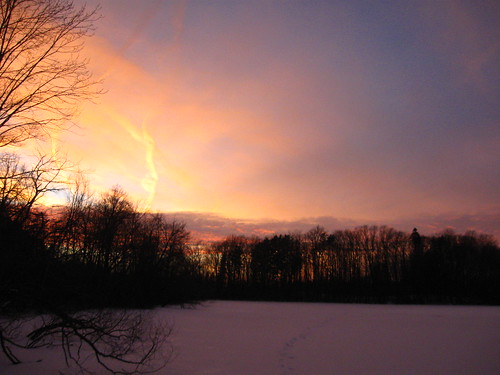
End of the second day of thaw: powerful sunset.

I ended up getting cold feet...
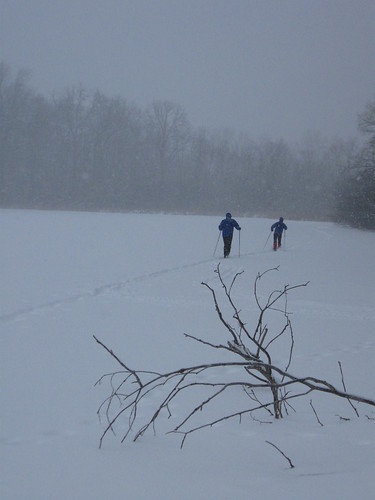
Skiing on Third Sister Lake

Even the ~8 inches of snow didn't stop the University of Michigan from holding classes. However, the city of Ann Arbor wasn't so gracious as to remove all the snow in a timely manner. (Hint to students who drive: don't do it after a blizzard, even if the University is holding classes.)
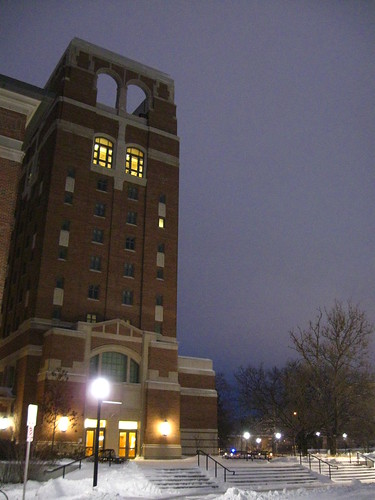
Early morning out front of the North Quad.
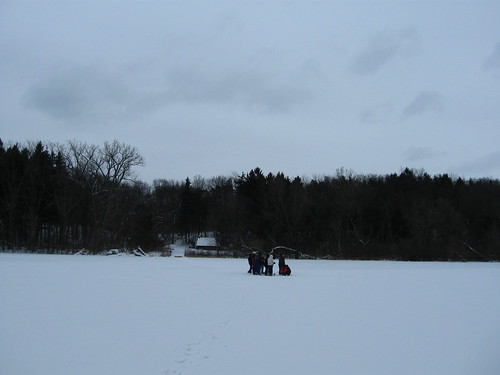
An undergraduate class on winter ecology out on Third Sister Lake. (It happened to be REALLY cold and windy that day, but they soldiered through heroically.)

Last day with stitches.
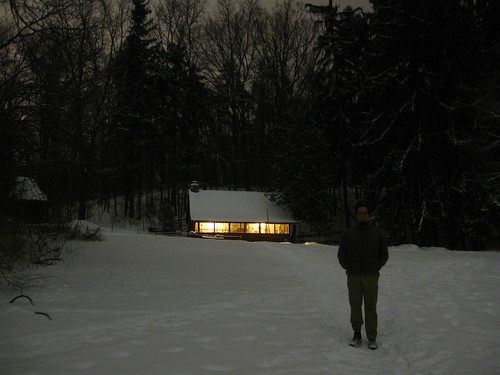
Night in Saginaw Forest.

Mock-up of the Law School facade.
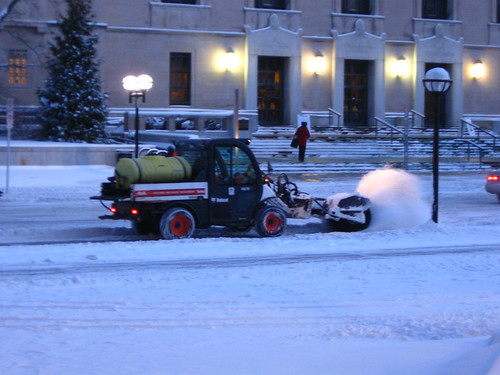
One of the many snow-brushers used by the University of Michigan to clear snow from walkways.

Yummy, yummy soon to be in my tummy at Frita Batidos.
Tuesday, February 08, 2011
Other sources of fueling our lives
Here are two additional options for energy sources. After all, why put all your energy eggs in one basket?
Insects as power sources:
Of course, this might be less useful in Michigan winters... If it could somehow store up summertime energy collection for the rest of the year. Now THAT would be an idea!
Left-over beverages as power sources (via Inhabitat):
Well, I don't know: I tend to finish my beers and sodas... In a world powered by wasted beer and soda, would this make me a bad person?
Insects as power sources:
Of course, this might be less useful in Michigan winters... If it could somehow store up summertime energy collection for the rest of the year. Now THAT would be an idea!
Left-over beverages as power sources (via Inhabitat):
The $500,000 plan is being spearheaded by New Brunswick Community College’s Bio-energy and Bio-products Applied Research and Technology facility in Grand Falls, New Brunswick, Maine. The research team will use Milco Industries’ waste soda and beer for the trial. Traditionally the unwanted liquid is deposited in landfills, which can cost the company between $100,000 and $200,000 in disposal costs. However, with the plant’s new ethanol system, this beer and soda will be converted into 250,000 to 500,000 gallons of ethanol yearly. If the pilot project is a success, it is believed that Milco Industries will acquire an even larger-scale ethanol plant for their own internal use.
Well, I don't know: I tend to finish my beers and sodas... In a world powered by wasted beer and soda, would this make me a bad person?
Wednesday, February 02, 2011
Happy New Year! (of the rabbit)
Happy New Year! It's now the Year of the Rabbit!
From the website of the Chinese Cultural Center of San Francisco:
From the website of the Chinese Cultural Center of San Francisco:
1915, 1927, 1939, 1951, 1963, 1975, 1987, 1999(Happy Groundhog Day, as well.)
People born in the Year of the Rabbit are articulate, talented, and ambitious. They are virtuous, reserved, and have excellent taste. Rabbit people are admired, trusted, and are often financially lucky. They are fond of gossip but are tactful and generally kind. Rabbit people seldom lose their temper. They are clever at business and being conscientious, never back out of a contract. They would make good gamblers for they have the uncanny gift of choosing the right thing. However, they seldom gamble, as they are conservative and wise. They are most compatible with those born in the years of the Sheep, Pig, and Dog.
Massive snowstorms ARE predicted by global warming theory
With all the snow storms this winter (I'm in one right now), the question of, "how can global warming be real?" has come up often.
There are many posts that patiently explain the various reasons why more snow doesn't automatically mean no more global warming. A brief summary is found at Inhabitat:
In the southern hemisphere, the increased warming of the oceans during the hottest global year (that 2010 was) has caused massive flooding in Australia and Brazil as well as South Africa, as well as increased the magnitude of the hurricanes "down under". And this is what is happening concurrently with the snow storms in the northern hemisphere.
It is naive to only cast your view to the borders of the United States when trying to think about GLOBAL warming.
There are many posts that patiently explain the various reasons why more snow doesn't automatically mean no more global warming. A brief summary is found at Inhabitat:
The answer is simple: global warming causes more precipitation, which translates to more snow when temperatures dip below 32 degrees [F].
There is a clear consensus in the science community that climate change will cause more frequent and more intense storms. Storms, of all types, result from energy in the atmosphere — the more heat, the more energy. Considering that 2010 was the hottest year on record, it should be no surprise that we’ve already seen multiple mega-blizzards this season. As Al Gore explained to Bill O’Reilly, “A rise in global temperature can create all sorts of havoc, ranging from hotter dry spells to colder winters, along with increasingly violent storms, flooding, forest fires and loss of endangered species.”
In the southern hemisphere, the increased warming of the oceans during the hottest global year (that 2010 was) has caused massive flooding in Australia and Brazil as well as South Africa, as well as increased the magnitude of the hurricanes "down under". And this is what is happening concurrently with the snow storms in the northern hemisphere.
It is naive to only cast your view to the borders of the United States when trying to think about GLOBAL warming.
I don't understand...
I don't understand why some people find it so difficult to realize that being raised in a gay family is independent from being raised well. Nineteen-year-old Zach Wahls gives a personal statement to his government in Iowa, which just voted to support a constitutional amendment to ban same-sex marriage.
Now that's some powerful testimony.
Now that's some powerful testimony.
Wednesday, January 26, 2011
An interesting -- if poorly titled -- map
I saw this map while scrolling through The Daily Dish, and although I find it interesting (due to many reasons, the greatest of which is that of what data sets were used), I wanted to point out the ambiguity of the title: "What is your state the worst at?"
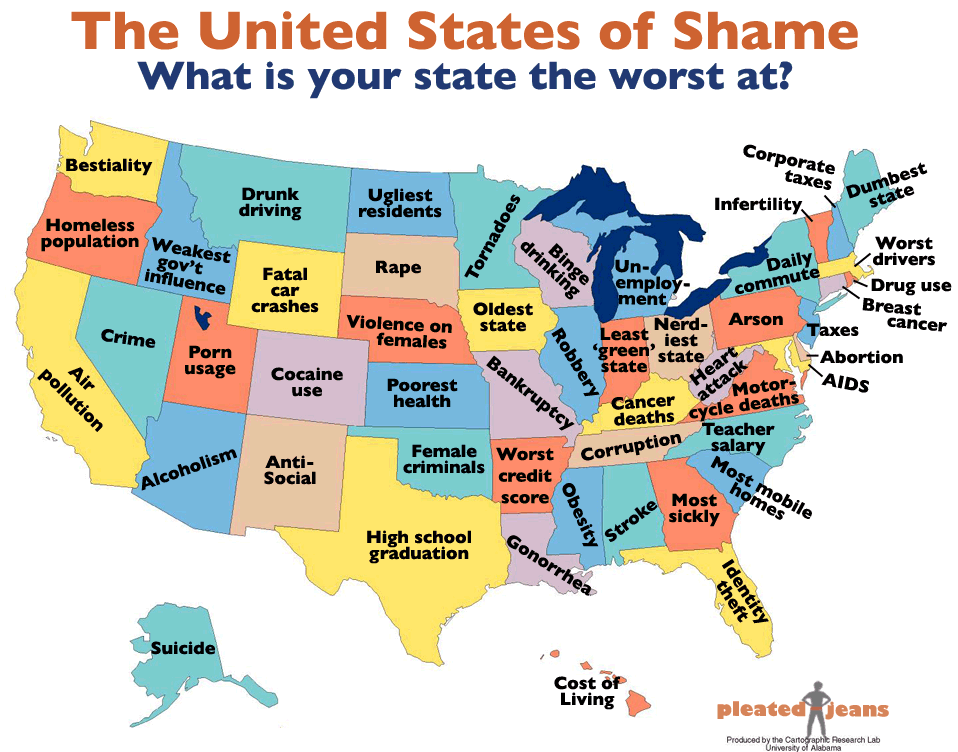
This type of phrasing is what gets people into trouble, especially non-English speakers. To show you what I mean, take the example of Michigan. Apparently, Michigan is "the worst at" unemployment. So... does this mean that the ability of Michigan to successfully accomplish unemployment is low (i.e., that unemployment is low; that employment is high)? No. The same thing for almost everything, save for aspects that are not inherently negative.
This points to the implicit understanding of a negative statement (or question) and the correct (culturally dependent) response to that statement (or question). We understand that Michigan has very high levels of unemployment (one of the worst in the country), which, strictly speaking, makes Michigan the worst at employment (although Nevada presently has the highest unemployment levels). Similarly, we understand that Arkansans have (on average) the worst credit scores in the country, which, strictly speaking, makes Arkansas the worst at credit management.
Conversely, when looking at concepts that are not inherently perceived as negative (e.g., teacher salary or high school graduation), the cognitive dissonance is much lower. The literal and implied meanings behind the label showing Texas being the worst at high school graduation seem pretty coherent, as does the label showing North Carolina being the worst at teacher salaries (although, to be pedantic, it would be more accurate to say that they are the worst at the monetary compensation of teachers).
Then there is "tornadoes"... How can a state be "the worst at" tornadoes? The phrasing of "is the worst at" implies something influenced by society. Tornadoes aren't (AFAIK) a social phenomenon. However, tornado damage is. But how does the viewer know what characteristic of tornadoes is being cited as "the worst"?
In the end, the map is humorous and informative... if (respectively) the viewer understands something about the states and understands the logic behind (what is effectively) a double-negative.
Map originally from here.
UPDATE: A counter-map was made over at Political Language.

At least this map doesn't suffer the problems of language as the one above. However, I have one general question: How can Arizona do "sunniest" well? I mean, I suppose they could have the most social groups (government and private) that enhance the culture of sunniness. However, I think that the label is based on data on the number of sunny days, and not the number of sun societies.
This type of phrasing is what gets people into trouble, especially non-English speakers. To show you what I mean, take the example of Michigan. Apparently, Michigan is "the worst at" unemployment. So... does this mean that the ability of Michigan to successfully accomplish unemployment is low (i.e., that unemployment is low; that employment is high)? No. The same thing for almost everything, save for aspects that are not inherently negative.
This points to the implicit understanding of a negative statement (or question) and the correct (culturally dependent) response to that statement (or question). We understand that Michigan has very high levels of unemployment (one of the worst in the country), which, strictly speaking, makes Michigan the worst at employment (although Nevada presently has the highest unemployment levels). Similarly, we understand that Arkansans have (on average) the worst credit scores in the country, which, strictly speaking, makes Arkansas the worst at credit management.
Conversely, when looking at concepts that are not inherently perceived as negative (e.g., teacher salary or high school graduation), the cognitive dissonance is much lower. The literal and implied meanings behind the label showing Texas being the worst at high school graduation seem pretty coherent, as does the label showing North Carolina being the worst at teacher salaries (although, to be pedantic, it would be more accurate to say that they are the worst at the monetary compensation of teachers).
Then there is "tornadoes"... How can a state be "the worst at" tornadoes? The phrasing of "is the worst at" implies something influenced by society. Tornadoes aren't (AFAIK) a social phenomenon. However, tornado damage is. But how does the viewer know what characteristic of tornadoes is being cited as "the worst"?
In the end, the map is humorous and informative... if (respectively) the viewer understands something about the states and understands the logic behind (what is effectively) a double-negative.
Map originally from here.
UPDATE: A counter-map was made over at Political Language.
At least this map doesn't suffer the problems of language as the one above. However, I have one general question: How can Arizona do "sunniest" well? I mean, I suppose they could have the most social groups (government and private) that enhance the culture of sunniness. However, I think that the label is based on data on the number of sunny days, and not the number of sun societies.
The topography of American swearing
I came across a link to a map from Cartastrphe on the topography of swearing in the United States' 48 contiguous states (one can download a ~12MB pdf of this map at the Cartastrophe site). As one can imagine, metropolitan areas tend to have higher swearing levels than other places, but there are some interesting points.

1. As Huffman points out in his entry, Utah is a depression-point in the swearing topography,
2. I noticed that Flint, MI seems to be the epicenter of Michigander swearing (side note: "Michigander" is in the Firefox spell-checker, while "Obama" still isn't),
3. The lower reaches of the Mississippi River is like a tall (if somewhat short) range of swearing mountains, and is much more contiguous than the swearing mountains that connect the major cities of the South (from Atlanta to DC).
H/T Flowing Data
1. As Huffman points out in his entry, Utah is a depression-point in the swearing topography,
2. I noticed that Flint, MI seems to be the epicenter of Michigander swearing (side note: "Michigander" is in the Firefox spell-checker, while "Obama" still isn't),
3. The lower reaches of the Mississippi River is like a tall (if somewhat short) range of swearing mountains, and is much more contiguous than the swearing mountains that connect the major cities of the South (from Atlanta to DC).
H/T Flowing Data
Saturday, January 22, 2011
Cycled the equivalent of going to Shreveport
Well, since July (when I started recording miles cycled) I've definitely cycled further than the 1050 miles that show up when doing a direction search for bike riding from Ann Arbor. If I made a conservative estimate, it would be closer to 1500 miles (about the biking distance to San Antonio, TX).
Well, after all those miles cycled -- almost all of them commuting to work -- I got clipped yesterday while making the morning commute. It ended up with 4 stitches in my elbow (caused by a contusion), scrapes along my thigh (destroying my trouser leg), and a contusion on my shin (nothing more than what one might get in playing soccer). My bike turned out to be fine, so at least I didn't have to pay out more for bike parts.
Well, after all those miles cycled -- almost all of them commuting to work -- I got clipped yesterday while making the morning commute. It ended up with 4 stitches in my elbow (caused by a contusion), scrapes along my thigh (destroying my trouser leg), and a contusion on my shin (nothing more than what one might get in playing soccer). My bike turned out to be fine, so at least I didn't have to pay out more for bike parts.
Tuesday, January 18, 2011
Let the short-term melting commence!
It's shortly after 2am, and the temperature has crossed over the freezing point, inching into melty territory. So... look forward to icy roads, y'all!
Monday, January 10, 2011
The Americas seem to be lagging behind the world when it comes to mobile web access
Over at the FedEx website, there is an interactive atlas of the world, showing different social characteristics of the world's countries, changing their size (but keeping their rough shape) to represent different variables.
Turns out that the Americas are quite far behind the rest of the world when it comes to mobile web access. (I don't know how this was measured, but the graphic really makes for an interesting way of looking at the world.)

H/T: Flowing Data
Turns out that the Americas are quite far behind the rest of the world when it comes to mobile web access. (I don't know how this was measured, but the graphic really makes for an interesting way of looking at the world.)

H/T: Flowing Data
Thursday, January 06, 2011
Monday, January 03, 2011
Few people @ GP
Not too many people at the peak tonight... I suppose that the people aren't all back in town yet... Perhaps next week there will be better turn out.
Saturday, January 01, 2011
Changing views of the forest
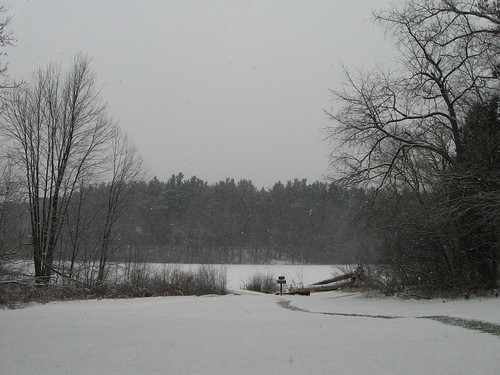
Happy New Year! Over the months, I have taken photos of the lake from the front of the cabin. Putting them in chronological order, one can see the progression of the seasons...
Friday, December 24, 2010
Thoughts on language and "the environment"
The hard sciences are characterized by the fact that they are used to study, describe, and predict the physical world - the mundane world - in a way that is (supposedly) divorced from social constructs that may introduce bias. It is one reason why the use of the language of mathematics - supposedly devoid of social constructs and the ultimate objective language - is so prized in the hard sciences. (It is arguably one reason why the use of numbers is so desirable among both researchers and the larger public is because numbers carry with them a high level of perceived objectivity... and therefore - perhaps - 'truth'.)
I would argue that mathematics is, itself, its own language. Even when learning of mathematics in other spoken languages, the concepts - as taught through mathematics - are consistent, and (for most concepts of mathematics) they don't intersect with social constructs present in the wider social culture of each mathematician. Since mathematics effectively requires the learning and use of a language other than the mathematician's own mother tongue, one might argue that - by and large - it is not difficult for mathematicians across social cultures to understand the meanings behind each others' research.
In a similar way, the work done by many of the hard sciences (e.g., physics and chemistry) relies on the specialized language of mathematics in addition to the specialized language of each discipline. Furthermore, the concepts that many of these disciplines describe are similarly non-intersecting with that of the societies from which each scientist comes. Therefore, it is possible to teach the same concepts of (for example) kinematics and electromagnetism (two major subjects of 1st year university-level physics in the US) in English in the US, Britain, Australia, New Zealand; Spanish in the various Spanish-speaking countries around the world; or even Mandarin and still provide a standard test that can test these theories that don't intersect with most modern-day social constructs and receive the same correct answers from these groups of people who may well hold very different social constructions of how the wider world (which includes social sciences, history, etc.) works.
Biology is different from the hard sciences in many ways. One of these was is that the boundaries of biology have constantly grown, and now but up against so many other physical and social areas of study, such as biochemistry, biophysics, animal behavior, neurology, biological anthropology, and ecological history. However, this point is for a different conversation. The one that I wish to focus on is that some areas of biology are derived from very distinct social constructions of how the world works. Medicine and ecology are two that come most sharply into mind, while systematics (the science of labeling all biological species and showing how they are related) also has suffered from this, but I will not speak of it further. (By the way, the controversies of evolution vs. religious teaching is, I believe, a different kettle of fish, although I am open to counter-arguments.)
Both ecology and medicine - in their widest senses - deal with things of which people have some level of intimate knowledge and may also intersect with social construction. Medicine - which deals with the concepts of "health" and "sickness" - is a field that tries to describe and treat that which every person feel they have an intimate connection with: the human body.
... more later. I've got to get something to eat.
I would argue that mathematics is, itself, its own language. Even when learning of mathematics in other spoken languages, the concepts - as taught through mathematics - are consistent, and (for most concepts of mathematics) they don't intersect with social constructs present in the wider social culture of each mathematician. Since mathematics effectively requires the learning and use of a language other than the mathematician's own mother tongue, one might argue that - by and large - it is not difficult for mathematicians across social cultures to understand the meanings behind each others' research.
In a similar way, the work done by many of the hard sciences (e.g., physics and chemistry) relies on the specialized language of mathematics in addition to the specialized language of each discipline. Furthermore, the concepts that many of these disciplines describe are similarly non-intersecting with that of the societies from which each scientist comes. Therefore, it is possible to teach the same concepts of (for example) kinematics and electromagnetism (two major subjects of 1st year university-level physics in the US) in English in the US, Britain, Australia, New Zealand; Spanish in the various Spanish-speaking countries around the world; or even Mandarin and still provide a standard test that can test these theories that don't intersect with most modern-day social constructs and receive the same correct answers from these groups of people who may well hold very different social constructions of how the wider world (which includes social sciences, history, etc.) works.
Biology is different from the hard sciences in many ways. One of these was is that the boundaries of biology have constantly grown, and now but up against so many other physical and social areas of study, such as biochemistry, biophysics, animal behavior, neurology, biological anthropology, and ecological history. However, this point is for a different conversation. The one that I wish to focus on is that some areas of biology are derived from very distinct social constructions of how the world works. Medicine and ecology are two that come most sharply into mind, while systematics (the science of labeling all biological species and showing how they are related) also has suffered from this, but I will not speak of it further. (By the way, the controversies of evolution vs. religious teaching is, I believe, a different kettle of fish, although I am open to counter-arguments.)
Both ecology and medicine - in their widest senses - deal with things of which people have some level of intimate knowledge and may also intersect with social construction. Medicine - which deals with the concepts of "health" and "sickness" - is a field that tries to describe and treat that which every person feel they have an intimate connection with: the human body.
... more later. I've got to get something to eat.
Thursday, December 23, 2010


Subscribe to:
Posts (Atom)