Saturday, June 29, 2013

Misunderstanding Flood Frequency and Climate Change

Apparently, some people still have problems understanding what the difference is between "climate" and "weather" - or in this case the impact of a changing climate on flooding (which is an outcome of severe weather). The high rains that hit the Calgary, Alberta region of Canada were caused by what The Weather Network described as an "atmospheric river"caused by a major meander in the Jet Stream. This sort of major meander in the Jet Stream is what caused Alaska to shatter high-temperature records, and could be linked to what is now causing a massive heat wave in much of the western US. This meandering of the Jet Stream is the reason why the UK is having such a soggy summer. And why, exactly, is the Jet Stream meandering so much? If only we had an explanation for it that makes sense of it in scientific terms. Oh, wait, we do, and it's called climate change (aka global warming).


See? Climate change is causing increased warming in higher latitudes. Warmer air in the higher latitudes means that the energy gradient compared to lower latitudes diminishes, which means that the Jet Stream meanders more. This is what the theory predicts, and this is what we actually see.

But - apparently - many people don't understand this. Many in the initial piece really wanted to bludgeon others with the contention that - since the Bow River had flooded in the past to the same magnitude (and even greater amount) - the current flooding has absolutely nothing to do with climate change. This is problematic on two fronts. The first is that the evidence of why the Bow River flooded (the "atmospheric river" caused by a major meander in the Jet Stream, which is exactly in line with what our models of climate change would predict to become more common). The second is that the justification for the argument (that we can use historic data and historic probabilities of flooding to predict the likelihood of future flooding) fly out the window when we recognize that global warming will alter the underlying processes governing flooding.

There was one particular commentator - Luke - who was more than a bit of an arrogant twit. Unfortunately, it looks like he deleted all of his comments from the page. (I'm making the assumption that he did it himself, because none of the other obviously-wrong-and-just-as-arrogant statements have not been removed.) Still, Luke's comments showed an obvious misunderstanding of flood frequency and the link between floods and global warming (outlined above). The basic contention by Luke was that the recent flooding in Calgary was nothing strange, and that - in fact - the name of the river indicates that flooding is a normal part of the river's course, citing this story, and specifically this passage:
The Bow River gets its name from the Peigan name “Makhabn” which means the “river where the bow reeds grow.” And a good place for reeds to grow is a flood plain.
To Luke, the fact that bow reeds grow on flood plains (and - apparently - that the term "flood plain" has the word "flood" in it) must have meant that the recent massive flooding wasn't really that big of a deal. To that contention, I wrote:
Perhaps you ought to look up what a floodplain is, and what the flooding frequency of a floodplain.

Or you can just keep believing that you aren't seeing the truth of your constructed reality being washed away. But that's your choice.

I prefer to side with reality. Call me biased in that way.
His response was to point me to another comment that he made about the size of the ten biggest floods recorded on the Bow River in Calgary. However, if you knew what a flood plain is, you would know that flood plains are not flooded only when there are historically huge floods. Indeed, flood plains are flooded far more frequently than once every 100 years or so. It's why they're called "flood plains", instead of just "plains." Indeed, I decided to even give Luke a link to an easy-to-read explanation from the USGS (yeah, I know, Calgary is in Canada, and the USGS is a US governmental agency, but the hydrology of rivers doesn't change at the border). (The portion in Courier is a blockquote from his comment, to which I was responding.)
Had you bothered to look at the table I posted below, you'd know exactly what the frequency is. But, evidently, all you've got is a big mouth.
Umm... Actually, all you're doing is showing the extent of your naivete about these issues. What you provided is the historical maximum floods. I actually did see that table. However, these incredibly large floods are not the only ones that inundate floodplains, and pointing to only this table indicates to me that you don't actually know what a flood plain is.

(To recap: Your original contention is that the name of the place - river where the bow reads grow - indicates that this is a flood plain, and that flood plains are known for ... flooding, and so what we just saw in Calgary ain't that big a deal. And then when I asked you if you actually know what the flooding rate of a flood plain is, you pointed me to a table that shows only the largest floods, which - if you know anything about flood plains - doesn't even come close to the numbers of floods that inundate a flood plain, which indicates your ignorace of what a flood plain actually is.)

Here is some reading material about what a flood plain actually is, and what the flooding frequency of a floodplain is. (I'll give you a big hint about where to find the answer: paragraph three, which begins with the words "Bank-full discharge..."

http://nevada.usgs.gov/crfld/floodfreq_desc.htm

Of course, these floods are several magnitudes smaller than the one that hit the city, but the point is that you can have flood plain inundation - and therefore have a great place to grow bow reeds - with river discharge rates far below the one that you're trying to show as being no big deal.

Still, I applaud your efforts to try and understand something that either beyond your comprehension or actually operates in a way that runs counter to your presuppositions. My advice to you is to keep working at it, eventually you might come to recognize that you're wrong, which might then allow you to actually learn something correct.

Good luck!
After this point, Luke decided to cut his losses and say that I won... but without actually recognizing why his position was wrong. I really wish that I had his wording, since it's patently clear that Luke was just trying to find a way to get out of having to argue against someone who slung his arrogance back in his face, along with a ready understanding of the very facts that he was trying to use to bludgeon his opponents. Of course, his weasel-worded "concession" comment tried to have it both ways; saying that I won the debate but that he was right on the facts. However, there was a problem... A: there was no "debate", and B: the whole point of my comments were that he was wrong on the facts. (Did I mention that he was an arrogant-twit?) So, since he crowned me the victor, I felt that it was important to explain to him why his concession was actually just annoying:
Wow. Apparently you don't understand simple hydrology (or you are incapable of taking 10 minutes to read some easy-to-digest science from people who do and written for people who don't).

I'm not going to waste time even trying to explain more to you, since you have twice shown an unwillingness to actually make the slightest modicum of effort to understand why your statements are just grossly and laughably wrong.
To this, he gave the completely bizarre (and equally weasel-worded) response that amounted to, "But I said you won. Why don't you just accept that you won and move on?" And I decided not to respond further, since - as I wrote - he wasn't worth my time.

Things were left there for a day, and now, another commentator felt that I was too harsh on Luke, and insinuated that some of the positions I outlined were wrong:
Your arrogance overshadows everything you've said. The point is that the big floods in Calgary were 125 years ago when 1/100th as many buildings were on the Bow River's flood plains. So this flood was both normal, and predictable. That may not follow the climate alarm industry's script, but it is observed fact. BTW, the Bow River's floodplains mostly grow cottonwoods.
I do recognize that I'm acerbic. And I also recognize when others are being acerbic. If someone wishes to be acerbic, I'm more than happy to oblige them, but what am I supposed to do with this comment? I mean, there is nothing there that actually is written to confront or try to refute any factual piece that I wrote (other than the observation about the current plant ecology, which I didn't introduce in the first place) while simultaneously implying that none of it is valid because I wrote arrogantly to an arrogant person or to bring up points that are only tangentially related to things that I wrote and to point out that the reference to the plant ecology of the Bow River (which I didn't introduce, but was actually responding to) was incorrect. Well, I decided to spend about 30 minutes to write the following exhaustive reply to each of the points that this commentator raised (many of which I didn't discuss at all in the first place, but whatevs):
As with kindness, respect, or sincerity, I return arrogance, like for like, pound for pound, and Luke was dishing his arrogance out like there was no tomorrow. From the above, though, you'll note that neither Luke nor I really minded (or at least commented that we minded) on the heights of arrogance that we were using to talk with each other. I enter each interaction with the understanding of how - based on the evidence - the other person/people are already conducting themselves in the forum, and apply the Golden Rule: they are treating others with arrogance, which means that it is apparently how they wish to be treated. (After all, if they didn't wish to be responded to with arrogance and derision, they shouldn't have done it in the first place, right?) However, those are issues of interactive game theory and socialization, which (although an interesting topic) isn't the one covered by this article, nor by Luke.

To the substantive points you make, you are right: there are more buildings in Calgary now than there were 125 years ago, but this has nothing to do with regional flood frequency. But if I am missing some connection between flood frequency and the different number of buildings in Calgary, I would be happy for you to explain that link to me. The only major impact of building construction to flood frequency is the extent to which the land-cover changed, although landcover change creates local impacts, and the flooding wasn't only occurring within Calgary, which means that land-cover change wasn't the significant driver of this flooding event. But again, if I'm wrong on the facts here, please let me know.

As for the growth of cottonwoods vs. bow reeds, I was not making any claim about the actual biodiversity in the region, only responding to the claim by Luke that the large floods are somehow normal, because the name cites bow reeds, and bow reeds grow in floodplains, and - as evidence of flooding - Luke points only to extreme flooding events instead of a natural frequency of flood-plain inundation. Still, this doesn't change the general point of linking the comment to the flood-plain inundation rate and not the historical maximum flood rates, because although I am not a plant ecologist, the species of cottonwood I am familiar with tend to grow in/near floodplains and (especially in more arid regions) rely heavily on the periodicity of flood-plain inundation. Therefore, whether it's bow reeds of cottonwoods, it's the flood-plain inundation frequency (and not the historical maximum flood volumes and rates of flooding) that are more important in understanding those local ecosystem dynamics. (Although, to be fair, extreme floods do have a significant effect in shaping certain constraints to ecosystem structure, but the temporal scale of their impacts are at a completely different scale than the flood-plain inundation rates, which are far more important for year-to-year survival and propagation. This is the case for most flood-plain ecosystems, and I'm assuming that those in Alberta are no different in these broad-brushstrokes.)

Also, I agree with your point that the flood was predictable, and - in that sense - as normal as any large and predictable flood would be in the course of the history of a location. I am hesitant, though, to say that it's "normal," since the idea of "normal" is different when speaking about flood frequency and speaking in a day-to-day context. To most people, the idea of "normal" tends to be in the "happens regularly within a time frame that I happen to expect it to occur within (which usually extends to a maximum of "my life so far")". Therefore, while a 100-year flood, 500-year flood, or 1000-year flood occurring at some time in the history of a river system is "normal" in the grand-scheme of things, to most people, that particular event wouldn't be seen as "normal", since it didn't happen in their lifetimes (and if it did, then it wouldn't be "normal" since multi-century events "shouldn't" happen more than once in their lifetimes, even though - statistically - they could, and would be perfectly "normal" from a flood-frequency perspective).

Finally, to shift the discussion to where I infer that you're implying that I'm "follow[ing] the climate alarm industry's script", let's step away from the label-placing and automatic assumptions and speak about how climate change will affect the reliability of current flood frequency statistics. Flood frequency is based on a statistical probability based on past events, and this is fine, so long as current climate is adequately described by past climate. In general, though, climate change is expected to significantly alter flood frequencies in many places. Therefore, methodologically speaking, a future with altered climate makes using flood frequencies that were established on historic data methodologically troubling at best (and - if a region's climate has changed dramatically - it makes them completely useless).

Again, if I get anything wrong here, please do let me know. I'd be happy to have a discussion with you about them and to correct my knowledge and expectations.
I won't hold my breath to see if there's a response.

Thursday, June 27, 2013

Just what does Supreme Court Justice Antonin Scalia think the Supreme Court is SUPPOSED to do?

In his scathing dissent in the minority opinion on Windsor v. United States Scalia wrote (and spoke) this statement, which left me scratching my head a little bit (emphasis mine):
The Court says that we have the power to decide this case because if we did not, thenour “primary role in determining the constitutionality of a law” (at least one that “has inflicted real injury on a plaintiff ”) would “become only secondary to the President’s.” Ante, at 12. But wait, the reader wonders—Windsor won below, and so cured her injury, and the President was glad to see it. True, says the majority, but judicial review must march on regardless, lest we “undermine the clear dictate of the separation-of-powers principle that when an Act of Congress is alleged to conflict with the Constitution, it is emphatically the province and duty of the judicial department to say what the law is.” Ibid. (internal quotation marks and brackets omitted).

That is jaw-dropping. It is an assertion of judicial supremacy over the people’s Representatives in Congress and the Executive. It envisions a Supreme Court standing (or rather enthroned) at the apex of government, empowered to decide all constitutional questions, always and every- where “primary” in its role.

This image of the Court would have been unrecognizable to those who wrote and ratified our national charter. They knew well the dangers of “primary” power, and so created branches of government that would be “perfectly coordinate by the terms of their common commission,” none of which branches could “pretend to an exclusive or superior right of settling the boundaries between their respective powers.” The Federalist, No. 49, p. 314 (C. Rossiter ed. 1961) (J. Madison). The people did this to protect themselves. They did it to guard their right to self-rule against the black-robed supremacy that today’s majority finds so attractive. So it was that Madison could confidently state, with no fear of contradiction, that there was nothing of “greater intrinsic value” or “stamped with the authority of more enlightened patrons of liberty” than a government of separate and coordinate powers. Id., No. 47, at 301.

For this reason we are quite forbidden to say what the law is whenever (as today’s opinion asserts) “‘an Act of Congress is alleged to conflict with the Constitution.’” Ante, at 12. We can do so only when that allegation will determine the outcome of a lawsuit, and is contradicted by the other party. The “judicial Power” is not, as the majority believes, the power “‘to say what the law is,’” ibid., giving the Supreme Court the “primary role in determining the constitutionality of laws.” The majority must have in mind one of the foreign constitutions that pronounces such primacy for its constitutional court and allows that primacy to be exercised in contexts other than a lawsuit.See, e.g., Basic Law for the Federal Republic of Germany, Art. 93. The judicial power as Americans have understood it (and their English ancestors before them) is the power to adjudicate, with conclusive effect, disputed government claims (civil or criminal) against private persons, and disputed claims by private persons against the government or other private persons. Sometimes (though not always) the parties before the court disagree not with regard to the facts of their case (or not only with regard to the facts) but with regard to the applicable law—in which event (and only in which event) it becomes the “‘province and duty of the judicial department to say what the law is.’” Ante, at 12.

In other words, declaring the compatibility of state or federal laws with the Constitution is not only not the “primary role” of this Court, it is not a separate, free standing role at all. We perform that role incidentally—by accident, as it were—when that is necessary to resolve the dispute before us. Then, and only then, does it become “‘the province and duty of the judicial department to say what the law is.’” That is why, in 1793, we politely declined the Washington Administration’s request to “say what the law is” on a particular treaty matter that was not the subject of a concrete legal controversy. 3 Correspondence and Public Papers of John Jay 486–489 (H.Johnston ed. 1893). And that is why, as our opinions have said, some questions of law will never be presented to this Court, because there will never be anyone with standing to bring a lawsuit. See Schlesinger v. Reservists Comm. to Stop the War, 418 U. S. 208, 227 (1974); United States v. Richardson, 418 U. S. 166, 179 (1974). As Justice Bran- deis put it, we cannot “pass upon the constitutionality of legislation in a friendly, non-adversary, proceeding”; absent a “‘real, earnest and vital controversy between individuals,’” we have neither any work to do nor any power to do it. Ashwander v. TVA, 297 U. S. 288, 346 (1936) (concurring opinion) (quoting Chicago & Grand Trunk R. Co. v. Wellman, 143 U. S. 339, 345 (1892)). Our authority begins and ends with the need to adjudge the rights of an injured party who stands before us seeking redress. Lujan v. Defenders of Wildlife, 504 U. S. 555, 560 (1992).
Is Scalia really saying that the Supreme Court is not there to judge whether a law passed by Congress is constitutional or not if the specific offended party gets a positive decision in their case? Is Scalia really saying that the Supreme Court isn't really there to determine the compatibility of state and federal laws with the Constitution? I'm sorry, but whaaaa?

First of all, I don't really see this rationale in the decisions he makes in striking down legislation and court decisions that he doesn't agree with. So he's not being consistent in his framework. Or, as the Daily Show's Samantha Bee reported, "It's what lawyers call 'the Principle of Waaaaah!'":


Second of all, perhaps Scalia needs to take a refresher course in civics, because the role of the Supreme Court is often defined as follows:
[The Supreme Court] can tell a President that his actions are not allowed by the Constitution. It can tell Congress that a law it passed violated the U.S. Constitution and is, therefore, no longer a law. It can also tell the government of a state that one of its laws breaks a rule in the Constitution.
Maybe, though Scalia should contact Scholastic.com (and all the other textbook publishers) to inform them of what the real role of the Supreme Court is (right after he figures out a way to make it consistent with his own past judicial positions as well as those of the Supreme Court through time).

Maybe, too, Scalia could jump in his time machine and explain to the writers of the US Constitution what they meant when they wrote the following about the role of the judiciary (and the Supreme Court):
The judicial Power shall extend to all Cases, in Law and Equity, arising under this Constitution, the Laws of the United States, and Treaties made, or which shall be made, under their Authority; ...
Of course, maybe Scalia doesn't think that the Constitution actually says what it means to say.

(I also think that this is the first time that the phrase "argle-bargle" was used in a Supreme Court opinion, but I could be wrong here.)

Tuesday, June 25, 2013

"Did climate change cause storm X" is the wrong question to be asking.

Treehugger has a story titled, "Did Climate Change Cause the Alberta Flooding?" Although the short article was decent, it leads with a question - the general form of, "Did climate change/global warming cause weather catastrophe X?" - that is misguided in its construction. Let me explain.

"Climate change" is talking about the shift from the historic climate regime into a different (ahistorical) one. That is all. Different areas (e.g., Toronto vs. Denver) have different climates, but they still do share some weather events (e.g., snow, wind, rain). However, the likelihood of one type of weather event happening is more an issue of climate.

However, what's makes this complicated is a conflation of the actual incidence versus the likelihood of the incidence. For example, if there is a 10% chance of rain for a particular date, and then it does rain on that date, the statistical likelihood of rain remains at 10%, even though the actual incidence of rain is 100%. Why? Because these are measuring different things. To use a baseball analogy, let's look at the Blue Jay's Adam Lind who has a .337 batting average and 30 RBIs for 202 at-bats so far in 2013. This means - all things being equal - he will get on base about 1/3 of the time and - of those times that he gets on base - his hit will allow someone(s) to score about 1/3 of the time. (That's pretty darn good.) Okay, now let's say that at his last at-bat, Lind hit a grand-slam home-run. (Congrats to Lind in this hypothetical case!) Now the analogous question: "Did his batting average and RBIs cause the grand-slam home-run?" That's a nonsensical question, and the only way you can really answer it is, "no, Lind's batting average and RBIs did not cause the grand-slam home-run." And - with baseball - we understand why that question doesn't make sense to ask. When it comes to climate change, though, we don't understand (yet) why the question is the wrong question and why the answer given by climate change deniers (as well as climate change scientist) are both, "No," or, "We can't say for sure." (This last response more often from scientists.)

A better question is, "How much has the likelihood of something like storm X occurring changed from its historical condition?" To use the baseball analogy one more time, this form of the question is more similar to the question of, "How have Lind's batting average and RBIs changed compared to his average before he was sent down for a time in the the Triple A's (i.e., his "historic batting average")?"

Previous entries explaining the difference between climate and weather: here (also using the Blue Jays), here, and here.

Previous entries looking at the implications of a change in the underlying incidence rate of floods: here and here.

Sunday, June 23, 2013

Response to a comment in AnnArbor.com

The following comment was left on an AnnArbor.com story about the feasibility of a Chicago-Detroit high-speed rail line. I wanted to make a refutation comment, but I was limited by the numbers of characters in the response box, so I decided to respond on my own blog.
you mention a feasibility study that shows this plan "earning tens of millions of dollars a year in profit" yet i don't see a link to the study. You provide a link to the high capacity transit costs in other stories . 

Also to begin a piece using Japan as a success is problematic. In terms of square miles the entire nation of japan would only be the 6th largest State in America yet in terms of population it nearly matches our top 8 states combined. 

Also when factoring cost for a plane versus a train its better not to throw in ancillary costs for one but not the other.
I agree that it would be nice to see the feasibility study. However, even looking at the numbers, what is reported seems within the ballpark. Still, having a link to the study itself would be nice. No real issue here, but the next paragraph contains some real non sequiturs (at least when one looks at the issues in relevant terms).

You suggest that Japan is not a good comparative example with the United States, and make the astute point that - by land area - it smaller than the five largest states of the nation. However - unlike many of the states west of Michigan - Japan isn't boxy; it's quite elongated, northeast to southwest. You failed to account for that in your comment. Indeed, if you were to look at the distance from Sapporo (the capital of the northernmost prefecture, and the terminus of one of the "Bullet Train" lines once that line is completed) to Kagoshimachuo (the southernmost Bullet train terminus in the city of Kagoshima), you'd get a straight-line distance (which I'm using as a rough analogue for the airplane distance) of roughly 960 miles (which happens to be about the same as the straight-line distance from Los Angeles to Vancouver and further than the straight-line distance from Detroit to Oklahoma City). In this sense, the distance of two relatively important Japanese cities is far longer than the distance between any two similarly important cities within any one state. So your first point of pure SIZE - while technically correct - is not a useful statistic, since Japan is a long country, but not a relatively wide one. But let's move on to the comment about population density.

It's true that Japan is a country with a greater population density than the entirety of the United States, and you are right in pointing this out, since greater population density correlates strongly with greater train transport. However, like the problem of looking at gross land area (see above), your association of gross population is also problematic. If you are going to compare demographic distribution, shouldn't you do so at a scale that is - itself - comparable? If we look at Japan, it is easy to see that its population distribution pattern is completely different from that of the United States as a whole. However, it is far more similar to the concept of megalopoli. If we consider the nation of Japan to operate in a similar way to the megalopoli of the combination of the Great Lakes and Northeastern megaliopoli, we would then be able to consider like with like. Indeed, the comparison of the Japan against the Great Lakes-Northeastern Megalopolis provides the following results:

  • Japan: 126,659,683 people/145,925 sq.mi. = 867.978 people/sq.mi.
  • GL-NE Megalopolis: 90,500,000 people/173,000 = 523.121 people/sq.mi.
This regional perspective allows a person to compare like with like, since Japan and the GL-NE Megalopolis have roughly the same land area and comparable numbers of people. (Indeed, many planners actually look at the unit of "megacity" or "megalopolis" when conducting regional planning; they don't look at the entire United States.) Therefore, your contention that comparing the regional plan of high-speed transport with Japan is "problematic" is - itself filled with problems. However, let's move on to your final paragraph.

You make the point that the author doesn't add the ancillary costs when adding up the prices for train travel. Okay, let's add the additional costs. AATA bus fare from Blake Transit Authority to the train station ($1.25), a taxi could put you out by as much as $15. But maybe the person gets their spouse or a friend to drive them to the station on their way to work. Then the additional cost is approaching $0.00. So, transport costs to the train station: $0 - $1.25. We can - of course - add the estimates from the story about costs at the other end (which would be the same, regardless of traveling by train or airplane) which are, "car mileage ($25), taxi ($30) or mass transit costs ($3)." So the ancillary costs associated with the proposed high-speed rail system would be: $3 (get dropped off in Ann Arbor and use mass transit in Chicago) to $45 (take a cab to the train station, take a cab to your destination in Chicago). There. Done.

Saturday, June 08, 2013

More bike companies need to make these kinds of bikes

If even Bianchi is making "City" commuter bikes like this:


then maybe we can have even more people choosing to become daily bike commuters. From The Urban Country, we are offered a different way to think about urban commuter cycling... It's for lazy people!
I arrive on time, I’m not sweaty, and I rode my bike not for a workout, but rather au contraire, I rode my bicycle because I am lazy.

I step outside my front door and hop on my bike because I’m too lazy to go downstairs in the parking garage to get the car. I pull my bike up to the front door at my destination because I’m too lazy to drive around looking for a parking spot then having to walk from the car to the building.

I ride my bike instead of taking public transit because I’m too lazy to go to the store to buy bus tickets, and I am far too lazy to dig for loose change under my couch. I am also too lazy to transfer from the bus to the subway to the streetcar, preferring to ride directly to my destination without transfers.

Instead of walking 15 minutes to my destination, I ride my bicycle there in 5. Yes, I ride there because I am too lazy to walk.

I ride my bicycle past dozens of cars at rush hour because I’m too lazy to be stressed out sitting in traffic and too lazy to explain why I’m late all the time.
Brilliant. I also ride my bike because I'm lazy. Too lazy to go to a gym to work out. Too lazy to go park a car. Too lazy to wait for the car to get cool enough in the summer or warm enough in the winter. Too lazy to go and pump gas.

I love it that I'm too lazy for all that.

Thursday, June 06, 2013

Tuesday, June 04, 2013

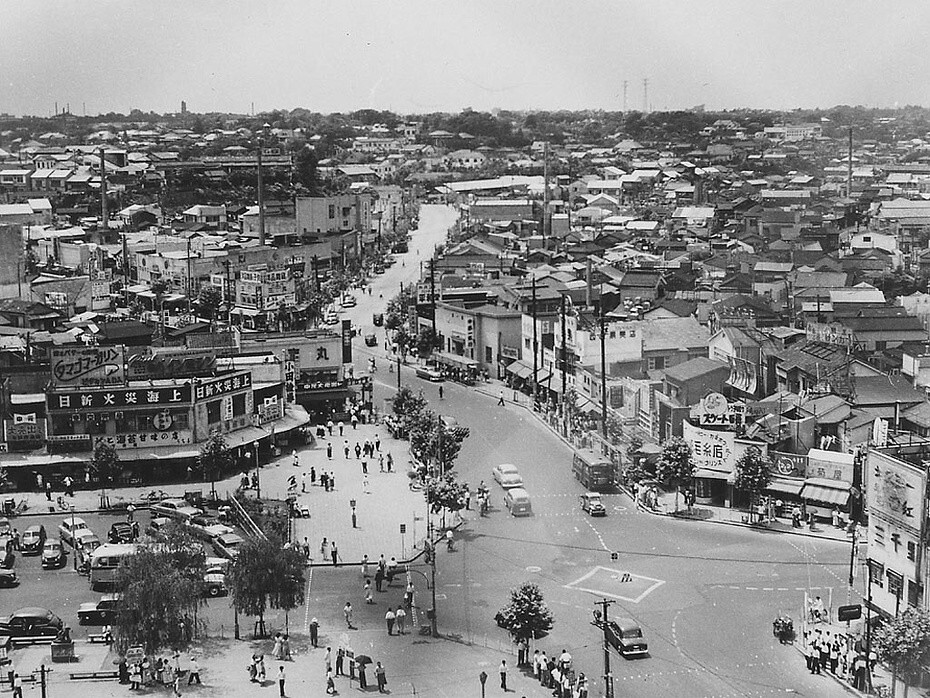
Shibuya, Then and Now

A recent post by Danny Choo showed Shibuya in 1952:


This made me think about what the place looks like today, and going over to Google Earth, I find:


Not too different, right? ;)

(Previously: A "Then-and-Now" comparison of New York City)

Saturday, June 01, 2013

Cleared massive fallen branch

Yesterday, there were bands of storms working their way across Michigan (and much of the Midwest). Yesterday, too, there was an Elderwise event: "Walk in the Woods," led by professor emeritus, Chuck Olson. Luckily, they didn't get rained out, but there was apparently a near miss:
The thunder shower that came through about 12:20-12:40 was over by the time we started. While we had a brief shower, later, most of the wet stuff was dripping of the trees. When we walked around the lake, I was surprised at the amount of windfall I saw, and especially by the very recent tree that dropped across the path just befoer we got to the side path to the board walk. We got around it (actually over it) and finished our walk without any real difficulty.
I went out there this morning and took care of the MASSIVE fallen branch.

BEFORE, there was a massive branch across the path, making it rather difficult to walk that route:
IMG_5592

AFTER, apart from some debris and dug-up earth, the pathway is now clear:
IMG_5593

I'm gonna miss this kind of work, even though I probably sweat several pints in the process. It's good, honest, physical labor, and it feels great.

Friday, May 31, 2013

Skepticism Blogs on Non-scientific Topics

Interested in websites that (often) do a good job of fact-checking the claims thrown up in our modern society? Richard Carrier pulled together six websites that do their best on exposing the nonfactual bases of many social claims.

The first one on his list is snopes, which is a really great one to go check whenever you receive an e-mail/see a FB post from "that relative" or "that friend" that really just "smells wrong". (Often, you can just copy-and-paste the factual claim word-for-word into snopes, and up it comes, often with fact-checked sources of rebuttal.) Some of these "facts" have been around for years and years, but rarely does their syntax actually change from when they were first written! For example, this breathless crowing over the duplicity of Obama over the ACA was written in 2009:
"MR. PRESIDENT WILL YOU AND YOUR FAMILY GIVE UP YOUR CURRENT HEALTH CARE PROGRAM AND JOIN THE NEW 'UNIVERSAL HEALTH CARE PROGRAM' THAT THE REST OF US WILL BE ON ????" ..... (BET YOU ALREADY KNOW THE ANSWER)....
It goes on from there in its continued caps-locked-ness. Interestingly, I copied this first line and came up with Snopes. After almost four years after it was debunked, this line had been perfectly preserved from the above when it showed up in my Facebook feed. And Snopes does a good job of checking conspiracy theories of all stripes.

I haven't really checked any of the other sites, but at first glance, they look interesting. I might well check through some of them on a lunch break.

Monday, May 27, 2013

The world (and universe) is not about us... and that's exciting!

Neil deGrasse Tyson counters the depression that some people have associated with learning how insignificant we are (both as individuals as well as humans in general) when faced with the cosmos.


I've never understood the reasoning that underlay much of the arguments of heresy that accompanied the findings of Copernicus and Galileo, just as I've never understood the depression that some (not small number of people) assert they feel when their religious beliefs are assaulted by scientific understandings of how the physical universe actually works. As a kid, I was also of a mind of, "Woah, that's exciting that we are so small in this vast universe!" instead of picturing that it was a special creation made all for us by this or that religion's god(s).

The fact that we are one infinitesimally small collection of species on a relatively small planet circling and average-sized star toward the distant edge of an average sized galaxy shouldn't be depressing, just like the inability to grow wings and fly shouldn't be depressing. It's the existence we live, and we should be excited about the potentials that are there.

Thursday, May 23, 2013

Mass-produced skyscrapers

The tallest building in the world will be constructed in only months:


Is this necessarily a bad thing? Does this mean that the near-decade spent on constructing the Freedom Tower in Manhattan is all just "wasted time"?

Well, maybe not a bad thing, and maybe "traditional" construction methods of building skyscrapers will come to be seen as "wasted time". Brian Merchant has the skinny on pre-fab skyscrapers. It's still a new application of technology, but if this takes off, we might well see another boom in skyscraper construction, which can - again - change the skylines of cities - as well as the street-level densities. Of course, we might also just end up with more sky-way connected cities, a-la Metropolis:

In fact, this could prove to be the catalyst to create the "cities of tomorrow" that prognosticators in 1900 and 1950 once dreamed of being here by 2000. Of course, the cynic/realist in me recognizes that The Jetsons will only remain as a cartoon, and not become reality; that Star Trek will only remain as a series of TV shows; that Lost in Space will never become our reality, either. But we can still dream our technicolor dreams. After all, some predictions made in 1900 did - after all - turn out correct(ish).

Wednesday, May 22, 2013

Post #1300

Since I believe that I missed out on the rather arbitrary mark of 1000th post, I'm now taking the opportunity to point out - for no other reason than "just because" - that this post marks the 1300th since I started this blogging journey.

Hopefully there will be another arbitrary, more-than-1000 posts to come in the future.

Ruminations on miscegenation

Recently, there was a Heritage Foundation study that a liberalized immigration policy would cost the United States $6.3 trillion. The Colbert Report did a good job of explaining why the context of the Heritage Foundation's report is just ... huh?


Over at The Dish, Andrew Sullivan started up a series of posts - "Is Race Only A Social Construct?", and the posts (in usual Sullivan style) have been thought-provoking.

In the most recent installment - "Racists Love Race Science" - Sullivan concludes the post with this:
I cannot analyze myself – but I’m sure I am affected by my history on this. One part, as I’ve written before, is that my entire education was made possible by an IQ test at age eleven, which gave me entrance to what Americans would call a magnet school. I owe a lot to that test – and it was initiated by the left. Today’s liberals forget that testing IQ was once a leftwing idea. It was designed to rescue the poor from the trap of poverty by giving bright kids from poor backgrounds a swift entry to the British elite. That was the left of the 1940s – and you can look up Keynes and eugenics for further insight into how socialist this idea was in origin. Another part was, indeed, the reaction to my convening a debate on “The Bell Curve” at TNR, in the best-selling issue in that magazine’s history. I saw how some liberals really do not believe in free debate where race is concerned.

But I do not believe that critics of the whole project are fueled by groupthink or emotion alone. There’s a very solid case against race as anything meaningful in our culture, and an even stronger case that in the process of constant miscegenation, we are rendering the whole idea of race moot. I sure hope so. There’s also a strong argument that IQ is of extremely limited use – and, in fact, misses a whole range of intelligences that are often more important to our lives and cultures as humans.

I just refuse to wish the data away. The data shocked me when I first read it, and shocks me still.
As a person who grew up - like Sullivan - in a cultural milieu different from the United States, the structures of "race" were rather puzzling to me when I found myself "back" in the US in 1999. The subsequent fourteen years have given me perspective on the issue, but it continues to remain somewhat of a "foreign" perspective than my own, and I find that I don't have as strong or as deep a sense of (the American construction of) race. However, I do fully recognize that I am the product of miscegenation: a White parent and an Asian parent, and I see no problem with that.

I also sense that there is - in my generation and the ones following mine - less knee-jerk animosity or revulsion to the idea of being mixed-race. After all, it's not my "fault" that my parents didn't live up to someone else's idea about racial purity; I can't change my racial past anymore than anyone else. Being mixed race is - therefore - a moot point when it comes to the concepts of racial purity. I didn't ask to be born this way; I'm not asking to be different; if you can't deal with it, tough cookies.

Of course, the increasing presence of mixed-race (aka "hapa") people - I hope - seriously call into question the very concept of miscegenation, since it presumes that there are distinctions of race that can be made in the first place. However, if I'm half-Asian/half-White, and I get married to a halfie, then are my wife and I engaging in miscegenation, too? In an absolutist sense, the answer is yes: mixed-race individuals who procreate with mixed-race individuals are - by definition - mixing races. However, in the social contexts in which the term is used, the answer is far murkier.

The history of the term "miscegenation" revolves around ideas of racial identity and racial purity. Indeed, it is a relatively recent word, being coined in the US in 1863, in a pamphlet entitled "Miscegenation: The Theory of the Blending of the Races, Applied to the American White Man and Negro", as part of a political hoax to discredit Lincoln and his party by ascribing ideas of mixing the races (only seen as "white" and "negro" at the time; never mind that there were Asians and Native Americans around), which was seen by many Whites as disgusting. This animus of disgust - along with the associated idea of maintaining racial purity - has continued to be associated with the term. Indeed, even after the Civil War, there were laws made to make miscegenation illegal in certain states, and these were maintained through almost 100 years, until the SCOTUS decision in Loving v Virginia. Even after, though, the social taboo of miscegenation continued.

However, for my generation and for those following me, the idea that you could marry someone you love and want to spend your life with is not so strange, even if it means marrying outside your "race" or social class (or both). Of course, there are still some hold-outs (especially among the social conservatives), and a "good" example of this was the reaction among mostly White, mostly conservative, mostly Republican supporters of John Boehner to the marriage of his daughter to a black Jamaican who sported a respectable mane of dreadlocks. To say that the responses from the conservative base were all happy felicitations for the newlywed couple (i.e., the standard, polite, and well-meaning response) would be missing the mark. Indeed the Daily Mail had to stop any further commenting and expunged the existing comments. However, over at the New York Daily News, the comments by these readers were FAR from generous. Looking at the first dozen, we get a few prominently racist comments (and more were found throughout the comments section):
Michelle837 days ago
so many beautiful women ending up with human vomit on legs these days...
norman west7 days ago
she is just another white woman who went black except for who her father is.....she did this to hurt someone....most probably herself....she loathes who she is and despises her life and lifestyle....this is a real psycho that is laying a trip on her family and laying this nap head....with a 14 inch pipe for certain.......
HoChin7 days ago
Dominic doesn't look like he has a whit of education I bet the bride puffs the pipe as well.
Jon Player7 days ago
Boehner is actually darker than him lol
Based on the tone of these comments, it's pretty clear (to me) that they were fueled by anti-miscegenation, racial purity, and social maintenance sentiments. But what about their future children (presuming that they have any)? What sense does the idea of "racial purity" have when you are not at all "pure" and see no problem with it? What happens when more and more Americans are less and less "pure"? The number of mixed-race individuals in the US is growing; according to the US Census Bureau, it grew by three-and-a-half times in the last decade, and in some places - especially in West-Coast cities (and Hawaii), mixed-race Americans make up significant portions of the population.

... so what will "racial politics" look like among a group of people who aren't a single race? Will social pressures (either overt or covert) pressure mixed race citizens to "choose sides" in the dirty politics of racial hatred and bigotry? Will a refusal to do so mean that we are left out completely? Will it be possible to create a "we-don't-care-about-your-single-race-politics" bloc that tries to move thing away from (at minimum) a discussion of "race-is-white-and-black-only" into the realm of increased nuance and understanding that will become our future?

Furthermore, what will "miscegenation" mean to groups of children for whom mixed-race is the norm? When the population of mixed-race individuals tops 50%, will "racially pure" families become the ones who are strange and unnatural? Will there be pressures going the other way; to push more-pure people to meet, date, and marry more-pure people from another mixed-race grouping? Or will people just stop caring about using race as a predominant way to group people? After all, into what stereotypical race-based category would you a "1/2 filipino, 1/2 scottish/german/english" young girl, a "hawaiian, chinese, english, irish, puerto rican" woman, a "half white (irish/german/swedish/italian), half asian (cambodian/thai/chinese)" little boy, a chinese, english, irish, and fijian man, or any person like me and those on the Hapa Project?

Thursday, May 09, 2013

Liking that song from ... Wait... WHEN did you say that was released?!?

I just realized that Laid by James:


... was released in 1993. That's 20 years ago. That means that this song came out when many of this year's crop of juniors at university were born.

Which got me thinking: what was a major song when I was born; a song that would be the analogue to Laid for that 20-year-old junior? A song that would likely have been playing as a "soundtrack throughout my life"? (Well, I don't know if Laid would have played so often in the US, but it was all over the airwaves in the UK whilst I was living there.)

On the week of my birthday, the chart-topper in the US (for people interested in the UK chart-toppers for that week, here you go) was Undercover Angel (I said, "What?"):


...Da Doo Ron Ron (which I did hear quite often growing up) was climbing the charts, moving in at #2:


... Coming in at #3 was Looks Like We Made It, up two places:


... and Bill Conti's Gonna Fly Now (better known as the theme from Rocky) dropped from #1 to #4:


Looking through the list of the top 40 for that week, I notice Margaritaville (in at #9), another song that's dogged me my whole life,


Abba's Knowing Me, Knowing You (in at #19), a song that was on the cassette (and later, the CD) that my mom would play in the car,


Life in the Fast Lane by the Eagles (at #21), and


Kenny Rogers' Lucille (#25).


ALSO: the main theme of StarWars debuted on the week I was born:


cool, but ... yeah, I'm getting old.

Wednesday, May 01, 2013

Sometimes I Just Can't Understand Religiously Motivated Reasoning

In the comments section of a Mother Jones article, titled "Charts: How Much Danger Do We Face From Homegrown Jihadist Terrorists?", I found a comment that I just couldn't wrap my head around, since it was so poorly constructed (weird formatting and bad grammar in the original):
You
can find no justification for the crimes perpetrated by Christians in the
teachings of Jesus. When Christians do evil, it is because they deviate from
what Jesus taught. When Muslims do good deeds, it is because they disobey their
prophet. When they follow him they become evil. A good Christian becomes Mother
Theresa. A Good Hindu becomes Gandhi. A good Buddhist becomes Dalai Lama. A
good Muslim becomes Osama Bin Laden. Today
the secular and liberal western culture is influenced by the repressive Islamic
culture. We punish people who speak the truth against Islam. This insanity is
not because of secularism. It is the blasphemy law slowly seeping into our
secular laws. Western secularism is becoming Islamized.
Hrm. How does any of this make sense historically, religiously, or ontologically?

"You can find no justification for the crimes perpetrated by Christians in the teaching of Jesus." This must mean that either (A) all potential crimes carried out by Christians weren't actually crimes if they followed some interpretation of what was written as a teaching of Jesus or (B) there aren't a lot of Christians out there. If you believe that Jesus made Peter the first Pope, and that the Pope is therefore the mouthpiece of God here on Earth, then none of the actions of the Crusades or Inquisitions (against the Muslims, against heretical sects of Christianity, against the Central and South American peoples) were actually crimes, since these were commanded by Jesus through the Pope. OR these acts were crimes, because the Pope isn't the mouthpiece of God here on Earth, which means that the bloody wars of the Reformation MUST NOT have been crimes, since these were done to restore the Church to their original meaning. OR these acts were crimes, because the Pope actually is the representative of God here on Earth. Similarly, the American Revolution had to be a crime since it was done in direct opposition to the divine right of the King of England. Or maybe it wasn't a crime, since the Anglican Church didn't recognize the nature of the Pope. Of course, this argument is highly problematic, since the leaders of the American revolution weren't Catholic... But this type of argumentation would definitely work to explain why the French Revolution was a crime... until Napoleon re-took the throne. Of course, his reign was destined to fail once he committed the crime of emancipating the Jews and Protestants... Unless you believe the Pope to not be the divine representative of God, and then ....

... oh, wait. This whole thing is just too complicated, and none of the commentator's original statement makes any relevant sense to this discussion. At all. In fact, its own logic chases its own tail and ultimately - like Oroborus - eats itself.

The next two sentences - "When Muslims do good deeds, it is because they disobey their prophet. When they follow him they become evil." - make no sense to me for a couple of reasons. First is the question of who decides "good" and "evil." (The ontological question if you will.) As outsiders to a group, we can only consider the actions of that group based on our own group's sense of "good" and "evil." However, we must also recognize that members of that other group will likely have their own classifications for those things. Furthermore, the definitions of these things change over space and time, too, even within the same "group." For example, if we could somehow travel back to a Georgian plantation in 1800, slave ownership would not be considered to be "evil", while - several states north - it would... but members of both locations would each consider themselves to belong to the same group: "Americans". Travel forward 100 years to 1900, and then you will find discord around that Georgian plantation about whether the practices of slavery were actually "evil". Travel forward yet another 100 years to 2000, and you will find that the question of slavery being "evil" has been accepted, even in around that Georgian plantation. Similar examples can be found with most issues that we break down into "good" and "evil" (including the morality of women wearing trousers). To claim any deed of another group to be "good" or "evil", one must first recognize that one is imposing their personal definitions upon what they see. To not do this is... troubling... to say the least.

Next, though, is the bald assertion that amounts to "good Muslims do evil things". WTF? This assertion is doubly bald-faced when it is found in a comments section of an article that actually described how few Muslim Americans are perpetrating violence of any kind. Now, to be charitable, one could interpret this commentator's meaning to be, "Well, look at all the bloodshed from North Africa to Pakistan!" Okay... let's do that: Syria is currently in a civil war, while Libya, Algeria, Egypt, Iraq, and Afghanistan are countries in which revolution and government overthrow just recently has taken place. Let's take a look at the comparative level of violence in the United States during those periods.

During the US Civil War, ~750,000 soldiers died and ~50,000 civilians (~2.6% of a population of ~31,000,000) using mid-19th century armament and medicine. (These figures may well represent an underestimate, given the problems of tracking deaths during those years.) Currently, the Syrian civil war has killed ~120,000 (~0.5% of population of ~23,000,000) using late-20th/early-21st century armament and medicine. So, compared the US Civil War, the Syrian Civil War has a long way to come to be as violent as the US Civil War (which was fought primarily by people who considered themselves to be Christian; a good number likely considering themselves to be "good Christians").

But surely the violence in Libya, Algeria, Egypt, Iraq and Afghanistan are all pretty high, too, showing the violence of these vastly Islamic-identifying countries, right? Well, the years following the US Revolutionary War weren't all peace-filled idyllic years. Following the defeat of the British in 1783, the United States had to contend with a series of violent "incidents" (including a major military attempt at rebellion), most of which are characteristic of a young government that hasn't (yet) established robust governance structures. In fact, the US has been - until very, very recently - a place where violent incidents have been the norm. And this is what the Mother Jones piece described. In comparison to the heavily-Christian United States, the countries of the Arab Spring, along with Iraq and Afghanistan, cannot reasonably be stated to be more violent than the United States of 1783-1793, nor can one reasonably state that any of this violence is specifically caused by the predominant religions of the countries. (Indeed, even when religion is invoked as a reason for armed conflict, it's often just a justification for political motivations, but even if you do count these as the actual justification of the associated wars, Christian holy wars against other Christians lead the death toll, followed by Christian holy wars against non-Christians.)

While one might allow the logical problems behind labeling things as "good" and "evil", the actual lack of historical accuracy in these two sentences is just ... really bad. However, the fact that these two sentences - devoid of any historical accuracy - pale in comparison to the lack of logical coherency that follow in the next four sentences.

Since when does "A good Christian becomes Mother Theresa"? Are this commentator saying that all real "good Christians" are Albanian nuns working (and conducting some questionable actions) in Kolkata? If so, then that's a pretty small group of people who can be "good Christians." In fact, by that definition, almost no one can be a "good Christian." But even if this commentator didn't specifically mean Mother Theresa, it implies that one has to be invested in the Catholic Church to be a "good Christian." Sorry, but wars have been fought over that question. ... wars fought (on both sides) by "good Christians." Furthermore, you would have been hard-pressed to find slave-owners in the American South who didn't consider themselves to be "good Christians", either. Among the membership of many white-supremacist groups, one will also find many who believe themselves to be "good Christians." And - outside, among the vast swath of "moderate Christians" - one would be hard-pressed to find many who would actively protest who can and can't choose to call themselves "Christians." So... this definition of "good Christian" is laughable at best.

Since when does "A good Hindu becomes Gandhi"? "Gandhi" is a family name, not a religious status, a position in a religious hierarchy, or anything like that. The commentator might erroneously be referring to Mohandas Gandhi's religious title of "Mahatma". However, if one looks at the actions of religious Hindus through the history of the Indian sub-continent, one will find many (many, many, many) who justify violence against others. Indeed, Gandhi was - until that time - a bit of an exception when it came to advocating non-violence as the sole means of anti-colonial activism, and he was a major exception when it came to embodying his advocacy. At the time, he was considered by many prominent Hindus to be religiously (or dogmatically) suspect, and not what embodied a "good Hindu". So... this definition of "good Hindu" is also laughable at best.

Since when does "A good Buddhist becomes Dalai Lama"? What about all the other branches of Buddhism? Is the commentator really saying that a member of the Japanese Jodoshinshu sect of Buddhism (for example) can become Dalai Lama? If so, you are betraying a massive ignorance of Buddhism. Indeed, this statement makes even less sense than stating, "A good Christian becomes Pope." No. Not even... No. *facepalm* This definition of "good Buddhist" is even more laughable than the definitions of "good Christian" and "good Hindu".

Finally, since when does "A good Muslim becomes Osama Bin Laden"? Even if we say, okay, you really meant to say, "... LIKE Osama Bin Laden", where is evidence for this? The commentator hasn't got any, other than the sayings of fundamentalists who want to emulate people like bin Laden. Taking what fundamentalists say as gospel would be the same thing as taking what the members of the Westboro Baptist Church say makes a good Christian and only using that metric to discuss all of Christianity. If the commentator were smart enough recognize the Westboro Baptist Church is an extremist group claiming to be Christians, and is - therefore - not allowing them to dictate the commentator's definition of "good Christian", then why does the commentator allow him/herself to fall for what a Muslim extremist group claims to be the definition of what "good Muslims" are? The commentator proves to have failed at maintaining logical consistency with the real world. However, considering the "evidence" and "logic" you have displayed above, this statement is not surprising.

Finally, this commentator appears incapable of recognizing that there is a double standard that people like him/herself are perpetrating in the name of equality. Commentators like this person often feel that their religion (Christianity) is being unfairly punished for the actions of a few people who claim to be Christian, but fail to recognize that they are doing the same thing to all non-Christians. It's in this mindset that the final lines of this comment are seen: "We punish people who speak the truth against Islam. This insanity is not because of secularism. It is the blasphemy law slowly seeping into our secular laws. Western secularism is becoming Islamized." Apparently, "Western secularism" can only be that thing if we punish people who speak this commentator's "truth" about Islam. Going further, it's likely that it's only if we impose this commentator's viewpoint of Christianity (it's conveniently never defined) that we can save "Western secularism" (failing to note that secularism specifically deals with "the principle of separation of government institutions, and the persons mandated to represent the State, from religious institutions and religious dignitaries".

Thursday, April 25, 2013

The Steam Vents at the University of Michigan

They're all over the Central Campus, often acting as notice boards for student organizations; plastered with paper and wrapped with layers of tape. The vents are supposed to be used to literally let off steam, and - now that it's cool enough to see the condensation - we can see just how much steam there is to be released...

IMG_5214

Wednesday, April 24, 2013

And I thought I had a big bike

Well, it's not so much a LONG bike as a friggin' TALL bike:

Richie Trimble’s 14.5 ft. Tall Bike


I read about L.A.'s CicLAvia a few years back, and I've thought that it was a great idea to encourage cycling in the city as something more than a recreational hobby for men in lycra. Of course, this sort of event tends to bring out everyone (except maybe the road-racers) for a nice and easy ride through the streets.

...including a man on a 14.5 foot bike. :D

Craziness!

Friday, April 12, 2013

Spring

The crows are back,
Cawing in the rain-beaten morning.
Black heralds of spring.

Wednesday, April 10, 2013

Console Themes in Acapella

I remember these games. And now you can listen to them sung acapella by a man with long hair and a long beard.

Heh. :)

Street Fighter 2 - Guile Theme Acapella


Castlevania - Bloody Tears Acapella


Final Fantasy VII - JENOVA Theme Acapella


Final Fantasy VII - Aerith's (Aeris) Theme Acapella

Saturday, April 06, 2013

Cool website: Sustainable China

I just came across the Sustainable China website today. While the title of the site may - for people like me - evoke images of ecosystem sustainability, of industrial sustainability, or of economic sustainability and the dystopic landscape that we (in natural resource management) often hear about, this site is actually filled with issues regarding how Chinese people in different regions of mainland China and Taiwan are associating themselves with ideas of sustainability. In other words, instead of doom-and-gloom reporting about the terrible smog in Beijing (or dead pigs floating through Shanghai, algae growth choking bays, mine tailings poisoning the waters of countless villages, day-long traffic jams, drying rivers, etc., etc.), this blog talks about how local and regional culture shapes how people interact with their landscape.

The most recent story -
green spirituality and the limits to modernityhttp://www.sustainablechina.info/2012/06/26/green-spirituality-limits-modernity/
- ties the sustainability mission to the rise and return of spirituality in the country:
In China, the quest for a sustainable future is mirrored in the “back to the future” rise of religions. For sure this is a complex phenomenon: people pray to the gods for wealth and happiness, not for a lower ecological footprint. But at the same time, Chinese religions send messages about reducing desire, non-violence to living beings, harmony with nature, and the value of balance and moderation.
In another story - religious diversity and ecological sustainability - the author posts his defense of why we - outside China - need to change our view of what a modern China is and how a modern China thinks of itself:
it is necessary to resist the simplistic construction of “New China” as exclusively “secular”, “modern”, or “materialistic.” The resurgence of religious expression in contemporary China, the attention paid to minority nationalities throughout China’s diverse environmental contexts, and the resuscitation of Confucius as supreme icon of Chinese culture together compel us to pay attention to the cultural and religious diversity of contemporary China. Doing so leads us to question the binary taxonomies of tradition / modernity, sacred / secular, rural / urban, religion / science that inform the ideology of mo- dernity, and to pay particular attention to the way their attendant ideologies and narratives serve to construct and authorize particular views of nature and environment.
I have to say that this sort of website is really useful in helping non-native scholars and activists for sustainability understand how to think of the China/Taiwan region and its people. One mantra for (ecological) sustainability is, "Think globally, act locally," and one of the most important parts of being able to accomplish the second part is to divest yourself of your previous assumptions (especially in a rapidly changing part of the world) and invest strongly in information that best informs you about the root causes and motivations of the people that you are trying to reach.

I have, myself, been interested in trying to learn what the social and personal motivations are for people entering the area of natural resource conservation. We aren't all hippy tree-huggers and we aren't also all hunters and fishers (nor do we all get along). Our personal stories are all different, but I imagine that most US citizens likely share some similar themes. Getting to those themes - especially as we move further from the environmental movement of the 1970s, when the major themes of environmentalism in the US emerged - is going to be important in maintaining relevance in natural resource conservation efforts within the US; the activists of Earth Day 1970 are (if they are still alive) 43 years older now, and their university-age counterparts were born as much as 25 years after that first Earth Day. Understanding how to connect and keep relevant the message of environmentalism and (now) sustainability will require connecting it to robust existing social structures, and I believe this is already happening.

However, that is merely "acting locally" within the context of the United States. In an increasingly globalized world that is increasingly less willing to just take social policy that we foist upon them, and one that is moving ever faster toward inescapable effects of climate change, an important aspect of creating "buy-in" to the ideas of sustainability is to learn what the cultural resonances are between the goals of sustainability and already existing social institutions. Scholars like James Miller are doing this work in China and Taiwan. Similarly motivated scholars are working on this question in various parts of the world, too.

... and I think that it's a good thing that they're doing.