Friday, March 07, 2008

On use of public transport.

From Treehugger:
I complain about my city a lot (but I complain about everything) but it has subways, streetcars and buses galore (could have more) and a growing bike lane infrastructure (which they could plough in winter) but I was shocked by the statistics in Spacing that showed how many people rely on cars to get to work in Toronto, and how the number has barely budged in five years. Over all, 71.1% drove, 22.2% took transit, 4.8% walked and only 1% biked.
I live near Detroit, and was surprised at the high value of 2% that the Motor City got. One major thing that the study didn't account for was the penetration of non-bus public transportation. Here's my reasoning for why this is important: bus systems rely on the same roads that cars and trucks rely on (save for a very small handful of cities worldwide). Therefore, riding on a bus doesn't provide as much of a time-savings (especially when commuting through traffic) as riding the rails. Further, if the primary public transport is a bus system, there is less incentive to not own a car (especially if that system doesn't really provide good coverage throughout the city). However, if there is a dense non-bus public transport system (or a bus system operating on exclusive roadways), there is little reason to drive in order to live in your city.

Therefore, to return to Detroit - a city with a very limited non-bus transport system - I was surprised with the number of 2%. The only non-bus system in D-town is the People Mover - a one-way automated elevated tramway loop of only 2.9 miles through the downtown area - and with its limited service area, it's surprising that it has a reported 7,300 riders per day (quite possibly from parking garages).

Thursday, March 06, 2008

Why giant CO2 bags on the bottom of the ocean should't explode

Via Inhabitat:

Plastic bags are the center of a huge green debate, but here’s one use we’d never imagined: Underwater ocean carbon sequestering!? With all the talk about carbon sequestration, which involves storing liquefied CO2 deep beneath the earth, Dr. David Keith from the Department of Chemical and Petroleum Engineering at the University of Calgary has devised a scheme to store it underwater in the ocean floor, contained in giant sausage-like plastic bags. Could this possibly be a good idea?

Just to give this perspective, visualize this: in order to hold around 160 million tons of CO2 (around 2.2 days worth of current global emissions), it would take a cylindrical bag measuring 100 meters in radius and several kilometers long. The obviously immense weight of the bag, as well as the pressure from the ocean, would contain the CO2 and prevent the bag from floating up. If you’re wondering where a gas-filled bag of this size might be located, it would sit 3 kilometers below the ocean’s surface. Just like in subterranean carbon sequestration, the CO2 would be pumped and moved via pipes to the bag.

Maybe it’s just us, but giant plastic bags filled with carbon dioxide, submerged in the oceans depths sounds like a recipe for disaster. What if one of those things leaks or explodes? And with that kind of deep-ocean pressure on a bag so large.. how would this really work?

I wish to address the "bag explosion" issue. Let's assume a few things:

1. The depth the bag is placed at is roughly 3800 m (the average ocean depth).
2. The temperature of the surrounding water is roughly 4 C (the average water temperature at that depth).

This means that the pressure on the bag (and the CO2 in the bag) is roughly 368bar, and the temperature of the CO2 will be roughly 277Kelvin. If you look at a phase diagram of CO2, you'll note that when CO2 is in this range of pressure and temperature, it is actually a liquid. (True, CO2 sublimates at ranges near standard temperature and pressure, but the ocean floor is anything but standard.)

It is likely, therefore, that if the bag bursts, there will not be a catastrophically large explosion. Instead, there will be a "pool" of liquid CO2 (CO2 is heavier than H2O) at the bottom of the ocean.

"So this isn't too bad," you say, right? Well, you have to remember that CO2 is also highly dissolvable in water. The pool of CO2 will slowly dissolve into the surrounding ocean waters - up to its saturation point, but here's the caveat. CO2 changes into carbonic acid when mixed with water:
CO2 + H20 <=> H2CO3

Near the atmosphere, this isn't really an issue, since there is gas exchange with the atmosphere, and the partial pressure of H2CO3 remains relatively low. However, at the ocean floor, this might be very different. (I'm not a physicist, nor a chemist, so I'll leave that train of thought there for now.)

The additional "downside" of all this is that you now have a pool of heavy liquid CO2 sitting on the ocean floor. That CO2, like any liquid, will slowly flow downhill, to the lowest point it can fill. This will mean that it could easily wash over organisms living on or near the sea floor (sponges, nudibranchs, etc.), suffocating them.

Therefore, long story short, the scary thought of an exploding bag of CO2 is not likely to occur (since the CO2 will change into a liquid at that temperature and pressure). However, a burst giant bag of CO2 will mean a liquid pool of suffocation streaming across the sea floor until it reaches a nadir.

Friday, February 29, 2008

Mexico City to start composting organic matter

I saw this on Treehugger.com:

Mexico City To Compost Food Waste From Central Food Market

Each day Mexico City produces 5,100 tons of organic waste, 600 of which come from the city's sprawling Central de Abasto, or central marketplace. The center, known as the CEDA, is the largest food distribution center in the country and one of the largest in the world. In February, the city closed one of its principal dumps, the West Dump, when it reached maximum capacity. The closure has forced experts to think creatively about new ways to divert waste.
I saw the photo on the Treehugger page and thought, "Holy crap, but that's a large food distribution center.... I wonder if I can see it on Google Maps." Short answer: yes you can:


View Larger Map

That such a large, sprawling operation is now starting to compost its waste material is a good thing. However, one hopes that there is good oversight of health and public safety issues that might well arise from a lot of rotting [former] foodstuffs. Hopefully, too, there's a good method of ensuring that no meat or dairy gets into the vegetable matter (or animal waste, either).

That said, one has to wonder what method of composting will be used for such a large operation. If something like this is really going to be "green", then one would hope for as little use of fossil fuel energy as possible, but yet having an adequate amount of tilling and turning to ensure methane production is kept to a minimum. (Remember that methane is 25 times more-potent a greenhouse gas than CO2.)

Also, composting up to 5,100 tons of organic waste per day is going to require a lot of land area. Looking around Mexico City, it is difficult to easily see where one might be able to build such an operation, and so it is likely that any single operation will be limited primarily by size. I think (since I'm not an expert on these things) that the tighter the area you need, the more energy-intensive your operation (to ensure proper aeration and turning of the compost).

Under optimal conditions, fresh compost can be had in as little as 2 months. However, two months is a long time in a start-up business. Luckily, the Mexican government is providing start-up funds (since it is eventually a saving for them on waste management costs). If the people are smart enough, they will set up the system to operate on a continuing rotation of compost production.

Tuesday, February 26, 2008

More on the Georiga border shift

Today, the AJC reports that last week's border shift resolution from the Georgia legislature is really a serious bid for more water. Georgia governor Sonny Perdue is apparently going to pursue this course of action (legislative resolution notwithstanding):

“I don’t think it’s a gimmick,” Perdue told reporters a few hours after his [Google Earth] demonstration [showing that moving the border to the 35th parallel will place the NW corner of the state right in the middle of Nickajack Lake]. But the enthusiasm the governor showed in the basement had shifted to a diplomatic practicality.

“I think we have to be very careful in the way we proceed in this effort. As it gets more and more serious, the people of Tennessee get more and more concerned. There was probably a better way to do this — legislation’s a sort of in-your-face sort of thing,” the governor said.

All of this appears to be part of a behind-the-scenes strategy to sustain the growth of the state of Georgia, specifically Atlanta. There's a link to the confidential report at the AJC.
[Brad Carver - a utilities lawyer in Atlanta - and a water expert at the University of Mississippi] drew up a confidential, 19-page memo that outlined the history of Georgia’s 190-year dispute with Tennessee, and offered advice on how Georgia might finally win the argument and gain access to a river with 15 times the flow of the Chattahoochee River at Buford Dam.

“As the drought got worse, this made more and more sense. We can’t conserve our way to a solution,” Carver said. The state is growing too fast, he said — and the only alternatives are desalination plants on the Atlantic coast, and the Tennessee River.
I personally think this is a perfect example of mindless "training-speak". By "training-speak" I mean the inability of people to think creatively within their own field. Carver is a utilities lawyer. I don't think he is an expert on water conservation strategies, modernist urban planning, watershed management, conjunctive management, water economics, or anything other than utilities law. The AJC doesn't list who the "water expert" is. However, I doubt that it is a person who is an expert on the subjects I listed above, either.

Both these people are experts in their own field. I'm sure that Carver is a good attorney. I'm sure the "water expert" is a "water expert." However, I've met too many civil engineers who can't look past their training to see alternative solutions that lie outside their field of expertise. Rigorous training (and success in one's field due to that training) has a tendency of narrowing one's vision, and looking at the world through their own lens of training.

Carver stated something that I've known for over 10 years (apparently the message hasn't gotten to Carver): that continued growth cannot be sustained. This is the lesson of Los Angeles and the Southwest (just read Cadillac Desert). One cannot (yet) overcome the "shortcomings" of nature and place, unless one wishes to invest ever-more into sustaining infrastructures. Atlanta cannot be sustained on a river the size of the Chattahoochee alone, unless there is a serious effort to conserve water (which Atlanta really hasn't done yet - sorry, but you haven't). The statement, "We can't conserve our way to a solution," is a mindset from the 1950s, and indicates (to me) that the man hasn't a grasp of how natural water systems and urban growth work (without the requirement of aforementioned infrastructure demands).

Let me ask what will truly happen if Atlanta gets the water from the Tennessee River? How much will the construction of that pipeline cost? What will be its maintenance cost? Who will profit from its construction? Who will lose? The costs of building the pipeline will make someone's company quite profitable. The costs of maintaining the pipeline will likely require a tax increase to pay for all the maintenance engineers. Will the state levy taxes from all citizens, or only the citizens of Atlanta? If all citizens have to pay for its construction, will all citizens benefit from the pipeline's construction? (Of course not.) If only Atlanta residents have to pay for its construction, will water rights remain exclusive to the city? (Probably.)

Will Atlanta be required to have a return flow back to the Tennessee River (thus making it a federal issue)? If so, then return flows monitoring means that Georgia will now have another level of federal government oversight.

What about all the people living across the border from Georgia, in Tennessee. Will Georgia purchase their homes to allow them to "move back" to Tennessee, their home state? If so, what will Georgia do with all their purchased properties? Possibly sell it to some real estate broker. (Who profits here, we wonder?) Will Georgia allow them to effectively remain Tenneseeans (thus having two standards of residency within the state)?

Meanwhile, the Chattanooga Times Free Press reports that the Tennessee legislature has introduced a resolution (HJR0919) criticizing Georgia's resolution. However, the Times reports:
... a Georgia lawmaker who helped engineer the Peach State resolution warned Tennessee would be wise to “join with us in resolving the border dispute in a neighborly fashion.”

“Appointing boundary line commissioners and beginning discussions would be better, all the way around, than litigation,” said Georgia state Sen. David Shafer, R-Duluth. “It would be a mistake to quickly dismiss the idea of discussions.”
Ahh, the wonders of the "fences make good neighbors" phrase are brought into the sharp glare of reality. Apparently, if one neighbor feels the other neighbor has their land (by original deed), the first neighbor feels allowed to take it over (regardless that 190 years have passed and this could set a dangerous precedent if won in court).

Meanwhile, there is still no word on the eventual water-sharing agreement between GA, FL, and NC that was supposed to happen on February 15.

Friday, February 22, 2008

Tennessee working out a retort

From the Chattanooga Times Free Press:
Tennessee officials said Thursday that drought-parched Georgia lawmakers legally are all wet in their attempts to claim part of the Tennessee River on grounds the border was drawn sloppily in 1818.

Tennessee state Rep. Henry Fincher, D-Cookeville, said his research of several legal cases indicates Georgia officials would not succeed if they sought to challenge the current border before the U.S. Supreme Court, which has original jurisdiction in state boundary disputes.
What really gets my goat is what Georgia Senator Shafer (one of the initial Georga state senators to draft the resolution passed yesterday) said on Wednesday, “This is a serious effort to secure our [Georgia's] border and begin a discussion of water sharing.”

If this is a "serious effort," then why did Shafer wait until 2008 to introduce his resolution? If a nearly 200-year-old border dispute was a "serious effort," then why wait a whole seven years of being in the senate before raising it? Furthermore, why does it suddenly become a "discussion of water sharing" when Georgia can't figure out how to share water among its own users? When does "water sharing" mean "we will steal your water and when you complain about it, we'll say that you don't want to share with us"? And why is "a discussion of water sharing" contingent on on "securing [Georgia's] border"? Shouldn't you be thinking about water management (of which water sharing is but one option) anyway? (By the way, wasn't Georgia supposed to be talking about a regional water-sharing agreement with Florida and Alabama, anyway? And wasn't that supposed to be completed on February 15?)

The Georgia General Assembly attempt at a water grab from Lake Lanier was already shut down by the Army Corps of Engineers who manage the dam for the primary purposes of flood control and hydropower (the provision of municipal water to Atlanta was an additional incidental use that was approved by Congress - sorry Atlanta). In the meantime, I cannot find evidence on the interwebs that the Georgia General Assembly has made a real good-faith effort to figure out how to use water conservatively during a time of regional drought. (Makes you wonder - what with a time extension on water-sharing agreements - just how good these closed-door policy decisions are really going. "Smoke-filled rooms" anyone?)

There's a great timeline (through article progression) at the Chattanooga Times, so if you want to check out some of the previous stories on this (prior to this iteration of this silly little mess of cross-border politics), go and check it out.

Thursday, February 21, 2008

Georgia Legislature passes bills to move the border! (Urgh.)

Apparently, the Georgia Legislature passed two bills to move the Georgia state line north 1 mile into the state of Tennessee.

House Resolution 1206 passed overwhelmingly (136-26, with 3 not voting and 9 excused). Senate Resolution 587 passed overwhelmingly (52-0, with 3 not voting and 1 excused). This is the first bit of both the House and Senate resolutions (my emphasis added):
WHEREAS, the northern border of the State of Georgia and the southern border of the states of North Carolina and Tennessee lies at the 35th parallel, north of the southernmost bank of the Tennessee River; and
WOW. I'm jaw-on-the-floor amazed for two reasons. The first reason is that this is (at least to me) a blatant water grab on the part of Georgia. Why? Well, because the root of this iteration of this border dispute, at least in much of what I've read, is about the water in the Tennessee River, and it seems to be supported in the first statement of both resolutions. The reason why Georgia wants to have all this water is because there is a drought, and the state hasn't taken any real measures to effect conservation measures.

The second reason I'm amazed is that the bill passed so overwhelmingly in both chambers. (There wasn't even dissent in the Senate!) I'm not an expert on Georgia Constitutional law, but it seems to me that it passed both chambers with a greater than 2/3 majority, meaning that (if Georgia is like other states) even if the Governor doesn't sign it, the resolutions are passed into law.

At the beginning of it all, Tennessee Gov. Phil Bredesen (D) asked if this resolution was a joke. Rgardless of whether Georgia's governor signs these resolutions, I wouldn't be suprised if Tennessee sues Georgia in Federal Court if any real action is taken on this. Right now, Tennesseean legislators are "trying not to take it too seriously":
“I think they’re embarrassing themselves, and I think it’s a waste of taxpayers’ money to have them going into session and doing such silly things on taxpayers’ time,” said Rep. Gerald McCormick, R-Chattanooga

I was only able to find one reaction in N. Carolina about this in today's papers, and that from Representative Roger West from NC's 120th District. (North Carolina's border with Georgia will also be affected, as it is here that the 1.1 mile "notch" south begins.)

"As long as that line's been established, I can't see them overturning it now. I think they're serious about getting access to the water in the Tennessee River. They should be talking with Tennessee about buying water. I don't think I'd take on a battle to move the state line."

If Gov. Bredesen doesn't cooperate with Georgia's "request", the border dispute decision will go straight to the Supreme Court (since it is a border dispute between two states of the Union), and it will be an interesting case to follow. (Or maybe not so interesting, if the Supreme Court decides not to pick it up.)

Now, both resolutions have words to the effect that this border dispute was brought up several times (1887, 1947, 1974), and the US Court of Appeals for the D.C. Circuit suggested that there be some sort of resolution between the states:

WHEREAS, by suggestion of the United States Court of Appeals for the D.C. Circuit, the Chairman of the Tennessee Public Service Commission and the Chairman of the Georgia Public Service Commission agreed in 1974 to reserve resolution of the general boundary issue until a later date (15 FERC, p. 61240), the resolution of which has never been reached; andWHEREAS, notwithstanding these authorizations and directions, the boundary lines have never been accurately resurveyed and marked and remain in doubt; and
I'm not sure what the actual wording was of that Court of Appeals judicial suggestion, or how much legal weight it holds (in terms of the United States Constitution), but I really wonder if Georgia really will go through with this whole thing. True, this whole thing started off as sabre-rattling on Georgia's part. The overwhelming passage of these twin resolutions out of the Georgia Legislature may the be equivalent of unsheathing that metaphorical sabre, readying for battle. I hope cooler minds prevail. I hope Georgians realize what happens when one outgrows (flagrantly wastes) one's available water resources, and pass some bills that really get at water conservation. If they don't then I feel that this chapter in the border dispute will easily be won by Tennessee (and they might be able to push for closure, once and for all).

Wednesday, February 20, 2008

Your Inner Fish

From Shifting Baselines comes a heads-up about a new book that's out there informing the public about our fishy heritage: Your Inner Fish. Reading the NYTimes book review, I think that it will be a good read for anyone who hasn't taken a fish biology, comparative anatomy, or evolution course at university. For those of us who have, it looks to be a good book to get us up to speed on what's been happening in the field since we last studied it.

Right now (7:25PM on 20 February, 2008), there are 14 book reviews on Amazon.com, and so far they are all very positive (5 stars, except for a 4-star review). I take it that the anti-evolutionists haven't figured out that the book exists (after all, it was written up in the NYTimes, and not the "Worldnutdaily").

Science discoveries at U-M

A little while ago, there was a story that came out about self-generated human power: strap a power generator to your knee and walk! Well, a research team at the University of Michigan was involved with that one. (Go Blue!)
The wearable mechanism works much like regenerative braking charges a battery in some hybrid vehicles, said Arthur Kuo, an associate professor of mechanical engineering at U-M and an author of the paper.
The University of Michigan's Department of Electrical Engineering have built an effin-powerful laser. (Yessss....) Are we next going to put these on sharks, a la Austin Powersi?
The record-setting beam measures 20 billion trillion watts per square centimeter. It contains 300 terawatts of power. That’s 300 times the capacity of the entire U.S. electricity grid. The laser beam's power is concentrated to a 1.3-micron speck about 100th the diameter of a human hair. A human hair is about 100 microns wide.
Just to prove that the University of Michigan does produce groundbreaking research in areas other than the physical sciences (although some might argue that biology is a physical science), we learn that researchers have found the cells that cause nervous system disease. (Alright!)
In addition to pinning down the cell type, Zhu's lab determined how non-myelinating Schwann cells start overmultiplying. They found that nerve damage and inflammation were among the two earliest events in tumor initiation.
Back to engineering now with a story about an autonomous seaplane with a twist: it can initiate and perform its own takeoffs and landings in the water. Nice photos and a video, too. (How do I get one of them?)
Flying Fish, an electric vehicle, drifts until its onboard Global Positioning System tells the craft it has floated too far. That triggers the takeoff sequence, which gets the plane airborne in just 10 meters. Other GPS coordinates trigger the landing sequence. The craft accomplishes both in simple ways, explained Ella Atkins, associate professor of aerospace engineering and associate professor of electrical engineering and computer science.
And finally, (although there are many other scientific outputs from this small Midwestern university listed on its news page), a study that says that viewing your spouse negatively is good for your mental health. (Just in case he/she asks you why you keep harping.)
Viewing our spouses more negatively over time may not be all bad, Birditt says. In fact, it might even be, well, positive. “As we age, and become closer and more comfortable with one another, it could be that we’re more able to express ourselves to each other. In other words, it’s possible that negativity is a normal aspect of close relationships that include a great deal of daily contact.”

So, in sum, if you feel like you're being nagged too much by your spouse, realize that it's for your own good, and that it is not the cause of your degenerative nerve problem, and definitely don't walk down to the pond as your knee-brace power generator powers up your DARPA-funded autonomous model sea plane for the express purpose of strafing your nagging spouse.

s

ScienceDebate 2008

A little while ago, I heard from The Intersection about what seemed (to me) to be a fantastically great idea: having the presidential candidates debate science and science-related issues. There have been a few people on the scienceblogs website that agree with my POV and some that disagree. However, just in case you want to know why I think that having a presidential debate on science is a good thing, check out the following (yes, Huckabee and I don't agree on many things):


If you want more (or better) reasons (in case the written statements on ScienceDebate 2008 website are not good enough for you) why it would be very good to hear why the presidential candidates should have a debate on science and science-related topics (as if scientists and science-related people don't know the reason already), then you will be happy to know that there are a number of videos available on the ScienceDebate 2008 website (to supplement all the written statements).

Now, in case you don't want to scroll through all the interviewees' responses on ScienceBlogs 2008 (you lazy bugger!), then I have embedded a few of the ones that I think are good. (Ha! That means that if you want to learn about other experts' points-of-view, you still have to check out the website).

ROSINA BIERBAUM - Dean of School of Natural Resources, University of Michigan


STEVE CHU - Director of Lawrence-Berkeley National Laboratory, Nobel Prize (Physics) Co-Recipient 1997


JOHN HOLDREN - Kennedy School of Government, Harvard University


JOHN C. MATHER - Senior Astrophysicist NASA, Nobel Prize (Physics) Recipient 2006

Monday, February 18, 2008

DEQ out of money?

From the Michigan Messenger:

The state agency responsible for cleaning up toxic spots in Michigan has run out of money.

Robert McCann, spokesman for the Michigan Department of Environmental Quality, said the 1988 and 1998 statewide bonds that funded cleanups are now "more or less completely exhausted," and the state is not accepting any new brownfield redevelopment proposals or cleanup projects.

"The DEQ is working with stakeholders to develop a funding strategy," McCann said. "It's going to be a difficult situation to deal with."

So this is another way in which tax cuts are helping the citizens of Michigan, by ensuring that toxic waste clean up doesn't go forward. Oh, wait. That isn't really such a good thing, is it? But smaller taxes is a good thing! Especially when you don't want big government to meddle in your affairs! And definitely especially when you want small government so that you can have big business!

Oh, wait. If you don't have a decent-sized government, there is little oversight and policing of bad business practices (such as what leads to excessive toxic waste being improperly (or unhealthily) disposed of, eventually creating brownfield sites). If you don't fund your decent-sized government, there is little ability to pay for oversight and policing bad business practices. And if you don't tax your people, then there is no way of being able to fund your decent-sized government.

Just another reason why it's a bit of a shitter right now.

Why definitions - in the end - might not really matter.

Is this really something that a mere definition can really bridge? I mean, on one side, you have rationalist thinkers, and on the other side, you have non-rationalist believers. I - for one - do not think that a definition alone will really solve any problems.

Of course if you do want to include correct definitions, one should require a definition of "scientific theory" in all science textbooks, including the very first science texts a student might get.

In any case, if this proposal were to pass, I think "scientific theory" should include all the following (and other scientific theories that other people know):
* the scientific theory of atoms
* the scientific theory of cells
* the scientific theory of circuits
* the scientific theory of [computer] computation
* the scientific theory of electromagnetism
* the scientific theory of gas kinetics
* the scientific theory of general relativity
* the scientific theory of global climate change
* the scientific theory of gravity
* the scientific theory of plate tectonics
* the scientific theory of quantum fields
* the scientific theory of relativity
* the scientific theory of special relativity
* the scientific theory of systems
* the scientific theory of the big bang

And you can also have (for those of us who don't think that mathematics is a "real" science), statements warning the students about "mathematical theories":
* the mathematical theory of catastrophe
* the mathematical theory of category
* the mathematical theory of chaos
* the mathematical theory of graphs
* the mathematical theory of knots
* the mathematical theory of numbers
* the mathematical theory of probability
* the mathematical theory of sets.

(Don't get me started on "mathematical theorems"!)

But guess the crazies on the side of the non-rational believers will say: "WOAH! So many theories! They must ALL just be based on wild guesses! SEE!?! Because a "scientific theory" is just a wild guess by stoopid scientists, and "mathematic theory" is the same thing with those dumb-ass mathematicians. Scientists and mathematicians are trying to pull the wool over our eyes! Only faith in the ONE TRUE GOD, three-in-one, one-in-three, the mystery of faith can save you from the fiery pits of HELL to which you will be cast if you dare travel down the path of materialist atheism so central to the godless, evil[utionist], heathen mob of Fascio-communist totalitarian goose-stepping Nazi mathematicians and peace-and-free-love hedonistic gay-loving transvestic-transexual-transgendered Castro-worshiping dogmatic idolater scientists! And don't say we didn't warn you!"

A part of me just make me want to let that area of the country sink slowly into its own "Age of Endarkenment." Let them wonder why they are being "left behind" in the advancement of modern society. Maybe we should make Florida a state-sized analogue of an Amish community (nothing against FL or the Amish, but it is the only peninsula that would be large enough to hold all of them), and send all the "scientific-theory-isn't-real" people there. Given only a few years of social isolation, anthropologists even be given a new opportunity to study a non-modern society without having to travel great distances. (Of course, by this time, the English language spoken by the "natives" would likely have migrated to something completely foreign - with so many similar-sounding words - that it would provide linguists an opportunity to create their own theories (!) of language development. It might even provide the US military with an impenetrable code that could be used like the Navajo code talkers were used in WW2.)

Friday, February 15, 2008

The "Map of Misery" (aka, Crappy Ocean Map)

A new study in Science shows the human impacts on the world's oceans in a nice (!) little map the research group calls the "Map of Misery."


You can also view the layers on Google Earth, by downloading them from the group's project website. The group also discuss why they did the project, and how they came up with the final map. For something that is pretty dismal (degradation of oceans is something that everyone should feel at least slightly bummed about), it is an intriguing project.

I expect that the cumulative impacts from all these impacts will be really bad for oceanic fishing, as well as marine ecosystems, generally. Jennifer Jacquet discusses this (and other disturbing oceanic fisheries findings) over at her scienceblog, Shifting Baselines.

MI is again allowing legal foreign temporary residents the ability to get a driver's license (and none too soon)

Well, once the Governor signs the bill that was signed off by both the Michigan House and Senate. First a brief history of the issue. (UPDATE: Governor Granholm signed the bill detailed below on Feb 15, 2008.)

On December 27, 2007, the Honorable Representative from Michigan's 71st District (centered on the small town of Charlotte, MI, southwest of Lansing), Rick Jones, received a reply from Michigan's Attorney General, Mike Cox, about a letter asking for an update to a previous opinion regarding issuing driver's licenses to non-residents (of Michigan). I wasn't able to find a copy of the letter that Rep. Jones sent A.G. Cox, however, the gist of it was summarized in the opinion's opening sentence:
You ask whether, in light of OAG, 1995-1996, No 6883, p 120 (December 14, 1995) (OAG No 6883), the Michigan Secretary of State is required to issue a driver's license to an illegal alien1 living in Michigan.
The rationale for a new opinion was likely based on language that was changed by the Social Security Department regarding the use (and misuse) of SSNs:
At one time, the federal government assigned social security numbers for certain valid nonwork purposes, including for the purpose of obtaining a state-issued driver's license that required an applicant to provide a social security number as a condition of receiving the license. In 2003, this policy ended. In explaining the rationale behind the policy change, the Social Security Administration cited the problems of fraud and misuse arising from the issuance of social security numbers (SSNs) so that illegal aliens could obtain driver's licenses: "Our experience has revealed that fraud and misuse regarding SSNs for nonwork purposes has been almost exclusively in relation to SSNs issued for driver licensing." 68 Federal Register 55304 (codified at 20 CFR 422.104 effective October 27, 2003).
The A.G.'s opinion hinged on definitions of "resident," both within state law and federal law. Although I haven't tracked down all the references to other statutes, the opinion does seem to have good internal logic. (I personally disagree with his starting-point, but that's another issue.)

Effectively, the new opinion was summed up with:
It is my opinion, therefore, that only a resident of Michigan may be issued a Michigan driver's license. A person who is not a lawful resident of the United States cannot be a resident of this State for purposes of obtaining a driver's license under sections 51a and 303(1)(h) of the Michigan Vehicle Code, MCL 257.51a and MCL 257.303(1)(h).
Here, the definition of "resident" was effectively narrowed down to people legally in the United States who had intent to set up permanent residence in the state. (This is where I don't agree with his definition, but again, that's another issue.) This effectively meant that illegal aliens were non-resident, as were all people in the state on temporary work visas, or student visas, and as non-residents, they were disqualified from being allowed to obtain driver's licenses.

On January 21st, Michigan's Secretary of State office issued this news statement (block-quoted in full, in case it is removed from the SOS website):
Secretary Land promotes border, document security

First-time applicants for a Michigan driver's license or identification card must prove that they have established a permanent legal presence in the United States, under a requirement taking effect Tuesday, Jan. 22, Secretary of State Terri Lynn Land announced today.

Land's push to enhance driver's license security can now move forward due to a recent attorney general's opinion. The opinion says that under current law the state cannot issue a driver's license to anyone who is not in the country legally and permanently. Today's announcement only deals with original applications. Updated procedures for renewals will be released soon.

"This is one more tool in our initiative to bolster Michigan's border and document security," Land said. "It also puts Michigan's procedure in line with those of most other states. The department will maintain its highest standards of customer service by sharing information with the public and working with applicants so that they understand the requirements. We all share the goal of a safer Michigan and America."

As of Tuesday, applicants for an original driver's license or state-issued ID card must meet four standards in addition to Michigan's driving and physical health requirements by providing documentation of:

* A valid Social Security number or ineligibility for one. Applicants will have to bring their Social Security card or other acceptable document to a Secretary of State office, or a letter of ineligibility from the U.S. Social Security Administration.
* Legal and permanent presence in the United States.
* Their identity (legal name and date of birth).
* Michigan residency.

A list of acceptable documents is at www.Michigan.gov/sos. The Web site includes information on obtaining a Social Security card from the federal government.

Land encouraged customers to make sure they have the documents necessary to complete their applications before going to a branch office.

She added that the new policy actually complements the department's commitment to speeding up branch office service. Because fewer foreign identity documents will be accepted from applicants, employees at the counter won't be confronted with as many time-consuming transactions and can serve other customers. Documents that need additional verification will be reviewed in Lansing rather than in branch offices. In those instances a customer may be asked to visit the branch again.

Land also pointed out that the number of original applications processed in branch offices is relatively small, accounting for less than 4 percent of all branch transactions.

A state lawmaker recently asked Michigan's attorney general to revisit a 1995 opinion that has guided Michigan's policy to this point. The 1995 opinion said the department could not refuse to issue a license simply because the applicant was not legally in the country. The most recent opinion takes precedence over the earlier opinion.

Land already has been working to enhance driver's license security. In December 2007 she proposed the creation of an upgraded "standard" driver's license and an optional "enhanced" version that can be used in place of a passport at the Canadian border. The plan is being considered by the Legislature.

Her proposal would change the law to allow residents who are in the U.S. legally but temporarily to apply for an upgraded standard license.

"Michigan has many outstanding residents who contribute greatly to our economy and society even though they're here on a temporary basis," Land said. "Businesses rely on these talented individuals as well. Under the attorney general's opinion, those who are in the country legally but on temporary student or work visas are ineligible for a Michigan license, though most still can drive using the license of their home country. We need to reconsider that aspect of the law to avoid unintended consequences for individuals or job providers. I encourage citizens to voice their support for our proposal and contact their legislators."
Needless to say, this caused a bit of a tizzy with some people. Land said her hands were tied by the A.G.'s opinion. Cox said he didn't mean that Land should take away temporary (legal) immigrant worker's ability to apply for driver's licenses. However, it wasn't until universities and companies started to realize what sort of impact this would have on their recruiting abilities that Land's office gave out the following press release (again block-quoted in full):
Secretary of State Terri Lynn Land today urged swift approval of legislation that eases the identification burden on residents traveling to Canada, and also allows those who are in the U.S. legally but temporarily to apply for a driver's license or ID card.

"Protecting our borders is critical in this post-911 world," Land told the Senate Transportation Committee. "Ensuring the integrity of state-issued documents is an important step toward that goal. However, we can and must implement these safeguards in a reasonable manner. This legislation provides travelers with greater convenience, protects our economy and recognizes the needs of residents who are here legally but are not permanent residents. Most important, it does so without sacrificing the safety of our great state and nation. I encourage the Legislature to pass these measures without delay."

The pending legislation is based on Land's proposal to enhance driver's license and ID card security. Land said that prompt action is needed due to recent developments. Michigan law now bars legal residents who are in the country on student and work visas from obtaining a driver's license or ID card. Land wants the law changed to avoid unintended consequences for job providers and legal but temporary residents.

In addition, key U.S. Department of Homeland Security rules take effect today. Those who travel to Canada and Mexico by land now must show a passport or a photo ID such as a driver's license, as well as proof of citizenship such as a U.S. birth certificate, at border crossings. Homeland Security no longer accepts oral declarations of citizenship at the border and restricts the types of ID documents that can be used. Land wants to preserve Michigan's

$70 billion-a-year trade relationship with Canada and spare travelers the inconvenience of having to provide multiple documents at the border.

Land's initiative, unveiled in December 2007, will alleviate the burdens on travelers and temporary residents by:

- Creating an upgraded "standard" driver's license and ID card. The new documents will have added security features to prevent fraud. They will be available to Michigan residents and those who are in the U.S. legally but temporarily. The upgraded license and ID also can be used by residents for domestic air travel when the federal REAL ID Act takes effect. Without these upgraded documents, all residents will need a passport to board even domestic flights.

- Creating an optional "enhanced" driver's license and ID card that is REAL ID-compliant and can be used for travel to and from Canada and other Western Hemisphere countries under the Western Hemisphere Travel Initiative. Only Michigan residents who also are U.S. citizens will be eligible. Land first introduced the concept of an enhanced license in 2005 as a way to prevent the new federal requirements from negatively impacting commerce and inconveniencing residents who visit Canada.

Bills that will upgrade Michigan's "standard" license are House Bills 5518 and 5519 and Senate Bills 962 and 963. Bills creating the optional "enhanced" license are HB 5535 - 5537 and SB 964 - 966.
Yesterday, universities and the ACLU made statements that it will be very difficult to recruit highly skilled researchers, faculty, and students to come to Michigan. Today, though, a bill rectifying this problem (HB4505) has passed (nay, pushed) through the Legislature to the Governor to sign into law. (I wonder if the ACLU is still going to sue over Land's decision.)

There are a few interesting points about this house bill. First, it was introduced by Representative Chris Ward (R-Brighton) on March 21, 2007, and referred to Oversight and Investigations. Then no stated action was taken on it until February 6, 2008. Then, from February 6, it moved from O&I to the Transportation committee. On February 7, the committee had a substitution (H-3) reported, read a second time, had the substitution adopted and amended, read a third time, adopted substitutions H-5 and H-6, and passed (overwhelmingly), 103-2, changed the name of the bill, and sent it to the senate. (I'm sure I'm leaving out some critical procedural steps, but my point is that when they had to act, the house of Reps, acted promptly.)

Similarly, in the Senate, the bill was received and passed to the Transportation committee. On February 14, it passed out of committee, placed on general order, normal rules were suspended, it was placed on immediate passage, and voted on (less overwhelmingly) 48-38, given a full title, and sent back to the House. Then, on the same day, the House suspended normal rules and voted on the returned senate version (not as overwhelmingly as the first time) 98-6, agreed to the full title, and passed it to the governor.

The part of the bill that I like is this bit (Section 307, 1, b):
If the applicant is not a citizen of the United States, the applicant shall provide documents demonstrating his or her legal presence in the United States. A person legally present in the United States includes, but is not limited to, a person authorized by the United States government for employment in the United States, a person with nonimmigrant status authorized under federal law, and a person who is the beneficiary of an approved immigrant visa petition or an approved labor certification. The secretary of state shall adopt rules under the administrative procedures act of 1969, 1969 PA 306, MCL 24.201 to 24.328, as are necessary for the administration of this subdivision. A determination by the secretary of state that an applicant is not legally present in the United States may be appealed under section 631 of the revised judicature act of 1961, 1961 PA 236, MCL 600.631.
In other words, students and visiting scholars (the bit I italicized above) are allowed to get drivers licenses again. I'm still a little worried about the following exception of a type of person ineligible for a driver's license:
A nonresident, including, but not limited to, a foreign exchange student.
This language is a hold-over from the previous versions of the law. I don't know why it was entered into the law in this form, and the law doesn't provide a definition of "foreign exchange student." (Maybe it refers to high-school foreign exchange students?) I am assuming, though, that international students at university don't fall into this category, since there was no "exchange" of students.

Georgia loses a water grab attempt on Lake Lanier

From treehugger.com

Yes, Lake [Sydney] Lanier is totally within the state of Georgia. Yes, it is a major water source for the city of Atlanta. No, the state cannot just take more water from the reservoir. Buford Dam - which is responsible for the existence of the lake - was built and managed by the Army Corps of Engineers. Therefore, its management falls under the purview of the federal government (unless I'm seriously wrong about my understanding here). Federal government projects usually have some sort of cross-state nature justifying their creation; in this case hydropower and flood management (the usual two justifications of USACoE dam projects). Its use for recreation and drinking water for Atlanta were not primary mandates of the dam's creation. Therefore, the city of Atlanta (nor the state of GA) can demand more water from the dam, as watering Atlanta was not the purpose for which the dam was built (see how the logic works here?).

I guess Georgia's got to really figure out what it will do with the available water resources to which it has access, and play nice with downstream users.

(There still hasn't been any announcement about what will happen with Georgia's massive land-grab/border rectification. However, I really don't think that it has a snowflake's chance in Gehenna.)

Thursday, February 14, 2008

A statement about America on Valentines Day.

On America: . . . . . . . . Loving Coffee

The average American likes to drink a cup of coffee.

The average American likes to drink a cup of joe.

The average Joe likes to drink a cup of joe.

The average Joe drinks a cup of joe.

The average Joe drinks joe.

Joes drink joe.

...

Wednesday, February 13, 2008

The crazies are out of the box (and I can't fit them back!)

From today's reading of Dispatches, I was offered a walk down crazy lane. (Uaragh!) I'm just paraphrasing each paragraph from crazy lane below so you won't have to torture yourself so much. Please bear with me. If you think this is markedly shorter than the original (having glanced over there briefly before you ran screaming from your computer), please realize that I've left out almost all of blokey's supporting drivel (but added parenthetical commentary).

Intro-bit
Athiests are trying to appeal to the gay community because of a perception of religion being anti-gay. Blokey feels like homosexuality has taken up too much of his time, doesn't fit with the teachings of "the Lord", doesn't like the homophobic culture (specifically rap), or the homosexual culture (specifically hedonism). High levels of sexuality common in hedonism is "squalid" regardless of sexual orientation. Blokey then basically says, "I don't come to praise homosexuality, but to bury the notion that atheism is good for the gays." (My own horribly pathetic reference to Julius Caesar.)

Pro-Homosexual Attitudes in Paganism
"Pagan" religions have been tolerant of homosexuality. Here are lots of examples: Babylon, Canaan, Ishtar, look I have done my google research, Greeks, Neo-Paganism, more research on the googles, shamans, Scythians. Sexually-transmitted disease! Transvestism is dangerous. Individual religions may (or may not) condemn the gays.

Lack of Basis for Tolerance to Gays in Atheism
Athiesm is a rejection of theism and theistic values, but not acceptance or tolerance of homosexuality. A BBC poll - which must have included secularists (I love how he mashes "secularist" together with "atheist") - showed that 3/4 of the Brits were against gay marriage. BBC Radio 4 had a documentary on hatred of homosexuals in Caribbean cultures, which Xtian ministers feel was due to the "masculine culture". Blokey guesses that there is a little redirection of hatred going on, since Jamaican gov't has been highly corrupt since the 1980s, and these rappers are just taking it out on the gays.

Postmodernist philosophy is fashionable, but intolerant despite its claim to the opposite. British gay spokesperson was not happy with nihilism, and gays should go beyond this. Apparently going more negative than Nihilism embraces the positive. (Silly little gay Limey.) Nihilism seems to be a fashionable position for those feeling oppressed by society. One cannot condemn gay-bashing without overarching morals necessary for society. Nihilism rejects society (ergo, gays must not hate gay-bashing?). Blokey uses Brothers Karamazov which I haven't read, so I'm not covering here. Blokey then tries a half-hearted attack against Dawkins via proxy, and fails horribly.

Hostility to Homosexuality in Atheist and Anti-Christian Ideologies
Many athiest ideologies can be traced to anti-gay roots. Freudianism. (I didn't know Freud was an "-ism"!) Stalinist Soviet Union. Nazi Germany. (Apparently it wasn't Christian.)

Materialistic Conceptions of Humanity No Guarantee of Tolerance
Scientific claim that there might be a genetic link with homosexuality was done "as part of a campaign to remove the perceived prejudice against gays". (Wow. How nice and well-organized of the scientists. Here's a hand for you/us.) Blokey provides examples from literature with no citation apparent, save for the sole questioning one.

Science tries to overthrow the views of how society is supposed to be run. Science proposes explanations of origins, but no philosophical justification of morals. However, scientific justifications of morals is wrong. Blokey cites Haldan's back-of-the-envelope altruism calculation, but says altruism doesn't work based on kin selection, but on a belief of what is right.

Materialism a Threat to Human Dignity
Much of atheism is based on materialism. Materialism undercuts morality. Reductionist scientists think of humans as organic automatons, but people act as if there is an id. (Oh, the humanity!) Theists believe that the basis of altruism is "the belief that the suffering experienced by people is ... real pain suffered by a real person" This basis of belief will save the gay and the straight from dehumanization!

Reproductive Technology and Children's Right to Life, regardless of Predicted Sexuality
Christian (apparently we've moved from pagan to theist to Xtian) objections to designer babies will save the gays, since legislating a ban on designer babies will ensure that - if there is a gay gene - parents-to-be can't get rid of the gay gene. Xtians believe people are more than the sum of their genes! They have free will! A right to choose! (Wait...) Xtians moral attitudes to the unborn will protect the nascent gay and straight alike!

Christian Attitudes to Homosexuality: A Middle Way
Xtians are right now waging holy Crusades over the morality of gay-ness, but there's a THIRD WAY: Love the sinner hate the sin! (Oh, why didn't someone think of that earlier!) Therefore, while the traditional Xtian hates homosexuality (ya don't say), the Xtian love of the transcendent subject - made in the image of an ineffable being - just might (maybe, if we cross our fingers and wish REALLY hard) protect both the gay and the straight from the dehumanization and mechanism of atheism.

End of blokey's tract.

n.b. I don't think this guy's firing with all cylinders. I also don't think that his pals are, either. If you find something wrong with my paraphrasing of his tract, please feel free to let me know. (And I will feel free to consider correcting the perceived mistake.)

Tuesday, February 12, 2008

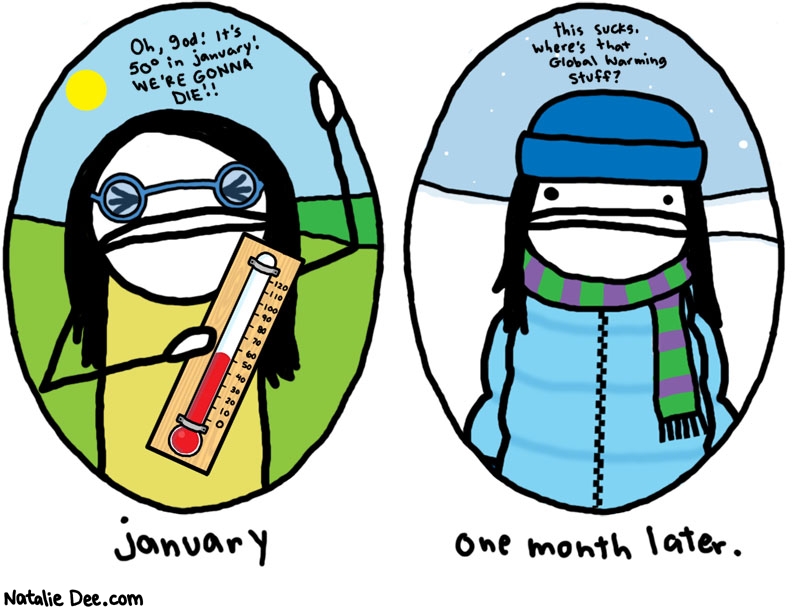
Weather: Freezing (with snow)

It's pretty cold, this start of February, and I had to walk home in it...

natalie dee
nataliedee.com

Bleugh. Mind you, I normally like walking through the cold, but it was particularly "snowy-and-blowy" this evening, and the police had closed down one of the highway entrances. This meant that everyone was parked in the streets from 5PM, waiting for some forward movement in any direction. Such gridlock makes me happy and frustrated. Happy because I don't drive, and it provides me with a good dose of schadenfreude - especially since I have to suffer first-hand the biting wind and billowing snow. It makes me frustrated with the whole stupidity of the system:
  1. Why not allow people to work from home?
  2. Why not allow for flexible work hours?
  3. Why even feel the need to buy a house BFE?
  4. Why not have a reasonable lightrail system?
The first option - allowing people to work at home - would mean fewer cars on the road on any day (regardless of weather) during rush hour. It also allows for the possibility (for those jobs that allow it) to have workers not come in to work if the forecast shows inclement weather, or to leave the office early (making up the time in the evening) if there is an incoming severe weather front.

The second option -allowing flexible work hours - would mean that the "rush hour" would be less severe, as people leave work anywhere between (for example) 3PM and 7PM, instead of peaking out at 5PM. Another benefit of this option would be to allow parents to schedule their work hours to coincide with school hours, meaning that parents with jobs allowing for greater flexibility wouldn't have to pay for as much after-school daycare. Put together with the first option (telecommuting), this option could dramatically reduce the impact of a 5PM rush hour. A further benefit would be garnered by small local businesses that might need to keep "traditional" 9-5 hours. Owners of these businesses would see more activity, since workers that are allowed flexible work hours won't have a complete overlap of working times. This would allow such a worker to go to businesses either soon after opening (if that person chooses to work from 10-6) or before closing (if that person chooses to work from 8-4).

The third option - not buying a home BFE - is not something that employers can really do much about, but it would mean shorter commutes for all workers. Shorter commutes will likely mean that people would be less-inclined to drive in to work (especially if they live near a bus line or within walking distance), further dropping the number of vehicles on the road come the general end-of-the-day.

The fourth option - having a decent light rail system - is not something that most employers can also do much about. (Apparently, the light rail system in Cleveland, OH was built by the president of a major company, ensuring that the layout of the transport system had the company headquarters as its hub.) However, a light rail system is superior to a bus system. A light rail train system can be built to have either exclusive train lanes or to share the road with cars. In the former case, these exclusive lanes can be used as a route for emergency vehicles traveling during a high-traffic period, but otherwise it will allow trains the ability to travel unimpeded by other surface traffic conditions. In the latter case, the train can easily take up the entire width of a lane that less road-crowding would take place, allowing for a slightly smoother (if still quite slow) commute.

Okay, my rant's done.

Happy Birthday, Mr. Dawrin!

Although I think Mr. Charles Robert Darwin might have been a little mortified by a sultry Marilyn Monroe-type person wishing him a "happy birthday", I (in my twisted mind) can picture the scene. (And now you are likely thinking about it, too.)

Today is Mr. Darwin's 199th birthday, and, although he would never have lived to see it, I think he would impressed to know how major an impact his "little theory" has had (for good and bad) on the intervening years. I also think that he might find it humorous that his book (Origin of Species) was being quote-mined by Christian creationists about as much as much as the average Christian quote-mines the Bible. (What is it with Christians, quote-mining, and non-existent contextualization?)

So long as Mr. Charles Robert Darwin remains as a man, and never reaches the dogmatic position of a "saint of science", I will be happy to wish the memory of the man a happy birthday each year on this day (since I can't really with the "man" a happy birthday, seeing as he is no longer alive with very little of his physical remains left, most likely).

Anyway, "Happy Birthday, Darwin!" (It really was a shame, though, how your cousin Galton misused your ideas to justify the ideas of eugenics.)

More evidence of environmental problems in China

A while ago, I wrote on the problems of obfuscating CO2 emissions numbers from the Bush administration. That entry was motivated by reading a story about how China surpassed the US in the CO2 emissions factor.

Now, NASA has released some photos accompanying their web report of their 2006 report NASA: Supporting Earth System Science 2006. The one photo that I found really startling (and illustrative, pardon the pun) was the one toward the bottom of the page, of [gray] cloud cover over China. Go over there and check it out.

The NYTimes have written a series of pieces about air pollution and the Beijing Olympics:
(Registration required)

These pieces all point to a serious problem of air pollution in China (or they are all lying and have doctored several hundred/thousand photos). The photo the kite-flier in the "Beijing's Olympic Quest" really hits home for me, because it was taken outside the gates to the Forbidden City, near a location I stood at in 2000. In my photo, the red gates with Mao's painting is clearly visible over my shoulder (like the photos in the Wikipedia entry of Tiananmen Square). However, one can only barely make out the imposing outer wall and gateway to the forbidden city in photo accompanying the NYTimes story.

The scale of the impacts on China are so massive that they defy one's normal ability to comprehend it. However, the problems are there, and they are compounded by other systemic problems, by the immense number of people (all those independent degrees-of-freedom), by the perceptions of growth and development, the urgency of showcasing the country for the Olympics, the struggle of the central government to maintain power, the Westward expansion of development within China to non-Han regions, etc. One can only get a snap-shot of these major social issues taking place both within China, and outward from China.

The environmental stories (due to my own background and biases) are perhaps the most alarming, and the NYTimes can only really cover a small number of them. Combining the known changes (listed above) taking place with stories of water pollution, falling water levels, disappearing animal species, increased coal mining, and others discussing the hazardous growth of the country, I have to wonder how the future of such a large nation can be maintained, even in the short-term.

To me - right now - that photo on the NASA page is a great summary of the scale of environmental impacts on China. It is scary. It is real.

Post 200: Discovery Channel's "Earth Live"


The Discovery Channel obviously worked very diligently on putting this flash-based tool together. Check it out!

(Woo-hoo, two years in and I've finally got to 200 posts.)