Wednesday, March 21, 2012

The winter that never came, and what it might mean

Well, I pointed out back in January that the winter - at least the version one could expect in Ann Arbor, MI - wasn't actually here. Then, through February, we waited for winter to come, and - other than a couple of dips in the temperature and some snow that lasted a couple of days - we continued to remain stubbornly above freezing on most days.

Now, in March, the trees are trying to catch up with the temperatures that closer to what is typical of late June than anything close to what we would expect in March, let alone April (we could reasonably expect 82F/28C temperatures in May, but they are historically rare). In short, the temperatures we are experiencing in Ann Arbor are presently CONSISTENTLY SHATTERING all historical measurements (all the days from March 14 through March 21, 2012 have broken the previous high-temperature record, and the current forecast expects that March 22 and 23 are also going to be record-breakers, which - if true - means that there will be nine full days of record-shattering temperatures).

"But it's not TOO hot," and, "I LOVE this kind of weather," I hear some people say. Well, true: temperatures of 70-80F are quite comfortable, and it's no surprise that we'd love the temperatures that we (likely) evolved to thrive in. Such high temperatures, do, however, bring drawbacks.

The insects are also loving it - I've been having mosquitoes in Saginaw Forest for the past two weeks, and the moths and mayflies are starting to emerge. The frogs, too, are quite happy, singing up a storm in the evenings, but their choruses are already starting to die down. I wonder how long the summer temperatures will hold this year: will we remain (relatively consistently) above 70F from now to late September? Will we again get up past 100F in July? Will we again have a rain-stressed year? (I also wonder if the weather will suddenly remember that it's only mid-March and dip back into the "average" temperature range of lows in the low-30s and highs in the mid-40s.)

I know that this isn't (necessarily) climate change upon us. It is (and has been) a bitterly cold winter in Europe, after all. However, if this year is anything to use to predict some likely occurrences in a warmer climatic future, then I hope that people are paying attention. What starts as "nice temperatures" turns into "bad weather" as the high level of heat energy in the atmosphere brings about earlier and more intense storms than what our experience has led us to expect. In the Ann Arbor region, this meant a tornado touching down in Dexter, combined with intense rain (over 1" of rain in 1 hour at Ann Arbor airport) and hail, which caused flooding in Ann Arbor (as both storm and sanitary sewers became flooded beyond capacity), massive erosion along rivers (as they "endeavored" to accommodate the massively increased flows of water), and felled trees (thus knocking out electricity for thousands as well as destroying more property).

Looking more regionally, we have seen the start of one of the earliest tornado seasons on record. According to MNN.com:
In the U.S., tornado season tends to move northward from late winter to mid-summer. In Southern states, tornado season is typically from March to May. In the Southern Plains, it lasts from May to early June. On the Gulf Coast, tornadoes occur most often during the spring. And in the Northern Plains, Northern states and upper Midwest, peak season is in June or July.
As of March 20st, the number of tornadoes in the US reached 285, which is almost tied for the most tornadoes on record by NOAA. (As a contrast, in a year that is at the 50th percentile, we wouldn't reach 285 tornadoes until roughly the end of April.) When looked at through the light of all the record temperatures, it's not too surprising that so many tornadoes are happening, but it's also very little consolation that warmer temperatures means better times.

Removing keystones and cornerstones from ecosystems

Within the field of conservation ecology, the concept of a "keystone species" is pretty central. It is based on ideas from ecology about inter-species interactions while drawing upon the visualization of a bridge's key-stone, representing the fundamentally important pinnacle stone of an arched structure. Appropriately - for the imagery - keystone species tend to be near or at the top of the "food chain"*; oftentimes being predators. The idea is that keystone species act as a limiting pressure on other species, diminishing the possibility of explosive growth (and eventual collapse) of a species in the system (as well as potential negative outcomes from such a boom and bust).

For example, wolves are considered to be a keystone species in many of the North American ecosystems, acting - alongside other large predators - as mediators in population growth among prey species, such as deer, by - to put it bluntly - killing them, which means that there are fewer fawns come springtime than if there were no wolves. This reduction from the potential deer population means that the existing deer will not likely be in such strong competition with each other to find food (and that their food sources will not be over-exploited). Conversely, if you remove wolves and other predators (and ban hunting or trapping), the deer population will boom for a few years, and then - as they outstrip their food source - will suffer massive starvation-induced die-offs. In short, it's the wolf population that keeps the ecosystem in "balance".

There is emerging a complementary concept of "cornerstone species", in which species that are low on the "food chain"* provide an essential and foundational role in the ecosystem. Although there is come question - at least in my mind - of whether this is yet another example of terrestrial systems appearing to be top-down mediated, while marine systems seem to be bottom-up mediated, I think that this concept has its own merits in understanding the functioning of ecosystems (both for pure science as well as for conservation goals).

In the linked press release, the researchers "analyzed the impact of removing seaweed and sessile animals, such as mussels and barnacles, from the rocky shores of Northeastern’s Marine Science Center in Nahant, Mass. The experiments were designed to mimic naturally occurring changes in biodiversity on rocky shores." They found that the removal of these relatively rare species caused "major declines in the abundance and diversity of animals, such as snails, crabs and other mobile animals".

It seems to me that we are finding that - not too surprisingly - that ecosystems are interactive and controlled by various links throughout, in linear and non-linear manners. If we can recognize this point about how ecosystems function, then it seems to me that our collective actions on the planet are randomly removing portions of the system without any real idea about what consequences will come about. If our ecosystems are like structures, we may well end up removing both the keystones that hold up the ceilings, but also the cornerstones that firm up the walls. This is why ecology should be studied as an applied science, to understand how our actions will have an impact upon everything else that is connected to them (and onward out from that connection, ultimately back to us).

We understand only dimly the course of impacts that removing a top predator has on an ecosystem. We understand, too, only dimly the impacts of removing a key producer has on an ecosystem. However, the total, linked effects of the removal of so many different things from so many different parts of so many different ecosystems as well as the introduction and cross-movement of so many other parts of ecosystems across into novel locations remains - as a whole - invisible. In other words, as much as we know of the direct impacts that wolves have on North American ecosystems, we remain ignorant of the indirect ecosystem impacts, and we know next to nothing about the direct and indirect impacts of species loss and species invasions across the globe.

Without keystones or cornerstones, a structure would have to be greatly simplified, making it prone to collapse at any perturbation. While I recognize that buildings are not ecosystems (nor vice versa), I think that the analogy holds; a greatly simplified ecosystem will be neither robust nor resilient, and our position within that ecosystem will become evermore imperiled. (And this will be in addition to habitat loss due to changed climate and sea level rise, with some projections of the latter as being up to 70ft.)

* "Food chain" is a term that has some scientific problems associated with it, since the recycling processes of decomposition don't fit well within the one-way concept. Interactions are better described along the lines of a "food web". However, that conceptualization also has problems associated with it.

Tuesday, March 20, 2012

On writing: it takes constant practice

Ira Glass on Storytelling:

Ira Glass on Storytelling from David Shiyang Liu on Vimeo.


I think that it's true with any type of writing. (Including my dissertation.) Gotta set more deadlines, gotta set more goals, gotta write more pages.

Gotta. Do. It.

Sunday, March 18, 2012

Saturday, March 17, 2012

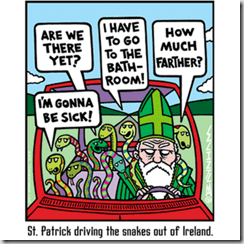
Happy St. Patrick's Day

Ahh, St. Patrick's Day.

Let's celebrate the myth of the saint driving the snakes out of Ireland.


He was so good that there isn't even fossil evidence that snakes were on Ireland. (Not too surprising, though, considering that it's an island and - well - island biogeography.)

Still, let's also celebrate with a pint of GUINNESS! And a pint of Murphy's! And some whiskey!

But men in plaid kilts playing highland pipes? THAT'S for St. Andrew's Day! (C'mon America, get it right!)

Friday, March 16, 2012

Storm washouts in Saginaw Forest

The berm that acts as a pathway between the south and north sides of the property and runs along the western property line has washed away (again).
IMG_2561

There are also some other areas where the trail has been somewhat eroded:
IMG_2564

... and the roadway is becoming (again) gully-city:
IMG_2559

And all that erosion has stained the water,
IMG_2563

...and it's still coming out of the creek looking like milk-tea.
IMG_2577

On the plus side, the lake seems to be draining nicely, dropping about 10 inches over the past 14 hours. (That's a loss of roughly 0.6 acre-feet/hour.*)

Buuut... it's getting very humid out there, what with all the sun and lack of much cloud cover. Who knows: it might dry out relatively quickly and the frogs might have infiltrated into the standing pools in sufficient numbers to eat up lots of the mosquito larvae. (See? I can be optimistic.)

*Assuming Third Sister Lake is 10 acres.

Round up your friends for a GUINNESS

Tomorrow is St. Patrick's day. Time to round up your friends for a GUINNESS!


Mmmmm.... GUINNESS....

Thursday, March 15, 2012

Well THAT was a lot of rain...

Well, THAT was interesting! A massive storm cell passed over Saginaw Forest at about 6:00 pm today,

March 15th storm

dumping a boatload of rain on the property and inundating the little creek...

...and causing erosion on the paths. It even raised the lake level about a foot!

Right now, the water is not far below the level of the footbridge...

...and is maybe a finger's breadth below the level of the dock.

SHEEESH! that was a lot of rain.

I'll be making rounds tomorrow morning to check whether there was more damage on the property, but right now all the land down near the lake is very squidgy. (Heh, my spell-checker apparently recognizes "squidgy" as a word.)

And the spring's just beginning...

On a positive note, the willows are starting to blossom - their feathery buds are just peeking through... so that's nice. The frogs are happy (although Prof. Berven's student assistants aren't too happy) in all that new standing water. And, happily, the cabin suffered no discernible problems.

Let's hope that the frogs eat up all the mosquito larvae...

Pink light doesn't exist...

... well kinda:


h/t: Andrew Sullivan

So, if "pink" is actually "not green", then does that make Komen's Race for the Cure (aka, the pink ribbon campaign) actually anti-environmental (since environmentalism is based on the color green)? Or does it mean that environmentalism is somehow against breast cancer?

Obviously not, since our associations with the color pink with breast cancer awareness and green with environmentalism are completely social constructions that don't actually have anything to do with the physical properties of color. In fact, Michael Moyer points out - and if you remember your basic physics about the electromagnetic spectrum - there is no such thing as a "color circle" (sorry artists):
The classical electromagnetic spectrum extends from a wavelength of zero meters all the way up to infinity. How is one to connect those two ends? And even if one could, adding two (or more) invisible wavelengths together would never produce something visible. Infrared light plus ultraviolet light is just that—a combination of infrared and ultraviolet. They do not average out to yellow.
Furthermore, Moyer makes the scientifically astute point that all colors are actually just interpretations of physical stimuli:
On a more fundamental level, however, Krulwich is right. Pink is not out there, because no color is really “out there.” The world is full of electromagnetic radiation, and the only intrinsic properties that this radiation possesses are physical ones such as wavelength and intensity. Color, on the other hand, is all in your head. “Color is not actually a property of light or of objects that reflect light,” wrote the biologist Timothy H. Goldsmith in his 2006 Scientific American article What Birds See. “It is a sensation that arises within the brain.”
Not as romantic a notion as Krulwich's idea of color (and - presumably - the idea of color drawn from history), but technically correct. However, whether we can draw humanizing and creative understanding about ourselves and our universe from such explanations is - IMO - what the humanities ought to be doing, instead of trying to fit physical phenomena into historical ideas of human perception. (Still, doing it this way is very tempting, and the next time I see a pink anything, I'll be thinking, "not-green".)

BTW, if someone wears pink on St. Patrick's day, does it negate the green that he or she might also be wearing? (I mean, does green and not-green equal zero?) ;-)

Wednesday, March 14, 2012

A comparison of years

This winter was weirdly warm. As a piece of evidence showing how different it has been this year, consider the following:

IMG_2537
March 14, 2012


IMG_8351
March 13, 2011


IMG_1520
March 12, 2010


IMG_6913
April 6, 2009

Automated driving

I was discussing the benefits of fully automated driving with a friend of mine the other week. What I think he couldn't quite grasp was how it would look if all the cars were automated. If we have driven, we have all likely witnessed poor driving decisions made by people that have resulted in accidents or near accidents, both of which have an end result of causing back-ups (and the possibility of related accidents). Also, people fundamentally cannot make instantaneous decisions based on knowledge of the entire network (or even a regional portion of the road network). Things are getting better, with smartphone navigation having information about traffic congestion, and even providing alternatives that circumvent it, thus wending our way toward network-smart driving.

However, even with this, it would be difficult to maximize the potential efficiency of a four-way intersection. Especially if each direction had five lanes of traffic. We currently rely on traffic lights and patterns to try and move people through the intersection. However, even with these rather crude measures, people still manage to balls it up. But what if it were automated?

Well, it would look something like this:


Pretty cool, right? Kinda scary, but pretty cool. "What about pedestrians?" you might ask. Well, there are cars that already take into account various "obstacles" that exist on the road, as well as navigating within lanes and keeping in relative motion with respect to other vehicles. In fact, Google uses one for its street mapping:


And its operation is pretty cool, too!


UPDATE (April 2, 2012): Steve Mahan - a 95% blind man - is out testing one of Google's self-driving vehicles!

Tuesday, March 13, 2012

I wanna get this...

Well, maybe I want to get this.

On days when I'm tired, it's raining, or the ground's icy, I would want to have this. This all-in-one wheel conversion to make an electric bike. It would make it easy to convert from my comfortable middle-distance touring-esque bike (that can average 20+ mph on the flats) to an around-town runabout (with a 20mph limiter).

What I like about it is the modularity.


... and the music.

Monday, March 12, 2012

Michio Kaku: How Physics Got Fat


If Michio Kaku is saying that scientists need to engage the public, then you know that the separation of science and policy is likely a load of bunk. True, it can mean that scientists can make bad engagement actions, but this does not mean that all scientists should just sit outside policy and pretend that the Cold War funding mechanism still exists.

Sunday, March 11, 2012

Saturday, March 10, 2012

Multiple lyric mashup!

Whence the term donnybrook

I saw the title of an article - "Social Media And Rush Limbaugh's Donnybrook" - and it made me realize that I didn't actually have a firm idea about what a "donnybrook" actually was.

Off to World Wide Words. And here I find the entry:
We are in Ireland, in what was once a village on the high road out of Dublin but which is now one of that city’s suburbs. King John gave a licence in 1204 to hold an annual fair there.

By the eighteenth century it had become a vast assembly, held on August 26 and the following 15 days each year, a gathering-place for horse dealers, fortune-tellers, beggars, wrestlers, dancers, fiddlers, and the sellers of every kind of food and drink. It was renowned in Ireland and beyond for its rowdiness and noise, and particularly for the whiskey-fuelled fighting that went on after dark. A passing reference in, of all sober works, Walter Bagehot’s The English Constitution of 1867, gives a flavour: “The only principle recognised ... was akin to that recommended to the traditionary Irishman on his visit to Donnybrook Fair, ‘Wherever you see a head, hit it’.” The usual weapon was a stick of oak or blackthorn that Irishmen often called a shillelagh (a word which derives from the town of that name in County Wicklow). The legend was that visitors to Donnybrook fair would rather fight than eat.

As Donnybrook progressively became a residential suburb of Dublin, the fair became more and more a nuisance until a campaign was got up to have it closed; in 1855 the rights to the fair were bought up by Dublin Corporation and it was suppressed. It was around that time that its name started to be used to describe a brawl, at first in the form like Donnybrook fair but then elliptically.

And here's a "fighting song" ;-)

Friday, March 09, 2012

Happy Birthday, Amerigo Vespucci!

On this day in 1454 (or perhaps on a different day, since calendrical reform wasn't really fulfilled yet), Amerigo Vespucci was born.

Who? The guy whose name was given to the Americas (based on the Latinized version of his name - Americanus), which is why we don't call the continent(s) "Columbiana" or something similar. (Wouldn't it have been interesting to call it "Eriksonia"?)

So just what does "Amerigo" mean? Well, it's the Italian version of Emmerich. "Emmerich"? Yeah, I don't know anyone named "Emmerich", but it apparently means one of the following:
  • "Universal power"
  • "Work power"
  • "Home power"
So, "America" is a Latinized version of an Italianized version of a German name that could mean of of three things about power.

FOXNews correctly explains why presidents don't control gas prices ... in 2008

Question: Who said this back in 2008:
So the next time you hear a politician say he or she will bring down oil prices, understand it's complete BS. If Americans want lower prices, cut back. Sell those SUVs! Ride a bike when you can. If every one of us bought ten percent less gasoline, prices would fall. Fast. That's what the candidates should be saying. We need a smart leader that's honest, smart, courageous, and willing to explain dubious associations. That's what we need.
Answer:  Bill O'Reilly.

Wow... FOXNews is actually right on this one:


But where are these comments today? The pundits at FOXNews now want to sell the story that Obama isn't doing good things for gas prices. Andrew Sullivan makes some points about the some of the points brought up by commentators on this subject (including Barack Obama). The block quote from Jared Bernstein is a good one:
The United States holds only a couple of percent of known global oil reserves, and we produce less than 10% of total crude.  These are binding constraints that no president can change.  I’m not suggesting that our domestic production has no effect on prices.  But oil is a global commodity and most of it is under the land of other countries.  Our contribution to supply will always be a drop in the bucket and will thus generally be a matter of cents on the gallon, not dollars.

UPDATE (3/22/2012): In a discussion on Facebook, a friend of mine posted the following, which cited a comment by GOP presidential candidate, Newt Gingrich:
Newt was saying that he could get gas down, today on NPR. "We have the potential of producing more oil than any other country", or something along those lines.
To this, I replied:
Well, we are producing more oil now than any time during the past 10 years. We are also using less oil now than during the last gasoline price spike (in 2008).

Newt is implying that the government needs to open up more federal lands to drilling. However, the amount of additional oil that the US could produce - in comparison to increased demand and available reserves in OPEC countries - is rather small, and - due to international trade agreements - we have to sell that additional oil on the world market (and not be able to have a special "American price" for sales only in the US).

HOWEVER... other countries are using more oil and the oil we are pulling requires more refining. Oil speculation markets have also developed since 2008.

And that's just for oil. The price of gasoline is affected by additional factors, including refining costs and transportation costs. The latter is - of course - a bit of a positive feedback system: the more gasoline costs, the more it costs to transport it, thus driving up the cost of gasoline. The costs of refining, though, are a little bit more complicated. Refining requires refineries (duh), and these operate on industrial economies (there was a maximum of 150 in the US in 2008). Our diminished fuel consumption since 2008 has meant that 9 of the nation's oil refineries have shut down/made idle since 2008. If the GOP want to diminish gas prices, they need to pay for oil refineries to start back up again... but that's not really the free market, right?

There is a very fast way to bring down gas prices: have the government pay a subsidy on the price of gasoline (this could be instead of or in addition to the monies allocated to oil and gas companies themselves, which has little evidence of lowering the price of fuel in any appreciable manner). Of course, that openly smacks of socialism (especially since it's effectively what Hugo Chavez's government - the GOP's modern-day socialist boogey-man - does), so that straight-forward and guaranteed lowering-of-gas-price measure is a no-go.

The other way is to remove speculation from all fuels. Of course, natural gas companies would love this idea, since natural gas speculation is one of the reasons why its price has been driven DOWN over the past year. Oil companies would hate the idea, since its prices have been driven up. (Of course OPEC can change how much oil they are producing to have some influence on this sweet money-train that they're living off of right now -- at least those OPEC countries that are stable.) However, since there are fewer oil-producing states than natural gas producing (and potentially producing) states, the senate is unlikely to pass a ban on all fuel speculation. Plus, for the GOP, that's against the free market, so it's a no-go.

Yet another way is to stop trying to declare war on Iran, to get out of Afghanistan, stop pissing off OPEC countries (which is different from "being nice to OPEC countries"), and help with stabilization efforts in Libya and Egypt. (We should help with the former because they produce a serious amount of oil and we should help with the latter because of the position of primacy that Egypt holds in the region, the fact that they have historically been our strongest ally in the region, because they control major shipping routes into Europe - which houses many, many of our strong allies - and because a stabilized, democratic Egypt is likely to move toward government reforms in the greater Middle East, likely to our long-term benefit.) Of course, this goes against the "bomb Iran" rhetoric that hasn't cooled since 2008 (which is part of the fueling - pardon the pun - of the oil price increases caused by speculation; a war with Iran - or even a destabilization in the Persian Gulf (combined with a lack of stability through the Suez) - will definitely raise the price of oil, and the speculators are betting on it). Of course, many conservative Americans apparently don't understand the difference between "not pissing off countries for no really good - or advantageous - reason" and "appeasement of dictators", so cooling one party's jets about "bomb Iran" is not a likely go-ahead strategy during a campaign year.

So what are the options that a divided, highly partisan government can pass - in an election year, no less - to lower the price of gasoline at the pump? We can't drill more oil and hope to see a diminution (heck, even if we open all the oil fields today and require drilling ASAP, the turn-around time is too long to see much of an impact before election time). We can't have an exclusive American market for oil. We can't force oil refineries to re-start. We aren't likely to pass a subsidy for gasoline. We aren't likely to stop or highly regulate the fuel speculation market. We aren't likely to help increase political stability in the one region of the world producing a significant amount of oil.

So... we are left with individual options that won't work for everyone (drive less, buy a more fuel efficient car, bike and walk more) and presidential candidates who are lying through their teeth. Hey, it's just like O'Reilly said back in 2008! Who'da thunk it?

Thursday, March 08, 2012

Happy International Women's Day!

Let's celebrate the successes, advances, achievements, and contributions that women have made to society and continue to make in society.


However, there still is a major area in need for improvement at the most basic levels.


The hidden potential of women is - unfortunately - something that continues to remain untapped.


Think about the possibilities that come when all adults are able to have opportunities to recognize their potential: it will be a world significantly different from the one in which we live in today.

EL DÍA MUNDIAL DE LA MUJER