- A recent report in Science magazine indicated that since 1990 (the publication of the first IPCC report), actual observed climatic trends have followed the upper bound trajectories of atmospheric CO2 concentrations, global temperature change, and global sea level rise.
- A report has come out from the CNA showing that retired US generals and admirals have stated that they believe that climate change is happening, and that we must anticipate the impacts for purposes of national security.
- If you thought that rising sea levels were the only thing to worry about in the oceans, you have forgotten your basic aquatic chemistry: greater atmospheric CO2 means increased water acidity (just think of any fizzy drink's ability to clean a dirty penny). This means in the short run that coral reefs will die out (causing massive problems to local economies - think Australia, Palau, Thailand, Egypt, Florida, Bermuda, etc.); shorelines will erode faster since reefs will not be acting as a energy disperser; and associated fish communities will crash causing sharp declines in local and international fisheries). In the long run, this can likely affect crabs, shrimp, and lobster - and all species that require the presence of CaCO3 in ready abundances (and not changed to CaCO2 because of increased water acidity).
- Increasing numbers of coal-burning power plants are being constructed each year. This will only exacerbate the volume of CO2 produced, leading to (potentially) upward deviation from even the upper-bounded estimates of the IPCCs future climate projections.
Thursday, May 10, 2007
Acclimatizing to Climate Change
Thursday, April 26, 2007
More Photos
Tuesday, April 24, 2007
End of the semester, and other various things.
I also found a fun plug-in for the Firefox browser: Speak It. This extension uses the already-installed Windows speech program to read out any web page (or selection of a web page) that you choose.
Although the voice sounds like the mechanical voice that Stephen Hawking uses, it is quite funny to have it going off in the background. (It's even more fun to have it read some of your own work back to you!)
Tuesday, April 10, 2007
Blog Request.
(Stitched photo)
Thursday, March 29, 2007
Wednesday, March 28, 2007
Societies of the future?
According to a recent news article,
This brings me to wonder how many people sit down and think about the physical changes that will cause political and social changes in the world of our future. People, that is, other than fiction writers. Do political scientists and policy wonks sit around and wonder what the world will be like after even a one meter rise in sea level? How many people would that cause to become migrants? How many countries would become inhospitable due to aquifer inundations and overland flooding? For one,
Would this lead to a precipitation of military expansionism? After all, much of the fertile lands of a region are located in the floodplains of a country, and many countries have floodplains near their shores. When these become inundated with sea water, it will undoubtedly have a social and economic impact. Who is to say that any country would be able to easily absorb these impacts? Why not invade neighboring countries to take their lands and crops before your own country becomes unable to feed her citizens? It is, after all, a question of being “nice” or survival of your nation.
This brings up the question of whether the use of nuclear weapons remains a viable threat. Since many nations built cities on their agricultural lands, use of nuclear weaponry will only shrink the amount of agriculturally viable lands available to the victor of such a war.
Possibly one thing that will happen will be the movement of cities from fertile areas to non-fertile areas. Since transportation systems have proven their capacity of shipping food from far-flung regions of the world to the cities of the planet, it would make sense that cities no longer need to be located near their food sources. By moving cities (and possibly including industries) to areas marginal agricultural lands, relatively large regions of the country could be returned to producing produce for a hungry and climatically impacted nation. Of course, countries would need to ensure that this radical reorganization of the entire basis of a nation did not rip the fabric of society apart. If the majority of US citizens now ended up living in cities in the mountains of the West or
So going back to the original premise of this whole question: what is going to happen in the future? We as a society or government make plans going out into the future for ten, twenty, fifty, or a hundred years. However, we blindly accept that there will be a future
Having played such simulations as the Civilization series of games, it always struck me that a viable option of feeding a nation (once my civilization had moved to the level of having vast roadways and railways) was to shift my major population centers to regions where natural resources were scarce. This alleviated localized pollution impacts (which would negatively affect agriculture), while allowing for population maintenance (usually my populations would reach ridiculously large numbers well before this became a viable option). In my scenario, mountain ranges housed the mega-cities of the future, and the formerly-populous grasslands once again opened up to agriculture and forestry.
Now there is obviously a large difference between Civilization the game, and civilization the reality. For one thing, all the versions I played didn’t have climate change as a disaster that could strike the world. (It did have alien invasions in one add-on version, as well as guerillas that would strike at you from the frost-bitten northlands of your country, which were rather odd things one had to deal with, although you did have the option of turning these random encounters off.) For another thing, the diplomacy and policy buttons were rather crude instruments (about as precise as using a pneumatic hammer to do dentistry) that could suddenly cause a war to start because a trade relation didn’t work out so well. Yet another was that battles and campaigns were affairs that took place somewhere in the background of the game with a random number generator. Still, it is my opinion that these kinks could be worked out, and as the game becomes more complex with the passage of time. Perhaps the next version will include global climate change as a factor in the game. (Ahh, how will the resource-hungry leaders of other nations reply to such a major impact to their countries?)
Although Civilization was an interesting tangent, I still haven’t really gotten to theorize about my original question, which was who sits down and plans out alternative futures? I’m sure people do it in the time frame of 5 years. After all, corporations and governments all come out with their Five Year Plans. However, I wonder how many people consider the Fifty Year Plan. Or the Hundred Year Plan. True, it is really difficult to enact public policy that you will be assured will be around for the next 100 years. However, if the nations of the world today wish to remain the nations of the world tomorrow, especially in the light of the impacts of climate change on the world’s societies, long-term planning needs to be done. The time frame of the “strategic planning” of today needs to stretch further.
Again hot, but cooled off thanks to rain.
I don't know why weather.com insists on using the visual data comparison method they do. Admittedly, on days without record high temperatures, it works fine, but on days when it doesn't, you can tell that the thing is just bogus. Look at the one on the right. Obviously, the actual low temp (51F) should be shown as being higher on the graph than the average high temp (50F). (I talked yesterday about the record highs and the actual high.)The website currently predicts that the weather will remain below 60F for much of the next 10 days (save for one day at 62F), and dipping down into the 40s F toward the start of April. (We'll see. Yesterday morning they were predicting 65F as the high for the day.)
Tuesday, March 27, 2007
I thought I lived in Michigan!
So.... I am wondering. Why is it being so darn hot these days? The tempting answer is (especially for me - "the enviro") global warming. However, I also know that global warming (aka climate change) is something that is a change in the overall state of areas' climates. So. Does an actual high temperature of 79F on March 26, 2007 mean anything?Well, it does mean that I got too hot to deal with my growing hair and decided that it was long enough to donate to Locks of Love. I am likely to post photos of this strange process later. But other than that?
Does the fact that the temperature was 6F higher than the previous record count? Does it matter that the average low for this time of year was only 1F higher than the actual low from yesterday?
Other than those observations, I can't say anything about how yesterday's temperatures has anything to do with global warming. (As much as I might like to.)
Still. Yesterday was way too hot for it to be considered by any stretch of the imagination as "in the normal range." (At least I can't stretch my imagination that far.)
Hopefully, the thunderstorms that are forecast for today actually cool this blasted heat off. And to think that the University still hasn't shut off its steam generators for heating the buildings. After all, why should they? IT'S MARCH!
Wednesday, March 21, 2007
On my way home I saw a bird...

It's sometimes good to have a camera in your pocket. Take today: was walking home, I saw a group of people standing around, looking at the ground, near a tree on campus. "Oops," I thought. "A squirrel has probably fallen out of the tree, and everyone's looking at it." I got closer, and noticed that there was something larger than a squirrel on the ground. It was a hawk.
It turns out that, yes, there was also a squirrel (or what remained of one) on the ground, and that the hawk had effectively torn it out of the tree before slamming it to the ground and killing it. It had been at it for about an hour, according to a bystander who had been watching the whole thing.
Since I don't normally see hawks around, I decided to take some photos.
In additional photographic news, the continued destruction of the Frieze Building continues (the old A2 High School).
Wednesday, March 14, 2007
Yesterday was sunny and warm...
Since today is Wednesday, I am holding office hours for my students. However, as in previous weeks, no one is likely to show up. Of course, I will make use of the time by updating my blog and grading more homework. They have just turned in a larger, rather open-ended assignment, meaning that I will take a longer time in going through it.Such is my life at the present time.
Tuesday, March 06, 2007
Risk Society
Amongst the many interesting points brought up by Gary Was, the scale of the energy demand was something that I hadn’t thought of for some time. The number of nuclear energy plants (i.e., clean energy) needing to come online every year to power growth in the
This is a little ironic, considering that Ulrich Beck discussed many of the issues of scale by pointing out the potential hazards of nuclear technology (amongst other things) in his book Risk Society: Towards a New Modernity. In a more-recent article he stated:
“With the past decisions on nuclear energy and our contemporary decisions on the use of genetic technology, human genetics, nanotechnology, computer sciences and so forth, we set off unpredictable, uncontrollable and incommunicable consequences that endanger life on earth.”[1]
That Beck would flash into my mind while I was watching the presentation was not surprising. However, it is interesting that looking back on what I recall reading of Beck and his arguments, he didn’t discuss the issues of risk surrounding reliance on fossil fuels. This form of energy appears to have become the albatross around the neck of industrialized society; the medallion of progress that we have accepted in place of the possible risks associated with diversification into alternative (possibly risky) energy sources.
The issue of scale – when referring back to Was’ lecture – appeared throughout his talk, and brought to mind two immediate questions:
1) Since he didn’t discuss the issue of changing scale too much, does Was think it central to the issue (and left it out for brevity’s sake) or peripheral (leaving it out for that reason)?
2) How many people recognize the issue as one encompassing different temporal and spatial scales?
As for the first question, I would like to thin the answer lies closer to the former, and that a discussion on issues of scale would be not only off-topic, but rather dull to the majority of people there (quite probably including myself). Further analysis of this question would require being able to get into Was’ head, so I will leave off here.
The second question is (while possibly just as philosophical) more interesting than the first, because it draws upon implications stemming from social constructs as well as biological limitations. Some of the more obvious social constructs that limit our recognition of scale are the “invisible hand” of the market; the overarching social identity (e.g, American individualism or Japanese conformism); and the robustness of nature.
The “invisible hand” of the market is a great “black-box” explanation of all the interactions taking place to get any good (and all its constituent energy and material flows) from its sources to you. If you were to ponder where the fried egg you had this morning actually came from, you might get back to the obvious point of a chicken (unless you get eggs from a different fowl). However, this doesn’t give you any idea about the number of chickens it takes to supply even a single grocery store’s-worth of eggs over a month; the transport network needed to get eggs from farm to packaging to warehousing to your market; and any other myriad connections I cannot even begin to fathom (and all I wanted to do was enjoy my egg!). The almost-flippant tacit semi-acknowledgement of this process in the over-used, dogmatic, and therefore near-useless term “invisible hand” is a convenient way to ignore the network underlying a majority of market transactions.
Overarching social identity is also a great way of cudgeling a nation’s people into thinking between a particular set of blinders. As a person who grew up with expectations of living according to two apparently opposing social identities (US individualism and Japan’s conformism), I realized the presence of these identity pillories early on, and did my best to have an identity of individualism of my own creation. However, I didn’t realize the immense impact an American social identity had on her citizens until returning to the
I would argue that the idea of the robustness of nature is both a social construct as well as a biological limitation. The robustness of nature operates as a social construct, because although we know that massive engineering projects have changed the face of the planet, we still act as if the planet cannot be broken. They physical enormity of the planet gives us comfort in this way. The time scales over which impacts are fully imprinted on the earth is much longer than our biological ability to fully comprehend, making it a biological limitation. Because of these two sets of blinders, we are unable to comprehend the absolute vastness of environmental (or socio-environmental) impacts: tsunamis, drought, famine, desertification, etc.
Our biological limitation is a limiting factor that we cannot really get past (perhaps genetic engineering at some point in the future can get us over this current high-bar and on to a different level of biological limiations). Our minds can only process so much information; can only comprehend numbers of a certain magnitude; can only grasp the interconnectedness of a frustratingly few variables; etc. Due to these limitations, we came up with simplified explanations and models of the way the world should ideally work; models that ultimately fail when taken to increasing levels of complexity. Because of this exploration of increasing complexity, having computers is a godsend. Of course, computer technology created a new set of new social and technological complexity.
At the end of the day, if we were sit down and try to think about growing levels of complexity (as I have done while thinking about and writing this paper) within any field of our choosing, I vouchsafe that it would be one of the most frustrating mental exercises you could try and attempt to do. It’s frustrating (at least to me) because of the attempt in trying to maintain all the potential outcomes as they grow exponentially, along with the number and quality of connections between each new level of elements.
This discussion of complexity all comes back (of course) to being reminded about how to scale the needs of a growing planet to that which people can grasp. From there we can only wonder what people will do when faced with the enormity of the implications behind the numbers. I suppose a form of Beck’s “risk society” has arrived, and we must face it, complete with our cultural constructs and biological limitations of understanding, as Dylan Thomas wrote, “Wild men who caught and sang the sun in flight,/And learn, too late, they grieved it on its way,/Do not go gentle into that good night.”[2]
Thursday, March 01, 2007
Rain and thunderstorms
I took the photo below as a contrast to the one I took last week from the same location. (This might be something I continue doing as the seasons change... I did something similar for a couple of building sites around town, and they turned out pretty cool.)

Friday is tomorrow.
Wednesday, February 28, 2007
Bini's birthday.
Today was Bini's birthday! We went to Eve's Restaurant for a fantastically sublime dinner. Happily, their kitchen was open after 9:30PM, since we wouldn't have been able to get to eating until then. Their birthday special is apparently a free dessert or drink. Luckily for us, when I called ahead they were willing to allow Bini to have a free appetizer instead of a choice of others. (Of course, she/we did end up having a fantastic triple chocolate dessert.)Happy Birthday, Bini!
Shaman Drum commercial & Brown Jug
The Shaman Drum (and Amer's across the street) was having a commercial filmed. I don't know for what, but it did mean that I was not able to get a sandwich at the deli.I guess I should have asked where the commercial was eventually going to be shown, but I was not thinking about that at the time: merely where to get myself fed for lunch.
Tuesday was the second weekday with a majority of undergraduate students off to wherever they decide to go during the U of M's incredibly early Spring Break.
Walking through campus is almost like walking through an eerie potential future world where there are large institutional buildings with very few people to fill them. Of course, all the restaurants are all well under-capacity, meaning it's easy to get a seat. On the flip side, it means that the waitstaff are really getting a short shrift, since waitstaff is one of those positions that doesn't get their base pay at the level of minimum wage. (For some reason, the federal government, way back in history, decided that waiters don't need to get the full benefits of minimum wage, and so, until this day, they are slaves of tips - and the ups and downs of the local populace who don't really want to take the time to calculate an extra 15% on top of the 6% sales tax which isn't always included in the bill that is brought to your table.)

Anyway, Menan, Morgan, and I went to the rather empty Brown Jug for some food, and got into a discussion of intra-familial relationships. In Tanzania, the words "aunt," "uncle," "nephew," and "niece" mean different things than they do in an English context. Similarly, so do "mother" and "father." Very interesting. It took me an hour to figure this out (and I'm not sure that I really did get all of it) - but I wonder how confusing it might be for visitors when someone starts calling several different people their "mother." (Btw, the pizza was standard, but pretty good.)
Friday, February 23, 2007
Start of Spring Break

Last night was a happy hour, followed by going out to Bridge to Terabithia. Turns out that we were the only ones in the theater! The film was pretty good, but I think it would have been better if the final scene wasn't so over-done. Oh, well.
So, I'm taking the bus back this evening, and I get off at my stop. Across the street, A2 Waterworks is tearing up the street. So, what else am I do do except take a photo?

I also took some time earlier today and took a photo from atop one of the rocks outside the Dana Building.
Monday, February 19, 2007
United States highway map
Anyway, check it out here.
Thursday, February 15, 2007
They're back.
Saturday, February 10, 2007
Role of Universities
One very interesting lecture presented was Jim Duderstadt’s presentation on the history of the institution of “the university,” the university in
A couple of points of interest that came up for me were:
· the continued desire of higher education to continue to require a liberal arts education;
· research universities teaching basic classes; and
· an (apparent) lack of connection between secondary and higher education.
With regard to the first point – the continued desire to teach a liberal arts education – is, I believe, one of the major points of weakness in the
The idea that the US-educated university graduate knows a little about everything, and more about their topic is a good thing to have, but I believe that there are enough students who are in the system that have little desire to learn outside their field. This leaves me at an intellectual fork-in-the-road situation: should students be forced to take courses they do not want to (and professors and lecturers teach courses to these students who do all wish to learn) in order to have a liberal education, or should the requirements of education be changed to be more in line with a different goal?
I feel that a student body should not be forced to take courses for the sake of broadening their education – that is what personal development (for which everyone has a whole lifetime) is for. Instead, the
This last point brings me to my second point of interest: research universities teaching basic classes. Should UofM be offering classes in basic algebra, biology, chemistry, etc? What difference does it make for a student to take such courses at an expensive research university, as opposed to a community college? A lecturer at a community college should have as much knowledge with such foundational material as any professor, lecturer, or graduate student at a research university. Indeed, I would make the argument that a professor at a research university who is interested in the cutting-edge of science might be less inclined to be interested in re-hashing the basics of his or her field every four months. If this is the case, it makes little sense that such a professor would teach such a class, leaving it (or as much of the running of it as possible) to his or her graduate students – which is what happens in many of these introductory 100-level courses around campus. So why should a student (or the parents of a student) pay thousands or tens-of-thousands of dollars to learn material from a graduate student when they can pay a fraction of the cost to learn the same material at a community college? Although Jim didn’t go into it very much in his presentation, I subsequently learned from him that the original setup of the University of California system was set up to focus only on upper-level and graduate courses, but was eventually scrapped due to recruitment concerns.
Of course, this could potentially all be solved by having a much-improved secondary education system in the
And this leads me back, full-circle, to the questionable insistence by
Monday, January 15, 2007
Snow has fallen
I wonder how many people might be able to actually come out to ABC as the snow continues to drift down... Who knows? I'll just have to go and see.
Ice on the trees.
And I want to get to ABC for some happy hour pints!
Thursday, December 14, 2006
SNRE Winter Solstice Party

- Once again, it was in the Dana Commons.
- Once again, the Ecotones (lead vocals again Kate Elliott) played the standards.
- Once again, I was taking photos of people (although not as many people were telling me to, "Stop already!").
- As part of a new tradition, the SNRE StuGov was distributing pre-purchased "MICHIGAN NATURAL RESOURCES" hoodies, and selling their surplus. According to Christine, there was a bit of a clamoring from people to get their hands on these hot little dealy-whos (that's my take on what she said, but I think I captured the assimilation desires of the students adequately).
- Once again, good food was served. (This time, there seemed to be more meat dishes than before... ) It was well-attended by the first year students, and I could swear that people stayed for minutes longer than last year - a much less of an eat-and-run.
Until next post: "PEACE."
Thursday, December 07, 2006
December 7, 2006
But how famous/infamous is the day (12/07)? I looked up December 7th on Wikipedia, and found that...
- 2048 years ago (apparently), Cicero died.
- 230 years ago the Marquis de Lafayette tried to join the newly-formed American army as a major general.
- 219 years ago, Delaware became a state.
- 143 years ago, Richard Sears (founder of Sears) was born.
- 89 years ago, the United States declared war on Austria-Hungary
- 78 years ago, linguist Noam Chomsky was born.
- 57 years ago, the Republic of China moved its capitol city from Nanking to Taipei.
- 50 years ago, basketball star Larry Bird was born.
- 41 years ago, Pope Paul VI and Patriarch Athenagoras "dis-"excommunicate the other's office that had been in place for the previous 911 years (12 years before the Battle of Hastings took place)
- 34 years ago, Apollo 17 (the last US lunar mission) took the "Blue Marble" photo of earth.
- 31 years ago, Indonesia invaded East Timor.
- 24 years ago, Galileo spacecraft arrived at Jupiter.
I don't think that the attack on Pearl Harbor is remembered in Japan anymore. Indeed, a search on the MSN/Mainichi News search engine, "Pearl Harbor" comes up with links to the movie, the wikipedia entry, and the online tour of the museum. As I said at the start of this piece, the nation of "Imperial Japan" no longer exists. It is effectively as dead as the nation of "National Socialist Germany". The fact that they both are called "Japan" and "Germany" are merely a recognition of the people that live there, rather than the political identity of that nation.
In this way, I would say that the understanding of the differences between Imperial Japan and modern-day Japan are a gulf that one would find difficulty shooting a cannonball over, just as the Imperial Japan of the early 1900s was a different country from the Shogun-controlled Imperial Japan from the early 1800s. One could similarly say that the United States post Civil War was a different country than the one that existed even two generations.
Tuesday, November 07, 2006
Voted
It is raining today. One hopes that this does not unduly affect election turnout.
I have just come into work, and found out that I am one of only two people here. Since the IFR is part of the Michigan DNR (and the majority of people here are state employees), no one is here, since all state employees are given this day off to go vote. I approve of this practice, and feel that there should be some way for the state to allow this to happen for all citizens. I was discussing this with the other person here - Tom - and came up with the idea that it would be grand if private business was not allowed to take punitive actions against a person who could provide standard proof that he/she was out voting on election day. (Of course, this raises the question of what immigrant workers would have to do on election day...)
Finally, I watched the History Channel's program on Carthage. I didn't know that the city of Carthage was so greatly fortified. The show was a great one, and I hope to see the one next week about the Maya.
Thursday, October 12, 2006
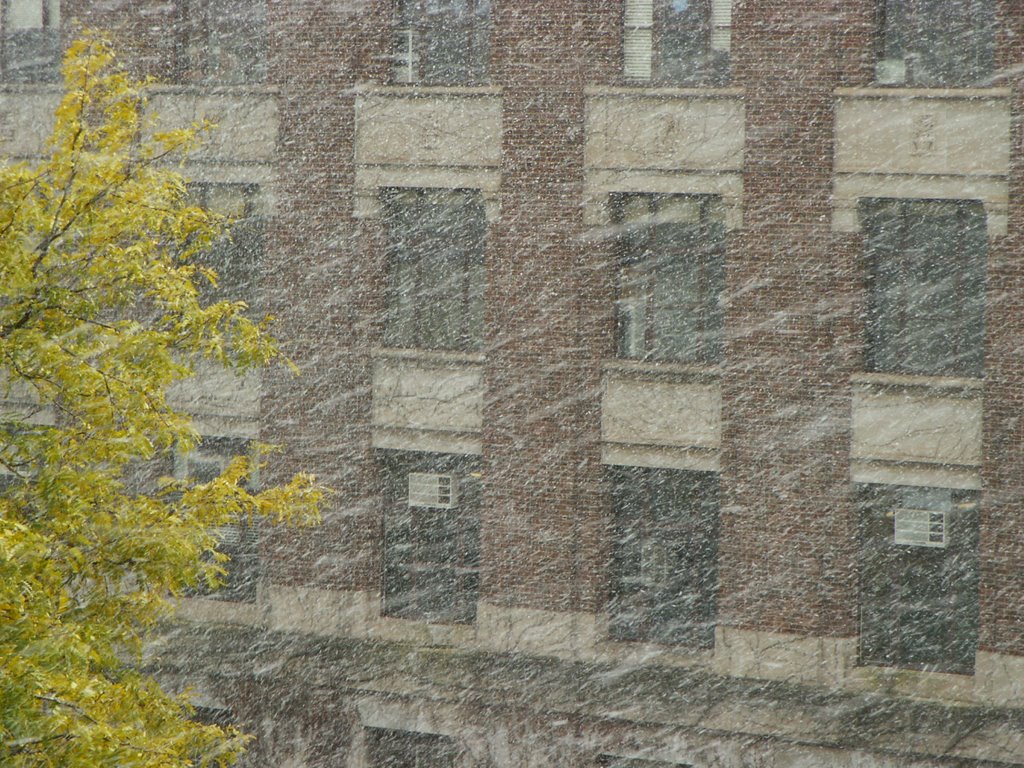
Snow Falling on UM
Snow on the ground.
Okay, so there wasn't a lot of snow that stayed on the ground by the time I got to the bus stop at 9:20 this morning. However, there is likely to be more tonight.Currently, the temperature is a nice (!) 37F, but - with the wind - apparently feels like 25F. With the sun out, I think that this weather is really NICE! Ahh... Autumn - the hopefully-slow decline into winter.
I noticed one thing while waiting for the bus this morning: people do really odd things while driving in their cars. I know that this is something that shouldn't be too difficult for me to realize, but it just struck me as odd. There was one person driving with one hand, while shading her eyes with the other, driving along at 40mph, apparently mostly blinded by the sunlight reflecting off the slick road. Another person was blithely (blindly) driving along at a similar clip while applying lip gloss while looking into the rearview mirror. (Apparently, she felt that looking intently into the mirror would save her from the blinding rising sun while driving eastward.
Well, enough of that for now. I expect to have more snow photos tomorrow (I might actually post them as well).
Saturday, October 07, 2006
SNRE Campfire
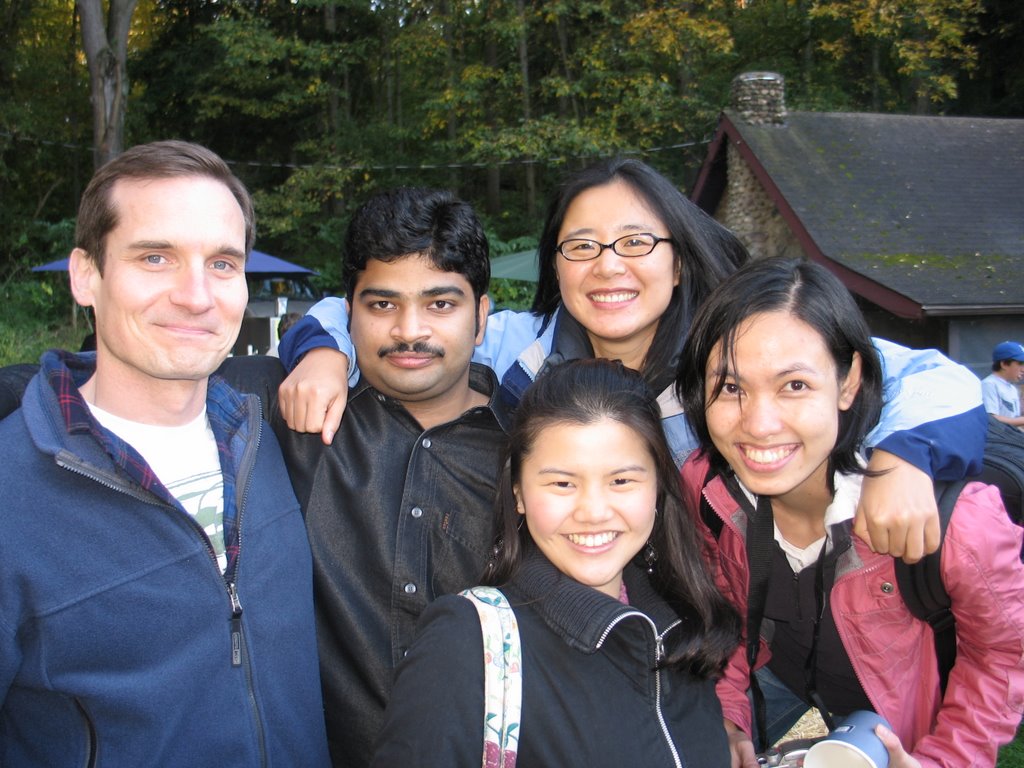
I was surprised that no one other than me decided to actually feed the fire (after all, this was SUPPOSED to be a campfire event). Still, in the end, it was "all good". The hotdogs were plentiful. The desserts were tasty. The company was all good. And photos were taken...
Josh, Jay, Oracha, Yuka, and Tong
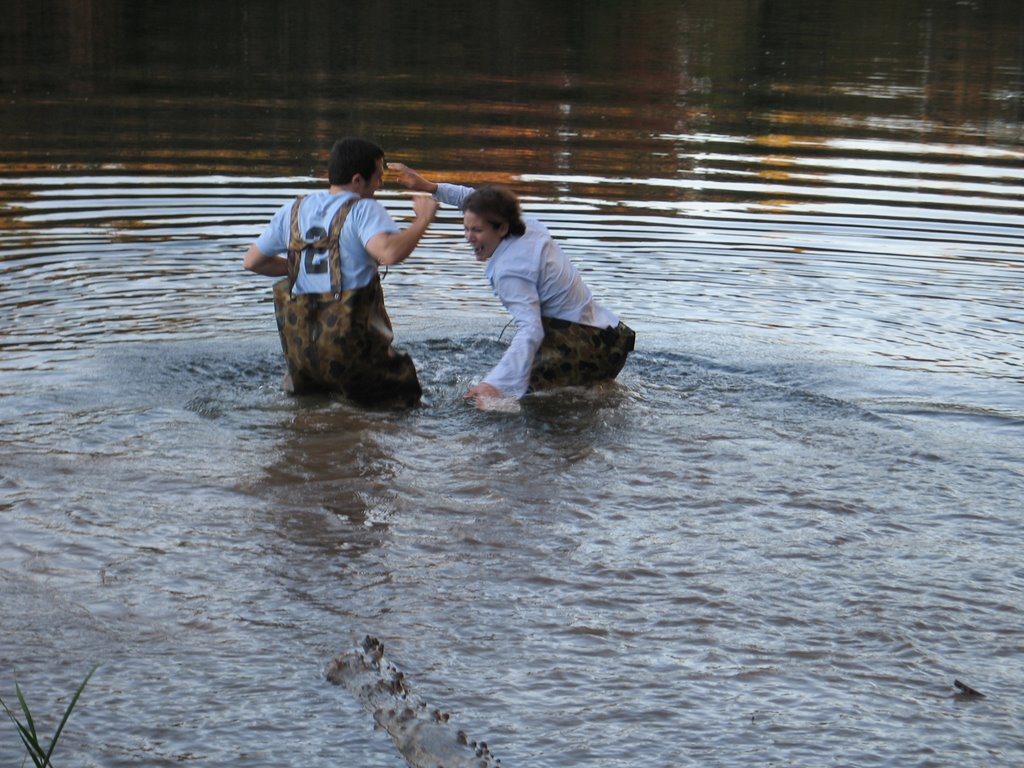
Hans fights off Sara's attempts of scuttling his waders.
Damon and Solomon attempt to beat their previous cross-cut sawing time. However, they only barely managed to beat 2 minutes. (The winning time was 1:05.) Sarah sits on the log, staring blankly into space (seemingly oblivious to the rusty saw tearing through wood not even a foot away).
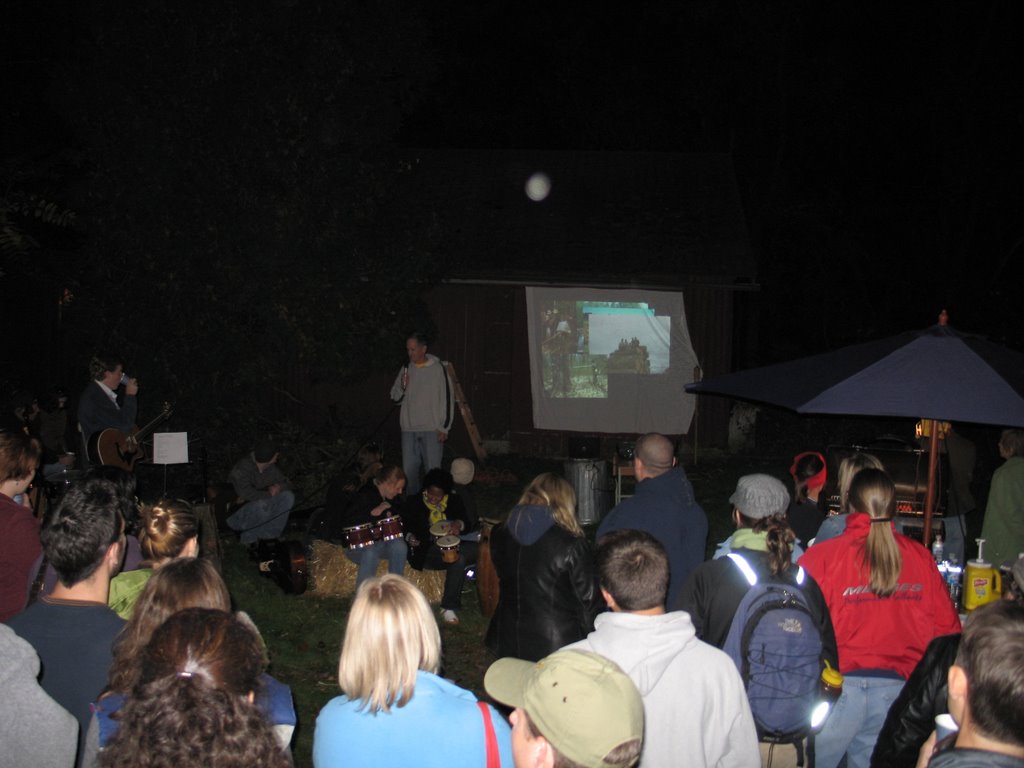
Jim gives a (humorous) presentation of the SNRE experience.Wednesday, September 27, 2006
Tired.
Autumn-time,
And the weather is breezy.
Leaves are blowing,
And the skys are grey.
Your's truly's tired,
And he wants to sleep.
So hurry up Mr. Clock,
Read 5 P.M.
Okay, so more bad lyic translations (apologies to the original Summertime lyrics), but that's what my head is currently spewing out.
On a side note, check THIS LINK out if you have time. It's an interesting call out on YouTube for people to speak a list of words in their own (presumably local) accent. Some are funny, but I would say that the word list doesn't do a good enough job of exploring the differences in accent. Still, the idea got a lot of apparent interest, and several responses. (I think it's interesting that there seemed to be a not insignificant number of East Asian descent respondants - all living in different places in the world.) One interesting meta-comedic (I think this is the correct word I'm tryign to use) response was an East Asian doing an FOB-like response.
Monday, September 25, 2006
Farewell Bernhard
Sunday, September 17, 2006
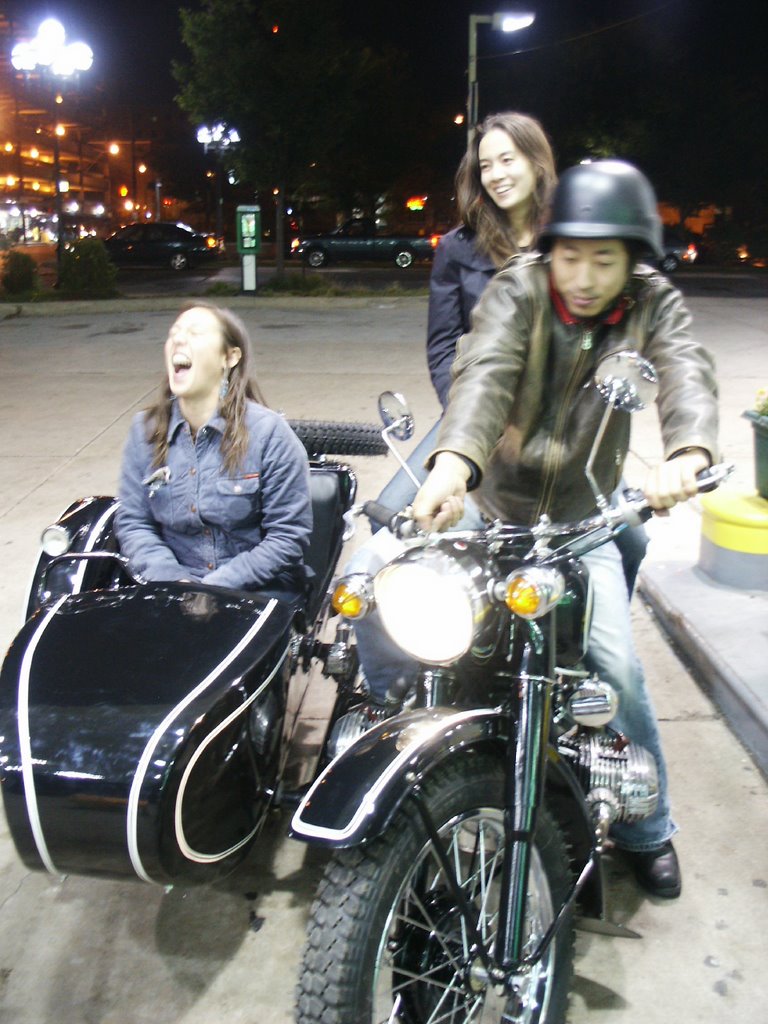
Tao's new motobike (with sidecar)
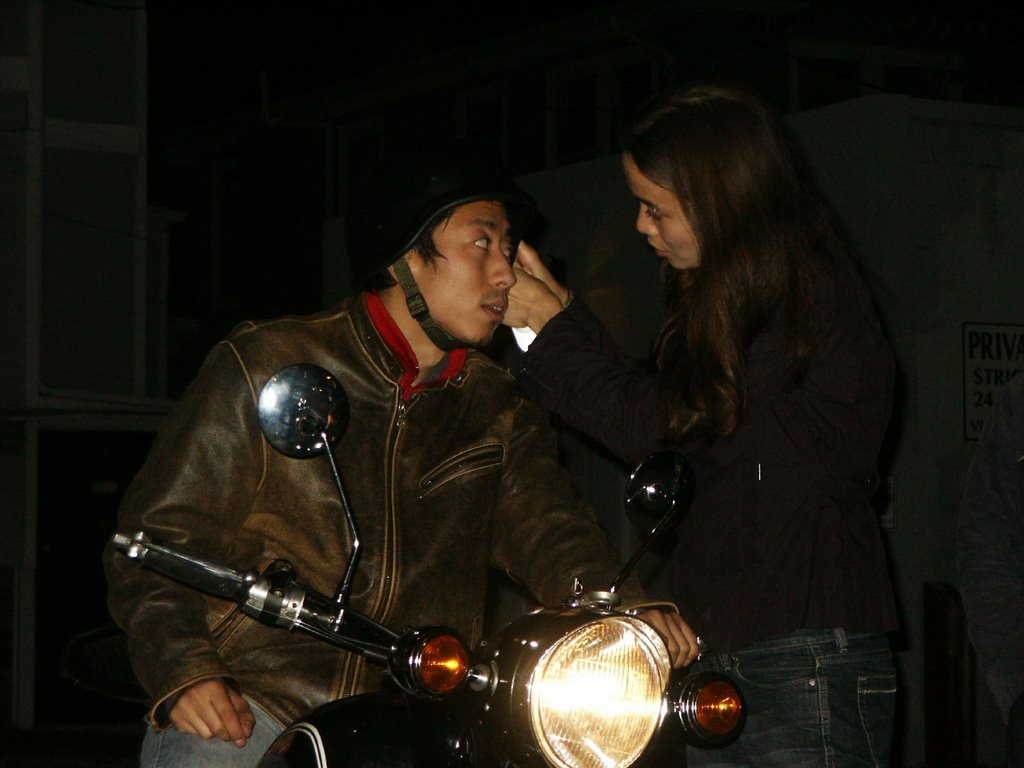
K takes time to ensure that Tao's noggin stays put.
Terry and K await the return from the gas station fuel tank fill-up trip.
Terry, K, and I have just run over Dan! Oh, no, Terry, keep your eyes on the road!
Tao gives a lift to Emily and Jen.