... I was annoyed with the rain. True, I did cycle home in the rain last night, but it was much lighter, and stopped about half way home. ...and I didn't have to show up at home not smelling of the sweat that inevitably happens whenever I ride in damp weather (evaporation doesn't really work very well when vapor pressure isn't working in its favor). But this morning was different: the rain was falling hard enough at the time that I decided to pack things up for my commute that I had ended up putting on my rain gear -- light, waterproof trousers and jacket -- before heading out, and the problem with (most) rain gear is that, while it keeps rain water out, it also keeps body moisture (and a fair amount of heat, since evaporation doesn't work very well in enclosed spaces) in. Still, can't show up to work all drenched, right?
Part of my commute is to turn onto Washington, and I usually make the turn on Ashley (which one-way, thus making the left-turn-on-red, which legal in MI) to take me the one block north before I turn eastward again. Often, at minutes-to-nine in the morning, there are other cyclists (some in the road, others on the sidewalk), and I have a list of "usual suspects" that I am accustomed to seeing. Today, though, there was a guy on a fixie and a messenger bag.
Side-note rant: I don't understand the fascination with fixies. They (often) have no brake levers, and (as the name suggests) cannot freewheel. I suppose that benefits include their light weight (after all, there is no need for gears, derailleurs, brake levers, cables, chain tensioner, or a long chain), simplicity (there are fewer parts to worry about), the rider's ability to freely spin the handlebars in a complete circle (or even several revolutions, thanks to the lack of cables that would normally impede such a maneuver), and the rider's ability to move backward (since the lack of free-wheeling means that backward pedaling produces backward movement). However, other than that, I can't see much of a draw, since their lack of gearing means that you are either heavily over-geared on upward climbs (don't even think about an easy start from a standstill) or heavily under-geared on downward climbs (with legs pumping faster and faster just to stay on the pedals as gravity takes over). True: some people apparently think that this latter point is good, since -- if you provide backward resistance to the pedal as you move downhill, you are able to slow the bike down... just like braking does with a lever brake. And looking at how fixie riders actually slow down -- by skidding -- I'm even less impressed of the ability of such a bike to perform during a Michigan winter (even one of the relatively milder winters we get in SE Michigan), which makes the personal decision of purchasing one less-than diminishingly small. Side-note rant over.
Now, I don't know if fixie-riders with messenger bags are actually bike messengers, or if they are pretending to be one. All of the people that I've known who ride fixies aren't bike messengers, but that doesn't mean that any one fixie-rider might not be. That aside, though, I hadn't had the opportunity to test out my bike against a fixie-rider, and the wait at Main Street for the light to change provided me with the setup of such an opportunity. I quickly took off my jacket-cum-personal-sauna and -- slowly cooling in the damp, rainy air -- waited for the light to turn. Fixie-rider didn't know that we were going to have a race, but that would be fine by me.
He took off -- much faster than me on my significantly heavier bike in low gear -- and remained ahead of me while going through the intersection at 4th Ave. Coming up to 5th Ave., I saw the cross-traffic light change from green to yellow, and I knew that we would be all-go by the time we hit the intersection. Fixie-rider apparently also figured this out, since he didn't stop pedaling. However, the cars that were tagging along with us had to come to a full stop -- blocked by the one vehicle already waiting at the intersection: fixie-man and I had free-reign of the lane ahead, and I was fast catching up with him as I shifted from 3rd into 4th.
By the time we reached about mid-way of the next block, I noticed something -- my cadence (and fixie-riders are all about cadence) was slower than his, but my gearing was already providing a small speed advantage. I matched his cadence and soon found myself walking past him and on up to Division.
I'm not a racer... well anymore. The best that I've always felt in a race was when I was just behind the leader, though: I knew where I was in relation to the guy in front of me, whereas he (usually it was a he) had little good knowledge of where I was in relation to him. It's a major personal psychological aid, and it makes me very wary when I'm out in the lead, especially when I don't know where the finish line is. This is how I felt as I overtook fixie-guy out front of the Neutral Zone, speeding up to the light at Division. I was also getting a little tired after my three-and-change-mile hard bike ride, and I started to feel the energy drain. "If I make it to the front of ELI, that'll be fine by me," I said to myself as I took to the sidewalk outside the Google building, coasting along and pulling up in front of the bike racks. Fixie-guy rode by almost immediately after I stopped, glancing over at me and my bike: "the bike that beat him" is how I thought about it, imagining that he did know that we were in a race, and conceding grudging admiration. As it was, though, it was just as likely that he was wondering who the frick I was to pass him at an intersection, only to pull onto the sidewalk a few tens-of-yards later.
Still, I wanted to get out of the rain and start my day. And so I did, and I did.
Tuesday, September 28, 2010


Saturday, September 25, 2010
My 30-mile trip

To and from the Dexter Cider Mill along Huron River Drive. Four of us (one less than we had hoped) headed out from Ann Arbor in the late morning for this merry little jaunt.

Although the morning started off quite cold and cloudy, the sun poked out from behind the clouds by the time we all got onto the roadway.

The rebuilt Delhi Bridge -- now we can once again get to Delhi Metropark from Huron River Drive. (I could never remember how to get to the metropark from along Dexter-Ann Arbor Road, but then again I don't drive, so that was only a problem when I was driving someone else -- or asked to navigate.)

Many cyclists take the trip along the road on weekends, especially if it's nice weather.

After we got to the Dexter Cider Mill, we ate some donuts, drank some ... water, and purchased a jar of ... blueberry preserve. However, Leah purchased some cider syrup (a gallon of cider, reduced down to a pint), which was quite tasty! Of course, the syrup was from Vermont, and not the DCM, but that's okay, I guess. After all, the DCM wasn't the (only) goal of the trip.

On the way home, Jennifer got tired of all my picture-taking, took my camera and put me and Leah in a photo. See, people? I bike!

But I had my revenge, taking a photo of all of them as we rode down the road.
And took this little piece of film of me going along at an easy pace. (Unfortunately, the ride was a little more windy than I would have preferred.)

All ended well after party ways at "The Fort", and me catching the end of the Michigan game at the Grizzly Peak, with some ale.
Thursday, September 23, 2010
Mid-Autumn Festival Moon
Last night was the mid-Autumn Festival in places that are of Chinese and Vietnamese culture. And, although I'm not Chinese nor Vietnamese, I remembered it in the morning and woke up early, walked out to Third Sister Lake and took this photo of the full moon:

Monday, September 20, 2010
The building of the North Quad
Over the past couple of years, the University of Michigan tore down the old Frieze Building and built its new North Quad combination of dormitory and teaching space. Over the past same period of time, I took a bunch of photos from the Modern Languages Building -- diagonally opposite the new buildings' southeast corner. Every so often, I would take a series of nine photos, and then I stitched them together using a photostitch program.
(The viewer currently shows January 2009 through September 2010 -- without any photos in 2010, save for the September one. I need to go through my photo archives to find earlier photos.)
(The viewer currently shows January 2009 through September 2010 -- without any photos in 2010, save for the September one. I need to go through my photo archives to find earlier photos.)
Wednesday, September 15, 2010
British vs. US English
There are many comments and writings that have been made about the differences between UK and US English. However, an interesting thing came across my news-ticker: UK archaeologists discover Roman armor. This was not the surprising thing (although as far as I know, the finding is momentous for many reasons, including that a complete set of Roman armor had not previously been found -- to the best of my knowledge). What was surprising (to me) is that the entire copy following the title (which spells armor the US way; with the "or" instead of the "our" ending) was written in British English (indeed, the first sentence reads, "Cardiff University archaeologists excavating at the Roman Fortress in Caerleon, South Wales have discovered what they believe is a complete suit of Roman armour." Huh? Why didn't the editor of this Cardiff-University-prepared piece not just go through and change the UK into US English, or just change the "armor" in the title to "armour"?
Other words which are British (or more common in UK usage):
Other words which are British (or more common in UK usage):
- penultimate (uncommon in the US)
- artefact (spelled artifact in the US)
- barrack (more often encountered as barracks in the US)
- monumental (in the US it often refers directly to monuments, not to the size of a building)
Sunday, September 12, 2010
A Comparison of Changes in Some Gendered Language over Time
An entry over at SocImages posted three graphs of the change in frequency of different gendered words in British English since the middle of the 20th century. Knowing that the Corpus of Historical American English is now up and running, I decided to see what an initial survey of the data would reveal of the trends in US English, presenting the two side-by-side. (Understand, though, that the British corpus study is much more than the broad-level survey that I'm doing here.)
Male vs. Female Pronouns
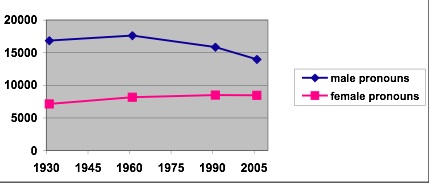

As one can see, looking at a comparison of male pronouns (he, him, his) versus female pronouns (she, her, hers) over time, the trend of diminishing male pronoun use and increasing female pronoun use is visible in both corpora. However, there appears to have been an upward tick in male pronoun use during the 2000s in the US, but not in the UK. In addition, while female pronoun use took a dive in the 1940s US corpora, steadily regaining ground after the war, whereas it appears to have grown slowly-but-steadily in the UK. There was a high point of female pronoun usage in 1870, but I don't know why.
Man, Men, Woman, Women
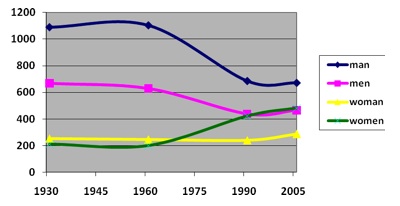
 Here, somewhat interestingly, the two graphs appear to show very similar trends: the use of man and men has diminished significantly in both the US and the UK (although the uptick seen in the US during the 2000s for male pronouns are also seen here, whereas although the value seems to have increased in the UK, I think that this might be a trick of the curving function of Excel). By the 2000s, although man is still much more common than the others, woman and women are in equal usage as man. Looking at the pre-1930s data (from the US corpus), almost all of the significant downward trend in the use of man and men occurred during the period covered by the British corpus graph.
Mr, Mrs, Miss, Ms
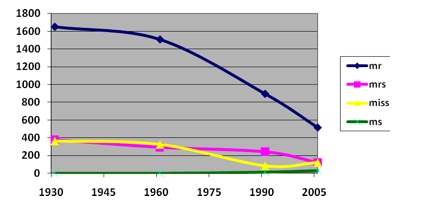
 This graph needs a little explaining. While the COHA interface can provide a table (broken into decades) of the frequency of the search terms, it requires more work than this brief survey of terms to puzzle out the contextual usage of these terms. For that reason, I believe that the really high values for miss are not adequate in describing what is really happening (since miss is a verb as well as a title). Therefore, unless anyone wants to spend the time to tease out the different uses in context, I will focus my look at Mr., Mrs., and Ms. (and after 1820, due to the unknown reason for the really high level of the usage of Mr. in that decade).
 What seems noteworthy is that the use of the three titles change dramatically over time, with Mrs enjoying relatively high use during the 1890s, 1900s, and 1910s, much higher than Mr (save for the in the 1820s -- see preceding graph). Unlike in the UK, Ms is much more commonly used in the US corpora (although the presence of Ms Magazine might have an effect). Still, the general trend since the 1930s is roughly equivalent as seen in the UK: approaching intersection. In fact, one might even say that (although there is a lot of decadal noise in all the titles), Mr has become less important than either Mrs or Ms in the past decade.
It vs. Them
 Although not reported on in the Dispatches site, I also decided to look at it and them and how they tracked over time. Of course, I also included the plural and possessive forms of the pronouns, and what we see is that the two (perhaps gender-neutral) pronouns are also generally declining over time, although not as strongly as the male pronoun has since 1930 (in both the UK and the US). A part of me had thought that perhaps the rates of it and them would not have changed that much over time, since one cannot make a direct substitution for he,him,his with either it or them pronouns. However, the slight decline in the usage of these pronouns might imply that the subject matter of the writing might have changed, or that writers are just choosing to use these pronouns less often, although why is something that I don't know (and I don't want to sift through the contexts in order to really find out).
Tuesday, September 07, 2010
Over 400 miles cycled since the start of July
I've cycled over 470 miles since the start of July -- when I started recording them on the 2 mile challenge. For most of those miles, I had a GPS unit strapped to my bike, keeping track of not just distance, but also location.

While my trips to North Campus were done sans GPS, I don't have those marks on the map. However, I did manage to remember to have the GPS unit with me for 370 of my total miles (yeah, I know that I didn't carry the thing with me for what amounts to around 100 miles of trips, but what can I say?).
Still, as amazing (to me) as the number 470 miles sounds, it works out to an average of 10 miles per weekday (470 miles/9 weeks = 52.2 miles/week = 10.4 miles/weekday), which is about 3 miles more per day than a mere round trip to work.
Perhaps I will take a trip to Dexter (to the WNW) or even around the North Campus area...
Friday, September 03, 2010
New top speed: 38.2mph
On my way in today, I hit 38.2mph. And that was while I was also riding with both of my shopping-bag panniers on the back.
 Total time: 17mins, 53secs
Total distance: 3.95 miles
Average speed: 13.3 mph
Total calories: 1067 Cal
Fastest speed: 38.2 mph (!!!)
Average heart rate: not recorded
I'm quite happy with that accomplishment, and am also amazed at the estimated caloric burn of 1067Cal (which is roughly double of what I supposedly burned in total yesterday in riding to campus, then to Trader Joes, and then back home - a total of 14 miles, but at a much slower speed than this morning's blast into town).
Total time: 17mins, 53secsTotal distance: 3.95 miles
Average speed: 13.3 mph
Total calories: 1067 Cal
Fastest speed: 38.2 mph (!!!)
Average heart rate: not recorded
I'm quite happy with that accomplishment, and am also amazed at the estimated caloric burn of 1067Cal (which is roughly double of what I supposedly burned in total yesterday in riding to campus, then to Trader Joes, and then back home - a total of 14 miles, but at a much slower speed than this morning's blast into town).
Photos of Ann Arbor at the end of summer
The Labor Day weekend is looming, and with that the return of the 25,000 undergraduates to campus. The town is still celebrating the summer, while also trying to entice the spending of the parents of many of those returning students. It's nice to walk through town and see some of these more musical and colorful enticements that mark the end of an Ann Arbor summer.


Even when it's rainy, you know that the start of the new fall semester is about to begin... with the practices going on in the athletic fields. (Okay, there aren't that many people out practicing right now, but there are some plays being run out there.)

Even when it's rainy, you know that the start of the new fall semester is about to begin... with the practices going on in the athletic fields. (Okay, there aren't that many people out practicing right now, but there are some plays being run out there.)
Wild grapes ripe
Cycling home, I saw these wild grapes all ready to eat on the side of the road. The grapes are all over town (all over the region, in fact), and although invasive in these parts, do produce some tasty morsels.

Thursday, September 02, 2010
Plastic bag bans in the US
Back in 2007, it looked like the state of California might follow San Francisco's lead in banning "disposable" plastic bags. The "why" question of worrying about plastic bags comes with the problems that they have during their persistence in the environment:
Via BBC:
However, we received news today that California senators decided to nix the whole plan that could have prevented tons of plastic waste sitting in a landfill or finding its way into the ocean, citing that it would be too costly to consumers. Maybe I'm a little cynical, but whenever I hear people citing "too costly for consumers," I'm immediately wary of the real motivations of the person saying it, especially when I am not convinced of their arguments.
Still, on the same day (well, on the next day, since American Samoa is on the other side of the date line), we hear that American Samoa has decided to ban the use of disposable plastic bags on the island. Go territory! Of course, living on an island in the Pacific Ocean, one is very aware of the problems of limited space, especially with regard to all the problems inherent with imported plastic bags that end up in landfills and the surrounding ocean.
On another note, there is also the really artistic film on the life of a disposable plastic bag:
Wednesday, September 01, 2010
Happy September!
Today is the first day of the first of -ber months (Septem, Octo, Novem, and Decem). Happy day!
September derives from the Latin "septimus" or "seventh", and it used to be the seventh month of the Roman calendar... until the Roman calendar was changed in 153 BC, from the new year beginning in March to the new year beginning in January (and - not so surprisingly - the people didn't really want to change the names of the months).
So welcome to the so-called seventh month.
(Such realizations make it all the more obvious how culturally created measurements of time really is.)
Denialism
I've recently become interested in the question of why people believe in the sometimes obviously factually wrong things that they do. Especially with regard to scientific evidence. Take a look at this panel discussion on the topic of denialism in the new media age.
Tuesday, August 31, 2010
Perhaps another instance of reading too much into the science
Via PhysOrg:
In my opinion, this study is an example of thinking too much about your subject that you don't really take into account the evidence surrounding you. For example, how did they control for environmental effects and nutritional effects? How did they control for the underlying genetics?
Bah.
Girls are hitting puberty earlier and earlier. One recent study found that more than 10 percent of American girls have some breast development by age 7. This news has upset many people, but it may make evolutionary sense in some cases for girls to develop faster, according to the authors of a new paper published in Psychological Science, a journal of the Association for Psychological Science.Ummm.... So, the premise is that girls reaching puberty earlier is an evolutionary response? Are these traits that are plastic in their presentation, or are they fixed? What were the findings? Well, they seemed to fit the theory:
Girls who physically mature earlier tend to start dating, have sexual intercourse at a younger age, and have more sexual partners than girls who develop later. That puts them at risk of sexually transmitted diseases and makes them more likely to have a child while they're still teenagers. These are generally seen as bad things, says Jay Belsky, of Birkbeck University in London, given that many psychologists and doctors think there are right and wrong ways to develop. But he says it makes more sense to look at development the way nature does—from an evolutionary perspective. This leads to the expectation that growing up in a risky, unstable environment—the kind that fosters an insecure rather than secure attachment of infant to mother—should accelerate pubertal maturation thus increasing the chances that one could reproduce before they die.
Girls in the study were followed from birth until the age of 15. At 15 months, security of attachment to mother was evaluated using a standard procedure involving separating and reuniting the baby with her mother in a university laboratory. Babies who smiled, vocalized, reached, or otherwise demonstrated appreciation that their mother was back were considered to be secure; those who avoided their mother following the separation or could not be comforted by her return were considered insecure. Pubertal development was evaluated by means of annual physical exams administered by nurses or physicians starting when girls were 9.5 years of age. Results revealed, as predicted, that girls who were insecure as babies started their pubertal development sooner—by about two to four months—than girls who were secure as babies. They also completed pubertal development sooner and had their first period earlier than girls who were secure as infants.By this part of the article, my BS sensors were sounding. What about environmental conditions, such as increased levels of human hormones in the environment (due to the use of rBGH in cows, presence of estrogens in drinking water from unused birth control pills, as well as the presence of in the environment and our food)? What about the argument that increased nutritional levels (especially higher levels of fats in the diet) have led to decreasing age of puberty? Well, the story did include these points:
A risky, unstable early environment, as reflected in an insecure attachment, is not the only reason girls mature early; it's also partly due to genetics. Environmental chemicals may also have some effect. Also, there's been a trend over the last 150 years of girls maturing earlier, possibly because of improved nutrition.Okay. Great. Toss me a bone. But don't actually, you know, discuss these points at any length. Instead, let's go back immediately to reporting on the paper and its authors' points of view:
"An evolutionary biology perspective says, 'look, the thing that nature most cares about—with respect to all living things, humans included—is dispersing genes in future generations,'" says Belsky. "Thus, under those conditions in which the future appears precarious, where I might not even survive long enough to breed tomorrow, then I should mature earlier so I can mate earlier before that precarious future might get me." This is the evolutionary logic, according to Belsky, which led to the prediction—and now evidence—that early insecurity should be related to earlier pubertal development.But surely, if this were the case, then children in Dickensian orphanages would have been mothers at 8 years of age; children during the 100 Years War would have been the mothers and fathers of Joan of Arc; and you should have seen a serious decrease in the age-at-puberty in the years following the Black Death and Spanish Influenza. You should see this today in places like Somalia or Palestine. Or even Pakistan or Iran. And while I would grant you that the age of first pregnancy is likely much lower than in Italy or Spain (where pregnancy is delayed), I doubt that it is due solely to reaching puberty at a younger age...
In my opinion, this study is an example of thinking too much about your subject that you don't really take into account the evidence surrounding you. For example, how did they control for environmental effects and nutritional effects? How did they control for the underlying genetics?
Bah.
Friday, August 27, 2010
Coffee and feeling tired
I know that I am getting used to coffee because after drinking a whole pot of 10 cups-worth of the stuff over the past three hours, I am already drifting off. I suppose that this means that I will have to wean myself off the java for a few weeks, until I can become affected by it like any regular person.

Wednesday, August 25, 2010
Outside my door
This week, there will be a drilling of a monitoring well. I knew that they were coming out at the end of the working day yesterday, but I was still interested to see the drilling truck outside the cabin when I got home from a day of teaching.

This morning, the drillers came out at 7AM and started setting up for work.
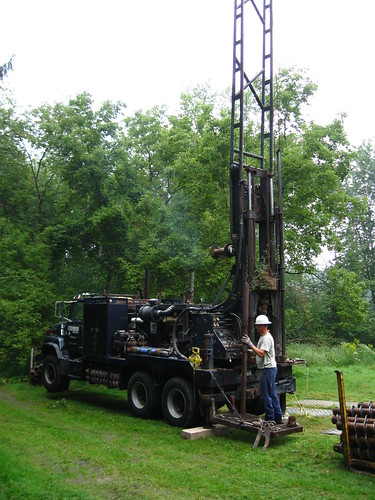
The drilling will continue until a depth of about 200' -- when it hits bedrock -- and people will be working for about five days, slowly auguring out the sediment and hauling it out of the forest, monitoring the progress and the water, and then installing the well and capping it.
This morning, the drillers came out at 7AM and started setting up for work.
The drilling will continue until a depth of about 200' -- when it hits bedrock -- and people will be working for about five days, slowly auguring out the sediment and hauling it out of the forest, monitoring the progress and the water, and then installing the well and capping it.
Newly paved section of Liberty Road
The stretch of Liberty Road which had no hard shoulder/bike lane has now been re-paved to be wider.
August 23, 2010:
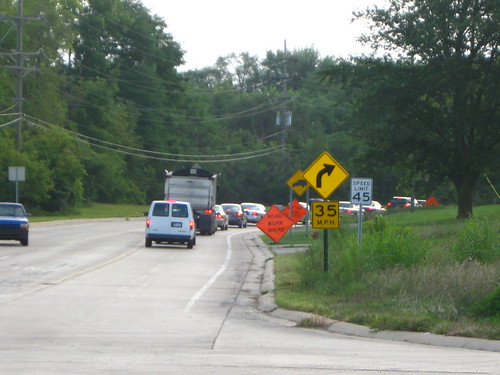
Lots of work backing up the traffic all the way up to Wagner Road.

The road is getting torn up for laying new pavement later. The road is now down to a single lane. Unfortunately (for all the drivers on the road), there was no sign of detour signs at Wagner/Liberty (nor did there appear to be one on Maple/Liberty, either).
August 24, 2010:

The newly paved road. The lines still need to be painted, but at least it should now have a hard shoulder/bike lane that goes all the way from the Liberty Road bride over I-94 all the way to Wagner road (and in fact that hard shoulder/bike lane goes all the way to Zeeb Road, after which Liberty Road becomes gravel).
August 23, 2010:
Lots of work backing up the traffic all the way up to Wagner Road.
The road is getting torn up for laying new pavement later. The road is now down to a single lane. Unfortunately (for all the drivers on the road), there was no sign of detour signs at Wagner/Liberty (nor did there appear to be one on Maple/Liberty, either).
August 24, 2010:
The newly paved road. The lines still need to be painted, but at least it should now have a hard shoulder/bike lane that goes all the way from the Liberty Road bride over I-94 all the way to Wagner road (and in fact that hard shoulder/bike lane goes all the way to Zeeb Road, after which Liberty Road becomes gravel).
Tuesday, August 24, 2010
Some more funny (s)
Stephen Fry on the Joy of Swearing:
And now that you've seen that, here's a funny song:
The tone of the lyrics, placed against the upbeat tune makes for a wonderful juxtaposition that reminds me of some of the better songs from The Beautiful South, like this one:
And now that you've seen that, here's a funny song:
The tone of the lyrics, placed against the upbeat tune makes for a wonderful juxtaposition that reminds me of some of the better songs from The Beautiful South, like this one:
Sunday, August 22, 2010
Humor is
"Humor is also a way of saying something serious." - TS Eliot
I personally believe that the best way of fighting against bigotry is to deny them the stage. This can be done by ignoring them or exposing their bigotry. Of course, one of the easiest (and less confrontational) ways to expose their bigotry is to use honest humor (as opposed to bigoted humor).
I personally believe that the best way of fighting against bigotry is to deny them the stage. This can be done by ignoring them or exposing their bigotry. Of course, one of the easiest (and less confrontational) ways to expose their bigotry is to use honest humor (as opposed to bigoted humor).
China tries to cut CO2 emissions to meet required limits
From PhysOrg:
I had written about the relationship between GDP and CO2 and why such a relationship -- especially as a comparison between countries -- is misleading. However, I suppose that it's the way in which governments set their limits. I ran the numbers to see what China needs to do in order to get to reach their 2010 and 2020 goals.
 This means that even if China were to make its 2010 requirements, it will need to continue reducing CO2 emissions over the next 10 years by about 36,700 tons each year. And if we assume that China will continue to average a 9% growth rate over the next 10 years (which is very optimistic, but even the IMF is projecting a 9%+ growth rate over 2010 and 2011), then we can project (very, very roughly) the following CO2/GDP relationships, based on different scenarios (on the right).
SIDE NOTE: Although I don't like the CO2/GDP relationship, by keeping the future GDP scenarios constant across the four future scenarios, it makes them comparable against each other.
DATA SOURCES: I used the same data sources as listed in this post.
China, facing the risk of embarrassment if it misses a looming environmental deadline, has ordered thousands of companies to close high-polluting plants as its leadership vies to retool economic growth.
Beijing has pledged to slash China's energy consumption per unit of gross domestic product by 20 percent between 2006 and 2010, as the world's biggest greenhouse gas emitter seeks to reduce pollution and clean up its environment.
...
Leaders in Beijing have been keen to promote their green credentials.
Ahead of global climate talks in Copenhagen last year, they pledged to reduce China's carbon intensity -- the measure of greenhouse gas emitted per unit of economic activity -- by 40-45 percent by 2020 based on 2005 levels.
I had written about the relationship between GDP and CO2 and why such a relationship -- especially as a comparison between countries -- is misleading. However, I suppose that it's the way in which governments set their limits. I ran the numbers to see what China needs to do in order to get to reach their 2010 and 2020 goals.
- Assuming CO2 emissions from 2006 were 1,498.905,000 tons, then a 20% reduction by the end of 2010 would mean that the total for 2010 needs to be no more than 1,199,124,000 tons.
- Assuming CO2 emissions from 2005 were 1,385,607,000 tons, then a 40% reduction by the end of 2020 would mean that the total for 2040 needs to be no more than 831,364,000 tons.
 This means that even if China were to make its 2010 requirements, it will need to continue reducing CO2 emissions over the next 10 years by about 36,700 tons each year. And if we assume that China will continue to average a 9% growth rate over the next 10 years (which is very optimistic, but even the IMF is projecting a 9%+ growth rate over 2010 and 2011), then we can project (very, very roughly) the following CO2/GDP relationships, based on different scenarios (on the right).
- CO2/GDP*1000: the historical data
- +8%CO2/+9%GDP: business as usual (based on projections of average CO2 and GDP growth over the previous 10 years)
- 0%CO2/+9%GDP: the total CO2 output doesn't change from the 2009 levels
- CO2commit/+9%GDP: China meets its 2010 obligation and works to cut CO2 by 36,700 each year
- -7%CO2/+9%GDP: the amount of annual CO2 reduction necessary to meet the 2020 obligation
"If Beijing fails to hit the 2010 target by a wide margin, its credibility on climate change commitments will be subject to a great deal of international scepticism," said Damien Ma, an analyst with the New York-based Eurasia Group, a political risk research and consulting firm.
SIDE NOTE: Although I don't like the CO2/GDP relationship, by keeping the future GDP scenarios constant across the four future scenarios, it makes them comparable against each other.
DATA SOURCES: I used the same data sources as listed in this post.
Saturday, August 21, 2010
Another type of caretaker
Although the winters aren't as snowy and remote as Yosemite winters at the Ostrander Ski Hut, I know kind of how this guy feels about being out of the confines of the city during winter time.
Of course, I don't have to break through the ice to get water in buckets...
Via Treehugger.
Winters of My Life from Jonathan Burhop on Vimeo.
Of course, I don't have to break through the ice to get water in buckets...
Via Treehugger.
Friday, August 20, 2010
Shopping on my bike
Went to Trader Joe's for some shopping. Once I got to the check-out, I thought that I wouldn't be able to make it all fit into the two panniers that I brought, and thought that I might have had to bring two more...

But it worked. Just barely.
But it worked. Just barely.
Thursday, August 19, 2010
Maslow's pyramid changed?
I read today that Maslow's hierarchy of needs (also known as Maslow's pyramid) may be undergoing an updating change, based on some of the understandings of human psychology that have come about in the 70 years since Maslow published in 1940.
Maslow's original hierarchy is based on the principle that as the needs of any one level are satisfied, a person can focus on the next level of the hierarchy. The original names of the levels of the hierarchy were:
Maslow's original hierarchy is based on the principle that as the needs of any one level are satisfied, a person can focus on the next level of the hierarchy. The original names of the levels of the hierarchy were:
- Immediate Physiological Needs
- Safety
- Love (affection, belongingness)
- Esteem (respect)
- Self Actualization
- Immediate Physiological Needs
- Self-Protection
- Affiliation
- Status/Esteem
- Mate Acquisition
- Mate Retention
- Parenting
The research team - which included Vladas Griskevicius of the University of Minnesota, Minneapolis, and Mark Schaller of the University of British Columbia, Vancouver - restructured the famous pyramid after observing how psychological processes radically change in response to evolutionarily fundamental motives, such as self-protection, mating or status concerns.So, while some people don't like the ideas that are espoused by evolutionary psychology, there might be a point to this change.
The bottom four levels of the new pyramid are highly compatible with Maslow's, but big changes are at the top. Perhaps the most controversial modification is that self-actualization no longer appears on the pyramid at all. At the top of the new pyramid are three evolutionarily critical motives that Maslow overlooked - mate acquisition, mate retention and parenting.
The researchers state in the article that while self-actualization is interesting and important, it isn't an evolutionarily fundamental need. Instead, many of the activities that Maslow labeled as self-actualizing (artistic creativity, for example) reflect more biologically basic drives to gain status, which in turn serves the goal of attracting mates.
Tuesday, August 17, 2010
The problem I've long had with Pascal's wager
Pascal's wager has long seemed a bad way of trying to get people to believe in God. It first assumes that the decision is a binary one: believe in the Christian god or not believe in the Christian god. If you did the former, and the Christian god were real, then you would go to Heaven for an eternity of bliss. If you did the latter and the Christian god were real, then you would go to Hell for an eternity of damnation. If you did either the former or latter and the Christian god were not real, then you would just die. Therefore, as the argument goes, belief in God is a safer bet, since you are betting the length of an possible eternity of Heaven or Hell against a relatively insignificantly long existence on Earth.
However, it presupposes that the decision is binary. What if people revered a Christian god, even though there were none, but there actually existed another one (one who seemed as possible as the Christian god) that would consign you to a pit of Hell for eternity? By adding a single possibility, your "safer bet" option flies out the window, since you have two options of utter damnation vs. utter bliss, both against the possibility that neither exists. If you knew of the possibility of damnation if you followed the wrong religion, would you then take the "safe bet" and believe in both? In neither? Randomly choose one?
What if the choice included all the possible pantheon of gods revered throughout time? What if only one of them were the "true god"? How would you know which god to follow and which to spurn? The choice between choosing one over the other to save your eternal soul and choosing none becomes more and more like a lottery play: saving your money and not playing the lottery will -- for the majority of people -- not put you further back than playing it. Therefore, putting your trust in one of the many gods and goddesses and spirits that we've prayed to over our existence is just as good as putting your faith in yourself.
Of course, it took me several more paragraphs than Greta Christina:
"Believing in God is a safer bet" is a terrible reason to believe in God. How do you decide which god to bet on -- and which religion is right about how their god wants to be worshipped? For this bet to make sense, you'd need good evidence that the religion you've chosen is the right one -- which is exactly what atheists are asking for. Pass it on: if we say it enough times to enough people, it may get across.I could also make the argument that if motivation for belief were a true commodity, then becoming a follower because of the logic behind Pascal's wager wouldn't save you from a chance of an eternity in Hell, either. After all, how can the Christian god let you into Heaven under false pretenses?
Monday, August 16, 2010
What a difference no clouds make at night
I was kvetching yesterday about the heat and humidity. Well, the cloud cover last night was minimal (as opposed to when I was trying to watch the Perseids), and the outside temperature dipped below the inside of the cabin around dusk. I opened up the windows to let the cool breeze into the cabin, and went to sleep. While some mosquitoes and other small insects did find their way into the cabin through the holes in the screen windows, this was the only downside, and I woke up in a cabin much cooler (and not too much more humid) than when I went to sleep. Indeed, I woke up a little chilly.
Sunday, August 15, 2010
Record temperature today
It is only 3:20pm, and the temperature for today has reached 89F, three degrees hotter than the previous record high temperature for this date of 86F, set in 2003. The expectation is that the temperature is supposed to get up to at least 90F. We'll see how that goes.
Saturday, August 14, 2010
Widening a part of Liberty Road
There is a section of my commute that is through a section of road without a shoulder or bike lane: that bit between Lakeview and Scio Ridge. This past week, I noticed that there was some road-widening action that was going on. I hope that it gets done soon, because it will mean that I could ride through without having to worry (as much) about morning-drive commuters who are operating on auto-pilot and not enough coffee.
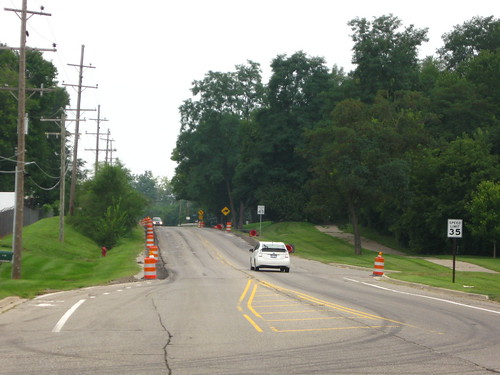
Now, if the city could widen the bridge over I-94 as well, that would be awesome...
Now, if the city could widen the bridge over I-94 as well, that would be awesome...
Thursday, August 12, 2010
Weather is turning ever-more cloudy
I don't think that I will be able to watch the Perseid meteor shower tonight, since the cloud cover seems to becoming greater with every passing hour.
This will be the fourth meteor shower (2nd Perseid) that I will not be able to witness, thanks to the inconvenience of cloud-cover.
Shoot.
This will be the fourth meteor shower (2nd Perseid) that I will not be able to witness, thanks to the inconvenience of cloud-cover.
Shoot.
More support for gay marriage (and that support's growing, too)
I don't know if it was because of the vote on Prop 8 in California, but the past two years have seen a rather meteoric rise in public support for gay marriage among polled Americans. Apparently, at the time when Prop 8 was passed (November 2008), the percent of Americans who supported gay marriage was around 42%. In the next 20 months, that number climbed to an all-time high of roughly 50%. That's an average rate-of-change of 2.5% per month, but looking at the chart, we can see that most of the rise occurred over the last 12-ish months!
 Even if the constitutionality question wasn't a part of the argument as to why a California judge can "over-rule the will of the people," the trend is definitely on a nation-wide one of greater and greater favoring of letting people who love each other have a married life. Of course, this trend toward greater favor isn't as great in all the states of the union:
 In fact, in the case of Utah, there was less support for gay marriage in 2008-9 than in 2003-4. Of course, it doesn't take a statistician to see that Utah is an outlier when it comes to the national trend, where the change from five years previous was across-the-board positive. "As go Utah, so goes the rest of the country," isn't (thankfully) the mantra of guiding wisdom.
This makes clearer (at least to me) the hollow arguments of those seeking to deny homosexual couples the ability and right to marry the person they love; the person they wish to attempt to share a life with. It makes the arguments against it -- one of the loudest ones being that it will ruin the "sanctity of marriage" -- sound all the more shrill, especially when voiced by those who have ridden roughshod over their own "sanctified" marriages. It makes the argument that Judge Walker's ruling was invalid because he's (supposedly) gay all the more shrill. Meanwhile, it makes level-headed statements of why people should be treated as people (gay or straight) sound ever-more reasonable (if being more than 100% reasonable is possible).
However, unless the US Supreme Court rules differently, gay marriage is a constitutional question about individual civil liberties, and such issues of constitutionality are not up for majority-rules votes.
Wednesday, August 11, 2010
The I-Beam Orion
I though that we had the only I-Beam Orion. While watching the Daily Show, I noticed that there was a sculpture in New York City that looked a lot like the I-Beam Orion:

Is this like the Cube? I know that the twin of the one at the University of Michigan is located in Astor Place (although it is less well-maintained).
UPDATE: Apparently, there's another I-beam Orion in Chicago, too.

Is this like the Cube? I know that the twin of the one at the University of Michigan is located in Astor Place (although it is less well-maintained).
UPDATE: Apparently, there's another I-beam Orion in Chicago, too.
Weather: ugh.
Right now, the relative humidity is 94% outside. The temperature is 72.5F, with a dewpoint temperature of 71F. Although not as hot as it will be (supposedly 90F), I don't relish the idea of cycling in to the university today.
Tuesday, August 10, 2010
Disc brake failure
Cycling in to work today, my rear disc brake broke. Well, in actuality, the brake pads were pretty much worn out, and one of the two pads sheared off its mount, thus meaning that there was only one pad in the back brake... which meant no ability to use it.
I got it replaced earlier this evening. Total cost $32.
I got it replaced earlier this evening. Total cost $32.
Monday, August 09, 2010
Apologies for wartime actions are difficult to make
Every year, the difficulty of the legacy of the US atomic bombing of the cities of Hiroshima and Nagasaki play out again. "Should the US apologize?" "Why apologize?" "It was bombing civilians!" "We'll apologize after they apologize for Pear Harbor, Nanking, etc." are all questions and sentiments that get shot around by people.
As the son of a Japanese and an American, born on an island that was won from Spain in 1898, lost to Japan in 1941, and regained in a bloody series of battles in 1944 (i.e., Guam), the dates of December 7, August 6, and August 9 are always haunting, and (for some reason) always come as a surprise. In searching over the years for what I ought to feel about the painfully intertwined histories of the nations that make up my heritage, I have come the the conclusion that the events of World War 2 are not something that are my own; I do not own their tragedies, and in many ways, I am a product of the very different world that has come about in the 65 years following its end.
I don't think that an apology for the war is necessary, since I feel that the utter loss of the war by Japan and Germany -- and the subsequent forming of close diplomatic, economic, and military ties -- more than makes up for any apology that the former Axis nations might issue to the US. After all, saying that they will unconditionally surrender is about as close to an apology as can be, without actually saying the words, "I apologize." And then, even if the surrender required those words, there would always remain the question of whether they were sincere. Still, giving up one's country completely to the mercy of the victorious nation had -- in the past -- meant a total capitulation of national sovereignty (which was the case in Germany and Japan, at least until the early 1950s), and possible break-up of the country; the spoils literally going to the victor. Metaphorically turning belly-up and offering oneself to the uncertain altar of the future was the apology-in-action, if not in words. (And doesn't action count more than words in many cases?)
Then what about the specific actions taken during the course of the war? What about the Rape of Nanking, the firebombing of Dresden, and the Bataan Death March? What about the lynching of Ukranian partisans or the bombing of London? And what about the only two nuclear weapons attacks that have ever taken place?
Every year I've read about why Japan should receive an apology (and responses as to why I should not). However, a recent piece touched me the most. Robert Fisk's piece from August 7. It starts:
At last we've apologized for Hiroshima - well, sort of. We've recognized the suffering our atom bombs caused -well, kind of. President Obama was showing off his anti-nuclear credentials in the killing grounds of Hiroshima, but this was not to be confused with saying sorry.He goes on to say that political apologies -- if they are to have any real meaning, save for a personal closure to those involved -- need to swiftly follow the event, lest they lose their power:
What it really comes down to is this. If you apologize for slaughtering civilians - or, at the minimum, causing their deaths - you have to do it quickly and for humanitarian reasons. Wait too long and do it for political reasons, and it will lose its effect. Germany was quick to start admitting responsibility for the Jewish Holocaust and now calls itself Israel's best friend in Europe. Turkey has never apologized for committing the Armenian Holocaust in 1915. But if it ever does, will anyone except the Armenians care?His ending really hits the nail on the head (at least for me):
Yet it's intriguing to go back to what people said about Hiroshima at the time. Today, we might share these words. "This outrage against humanity ... is not war, not even murder. It is pure nihilism." And we might be appalled by a newspaper that found it possible to legitimize the use of the atom bomb because it was impossible to judge the morality of the bombing by the size of the bomb that was used. So for the paper, the slaughter was "entirely legitimate". But the first quotation comes from the venomous Imperial Japanese radio station in occupied Singapore. The second comes from a 1945 edition of what was then called the Manchester Guardian. And we might do well to note how the poet and novelist Vita Sackville-West reacted to Hiroshima. Her husband, Harold Nicolson, wrote in his diary that "Vita is thrilled by the atomic bomb. She thinks ... that it means a whole new era."
Well, yes, I suppose it did. But ever since the American journalist John Hersey revealed the terrible suffering of the people of Hiroshima - unlike Wikileaks, he didn't suck the stuff out of computers, he set off there, on his own, to find out the truth - the name of the city has become a symbol of the guilt of humanity. And rightly so.
But it raises another question. When do our war "crimes" have an expiry date. Blair gave his half-hearted apology to the Irish a century and a half after the Brits exported Ireland's food instead of using it to save Irish men and women who were found dead in ditches after trying to eat stinging nettles. The Americans and the Australians have said sorry to their native peoples. But what about Cromwell and Drogheda? Or the Thirty Years' War, or the Hundred Years' War? Or the sack of Rome - a Goth war crime (poor Mrs Merkel)? - or the Roman destruction of Carthage? Or the death of Jesus - I guess Rome's imperial history means Berlusconi has to apologize, though an awful lot of Catholics have spent centuries living in their anti-semitic world by blaming the Jews. Poor Benjamin Netanyahu!
All in all, then, the apology business is a pretty sticky wicket. And yesterday's theater was played to boost the image of an increasingly self-regarding president, not out of any real concern for suffering - by which I mean physical pain - or humanitarian sorrow. A step in the right direction, you may say. Sure. But if you want to to believe in it, alas, it all came far too late.
Thursday, August 05, 2010
Witness credibility: exerpts from the Prop 8 ruling.
There was some (what appeared to me) important statements by Judge Walker in his ruling about the credibility of the various witnesses in this case. There is also a fair amount of really good reading on the various requirements for expert witness standing from the Federal Rules (this starts on page 39 of the ruling, and go until 41), a reminder or primer of what -- exactly -- makes a witness an expert witness in terms of testimony.
While Judge Walker First, his statements about the credibility of the plaintiff witnesses:
While Judge Walker First, his statements about the credibility of the plaintiff witnesses:
Having observed and considered the testimony presented, the court concludes that plaintiffs’ lay witnesses provided credible testimony:In contrast, the judge wrote of the proponents' actions and witnesses in a very different tone:
...
As the education and experience of each expert show, plaintiffs’ experts were amply qualified to offer opinion testimony on the subjects identified. Moreover, the experts’ demeanor and responsiveness showed their comfort with the subjects of their expertise. For those reasons, the court finds that each of plaintiffs’ proffered experts offered credible opinion testimony on the subjects identified.
Proponents elected not to call the majority of their designated witnesses to testify at trial and called not a single official proponent of Proposition 8 to explain the discrepancies between the arguments in favor of Proposition 8 presented to voters and the arguments presented in court ... [since] they “were extremely concerned about their personal safety, and did not want to appear with any recording of any sort, whatsoever.” Tr 1094:21-23.and later, of the first of two witnesses the proponents did call:
The timeline shows, however, that proponents failed to make any effort to call their witnesses after the potential for public broadcast in the case had been eliminated. ... The record does not reveal the reason behind proponents’ failure to call their expert witnesses.
For the reasons explained hereafter, Blankenhorn lacks the qualifications to offer opinion testimony and, in any event, failed to provide cogent testimony in support of proponents’ factual assertions.Of the proponents' second witness, there was an initial argument as to his qualification of being an expert on the topic of the political power of gays and lesbians, but not his qualifications as to political science. However, the judge writes:
...
Plaintiffs challenge Blankenhorn’s qualifications as an expert because none of his relevant publications has been subject to a traditional peer-review process, Tr 2733:2-2735:4, he has no degree in sociology, psychology or anthropology despite the importance of those fields to the subjects of marriage, fatherhood and family structure, Tr 2735:15-2736:9, and his study of the effects of same-sex marriage involved “read[ing] articles and ha[ving] conversations with people, and tr[ying] to be an informed person about it,” Tr 2736:13-2740:3. See also Doc #285 (plaintiffs’ motion in limine). Plaintiffs argue that Blankenhorn’s conclusions are not based on “objective data or discernible methodology,” Doc #285 at 25, and that Blankenhorn’s conclusions are instead based on his interpretation of selected quotations from articles and reports, id at 26.
The court permitted Blankenhorn to testify but reserved the question of the appropriate weight to give to Blankenhorn’s opinions. Tr 2741:24-2742:3. The court now determines that Blankenhorn’s testimony constitutes inadmissible opinion testimony that should be given essentially no weight.
...
Blankenhorn offered opinions on the definition of marriage, the ideal family structure and potential consequences of state recognition of marriage for same-sex couples. None of Blankenhorn’s opinions is reliable.
...
Blankenhorn gave no explanation of the methodology that led him to his definition of marriage other than his review of others’ work. The court concludes that Blankenhorn’s proposed definition of marriage is “connected to existing data only by the ipse dixit” of Blankenhorn and accordingly rejects it. See Joiner, 522 US at 146.
...
Blankenhorn’s conclusion that married biological parents provide a better family form than married non-biological parents is not supported by the evidence on which he relied because the evidence does not, and does not claim to, compare biological to non-biological parents. ... The studies may well support a conclusion that parents’ marital status may affect child outcomes. The studies do not, however, support a conclusion that the biological connection between a parent and his or her child is a significant variable for child outcomes. The court concludes that “there is simply too great an analytical gap between the data and the opinion proffered.” Joiner, 522 US at 146. Blankenhorn’s reliance on biology is unsupported by evidence, and the court therefore rejects his conclusion that a biological link between parents and children influences children’s outcomes.
...
To the extent Blankenhorn believes that same-sex marriage is both a cause and a symptom of deinstitutionalization, his opinion is tautological. Moreover, no credible evidence supports Blankenhorn’s conclusion that same-sex marriage could lead to the other manifestations of deinstitutionalization.
...
Neither of [the cited] sources supports Blankenhorn’s conclusion that same-sex marriage will further deinstitutionalize marriage, as neither source claims samesex marriage as a cause of divorce or single parenthood.
...
Blankenhorn had not seen [a scientific study that showed exactly the opposite findings of his deinstitutionalization claim] before trial and was thus unfamiliar with its methods and conclusions. Nevertheless, Blankenhorn dismissed the study and its results, reasoning that its authors “think that [the conclusion is] so self-evident that anybody who has an opposing point of view is not a rational person.” Tr 2918:19-21.
Blankenhorn’s concern that same-sex marriage poses a threat to the institution of marriage is further undermined by his testimony that same-sex marriage and opposite-sex marriage operate almost identically...
Blankenhorn gave absolutely no explanation why manifestations of the deinstitutionalization of marriage would be exacerbated (and not, for example, ameliorated) by the presence of marriage for same-sex couples. His opinion lacks reliability, as there is simply too great an analytical gap between the data and the opinion Blankenhorn proffered. See Joiner, 522 US at 146.
Blankenhorn was unwilling to answer many questions directly on cross-examination and was defensive in his answers. Moreover, much of his testimony contradicted his opinions.
...
Blankenhorn’s opinions are not supported by reliable evidence or methodology and Blankenhorn failed to consider evidence contrary to his view in presenting his testimony. The court therefore finds the opinions of Blankenhorn to be unreliable and entitled to essentially no weight.
Having considered Miller’s background, experience and testimony, the court concludes that, while Miller has significant experience with politics generally, he is not sufficiently familiar with gay and lesbian politics specifically to offer opinions on gay and lesbian political power.
...
The credibility of Miller’s opinions relating to gay and lesbian political power is undermined by his admissions that he: (1) has not focused on lesbian and gay issues in his research or study; (2) has not read many of the sources that would be relevant to forming an opinion regarding the political power of gays and lesbians; (3) has no basis to compare the political power of gays and lesbians to the power of other groups, including African-Americans and women; and (4) could not confirm that he personally identified the vast majority of the sources that he cited in his expert report, see PX0794A. Furthermore, Miller undermined the credibility of his opinions by conceding that gays and lesbians currently face discrimination and that current discrimination is relevant to a group’s political power.
Miller’s credibility was further undermined because the opinions he offered at trial were inconsistent with the opinions he expressed before he was retained as an expert. Specifically, Miller previously wrote that gays and lesbians, like other minorities, are vulnerable and powerless in the initiative process, see PX1869 (Kenneth Miller, Constraining Populism: The Real Challenge of Initiative Reform, 41 Santa Clara L Rev 1037 (2001)), contradicting his trial testimony that gays and lesbians are not politically vulnerable with respect to the initiative process. Miller admitted that at least some voters supported Proposition 8 based on anti-gay sentiment. Tr 2606:11-2608:18.
For the foregoing reasons, the court finds that Miller’s opinions on gay and lesbian political power are entitled to little weight and only to the extent they are amply supported by reliable evidence.
Prop. 8 blasted by federal judge in California
And he was a George H. W. Bush appointee, so does that make him an activist judge? The 136-page ruling from U.S. District Judge Vaughn Walker was meticulous and harsh in its findings:
Of course, though, the whole thing will appealed in the 9th Circuit Court of Appeals, and then (almost certainly) have an attempt to be appealed in front of the US Supreme Court. Still, though, a good day for equal rights in the US, methinks.
UPDATE: In an interesting twist, Andrew Sullivan muses on a commentary about whether Judge Walker should have recused himself in this case, because he is gay:
Visit msnbc.com for breaking news, world news, and news about the economy
Of course, though, the whole thing will appealed in the 9th Circuit Court of Appeals, and then (almost certainly) have an attempt to be appealed in front of the US Supreme Court. Still, though, a good day for equal rights in the US, methinks.
UPDATE: In an interesting twist, Andrew Sullivan muses on a commentary about whether Judge Walker should have recused himself in this case, because he is gay:
So Bradley wants to raise the issue of Walker's alleged bias - without substantiating any claims to it - while not raising it. Leave this particular piece of passive aggression aside - and you find that the logical conclusion of preventing gay judges from adjudicating on questions to do with gay rights would be removing all gay people from the discussion. Every gay person might one day fall in love and want to get married. Some may choose not to (should they recuse themselves too?); some may believe it violates their faith (ditto); others may already be in such marriages in one of five states (ditto plus plus). Similarly, since we are debating the alleged superiority of heterosexual sexual orientation here, is not heterosexuality by the same reasoning also a conflict of interest? Or are gay rights only legitimate when they are supported by straight people?
And here's something that really does pose a dilemma for a free and fair society. On this issue, there is scarcely any opposition in the gay community. Yes, there are some debates about the role of courts, and strategy. But I know of almost no gay people who would disagree with the core arguments that Judge Walker elaborated upon. And so we really do get an almost exquisite example of a majority deciding the fate of an issue where the minority is united and clear. When Newt Gingrich speaks of the views of "the American people", he means heterosexuals.
That is also a conversation worth having.
Review of Barbeque in the Southern United States
I love eating barbecue, and would really like to try the various types of barbecue:
"And when my life is through, cover me in barbecue, but make sure it's vinegar-based, because it slows decay..."
(via Greg Laden's Blog via Mis Cellania)
A fun video and song, but I don't know why the silhouette of Florida is actually that of California...
"And when my life is through, cover me in barbecue, but make sure it's vinegar-based, because it slows decay..."
(via Greg Laden's Blog via Mis Cellania)
A fun video and song, but I don't know why the silhouette of Florida is actually that of California...
Another red herring: churches in Saudi Arabia and the "Ground Zero Mosque"
Some people are making a large to-do about the building of an Islamic cultural center in lower Manhattan, having taken to calling it the "Ground Zero Mosque". This particular bit of xenophobia came into my own awareness back on July 20, 2010, with the whole "Sarah Palin refudiate tweet" story broke in which she tweeted:
Perhaps in an attempt to one-up Sarah Palin, former Speaker of the House, Newt Gingrich, made a nationalist, Christianist, populist appeal by making an equivalency of mosque-building in Manhattan with church-building in Saudi Arabia:
When I heard this, I was thinking, "Okay... what?" The logic here seems to imply that since a specific country passes its own laws about religious freedom (or lack thereof), the United States retaliate by limiting religious freedoms? And to people who aren't citizens of that country, but who follow the primary faith of that country?
And then Newt talks about how the United States should not allow sharia law. Ummm... Newt, sharia law is -- roughly speaking -- religious law, and excluding one religion over all others is a religious law, which is analogous to being sharia. Even if you justify it with the flawed logic of, "they are doing it, so we need to do it too," is basing a law on sharia, and is therefore analogous to passing sharia law. If you follow the flawed logic of "this is a Christian nation," and therefore provide a government preference for Christian-based laws, then you are making laws analogous to sharia law.
All this from a person who has, in the past, said that we shouldn't be governed by international laws. Well, Newt, basing a national law on the law of another nation is governing by non-national standards. That the laws to which you refer dictate who (including international visitors) is allowed in which parts of Saudi Arabia and what can be built there (including houses of worship to international gods) are the laws of Saudi Arabia, and creating reactionary laws against them is tantamount to being governed by international laws.
Also, coming from a person who has attested to a preference for a free-market, the sanctity of private property, the non-interference of government, the desire to have small-government, and the desire to follow the US Constitution, the "Ground Zero Mosque" controversy is really an example of competing rhetorical values being pitted against each other. If Newt were for the above points, then he should agree that the purchase -- or even lease -- of a private piece of land should not come under the scrutiny of government, unless it could be proved that it was the site of illegal activity (which being Islamic and opening a community center are not). If Newt were for the above points, then he should also agree that the government should not be incited to attempt to seize the property via immanent domain (since it would go against the "no illegal search and seizure" part of the Constitution, aka the 4th Amendment).
Recently, too, the Anti-Defamation League has also come in against the building of the "Ground Zero Mosque," stating -- quite openly hypocritically -- that while they are for religious freedom, they just aren't for religious freedom in this case:
Of course, none of the points by Palin, Gingrich, or the ADL actually address what I consider the pertinent points:
Those Roman Catholics and their apologists who argue for "religious toleration" are arrogantly dishonest. They ignore the fact that more than 100 churches already exist in New York City. Meanwhile, there are no mosques or synagogues in all of Vatican City. Although Muslims and Jews can enter the city, access much of its wonders is restricted.
Yes, I realize that Vatican City is much smaller than Saudi Arabia. However, Newt's point wasn't about the size of Saudi Arabia, but of its lack of churches and synagogues.
Yes, I realize that there is a mosque (quite large in fact) and a synagogue (also large) in Rome. However, the Vatican is its own sovereign country, nestled inside the city of Rome. It has its own military, its own police force, and its own government. Newt's point wasn't about the proximity of a church or synagogue to Saudi Arabia, but of its lack of these buildings.
Yes, I realize that the Vatican City is the seat of the Roman Catholic Church, analogously like Mecca is one of the holiest cities in Islam (right up there with Medina). However, Newt wasn't talking about the holiness of the city, merely its lack of a church or synagogue in Saudi Arabia.
Peaceful New Yorkers, pls refudiate the Ground Zero mosque plan if you believe catastrophic pain caused @ Twin Towers site is too raw, too realThe ensuing brouhaha was stoked by her refusal to own up to her continued misuse of the English language -- something that seems to align with this notion of ignorant politicians being somehow better for the country that has become inculcated among certain parts of the electorate, especially as the November elections approach and candidates (especially on the right) appear to be trying to woo Tea Party members. In my opinion, the whole mini-fracas over the use of "refudiate," the subsequently incorrect use of "refute," followed by the self-comparison with Shakespeare all spoke more to a large public view of the saccharine quality of Sarah Palin as opposed to the veracity of the argument she was forwarding. However, in the weeks since the former Alaskan governor asked "peaceful New Yorkers" (who never were her constituents, and are often portrayed as being godless, socialist, liberal, not part of "real America", etc.) to reject the "Ground Zero mosque plan", other right-wing pundits and politicians have stepped up to the same batter's box, and decried the plan to build the "Ground Zero mosque".
Perhaps in an attempt to one-up Sarah Palin, former Speaker of the House, Newt Gingrich, made a nationalist, Christianist, populist appeal by making an equivalency of mosque-building in Manhattan with church-building in Saudi Arabia:
Those Islamists and their apologists who argue for "religious toleration" are arrogantly dishonest. They ignore the fact that more than 100 mosques already exist in New York City. Meanwhile, there are no churches or synagogues in all of Saudi Arabia. In fact no Christian or Jew can even enter Mecca.
When I heard this, I was thinking, "Okay... what?" The logic here seems to imply that since a specific country passes its own laws about religious freedom (or lack thereof), the United States retaliate by limiting religious freedoms? And to people who aren't citizens of that country, but who follow the primary faith of that country?
And then Newt talks about how the United States should not allow sharia law. Ummm... Newt, sharia law is -- roughly speaking -- religious law, and excluding one religion over all others is a religious law, which is analogous to being sharia. Even if you justify it with the flawed logic of, "they are doing it, so we need to do it too," is basing a law on sharia, and is therefore analogous to passing sharia law. If you follow the flawed logic of "this is a Christian nation," and therefore provide a government preference for Christian-based laws, then you are making laws analogous to sharia law.
All this from a person who has, in the past, said that we shouldn't be governed by international laws. Well, Newt, basing a national law on the law of another nation is governing by non-national standards. That the laws to which you refer dictate who (including international visitors) is allowed in which parts of Saudi Arabia and what can be built there (including houses of worship to international gods) are the laws of Saudi Arabia, and creating reactionary laws against them is tantamount to being governed by international laws.
Also, coming from a person who has attested to a preference for a free-market, the sanctity of private property, the non-interference of government, the desire to have small-government, and the desire to follow the US Constitution, the "Ground Zero Mosque" controversy is really an example of competing rhetorical values being pitted against each other. If Newt were for the above points, then he should agree that the purchase -- or even lease -- of a private piece of land should not come under the scrutiny of government, unless it could be proved that it was the site of illegal activity (which being Islamic and opening a community center are not). If Newt were for the above points, then he should also agree that the government should not be incited to attempt to seize the property via immanent domain (since it would go against the "no illegal search and seizure" part of the Constitution, aka the 4th Amendment).
Recently, too, the Anti-Defamation League has also come in against the building of the "Ground Zero Mosque," stating -- quite openly hypocritically -- that while they are for religious freedom, they just aren't for religious freedom in this case:
We regard freedom of religion as a cornerstone of the American democracy, and that freedom must include the right of all Americans – Christian, Jewish, Muslim, and other faiths – to build community centers and houses of worship.The statement then goes on to say that the whole brouhaha about the building of this mosque is ruining any chance for healing, but places the blame not on the demagogues who are doing the actual spoilage, but upon the target of that demagoguery. In their defense, the ADL did not continue to explicitly build upon the non-sequitur point of linking the desire not to build it because of what another country is doing, however, their final paragraph makes their stance much more explicitly closer to that of the right-wing ideologues that perpetuate the xenophobia.
We categorically reject appeals to bigotry on the basis of religion, and condemn those whose opposition to this proposed Islamic Center is a manifestation of such bigotry.
However, there are understandably strong passions and keen sensitivities surrounding the World Trade Center site. We are ever mindful of the tragedy which befell our nation there, the pain we all still feel – and especially the anguish of the families and friends of those who were killed on September 11, 2001.
Of course, none of the points by Palin, Gingrich, or the ADL actually address what I consider the pertinent points:
- The "Ground Zero Mosque" is located two blocks away from Ground Zero, and one cannot actually see the site (as if this latter part has any bearing on the issue anyway),
- Various city government officials, committees, and councils -- as well as the mayor -- have agreed to the plans of the "Ground Zero Mosque",
- The "Ground Zero Mosque" isn't primarily a mosque, but is a community center, and won't be minaret-clad houses of worship, and
- There are other Islamic places of worship near Ground Zero that no one is protesting (indicating -- at least to yours truly -- that this whole thing is a red herring to stoke nationalism and xenophobia),
No such plea of mitigation can be entered on behalf of Mr Gingrich. The former Republican speaker of the House of Representatives may or may not have presidential pretensions, but he certainly has intellectual ones. That makes it impossible to excuse the mean spirit and scrambled logic of his assertion that “there should be no mosque near ground zero so long as there are no churches or synagogues in Saudi Arabia”. Come again? Why hold the rights of Americans who happen to be Muslim hostage to the policy of a foreign country that happens also to be Muslim? To Mr Gingrich, it seems, an American Muslim is a Muslim first and an American second. Al-Qaeda would doubtless concur.One final way of framing what Gingrich proposed is to use his own words, only slightly altered:
Mr Gingrich also objects to the centre’s name. Imam Feisal says he chose “Cordoba” in recollection of a time when the rest of Europe had sunk into the Dark Ages but Muslims, Jews and Christians created an oasis of art, culture and science. Mr Gingrich sees only a “deliberate insult”, a reminder of a period when Muslim conquerors ruled Spain. Like Mr bin Laden, Mr Gingrich is apparently still relitigating the victories and defeats of religious wars fought in Europe and the Middle East centuries ago. He should rejoin the modern world, before he does real harm.
Those Roman Catholics and their apologists who argue for "religious toleration" are arrogantly dishonest. They ignore the fact that more than 100 churches already exist in New York City. Meanwhile, there are no mosques or synagogues in all of Vatican City. Although Muslims and Jews can enter the city, access much of its wonders is restricted.
Yes, I realize that Vatican City is much smaller than Saudi Arabia. However, Newt's point wasn't about the size of Saudi Arabia, but of its lack of churches and synagogues.
Yes, I realize that there is a mosque (quite large in fact) and a synagogue (also large) in Rome. However, the Vatican is its own sovereign country, nestled inside the city of Rome. It has its own military, its own police force, and its own government. Newt's point wasn't about the proximity of a church or synagogue to Saudi Arabia, but of its lack of these buildings.
Yes, I realize that the Vatican City is the seat of the Roman Catholic Church, analogously like Mecca is one of the holiest cities in Islam (right up there with Medina). However, Newt wasn't talking about the holiness of the city, merely its lack of a church or synagogue in Saudi Arabia.
Tuesday, August 03, 2010
Flowing Data looks at the reach of Firefox
I have -- for many years now -- really enjoyed the Firefox web browser. I've always tried to stay away from Microsoft's Internet Explorer (due to generally crappy performance in most web-surfing that I did), and was one of the early adopters of Firefox when it came out in 2004.
I haven't really been disappointed, and maybe because I live in my little bubble of Firefox add-ons that help one with (such great things like block annoying advertisements, transfer my bookmarks between computers, give me quick-links to Google applications, and inform me of the safety of particular sites) as well as being able to manage the appearance of the browser (for example, by changing the fonts, colors and icons in the dropdown menus; putting on a colorful background; and changing the shape of the buttons), I assumed that others would cotton on to the better product. However, I have always been surprised at how people stick with the default of "blah" Explorer (now the 8th version of not-working-very-good).
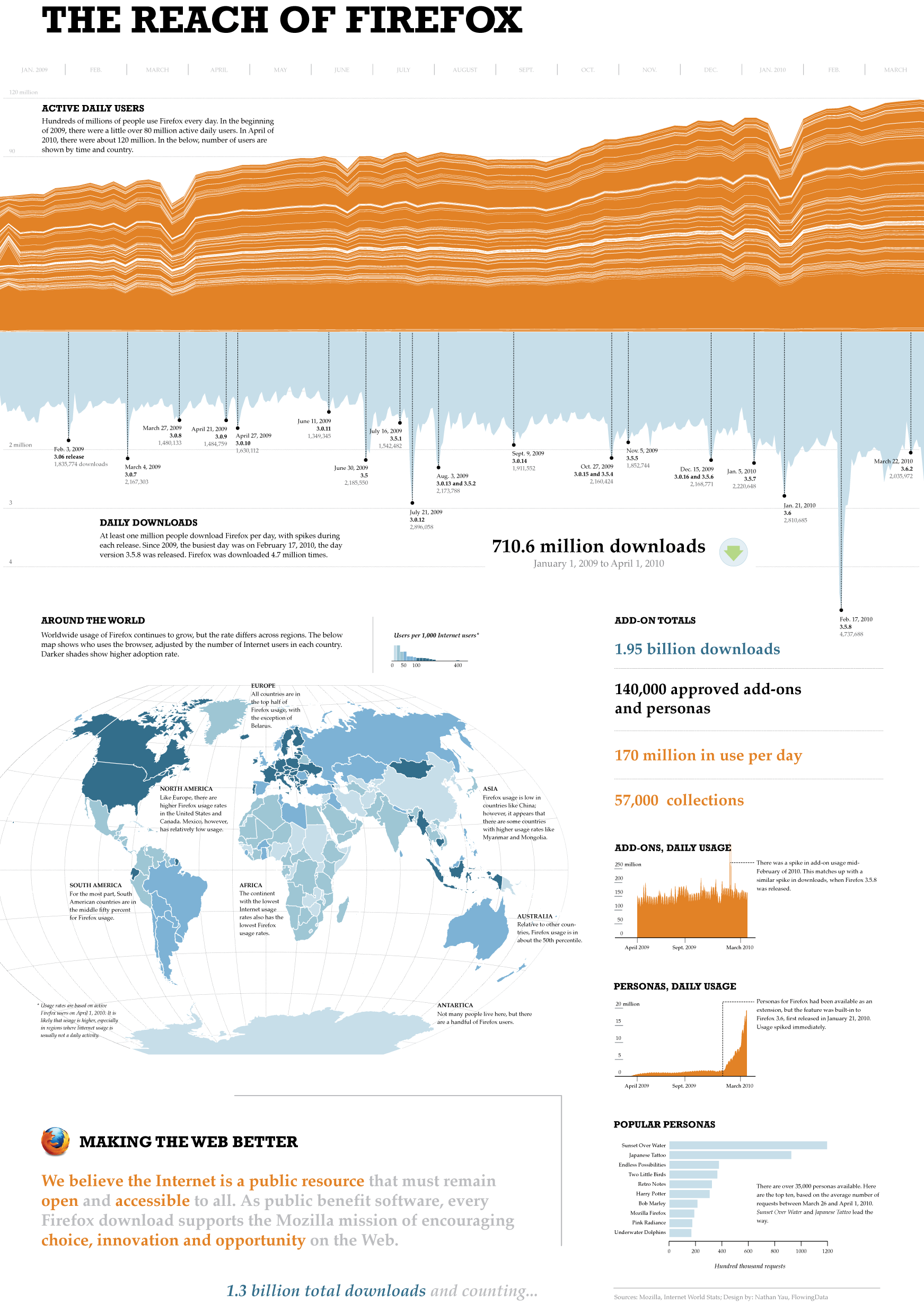 Just today, Flowing Data presented the infographic of "The Reach of Firefox", and it is interesting to see how people react to new changes in this browser (i.e., how quickly the download a new version, how quickly they take advantage of new features, etc.). Still, as one commenter points out, the number of users is still quite low, compared to "other" browsers (most likely IE).
Looking at the map, it's pretty clear that Firefox is most popular in Europe (not Russia, though), Canada, the US, and Mongolia. What is also interesting to note is that it is also popular in the smaller (area) Asian countries of Myanmar (easier to thwart the military junta? or is it being used by them?), Bangladesh, and Indonesia -- maybe due to licensing fees for the Windows OS? It's also relatively popular in Ecuador and French Guyana, and maybe for the same reasons.
Looking closely at the (relatively) tiny countries that constitute Western (Southern, Central, and Northern) Europe, it is interesting to note that Belarus and Norway are outliers in that their adoption rates are much lower than their that of their neighbors. At Flowing Data, I floated the possibility that the lower Norwegian Firefox adoption might be due to the presence of the Opera system, which is developed by the Norwegian telecom industry, and may therefore act as a serious competitor to all non-IE browsers. (True, though, the UK and Spain seem to be in the same category of Firefox adoption as Norway, so maybe the presence of Opera isn't such a major impact.) I have no idea, though, as to why Belarus is so much less adoptive of Firefox than its neighbors...
I haven't really been disappointed, and maybe because I live in my little bubble of Firefox add-ons that help one with (such great things like block annoying advertisements, transfer my bookmarks between computers, give me quick-links to Google applications, and inform me of the safety of particular sites) as well as being able to manage the appearance of the browser (for example, by changing the fonts, colors and icons in the dropdown menus; putting on a colorful background; and changing the shape of the buttons), I assumed that others would cotton on to the better product. However, I have always been surprised at how people stick with the default of "blah" Explorer (now the 8th version of not-working-very-good).
Just today, Flowing Data presented the infographic of "The Reach of Firefox", and it is interesting to see how people react to new changes in this browser (i.e., how quickly the download a new version, how quickly they take advantage of new features, etc.). Still, as one commenter points out, the number of users is still quite low, compared to "other" browsers (most likely IE).Looking at the map, it's pretty clear that Firefox is most popular in Europe (not Russia, though), Canada, the US, and Mongolia. What is also interesting to note is that it is also popular in the smaller (area) Asian countries of Myanmar (easier to thwart the military junta? or is it being used by them?), Bangladesh, and Indonesia -- maybe due to licensing fees for the Windows OS? It's also relatively popular in Ecuador and French Guyana, and maybe for the same reasons.
Looking closely at the (relatively) tiny countries that constitute Western (Southern, Central, and Northern) Europe, it is interesting to note that Belarus and Norway are outliers in that their adoption rates are much lower than their that of their neighbors. At Flowing Data, I floated the possibility that the lower Norwegian Firefox adoption might be due to the presence of the Opera system, which is developed by the Norwegian telecom industry, and may therefore act as a serious competitor to all non-IE browsers. (True, though, the UK and Spain seem to be in the same category of Firefox adoption as Norway, so maybe the presence of Opera isn't such a major impact.) I have no idea, though, as to why Belarus is so much less adoptive of Firefox than its neighbors...
I voted. Did you?
Today is Primary Election Day in Michigan. I checked out the location of my polling place through publius.org, and showed up a little past 8AM this morning.
If you are able to vote in Michigan, then go and do so. Polls close at 8PM today. Just remember that it is a partisan ballot, meaning that you can only vote for one party's candidates throughout the entire ballot. For example, you cannot choose a Republican for state representative and then a Democrat for governor. You can only choose candidates from one party across all primaries.
If you are able to vote in Michigan, then go and do so. Polls close at 8PM today. Just remember that it is a partisan ballot, meaning that you can only vote for one party's candidates throughout the entire ballot. For example, you cannot choose a Republican for state representative and then a Democrat for governor. You can only choose candidates from one party across all primaries.
Subscribe to:
Posts (Atom)