If this all works out, then I will have connected this blog with my Facebook and Twitter feeds. We'll see how that works, though.
The "need" for connecting various communication platforms is something that -- in a multi-platform world of greater communication (but perhaps diminished actual contact) -- is becoming increasingly necessary (well, if you've hooked in already). Thus, the wonder of tools like "Tweet Deck" that you can either install on your computer, or use as an app in Google Chrome. And the Android device that can query your Gmail account, your Facebook account, and even your Skype account to pull in different contact details for your friends, family, colleagues, etc.
Of course, with this increased connectivity between communication resources, a part of me wonders about the amount of privacy that I'm giving up. For example, now that this is connected to Facebook even more obviously (other than a link to the blog on my "info" page), what is the benefit of using a pseudonym? Also, what amount of information am I sharing anyway? Should I start up a blog with my real name or just keep on trucking with this one, since my online identity is it's own thing anyway.
In the end, I believe that the increased number of platforms that are hooked into communications will only work if people either all buy in to one or another platform or if platform-linking services like NetworkedBlogs and TweetDeck help take up the slack for people who don't have the time or intent to get onto every single social networking and communication tech and app that comes online. Of course, a possible trade-off is privacy, but I'm not one that is in a good position to determine the exact degree of this trade-off. Therefore, like someone hoping for herd-protection, I march onward, partially hoping that -- if privacy concerns occur -- breaches occur to someone else and not to me, perhaps conveniently forgetting that privacy information "predation" is less like lions attacking a herd of wildebeest (i.e., only one gets pulled from the herd), but more like drag-net fishing (i.e., it's a technologically driven, targeted, mass capture).
Monday, July 11, 2011


Friday, July 01, 2011
Six days, 102 miles.
Okay, so it's not a century in the true sense (i.e., 100 miles in one day). However, my bike ain't a road bike, so with a relatively heavy bike, I think that it's pretty good (especially if I'm working during the day, and all the miles are commuting miles).
Basic stats:
Basic stats:
- Distance: 101.68 miles
- Time: 7.35 hours.
- Average speed: 13.83 mph
I'd say that it's not too shabby.
Thursday, June 30, 2011
A HEPA-type air-filtration system for ~$25.
I'm just getting over my allergies -- that were causing me troubles for much of the springtime. It was with this in mind that it made me very happy to see a story about building a cheap air purification system.
h/t: Inhabitat
To avoid indoor allergens, many doctors recommend using an air purifier with a High Efficiency Particulate Air (HEPA) filter. The cost of these machines can run from $75 up to $800 for high-end systems. For those who are looking for a cheaper alternative for high-use rooms such as the bedroom, Terrell offers a do-it-yourself solution at a fraction of the cost. “This is a filtration system that you can put together with items from your local hardware store for $25 to $30 and use in your home to cut indoor allergens by about 90 percent,” says Terrell.
h/t: Inhabitat
Tuesday, June 28, 2011
Increasing number of strong hurricanes
I'm reading Changing Planet, Changing Health, and I came across a mention of increased number of more intense storms:

As you can see, the most recent lustrum was characterized by a slight decline in Category 1 storms, a serious decline in Category 2 & 3 hurricanes, and a very small increase in the number of Category 4 &5 hurricanes worldwide.
Recalculating to collapse the categories into decades, we can look at how many more (or fewer) storms were occurring worldwide during the 2000s relative to the 1970s. From the data, we find that there were 25% fewer Category 1 storms, 10% fewer Category 2 &3 storms, and 91% more Category 4 &5 storms worldwide in the 2000s compared to the 1970s! To quote further from the book about the significance of this trend:
While I don't have worldwide data on this, it seems to track with the trend in the record-high-temp-to-record-low-temp ratio over the continental United States over the same period of time does indicate continued warming:

The trends of an increasing number of high power storms corresponds to the expectation of increased magnitudes of storms caused by increasing global temperatures, and the high-record-temperatures across the continental United States corresponds with expectations of larger-scale warming trends that are being seen throughout the world.
What does all this mean? Well:
ADDENDUM: The number of storms in the 1975-1979 and the 2005-2009 lustra were both well below the lustral average of ~240 storms/lustrum; '75-'79 had ~206 storms, and the '05-'09 had 217. All the other lustra experience between ~232 and ~270 storms.
ADDENDUM: Webster et al use the term "pentad" to refer to a period of five years, while I prefer the use of the term "lustrum". Looking at the Wikipedia entry for "lustrum", one finds that "pentad" is synonymous, as is "quinquennium." However, "pentad" is a general term that means a group of five things, while "lustrum" specifically means a period of five years. Of course, "quinquennium" also means a period of five years. However, it's a lot more difficult to spell than either "lustrum" or "pentad".
Studies over the last five years have shown that hurricanes are getting stronger. In a 2005 paper in Nature, meteorologist Kerry Emanuel of the Massachusetts Institute of Technology described a new measure, the power dissipation index, that captures the amount of energy that flows through a hurricane over its lifetime. ... The same year, Peter Webster's team at Georgia Tech University reported in Science that while the total number of tropical cyclones per year stayed roughly constant worldwide, the strongest storms -- category 4 and 5 storms ... -- nearly doubled over thirty-five years.Then, the figure from the Webster et al paper was presented. However, the data that was included was from 1970-2004. Looking at that, I realized that there was enough of a time interval since the publication of the paper to extend it by another lustrum. While waiting for students, I decided to track down the data for the period of 2005-2009. Using the various hurricane records from Wikipedia (and roughly estimating the lustral hurricane values published by Webster et al), I was able to come up with the following (expanded) graphic:

As you can see, the most recent lustrum was characterized by a slight decline in Category 1 storms, a serious decline in Category 2 & 3 hurricanes, and a very small increase in the number of Category 4 &5 hurricanes worldwide.
Recalculating to collapse the categories into decades, we can look at how many more (or fewer) storms were occurring worldwide during the 2000s relative to the 1970s. From the data, we find that there were 25% fewer Category 1 storms, 10% fewer Category 2 &3 storms, and 91% more Category 4 &5 storms worldwide in the 2000s compared to the 1970s! To quote further from the book about the significance of this trend:
Top hurricane researchers do agree that as the globe warms, hurricanes will intensify, though the total number of hurricanes will remain relatively constant, or perhaps even drop.
While I don't have worldwide data on this, it seems to track with the trend in the record-high-temp-to-record-low-temp ratio over the continental United States over the same period of time does indicate continued warming:
The trends of an increasing number of high power storms corresponds to the expectation of increased magnitudes of storms caused by increasing global temperatures, and the high-record-temperatures across the continental United States corresponds with expectations of larger-scale warming trends that are being seen throughout the world.
What does all this mean? Well:
In 2010, Science published a study by Morris Bender, Tom Knutson, and Robert Tuleya ... [that] concluded from modeling studies that category 4 and category 5 hurricanes will double in frequency in the Atlantic this century because of ocean warming.And with an increased number of hurricanes globally comes increased incidence of disease outbreaks, famine, and price spikes in commodities (e.g., food, fuel) increasing the likelihood of war (or at least some sort of punitive action by one group of people against another; state-sanctioned or not).
ADDENDUM: The number of storms in the 1975-1979 and the 2005-2009 lustra were both well below the lustral average of ~240 storms/lustrum; '75-'79 had ~206 storms, and the '05-'09 had 217. All the other lustra experience between ~232 and ~270 storms.
ADDENDUM: Webster et al use the term "pentad" to refer to a period of five years, while I prefer the use of the term "lustrum". Looking at the Wikipedia entry for "lustrum", one finds that "pentad" is synonymous, as is "quinquennium." However, "pentad" is a general term that means a group of five things, while "lustrum" specifically means a period of five years. Of course, "quinquennium" also means a period of five years. However, it's a lot more difficult to spell than either "lustrum" or "pentad".
ADDENDUM (06/30/11): I tried to extend the graph to earlier lustra, but soon realized that this might be difficult, since gaps in the data exist on Wikipedia. (The gaps might not be problematic ... if I actually wanted to wade through all the raw data.) Therefore, since I don't want to commit too much more time on this, I'll be leaving the analysis (as much as it's an analysis) as is.
Tuesday, June 21, 2011
Sunday, June 19, 2011
Tuesday, June 14, 2011
Hurricane Categories: Why are we only using five categories?
In reading books and articles written about a future in which we have to adapt to a certain amount of climate change, one is struck by the consistency of using New Orleans and Hurricane Katrina as an example that illustrates many of the social considerations that future planning must incorporate. This make sense, since we wouldn’t care about the effects of climate change if it were happening elsewhere (i.e., we don’t care about how the climate is or isn’t changing on the planet Xenu, nor how it is affecting what may be living there). This is analogous to the underlying meaning behind the question, “If a tree falls in the woods, and no one is there to hear it, does it make a sound?” (The question never made sense to me, because I grew up with the “strange” notion that sound is a byproduct of the motion of air, and so it doesn’t matter who may – or may not – be in proximity of any object that makes a sound; it will happen. Considering the implication of the question to be something more than a physical description didn’t dawn on me until my 20s.)
In the last days of August, 2005, the city of New Orleans was hit by the eleventh Atlantic hurricane, named Katrina. It had – prior to landfall – reached a “Category 5” condition, but by the time it made landfall, had diminished to “Category 3.” Still, due to several factors – the greatest of which were undoubtedly the catastrophic failure of the levees, the lack of a city-wide evacuation order, and the systematic loss of buffering wetlands and barrier islands – the city suffered widespread flooding, and the death toll shocked the nation and the world. Many of us know these basic facts about Hurricane Katrina; many of us know additional facts. However, my most recent reading of these facts piqued a question: “In a world that is warmer, how strong might the hurricanes get?” From that, as series of other questions, including, “Why is ‘Category 5’ the strongest category?” or, to put it in another way, “Why are there only five categories?”
Looking online, it is easy to discover the basic facts of the “Category” system (called the Saffir-Simpson Hurricane Scale, or SSHS for short): there are five enumerated categories, as well as additional classifications of “tropical depression” and “tropical storm” that below the “Category 1” hurricanes; that Category 1 hurricanes have wind speeds of 74-95mph, Category 2 of 96-110mph, Category 3 of 111-130mph, Category 4 of 131-155mph, and Category 5 of >155mph; and that the system is used by the US (other places may use other systems). Doing a query for the fastest wind speed ever recorded in a hurricane, I found that Hurricane Camille (1969) maxed out the meter at around 205mph; 50mph faster than the minimum for a Category 5 hurricane, which is a much greater interval difference than any other category. True, Hurricane Camille-strength equivalents do not often show up in recorded history, making them a statistical rarity, and it would therefore make sense that their consideration might not have been deemed “necessary” at the time when the SSHS was conceived in 1971 – even though it was derived after Camille.
As a side note, looking at the historic hurricane data from NOAA, there have been 77 weeks – in the corrected data record – during which there has been a hurricane with wind speeds at or exceeding 155mph, 48 weeks of which exceeded 160mph, 12 weeks of which exceeded 170mph, and 3 weeks of which exceeded 180mph. As of the writing of this entry, the NOAA site has records for 1949-2010 for the Eastern North Pacific and for 1851-2010, with possibly some years missing (i.e., check the website for the most up-to-date stuff). For example, I cannot find the data for Camille in the NOAA data that I used to get these hurricane wind speed frequencies. However, even looking at the historic hurricane record of the waters near the US, it is pretty clear that there have been times when the winds have been significantly stronger than 155mph. In these conditions, wouldn’t it be better to have other categories in order to compare and discuss differences between hurricanes?
Now back to my original train of thought.
If we are going to be approaching a world in which hurricanes will be stronger, then wouldn’t it be likely that Camille-class hurricanes will be more likely? If so, then why not extend the range into Category 6 and possibly beyond? I mean, just because one has not yet encountered such a hurricane doesn’t mean that one cannot set aside a classification for it. Helpfully, the Wikipedia page for the HHSH presents a formula for deriving the maximum wind speed for Categories 1 through 4 (remember that Category 5 has no stated maximum) as: 83x10^(c/15) mph, where c is the category number, rounding the final number to the nearest multiple of 5. (One thing to note is that if you plug in c=4, then you will get a value of 147.8mph, which, even when rounding to the nearest multiple of 5, will only get you 150mph, which is kind of screwy. In my calculations, I will use the calculated value of 150mph, instead.) The resulting Categories 1-7 are:
Category 1: <95mph
Category 2: 96-110mph
Category 3: 111-130mph
Category 4: 131-150mph
Category 5: 151-175mph
Category 6: 176-205mph
Category 7: 206-235mph
If we assume that Camille did, indeed, exceed the 205mph that was recorded before the measuring device broke, then it would place that hurricane just inside Category 7; two categories higher than what the current system can allow, and thus making it possible to show just how much stronger those winds were. Furthermore, using 150mph as the corrected break point between a Category 4 and Category 5 hurricane, this would mean that there were 114 weeks of hurricanes at or exceeding 150mph! (Recall, too, that some data are – at this point – missing from the historical analysis, so it is likely that the true number is larger.) Of these 114 weeks, 5 of them would be classified as Category 6, and – because of the incomplete data set – none exist in Category 7 (save anecdotally for Camille).
Being able to say that there had been at least one Category 7-hurricane as well as at least five weeks of Category 6-hurricanes presents a very different description of hurricane activity than saying that they are all Category 5s. Furthermore, with wind speeds of future hurricanes expected to increase due to increased sea temperatures, we may well need to start adding higher categories as a normal course of action.
UPDATE: Looking at Wikipedia, someone had also listed a Category 6 criticism, with a quote from a former NOAA hurricane center administrator and co-inventor of the SSHS that, "there is no reason for a Category 6 on the Saffir-Simpson Scale because it is designed to measure the potential damage of a hurricane to manmade structures. If the wind speed of the hurricane is above 155 mph (249 km/h), then the damage to a building will be 'serious no matter how well it's engineered'." However, this sounds like the wrong logic. Why not have a Category 6, 7, 8 or more, since the metric isn't potential damage to structures (which might be expressed as a percent), but is rather wind speed. The implication of a wind speed is that there will be concomitant structural damage, but wind speed is not a measure of structural damage. Furthermore, the presumption is that it is impossible to build a structure to withstand the occasional 155mph sustained wind. Once people build structures that can withstand 155mph of sustained wind, the whole premise of the "argumentation" falls apart, since now there's a structure that is well-enough engineered to withstand the high winds. Hey, granddad! Technology progresses! I know that you invented the SSHS, but don't hobble us with your generational thinking and personal biases!
UPDATE: The Taipei 101 tower is a 101-floor skyscraper that was designed to withstand sustained 136mph winds. The Gateway Arch in St. Louis is designed to flex 18 inches in sustained 150mph winds. Furthermore, according to one site, "Most steel buildings that are engineered to resist hurricane damage can withstand wind forces up to 170 mph." (This claim can be seen elsewhere on the interwebs.) Sorry, Bob, what were you saying about buildings not being able to withstand 155mph winds? Tell us again, using your incomplete and now falsified reasoning, as to why we don't need a Category 6?
In the last days of August, 2005, the city of New Orleans was hit by the eleventh Atlantic hurricane, named Katrina. It had – prior to landfall – reached a “Category 5” condition, but by the time it made landfall, had diminished to “Category 3.” Still, due to several factors – the greatest of which were undoubtedly the catastrophic failure of the levees, the lack of a city-wide evacuation order, and the systematic loss of buffering wetlands and barrier islands – the city suffered widespread flooding, and the death toll shocked the nation and the world. Many of us know these basic facts about Hurricane Katrina; many of us know additional facts. However, my most recent reading of these facts piqued a question: “In a world that is warmer, how strong might the hurricanes get?” From that, as series of other questions, including, “Why is ‘Category 5’ the strongest category?” or, to put it in another way, “Why are there only five categories?”
Looking online, it is easy to discover the basic facts of the “Category” system (called the Saffir-Simpson Hurricane Scale, or SSHS for short): there are five enumerated categories, as well as additional classifications of “tropical depression” and “tropical storm” that below the “Category 1” hurricanes; that Category 1 hurricanes have wind speeds of 74-95mph, Category 2 of 96-110mph, Category 3 of 111-130mph, Category 4 of 131-155mph, and Category 5 of >155mph; and that the system is used by the US (other places may use other systems). Doing a query for the fastest wind speed ever recorded in a hurricane, I found that Hurricane Camille (1969) maxed out the meter at around 205mph; 50mph faster than the minimum for a Category 5 hurricane, which is a much greater interval difference than any other category. True, Hurricane Camille-strength equivalents do not often show up in recorded history, making them a statistical rarity, and it would therefore make sense that their consideration might not have been deemed “necessary” at the time when the SSHS was conceived in 1971 – even though it was derived after Camille.
As a side note, looking at the historic hurricane data from NOAA, there have been 77 weeks – in the corrected data record – during which there has been a hurricane with wind speeds at or exceeding 155mph, 48 weeks of which exceeded 160mph, 12 weeks of which exceeded 170mph, and 3 weeks of which exceeded 180mph. As of the writing of this entry, the NOAA site has records for 1949-2010 for the Eastern North Pacific and for 1851-2010, with possibly some years missing (i.e., check the website for the most up-to-date stuff). For example, I cannot find the data for Camille in the NOAA data that I used to get these hurricane wind speed frequencies. However, even looking at the historic hurricane record of the waters near the US, it is pretty clear that there have been times when the winds have been significantly stronger than 155mph. In these conditions, wouldn’t it be better to have other categories in order to compare and discuss differences between hurricanes?
Now back to my original train of thought.
If we are going to be approaching a world in which hurricanes will be stronger, then wouldn’t it be likely that Camille-class hurricanes will be more likely? If so, then why not extend the range into Category 6 and possibly beyond? I mean, just because one has not yet encountered such a hurricane doesn’t mean that one cannot set aside a classification for it. Helpfully, the Wikipedia page for the HHSH presents a formula for deriving the maximum wind speed for Categories 1 through 4 (remember that Category 5 has no stated maximum) as: 83x10^(c/15) mph, where c is the category number, rounding the final number to the nearest multiple of 5. (One thing to note is that if you plug in c=4, then you will get a value of 147.8mph, which, even when rounding to the nearest multiple of 5, will only get you 150mph, which is kind of screwy. In my calculations, I will use the calculated value of 150mph, instead.) The resulting Categories 1-7 are:
Category 1: <95mph
Category 2: 96-110mph
Category 3: 111-130mph
Category 4: 131-150mph
Category 5: 151-175mph
Category 6: 176-205mph
Category 7: 206-235mph
If we assume that Camille did, indeed, exceed the 205mph that was recorded before the measuring device broke, then it would place that hurricane just inside Category 7; two categories higher than what the current system can allow, and thus making it possible to show just how much stronger those winds were. Furthermore, using 150mph as the corrected break point between a Category 4 and Category 5 hurricane, this would mean that there were 114 weeks of hurricanes at or exceeding 150mph! (Recall, too, that some data are – at this point – missing from the historical analysis, so it is likely that the true number is larger.) Of these 114 weeks, 5 of them would be classified as Category 6, and – because of the incomplete data set – none exist in Category 7 (save anecdotally for Camille).
Being able to say that there had been at least one Category 7-hurricane as well as at least five weeks of Category 6-hurricanes presents a very different description of hurricane activity than saying that they are all Category 5s. Furthermore, with wind speeds of future hurricanes expected to increase due to increased sea temperatures, we may well need to start adding higher categories as a normal course of action.
UPDATE: Looking at Wikipedia, someone had also listed a Category 6 criticism, with a quote from a former NOAA hurricane center administrator and co-inventor of the SSHS that, "there is no reason for a Category 6 on the Saffir-Simpson Scale because it is designed to measure the potential damage of a hurricane to manmade structures. If the wind speed of the hurricane is above 155 mph (249 km/h), then the damage to a building will be 'serious no matter how well it's engineered'." However, this sounds like the wrong logic. Why not have a Category 6, 7, 8 or more, since the metric isn't potential damage to structures (which might be expressed as a percent), but is rather wind speed. The implication of a wind speed is that there will be concomitant structural damage, but wind speed is not a measure of structural damage. Furthermore, the presumption is that it is impossible to build a structure to withstand the occasional 155mph sustained wind. Once people build structures that can withstand 155mph of sustained wind, the whole premise of the "argumentation" falls apart, since now there's a structure that is well-enough engineered to withstand the high winds. Hey, granddad! Technology progresses! I know that you invented the SSHS, but don't hobble us with your generational thinking and personal biases!
UPDATE: The Taipei 101 tower is a 101-floor skyscraper that was designed to withstand sustained 136mph winds. The Gateway Arch in St. Louis is designed to flex 18 inches in sustained 150mph winds. Furthermore, according to one site, "Most steel buildings that are engineered to resist hurricane damage can withstand wind forces up to 170 mph." (This claim can be seen elsewhere on the interwebs.) Sorry, Bob, what were you saying about buildings not being able to withstand 155mph winds? Tell us again, using your incomplete and now falsified reasoning, as to why we don't need a Category 6?
Friday, June 10, 2011
Peak oil and what counts as a "big" find
Andrew Sullivan displays a graph of new discoveries of oil.

It's important to note that this is new oil discoveries using the MOST OPTIMISTIC estimates of the finds. Further, it's important to note that on top of these discoveries of oil, there is a world that is using increasing amounts of oil. (In other words, it's not just about your country's use of oil, but the world's use of oil.)
Unless companies, governments, and academics are all in on a secret cabal, we have reached peak oil, and we're on the downward slope, and it makes all the current discussions (in the US) about gas prices being too high (even though it is much lower in real and relative amounts than compared to any OECD country) absurd.
In a future world that is post-peak, one needs to learn how to find new sources of energy and learn how to diminish energy consumption. ... or create even more serious inequalities between rich and poor.
It's important to note that this is new oil discoveries using the MOST OPTIMISTIC estimates of the finds. Further, it's important to note that on top of these discoveries of oil, there is a world that is using increasing amounts of oil. (In other words, it's not just about your country's use of oil, but the world's use of oil.)
Unless companies, governments, and academics are all in on a secret cabal, we have reached peak oil, and we're on the downward slope, and it makes all the current discussions (in the US) about gas prices being too high (even though it is much lower in real and relative amounts than compared to any OECD country) absurd.
In a future world that is post-peak, one needs to learn how to find new sources of energy and learn how to diminish energy consumption. ... or create even more serious inequalities between rich and poor.
Tuesday, May 31, 2011
Cost of my commute
Andrew Sullivan has been posting commentary about riding a bike versus driving to work. I looked at the responses in his latest post on the topic, and felt an urge to state something plain about one commentator:
Well, duh. In my example, I have multiple options: drive (if I owned a car), take AmTrak, or carpool. Note that none of these options actually change the distance I need to commute to make bike commuting competitive, but at least I'm not mixing apples and oranges. If I wanted to only have a barrel of apples (i.e., compare the costs and benefits of cycling against driving), I need to put things into a perspective that makes sense: by either moving the location of my job or the location of my domicile (i.e., live closer to where I work). This option isn't available to many people who have already made the decision to subsidize their living standard with a higher travel cost (i.e, people who wanted to live in a larger house way outside of the city compared to living in a smaller apartment in the city), and since it's not available to these people, they shouldn't be commenting as if their situation is equivalent. It just plain isn't.
Now the other comment was:
When couched in these latter terms, I would imagine that the reasons why the argument is a non-generalizable one will be more clear: the availability of showers (or the willingness to take one outside of one's home and closer to one's work) is not a general problem that people have. Therefore, it's not a comparable cost of biking and driving in general.
So the next time someone says that they are "all for biking, but..." examine the premises of their arguments. Sometimes (often in my experience) they are comparing apples with non-apples, and as tasty as these non-apple fruit may be, their tastiness doesn't make them an equivalent fruit for comparison.
What about the opportunity costs of the extra time a bike commuter spends to get to work? My 15-mile car commute takes 25-30 minutes. To ride that same distance, it would take me at the very least 1.5-2 hours, each way. My round trip commute could go from one to four hours. All those extra hours are ones I could have spent working - or you know, doing anything besides commuting.This is a problem of mixed apples-and-oranges. The commentator obviously lives at a greater distance to work than would be useful to bike the whole way. Placing a single response to this issue is nonsensical. It's like me making the argument that I could cycle from Ann Arbor to Detroit every day, but that would create a huge opportunity cost for me.
Well, duh. In my example, I have multiple options: drive (if I owned a car), take AmTrak, or carpool. Note that none of these options actually change the distance I need to commute to make bike commuting competitive, but at least I'm not mixing apples and oranges. If I wanted to only have a barrel of apples (i.e., compare the costs and benefits of cycling against driving), I need to put things into a perspective that makes sense: by either moving the location of my job or the location of my domicile (i.e., live closer to where I work). This option isn't available to many people who have already made the decision to subsidize their living standard with a higher travel cost (i.e, people who wanted to live in a larger house way outside of the city compared to living in a smaller apartment in the city), and since it's not available to these people, they shouldn't be commenting as if their situation is equivalent. It just plain isn't.
Now the other comment was:
I'm all for being green and fit. Unfortunately though, the whole concept of biking to work is nonsense. I've worked with about 1000 people in my life and I have known 1 person who regularly biked to work. I can't bike to work because biking results in my body sweating, thus offsetting the purpose of my morning shower. So next time we calculate the cost of biking, can we factor in the cost of smelling like sweat all day and getting fired because no one wants to sit within 15 feet of you?My response to this is that one could find a place to take a shower near to where one works. If this isn't possible, then you are in a situation in which you are comparing apples with kumquats. It's hot and humid today in Ann Arbor (likely going to be another 90F/90%humidity day), and I biked my 4 miles this morning, headed to the gym to take a shower, and then came to the office. (No, I didn't take a shower before leaving home; that would have been pointless in the overall picture.) I am a person who sweats quite liberally at any provocation (cycling in the Michigan winters creates the potential problem of my sweat freezing when I stop), but I haven't had problems with "smelling like sweat all day and getting fired" because I have access to shower facilities. If you don't have access to shower facilities, this is a separate issue than the costs of biking versus driving in general, since it is a variable that is independent of either. I could easily make an analogous argument that I can't drive to work in in Tokyo because I can't find a place to park near where I work, and the extra time it takes for me to walk from the parking lot to work will make me late, "so can we factor in the cost of walking from the distant parking lot and getting fired because I will likely be late to work?"
When couched in these latter terms, I would imagine that the reasons why the argument is a non-generalizable one will be more clear: the availability of showers (or the willingness to take one outside of one's home and closer to one's work) is not a general problem that people have. Therefore, it's not a comparable cost of biking and driving in general.
So the next time someone says that they are "all for biking, but..." examine the premises of their arguments. Sometimes (often in my experience) they are comparing apples with non-apples, and as tasty as these non-apple fruit may be, their tastiness doesn't make them an equivalent fruit for comparison.
Wednesday, May 25, 2011
Google is like kratom

Typing in "Google" came back with "kratom" with a correlation value of 0.9807.
What is kratom? It's a "trendy" medicinal herb. So, I guess that Google is as correlatively as trendy as a medicinal herb. (Or is it the other way around?)
Moving Beyond the Automobile
In a series of ten short videos, StreetFilms has put together a collection of public work projects in cities that help move their populaces away from relying on cars. (True, most of the filming takes place in NYC, but although NYC is a common theme in StreetFilms' videos, there are plenty of other cities that are investigated as well.)
Examinations of the urban environment is an important (and ought to be integral) part of what it means to investigate "the environment." StreetFilms' various series on sustainable transportation and re-claiming the streets speak to a portion of that realization.
Enjoy:
One thing that you can do to show (during the summer) how much you don't rely on your car (if you one one in the first place) is to go to 2MileChallenge, join a team, and log your biking miles and challenge others to do the same!
Examinations of the urban environment is an important (and ought to be integral) part of what it means to investigate "the environment." StreetFilms' various series on sustainable transportation and re-claiming the streets speak to a portion of that realization.
Enjoy:
Part 1: Transit-Oriented Development
from Streetfilms on Vimeo.
Part 2: Bycling
from Streetfilms on Vimeo.
Part 3: Car Sharing
from Streetfilms on Vimeo.
Part 4: Bus Rapid Transit
from Streetfilms on Vimeo.
Part 5: Congestion Pricing
from Streetfilms on Vimeo.
Part 6: Highway Removal
from Streetfilms on Vimeo.
Part 7: Traffic Calming
from Streetfilms on Vimeo.
Part 8: "Road Diet"
from Streetfilms on Vimeo.
Part 9: The Right Price for Parking
from Streetfilms on Vimeo.
Part 10: Parking Reform
from Streetfilms on Vimeo.
One thing that you can do to show (during the summer) how much you don't rely on your car (if you one one in the first place) is to go to 2MileChallenge, join a team, and log your biking miles and challenge others to do the same!
Sunday, May 22, 2011
Sitting at the Corner Brewery
It was already warm when I work up this morning, and although waking up at 10 am is, in some quarters, considered "late", I did just have a work day at the forest, and (although not sweating-bullets hard work) it was warm and humid enough to be exhausting, and so (coupled with the lack of good sleep leading up to last night), I was able to tuck into 11 hours of sleep with no problem.
What to do, what to do, what to do? Ran through my mind.
There was the outside possibility that a community member who helped out at yesterday's clean-up would come by to help use the two-man cross-cut saw to chop out the large Scots Pine that had been downed on the other side of the lake for a few weeks' time now.... However, I did also need to seriously knuckle down on writing a paper for an upcoming conference... and -- come to think of it -- I needed to seriously get cracking on figuring out what sorts of questions to be asking people in my interviews for this summer... and I really wanted to get out of the forest, out of Ann Arbor, and (in some way) out of my skin.
Well, Ypsilanti was a good solution to most of the problems. Well... at least the physical, positional problems. So, I packed up my bike and headed out of the already bird-calling, insect chir-chir-chirrr-ing forest and onto the (somewhat) open road toward the border-to-border trail that basically follows the Huron River as it flows in from Livingston County to the north and out to Wayne County to the east. The 10-mile (ish) section between Ann Arbor and Ypsilanti is one that is well-traveled (possibly the most traversed part of the whole thing).
This time, to change things up a little bit, I decided to stay on Dixboro Road instead of following the BtoB along behind St. Joe's Hospital, and soon I found myself approaching Washtenaw Ave (a bane of cycling and walking, having been expanded with the sole purpose of pushing cars down an ever-widening (now six-lane beast) of a roadway, and damn the people who don't want to drive).
Wooops! Gotta turn around now.... Hrm.... Clark Road? It seems to ring a bell. I'll take that one.... Oh, yeah... the EMU stadium. That looks familiar. And the BtoB is really tempting now that there's a bastard of a Ford Focus riding my tail as if I didn't have a right to the roadway. Read the law, you bastard!
 Eventually, I made it to the Corner Brewery, at which I was hoping for a little bit of quiet repast in addition to my mug of locally brewed magic. However, the latter was not to be: there was a pub crawl in session. Oh well, at least I've got Ypsilanti Wireless and a fresh 1/2 liter of Mackinac Fudge Stout to help me through before I go out and try to find a coffee shop with WiFi and a plug-in. I'm thinking Bombadill's on Michigan Ave.
UPDATE: Well, Bombadill's is apparently no more. Long live B-24's!

What to do, what to do, what to do? Ran through my mind.
There was the outside possibility that a community member who helped out at yesterday's clean-up would come by to help use the two-man cross-cut saw to chop out the large Scots Pine that had been downed on the other side of the lake for a few weeks' time now.... However, I did also need to seriously knuckle down on writing a paper for an upcoming conference... and -- come to think of it -- I needed to seriously get cracking on figuring out what sorts of questions to be asking people in my interviews for this summer... and I really wanted to get out of the forest, out of Ann Arbor, and (in some way) out of my skin.
Well, Ypsilanti was a good solution to most of the problems. Well... at least the physical, positional problems. So, I packed up my bike and headed out of the already bird-calling, insect chir-chir-chirrr-ing forest and onto the (somewhat) open road toward the border-to-border trail that basically follows the Huron River as it flows in from Livingston County to the north and out to Wayne County to the east. The 10-mile (ish) section between Ann Arbor and Ypsilanti is one that is well-traveled (possibly the most traversed part of the whole thing).
This time, to change things up a little bit, I decided to stay on Dixboro Road instead of following the BtoB along behind St. Joe's Hospital, and soon I found myself approaching Washtenaw Ave (a bane of cycling and walking, having been expanded with the sole purpose of pushing cars down an ever-widening (now six-lane beast) of a roadway, and damn the people who don't want to drive).
Wooops! Gotta turn around now.... Hrm.... Clark Road? It seems to ring a bell. I'll take that one.... Oh, yeah... the EMU stadium. That looks familiar. And the BtoB is really tempting now that there's a bastard of a Ford Focus riding my tail as if I didn't have a right to the roadway. Read the law, you bastard!
Eventually, I made it to the Corner Brewery, at which I was hoping for a little bit of quiet repast in addition to my mug of locally brewed magic. However, the latter was not to be: there was a pub crawl in session. Oh well, at least I've got Ypsilanti Wireless and a fresh 1/2 liter of Mackinac Fudge Stout to help me through before I go out and try to find a coffee shop with WiFi and a plug-in. I'm thinking Bombadill's on Michigan Ave.UPDATE: Well, Bombadill's is apparently no more. Long live B-24's!
Wednesday, May 18, 2011
Obama as a TCK
I grew up as a kind of Third Culture Kid. True, my father's culture is "American", and I did grow up until the age of 8 in the US, and true, my mother's culture is Japanese, and I lived the following 7 years in that country. However, in neither case was it as an "American" or "Japanese" family. In that way, the culture inside my house was the culture of neither parent (although a strange synergistic hybrid of the two).
However, going to school in Japan with international students, as I did in Taiwan and Hungary, really did expand my horizons. I was introduced to the concept of TCKs by a friend of mine after I had started graduate school (I never knew that there was a term for this differently socialized group of people), but once I learned it, certain things did start to make sense.
When Obama won the Democratic ticket in 2008, I was very happy that a mixed-race, TCK candidate had the chance of being the president. As a mixed-race TCK, I felt the ineffable strengths that such a worldview could bring. Predictably (perhaps depressingly so), very few people in the popular press seem to have actually delved into the points about Barack Obama's cultural heritage and TCK upbringing. Recently, though, I came across some collected snippets of commentary on this point, posted over at The Daily Dish:
However, going to school in Japan with international students, as I did in Taiwan and Hungary, really did expand my horizons. I was introduced to the concept of TCKs by a friend of mine after I had started graduate school (I never knew that there was a term for this differently socialized group of people), but once I learned it, certain things did start to make sense.
When Obama won the Democratic ticket in 2008, I was very happy that a mixed-race, TCK candidate had the chance of being the president. As a mixed-race TCK, I felt the ineffable strengths that such a worldview could bring. Predictably (perhaps depressingly so), very few people in the popular press seem to have actually delved into the points about Barack Obama's cultural heritage and TCK upbringing. Recently, though, I came across some collected snippets of commentary on this point, posted over at The Daily Dish:
And in a continuation, some detractors of the TCK viewpoint (written, it seems, by people who didn't grow up that way):You are indeed right regarding Cornel West. He is a an articulate, well-read, pseudo-intellectual who plays the part of the black Yoda well, but is ironically very provincial. His world is literally black and white which limits his analytic powers and makes him ineffective as a true intellectual and impotent as a true force for change. Contrast this with Barack Hussein Obama.Obama, is what we call, a TCK—A Third Culture Kid. TCK’s grow up as the children of missionaries, or as military brats, or as the children of businessmen. It means that you grew up during your early developmental years in a culture outside of your parents’ home culture.
Travel the world and try to transcend your culture all you want, but you won't ever succeed. Not really. As Alasdair Macintyre put it, we are never more (and sometimes less) than the co-authors of our own narratives. There will always be a part of us that it is the product of the time and place and family in which we first came of age, perhaps especially when we are reacting to that experience and trying to "transcend" it. And even if by some miracle we actually succeeded in that project, then whatever else we may have gained, we will also have lost the ability to be truly a part of any culture from the inside.Myself, I have known many TCKs. Some have gone to do amazing things. Some have gone to do average things. Some, less so. However, they all share that interesting view of the world: a world that is somehow more united and common than our peers who grew up in once place, to one culture have seen the world. Not a different world; the same world, just seen and experienced more broadly (if not deeply).
Sunday, May 15, 2011
A meal of morels (and things bought at the store)
While I love mushrooms, I love even more wild mushrooms, and recently I was able to sit down with some friends (who had been out all day hunting mushrooms) for a repast of morels... and items purchased at a local store.
 I was able to join in on the last leg of the morel hunt, which took place in town (yes, they do grow here, but they can be hard to find). With my mycologist friend (BC) moving out of town, he was less reluctant to bring along some friends (PE, who was interested in learning how to hunt for mushrooms, and me, who was less interested in the hunting, and more interested in the company). BC and PE had already been to a few sites that day and, on their swing through town, picked me up for their last search site. (We stopped to pick up some additional fare: beer and complementary comestibles.)
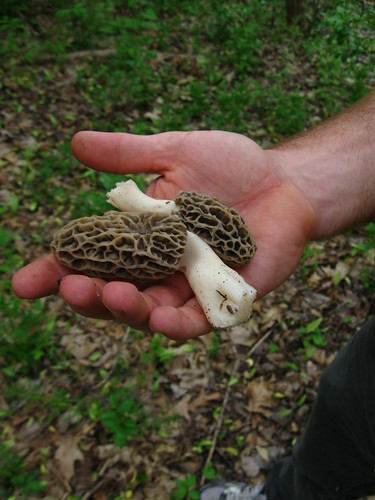 After about an hour at our last site (sorry folks, no comment), we only had two morels to show for it, and they were both found by BC. Still, these two would add to the small haul that BC and PE had managed to get earlier in the day.
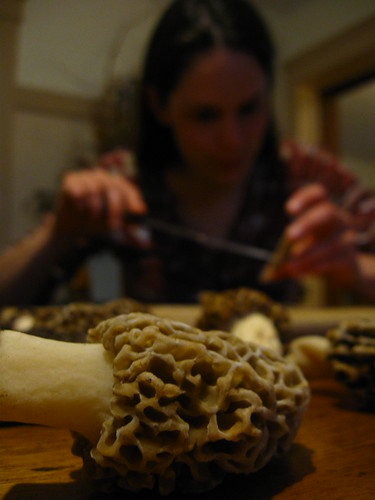 We headed back to BC's house. Together with other friends and housemates, we set to making a wonderful dinner for seven. The cutting preparation of the morels required a bit of work to ensure that bugs and worms (which often crawl up the fruiting body to live and enjoy the tasty morel, too) were removed before cooking. (As much as I don't mind a little extra protein, I felt that this step is warranted when one wants to have a nice meal.)
The final meal (chips with freshly made guacamole, grilled grass-fed beef steaks, organic pork chops, scalloped potatoes, chopped bacon and cabbage, peas cooked in butter, and (of course) the morels), was a wonderful combination of very earthy flavors, and melded flavors so very simply and very well.

The conversation softened as people tucked into their plates, BC playing the part of the host and making sure that all got enough food before sitting down himself. After about a minute of silent eating (well, silent eating interrupted with exclamations of how good everything tasted), the conversation started to meander lazily along many streams, flowing like a river lazily reaching its delta: slowly pushing through dense stands of personal experience, returning to the main channel of conversation, breaking off to surround and build memory sandbar, slowing down to near-stillness of pregnant pauses of conversation.
The evening ended, as evenings eventually must, and we all left, saying our good-byes, promising to help BC with his packing, loading, and moving come the start of the week. It was, in all, a great meal for a great friend.
I was able to join in on the last leg of the morel hunt, which took place in town (yes, they do grow here, but they can be hard to find). With my mycologist friend (BC) moving out of town, he was less reluctant to bring along some friends (PE, who was interested in learning how to hunt for mushrooms, and me, who was less interested in the hunting, and more interested in the company). BC and PE had already been to a few sites that day and, on their swing through town, picked me up for their last search site. (We stopped to pick up some additional fare: beer and complementary comestibles.)After about an hour at our last site (sorry folks, no comment), we only had two morels to show for it, and they were both found by BC. Still, these two would add to the small haul that BC and PE had managed to get earlier in the day.We headed back to BC's house. Together with other friends and housemates, we set to making a wonderful dinner for seven. The cutting preparation of the morels required a bit of work to ensure that bugs and worms (which often crawl up the fruiting body to live and enjoy the tasty morel, too) were removed before cooking. (As much as I don't mind a little extra protein, I felt that this step is warranted when one wants to have a nice meal.)The final meal (chips with freshly made guacamole, grilled grass-fed beef steaks, organic pork chops, scalloped potatoes, chopped bacon and cabbage, peas cooked in butter, and (of course) the morels), was a wonderful combination of very earthy flavors, and melded flavors so very simply and very well.
The conversation softened as people tucked into their plates, BC playing the part of the host and making sure that all got enough food before sitting down himself. After about a minute of silent eating (well, silent eating interrupted with exclamations of how good everything tasted), the conversation started to meander lazily along many streams, flowing like a river lazily reaching its delta: slowly pushing through dense stands of personal experience, returning to the main channel of conversation, breaking off to surround and build memory sandbar, slowing down to near-stillness of pregnant pauses of conversation.
The evening ended, as evenings eventually must, and we all left, saying our good-byes, promising to help BC with his packing, loading, and moving come the start of the week. It was, in all, a great meal for a great friend.
Sunday, May 08, 2011
At the AUT Bar
I'm sitting in the AUT Bar, having finished a nice repast while sitting next to two couples that don't really know what an "indoor voice" is. I've learned that one of them is trying to finish her dissertation (and another person at the table is telling her to make a schedule and stick to it; again and again she's saying this to her). Two others at the table are (apparently) nuclear/particle physicists (or engineers). The older of the two men is French and quiet. The younger is definitely not French and definitely not quiet. They spent most of the time that I was seated talking about this, that, and the other; merging conversations with as much skill as ... well, stereotypical physicists (or engineers).
However, the food was brilliant -- as usual. The weekend brunch is in celebration of three simultaneous things: the 25th anniversary of the AUT Bar, the recent Cinco de Mayo celebrations (with the bar being decked out with red, white and green; sunbursts and globes; different color palette on the tables; and paper cut-outs of sombreros and cacti), and Mother's Day (which is actually today, while the others are -- likely -- not). In celebration of their 25th Anniversary, I decided to get their Chile Relleno with eggs... y fue excelente y delicioso! (It it weren't for the discussions of dissertation-writing schedules and particle physics, it would have been like being back in one of the taquerias in Mexico City. ... Well, facing the full bar was a little different than the taqueria.)

However, the food was brilliant -- as usual. The weekend brunch is in celebration of three simultaneous things: the 25th anniversary of the AUT Bar, the recent Cinco de Mayo celebrations (with the bar being decked out with red, white and green; sunbursts and globes; different color palette on the tables; and paper cut-outs of sombreros and cacti), and Mother's Day (which is actually today, while the others are -- likely -- not). In celebration of their 25th Anniversary, I decided to get their Chile Relleno with eggs... y fue excelente y delicioso! (It it weren't for the discussions of dissertation-writing schedules and particle physics, it would have been like being back in one of the taquerias in Mexico City. ... Well, facing the full bar was a little different than the taqueria.)
In town on a Sunday
Yup, it's another Sunday of some memorialization during which I find myself in town. A couple of weeks ago, it was Easter, now it's Mother's Day. Soon it will be Memorial Day, and then Father's Day. Now don't get me wrong: I really have no problem with the days themselves; I enjoy Easter celebrations (well, most of them), I really do love my Mother and Father, and I really don't have anything against remembering the servicemen and servicewomen that have died in service to the US.
However, I really don't like the implication of the day. Living in Saginaw Forest, I get to 'enjoy' the (usually) significantly greater number of people who are out in the forest. *Sigh* I really don't mind that people are there, either, but I do mind when they decide to flout the rules. Well, I really don't like it when people flout the rules at any time, but I really don't like it when I get the response of, "But it's [X]'s Day. Can't I [break this rule]?" To me, this makes no sense at all. Would the people really be okay with encountering a burglar in their home on [X]'s Day saying, "Why can't I break the burglary law, it's [X}'s Day!"
Sure, no one is immediately being harmed by having a dog off of leash, however, for me, it's both a cumulative effect of people seeing other people with dogs off-leash then feeling that they can also do it along with the feeling that people really don't have much respect for the property.
So, instead of confronting people on a day that they are more happy than other days, I just avoid them by coming into town. After all, I don't want to be confrontational, either. Nor do I wish to remain ensconced in my house.
However, I really don't like the implication of the day. Living in Saginaw Forest, I get to 'enjoy' the (usually) significantly greater number of people who are out in the forest. *Sigh* I really don't mind that people are there, either, but I do mind when they decide to flout the rules. Well, I really don't like it when people flout the rules at any time, but I really don't like it when I get the response of, "But it's [X]'s Day. Can't I [break this rule]?" To me, this makes no sense at all. Would the people really be okay with encountering a burglar in their home on [X]'s Day saying, "Why can't I break the burglary law, it's [X}'s Day!"
Sure, no one is immediately being harmed by having a dog off of leash, however, for me, it's both a cumulative effect of people seeing other people with dogs off-leash then feeling that they can also do it along with the feeling that people really don't have much respect for the property.
So, instead of confronting people on a day that they are more happy than other days, I just avoid them by coming into town. After all, I don't want to be confrontational, either. Nor do I wish to remain ensconced in my house.
Saturday, May 07, 2011
Help day in Stinchfield Woods
Today was a help-day out at Stinchfield Woods. I decided to ride the 15 miles to Stinchfield Woods (mainly because I don't have a car, of course), and it turned out that the day was a really good one for removing invasive species: sunny and breezy for much of the afternoon.
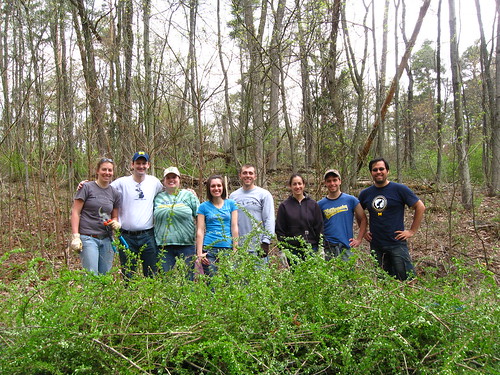
The final chop up (well the second half of what we pulled out of the area we worked).
After about 4 hours of doing some hard work, we decided to scratch the final hour -- partly because of impending rain, partly because the tarp was completely filled with Japanese barberry, and partly (mainly perhaps) because we were dog-tired. Therefore, we went up to the caretakers' cabin and had some hamburgers and hotdogs (and lots and lots of water).

Don't we all look really tired? :D
I raced back (along with another helper) most of the way back to Saginaw Forest, mainly because we (well, me, anyway) were trying to beat the threatening rain.
In the end, it was a great day of physical exertion. The only thing that I hope is that I didn't get too much poison ivy.
UPDATE: I just calculated my average speed to and from Stinchfield Woods to be 17mph. A personal best for a distance greater than 10 miles. Maybe I will have to change out my handlebars for something that gives me better aerodynamics.
The final chop up (well the second half of what we pulled out of the area we worked).
After about 4 hours of doing some hard work, we decided to scratch the final hour -- partly because of impending rain, partly because the tarp was completely filled with Japanese barberry, and partly (mainly perhaps) because we were dog-tired. Therefore, we went up to the caretakers' cabin and had some hamburgers and hotdogs (and lots and lots of water).
Don't we all look really tired? :D
I raced back (along with another helper) most of the way back to Saginaw Forest, mainly because we (well, me, anyway) were trying to beat the threatening rain.
In the end, it was a great day of physical exertion. The only thing that I hope is that I didn't get too much poison ivy.
UPDATE: I just calculated my average speed to and from Stinchfield Woods to be 17mph. A personal best for a distance greater than 10 miles. Maybe I will have to change out my handlebars for something that gives me better aerodynamics.
Saturday, April 16, 2011
Feeling tired
These past few weeks - for some reason - have been rather fatiguing for me. There is the now-normal fatigue of cycling every day (well, "sprinting on my bike" would be a better description of how I like to ride), however, there is more to it than that: there is a mental fatigue that I am starting to have; a sort of malaise that is settling on me.
I've felt this way before, of course, and I know what it is. (Or at least I would like to think that I know what it is.) It's a feeling of settling, of being sedentary. Some people seem to revel in the point of staying in one place. However, the feeling of being settled is itself unsettling to me. Perhaps it is that I grew up moving all over the place. Perhaps I would have felt this way regardless of my upbringing.
A part of me yearns to take a trip to Chicago for the remainder of the weekend. Or maybe to Seville, Spain. I don't know. Just somewhere that isn't "here." Somewhere that isn't anywhere related to "here." A place, you know, that is just far enough away that I am not thinking that I need to return to "here"; to settle "here"; to just be "here".
Sometimes, I can trick myself by meeting new people; hanging out with them; absorbing myself in their lives. You know, traveling away from "here" in another way. I've been doing this my whole life, and meeting new people isn't such a chore for me most of the time (especially when it is done in English - Spanish is more difficult for me).
The rain doesn't help. The threat of rain helps even less. Today it was the latter together with the fulfillment of the former. Staying cooped up in the forest on such a day - when I am feeling more "stuck" than usual - isn't mentally healthy. And I think that this mental malaise is one of the reasons why I have been more fatigued than normal these days.
(Okay, so there are other things that I have thrown myself into - including another committee - but I doubt that any of these things are actually the source of my problems. Indeed, they may be a symptom of them; a desire to "branch out" to "get away" from my regular, slowly settling life.)
Grey days are, perhaps, good days to think about these things a little more deeply than one would normally contemplate. Still, Toronto also sounds like a lovely place to escape to/visit for a while.
I've felt this way before, of course, and I know what it is. (Or at least I would like to think that I know what it is.) It's a feeling of settling, of being sedentary. Some people seem to revel in the point of staying in one place. However, the feeling of being settled is itself unsettling to me. Perhaps it is that I grew up moving all over the place. Perhaps I would have felt this way regardless of my upbringing.
A part of me yearns to take a trip to Chicago for the remainder of the weekend. Or maybe to Seville, Spain. I don't know. Just somewhere that isn't "here." Somewhere that isn't anywhere related to "here." A place, you know, that is just far enough away that I am not thinking that I need to return to "here"; to settle "here"; to just be "here".
Sometimes, I can trick myself by meeting new people; hanging out with them; absorbing myself in their lives. You know, traveling away from "here" in another way. I've been doing this my whole life, and meeting new people isn't such a chore for me most of the time (especially when it is done in English - Spanish is more difficult for me).
The rain doesn't help. The threat of rain helps even less. Today it was the latter together with the fulfillment of the former. Staying cooped up in the forest on such a day - when I am feeling more "stuck" than usual - isn't mentally healthy. And I think that this mental malaise is one of the reasons why I have been more fatigued than normal these days.
(Okay, so there are other things that I have thrown myself into - including another committee - but I doubt that any of these things are actually the source of my problems. Indeed, they may be a symptom of them; a desire to "branch out" to "get away" from my regular, slowly settling life.)
Grey days are, perhaps, good days to think about these things a little more deeply than one would normally contemplate. Still, Toronto also sounds like a lovely place to escape to/visit for a while.
Monday, April 11, 2011
Sunday, April 10, 2011
Long ride
In total, the ride was roughly 48 miles long.
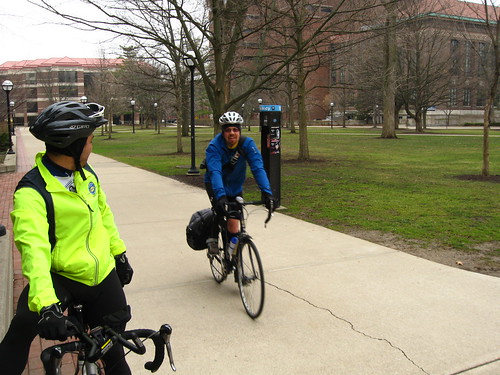
Heading out from the campus

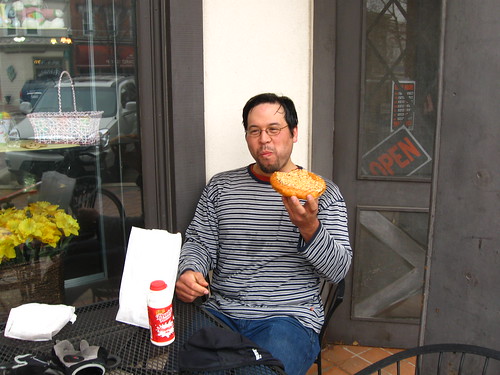
Yummy prune-filled cookie
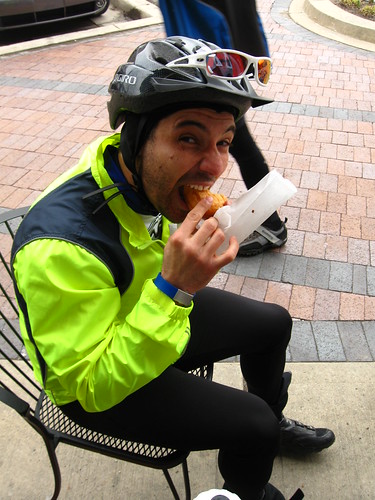
"Fried cinnamon" pastry
Custard creme
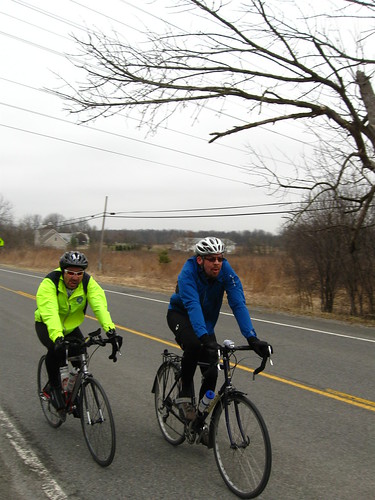
Heading along Whitmore Lake Road
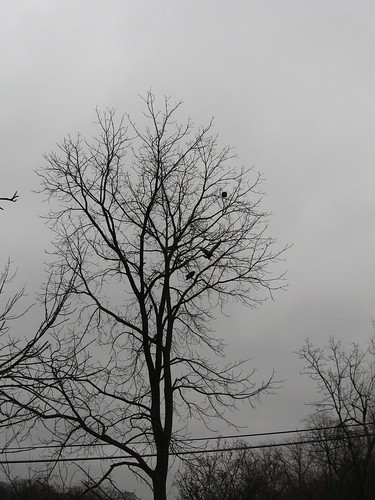
Buzzard tree

The trip -- which I'm counting as starting and finishing at my house -- went to the central campus, headed to Dexter along Huron River Drive (stopped at the Dexter Bakery for a little bit), headed north along Mast Road, turned right along Strawberry Lake Road until reaching Whitmore Lake, and then took Main Street/Whitmore Lake Road back to Ann Arbor, cut through Bandermer Park back to the central campus, and then back home.
Heading out from the campus
Yummy prune-filled cookie
"Fried cinnamon" pastry
Custard creme
Heading along Whitmore Lake Road
Buzzard tree

The trip -- which I'm counting as starting and finishing at my house -- went to the central campus, headed to Dexter along Huron River Drive (stopped at the Dexter Bakery for a little bit), headed north along Mast Road, turned right along Strawberry Lake Road until reaching Whitmore Lake, and then took Main Street/Whitmore Lake Road back to Ann Arbor, cut through Bandermer Park back to the central campus, and then back home.
Strange fauna in the forest
Sometimes, I have stumbled across some strange animals in the forest. "Strange" not in that the animal itself is strange, but rather "strange" in that they are not expected to be found in the forest (or at least a forest in Southeastern Michigan).
Last summer, there were feral cats, preceded in the winter by a Russian duck. Today, it was a peacock.
Last summer, there were feral cats, preceded in the winter by a Russian duck. Today, it was a peacock.
Saturday, April 09, 2011
Going for a bike trip...
Up until now, the longest bike trip that I've made was 34 miles. Today, I'm going for 40 miles...
Monday, April 04, 2011
Wooden xylophone in the forest, operated by gravity
Only in Japan?
From Copyranter:
From Copyranter:
(via the New York Times) “We did not add any artificial music at all,” said Morihiro Harano, creative director at Japanese ad agency Drill, Inc. I find that nearly impossible to believe. The video is for the Touch Wood SH-08C, a phone with an encasement made from discarded wood (Was the xylophone also made from discarded wood?) It will be released by NTT Docomo in Japan later this year. The commercial was filmed in Kama City in Kyushu, Japan.
Saturday, April 02, 2011
Yep: slower on studded tires
I just spent a whole lot of time working out whether I actually did ride my bike slower with my studded tires during the winter than on my road tires during the rest of the year. (Note: I ride only one bike, but I change the tires for the winter.)
Short answer: yes.
Longer answer: Examining the GPS-gathered data from mid-January 2011 until the end of March 2011, I was able to make two datasets. From January 2011 until mid-February 2011, I was riding on studded tires, and since mid-March, I was riding on road tires.
The total distance traveled from mid-January until mid-February was almost identical to the total distance traveled from mid-March until the end of March. (Yes, I didn't ride as often whilst snow and ice covered the ground; best to be safe than sorry.) The average speed during Jan/Feb was 8.9 mph. However, the average speed during mid-to-end-March was 10.1 mph; 1.2 mph difference.
Short answer: yes.
Longer answer: Examining the GPS-gathered data from mid-January 2011 until the end of March 2011, I was able to make two datasets. From January 2011 until mid-February 2011, I was riding on studded tires, and since mid-March, I was riding on road tires.
The total distance traveled from mid-January until mid-February was almost identical to the total distance traveled from mid-March until the end of March. (Yes, I didn't ride as often whilst snow and ice covered the ground; best to be safe than sorry.) The average speed during Jan/Feb was 8.9 mph. However, the average speed during mid-to-end-March was 10.1 mph; 1.2 mph difference.
Wednesday, March 30, 2011
3.77 miles / 14mins 49sec = 15.3 mph
Going at this speed, I was able to make it to the ELI three minutes faster than the bike estimate on Google Maps (and at about the same time as it took the driver that I kept catching up with). I also passed two other cyclists (safely, in the bike lane).
Okay, so my total time for the 3.99 miles was 17 minutes and 15 seconds (13.9 mph), which is still pretty good for a commuter bike with two boxy panniers... and having to wait for a few stops.
Still, I'm happy.
Okay, so my total time for the 3.99 miles was 17 minutes and 15 seconds (13.9 mph), which is still pretty good for a commuter bike with two boxy panniers... and having to wait for a few stops.
Still, I'm happy.
Wednesday, March 16, 2011
Sometimes, rebuttals take time, while at other times, they almost write themselves.
In a recent post at Treehugger.com (entitled "What If Every Environmentalist is Actually Wrong?"), I saw some pretty blatant denialist rants.... and so I (of course) had to reply.
From a "ghendric":
To which I replied (spending time on each strange point raised, but not spending enough time on editing):
Another commenter, Brian Ladwig, wrote the following one-sentence-per-paragraph post:
"Where to begin with all of these?" was my first thought. However, I quickly realized that, whereas Brian just made axiomatic claims with no supporting evidence nor lines of argumentation, I could just re-word his post to make a similarly axiomatic "counter-argument", thusly:
Sometimes, I really like it when people do most of the writing work, and all I have to do is copy-editing.
Finally, some people really make some strange arguments:
UPDATE: I really wasn't that happy about that paragraph about Mars, so I added more stuff to round out the explanation:
From a "ghendric":
In the 1970's global cooling was all the rage and we were going to throw ourselves into an ice age because we just wouldn't stop polluting.. Jump forward 40 yrs... Global warming is now the debate and we are all going to burn in a sudden flash of heat and then get put out by the rising water from all that melted ice from the polar poles.. You know, I've been around for a good 5 decades now and I know a scam when i see one. The truth of the matter is, it's really all about control. Those in high places think that we can't govern ourselves and that we are too ignorant to think that we can solve this on our own. Instead of offering solutions to "fix climate change", we get rules and regulations that prevent us from doing the right thing. All these rules and regulations do is weaken our country as a whole and makes us vulnerable. America is in a steady decline now because of these things. If they really wanted to fix the climate, they would do something about it instead making Al Gore filthy rich by buying his carbon credits. Buying carbon credits will not change the climate. All it does is make people poorer and Al Gore rich. Want to do the right thing? Expose Al Gore for the fraud he is. Give us real solutions.
To which I replied (spending time on each strange point raised, but not spending enough time on editing):
The "1970s were all about global cooling" is a canard. Anyone who has read anything objective about the politics of this topic can see through this point. You are either oblivious to it's outright falsehood or are consciously complicit in its spread.Following this, there was some more back-and-forth between ghendric and other commenters, with ghendric falling back on the "I'm older than you, so I'm right" argumentation that I find so confusing. If age were the determining factor of who was right, then my argumentation that I'm much older than his 10-year-old self who saw how global cooling was "all the rage" in the 1970s ought to be the only piece of "evidence" I need, especially since he later says, "I don't have to present any scientific evidence. I was there junior.. I know what happened." Yes, ghendric may have been there, but ghendric was 10 years old, while I am much older now (when I am looking at the evidence for global warming) than when he was looking at the evidence for global cooling, and (using his own logic), I don't have to present scientific evidence (or even rational reasoning, as I did) to be right.
"We are all going to burn in a sudden flash of heat..." is an acutely obvious straw man argument. No one credible has made this outrageous caricaturization of what global warming is. (Before you --- or anyone else --- says it, Al Gore didn't make this claim in his slide-show film. If you believe that he did, your memory has been affected by your personal biases. Go back and watch it again.)
Attacks against one specific person (Al Gore in in this case) is ad hominem and utterly fails to actually talk to the actual science of global warming. While I have no personal like or disdain for the former vice president, I really don't understand how vilifying him (specifically and repeatedly) actually helps do anything other than to create a (false) target for attack. Ad hominem attacks of this nature do nothing positive, advance no positive proposition, and appear to show a lack of insight of the situation by the person making the argument.
Randomly introducing a topic that was never discussed in the actual piece (which also happens to be framed in a red-herring manner) --- I'm talking about your sudden dropping of carbon credits into your comments --- but happen to have a tangential association with a solution that you then inveigh against without actually substantiating the basis for your annoyance. Beyond insinuating that this is "all about control" (by whom and for whom you never say, and I doubt that Al Gore --- as much as you appear to hate him --- is not the one seeking this control), you fail to back up your assertions (let alone provide an iota of evidence that you know what you are talking about when it comes to carbon credits).
You say that you've been around "for a good 5 decades now", but have you learned over that period of time how to actually make a genuine, intellectually honest and well-reasoned argument, or are you having an off day? I only ask because the evidence above seems to indicate that, while you have managed to cultivate good diction, in my opinion this is the only erudite facet of your entire comment.
(Note: this last paragraph, unlike ghendric's comments of Al Gore isn't an ad hominem attack, since I use evidence presented by ghendric to show how his --- I am assuming that ghendric is male --- comments demonstrably rely on false argumentation, are not each developed fully, and have been falsified repeatedly elsewhere. As opposed to ghendric's comments about Al Gore and carbon credits --- if one can make ad hominem attacks against non-human entities that ghendric appears to have reified --- which are --- to restate the above in slightly different terms --- based on intellectually dishonest, knee-jerk, multiply-debunked arguments that are maintained only through non-genuine argumentation of various forms of false logic.)
Another commenter, Brian Ladwig, wrote the following one-sentence-per-paragraph post:
This cracks me up. There is no legitimate science behind climate change claims at ALL, PERIOD!!
There can be no legitimate scientific claims regarding climate change PERIOD!!
Why you ask? Because we do not have enough data, nor can we ever have enough data.
We have roughly 150 years or so of real pertinent climate data. The earth has exist for 4.5 BILLION years.
This means the data that we have to work with is ~.000000003% of the data that could exist had climate been recorded since day 1.
The ignorance of the "green" movement is unbelievable.
If global warming is true then why does Mars have atmosphere of 95% CO2 yet it does not warm noticeably faster than the earth?
Most green movement people do not even realize the REAL definition of a greenhouse gas. CO2 cannot be a greenhouse gas because it is a natural part of our environment and atmosphere.
The problem is the chicken little effect.
The brutal truth is, we are NOT crusading to save our environment. The planet was here billions of years before humans and will be here billions afterwards. Human existence is but a blink of an eye in the sands of time.
The fact of the matter is the GREEN movement is doing much more damage to humans than pollution ever has or ever will by destroying economies, dictating political importance and and creating division among human beings.
I am doing my part though, I only buy items packaged in disposable plastic packaging, I only buy bottled water, and I make sure I never own a vehicle that gets more than 20 MPG.
I leave every single light I have in or outside my house on 24/7 I keep my AC on 365 days a year set to 65 with the Windows open and I make sure absolutely NOTHING goes into a recycle bin.
Why is it that none of the green movement people ever talk about the fact that volcanic eruptions are the largest producers of CO2 on the planet.
Mt. St. Helens by all reasonable estimates released about 25% as much CO2 in a single eruption as humans have since the beginning of the industrial revolution.
Let's talk facts here and not supposition based on ~0.000000003% of the actual data needed to determine what is going on.
"Where to begin with all of these?" was my first thought. However, I quickly realized that, whereas Brian just made axiomatic claims with no supporting evidence nor lines of argumentation, I could just re-word his post to make a similarly axiomatic "counter-argument", thusly:
This type of comment cracks me up. There is legitimate science behind climate change claims, PERIOD!!
There are legitimate scientific claims regarding climate change, PERIOD!!
Why you ask? Because we do have sufficient data, and we are continuing to accumulate more data.
We have roughly 150 years or so of real pertinent climate data. The earth has existed for 4.5 BILLION years, but has never had the impact of human activity until this final ~.000000003% of the existence of the earth.
The ignorance of the "skeptic" movement (read: "denialist") is unbelievable.
Since global warming is true, Mars (with its atmosphere of 95% CO2) is much warmer than it ought to be, considering its distance from the earth.
Most denialist movement people do not even realize the REAL definition of a greenhouse gas. CO2 is a greenhouse gas and is also a natural atmospheric constituent molecule.
The problem is the ostrich-in-the-sand effect.
The brutal truth is, we are NOT crusading to save our environment. The planet was here billions of years before humans and will be here billions afterwards. Human existence is but a blink of an eye in the sands of time, but could be a very short blink if we don't learn to adapt.
The fact of the matter is the DENIALIST movement is doing much more damage to humans than pollution ever has or ever will by destroying economies, dictating political importance and and creating division among human beings.
I am doing my part though, I only buy items with minimal packaging, don't buy bottled beverages, and I make sure I minimize my automobile use.
I turn off my lights when I'm not in the room, I don't use air conditioning, but leave the windows open (because I don't want to spend money heedlessly) and I make sure that as much as possible goes into a recycle bin.
Why is it that the skeptic movement people only ever want to talk about the fact that volcanic eruptions are the largest producers of CO2 on the planet, forgetting that there is a difference between constant and dispersed CO2 generation by people and temporally and spatially concentrated CO2 generation by volcanoes?
For example, Mt. St. Helens by all reasonable estimates released about 25% as much CO2 in a single eruption as humans have since the beginning of the industrial revolution, but did so over a much shorter period of time, and has effectively stopped doing so since, while humans continue to emit CO2 (and at an increasing global rate).
Let's talk facts here and not obfuscate and confuse actual data for misunderstandings of scale, source, and effect.
Sometimes, I really like it when people do most of the writing work, and all I have to do is copy-editing.
Finally, some people really make some strange arguments:
The last time we had a spate of "global warming" (CO2 1000ppm) the earth invented... chocolate.I really didn't know what to make of this one. Was this commenter mistaking climate for weather? Was this an argument that we don't know what's happening because climate has changed in the past? Was this an argument that humans couldn't possible affect climate, but that it's all because of the sun? ... and what is this about the evolution of chocolate, anyway? Given so many choices, I decided to answer the "it's changing" canard, while also (later) having a go at the "evolution of chocolate" statement:
Think long and hard before you think you've got it all down pat. Cooling, warming,... it's all changing all the time. How many peer-reviewed studies on global warming considered the totality of the variations in the input from... the sun?
So... we don't need to worry because humans never caused global warming before, and so we can pretend that the conditions of a pre-human earth are somehow equivalent to today (even though there is plenty of evidence that we are the main reason for the release of CO2 into the atmosphere, a process that was PREVIOUSLY driven by the wobble of the Earth's axis, the arrangement of the continents, and the influence of the sun)?
... or are you saying that since global warming happened at the same time as the evolution of chocolate, more global warming would necessarily create the conditions under which more delectable delights would evolve?
UPDATE: I really wasn't that happy about that paragraph about Mars, so I added more stuff to round out the explanation:
Since global warming exists, Mars (with its atmosphere of 95.32% CO2) is much warmer than it would be, considering its distance from the sun, than if it had an atmospheric CO2 concentration more similar to that of earth's (~0.039%). However, the Martian atmosphere isn't being affected by increases in anthropogenic CO2 (since there are no humans on Mars releasing CO2) nor decreases caused by photosynthesis (since there are no plants on Mars utilizing CO2 to make sugars), and its surface temperatures are therefore affected by purely physical processes analogous to what affected the earth before the past ~.000000003% of earth's existence.
Wednesday, March 09, 2011
Do Americans prefer "global warming" or "climate change"?
From today's annarbor.com:
In a recent study at UC Berkeley, researchers found that people were more likely to report believing in the terms "GLOBAL WARMING" if they were asked when they were in a warmer condition (not outside in the sun, but also inside a warm, windowless room).
The work was published in Public Opinion Quarterly by Schuldt, et al.
UPDATE: According to one report, the 2010 Russian heat wave was normal:
More people believe in “climate change” than “global warming,” according to a University of Michigan study.Of course, the terms are effectively synonymous during our current epoch. The climate changes because the globe is warming. (Regardless of what is causing the warming, the global climate is changing.) One cannot look at local weather for one day (or even one week) and attribute it to climate change. Okay, so we had a lot of snow this winter, and we heard the cries of, "Where's global warming when you need it?" This cry only showed how provincial the criers' view was. While we were getting snowed on, Australia was suffering from record heat waves, Brazil, South Africa, Australia, and Bolivia (and likely other S.Hemisphere countries) suffered massive floods, the biggest hurricane on record hit Australia only a few weeks ago... Similarly, Ann Arbor had a relatively mild summer in 2010, so people yelled out "global warming hoax!" Meanwhile, Russia burned and the totality of the N.Hemisphere had the warmest weather on record (or at least tied for the warmest).
And down party lines, the topic might not be as divisive as TV’s talking heads make it seem - at least, when it’s called climate change.
For the study, researchers asked a national online sample of 2,267 U.S. adults to report on whether global warming or climate change is a serious problem.
In a recent study at UC Berkeley, researchers found that people were more likely to report believing in the terms "GLOBAL WARMING" if they were asked when they were in a warmer condition (not outside in the sun, but also inside a warm, windowless room).
A new study finds that when people feel warmer—either because they are out in the hot sun or because they are in an overheated room—they believe in global warming more. The findings were published online Jan. 20 in the Journal of Personality and Social Psychology.Too many people, IMHO, attribute feeling warm (at the moment) with the term "global warming" to make it a useful term, since it still will get cold in the winter.
...[Risen and Critcher] found that participants answering [their] questionnaire in a heated cubicle were more likely to believe in global warming, suggesting that it was the experience of heat, not the information that it conveyed, that impacted people’s beliefs.
The work was published in Public Opinion Quarterly by Schuldt, et al.
UPDATE: According to one report, the 2010 Russian heat wave was normal:
The intense heat wave in Russia "was mainly due to natural internal atmospheric variability," the scientists reported in a paper to be published in Geophysical Research Letters.
The cause in this case, they said, was a strong and long-lived blocking pattern that prevented movement of weather systems. Blocking patterns occur when the high-level jet stream directing the movement of weather develops a sharp wave pattern. This forces storms to move around an area while conditions there stagnate.
Thursday, March 03, 2011
Gas prices in comparison
Here in Concepcion, Chile, the gas prices listed on the gas stations show 717 pesos. Using an online currency converter, this turns out to be $1.51. Not too bad, eh, especially considering that gas prices in Ann Arbor, MI is in the range of $3.36-$3.59.
This seems to make such stories as "A gas station sign of the times" worth merit: gas prices have gone up $0.15-$0.25 in two weeks, caused mostly be increases in the price of oil, cause mostly by the fighting in Libya. However, taking the price of ~$3.47 (the midpoint of the price range) in Ann Arbor as a base price, and comparing it to the $1.51 in Concepcion, Chile, is such a rise really such a financial hardship?
Well, looking at Purchasing Power Parity (PPP), using various comparative national metrics between the US and Chile (with the understanding that Ann Arbor and Concepcion aren't necessarily representative of the national metrics, but let's continue):
IMF 2010 statistics:
USA: $47,123
Chile: $14,982
World Bank 2009 statistics:
USA: $46,436
Chile: $14,331
CIA World Factbook 2010 statistics:
USA: $47,400
Chile: $15,500
OECD 2009 statistics:
USA: $45,674
Chile: $14,346
In other words, the relative PPP of the United States is 3.15 times larger than in Chile. If gasoline prices matched this relative PPP difference, then taking the midpoint Ann Arbor price of $3.47, then the relative price in Concepcion, should be around $1.10, as opposed to the standing price difference of a 2.30 times difference.
HOWEVER, the price of $1.51 for gasoline in Concepcion is dollars per liter, while the price of $3.47 is dollars per gallon. Translating the Chilean prices into dollars per gallon, one gets a Chilean gasoline price of $5.72/gallon... which is 1.64 times larger than the prices in Ann Arbor. In other words, in a country with a PPP that is slightly less than 1/3 that of the United States, the actual gasoline prices are 1.64 times larger than in the United States.
Looking at prices for petrol (aka "gasoline") in my alma mater, St Andrews, UK, one finds the price ranging from 126.90p to 131.90p, and an average price of 128.11p. Doing the conversions: 128.11p/liter = $2.09/liter = $7.90/gallon (i.e., TWICE the price in Ann Arbor).
The photo in the story "A gas station sign of the times" does show a sign of the times, but it is only troublesome when one thinks about how the United States has become so dependent upon gasoline for everything. People live in such a pattern that many have to drive to work, have to drive to shop, have to drive most places they wish to go, even if most daily car trips are less than 2 miles (i.e., a 30 min walk or 12 minute bike ride).
This seems to make such stories as "A gas station sign of the times" worth merit: gas prices have gone up $0.15-$0.25 in two weeks, caused mostly be increases in the price of oil, cause mostly by the fighting in Libya. However, taking the price of ~$3.47 (the midpoint of the price range) in Ann Arbor as a base price, and comparing it to the $1.51 in Concepcion, Chile, is such a rise really such a financial hardship?
Well, looking at Purchasing Power Parity (PPP), using various comparative national metrics between the US and Chile (with the understanding that Ann Arbor and Concepcion aren't necessarily representative of the national metrics, but let's continue):
IMF 2010 statistics:
USA: $47,123
Chile: $14,982
World Bank 2009 statistics:
USA: $46,436
Chile: $14,331
CIA World Factbook 2010 statistics:
USA: $47,400
Chile: $15,500
OECD 2009 statistics:
USA: $45,674
Chile: $14,346
In other words, the relative PPP of the United States is 3.15 times larger than in Chile. If gasoline prices matched this relative PPP difference, then taking the midpoint Ann Arbor price of $3.47, then the relative price in Concepcion, should be around $1.10, as opposed to the standing price difference of a 2.30 times difference.
HOWEVER, the price of $1.51 for gasoline in Concepcion is dollars per liter, while the price of $3.47 is dollars per gallon. Translating the Chilean prices into dollars per gallon, one gets a Chilean gasoline price of $5.72/gallon... which is 1.64 times larger than the prices in Ann Arbor. In other words, in a country with a PPP that is slightly less than 1/3 that of the United States, the actual gasoline prices are 1.64 times larger than in the United States.
Looking at prices for petrol (aka "gasoline") in my alma mater, St Andrews, UK, one finds the price ranging from 126.90p to 131.90p, and an average price of 128.11p. Doing the conversions: 128.11p/liter = $2.09/liter = $7.90/gallon (i.e., TWICE the price in Ann Arbor).
The photo in the story "A gas station sign of the times" does show a sign of the times, but it is only troublesome when one thinks about how the United States has become so dependent upon gasoline for everything. People live in such a pattern that many have to drive to work, have to drive to shop, have to drive most places they wish to go, even if most daily car trips are less than 2 miles (i.e., a 30 min walk or 12 minute bike ride).
Sunday, February 13, 2011
Photos
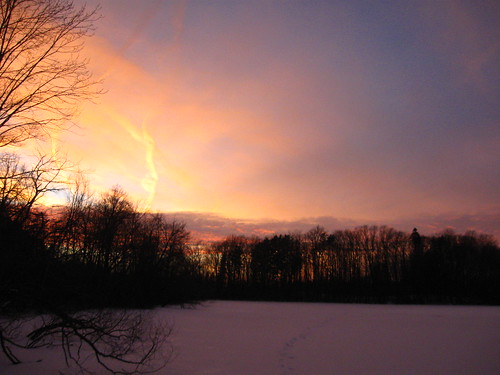
End of the second day of thaw: powerful sunset.

I ended up getting cold feet...
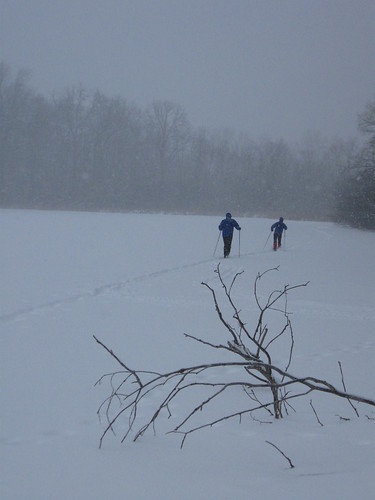
Skiing on Third Sister Lake

Even the ~8 inches of snow didn't stop the University of Michigan from holding classes. However, the city of Ann Arbor wasn't so gracious as to remove all the snow in a timely manner. (Hint to students who drive: don't do it after a blizzard, even if the University is holding classes.)
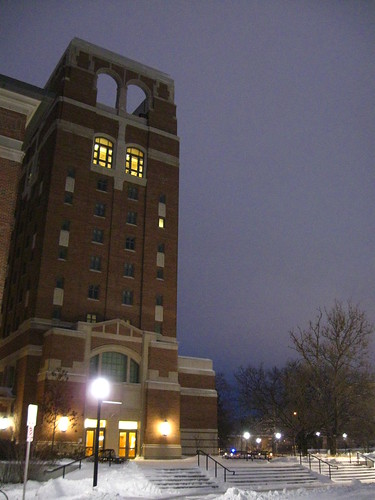
Early morning out front of the North Quad.
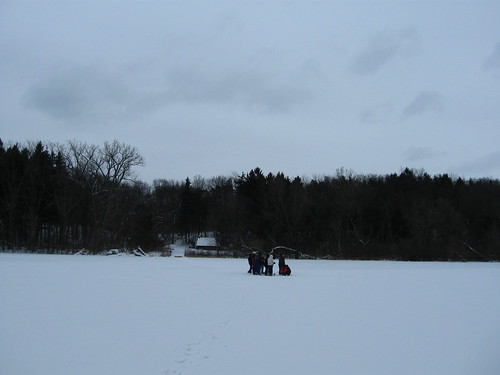
An undergraduate class on winter ecology out on Third Sister Lake. (It happened to be REALLY cold and windy that day, but they soldiered through heroically.)
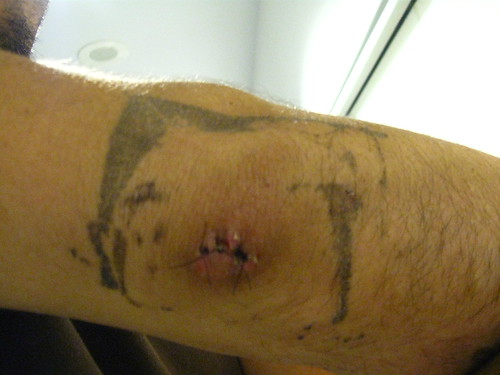
Last day with stitches.
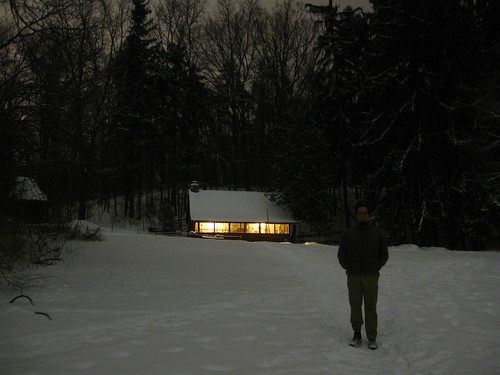
Night in Saginaw Forest.

Mock-up of the Law School facade.
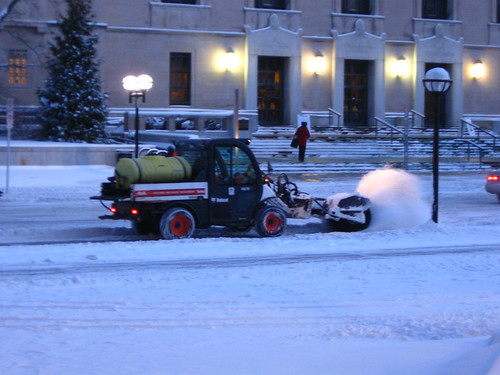
One of the many snow-brushers used by the University of Michigan to clear snow from walkways.

Yummy, yummy soon to be in my tummy at Frita Batidos.
Tuesday, February 08, 2011
Other sources of fueling our lives
Here are two additional options for energy sources. After all, why put all your energy eggs in one basket?
Insects as power sources:
Of course, this might be less useful in Michigan winters... If it could somehow store up summertime energy collection for the rest of the year. Now THAT would be an idea!
Left-over beverages as power sources (via Inhabitat):
Well, I don't know: I tend to finish my beers and sodas... In a world powered by wasted beer and soda, would this make me a bad person?
Insects as power sources:
Of course, this might be less useful in Michigan winters... If it could somehow store up summertime energy collection for the rest of the year. Now THAT would be an idea!
Left-over beverages as power sources (via Inhabitat):
The $500,000 plan is being spearheaded by New Brunswick Community College’s Bio-energy and Bio-products Applied Research and Technology facility in Grand Falls, New Brunswick, Maine. The research team will use Milco Industries’ waste soda and beer for the trial. Traditionally the unwanted liquid is deposited in landfills, which can cost the company between $100,000 and $200,000 in disposal costs. However, with the plant’s new ethanol system, this beer and soda will be converted into 250,000 to 500,000 gallons of ethanol yearly. If the pilot project is a success, it is believed that Milco Industries will acquire an even larger-scale ethanol plant for their own internal use.
Well, I don't know: I tend to finish my beers and sodas... In a world powered by wasted beer and soda, would this make me a bad person?
Wednesday, February 02, 2011
Happy New Year! (of the rabbit)
Happy New Year! It's now the Year of the Rabbit!
From the website of the Chinese Cultural Center of San Francisco:
From the website of the Chinese Cultural Center of San Francisco:
1915, 1927, 1939, 1951, 1963, 1975, 1987, 1999(Happy Groundhog Day, as well.)
People born in the Year of the Rabbit are articulate, talented, and ambitious. They are virtuous, reserved, and have excellent taste. Rabbit people are admired, trusted, and are often financially lucky. They are fond of gossip but are tactful and generally kind. Rabbit people seldom lose their temper. They are clever at business and being conscientious, never back out of a contract. They would make good gamblers for they have the uncanny gift of choosing the right thing. However, they seldom gamble, as they are conservative and wise. They are most compatible with those born in the years of the Sheep, Pig, and Dog.
Massive snowstorms ARE predicted by global warming theory
With all the snow storms this winter (I'm in one right now), the question of, "how can global warming be real?" has come up often.
There are many posts that patiently explain the various reasons why more snow doesn't automatically mean no more global warming. A brief summary is found at Inhabitat:
In the southern hemisphere, the increased warming of the oceans during the hottest global year (that 2010 was) has caused massive flooding in Australia and Brazil as well as South Africa, as well as increased the magnitude of the hurricanes "down under". And this is what is happening concurrently with the snow storms in the northern hemisphere.
It is naive to only cast your view to the borders of the United States when trying to think about GLOBAL warming.
There are many posts that patiently explain the various reasons why more snow doesn't automatically mean no more global warming. A brief summary is found at Inhabitat:
The answer is simple: global warming causes more precipitation, which translates to more snow when temperatures dip below 32 degrees [F].
There is a clear consensus in the science community that climate change will cause more frequent and more intense storms. Storms, of all types, result from energy in the atmosphere — the more heat, the more energy. Considering that 2010 was the hottest year on record, it should be no surprise that we’ve already seen multiple mega-blizzards this season. As Al Gore explained to Bill O’Reilly, “A rise in global temperature can create all sorts of havoc, ranging from hotter dry spells to colder winters, along with increasingly violent storms, flooding, forest fires and loss of endangered species.”
In the southern hemisphere, the increased warming of the oceans during the hottest global year (that 2010 was) has caused massive flooding in Australia and Brazil as well as South Africa, as well as increased the magnitude of the hurricanes "down under". And this is what is happening concurrently with the snow storms in the northern hemisphere.
It is naive to only cast your view to the borders of the United States when trying to think about GLOBAL warming.
I don't understand...
I don't understand why some people find it so difficult to realize that being raised in a gay family is independent from being raised well. Nineteen-year-old Zach Wahls gives a personal statement to his government in Iowa, which just voted to support a constitutional amendment to ban same-sex marriage.
Now that's some powerful testimony.
Now that's some powerful testimony.
Wednesday, January 26, 2011
An interesting -- if poorly titled -- map
I saw this map while scrolling through The Daily Dish, and although I find it interesting (due to many reasons, the greatest of which is that of what data sets were used), I wanted to point out the ambiguity of the title: "What is your state the worst at?"
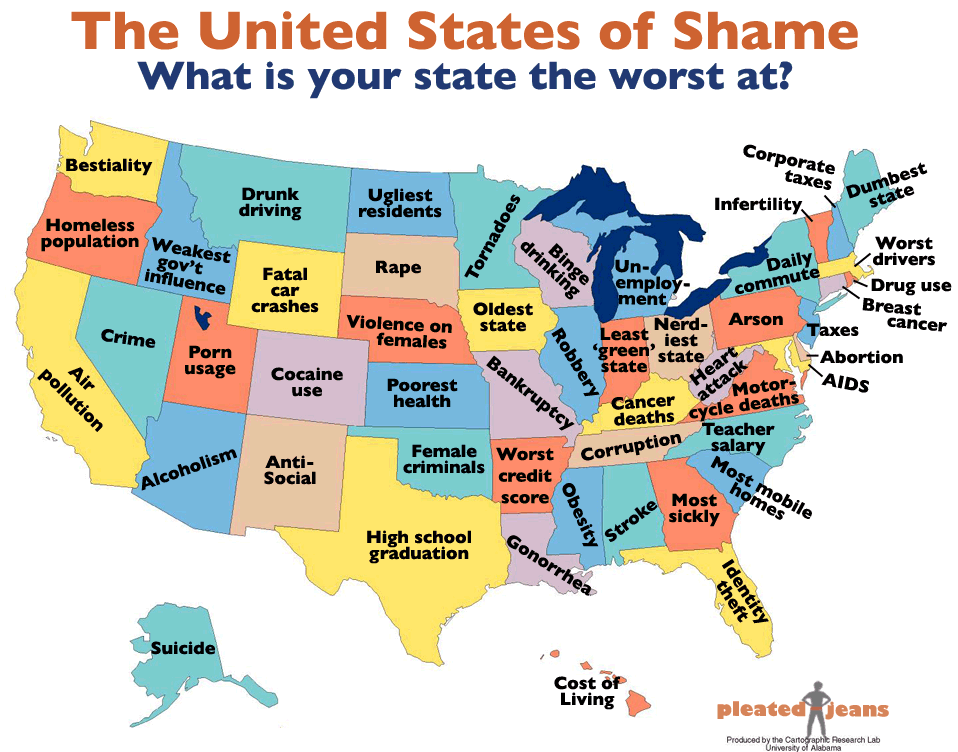
This type of phrasing is what gets people into trouble, especially non-English speakers. To show you what I mean, take the example of Michigan. Apparently, Michigan is "the worst at" unemployment. So... does this mean that the ability of Michigan to successfully accomplish unemployment is low (i.e., that unemployment is low; that employment is high)? No. The same thing for almost everything, save for aspects that are not inherently negative.
This points to the implicit understanding of a negative statement (or question) and the correct (culturally dependent) response to that statement (or question). We understand that Michigan has very high levels of unemployment (one of the worst in the country), which, strictly speaking, makes Michigan the worst at employment (although Nevada presently has the highest unemployment levels). Similarly, we understand that Arkansans have (on average) the worst credit scores in the country, which, strictly speaking, makes Arkansas the worst at credit management.
Conversely, when looking at concepts that are not inherently perceived as negative (e.g., teacher salary or high school graduation), the cognitive dissonance is much lower. The literal and implied meanings behind the label showing Texas being the worst at high school graduation seem pretty coherent, as does the label showing North Carolina being the worst at teacher salaries (although, to be pedantic, it would be more accurate to say that they are the worst at the monetary compensation of teachers).
Then there is "tornadoes"... How can a state be "the worst at" tornadoes? The phrasing of "is the worst at" implies something influenced by society. Tornadoes aren't (AFAIK) a social phenomenon. However, tornado damage is. But how does the viewer know what characteristic of tornadoes is being cited as "the worst"?
In the end, the map is humorous and informative... if (respectively) the viewer understands something about the states and understands the logic behind (what is effectively) a double-negative.
Map originally from here.
UPDATE: A counter-map was made over at Political Language.

At least this map doesn't suffer the problems of language as the one above. However, I have one general question: How can Arizona do "sunniest" well? I mean, I suppose they could have the most social groups (government and private) that enhance the culture of sunniness. However, I think that the label is based on data on the number of sunny days, and not the number of sun societies.
This type of phrasing is what gets people into trouble, especially non-English speakers. To show you what I mean, take the example of Michigan. Apparently, Michigan is "the worst at" unemployment. So... does this mean that the ability of Michigan to successfully accomplish unemployment is low (i.e., that unemployment is low; that employment is high)? No. The same thing for almost everything, save for aspects that are not inherently negative.
This points to the implicit understanding of a negative statement (or question) and the correct (culturally dependent) response to that statement (or question). We understand that Michigan has very high levels of unemployment (one of the worst in the country), which, strictly speaking, makes Michigan the worst at employment (although Nevada presently has the highest unemployment levels). Similarly, we understand that Arkansans have (on average) the worst credit scores in the country, which, strictly speaking, makes Arkansas the worst at credit management.
Conversely, when looking at concepts that are not inherently perceived as negative (e.g., teacher salary or high school graduation), the cognitive dissonance is much lower. The literal and implied meanings behind the label showing Texas being the worst at high school graduation seem pretty coherent, as does the label showing North Carolina being the worst at teacher salaries (although, to be pedantic, it would be more accurate to say that they are the worst at the monetary compensation of teachers).
Then there is "tornadoes"... How can a state be "the worst at" tornadoes? The phrasing of "is the worst at" implies something influenced by society. Tornadoes aren't (AFAIK) a social phenomenon. However, tornado damage is. But how does the viewer know what characteristic of tornadoes is being cited as "the worst"?
In the end, the map is humorous and informative... if (respectively) the viewer understands something about the states and understands the logic behind (what is effectively) a double-negative.
Map originally from here.
UPDATE: A counter-map was made over at Political Language.
At least this map doesn't suffer the problems of language as the one above. However, I have one general question: How can Arizona do "sunniest" well? I mean, I suppose they could have the most social groups (government and private) that enhance the culture of sunniness. However, I think that the label is based on data on the number of sunny days, and not the number of sun societies.
The topography of American swearing
I came across a link to a map from Cartastrphe on the topography of swearing in the United States' 48 contiguous states (one can download a ~12MB pdf of this map at the Cartastrophe site). As one can imagine, metropolitan areas tend to have higher swearing levels than other places, but there are some interesting points.

1. As Huffman points out in his entry, Utah is a depression-point in the swearing topography,
2. I noticed that Flint, MI seems to be the epicenter of Michigander swearing (side note: "Michigander" is in the Firefox spell-checker, while "Obama" still isn't),
3. The lower reaches of the Mississippi River is like a tall (if somewhat short) range of swearing mountains, and is much more contiguous than the swearing mountains that connect the major cities of the South (from Atlanta to DC).
H/T Flowing Data
1. As Huffman points out in his entry, Utah is a depression-point in the swearing topography,
2. I noticed that Flint, MI seems to be the epicenter of Michigander swearing (side note: "Michigander" is in the Firefox spell-checker, while "Obama" still isn't),
3. The lower reaches of the Mississippi River is like a tall (if somewhat short) range of swearing mountains, and is much more contiguous than the swearing mountains that connect the major cities of the South (from Atlanta to DC).
H/T Flowing Data
Saturday, January 22, 2011
Cycled the equivalent of going to Shreveport
Well, since July (when I started recording miles cycled) I've definitely cycled further than the 1050 miles that show up when doing a direction search for bike riding from Ann Arbor. If I made a conservative estimate, it would be closer to 1500 miles (about the biking distance to San Antonio, TX).
Well, after all those miles cycled -- almost all of them commuting to work -- I got clipped yesterday while making the morning commute. It ended up with 4 stitches in my elbow (caused by a contusion), scrapes along my thigh (destroying my trouser leg), and a contusion on my shin (nothing more than what one might get in playing soccer). My bike turned out to be fine, so at least I didn't have to pay out more for bike parts.
Well, after all those miles cycled -- almost all of them commuting to work -- I got clipped yesterday while making the morning commute. It ended up with 4 stitches in my elbow (caused by a contusion), scrapes along my thigh (destroying my trouser leg), and a contusion on my shin (nothing more than what one might get in playing soccer). My bike turned out to be fine, so at least I didn't have to pay out more for bike parts.
Tuesday, January 18, 2011
Let the short-term melting commence!
It's shortly after 2am, and the temperature has crossed over the freezing point, inching into melty territory. So... look forward to icy roads, y'all!
Monday, January 10, 2011
The Americas seem to be lagging behind the world when it comes to mobile web access
Over at the FedEx website, there is an interactive atlas of the world, showing different social characteristics of the world's countries, changing their size (but keeping their rough shape) to represent different variables.
Turns out that the Americas are quite far behind the rest of the world when it comes to mobile web access. (I don't know how this was measured, but the graphic really makes for an interesting way of looking at the world.)

H/T: Flowing Data
Turns out that the Americas are quite far behind the rest of the world when it comes to mobile web access. (I don't know how this was measured, but the graphic really makes for an interesting way of looking at the world.)

H/T: Flowing Data
Thursday, January 06, 2011
Monday, January 03, 2011
Few people @ GP
Not too many people at the peak tonight... I suppose that the people aren't all back in town yet... Perhaps next week there will be better turn out.
Saturday, January 01, 2011
Changing views of the forest
Happy New Year! Over the months, I have taken photos of the lake from the front of the cabin. Putting them in chronological order, one can see the progression of the seasons...
Subscribe to:
Posts (Atom)