Wednesday, July 14, 2010

Projecting beyond the data = bad methodology

As tempting as it might be to extrapolate what seems to be a very obvious curve, it is methodologically wrong to do so for very many reasons. The biggest one is that you don't know what the data will actually show when you look beyond it.

Today, the Pharyngula blog presents this graph of THE FUTURE:


It purports to show the demise of Christianity in the year 2240, based on about 40 years of data that begin around 1970. From this, the extrapolation for the next 230 years is done as a straight line, and that's just methodologically insanely incorrect.

True enough, the graph does seem to show a very strong linear correlation from 1970ish to 2010ish, but all that means is that we know the trend during the time. It might be able to say something about 2011, maybe even something about 2015. However, the further out one draws the graph based only on this single parameter (percentage of Christians in the US), the less powerful the prediction, and it does nothing to model the underlying drivers of that parameter.

When constructing a relationship that provides predictive power, the dependent variable (the value on the y-axis) needs to be a result of the independent variable (the value on the x-axis). Only then can you say that by increasing the value of x can you determine the value of y. The best sort of such predictions are with things that have direct cause-effect relationships, such as with simple kinematic equations.


Since simple kinematic equations deal with direct cause-effect relationships (because they assume no friction and free movement of the mass), it is possible to say that if I have a mass moving with an initial velocity of 10 m/s, and an acceleration of 0.1 m/s/s, then after 10 seconds, the mass would have traveled 105 m -- even if I didn't actually move a mass with that velocity and acceleration for that amount of time. However, the prediction is only correct in a condition where there is no friction -- which is a rather limiting assumption. However, kinematics still work very well, even with this limitation, because they implicitly describe a deterministic outcome based on specific variables.

In the graph presented (facetiously) by Pharyngula, the year is not something that is a predictor of the percentage of Christians in the US. If it were, then the US would have had a greater-than-100% population of Christians during the 1950s! Furthermore, if year were a predictor of the percentage of Christians in the US, what does it mean when it goes negative after 2240? No. Of course not. This shows in another way why the relationship cannot be extrapolated beyond beyond the data. In many cases, what year you are in is not a great predictor of a phenomenon.

When I was taking undergraduate biology, I took one class of sport science (a.k.a. kinesiology). In it, one of the lecturers pulled up a graph of the changes in performance of male and female athletes over a variety of track events over time. All this was part of an explanation that while male athletes are able -- due to major physiological differences between men and women -- to have significantly faster sprint times than women, the two sexes were much more even when it came to long-distance running. She pointed to a series of graphs that showed how female sprint times -- while declining throughout the 1980s -- remained greatly above males and how female long-distance running times had been declining rapidly, and seemed to be approaching that of males. She made the unfortunate error of hypothesizing -- based on the existing trend -- that female runners would catch up to male runners within the next 20 to 30 years. I think of this example every time I look at extrapolating from a limited dataset, and I will try to re-create the latter here.

If we were in 1981 (I will use 1981 instead of 1996 -- when I was a student at university taking that class -- because it describes a situation that can be then tested based on currently existing data, as you will see), and were looking at the yearly best times for men's and women's 1500m outdoors track races, we would see that over the previous 10 years, women's 1500m times had been dropping more precipitously than men's times. Following that trend as a linear function, we would have then made the prediction that women would be running the 1500m faster than men by the year 2005. However -- not too strangely -- this didn't happen, and women -- although closing the gap -- have not yet equaled or surpassed men in terms of yearly 1500m track races (it's a similar story for the Boston Marathon).

Why haven't female 1500m athletes surpassed male 1500m athletes, and why did they look like the could have done so in the first place? The reasons for this explanation of why looking only at the year to predict future performance is a bad methodology. In this specific case, I chalk it up to two major reasons: training and physiology. Women have only recently been allowed to compete in the 1500m (and Boston Marathon); starting in 1970 (and 1966). During those years when there was no ability to get official sanction to compete in international events, there was little incentive for women to train in the event, and so the pool of potential athletes from which to draw was much smaller, less funded, and -- as a result -- were slower than the runners of today. (Running technology and training practices have also evolved over time, which can only add to the differences we see between the runners of today when compared to the runners of 40 years ago.) However, after women were allowed to compete in long-distance running, more money allowed for better training and for a larger pool of athletes. This meant that during the initial years of officially sanctioned competition, the ability of the athletes improved as well as the raw talent pool, thus precipitously dropping the resulting annual best times. However, at some point during the 1980s, women started to approach the physiological limit of the human body (even if we assume that running technology and training practices have continued to improve over this time as well). From this point on, women's times seem to have remained effectively unchanged, oscillating up and down, but hovering always just under 240 seconds (4 minutes). In contrast, during the same period, men already had a relatively large talent pool (raw talent) from which to draw, and had probably reached the limits of physiology based on previous training, and the slow improvement over time is likely due to advances in running technology and training practice. However, just like the women's best annual times hover around 240 seconds, the men's best annual times hover around 210 seconds. I would imagine that neither men's nor women's record times will really significantly decrease without some major advance in running technology or change in physiology (or the allowance of performance-enhancing drugs).

This explanation that rests behind the change in women's best annual 1500m times pre1980s compared to post-1980 presents a mechanism (that I personally think is plausible) as to why the imaginary extrapolation done in 1981 has never happened. It shows, also, why doing such extrapolations (even over a relatively much shorter period of time than the graph presented in Phyrangula) is fraught with problems.

Going back to the presented graph, we therefore have to determine what might be the underlying reasons for the decline, and whether there would there be a leveling-off of the decline of Christians as a percentage of the US population. I believe that the major forces behind this trend might be immigration and disillusionment. The United States has had increased immigration from non-Christian countries since the 1970s. There has also been an increased distancing from Christianity during this time as people feel there is less relevance given to them by Christianity (or possibly any religion) in their daily lives. These are the two major reasons (increase of the population of non-Christians and people leaving Christianity) for a decline. Immigration alone will not lead to an eradication of Christianity in the population, and it would also be unlikely to follow a linear trajectory. The introduction of non-Christian immigrants to a population shouldn't be seen as an absolutely negative thing, however, since it provides Churches with a new population from which to draw followers; these people may not be disillusioned by Christianity, like those who "left the fold."

People moving away from the Christian faith is likely to create a change in the process of conducting the faith as the Christian Church (as a whole) or smaller denominations attempt to keep the faith relevant to those who have "lost the way". In other words, the Church will (again, like it has several times in the past) have to re-model itself in order to keep itself relevant to a changing perception of existence and man's place in it. In other words, Christians are highly unlikely to just stand idly by and let Christianity fade into oblivion.

In the end, it seems unlikely that in an ever-increasing cosmopolitan country, domination by one religion at a percentage greater than 95% seems less and less possible. People want to come to the US, even though they aren't Christian. People who are Christian may well feel that it no longer applies to their lives. And people will be introduced into Christianity. The same is likely to happen with all the other religions, philosophies, and codes that abound in the country.

Bottom line: Christianity dead by 2240? It's bad methodology, and the underlying social mechanisms that keep social institutions alive will not allow for it to happen.

Saturday, July 10, 2010

Cycled to Shadow Art Fair in Ypsi

I decided to cycle out to the Shadow Art Fair in Ypsi today. I'd never cycled out to Ypsi before, but knew roughly how to do it: go along the river, following the Borders to Borders (aka B2B) trail to Ypsi. I also knew roughly where the Shadow Art Fair was being held -- the Corner Brewery -- and so I felt pretty confident.

IMG_2835On the trip out, I had to make a detour to Great Lakes Cycling and Fitness to ask a small question about my bike before heading down Pauline and toward the Geddes neighborhood. (The Geddes neighborhood is known for its lack of a grid pattern, and its turn-around roads which make cutting through a difficulty.) Due to my lack of knowledge of the Geddes neighborhood, I soon found myself back out on Washtenaw Ave, but instead of trying to find another way to cut through (because I know there are ways to do it), I just decided to stop off at Walgreen's and pick up some M&M's (bike fuel, donchaknow?). I bumped into some colleagues walking back home with their young kids as I continued by going up Huron Parkway, and they were either impressed or incredulous that I was cycling out to Ypsi. "Keep hydrated!" was the advice I was given as I continued on my ride. Luckily, I had about 1.5 liters of water -- 0.5 of which was cold and in a thermos.


IMG_2841I reached Gallop Park and quickly found the B2B trail, and headed out, at roughly 15mph, but soon found myself at what looked to be a dead-end (or at least being shunted north into the Fleming Creek watershed instead of continuing east-ish along the Huron River). I recognized the Parker Mill when I rode up to it, and knew that I was going in the wrong direction. Apparently, I had messed up somewhere... I backtracked, checking all the possible outlets, but they all seemed wrong. As I continued backtracking, I found another B2B sign (these things are not always that large or obvious) pointing up the hill, along the access road, and up to the bridge. Oh, well, I guess I have to continue on the road.


A desolate playground
Surprisingly, the bike lane was quite wide, and very smooth, and I was soon speeding again along toward the Shadow Art Fair. Once I reached St. Joe's Hospital, I saw that the B2B trail circled to the north, but on the sidewalk this time. I continued along that one -- a very nice piece of sidewalk, with bike and foot paths labeled at curves -- until I reached Eastern Michigan University campus. At this point, I lost the B2B trail. Whether this was due to the construction going on in EMU, or just because I was blind, but I ended up just riding along the road leading to the stadium before I reached a dead-end, cut over a hill, cycled someway through campus, and then finally ended up near the water tower.


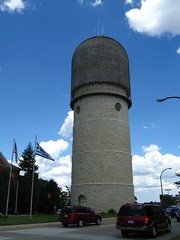
Ypsi water towerAh! The water tower. A landmark against which I had some sort of bearing. I stopped to take a photo of the Spanish American War monument placed in front of the Domino's Pizza (the original store, I believe...) and another of the most phallic building in America before continuing into the downtown area. ... which I quickly learned was a cycle-in-the-street-only section of the city, and I would have liked to comply, except for that section of street that I was on was blockaded for some reason, so I continued on foot, walking my bike toward Michigan Avenue, and the downtown of Ypsilanti.

All my memories of going to the Corner Brewery were from Frog Island park, and so my plan had been to head there, and then cut through the park to go to the brewery. However, once I arrived at the park, I saw that there was a large music festival going on. Two fluorescent-yellow T-shirted event staff members told me what I had rolled into: Elvis Fest.

"Elvis Fest?" I asked, blank-facedly.. I hadn't heard that there was a celebration for the King of Rock. Apparently, though, I was ill-informed, since a large part of Frog Island park was covered with concert-goers. "I'm trying to get to the Shadow Art Fair. Do you know where the Corner Brewery is?" I asked the man as the woman walked over to a newly arrived car to show where to park.

"Shadow Art Fair?" The guy was as lost about it (and the Shadow Art Fair) as I apparently was about Elvis fest. We stared at each other, amazed at the other's lack of what should have been such plain-faced knowledge. "Maybe this guy'll know," he said, pointing to a random man walking in to enjoy Elvis Fest. "Hey, buddy, do you know where the Shadow Art Fair or the Corner Brewery is?"

Long pause as the man spent time to take in the words, realize that we were asking directions (and not telling him that he had come to the wrong event) and then some more time as he thought about the best way for me to cycle there. "Umm...." he started. "If you take... no. If you, no. Wait."

Inside shadow art fair
Eventually, he got it, and I was back on my way, and once I made my way to the other entrance to Frog Island Park, things became more familiar. There was the Michigan Ladder Company factory, and the Corner Brewery was only a little distance away!


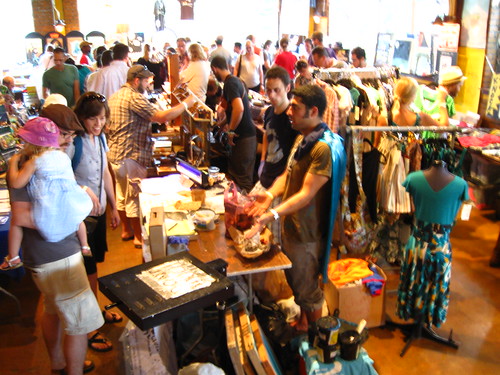
The building was not as packed as in previous years, but it was still fun. (I learned later that the events this year were spread across a few venues.) As I walked around the vendors inside the brewery, I sipped on a Sacred Cow IPA (yummy), and after chatting with a potter and a T-shirt artist, I went outside to listen to the band for a little bit. However, they were just finishing up their set, and intervening period was seemed that it would be filled with me baking slowly in the sun, so I decided to head back into the bar area. Sitting at the long bar, I ordered the high-alcohol Arborealis IPA (also yummy) and took a self-portrait.


Extra strong IPAWhile the Shadow Art Fair was originally the destination of my excursion, now that I was there, it didn't hold as much interest as it did when I was planning my trip. Indeed, the trip itself was a lot more exciting and interesting than the shopping inside. So, after another circle around, I headed out and back to Ann Arbor.

Since I basically knew the way back (I again got turned around in the EMU campus), and I didn't stop to take photos, the trip back took about half the time, and I soon found myself near Depot Street, Ann Arbor, so I decided to pay a visit to to Ft. Hiscock and the residents there... some of whom were just then getting ready to head out to the Shadow Art Fair! Still, I stayed for a little cool-down and catch-up before heading the final 4 miles back to the forest.

In total, the trip today was 34.33 miles. Compared to my last long cycling excursion (with my old Giant hybrid bike), this roundtrip was a lot more enjoyable (less windy, less hilly, and a better bike), and faster, too. Now that I know that the trip to Ypsi isn't so bad (and in some ways easier than cycling to Dexter), I might go more often. ("Might" being the key word there...)

Wednesday, July 07, 2010

Anthropocentrism and saving the world

A recent posting over at Soc Images made me return to some of my ideas about justifications for a conservation ethic. In the post, lisa talks about how an ad pits hopelessness against hopefulness, using some false logic:
Text:
Saving the world isn’t easy. Saving a life is.
Just one pint of blood can save up to three lives.
The ad commits two fallacies.
First, it compares saving the whole world (or maybe every tree in the world) with saving just “a” life. Saving a life may, indeed, be easier than saving the whole world, but it’s not a fair comparison. Saving the whole world is hard, but about as hard as saving every life on it.
Second, it suggests that we have to choose. “You could try to save the world,” the ad says, “but it’s pretty hopeless. It’s much easier to save a life. So put down that tree and donate blood.” Giving blood, then, is placed in competition with environmental activism as if (or because) volunteerism is a zero sum game.
I'm not going to get into the arguments that people had about whether the ad as actually presenting logical fallacies or not. (You can look at that long thread of comments, if you really want to.) However, there were a few points that some commenters made that did make me respond. These were based on the argumentation that human life is fundamentally more important than other life.

One commenter (Perseus) left the following comment in response to a comment about the importance of trees on the quality of human life:
Have you considered that trees grow back, and that human lives are irreplaceable? Hmmm?
Another commenter (AR), who had actually started the thread, left the following comment in response to the same importance-of-trees comment:

Trees aren’t that important, to my understanding. Contrary to popular belief, most oxygen is produced from algae, not trees, and any sequestering effect trees have on pollutants is temporary since all of that gets released when trees decay. Indeed, they can even contribute to global warming, depending on latitude, because their relative darkness traps more heat from sunlight than would the green house gases they absorb, which are released when they die anyway.
But even granting for the sake of argument that all of that is false, you’re still back at saving human lives, not trees for their own sake, so that doesn’t contradict what I’m saying.
I won't discuss here the problems with AR's scientific understandings, but will focus more on his second paragraph, alongside what Perseus wrote. Although I answered both Perseus and AR, I will just present my response to AR:
you’re still back at saving human lives, not trees for their own sake, so that doesn’t contradict what I’m saying.
This is the same false equivalency that Perseus appears to make. You seem to be implying that humans’ unique, individual natures are what makes each human worth saving, as opposed to trees, for which you hold no value with regard to their unique, individual natures.
Of course, all of that is implied in your statement. However, change out the organisms (either with new ones, or by switching their place). Suddenly, you can see that the two categories are not equivalent:
“You’re still back at saving trees, not human lives for their own sake, so that doesn’t contradict what I’m saying.”
… but it does, AR, but it does.
Of course, being human, we are predisposed to thinking of each person as being unique and important (because of and in addition to our own “human-ness” and ability to perceive each other’s uniqueness). However, why is the intrinsic importance of one more individual in a population of 6,800,000,000 different when the next individual (the 6,800,000,001st) is an member of a species of tree, dog, or snake, instead of a human?
According to your apparent argument (and Perseus’ more heavily implied argument), the 6,800,000,001st human is fundamentally more important than the 6,800,000,001st tree, dog, or snake. But what makes that human more important? Is it because you are human that you make that distinction? If so, at what point does a tree, dog, or snake become more important than the 6,800,000,001st human? When there are only 2 left (hopefully a mating pair)? When there is only 1 left (and thus meaning that the species will be gone forever once it dies)? Or never? (And if the reason is not based on you being a human, then what is your non-anthropocentric reason for the intrinsic importance of humans that you imply?)
NOTE: I’m not a misanthrope, but I do see the implications behind your (and Perseus’) argument as being not fully thought out. If you have, however, thought out the implications of your stance, then you have “merely” presented what I perceive to be a gross error of argumentation, as outlined above.
And I really think that this is true: we justify the saving of human life over other life by implicitly giving it more value than other life (even the save-the-trees comment to which both Perseus and AR were replying based the reason on how it helps humans). Given a choice between killing a parrot (cue Monty Python's "Dead Parrot" sketch) or a human (or even allowing one to die versus the other), I would choose to save the human, and I would imagine that most people would do the same. Never mind that humans number in the range of nearly 7 billion, and therefore the loss of one human is statistically non-significant to the population, whereas many species of parrots have near-extinct population levels, and the loss of one individual is statistically significant to the population.

This is one of the problems with many conservation movements: we need some reason to care about the protection of the environment, and the reasons that seem to create the strongest response (both for and against conservation) involve how action will affect "us" (either as humans generally speaking, or to "us" as a nation, region, or smaller group). The strong conservation organizations in the United States are based on hunting and fishing organizations -- groups of people who find utility in the outdoors, preferring more natural settings in which to do their activities. (Indeed, the implicit meaning behind "outdoor conservation" -- or similar labels -- in the United States is often that it is to protect the ability of the land and/or water to support certain types of human activity.)

One of the strongest images for environmental protection is the World Wildlife Fund's panda, and charismatic megafauna are commonly used to rally support for protection efforts. The reason why charismatic megafauna are important is usually not because of their position in an ecosystem, but rather because of their position within a social system, and how their perceived charisma can help create an umbrella of support for other organisms or ecosystems that need protection.

Even the various definitions of the popular concept of "sustainable development" is contingent upon human action. Indeed, the etymology of the phrase combines two very human concepts: sustainability -- which requires an understanding of resource (a human concept) management (a human concept) -- combined with development -- which requires a conceptualization of a desired future (based, likely, around a human conceptualization of what exactly IS desirable). In a recent article on the topic at Treehugger, Matthew McDermott points in the direction of anthropocentric justification when he describes what he calls the point around which sustainable development revolves:
All of human activity needs to stay within the ecological carrying capacity of the planet; it needs to not consume resources in excess of the ability of ecosystems (both planet-wide and more locally) to regenerate those same natural resources. Anything else compromises both the ability of the present generation to meet its wants and needs and the ability of future generations to meet theirs.
Of course, much this central point rests on the assumption that humans are somehow important, something that McDermott mentions in his article:
All of these factors contribute to a sustainable environment, but there's one other factor that is crucial and steps beyond many conceptions of sustainable development: The recognition that the planet and all species within it do not exist solely for human benefit and use. We may use them, within limits, but everything out there that is non-human is not rightly viewed through the lens of human utility.

We are part of the whole, not the sum of it nor separate from it. We cannot exist sustainably without it--in wonky terms, without the ecosystem services provided to us free of financial charge by clean air, clean water, clean and fully functioning habitats. Preservation of those, even at current levels (as degraded as they are based on what we know existed from historic record), is the big question that sustainable development attempts to address.
But although McDermott says that it is vitally important -- if we wish to have sustainability -- to incorporate this into the decision-making processes that run our (human) world, he doesn't attempt to answer how to strengthen non-anthropocentric arguments for conservation. I would argue that unless and until we can think beyond ourselves as towns, regions, and nations -- beyond ourselves as a species, even --we won't be able to really have sustainable development.

This could happen via technological fixes, all working to close the gaps caused by regional and nationalistic viewpoints. By closing all the holes by using technology, by linking human progress explicitly into the health of everything around us, we could potentially form a society that would be forced -- due to self-preservation -- act sustainably. However, that would still rest on an anthropocentric justification for action.

I don't know how one might transcend self-interest, let alone species-interest, to get toward a form of sustainability. Heck, in a time when we are living with intense nationalist fervor in several countries, I don't know how we can get beyond a tribalist viewpoint of the world... Perhaps Malthus will have the last laugh in the end: a post-world-wide population decimation (due to war, famine, disease, and death) to bring populations back in line with a regional carrying capacity. This would, too, be a form of sustainability, I suppose.

UPDATE: Perseus apparently wanted to respond to my comment. Here is what how he justified the relative importance of humans over trees:
Human lives are irreplaceable because the neural network in every human is entirely unique. The personality, the thoughts, the creativity and knowledge are like no one else. No other animals have that capacity, and trees are even far below animals. Trees can regrow, but nobody can replace a human brain. Trees also don’t have complex nervous systems. They can’t feel or think. They are simply reactionary things programed by their metabolisms.
I just couldn't leave it alone. Really, it reads (to me) like a serious jumble of circular logic based on false equivalency. So I decided to tell him so:
Your justification is that the human brain is unique (never mind the pedantic point that “entirely unique” is redundant). I will give that to you, while pointing out that every organism with a brain has a unique brain, thus making the presence of unique brains brain not — in itself — something special about humans. A poor opening salvo, but let’s see how you progress.
You point out that only humans have the capacity to have personality, thoughts, creativity, and knowledge like we do. However, that merely downplays the unique abilities that other species have that humans lack. I could easily say that only trees have the ability of making sclerenchyma and parenchyma (i.e., wood); photosynthesize across a wide array of photo-aspects and seasons, produce fruiting bodies to which many animals are evolved to eat; grow to heights unrivaled by other organisms in nature; etc. All of these reasons are just as valid for being characteristics of what is “valuable” as the ones you provide.
However, you base the remainder of your argument on the assumption that it is BECAUSE we have these traits, that we are higher than “lower” organisms like trees (and presumably other animals).
However, you present a false argument: humans are better than other organisms because they are the only animals that have human characteristics. This is circular logic.
You also fail to provide a means of classifying things that are not human into “higher” and “lower” beings. If things are to be classified as “high” or “low” based on how human-like they are (which is the only rule that I can divine from your statement), then how do you classify plants as “lower”, since they are of a different set than humans?
Such an classification of “lower” (and presumably, therefore, a presence of a “higher”) is based on a false equivalency and would be analogous to saying that pocket watches are better than DVDs because you can tell time using a pocket watch. The false equivalency of my statement is because I placed a member from another group in with the group for which I had a rubric for “being good.”
Seriously, if you just feel — axiomatically — that humans are better than trees (and there is nothing wrong with taking such a point of view: it’s perfectly natural), than just say so without trying to rationalize it, since when you do try to rationalize it, your logic fails because it is based on false equivalency and circular logic.
I really wonder if he will "get it" or not. If not, well, I suppose that's his problem. If so, then perhaps the next time will merely say, "Humans are more important than other organisms. Q.E.D." (or the like). Making an axiomatic statement like that is fine, since I haven't figured out a way of really justifying it -- or why people should save things that aren't human -- any other way, and if I can't come up with a train of logic that can justify it, then I shouldn't argue when someone else just cuts the logical reasoning and provides an axiomatic statement. (At least, I shouldn't argue until I am presented with a good one.)

Beat 35mph (56kph)

On my cycle in this morning, I was finally able to beat 35mph coming down the hill on Liberty. My recorded speed was 35.4mph, but I could swear that I saw a 36mph reading when I glanced down at the Garmin on my wrist. (If I was going 36mph, then it wasn't for a long enough interval to be recorded...)

Now what? 40mph? At 35mph, I was already encountering aerodynamics issues that made continued acceleration difficult. I suppose I might be able to do it if I removed my panniers, my front rack, and change my handlebars to something that would get my torso lower...

But... YAY!

Monday, July 05, 2010

Things SLoooooW in town today

Things are very slow in town today. True, it's only 9:30AM on a federal holiday (since Independence Day fell on a Sunday this year), but seriously: I saw more activity yesterday!

I really don't want to do a whole lot in Saginaw Forest today -- I woke up, walked outside, and was greeted by a feeling that I hadn't felt since I was visiting Guam: steamy (not just warm and humid). The insects were singing, and birds were calling, and I got the sensation of (again) being in a tropical setting. And it's supposed to get up into the 90s today, with a heat index of near 100F. Urgh. The only thing that I had going for me is my dehumidifier to keep things dry, and therefore let evaporative cooling take effect. So, for that reason, I came into town.

Well, that and the opportunity to take advantage of some of the birthday deals that are to be had around Ann Arbor. To see an unconfirmed list of deals that are available around Ann Arbor, check out ArborWiki. I already cashed in on the 6 free bagels at Zingerman's, and now I'm eyeing up the free breakfast at Northside, too...

Sunday, July 04, 2010

Happy Birthday to me, or why I can celebrate my birthday over two days.

In my passport, my birthdate is listed as "5 July." And yet, I am already celebrating my birthday. Yes, it is the 4th of July right now, so why can I justify it? Just because I want to cash in on the Independence Day celebrations in the US? No, not really (although it does play a little into it -- see below). The main reason why I can justify it is because I was born on Guam on 5 July. And when it was the 5th of July on Guam, it was still the 4th of July in the continental United States. So... since I was born on Guam, and I am now living in the continental United States, I can say (rightly) that it is already my birthday when the calendar reads "July 4" in Michigan.

But, why do it? Well, for a few reasons. True, I don't know of other people who do what I do, but I have decided to do it because July 4th is a major holiday in the United States, with barbeque parties, fireworks, very little traffic (in Ann Arbor), and generally good spirits. In comparison, July 5th is usually a difficult time to hold a gathering. If July 4th is on a Thursday, then people take a long weekend, and are away for my birthday. If July 4th is on a Friday, people are already away on my birthday (likely having left the city on July 3rd) -- and something similar happens if it were on a Saturday. If Independence Day is on a Sunday (like this year), many people take off the following Monday (my birthday). Only when Independence Day is on a Monday, Tuesday, or Wednesday is there a chance that people will be in town on my birthday on July 5th. However, no one wants to party, because they have spent too much time, money, and stomach space the day before to really want to celebrate.

... so I just celebrate my birthday based on Guam time. And it's been my birthday (on Guam) for several hours already. And now I'm off to a barbeque, quietly celebrating my birthday, like I do most years. I actually didn't grow up with large birthday parties, since most people (or, indeed, my own family) were away for summer vacation while I was growing up, meaning that my memories of most of my birthdays were with only my immediate family. Therefore, being happy in the company of friends while celebrating the birthday of the United States, while vicariously celebrating my own is actually quite nice, thankyouverymuch.

(Happy birthday to me... Happy birthday to me...)

Saturday, July 03, 2010

"Organic" doesn't necessarily make someting "better"

Just because something is "organic" doesn't make it better for you, especially in the calorie-counting department. The concept of "organic" is greatly divorced from the calorie count of the object. However, just like the "fat-free" craze if years past, the idea of "nutrition" seems to be trumping the idea of "healthy". In a recent study conducted at the University of Michigan, it was found that people used the wrong sort of inference about the "organic" label.
The researchers showed more than 100 study participants nutrition information for a regular Oreo cookie and for one that was made with organic flour and sugar. The nutritional label clearly showed a serving size (two cookies) of 160 calories for both Oreos. Nevertheless, 38 percent of the participants thought that the organic cookie had fewer calories than competing brands, whereas only 12 percent did so without the organic claim.
Part of this makes me want to just "face-palm", but it is also understandable: people don't always think through the implications of new information. It might just go into a mental map of "organic is good for me, therefore if I eat organic foods, then I will be more healthy." The first part of this may well be true (although the bulk of evidence supporting the idea that organic food is physiologically better than 'conventional' food is not in), there are more ways for organic foods to be "good" for a body than in calorie counts.

Calorie counts are calorie counts. At some level they are interchangeable. Therefore, if one is counting calories on a non-organic food, its organic counterpart has basically the same number of calories. True, calories from fat have different physiological impacts than calories from protein. True, too, the physiological pathways of different simple sugars are different, but still... at a basic level calories are calories, and at this level, the mistake that the participants make is analogous to the one in which people say that a pound of feathers is lighter than a pound of bricks.

On Independence Day Comestibles

Although I didn't grow up celebrating United States Independence Day, save for the relatively low-key events at American Clubs in Tokyo, Taipei, and Budapest, I knew that much of the food served on those days seemed to revolve around meat: specifically hamburgers and hot dogs.

These two words, to a child with a modicum of interest in etymology, provided a conundrum: why is it called a hamburger when it contains no ham (since a cheeseburger does contain cheese), and why is ti called a "hot dog" when I was pretty sure that it didn't contain any canine meat... As I grew up, I realized that how I was thinking about "hamburger" was incorrect, since the meaning of "burger" remained unknown, but was likely related to German, and "ham" was a word from French. It seemed unlikely that there would be a creation of a portmanteau to call a food item something unrelated to its origins (and what kind of food was a "burger" anyway?).

However, I learned second-handedly that words ending with "-er" used a German kind of conjugation, and Hamburg was a city in Germany. I had also learned that "Berliner" was used to mean a "jelly doughnut" (thus making President Kennedy's statement, "Ich bien ein berliner!" simultaneously a major political statement as well as a potentially humorous statement after the fact (but I was unaware of this latter point at the time, only that the term "Berliner" could have been related to people from the city, or a food from it). Therefore, using this logic, "hamburger" could well refer to a food from the city of Hamburg. And, then I remembered that when my family would go to a particular "European-style" restaurant in Tokyo, my father would order a "Hanbaagu-steeki" (aka. "Hamburg steak"), which was a pan-fried ground beef patty (without a bun). This logic seemed to fit with my new hypothesis that a "hamburger" was a food from Hamburg.

This was later confirmed by a girlfriend I had who was from Hamburg. (All of this hypothesizing occurred before the advent of Google, Yahoo! Answers, Wikipedia, and other on-line helpful guides.) It turns out that I could just as easily have looked it up in a dictionary, but for some reason, that never crossed my mind.

The term "hot dog" still evaded me. I had heard the reasoning that it looked kind of like a dachshund, and when shortened to "dachs, one can imagine it shifting its pronunciation to "dog"; the cooked variety being (therefore) a "hot dog". I had also heard the rumor that they were called "hot dogs" because there used to be dog mixed into the meat, but I choose not to give credence to this particular rumor.

While living in the UK, I came across the term "beef-burger", which seemed to me to be an unfortunate redundancy that focused too much on the term "ham" than on the origin of the word. However, it did follow the "accepted" form of word-root substitution that created the term, "cheeseburger", and the use of the simple "burger" had become well-known in both the US and the UK, so why not call a burger made out of beef a "beef-burger" instead of the more ambiguous "hamburger"?

On a side note, I always find it funny how things get imported into different languages, especially from English. In Japan, the words for "hamburger" and "cheeseburger" are both directly transliterated into ハンバーガーand チーズバーガー; there is no inherent meaning to the characters. In Taiwan, the word "hamburger" is transliterated to "漢堡", but since Mandarin doesn't use an alphabet, the characters convey the meaning of "Han (like the Chinese people) fortress" (which is a little strange). The word "cheeseburger" is "乳酪漢堡" means "cheese-hamburger", using the Mandarin word for "cheese" as well as the transliteration of "hamburger". In Hungarian, the words for "hamburger" and "cheeseburger" are "hamburger" and "sajtburger", respectively, following the conjugation structure originally found in English, translating the term "cheese" from English to the Hungarian "sajt". What is funny (to me) in that the pronunciation of "sajt" ("shite") made for ordering a cheeseburger at McDonald's quite an honest statement, "Yes, I would like a shite-burger, please!" And I would get one without a bit of irony.

Anyway, a few years back, I came across the website "World Wide Words" -- a website that discusses the origin and use of phrases and words. Something that a word-nerd like me would like. Its entry on "burger" was quite expansive. And its entry on "hot dog" is also quite explanatory.


All of these thoughts came back to me when I saw the link on dictionary.com for the Hot Word Blog's entry: "It's called "hot dog" for a gross and silly reason. Plus, "hamburger" history."


Writing this post made me wonder, though, exactly how the "national cuisine" surrounding United States' Independence Day became dominated by foods that came out of Germany. Surely, a country known for having bouts of antagonism against the United States (starting with Hessian mercenaries fighting alongside the British in the American War of Independence) shouldn't be from whence our national palate derives? But then, whence? And why not? The waves of German migrants that came in the 18th century had a major impact on the culture of much of the Midwestern and Western United States. Also, foods high in protein (i.e., meat) and lipids (i.e., fat and oil) are also what we evolutionarily crave, thus making them "tasty" and "popular".

Friday, July 02, 2010

Nothing to Envy

I just finished reading Nothing to Envy by Barbara Demick. It is a recounting of oral hisotries given by six North Korean defectors to South Korea. The tales are well-researched, moving, and powerful in their simplicity and horror. What spoke to me the greatest was the description of how the people came to their individual disillusionments of the regime. The stories -- chosen from over one hundred interviews -- interweave the lives of these six people in such a way that, even though, some of them didn't know each other, the reader (by being able to examine each person's life) is able to gain a much greater (and more powerful, harsh, and sad) understanding of life leading up to and following the death of Kim Il-Sung.

The death of Kim Il-Sung in July of 1994 marked the beginning of the utter collapse of the nation's social and physical infrastructure, and this is recounted in the book, as seen through the six sets of eyes, as well as a social interpretation of the greater context befalling the DPRK. Demick never seems to stray into reveling in the details of prison life, torture, executions, and death, as might be so easily done with the subject matter. Instead, the narratives lay out the horrors of the regime and the disintegration of life in a manner that is both starkly painful and yet not intrinsically repulsive. Reading between the lines, however, one can imagine that the descriptions -- as bleak as they are -- are themselves the examples of the silver lining, rather than of the darkness.

I don't know exactly when I became interested in life in North Korea. It might well have been when I was given a small assignment on North Korea when I was doing research for a political science professor. The news clippings from the Los Angeles Times (where Demick works) as well as releases from Amnesty International, the UNHCR, and the US State Department all piqued my interest in this seeming "parallel dimension" that exists on the Korean Peninsula. It was the first time that I read about the devastating famine that killed off so many people, but yet was something that I had never heard about. True, the tragic events in the Balkans during the mid-to-late 1990s was more present in my mind, since I was living at the time in Hungary, just "next door" to the fighting. Still, reading first the pieces I dug up in research, and other works on North Korea, and now Demick's book, I have always felt some sort of strange attraction to this time in history, and I don't really know why.

I had leafed through a copy of Guy Delisle's Pyongyang one day at my local Borders, and was intrigued by the graphical depictions of life in the city. I also watched short videos from North Korea on the History and Discovery channels, as well as on YouTube. A part of me has this strange, moribund interest in visiting the "Hermit Kingdom," so that I can see it "before it collapses" (as Demick notes many tour packages to the country are sold on). However, as of now, I have only books and video on the country, its history, its people, and their conditions. While that curious part of me wishes to visit before the collapse of the regime, a larger part of me, wishes the whole thing to dissolve; to fade eventually into a nightmare that quickly becomes just a hazy memory in the light of day. Of course, as Demick points out in her book, this reunification (if it were to happen), would be several orders of magnitude more monetarily expensive than the reunification of Germany... and since the Koreas have been separated for longer than the Germanies were, the social costs of reunification also continue to trouble the South Korean government as well as cause a greater re-calculation of costs among South Korea's youth.

Tuesday, June 29, 2010

BP gas station boycotts

The other day, as I was cycling home, I noticed that a local BP gas station had absolutely no cars filling up on gas, let alone queuing up to get gas. In Ann Arbor, there aren't too many BP gas stations, but the company's franchises have book-ended the downtown portion of Main Street, having one on the corner of William and Main, and another on the corner of Catherine and Main, and there are no other gas stations between them. BP also has gas stations near the highway entrances (Plymouth Road & M14/US23, Washtenaw Ave & US23, Jackson Road & I-94, and State Street & I-94) around town. In other words, they have very good coverage around the city of Ann Arbor.

However, I wondered about whether the Gulf of Mexico oil disaster would be having negative impacts on this company's gas station revenue (i.e., if it was "hitting them at the pump", so to speak). According to a recent report from NPR (cited on Treehugger), this seems to be the case:

Oil giant BP PLC is floating a financial lifeline to the owners, operators and suppliers of the gas stations around America that bear its name and have been struggling because of boycotts prompted by the Gulf spill.
The head of a trade group that represents distributors of BP gasoline in the U.S. told The Associated Press on Tuesday that the company is informing outlets that they will be getting cash in their pockets, reductions in credit card fees and help with more national advertising.
How about in your neck of the world? Do you notice a dearth of activity at your local BP gas station?

Skycam in the World Cup

I've noticed that many of the stadia of the 2010 World Cup have a skycam, but, unlike with American Football (both in the NFL and with certain college teams), it hasn't used very much. (I've only seen it used once over the seven or eight games I've watched so far, and only to see another angle of a goal shot replay.) Why, though?

I think that it might be because the skycam doesn't show any (or will show only a few) of the advertisements on the side of the pitch, which (on their electronic monitors) change every 30 seconds or so. Since the World Cup doesn't have any commercial breaks (save for half-time, and the stretch between game and overtime), I imagine that the advertisement space for these sides (especially on the side facing the "traditional" camera shots) are quite expensive. Therefore, I would imagine that the use of the skycam would be discouraged on the grounds of commercial reasons.

However, after consulting the Oracle of Google, I found this more practical conjecture posted on Core77:
Skycam use in the World Cup has been far more sparing, presumably because the unpredictable direction-changes and flight arcs of a soccer ball mean the camera must be safely out of the way; you mostly see it in use during set pieces, behind the action.
I suppose that the generally-one-direction nature of American Football does make it a much better sport with which to use this technology. Of course, if there were some way of putting a transponder on the soccer ball so that the skycam would automatically follow the ball (saving the viewer from the cameraman's inevitable jerkiness on sudden changes in direction), that would be an innovative way of watching the game.

The Tea Party: Purges just like the Commies?

The Tea Party seems to have done another "purge". It makes me wonder if this is an analogous example of the purges that took place in the early days of the USSR, as well as the "Great Purge" that took place in the Soviet Union in 1937-38.

The early purges apparently were based on loyalty questions, making sure that the person in question (or organization) was cleaving closely enough to the history, personages, and ideology of the movement.

A study linking obesity and public transportation

I've previously written on this blog about my conjectures that there is a connection between obesity and the availability of public transportation. The idea behind that conjecture was that public transportation makes the rider burn more calories (e.g., from walking to the station, walking between transfers, standing on the train, balancing through turns and starts/stops, etc.) than if that person were driving. However, the best piece of "evidence" that I came across was a correlation of obesity with the percentage of people who walk, bike, or use public transportation across countries. As I mentioned with that piece of evidence that the data used for the relationship doesn't work with categorical data, such as country, but that the evidence was interesting.

However, there are too many external factors that are wrapped up in such a relationship between countries, including social conditioning (the more obese people in your social network, the greater your chance of becoming obese), food consumption patterns (use of high fructose corn syrup, GMOs, etc), gasoline and car taxes (high gas and car taxes keep car ownership low), potential distance to be traveled (smaller socially perceived distance horizons imply a shorter travel distance), etc., etc. Therefore, a much better analysis would be a pre-test vs. post-test analysis of people in a city before (pre-test) and after (post-test) the installation of a public transportation network. Furthermore, the public transportation network needs to have wide-spread social buy-in. In other words, not buses, which get caught in the same traffic snarls as cars do, making their use less beneficial than driving (for those who have cars). In other words, a more conclusive study should try an apply an experimental design. Yet, how can one just do that?

Well, it works when you do a pre-test and post-test of a newly installed public transportation network in a major United States city: Charlotte, NC. The study in the American Journal of Preventative Medicine showed:
using light rail for commuting was associated with reductions in body mass index (BMI) over time. Specifically, LRT reduced BMI by an average of 1.18 kg/m2 compared to non-LRT users in the same area over a 12-18 month follow-up period. This is equivalent to a relative weight loss of 6.45 lbs for a person who is 5'5. LRT users were also 81% less likely to become obese over time.
Public transportation seems to work, folks. Still, it would be interesting to look at how these rates change as the network expands, as well as including how quickly people in currently unserved areas change their BMI as they get served by an ever-growing transportation network. (My thought is that the rate of BMI decrease will be faster as the network size increases, although the rate of decrease will be tangentially limited.)

UPDATE: In a recent study by Trust for America's Health, Michigan is rated as being the 10th fattest state in the nation, among adults (but 41st fattest among children). I don't know what their methodology was, but it seems to match up with some other things I've seen elsewhere. Anyway, if people want to use the evidence of the Charlotte, NC study to link up with obesity rates in the state, then it might be a new and interesting way to organize efforts to actually get more movement on regional light rail in Southeast Michigan. Of course, with Michigan being the traditional car capital of the world, this could still be a non-starter...

Friday, June 25, 2010

Biology happens

Almost every single place where one might do grocery shopping in the US (other than gas stations and some very small stores), you have the opportunity to purchase a re-usable bag that has the logo of the store. Usually, these bags -- made from recycled plastics -- sell for about $1, but some more high-quality bags can sell for more than $20. One of the touted benefits of purchasing -- and using -- these bags is that it is "good for the environment," since it will diminish the number of disposable plastic bags that are used and thrown away, and therefore, the number of disposable plastic bags that will be made in the first place.

Some of these campaigns are so strong that cities (like San Francisco in 2007) and states (California might well follow the example of San Francisco) are getting into the act, banning, or making stores charge money for disposable plastic bags (charging customers for plastic bags is something that was taking place in Tokyo, when I was living there in the 1980s).

However, I think that public consciousness about the implications of reusing a plastic bag has not moved past the framing of "helping the environment": people aren't washing their reusable bags. For the same reason that you would want to wash your cutting board after use, or your counter-tops, you should wash out the reusable grocery bags: because biology happens. What, exactly, does Umlud mean by this statement? Well, "out of sight, out of mind" is rarely a good way to live one's life, especially when "invisible" activities are taking place (remember, "invisible" doesn't mean "inconsequential). In this particular case, the invisible activity is the growth of microbial life that is feasting on the small pieces of microscopic residue being left behind after you are done using your bag in your shopping trip.

However, according to this piece, many people are unaware of this problem:
"consumers are alarmingly unaware of these risks and the critical need to sanitize their bags on a weekly basis."
Of course, one way of changing this is the method suggested by the researchers: to use labeling. However, I think that the problem goes beyond the power of what a label can accomplish. Until the idea in people's minds that reusable plastic bags cannot be used in the same way as disposable plastic bags (i.e., you have to wash a reused item), people's attitudes won't change significantly; or not in the direction that some might want. Indeed, back-sliding (moving away from using reusable plastic bags and returning to using disposable plastic bags) is a possibility, especially as people view this "new necessity" as an onerous task (as opposed to something that they should have been doing in the first place).

The question, therefore (at least to me), is how to incorporate the implications of "re-use" into shopping bags from the very beginning. Perhaps this might be an issue only with re-usable "plastic bags", and not so much with cloth "tote bags" (i.e., the material of the bag changes how people think about and take care of the bag). Perhaps it might be an issue with the rigidity of the bag (i.e., paper-bag-like, rigid reusable plastic bags are more difficult to turn inside out for cleaning by hand or in a machine than soft, pliable plastic bags). Or maybe it is an issue of how people conceive of the importance of something that is "plastic" (and therefore potentially "disposable") than for something that is not. (This last point is more than somewhat ironic, since plastics are orders-of-magnitude less biodegradable than natural fibers, such as cotton, and yet plastic items are usually seen as being more disposable than items made with natural fibers.)

At a larger scale, the statement "biology happens" is appropriate, not just for raising the awareness of bacterial growth in reusable plastic bags, but also in getting people to think about the longer-term consequences of actions. For example, "biology happens" whenever one follows a particular hunting management or fishing management plan, either in raising the number of stock of deer or salmon (as the DNR did in the 1980s and 1990s), or dealing with the impact of having raised the number of stock of deer or salmon (as the DNRE is doing right now). "Biology happens" when Chicago decided to connect Lake Michigan to the Mississippi River via a canal in order to minimize disease outbreaks due to sewage (i.e., bacterial growth) contamination of drinking water. Biology continues to happen in the form of using that channel as an avenue for colonization (a.k.a. "invasion") by foreign species (biology also happened when foreign species, brought in for aquaculture, find themselves suddenly in a major river system, thanks to a large-magnitude flood). In other places, "biology happens" by creating strains of microbes and weeds that are resistant to the antibiotics and herbicides that we apply to our bodies and our fields (it's called natural selection, people) -- and will continue to happen as we apply more and more "anti-bacterial" soap and hand sanitizer to ourselves and our environments.

However, the concept of "biology happens" in the above cases -- and countless more -- fall outside the realm of what many people think about, or (if they do consider them) deem important enough to do something about. The concept of "out of sight, out of mind" is a strong one, even though the processes of biology -- once understood -- are quite visible, and the direction of the outcomes are somewhat predictable.

Wednesday, June 23, 2010

Questionable Science

In a new study published in the journal Footwear Science (I'm not kidding, there's a journal on this), going barefoot in the home increases the chance of the elderly having an injury from falling.

WHAT?

Apparently, old Jewish people who don't wear shoes in the home fall more often.

Somehow, I'm skeptical of this science.

Thursday, June 10, 2010

New Destination Bing maps... kinda cool?

I just had to to try out the simplified "Destination Maps" that are part of Bing's new online engine. Don't know if I really like it though:

ROK and DPRK likely not going to be facing each other in World Cup 2010

I recently saw an interactive schedule for the 2010 World Cup and noticed that both South Korea and North Korea are in this year's world cup. This immediately conjured up images of an actual chance of having a head-to-head match between the two nations, which are still technically at war with each other. True, no major battle has been waged for over fifty years, but tensions are still high, especially now with South Korea blaming their neighbors of torpedoing one of their navy ships.

It made for the possibility of a Korean version of the US vs USSR at ice hockey, like what happened at the Sapporo Olympics in 1972 (US 2 - USSR 7 in the "final round"), Innsbruck Olympics in 1976 (US 2 - USSR 6 in the "final round"), and Lake Placid Olympics in 1980 (US 4 - USSR 3). (The US didn't make it past the first round in the Sarajevo Olympics of 1984, nor in the Calgary Olympics of 1988, and of course, the USSR no longer existed during the 1992 Albertville Olympics, although the US did play the "Unified Team" of former Soviet states, and lost 2-5.) However, the likelihood of there being a South vs. North Korea game is diminishingly small:

South Korea (ROK) is in Group B. North Korea (DPRK) is in Group G. If I read it properly, then both the ROK and the DPRK need to make it all the way to the semifinals before they might play off against each other. This is highly unlikely to happen, since the DPRK has only qualified for two World Cups (in addition to two Olympics and one Asia Games), and the ROK has a better record of seven World Cup appearances (i.e., the DPRK is likely not to continue to the second round).

I also can't imagine there being a lot of DPRK fans that are out to cheer for their team in South Africa...

(On a side note, the DPRK won't be able to play against other long-time enemies, Japan and the USA, at least until the quarter finals.)

Fingerprints: gone and now back.

During my recent trip to Chile, I managed to singe the finger tips of my middle and index fingers of my right hand. While this meant that my fingers really hurt, due to the burning. Now, I don't know of it was a first-degree burn, or a second-degree burn, but it really, really, really hurt.


Burnt finger tips


I was concerned (perhaps unnecessarily) how this would affect my fingerprint recognition software that I use on my computer. After returning to Concepcion, I fired up the computer, and although my middle finger was unreadable to the computer, the index finger still worked. (Luckily, I had set up fingerprint recognition profiles for all ten fingers, but I actually use my right middle and index fingers the most often.)

After a few days, the middle finger worked, too (although it was still a little discolored where it got burned). Lucky me, I suppose.

Wednesday, June 09, 2010

Reading some profound articles

Placing that link to Nippon-Kan led me down a bit of a road of nostalgia, and I ended up reading several articles written by Gaku Homma Sensei. Although his articles are long, they have an interesting point-of-view and (interestingly) seem quite aligned to some of the things that I'm interested in.

Tuesday, June 08, 2010

Trip to Pucon (pt.1)

My trip to Pucón, Chile this last weekend was -- in many ways -- like a dream. True, I was able to go there with my girlfriend, and that was (in itself) very nice. However, it was the first time in a long time that I was able to visit some natural hotsprings. (I believe that the last time I had gone to some thermal hotsprings was in 2000, when I was an uchideshi at Nippon-Kan, and we would take occasional trips out to Golden, Colorado, to visit the hotsprings there.)

Getting ready to go was a bit of a stressful task, combined with some serendipity. RR had wanted to go to one of the various locales that were jumping-off points for thermal springs (Termas de Chillan, Pucón, etc.) and was wanting me to make a decision on which one to go to. Needless to say, I was not really paying attention to time, and suddenly it was Friday, and no decision was made. I spent the whole day doing some research, and found that I preferred going to Pucón, mainly because it seemed more potentially picturesque than what I remembered Termas de Chillan to be (I went up there during my visit to Chile in 2008).

However, nothing seemed to be adding up: none of the hotsprings were actually in Pucón, but some tens of kilometers away. This would necessitate renting a car. Furthermore, there were no buses that went directly from Concepción to Pucón that I could find online. The cost of a car rental from Concepción for three days (Saturday, Sunday, and Monday) would have run roughly 200 USD, and I was sure that there had to be a more reasonable option. With nothing much to show for my day, I waited for RR to return home.

She got on the phone with her brother, whose wife lives in Pucón, and found that there was, indeed, a direct bus that went from Conce to Pucón, using Linea Azul. (However Linea Azul's website didn't show any sort of schedule.) Her brother also volunteered to call one of his friends in Pucón who worked at a car rental agency there, and he was able to get us a killer deal (60 USD for 1.5 days + the price of gas). Therefore, at 6AM, we were ready to head to Pucón. ... and found out that the Linea Azul direct bus only ran on weekdays, so we got on another bus to Temuco, and then transferred to another bus line that took us from Temuco, through the town of Villarica, and into the quite wealthy town of Pucón (situated some distance away from the foot of the Villarica Volcano, and on the shores of Lake Villarica).