The song Old Man River is one of my favorite songs. Lawrence Beaman recently sang Old Man River to riotous applause on America's Got Talent:
The version from the 1936 film version of Show Boat:
Julie Garland's version is considered by some to be a classic:
Another rendition by Screamin' Jay Hawkins:
Of course, the song is also popular in other parts of the world. The late Azerbaijani operatic and pop singer Muslim Magomayev gives us this operatic version:
Also, from Norway (methinks), there is this version:
Friday, July 31, 2009


Thursday, July 30, 2009
Wednesday, July 22, 2009
Tuesday, July 21, 2009
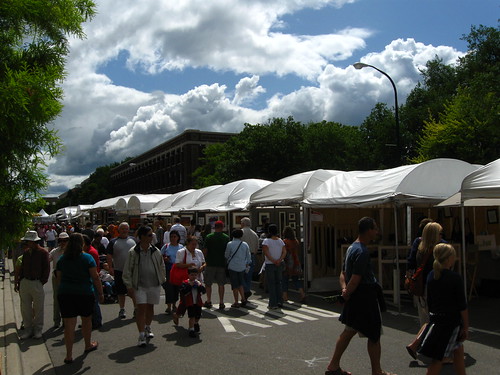
Moody skies over Art Fair
Art Fair finished last Saturday, and I'm only now uploading photos...
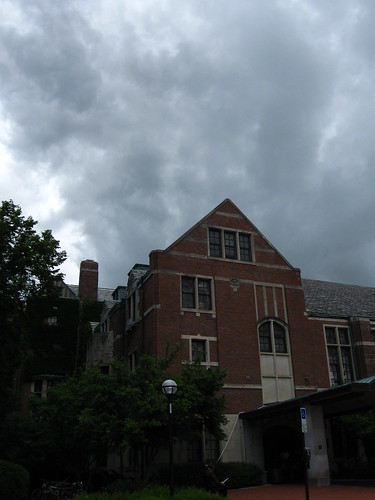
![]() http://www.flickr.com/photos/60809206@N00/3744428982
http://www.flickr.com/photos/60809206@N00/3744428982
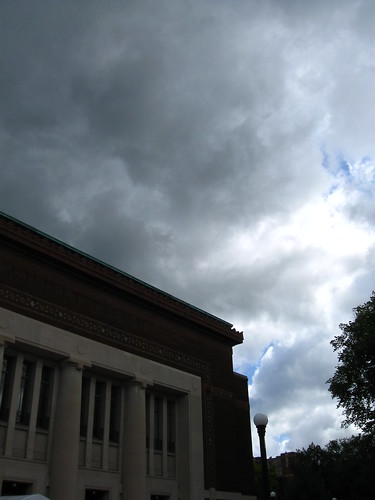
![]() http://www.flickr.com/photos/60809206@N00/3744427962
http://www.flickr.com/photos/60809206@N00/3744427962
(Sorry... I don't know how to hide the labels...)
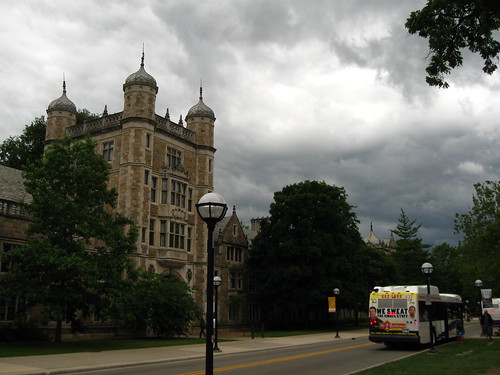
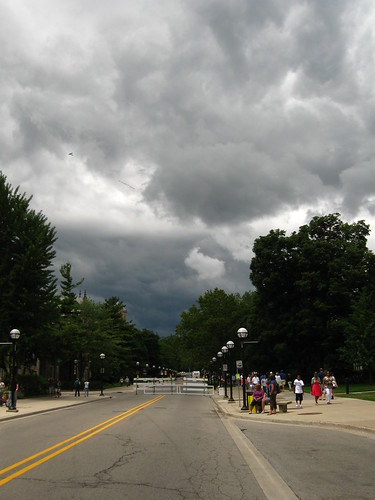
(Sorry... I don't know how to hide the labels...)
Monday, July 20, 2009
On BMI
I have a rough BMI of 30. What does this mean? It means that I'm in the "Obese" category, as defined by the CDC. There is no category above mine.
But wait, am I obese? I don't think so... I cycle 8 miles each day, do manual labor, and eat (relatively) healthily. I haven't checked my resting heart rate recently, but I'm guessing that it's between 60 and 70. I have a 36" waist, and 48" shoulders. I can benchpress 200 pounds, easily leg press 500 pounds, and do calf extensions at 250 pounds per side. How is this obese?
Recently, Devlin's Angle did a piece on BMI - the history, and stupidity of it. On the one hand, the usage of the BMI to indicate a single person's relative health is a good example of misuing a [simplistic] formula meant to determine population level characteristics, not individual ones. On another hand, this is also a story of how numbers and scientific wrappings seem to hold social significance. On yet another hand (this is turning into a Vishnu-statue of "other hands"), the BMI is a major tool in looking at trends in obesity. Finally, on the remaining hand (of Vishnu), it's completely meaningless, mathematically speaking.
Here's the equation:
Devlin's Angle goes on to explain where the 703 comes from, and ponders the question of why the height is squared...
Devlin's Angle outlines two reasons why the BMI is useless as a individual measure: it's a population-based measure, and populations are made up of sedentary individuals (not atheletes) and it was derived at an early time in the statistic-ization of sociology. On the first point, the formula assumes that all "extra" weight on an individual is from fat. On the second point, the formula is derived to measure the trend of the majority of the population.
I would like to outline two other reasons why the BMI sucks for people like me: height and body proportion. Devlin's Angle points out that the BMI was derived in the early 1900s in Belgium. Looking at Wikipedia's entry on human height, one finds that in the mid-nineteenth century the average height in the Netherlands and France (they don't list Belgium) was164 cm and 165 cm, respectively. Looking at these measures "today", one sees a "slight" difference: 182 cm (169.7 cm) and 177 cm (164.6 cm), respectively (female heights in parenthesis). I assume that female heights weren't included in the mid-nineteenth century measurements, but we see that after 150 years, Dutch females are taller (males much taller) and French females as tall (males much taller) than their ancestors. What is so important about this? Well, remember that the equation for BMI was based on the average person. The average person being (among males) as much as 12-18 cm taller than the people measured to derive the BMI.
Let's try and make two individuals who matches the criteria of different BMI groupings; one from the mid-nineteenth century, and one from today. Since BMI is only a relationship between height and weight, this shouldn't be difficult to figure out. Therefore, a mid-nineteenth century Dutchman of average height (roughly 65 inches), would have the following BMI table:
Underweight (below 18.5): below 110 lbs.
Ideal (18.5 to 24.9): 110 lbs. to 148 lbs.
Overweight (25.0 to 29.9): 148 lbs. to 178 lbs.
Obese (30.0 and above): 178 lbs. and above.
We can imagine the "average build" 5'5" person and think, "Okay, that works." However, now let's look at what the BMI chart would mean for the average height Duchman of 6'0":
Underweight (below 18.5): below 135 lbs.
Ideal (18.5 to 24.9): 135 lbs. to 183 lbs.
Overweight (25.0 to 29.9): 183 lbs. to 219 lbs.
Obese (30.0 and above): 219 lbs. and above.
That man would have to be one skinny person. Imagine a person who is 6'0" and 135 lbs. Jim Carrey - someone we might think of as tall and skinny - is according to this site - 6'1" and 180 lbs. That's on the upper end of "ideal". President Barack Obama is - according to this site - 6'1.5" and 180 lbs. (Which, strangely, gives him a slightly higher BMI of 23.4 compared to John Kerry's 22.5, even though I would say that Obama's more atheltic now than Kerry was in 2004).
So, height is a determinant. Therefore, BMI was a good measure of estimating the height/weight relationship of early 1900s Belgians, not necessarily early 21st century Americans.
Also, there is body proportion. Having a relatively long torso, I have been blessed with not having to worry about too little leg room on aircrafts (yet), but I am annoyed at how low the backs of seats cut me (usually well below the shoulder, even on "tall" chairs). There are trends on body proportions, both in terms of proportions of height (i.e., long torso vs. long legs) and width (e.g., hip-to-waist ratios). Neither of these are included in the BMI. True: certain regions have slightly different cut-off points for BMI measurements, such as in SE Asia where there is a relatively consistent height body proportion, however, in the United States - where there is such a wide range of different height and width body proportions that BMI loses its meaning even faster. But why?
Well, take me for example. I have a long torso. What does that mean, though. Well, a single inch of height that is comprised of torso has more mass than an inch of height comprised of leg; there are more organs, more girth, and more water in the torso than in the leg. Therefore, if someone has a relatively short torso compared to me (i.e., they are my height, but have much longer legs than me), having a 240 lbs. somewhat athetic build would mean that individual would have legs even more massive than mine (or a torso that was gigantic). In other words, body proportions will have a direct bearing on the amount of mass you are carrying around (and therefore, your weight), irregardless of how much muscle or fat you have.
Related to the issue of body proportion is the issue of amputation. If you amputated a leg, you could lower your total body weight by 20-40 pounds (depending, obviously, on the weight of your legs). If I cut off legs, then my BMI would drop to about 25 (still "overweight", but not "obese"). However, if you had both your legs amputated (or weren't born with both legs), then you could shorten your height by 27" (plus or minus) and your weight by 40-80 lbs. However, due to the formula, my BMI would actually increase to 44 if that happened to me.
What to do? Well, I have a novel idea of doing a BMI survey of a cohort of incoming students, combined with a number of other measures that will give an indication of body proportion, muscle mass, and fitness. Then, look at doing statistics on the whole set to see what sort of relationship one would get for "modern" BMI cut-offs, and determine if there is any easier way of determining a general figure of fitness that can be used by an individual (as opposed to being a proxy for an entire population, mostly made up of sedentary individuals).
But wait, am I obese? I don't think so... I cycle 8 miles each day, do manual labor, and eat (relatively) healthily. I haven't checked my resting heart rate recently, but I'm guessing that it's between 60 and 70. I have a 36" waist, and 48" shoulders. I can benchpress 200 pounds, easily leg press 500 pounds, and do calf extensions at 250 pounds per side. How is this obese?
Recently, Devlin's Angle did a piece on BMI - the history, and stupidity of it. On the one hand, the usage of the BMI to indicate a single person's relative health is a good example of misuing a [simplistic] formula meant to determine population level characteristics, not individual ones. On another hand, this is also a story of how numbers and scientific wrappings seem to hold social significance. On yet another hand (this is turning into a Vishnu-statue of "other hands"), the BMI is a major tool in looking at trends in obesity. Finally, on the remaining hand (of Vishnu), it's completely meaningless, mathematically speaking.
Here's the equation:
BMI = weight in pounds/(height in inches^2) x 703
Devlin's Angle goes on to explain where the 703 comes from, and ponders the question of why the height is squared...
Devlin's Angle outlines two reasons why the BMI is useless as a individual measure: it's a population-based measure, and populations are made up of sedentary individuals (not atheletes) and it was derived at an early time in the statistic-ization of sociology. On the first point, the formula assumes that all "extra" weight on an individual is from fat. On the second point, the formula is derived to measure the trend of the majority of the population.
I would like to outline two other reasons why the BMI sucks for people like me: height and body proportion. Devlin's Angle points out that the BMI was derived in the early 1900s in Belgium. Looking at Wikipedia's entry on human height, one finds that in the mid-nineteenth century the average height in the Netherlands and France (they don't list Belgium) was164 cm and 165 cm, respectively. Looking at these measures "today", one sees a "slight" difference: 182 cm (169.7 cm) and 177 cm (164.6 cm), respectively (female heights in parenthesis). I assume that female heights weren't included in the mid-nineteenth century measurements, but we see that after 150 years, Dutch females are taller (males much taller) and French females as tall (males much taller) than their ancestors. What is so important about this? Well, remember that the equation for BMI was based on the average person. The average person being (among males) as much as 12-18 cm taller than the people measured to derive the BMI.
Let's try and make two individuals who matches the criteria of different BMI groupings; one from the mid-nineteenth century, and one from today. Since BMI is only a relationship between height and weight, this shouldn't be difficult to figure out. Therefore, a mid-nineteenth century Dutchman of average height (roughly 65 inches), would have the following BMI table:
Underweight (below 18.5): below 110 lbs.
Ideal (18.5 to 24.9): 110 lbs. to 148 lbs.
Overweight (25.0 to 29.9): 148 lbs. to 178 lbs.
Obese (30.0 and above): 178 lbs. and above.
We can imagine the "average build" 5'5" person and think, "Okay, that works." However, now let's look at what the BMI chart would mean for the average height Duchman of 6'0":
Underweight (below 18.5): below 135 lbs.
Ideal (18.5 to 24.9): 135 lbs. to 183 lbs.
Overweight (25.0 to 29.9): 183 lbs. to 219 lbs.
Obese (30.0 and above): 219 lbs. and above.
That man would have to be one skinny person. Imagine a person who is 6'0" and 135 lbs. Jim Carrey - someone we might think of as tall and skinny - is according to this site - 6'1" and 180 lbs. That's on the upper end of "ideal". President Barack Obama is - according to this site - 6'1.5" and 180 lbs. (Which, strangely, gives him a slightly higher BMI of 23.4 compared to John Kerry's 22.5, even though I would say that Obama's more atheltic now than Kerry was in 2004).
So, height is a determinant. Therefore, BMI was a good measure of estimating the height/weight relationship of early 1900s Belgians, not necessarily early 21st century Americans.
Also, there is body proportion. Having a relatively long torso, I have been blessed with not having to worry about too little leg room on aircrafts (yet), but I am annoyed at how low the backs of seats cut me (usually well below the shoulder, even on "tall" chairs). There are trends on body proportions, both in terms of proportions of height (i.e., long torso vs. long legs) and width (e.g., hip-to-waist ratios). Neither of these are included in the BMI. True: certain regions have slightly different cut-off points for BMI measurements, such as in SE Asia where there is a relatively consistent height body proportion, however, in the United States - where there is such a wide range of different height and width body proportions that BMI loses its meaning even faster. But why?
Well, take me for example. I have a long torso. What does that mean, though. Well, a single inch of height that is comprised of torso has more mass than an inch of height comprised of leg; there are more organs, more girth, and more water in the torso than in the leg. Therefore, if someone has a relatively short torso compared to me (i.e., they are my height, but have much longer legs than me), having a 240 lbs. somewhat athetic build would mean that individual would have legs even more massive than mine (or a torso that was gigantic). In other words, body proportions will have a direct bearing on the amount of mass you are carrying around (and therefore, your weight), irregardless of how much muscle or fat you have.
Related to the issue of body proportion is the issue of amputation. If you amputated a leg, you could lower your total body weight by 20-40 pounds (depending, obviously, on the weight of your legs). If I cut off legs, then my BMI would drop to about 25 (still "overweight", but not "obese"). However, if you had both your legs amputated (or weren't born with both legs), then you could shorten your height by 27" (plus or minus) and your weight by 40-80 lbs. However, due to the formula, my BMI would actually increase to 44 if that happened to me.
What to do? Well, I have a novel idea of doing a BMI survey of a cohort of incoming students, combined with a number of other measures that will give an indication of body proportion, muscle mass, and fitness. Then, look at doing statistics on the whole set to see what sort of relationship one would get for "modern" BMI cut-offs, and determine if there is any easier way of determining a general figure of fitness that can be used by an individual (as opposed to being a proxy for an entire population, mostly made up of sedentary individuals).
Thursday, July 16, 2009
Friends Like These
Before traveling to Britain, I had no idea who Danny Wallace was. Indeed, I didn't know anything about the book until I was making my way back to my friend's R.M.'s house in Charlton (near London): there was a poster of the book plastered on the side of some building (or maybe it was a bus), and I read the subtitle: "How far would YOU go to get the old gang back together?" This subtitle piqued my attention because I felt that - having lived in several different countries, lost touch with some good friends over the years, and having just celebrated by 32nd birthday - the idea of getting the "old gang" back together was something that I could relate to; a yearning that I have had in the past that led me first to Friendster, MySpace, and Bebo, and leading (now) to Facebook, and connecting (even just today) with friends - both close and casual - from different periods of my past.
 The book describes in first-person narrative, the travels of Danny Wallace as he goes to find and meet up with the twelve people who were the most important to him growing up. (So important, in fact, that they were the only ones that made it into his special address book.) It's a trip not only of rediscovery, but also of approaching, inevitable adulthood taking him from London to Loughborough, Berlin, LA, Melbourne, Tokyo and Dundee in order to find the people who were the most significant to him.
I still don't really know much about Danny Wallace, but after reading his book Friends Like These, I think I know more about him. Similar to his mother, I know that mine is holding boxes in the crawlspace in their house full of my "stuff" from school (she has other boxes of my brother's stuff, too). There are yearbooks full of people I haven't seen or really thought about in years (decades in some cases).
The book took place in 2006, and now - three years later - some of the events seem haunting. The recent death of Michael Jackson was juxtaposed quite strangely in my head as I read all the references to MJ in the book, for who could deny that Jackson was a major cultural figure to people born in the late 1970s, like Danny and me. Still, learning about Danny's journeys two weeks after the death of the King of Pop was somewhat haunting, since it seemed like - for a moment - two realities existed simultaneously: the reality of the book (taking place in an indefinite "present") where Danny ends up going to a Michael Jackson concert with one of his old friends (sorry for the spoiler) and the reality of (well) reality.
Another thing that the book did for me was make me start to realize that I, too, am growing older. The book depicts events leading up to Danny's 30th birthday in 2006. It is now 2009, and I just celebrated my 32nd, learning yet more about myself and the connections I have to my own friends from my undergraduate studies in St Andrews. Time flies when you're having fun, and yet (and yet) it is with only a certain few that robust connections - no matter how thin - remain. However, although these connections are thin, their strength allows one to build stronger bridges upon them - a network of connections holding together that social fabric against which we identify ourselves.
This book may not be for everyone. Indeed, I think that Danny's voice is very strong in the book (it is, after all, written in the first person about personal events and personal thoughts), and it may not be for everybody. It might be difficult - for example - to identify with a man who grew up in different parts of the UK and Europe with friends from a similarly diverse background. It might be difficult, too, understand some of the cultural references or significances of certain types of statements about pubs, mates, and display cushions. However, if you are a kind of person who is interested and trying to reconnect with childhood friends (even passively through online "social networking" sites like Facebook), then this book might just be for you.
(Also, as a person who lived in Japan, his chapters about finding his friend in Japan, and his experiences in Tokyo and outside it, had me cracking up with laughter. But then again, most Westerners' takes on the "bizarre" nature of Japan - Tokyo in particular - often seem to be quite humorous to me, since I am able - I believe - to see both sides of that Lost in Translation coin.)
The book describes in first-person narrative, the travels of Danny Wallace as he goes to find and meet up with the twelve people who were the most important to him growing up. (So important, in fact, that they were the only ones that made it into his special address book.) It's a trip not only of rediscovery, but also of approaching, inevitable adulthood taking him from London to Loughborough, Berlin, LA, Melbourne, Tokyo and Dundee in order to find the people who were the most significant to him.I still don't really know much about Danny Wallace, but after reading his book Friends Like These, I think I know more about him. Similar to his mother, I know that mine is holding boxes in the crawlspace in their house full of my "stuff" from school (she has other boxes of my brother's stuff, too). There are yearbooks full of people I haven't seen or really thought about in years (decades in some cases).
The book took place in 2006, and now - three years later - some of the events seem haunting. The recent death of Michael Jackson was juxtaposed quite strangely in my head as I read all the references to MJ in the book, for who could deny that Jackson was a major cultural figure to people born in the late 1970s, like Danny and me. Still, learning about Danny's journeys two weeks after the death of the King of Pop was somewhat haunting, since it seemed like - for a moment - two realities existed simultaneously: the reality of the book (taking place in an indefinite "present") where Danny ends up going to a Michael Jackson concert with one of his old friends (sorry for the spoiler) and the reality of (well) reality.
Another thing that the book did for me was make me start to realize that I, too, am growing older. The book depicts events leading up to Danny's 30th birthday in 2006. It is now 2009, and I just celebrated my 32nd, learning yet more about myself and the connections I have to my own friends from my undergraduate studies in St Andrews. Time flies when you're having fun, and yet (and yet) it is with only a certain few that robust connections - no matter how thin - remain. However, although these connections are thin, their strength allows one to build stronger bridges upon them - a network of connections holding together that social fabric against which we identify ourselves.
This book may not be for everyone. Indeed, I think that Danny's voice is very strong in the book (it is, after all, written in the first person about personal events and personal thoughts), and it may not be for everybody. It might be difficult - for example - to identify with a man who grew up in different parts of the UK and Europe with friends from a similarly diverse background. It might be difficult, too, understand some of the cultural references or significances of certain types of statements about pubs, mates, and display cushions. However, if you are a kind of person who is interested and trying to reconnect with childhood friends (even passively through online "social networking" sites like Facebook), then this book might just be for you.
(Also, as a person who lived in Japan, his chapters about finding his friend in Japan, and his experiences in Tokyo and outside it, had me cracking up with laughter. But then again, most Westerners' takes on the "bizarre" nature of Japan - Tokyo in particular - often seem to be quite humorous to me, since I am able - I believe - to see both sides of that Lost in Translation coin.)
Wednesday, July 15, 2009
Back in Ann Arbor... for Art Fair
I'm back in Ann Arbor, and have returned to the start of Art Fair. (Yay?) Although I do understand that Art Fair is a major financial shot in the arm for Ann Arbor's businesses, especially for those along Main Street, Liberty Street, State Street, and South University Street, I still don't have to enjoy the massive throngs of people (expected 500,000 people), the closing off of major streets that I normally take to my work, and the increased traffic load along alternative streets.
Ah, well, I'll likely be taking photos of the throngs and throngs of people quietly and slowly milling among stalls, looking at pieces of artwork that have been lovingly positioned in booths - many of them being the same things that were on sale last year. Hopefully for these artists, there will be purchasing this year, irregardless of the ongoing recession.
Ah, well, I'll likely be taking photos of the throngs and throngs of people quietly and slowly milling among stalls, looking at pieces of artwork that have been lovingly positioned in booths - many of them being the same things that were on sale last year. Hopefully for these artists, there will be purchasing this year, irregardless of the ongoing recession.
Tuesday, July 07, 2009
le Tour
After a very late start to the day, I went to the pâtisserie to purchase sone pain au chocolat for Rafys as well as find out what time le Tour de France would commence - making its way up the nearby Avenue de l'Ecole de l'Agriculture Gabriel Bouchet. I was met almost immediately on this sourjourn by a lone, bored-looking policeman.
"Well, at least we won't have to go far to see the riders go by," I thought, but at what time zould they actually go by? Stepping into the avenue, I saw many people lining both sides of the street in an expectant air, causing me to quicken my pace as I continued toward the pâtisseri. There, I joined a short queue of people waiting to join the even larger group standing outside eating the various breads and pastries from that particular shop. (I had been coached very thoroughly on the pronunciation of 'pain au chocolat,' and was quite confident of my ability to be understood with that particular order). Unfortunately for me (and my practice), pain au chocolat is a very popular pastry among the French (at least among those waiting for le Tour), so there were none available at 12:20 PM, although I suspect they were making more in the back. Therefore, I decided to bucher the pronunciaction of croissants avec aumandes et chocolat and a brioche (also avec chcolat).
After paying the lady and wishing her bounjour née, I crossed the street to the tabac, and purchased a paper for 1€ after unsuccessfully trying to ask the man what time le Tour was going to pass. I then headed back to Rafys'.
The paper said something about a procession leaving the place de la comedie at 12:45, so I decided to head out to catch it before it passed us by. What I failed to do was read further, for I would have then learned that "procession" didn't mean "race". However, this didn' happen, and out I went to catch the procession.
The procession was a motorcade of the sponsors, with pretty men and women throwing things to the crowds. I collected a few things, including three hats, a bag, gummy bears, newspapers, a mouse pad, and clothes detergent. (I was hoping that Škoda would be giving out cars, but no such luck). At some point, Rafys joined me outside, and we both waited for le Tour to begin. At some point, there was a lull in the procession, and she suggested we moved to a space of grass further up the avenue in order to wait for the riders in a little more comfort.
After our move, and a little more of a wait, eight or nine brightly clad riders with their escort of police and cameramen flew past. After they were gone, there was a lull, which was followed by another group of nine riders and escort about ten minutes later. Had I read the newspaper closely, I would have (possibly) understood that the teams would be riding together in today's stages, each about seven minutes apart. No exciting peleton today, but there continues, even now, to be teams racing the 39 km around Montpellier.
"Well, at least we won't have to go far to see the riders go by," I thought, but at what time zould they actually go by? Stepping into the avenue, I saw many people lining both sides of the street in an expectant air, causing me to quicken my pace as I continued toward the pâtisseri. There, I joined a short queue of people waiting to join the even larger group standing outside eating the various breads and pastries from that particular shop. (I had been coached very thoroughly on the pronunciation of 'pain au chocolat,' and was quite confident of my ability to be understood with that particular order). Unfortunately for me (and my practice), pain au chocolat is a very popular pastry among the French (at least among those waiting for le Tour), so there were none available at 12:20 PM, although I suspect they were making more in the back. Therefore, I decided to bucher the pronunciaction of croissants avec aumandes et chocolat and a brioche (also avec chcolat).
After paying the lady and wishing her bounjour née, I crossed the street to the tabac, and purchased a paper for 1€ after unsuccessfully trying to ask the man what time le Tour was going to pass. I then headed back to Rafys'.
The paper said something about a procession leaving the place de la comedie at 12:45, so I decided to head out to catch it before it passed us by. What I failed to do was read further, for I would have then learned that "procession" didn't mean "race". However, this didn' happen, and out I went to catch the procession.
The procession was a motorcade of the sponsors, with pretty men and women throwing things to the crowds. I collected a few things, including three hats, a bag, gummy bears, newspapers, a mouse pad, and clothes detergent. (I was hoping that Škoda would be giving out cars, but no such luck). At some point, Rafys joined me outside, and we both waited for le Tour to begin. At some point, there was a lull in the procession, and she suggested we moved to a space of grass further up the avenue in order to wait for the riders in a little more comfort.
After our move, and a little more of a wait, eight or nine brightly clad riders with their escort of police and cameramen flew past. After they were gone, there was a lull, which was followed by another group of nine riders and escort about ten minutes later. Had I read the newspaper closely, I would have (possibly) understood that the teams would be riding together in today's stages, each about seven minutes apart. No exciting peleton today, but there continues, even now, to be teams racing the 39 km around Montpellier.
Tuesday, June 30, 2009
Reflection
I noticed on my trip to Scotland how many more non-Scots are living and working in Edinburgh as well as travelling to St Andrews. So, too, the number of Americans going to the university has also increased since I was a student. I (an American studying in Scotland) have become less-rare in the intervening years, and I don't know if that is a bad or good thing. On the one hand, having Americans living abroad only be good for them -- Americans being in the double position of being rather provincial-minded as well as knowing they belong to a superpower nation -- since there is so much that being a 'stupid foreigner' can do for one's humility and worldliness. Of course, the coarse sounds of some American accents does make for a jarring break back to reality as one walks through a throng of people.
Waiting for flight
Lounge in Edinburgh Airport. The airport has grown a lot in the past 10 years. I recall when I just came the first time to Edinburgh 15 years ago, when there was only one small terminal that had only a few gates. The parking was only a surface, and we actually walked into the terminal from the outside. Now, there is a BIG terminal, a multi-story carpark, and also an international arrivals area where -- presumably -- one might actually be subject to a customs check (as opposed to merely choosing to call if there was something to declare). Concomitant with this expansion is an apparent expansion in use as well. In 1995 -- when I started university -- the airport would have been rightly classified as 'sleepy'. In the many times I used it, I was rarely to encounter a busy terminal building, except save for when therew was construction going on. Now? Wow! There mgith need to be another expansion, especially if these crowds continue. Okay, the snapshots in my mind are several years apart, but in an ever-increasingly mobile Europe (and Scotland - what with its rich history of explorers and adventurers - is likely only to become more mobile) will only be increased in its desirability as a place to see beautiful sights of nature and history, further increasing the immigration rate here.
Tuesday, June 23, 2009
In London
and not only did I see a colleague at Paddington station, but I also went to Greenwich and saw the grounds (very lovely) and eat some curry before getting a few pints into me. Now to sleep.
Monday, June 22, 2009
Cycled a LOT today in getting packed
I leave in the morning for the UK, but - because I purchased a new hiking backpack that I left at a friend's house - needed to pack first. This meant that I had to bike over to my friend's house with some laundry (since someone's going to be taking care of the cabin whilst I'm gone), then cycle into town to get some last-minute gifts, cycle back to my friend's place to move laundry into the dryer, cycle to the forest to bring back items for packing, cycle to the hardware store to pick up some rope (to tie down my backpack's straps), then cycle back to the forest. Finally - since I would be leaving my bike with the Great Lakes Cycle and Fitness for a tune-up and putting on an extra mud guard - cycling out to Great Lakes Cycle and Fitness.
In total (based on the way I cycled, cutting through neighborhoods along paths that a car couldn't take), I cycled 33 km (20.5 miles). Phew! No wonder I was had the shakes afterwards (and that wasn't the end - I had to finish cleaning up the inside of the cabin).
Now that I'm done, I'm ready to get to sleep for a bit.
In total (based on the way I cycled, cutting through neighborhoods along paths that a car couldn't take), I cycled 33 km (20.5 miles). Phew! No wonder I was had the shakes afterwards (and that wasn't the end - I had to finish cleaning up the inside of the cabin).
Now that I'm done, I'm ready to get to sleep for a bit.
Wednesday, June 17, 2009
The Prodigal Tongue
 Just finishing up the book The Prodigal Tongue by Mark Abley. It is a really good read, put together along themes built around the author's travels around the world. Indeed, the book is kind of put together like a travel memoir, with each chapter not only based in a place, but also based around a concept of the changing nature of the English language.
He travels not only the "English-speaking" world, but also large swaths of the geography of the English language itself, starting with dictionaries and the creation of new words, the amazing vibrancy of "Asian English" (i.e., English spoken in Singapore), the infusion of English into other languages, the "special case" of Japan, the interplay of English and Español in Los Angeles, the influence of rap and R&B on US and world English, possible future trends in English, the impact of cyberspace on English communication, and finally the "usability" of English. In all, it's quite a heavy-hitting trek through the world of spoken (and written) English of the early 2000s (and even then, only a small part of it).
Some interesting things that he writes come up as truisms to me, especially when I recall those days when I was in highschool in Taiwan and traveled to other countries in Southeast Asia. Listening to the clipped tones of spoken English - complete with borrowed words and grammar - brought those sounds vividly to my mind as I read thinks like this:
"Your mouth is your tiger" - so says a Malay proverb. Given the sheer number of people in the region and the tigerish leap of their economies, it's possible that far in the future, Standard English will reflect an Asian norm rather than an Anglo-American one. Think of how syllables are stressed. In Britain, Australia and North America, variations in verbal stress are crucial to how people speak - the rythm of songs and poems depends on it. To a Western ear, the result sounds oddly percussive. That doesn't mean wrong.Having grown up for part of my childhood in Japan, having Japanese family members, and having studied Japanese in school, the chapter on English in Japan (Chapter 5: "Hippu Hangu") held more than a few topics that confirmed many of the things that I had remembered, as well as gave me a new insight into the Japan that had developed since I left it. For example, in order to discuss some of the psychological setting in which Japanese finds itself - in a world replete with English - Abley needed to first describe the condition of the grammar:
The absence of word-ending consonants can also disconcert. One day in Singapore I overheard a young man talking on his handphone to a past, present or future girlfriend. "You want me to repect you?" he asked. Except that it sounded closer to "Ya wa'me ta respe'ya?" In the unlikely event that an American were to ask "Got or not?" a Singaporean would probably hear "Gawd er nawd?" But an American listening to a Singaporean might hear "Gah'ah'nah?" If this sounds peculiar today, it may seem natural to our grandchildren. Beauty is in the ear of the listener.
For all the complications and elaborations of its script, spoken Japanese can be extremely concise. Pronouns are usually implied, not stated. Take the following brief exchange: "Did you go to the movie with Kazuki?" "Yes, I went." In Japanese, this might be rendered as "Kazuki to eiga e itta no?" "Un, itta yo." A literal translation would read: "Kazuki with movie to went that?" "Yes, went, final particle." Apart from its role as a name, kazuki can signify "pleasant peace" or, when written with different kanji, "shining one." Words look unseasy on their own. Conttext is everything.With regard to the (apparently) still-popular trend of using random English on Japanese items of clothing (kind of like how Westerners like to use random Chinese and Japanese on clothing and tattoos), Abley shares this piece of insight:
All of which begins to explain why the Japanese can appear so opaque to outsiders. "Eloquence is not one of the virtues people have been encouraged to cultivate," Masayoshi Shibatani writes in his book The Languages of Japan. "In fact, persuasion of others by means of linguistic skills is largely discouraged as direct confrontation in general is avoided ... It is the person's ability to arrive at an intended conclusion rather than the persuader's logical presentation that is evaluated. Thus, one who does not get the point by merely hearing hints is considered a dull person." From Periclean Athens to Hide Park Corner, the European tradition of rhetoric has aimed at convincing a listener by force of logic and argument. Japan's tradition is one that cherishes nuance and tolerates ambiguity, inviting a listener to come up with an implied meaning. If a man says that a woman is kirei, is he praising her beauty, her purity or her cleanlisness - or some combination of those attributes?
...
Foreigners who strive to master Japanese are often baffled by its remarkable system of keigo, or polite speech. Its rules place vocabulary at the mercy of social context. "Will X come to Osaka tomorrow?" seems a simple question. But depending on the setting, the speaker, the person being addressed and the person being asked about, it could be posed in more than twenty ways. Identity in Japan is fluid, open-ended, almost shockingly changeable. A male teacher might call himself watakushi (I, formally), boku (I, informally), ore (I, intimately or vulgarly), otosan (I as a father, talking to my children), sensei (I as a teacher, talking to my class), ojisan (I as an uncle, talking to other children) or niisan (I as an older brother).
... Once you start reading other people's clothing, it's hard to stop. Hard for me, anyway. A young blood in the station sported a T-shirt with the slogan The Sea Roars a Lullaby. Another T-shirt mysteriously declared: Happy Endless Bivis. ... For decades, sentences like these went by the name Japlish; but .. another name has recently come to the fore: Engrish. Websites are devoted to it. Engrish, like Japlish, cna refer to gnarled gobbets of language from all across East Asia. ... Why do they make such blunders anyway?
There are, as it happens, three good reasons. The main one is that English often functions simply as a design element in Japanese products. The words are not intended to carry any precise meaning - or rather, the meaning they're out to convey is that the product in question is hip, cool, ultranew. If you're manufacturing a T-shirt, the sea may as well roar a lullaby as murmer a pandemonium. A second reason is that in matters of grammer and phonetics, as well as vocabulary and social context, the differences between English and Japanese are huge. ... And third, some apparently inexplicable errors can be traced back to mistranslation. Why would a Japanese package of coffee have the name Ease Your Bosoms? The answer, almost certainly, is an inept rendering of the English phrase "Take a load off your chest."
There are many more interesting chapters and insights, but I'm not going to type them out here. (After all, I have to finish the book!) But if you are interested in learning about the breadth of the usage of English in today's world, then check out this book.
Thursday, June 11, 2009
Sunday, June 07, 2009
Cottage in the late afternoon
Sometimes I stop and realize that I now live in a 80-acre piece of land with 50-odd acres of forest, and much of the remaining 30-odd acres being water. I don't know if it's because I tend to live inside my own head so often, and that the simple action of going outside is - strangely - not something that I am presently prone to do very often.
However, when I do go outside, I'm struck again and again by how amazing it is to live in Saginaw Forest. (I'm also struck again and again by mosquitoes, but that's a different issue all together.) The other day, I as I was mowing part of the lawn in front of the cabin, I turned around and looked up the lawn and saw an amazing little tableau: the cabin beyond a short expanse of grass, overhung and surrounded by trees. Since I wasn't mowing the entire lawn (just three paths to the water), tall flowering grasses were waving in the wind like short green wheat, their height masking the gravel road. In fact, if it wasn't for the mowing of the lawn (which I do mostly to give people a 'pathway' along which to walk so they don't trample through the entire area), the vista would have been a more naturalistic one with (somewhat) tall grasses carpeting the small rise.
This last Friday I was so taken by the scenery - sunny late afternoon with little wind - that I took one of the boats out on the lake. Very nice, indeed, and an activity that I'll have to do again during this summer, but with an eye out for where future biological monitoring of aquatic insect emergences might be conducted -- I saw several dragonflies, damselflies, mayflies, and water-striders during my boat ride. Furthermore, the type of near-shore habitat is different between the west bank and the east bank -- the east bank has more cattails than the west bank and (obviously) gets more light in the late afternoon than the forested western shore.
I'm thinking that I'll have to design some sort of floating sampler that can be tethered in different parts of the lake for night-time sampling. I know that I won't be able to have a good sampling of odonates, hemipterans, and aquatic coleopterans, but I'll likely get a good sampling of the aquatic trichopteran, ephemeropterans, plecopterans, and (of course) dipterans. (And if I can figure out how to make a good sampling device to be deployed on the lake, I should be able to minimize the number of terrestrial taxa I collect.)

However, when I do go outside, I'm struck again and again by how amazing it is to live in Saginaw Forest. (I'm also struck again and again by mosquitoes, but that's a different issue all together.) The other day, I as I was mowing part of the lawn in front of the cabin, I turned around and looked up the lawn and saw an amazing little tableau: the cabin beyond a short expanse of grass, overhung and surrounded by trees. Since I wasn't mowing the entire lawn (just three paths to the water), tall flowering grasses were waving in the wind like short green wheat, their height masking the gravel road. In fact, if it wasn't for the mowing of the lawn (which I do mostly to give people a 'pathway' along which to walk so they don't trample through the entire area), the vista would have been a more naturalistic one with (somewhat) tall grasses carpeting the small rise.
This last Friday I was so taken by the scenery - sunny late afternoon with little wind - that I took one of the boats out on the lake. Very nice, indeed, and an activity that I'll have to do again during this summer, but with an eye out for where future biological monitoring of aquatic insect emergences might be conducted -- I saw several dragonflies, damselflies, mayflies, and water-striders during my boat ride. Furthermore, the type of near-shore habitat is different between the west bank and the east bank -- the east bank has more cattails than the west bank and (obviously) gets more light in the late afternoon than the forested western shore.
I'm thinking that I'll have to design some sort of floating sampler that can be tethered in different parts of the lake for night-time sampling. I know that I won't be able to have a good sampling of odonates, hemipterans, and aquatic coleopterans, but I'll likely get a good sampling of the aquatic trichopteran, ephemeropterans, plecopterans, and (of course) dipterans. (And if I can figure out how to make a good sampling device to be deployed on the lake, I should be able to minimize the number of terrestrial taxa I collect.)
Saturday, June 06, 2009
Two damselfies
Boating on Third Sister Lake and saw lots of aquatic insects. Here, at the east end of the lake, where many water lilies are, one can see dragonflies, damselflies, and other insects (luckily not too many mosquitoes).

Friday, June 05, 2009
Ruben at Angelo's
The next in my recurring posts of the Reubens of Ann Arbor: Angelo's.
After going to several of the restaurants and brasseries (since they technically aren't cafes) in Ann Arbor, I've noticed that many of them serve reubens - a favorite sandwich of mine. Therefore, I've decided that - as a semi-recurring event - I'll review the various reubens one can find around the city. Reubens will be reviewed based on presentation, taste, messiness, and cost, each rated on a 4-star scale. (Cost: $ < 5.99, $$ = 6-7.99, $$$ = 8-9.99, $$$$ = 10+)
I like Angelo's, it's a diner-type restaurant that is the lone remnant of a bunch of small eateries near the medical campus; the others having sold their property (or had the property sold out from under them) to the University in an ever-expanding "gobbling up" of the properties between the central and medical campuses. In some ways, Angelo's has it made now, since it is the only non-university eating establishment that is near the medical campus (excluding a Jimmy John's located about a block away from Angelo's), and on any given lunch hour, they are filled beyond capacity.
Normally, I eat there for breakfast, which is almost always tasty and quite filling. (They tend to over-do their potatoes a bit, but if you dont' mind the slight taste of burned carbs, then everything else is good.) The best part of the breakfast is that the bread you get (and it's quite sizeable) is made in-house, and is quite tasty.

The reuben ($8.99, and comes with a pickle and the option of adding a side of coleslaw or fries) there is quite good: good corned beef, tasty saurkraut, and not too much thousand island dressing. There is only one small problem with the bread. They use their own bread, which I normally feel is very tasty. Indeed, the texture, weight, and absorbability of the bread is really top-notch. However, it wasn't until it was matched with the reuben that I realized that it was just a little sweet, which is - for me - a little odd, and threw off the taste of the whole sandwich.
RATING:
Presentation: ****
Taste: **
Messiness: **
Cost: $$$
After going to several of the restaurants and brasseries (since they technically aren't cafes) in Ann Arbor, I've noticed that many of them serve reubens - a favorite sandwich of mine. Therefore, I've decided that - as a semi-recurring event - I'll review the various reubens one can find around the city. Reubens will be reviewed based on presentation, taste, messiness, and cost, each rated on a 4-star scale. (Cost: $ < 5.99, $$ = 6-7.99, $$$ = 8-9.99, $$$$ = 10+)
I like Angelo's, it's a diner-type restaurant that is the lone remnant of a bunch of small eateries near the medical campus; the others having sold their property (or had the property sold out from under them) to the University in an ever-expanding "gobbling up" of the properties between the central and medical campuses. In some ways, Angelo's has it made now, since it is the only non-university eating establishment that is near the medical campus (excluding a Jimmy John's located about a block away from Angelo's), and on any given lunch hour, they are filled beyond capacity.
Normally, I eat there for breakfast, which is almost always tasty and quite filling. (They tend to over-do their potatoes a bit, but if you dont' mind the slight taste of burned carbs, then everything else is good.) The best part of the breakfast is that the bread you get (and it's quite sizeable) is made in-house, and is quite tasty.

The reuben ($8.99, and comes with a pickle and the option of adding a side of coleslaw or fries) there is quite good: good corned beef, tasty saurkraut, and not too much thousand island dressing. There is only one small problem with the bread. They use their own bread, which I normally feel is very tasty. Indeed, the texture, weight, and absorbability of the bread is really top-notch. However, it wasn't until it was matched with the reuben that I realized that it was just a little sweet, which is - for me - a little odd, and threw off the taste of the whole sandwich.
RATING:
Presentation: ****
Taste: **
Messiness: **
Cost: $$$
Thursday, June 04, 2009
New Hampshire will allow same-sex marriage, too!
And then there was one... New Hampshire's same-sex marriage law will start in January 2010. This means that only one New England state that doesn't allow same-sex marriage: Rhode Island. If (or when) RI does allow same-sex marriage, then this historically (and politically) important region of the country will be the only region in which same-sex marriage is legal. (True, Iowa allows same-sex marriages, too, but Iowa doesn't the entire Midwest make.)
Wednesday, June 03, 2009
Why English is so difficult to learn...
This is from Greater Things.
Going a little further, turkeys aren't from Turkey and buffaloes aren't found in Buffalo (except maybe at the zoo). Why is the plural of bison "bison", but buffalo has a plural form? Why doesn't a near miss actually mean a hit? Why is insane the opposite of sane and indecent the opposite of decent; but inflammable is the same as flammable?
Ahh, so many conundrums with the English language... So little time.
We polish the Polish furniture.He could lead if he would get the lead out.A farm can produce produce.The dump was so full it had to refuse refuse.The soldier decided to desert in the desert.The present is a good time to present the present to the President.At the Army base, a bass was painted on the head of a bass drum.The dove dove into the bushes.
I did not object to the object.The insurance for the invalid was invalid.The bandage was wound around the wound.There was a row among the oarsmen about how to row.They were too close to the door to close it.The buck does funny things when the does are present.They sent a sewer down to stitch the tear in the sewer line.To help with planting, the farmer taught his sow to sow.The wind was too strong to wind the sail.After a number of Novocaine injections, my jaw got number.I shed a tear when I saw the tear in my clothes.I had to subject the subject to a series of tests.How can I intimate this to my most intimate friend?I spent last evening evening out a pile of dirt.Also:
There is no egg in eggplant, nor ham in hamburger; neither apple or pine in pineapple. And while no one knows what is in a hotdog, you can be pretty sure it isn't canine. English muffins were not invented in England nor French fries in France. Sweetmeats are candies, while sweetbreads, which aren't sweet, are meat.
We take English for granted. But if we explore its paradoxes, we find that quicksand can work slowly, boxing rings are square, and guinea pig is neither from Guinea nor is it a pig.
And why is it that writers write, but fingers don't fing, grocers don't groce, and hammers don't ham? If the plural of tooth is teeth, why isn't plural of booth, beeth? One goose, 2 geese. So one moose, two meese? Is cheese the plural of choose? One mouse, 2 mice. One louse, 2 lice. One house, 2 hice? If teachers taught, why didn't preachers praught?
If a vegetarian eats vegetables, what does a humanitarian eat? Why do people recite at a play, and play at a recital? Ship by truck or car and send cargo by ship? Have noses that run and feet that smell? Park on driveways and drive on parkways?
How can a slim chance and a fat chance be the same, while a wise man and a wise guy are opposites? How can the weather be hot as heck one day and cold as heck another?
If a house burns up, it burns down. You fill in a form by filling it out and an alarm clock goes off by going on. You get in and out of a car, yet you get on and off a bus. When the stars are out, they are visible, but when the lights are out, they are invisible.
And why, when I wind up my watch, I start it, but when I wind up this essay, I end it?
English is a weird language ... it doesn't know if it is coming or going!!!
War never determines who's right. War only determines who's left.
Going a little further, turkeys aren't from Turkey and buffaloes aren't found in Buffalo (except maybe at the zoo). Why is the plural of bison "bison", but buffalo has a plural form? Why doesn't a near miss actually mean a hit? Why is insane the opposite of sane and indecent the opposite of decent; but inflammable is the same as flammable?
Ahh, so many conundrums with the English language... So little time.
Short rant
From what I know of the U.S. Constitution, international treaties that the US signs on to become the law of the land. To wit, Article 6:
The Third Geneva Convention (of 1949) which deals with the conduct of handling prisoners of war states (Part 3, Section 1):
The Fourth Geneva Convention (also of 1949) deals with the handling of civilians and non-combatants and states (Part 1, Section1):
Also, the United States signed the UN Convention Against Torture.
Since the Geneva Conventions and the UNCAT are both international treaties that we (the US) signed on to (and haven't removed ourselves from), then we are constitutionally bound to uphold them, and to investigate and prosecute people who break these "supreme Laws of the Land".
... right?
All Debts contracted and Engagements entered into, before the Adoption of this Constitution, shall be as valid against the United States under this Constitution, as under the Confederation.
This Constitution, and the Laws of the United States which shall be made in Pursuance thereof; and all Treaties made, or which shall be made, under the Authority of the United States, shall be the supreme Law of the Land; and the Judges in every State shall be bound thereby, any Thing in the Constitution or Laws of any State to the Contrary notwithstanding.
With that being said, let us look at international treaties that we have signed regarding the use (or non-use) of torture by us (and other signatories):
The Senators and Representatives before mentioned, and the Members of the several State Legislatures, and all executive and judicial Officers, both of the United States and of the several States, shall be bound by Oath or Affirmation, to support this Constitution; but no religious Test shall ever be required as a Qualification to any Office or public Trust under the United States.
The Third Geneva Convention (of 1949) which deals with the conduct of handling prisoners of war states (Part 3, Section 1):
"No physical or mental torture, nor any other form of coercion"
The Fourth Geneva Convention (also of 1949) deals with the handling of civilians and non-combatants and states (Part 1, Section1):
...combatants who are hors de combat (out of the fight) due to wounds, detention, or any other cause shall in all circumstances be treated humanelyAnd goes on to list torture as one of the things that are not allowed to be done to them.
Also, the United States signed the UN Convention Against Torture.
Since the Geneva Conventions and the UNCAT are both international treaties that we (the US) signed on to (and haven't removed ourselves from), then we are constitutionally bound to uphold them, and to investigate and prosecute people who break these "supreme Laws of the Land".
... right?
Subscribe to:
Posts (Atom)